Become a Grammar Detective
Grammar Challenges and Answers
Can you spot the clues, solve the mistakes and crack each grammar case?
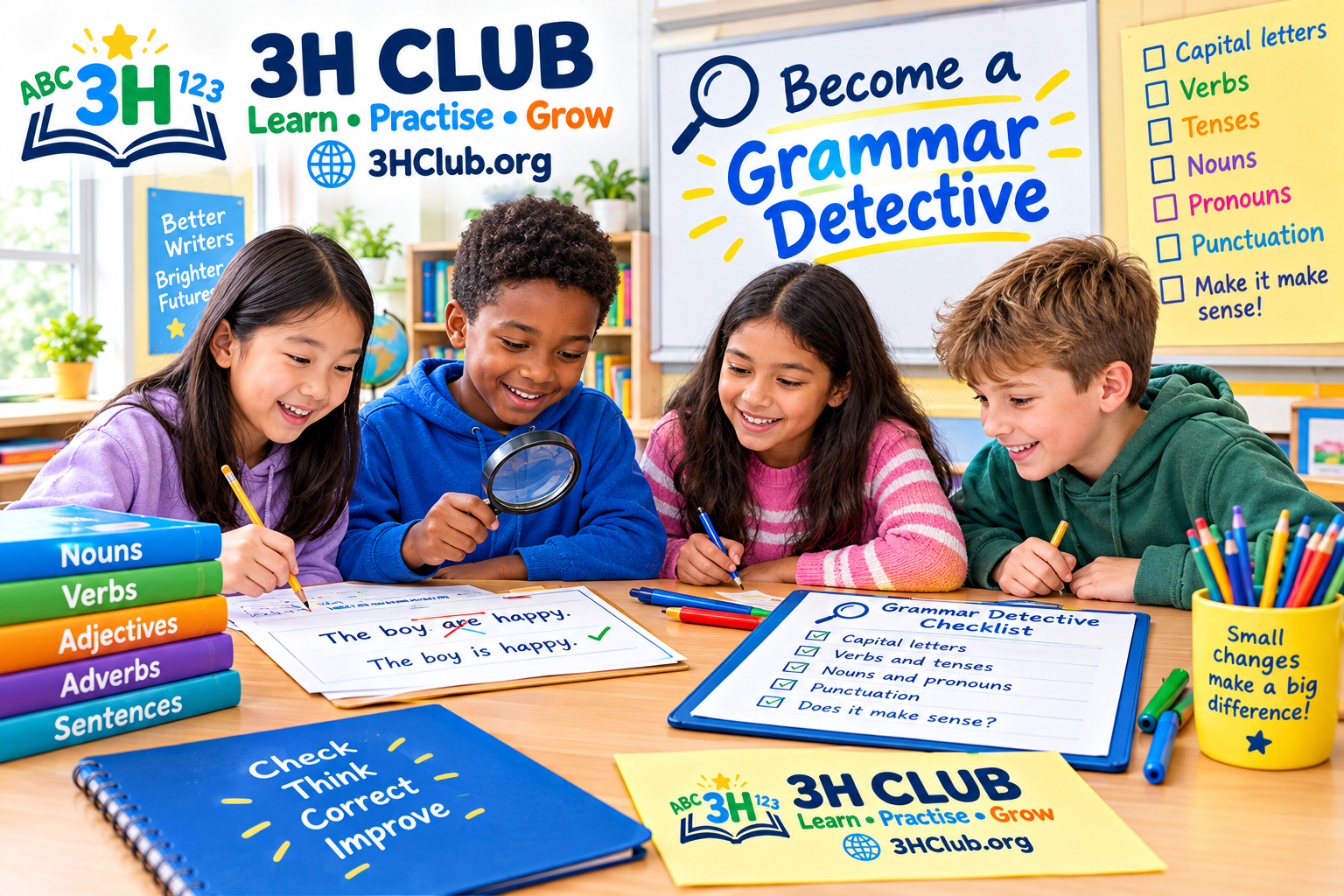
Welcome to Grammar Detective HQ! Your mission is to investigate words, sentences and punctuation. Look carefully for clues, explain what needs changing, and rewrite each sentence so that it makes sense.
Whether you are just starting out or ready for a tougher challenge, there is a case for you to solve.
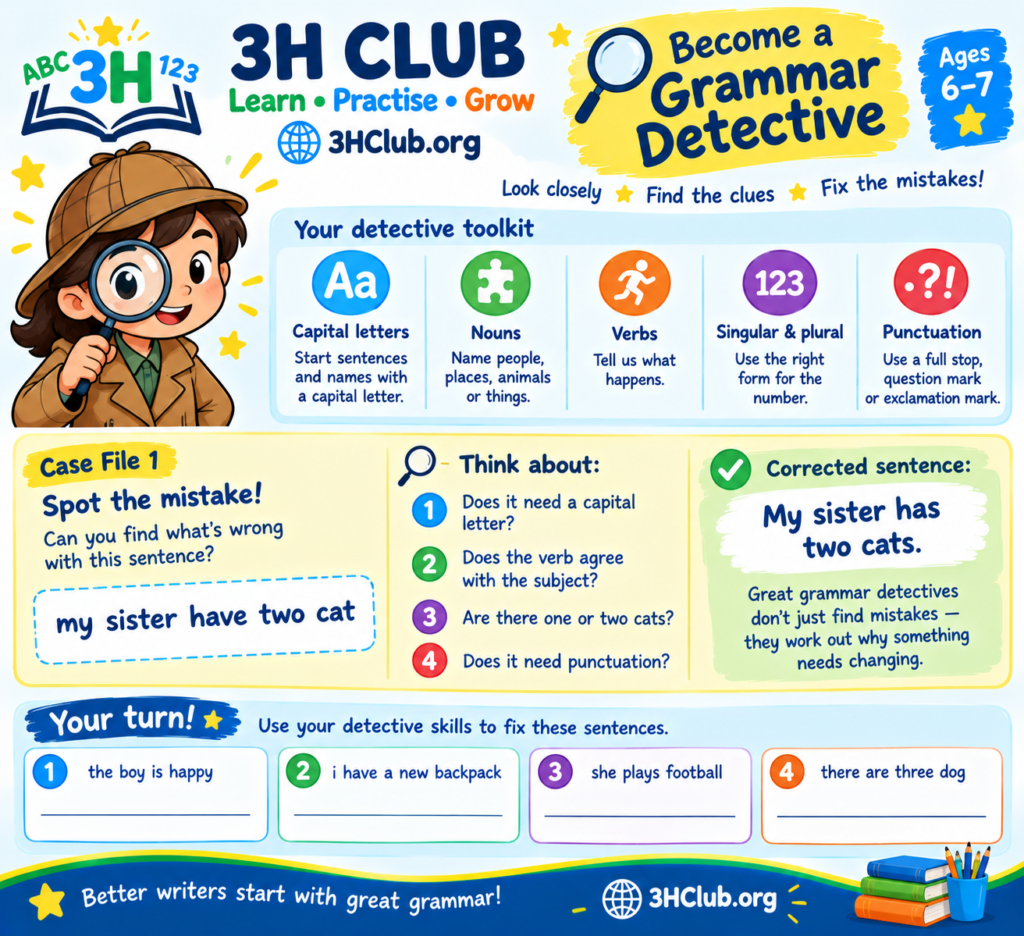
🔎 Your detective toolkit
- 🔠 Capital letters: Check sentence beginnings and names.
- 🧩 Word clues: Identify nouns, verbs, adjectives, pronouns and other word classes.
- 🔢 Number clues: Check singular and plural nouns.
- ⏰ Time clues: Make sure verb tenses match when something happens.
- 🔴 Punctuation clues: Check full stops, question marks, commas and speech marks.
- ✏️ Editing clues: Look for missing words, incorrect word order and sentences that do not make sense.
🔎 Case File 1: The Missing Capital Letter
Can you spot what’s wrong with this sentence?
my sister have two cat
Think about:
- 🔠 Does it need a capital letter?
- 🧩 Does the verb agree with the subject?
- 🔢 Are there one or two cats?
- 🔴 Does it need punctuation?
✔ Corrected sentence
My sister has two cats.
Why? A sentence begins with a capital letter. The singular subject my sister takes has, and the plural noun cats needs an -s. A full stop completes the statement.
Great grammar detectives do not just find mistakes — they work out why something needs changing!
⭐ Starters — Ages 6–7
🔍 Case File 2: Find the Naming Word
Your mission: Find the noun in each sentence. A noun names a person, place, animal or thing.
- The dog ran to the gate.
- Mia has a yellow pencil.
- The children visited the park.
Detective clues
- Which word names an animal?
- Which word names a person?
- Which word names a place?
🔍 Case File 3: The Missing Action
Each sentence is missing a verb. Choose the best word from the brackets.
- The bird ______ in the tree. (sings / blue)
- We ______ our books. (read / happy)
- Dad ______ the door. (opens / table)
Your mission: Circle the verb that tells what happens.
🔍 Case File 4: Singular or Plural?
Something does not match! Rewrite each phrase correctly.
- two dog
- three apples
- one books
- four bus
Detective clue: Check whether the number tells you to use a singular or plural noun.
🔍 Case File 5: Punctuation Patrol
Add a capital letter and the correct punctuation mark.
- where is my bag
- the sun is shining
- what a huge kite
- please close the door
Your mission: Decide whether each sentence is a statement, question, exclamation or command.
🔍 Case File 6: Put the Words in Order
Arrange the words to make a sensible sentence. Remember the capital letter and punctuation.
- playing / are / children / the
- likes / Sam / apples
- is / my / funny / brother
Bonus clue: Can you add an adjective to make one sentence more interesting?
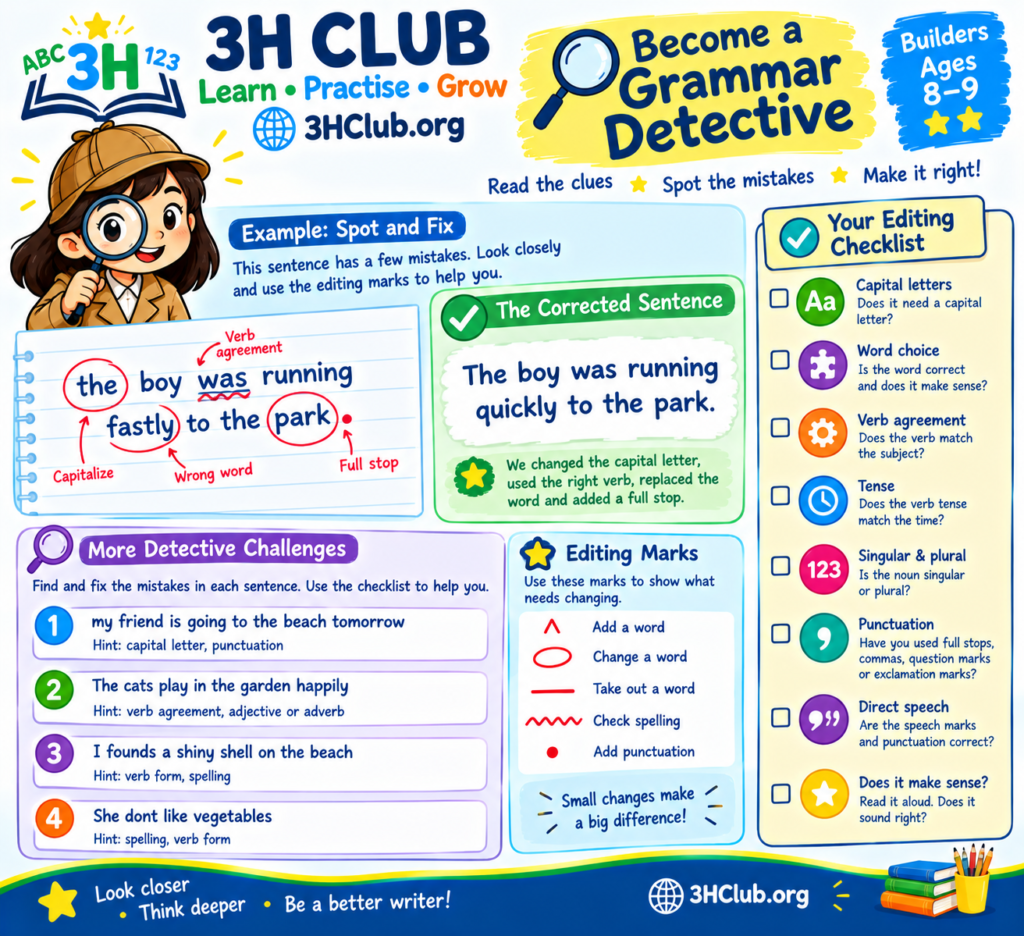
⭐⭐ Builders — Ages 8–9
You have learned the basics. Now you must examine how words work together. Read each clue carefully — some cases have more than one mistake.
🔍 Case File 7: The Verb Agreement Mystery
Rewrite each sentence correctly.
- The girls walks to school.
- My brother and I is excited.
- The dog bark loudly at night.
- Each of the players have a water bottle.
Detective clues
- Find the subject first.
- Ask whether the subject is singular or plural.
- Check whether the verb matches.
🔍 Case File 8: The Tense Time Machine
Each sentence has a verb tense problem. Rewrite it so that the tense matches the time clue.
- Yesterday, we walk to the beach.
- Every morning, Ava brushed her teeth before school. (Change it to describe a regular habit happening now.)
- Tomorrow, I visited my cousin.
- Last night, the children are watching a film.
Bonus case: Write your own sentence about something you did yesterday and another about something you will do tomorrow.
🔍 Case File 9: The Pronoun Mix-Up
Replace the repeated noun with a suitable pronoun. Then rewrite the complete sentence.
- Liam found Liam’s notebook.
- The birds spread the birds’ wings.
- Maya and I finished Maya and my project.
- The puppy wagged the puppy’s tail.
Detective clue: Pronouns help us avoid repeating the same nouns. Make sure the reader can tell who or what the pronoun refers to.
🔍 Case File 10: Adjective or Adverb?
Choose the correct word from the brackets.
- The rabbit moved ______. (quiet / quietly)
- It was a ______ afternoon. (sunny / sunnily)
- Jayden completed the puzzle ______. (careful / carefully)
- The soup tastes ______. (delicious / deliciously)
Think carefully: An adjective describes a noun. An adverb often tells us how an action happens. Some verbs, such as tastes, can be followed by an adjective describing the subject.
🔍 Case File 11: Join the Clues
Join each pair of ideas using the word in brackets.
- I wanted to play outside. It was raining. (but)
- We packed our bags. We were going on holiday. (because)
- You can have an apple. You can have a banana. (or)
- Ella practiced every day. She improved her spelling. (so)
Bonus case: Which conjunction shows a contrast? Which one gives a reason?
🔍 Case File 12: The Editing Investigation
Each sentence contains a mistake. Rewrite it correctly.
- on saturday, we visited grandma.
- The boys was playing football.
- I bought a pencil, an eraser and ruler.
- “Where are you going”? asked Noah.
Detective clue: Look at capitals, subject–verb agreement, articles and punctuation. In direct speech, the question mark belongs inside the closing speech marks when the spoken words are a question.
⭐⭐⭐ Champions — Ages 10–11
Welcome to the advanced investigation desk. These cases require you to look beyond individual words and examine sentence structure, meaning and punctuation.
🔍 Case File 13: The Word-Class Evidence
Read the sentence:
The curious detective carefully examined the muddy footprints.
Identify:
- The noun naming the person.
- The adjective describing the detective.
- The adverb describing how the detective examined the footprints.
- The verb showing the action.
- The adjective describing the footprints.
Bonus case: Write a new sentence using a noun, an adjective, a verb and an adverb. Label each one.
🔍 Case File 14: The Clause That Went Missing
An independent clause expresses a complete thought. A dependent clause does not express a complete thought on its own.
Read each example and decide whether it is an independent clause or a dependent clause.
- Although the rain stopped
- The team celebrated the victory.
- Because the lights went out
- We continued reading our books.
Now investigate these sentences. Correct the fragment or combine the clauses to make a complete sentence.
- Because the bus arrived late.
- Although Maya felt tired, she finished her homework.
Bonus case: Write one sentence containing an independent clause and a dependent clause beginning with although, because or when.
🔍 Case File 15: Active or Passive?
Compare these sentences:
- Active: The artist painted the picture.
- Passive: The picture was painted by the artist.
Rewrite each sentence in the passive voice where possible.
- The chef prepared the meal.
- The storm damaged the fence.
- The class planted the trees.
Detective clue: In the passive voice, the person or thing receiving the action becomes the subject. Use a suitable form of be with the past participle, such as was prepared.
🔍 Case File 16: Punctuation Under Pressure
Rewrite each sentence with the correct punctuation and capitalization.
- “i cant find my keys” said Elena
- Before we left we packed water snacks and a map
- The coach asked “are you ready”
- The explorers bag contained a compass a torch and a notebook
Bonus case: Explain why the apostrophe is needed in explorer’s bag and why the question mark belongs where it does in sentence 3.
🔍 Case File 17: The Subject–Verb Agreement Trap
Choose the correct verb and explain your choice.
- Neither of the answers (is / are) correct.
- The box of pencils (was / were) on the table.
- Everyone in the teams (has / have) a number.
- The players, along with their coach, (was / were) ready.
Detective clue: Do not let a nearby noun distract you. Find the main subject of the sentence.
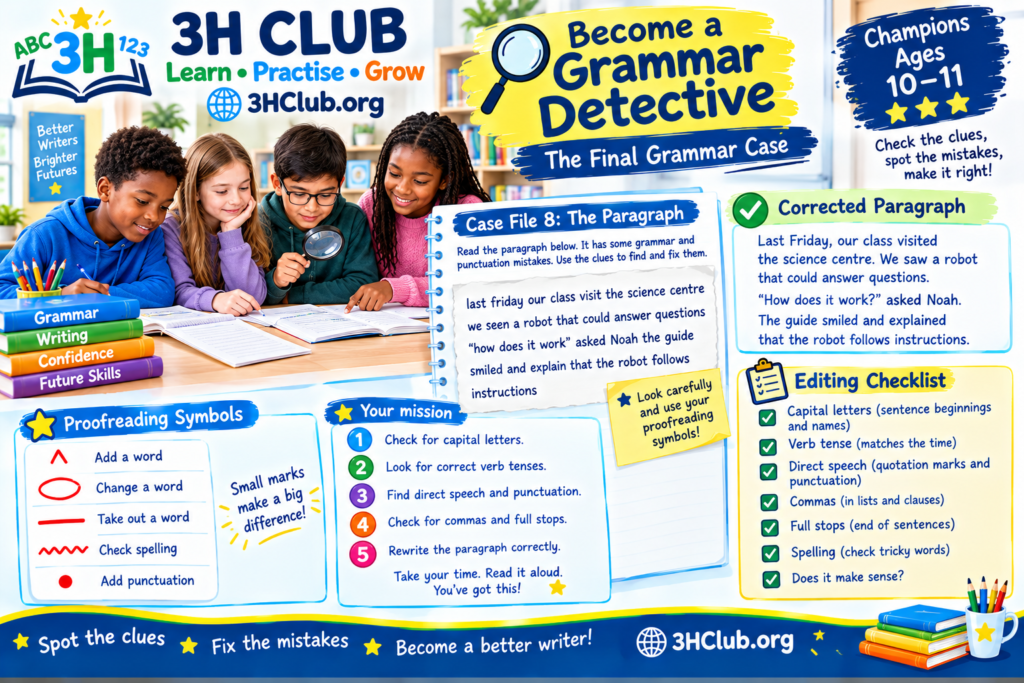
🔍 Case File 18: Repair the Paragraph
This paragraph contains grammar and punctuation errors. Rewrite it correctly.
last friday our class visit the science centre we seen a robot that could answer questions “how does it work” asked Noah the guide smiled and explain that the robot follows instructions
Your mission: Check:
- Capital letters and sentence boundaries
- Verb tenses
- Direct speech and question marks
- Commas and full stops
Bonus case: Add one more sentence to the paragraph using a conjunction to connect two ideas.
🔍 Case File 19: Meaning Matters
Each sentence contains a word or phrase that does not fit the intended meaning. Replace it with a better choice.
- The tiny elephant was so small that it towered over the fence.
- I was exhausted, so I decided to run five more races.
- The librarian whispered loudly across the silent library.
- We arrived before the show began, so we missed the entire performance.
Detective clue: Grammar detectives also check whether words and ideas make sense together. Some cases may have more than one reasonable correction if you explain your choice.
🔍 Case File 20: The Final Grammar Case
Rewrite this sentence correctly, then explain at least four changes you made.
yesterday the group of explorers were walking through the forest when they finds a strange box “what could be inside it” asked maya
Your mission: Check subject–verb agreement, verb tense, capital letters, sentence boundaries, direct speech and punctuation.
✅ Complete Answer Key
Try to solve each case before checking the evidence below. If your answer is different, check whether it is grammatically correct and keeps the intended meaning.
Starters answers
Case File 2: Nouns
- dog, gate
- Mia, pencil
- children, park
Case File 3: Verbs
- sings
- read
- opens
Case File 4: Singular or plural
- two dogs
- three apples — already correct
- one book
- four buses
Case File 5: Punctuation Patrol
- Where is my bag?
- The sun is shining.
- What a huge kite!
- Please close the door.
Case File 6: Word order
- The children are playing.
- Sam likes apples.
- My brother is funny.
Bonus: Answers will vary. For example, The cheerful children are playing.
Builders answers
Case File 7: Verb agreement
- The girls walk to school.
- My brother and I are excited.
- The dog barks loudly at night.
- Each of the players has a water bottle.
Case File 8: Verb tenses
- Yesterday, we walked to the beach.
- Every morning, Ava brushes her teeth before school.
- Tomorrow, I will visit my cousin.
- Last night, the children were watching a film.
Bonus: Answers will vary, but the first sentence should use a past-tense verb and the second should use a future construction.
Case File 9: Pronouns
- Liam found his notebook.
- The birds spread their wings.
- Maya and I finished our project.
- The puppy wagged its tail.
Case File 10: Adjectives and adverbs
- quietly
- sunny
- carefully
- delicious
Case File 11: Conjunctions
- I wanted to play outside, but it was raining.
- We packed our bags because we were going on holiday.
- You can have an apple or a banana.
- Ella practiced every day, so she improved her spelling.
- Contrast: but
- Reason: because
Case File 12: Editing
- On Saturday, we visited Grandma.
- The boys were playing football.
- I bought a pencil, an eraser and a ruler.
- “Where are you going?” asked Noah.
Champions answers
Case File 13: Word classes
- detective
- curious
- carefully
- examined
- muddy
Case File 14: Clauses
- Dependent clause
- Independent clause
- Dependent clause
- Independent clause
- Example correction: Because the bus arrived late, we missed the beginning of the show.
- Already a complete sentence: Although Maya felt tired, she finished her homework.
Bonus: Answers will vary. For example, When the bell rang, the children packed their books.
Case File 15: Passive voice
- The meal was prepared by the chef.
- The fence was damaged by the storm.
- The trees were planted by the class.
Case File 16: Punctuation
- “I can’t find my keys,” said Elena.
- Before we left, we packed water, snacks and a map.
- The coach asked, “Are you ready?”
- The explorer’s bag contained a compass, a torch and a notebook.
Case File 17: Subject–verb agreement
- is — neither is singular in this sentence.
- was — the subject is box, not pencils.
- has — everyone is grammatically singular.
- were — the main subject is players; the phrase along with their coach does not change it.
Case File 18: Corrected paragraph
Last Friday, our class visited the science center. We saw a robot that could answer questions. “How does it work?” asked Noah. The guide smiled and explained that the robot follows instructions.
Case File 19: Meaning matters
Possible answers:
- The tiny elephant was so small that it could fit through the gap.
- I was exhausted, so I decided to rest.
- The librarian spoke quietly in the silent library.
- We arrived after the show began, so we missed the entire performance.
Other sensible answers are acceptable.
Case File 20: Final grammar case
Corrected version:
Yesterday, the group of explorers was walking through the forest when they found a strange box. “What could be inside it?” asked Maya.
Evidence explained:
- Capital letters: Yesterday begins the sentence, and Maya is a name.
- Subject–verb agreement: Group is the main subject, so was is used in this sentence.
- Verb tense: Finds changes to found to match the past-tense story.
- Sentence boundaries: A full stop separates the statement from the spoken question.
- Direct speech: The spoken words are enclosed in quotation marks.
- Question punctuation: The question mark goes inside the closing quotation mark because the spoken words form a question.
🌟 Your Grammar Detective Score
Count one mark for each correctly solved main question. For the paragraph and final cases, award extra credit for each correction you identify and explain.
- Starters: 0–6 marks — keep practicing; 7–10 — clue spotter; 11 or more — brilliant detective.
- Builders: 0–8 marks — keep investigating; 9–15 — sharp investigator; 16 or more — grammar expert.
- Champions: 0–10 marks — review the evidence; 11–16 — skilled editor; 17 or more — master grammar detective.
These score bands are for encouragement rather than formal assessment. If you missed a clue, revisit the relevant topic and try again.
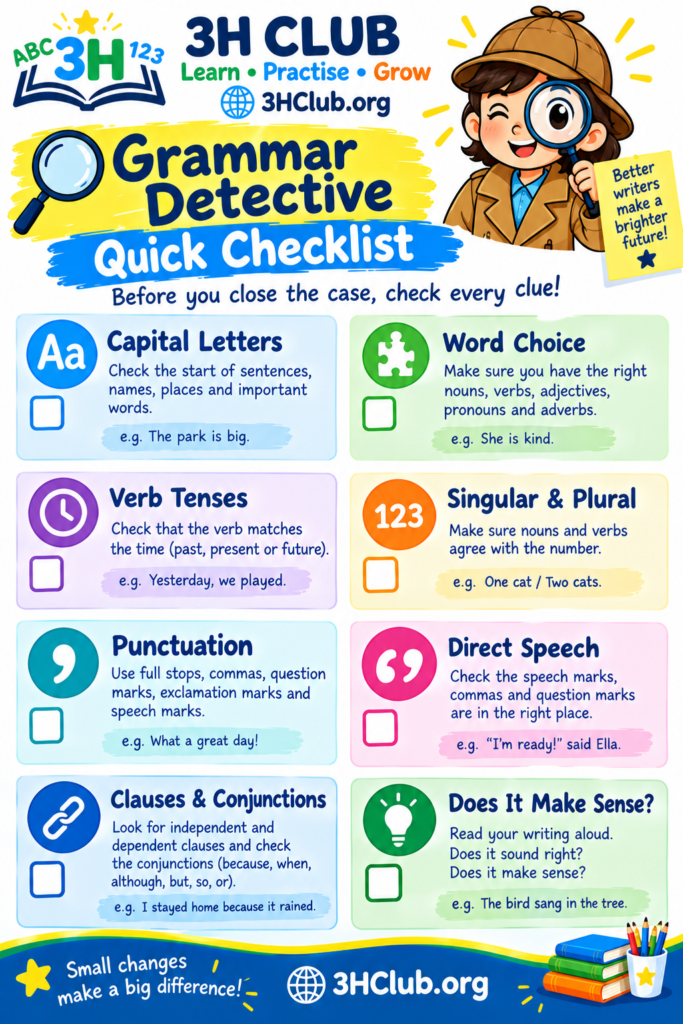
Quick Grammar Detective Checklist
Before you close a case, ask yourself:
- 🔠 Have I checked capital letters and spelling?
- 🧩 Does the verb agree with its subject?
- ⏰ Does the verb tense match the time?
- 🔢 Are singular and plural nouns correct?
- 📝 Does every sentence express a clear thought?
- 🔴 Have I checked punctuation and speech marks?
- 🔍 Do the words and ideas make sense together?
Keep investigating! Every mistake you understand helps you become a clearer, more confident writer.
Frequently Asked Questions
What is a grammar detective?
A grammar detective examines words and sentences to find mistakes, understand why they are incorrect and improve the writing.
How can I get better at grammar?
Read carefully, practise a little at a time, check your work and explain why you made each correction. Reviewing mistakes is part of learning.
Should I check grammar or punctuation first?
Start by checking that the sentence makes sense. Then check word choice, spelling, verbs, capital letters and punctuation. Reading the sentence aloud can help you spot problems.
Can more than one answer be correct?
Yes. Some editing and meaning challenges allow different correct answers. Your correction should be grammatical, clear and suitable for the meaning you want to express.