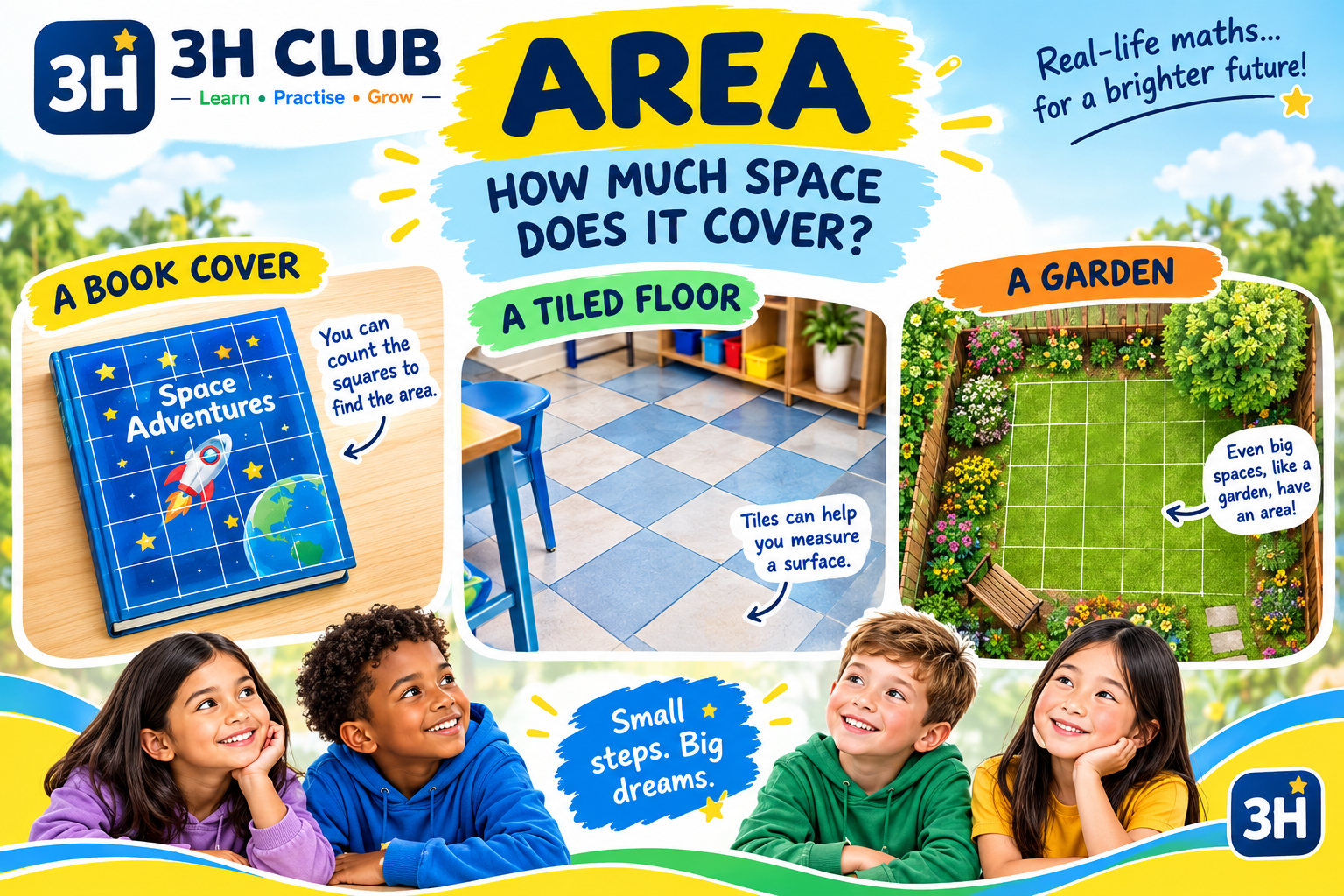
Area for Kids:
📐 Learn to Measure Space with Squares!
⭐ Starters — Ages 6–7 | ⭐⭐ Builders — Ages 8–9 | ⭐⭐⭐ Champions — Ages 10–11
📚 Subject: Mathematics – Measurement and Geometry
🎯 Skills: Counting square units, comparing areas, rectangles, squares, multiplication, area and perimeter, triangles, composite shapes, square-unit conversions and real-life problem-solving.
🌟 Hello, Young Mathematician!
Imagine you want to cover a table with colourful paper.
How much paper will you need?
Or perhaps you’re planning a little garden. How much ground will your garden cover?
To answer these questions, you need to understand area.
Area is the amount of space inside a flat shape or covered by a flat surface.
You can discover area by counting squares, multiplying measurements and breaking complicated shapes into simpler ones.
The exciting part is that the same idea works for tiny drawings and enormous playing fields!
Let’s begin your area adventure.
🎯 What Will You Learn?
By the end of this lesson, you’ll be able to:
- Explain what area means.
- Compare the areas of flat shapes.
- Measure area using equal-sized squares.
- Understand square units.
- Find the area of rectangles and squares.
- Distinguish between area and perimeter.
- Calculate missing side lengths.
- Find the area of triangles.
- Break composite shapes into simpler parts.
- Convert between common metric area units.
- Solve real-life measurement problems.
⭐ Your mission: Discover how to measure the space inside shapes accurately and confidently.
⭐ STAGE 1: STARTERS — AGES 6–7
🌈 Discover Area by Counting Squares
🟢 1. What Is Area?
Area tells us how much space a flat shape covers.
Think about:
- The top of your desk.
- The cover of your notebook.
- A small rug.
- A sheet of paper.
- The floor of your bedroom.
Each has a surface that covers a certain amount of space.
Imagine two rectangular mats.
One mat is small.
The other mat is large.
If the larger mat covers more of the floor, it has a greater area.
✏️ Activity 1: Spot the Area
Which surface would usually have the greater area?
- A postage stamp or a classroom floor?
- A notebook cover or a football field?
- A small placemat or a large dining table?
- A single floor tile or the whole tiled floor?
- A small sticker or a classroom whiteboard?
⭐ Starter Tip: Area is about the space a surface covers, not how heavy or tall an object is.
🔵 2. Cover Shapes with Equal Squares
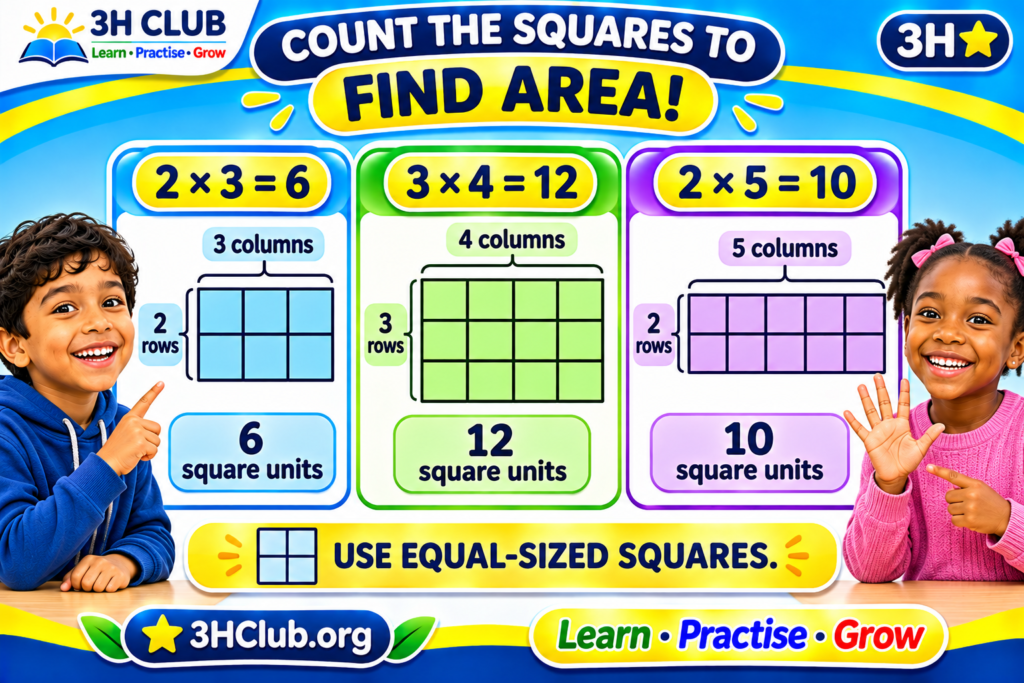
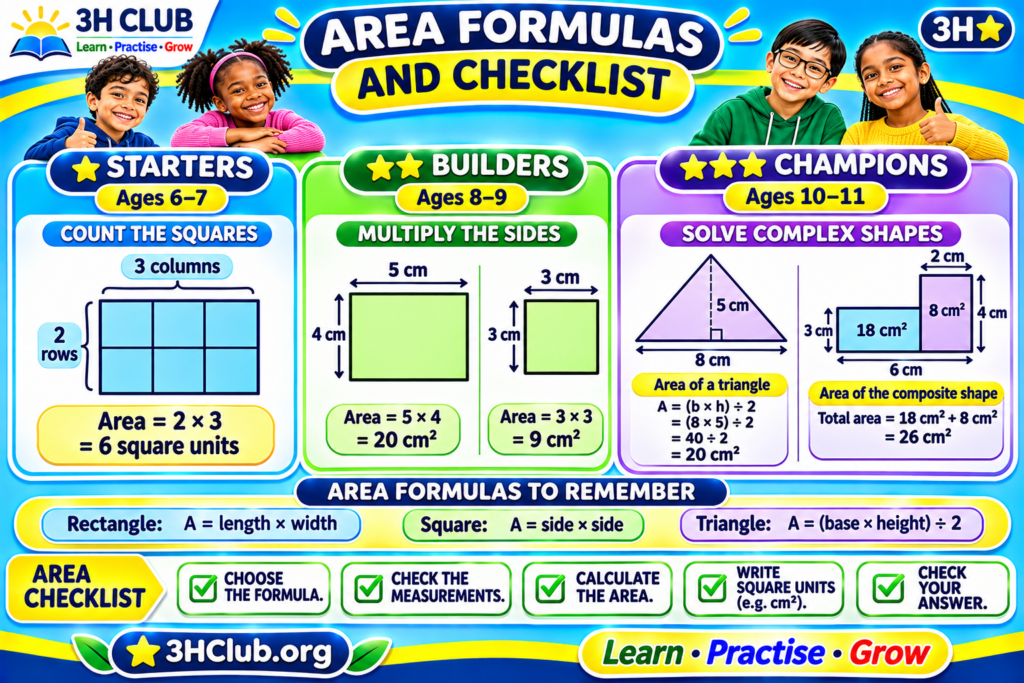
One way to measure area is to cover a shape with equal-sized squares.
Look at this rectangle:
🟦 🟦 🟦
🟦 🟦 🟦
Count the squares.
There are 6 squares.
So the area is:
6 square units
A square unit is the area of one square with sides that are each one unit long.
To measure accurately, the squares must be the same size, with no gaps or overlaps.
✏️ Activity 2: Count the Squares
Find the area of each arrangement.
A.
🟨 🟨
🟨 🟨
B.
🟩 🟩 🟩
🟩 🟩 🟩
C.
🟦 🟦 🟦 🟦
🟦 🟦 🟦 🟦
D.
🟪 🟪 🟪
🟪 🟪 🟪
🟪 🟪 🟪
Write each answer in square units.
🟡 3. Compare Two Areas
Let’s compare two shapes made from the same-sized squares.
Shape A
🟦 🟦
🟦 🟦
Area = 4 square units.
Shape B
🟩 🟩 🟩
🟩 🟩 🟩
Area = 6 square units.
Shape B has the greater area.
6 is greater than 4.
We can write:
6 > 4
✏️ Activity 3: Bigger or Smaller?
Compare these areas.
- 4 square units and 7 square units.
- 9 square units and 6 square units.
- 8 square units and 8 square units.
- 12 square units and 10 square units.
- 5 square units and 11 square units.
Write greater than, less than or equal to.
🟣 4. Different Shapes Can Have the Same Area
A shape does not need to look like another shape to have the same area.
Look at these arrangements of six squares.
Shape A
🟦 🟦 🟦
🟦 🟦 🟦
Shape B
🟩 🟩 🟩 🟩 🟩 🟩
Both shapes contain six equal-sized squares.
Both have an area of:
6 square units
Their shapes are different, but their areas are equal.
✏️ Activity 4: Make Two Shapes
Using six identical square tiles or six squares on grid paper:
- Make a rectangle with two rows.
- Make a long rectangle with one row.
- Count the squares in each.
- Explain why the areas are equal.
✏️ Activity 5: Draw Your Own Area
Draw a shape on squared paper that covers exactly:
- 4 squares.
- 6 squares.
- 8 squares.
- 10 squares.
- 12 squares.
Try drawing two different shapes with the same area.
🎲 Starters Game: Square Tile Builders
You will need: Square tiles, building blocks with square faces or grid paper.
- Choose a target area, such as 8 square units.
- Arrange eight identical tiles without gaps or overlaps.
- Make a different shape using the same tiles.
- Count to check the area.
⭐ Bonus: Can you make three different shapes with an area of 12 square units?
⭐⭐ STAGE 2: BUILDERS — AGES 8–9
🧩 Calculate Area Using Multiplication
🔵 5. What Are Square Centimetres and Square Metres?
When measuring area, we use square units.
A square centimetre, written cm², is the area of a square measuring 1 cm on each side.
A square metre, written m², is the area of a square measuring 1 m on each side.
The small raised 2 means squared.
Choosing a Unit
| Surface | Suitable Area Unit |
|---|---|
| Small sticker | cm² |
| Notebook cover | cm² |
| Classroom floor | m² |
| Garden | m² |
| Large field | m² |
You can also use other square units, such as square millimetres and square kilometres.
✏️ Activity 6: Choose the Unit
Choose cm² or m².
- Area of a classroom floor.
- Area of a postage stamp.
- Area of a school garden.
- Area of a small drawing.
- Area of a bedroom floor.
- Area of a pencil-case lid.
🟢 6. Find the Area of a Rectangle
A rectangle has four right angles, with opposite sides equal in length.
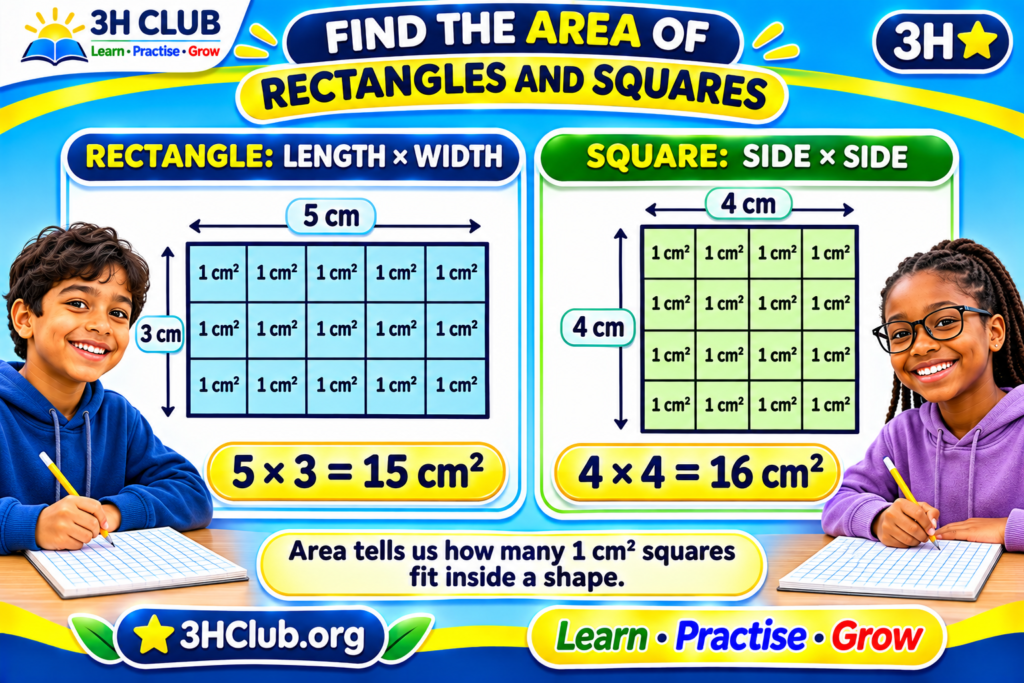
You can find its area by multiplying its length by its width.
📐 Rectangle Area Formula
Area = length × width
Or:
A = l × w
Worked Example
A rectangle is:
5 cm long
3 cm wide
Its area is:
5 × 3 = 15 cm²
Why?
Because five columns of three square centimetres make 15 square centimetres altogether.
✏️ Activity 7: Rectangle Area Practice
Find the area.
- 4 cm × 3 cm.
- 6 cm × 2 cm.
- 7 cm × 4 cm.
- 8 cm × 5 cm.
- 9 cm × 3 cm.
- 10 cm × 6 cm.
Remember to write cm².
🟡 7. Find the Area of a Square
A square has four equal sides and four right angles.
Its area is:
Area = side × side
Or:
A = s²
Worked Example
A square has sides measuring 4 cm.
Area = 4 × 4
Area = 16 cm²
✏️ Activity 8: Square Area Challenge
Find the area of a square with sides measuring:
- 2 cm.
- 3 cm.
- 5 cm.
- 6 cm.
- 8 cm.
- 10 cm.
🟣 8. Area and Perimeter Are Different
Area and perimeter both describe shapes, but they measure different things.
Area measures the space inside a shape.
Perimeter measures the distance around the outside.
Imagine a rectangular garden.
It is 6 m long and 4 m wide.
Area
6 × 4 = 24 m²
The garden covers 24 square metres.
Perimeter
6 + 4 + 6 + 4 = 20 m
You would need 20 metres of fencing to go around it, ignoring gates and other openings.
Remember
AREA = INSIDE
PERIMETER = AROUND
Area uses square units.
Perimeter uses length units.
✏️ Activity 9: Area or Perimeter?
Choose the correct measurement.
- Finding how much carpet covers a floor.
- Measuring fencing around a garden.
- Finding how much paint covers a flat wall.
- Measuring ribbon around the edge of a picture frame.
- Calculating how much grass covers a lawn.
- Measuring the distance around a playground.
🔵 9. Find a Missing Side Length
Sometimes you know the area of a rectangle but not one of its sides.
You can use division to find the missing measurement.
Worked Example
A rectangle has an area of 30 cm².
Its length is 6 cm.
What is its width?
Area = length × width
30 = 6 × width
So:
Width = 30 ÷ 6
Width = 5 cm
✏️ Activity 10: Missing Measurement
Find the missing side.
- Area = 24 cm², length = 6 cm.
- Area = 35 cm², width = 5 cm.
- Area = 48 cm², length = 8 cm.
- Area = 54 cm², width = 9 cm.
- Area = 72 cm², length = 12 cm.
Write each missing measurement in centimetres.
🟢 10. Solve Real-Life Area Problems
Area is useful when planning and measuring.
Example 1: A Classroom Rug
A rectangular rug is 3 m long and 2 m wide.
Area = 3 × 2 = 6 m²
Example 2: A Garden Bed
A rectangular garden bed is 5 m long and 4 m wide.
Area = 5 × 4 = 20 m²
Example 3: A Noticeboard
A rectangular noticeboard is 120 cm long and 60 cm wide.
Area = 120 × 60 = 7,200 cm²
✏️ Activity 11: Real-Life Maths
- A table is 2 m long and 1 m wide. Find its area.
- A rectangular mat measures 4 m by 3 m. Find its area.
- A square garden has sides of 7 m. Find its area.
- A poster measures 30 cm by 20 cm. Find its area.
- A rectangular playground measures 12 m by 8 m. Find its area.
✏️ Activity 12: Design a Mini Garden
Draw a rectangular garden on grid paper.
Your garden must have an area of 24 square units.
Find at least three different whole-number length-and-width pairs.
Label each design.
🎲 Builders Game: Area Architect
Draw a rectangle on squared paper.
Ask a friend to calculate its area.
Then swap roles.
Bonus challenge: Draw two different rectangles with the same area but different perimeters.
⭐⭐⭐ STAGE 3: CHAMPIONS — AGES 10–11
🏆 Master Triangles, Composite Shapes and Area Problems
🔵 11. Find the Area of a Triangle
A triangle is a flat shape with three sides.
To find its area, you need its base and perpendicular height.
The perpendicular height meets the base, or the line containing the base, at a right angle.
📐 Triangle Area Formula
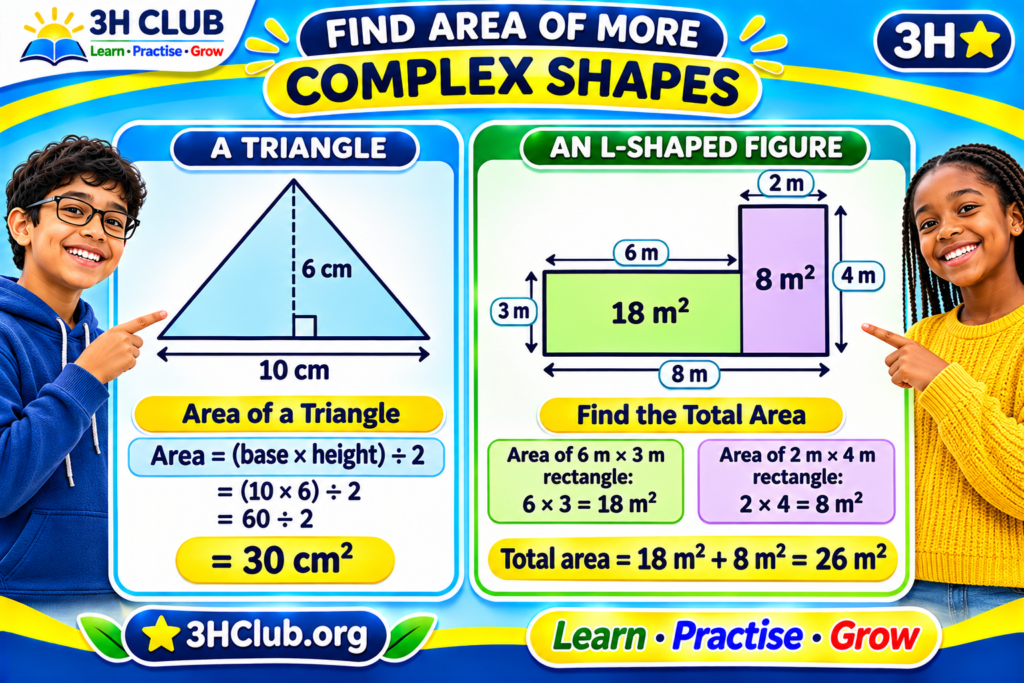
Area = ½ × base × height
Or:
A = (b × h) ÷ 2
Why Divide by 2?
Imagine a rectangle that is 8 cm long and 4 cm wide.
Its area is:
8 × 4 = 32 cm²
A diagonal divides that rectangle into two equal-area triangles.
Each triangle has an area of:
32 ÷ 2 = 16 cm²
Worked Example
A triangle has:
Base = 10 cm
Perpendicular height = 6 cm
Area:
(10 × 6) ÷ 2 = 30 cm²
✏️ Activity 13: Triangle Area Practice
Find the area of each triangle.
- Base 6 cm, height 4 cm.
- Base 8 cm, height 5 cm.
- Base 10 cm, height 7 cm.
- Base 12 cm, height 6 cm.
- Base 15 cm, height 8 cm.
- Base 9 cm, height 4 cm.
⭐ Champion Tip: Don’t automatically use a sloping side as the height. The height must be perpendicular to the chosen base.
🟡 12. Understand Composite Shapes
A composite shape is made by joining two or more simpler shapes.
For example, an L-shaped floor can be divided into rectangles.
To find its area:
- Divide it into shapes you can measure.
- Calculate each area.
- Add the areas together.
Worked Example: An L-Shaped Garden
Imagine an L-shaped garden made from two rectangles that meet along an edge without overlapping.
Rectangle A: 6 m × 3 m.
Rectangle B: 2 m × 4 m.
Area of A:
6 × 3 = 18 m²
Area of B:
2 × 4 = 8 m²
Total area:
18 + 8 = 26 m²
Another Method: Subtraction
Sometimes it’s easier to imagine a large rectangle with a smaller rectangle removed.
Suppose a shape fits inside an 8 m × 6 m rectangle, but a 3 m × 2 m rectangular corner is missing.
Large rectangle:
8 × 6 = 48 m²
Missing corner:
3 × 2 = 6 m²
Remaining area:
48 − 6 = 42 m²
Both addition and subtraction are useful methods.
✏️ Activity 14: Composite Shape Challenge
For each question, the smaller shapes do not overlap.
- A shape consists of a 5 cm × 4 cm rectangle and a 3 cm × 2 cm rectangle. Find the total area.
- A shape consists of a 7 m × 3 m rectangle and a 2 m × 4 m rectangle. Find the total area.
- A 10 cm × 8 cm rectangle has a 3 cm × 2 cm corner removed. Find the remaining area.
- A 12 m × 7 m rectangle has a 4 m × 3 m corner removed. Find the remaining area.
- A shape consists of a 6 cm × 5 cm rectangle and a triangle with base 6 cm and perpendicular height 4 cm. They meet along an edge. Find the total area.
🟢 13. Convert Square Units
Different-sized surfaces need different measurement units.
Common metric area units include:
- Square millimetres (mm²).
- Square centimetres (cm²).
- Square metres (m²).
- Square kilometres (km²).
Important Conversions
1 cm² = 100 mm²
1 m² = 10,000 cm²
1 km² = 1,000,000 m²
Why does 1 m² contain 10,000 cm²?
Because:
1 m = 100 cm
So a square measuring 1 m by 1 m is also:
100 cm × 100 cm
Therefore:
1 m² = 10,000 cm²
✏️ Activity 15: Area Unit Conversions
Convert:
- 3 cm² to mm².
- 5 cm² to mm².
- 2 m² to cm².
- 4 m² to cm².
- 30,000 cm² to m².
- 2 km² to m².
⭐ Champion Reminder: Converting area units is different from converting length units. You must account for two dimensions.
🟣 14. Find the Area of a Parallelogram
A parallelogram has two pairs of parallel opposite sides.
Its area can be found using:
Area = base × perpendicular height
Or:
A = b × h
Imagine cutting a triangular section from one side of a parallelogram and moving it to the other side.
You can form a rectangle with the same base and perpendicular height.
The area stays the same.
Worked Example
Base = 9 cm.
Perpendicular height = 5 cm.
Area = 9 × 5 = 45 cm²
✏️ Activity 16: Parallelogram Practice
Find the area.
- Base 6 cm, height 4 cm.
- Base 8 cm, height 3 cm.
- Base 12 cm, height 5 cm.
- Base 10 m, height 7 m.
- Base 15 m, height 6 m.
Remember: the sloping side is not necessarily the perpendicular height.
🔵 15. Discover Area and Fractions
Sometimes you need only part of a shape’s area.
Suppose a rectangular garden covers:
24 m²
Half of the garden is planted with flowers.
Flower area:
½ × 24 = 12 m²
If one quarter is used for vegetables:
¼ × 24 = 6 m²
✏️ Activity 17: Fractions of Area
- Find half of 18 m².
- Find one quarter of 32 cm².
- Find one third of 27 m².
- Find three quarters of 40 m².
- Find two fifths of 50 cm².
🟡 16. Solve Real-Life Area Problems
Area is useful for planning rooms, gardens, sports spaces and creative projects.
Example 1: Tiling a Floor
A rectangular floor is 4 m long and 3 m wide.
Area = 4 × 3 = 12 m²
If each tile covers 1 m² and the tiles fit exactly, you need 12 tiles.
In real projects, tiles are often smaller and extra material may be needed for cutting or waste.
Example 2: Painting a Wall
A rectangular wall is 5 m wide and 3 m high.
Area = 5 × 3 = 15 m²
This tells you the wall’s total surface area before accounting for doors, windows or the amount of paint required per square metre.
Example 3: A School Garden
A rectangular school garden is 12 m long and 8 m wide.
Area = 12 × 8 = 96 m²
If half is used for vegetables:
96 ÷ 2 = 48 m²
✏️ Activity 18: Real-Life Area Challenge
- A rectangular floor is 6 m long and 4 m wide. Find its area.
- A triangular sign has a base of 80 cm and a perpendicular height of 50 cm. Find its area.
- A square courtyard has sides of 9 m. Find its area.
- A 10 m × 8 m garden has a 2 m × 3 m rectangular pond area removed. Find the remaining garden area.
- A rectangular wall is 4 m wide and 2.5 m high. Find its area.
🟢 17. Same Area, Different Perimeter
Two shapes can have the same area but different perimeters.
Compare:
Rectangle A: 6 cm × 4 cm.
Area:
6 × 4 = 24 cm²
Perimeter:
2 × (6 + 4) = 20 cm
Rectangle B: 8 cm × 3 cm.
Area:
8 × 3 = 24 cm²
Perimeter:
2 × (8 + 3) = 22 cm
Both rectangles have the same area.
But their perimeters are different.
✏️ Activity 19: Investigate Area and Perimeter
Draw three rectangles with an area of 36 cm², using whole-number side lengths.
For each:
- Write its dimensions.
- Calculate its area.
- Calculate its perimeter.
- Compare the results.
What do you notice?
🟣 18. Avoid Common Area Mistakes
Here are five important mistakes to watch for.
Mistake 1: Adding instead of multiplying
For a rectangle measuring 5 cm × 3 cm:
Incorrect area: 5 + 3 = 8.
Correct area: 5 × 3 = 15 cm².
Mistake 2: Forgetting square units
Area should be written in units such as cm² or m².
Mistake 3: Using a sloping side as a triangle’s height
The height must be perpendicular to the chosen base.
Mistake 4: Overlapping parts of a composite shape
When adding areas, don’t count the same region twice.
Mistake 5: Converting area like length
1 m² is 10,000 cm², not 100 cm².
✏️ Activity 20: Find the Mistake
Correct these statements.
- A rectangle measuring 7 cm × 3 cm has an area of 10 cm².
- A square with sides of 5 cm has an area of 20 cm².
- A triangle with base 8 cm and perpendicular height 4 cm has an area of 32 cm².
- 1 m² = 100 cm².
- A rectangle with an area of 24 cm² and a length of 6 cm has a width of 6 cm.
🎲 FIVE FUN AREA GAMES
🎯 Game 1: Square Counter Race
Best for Starters
Draw a shape containing 4–12 unit squares.
Ask a friend to count its area.
The first correct answer earns a point.
🧩 Game 2: Area Match
Best for Builders
Make cards showing rectangle dimensions and matching areas.
Examples:
3 cm × 4 cm ↔ 12 cm²
5 cm × 6 cm ↔ 30 cm²
7 cm × 2 cm ↔ 14 cm²
Match the cards.
🏡 Game 3: Design a Room
Best for Builders
Draw a rectangular room on squared paper.
Label the length and width.
Calculate its area.
Then design another room with the same area but different dimensions.
🔍 Game 4: Composite Shape Detective
Best for Champions
Draw an L-shaped figure on grid paper.
Divide it into two rectangles.
Calculate each rectangle’s area.
Add them together to find the total.
🏆 Game 5: Area Formula Challenge
Best for Champions
Choose a rectangle, square, triangle or parallelogram.
Write its dimensions.
Challenge a friend to calculate the area and explain the formula used.
🏆 THE FINAL AREA CHALLENGE
Choose your level, or try the next level when you’re ready!
⭐ Part A: Starters Challenge
- What does area measure?
- A shape covers 5 equal unit squares. What is its area?
- Which is greater: 7 square units or 10 square units?
- Can two different shapes have the same area?
- Draw a rectangle containing 8 unit squares.
⭐⭐ Part B: Builders Challenge
- Find the area of a rectangle measuring 7 cm × 5 cm.
- Find the area of a square with sides of 6 cm.
- A rectangle has an area of 40 cm² and a width of 5 cm. Find its length.
- Explain the difference between area and perimeter.
- Find the area of a rectangular garden measuring 9 m × 4 m.
⭐⭐⭐ Part C: Champions Challenge
- Find the area of a triangle with base 14 cm and perpendicular height 8 cm.
- Find the area of a parallelogram with base 12 cm and perpendicular height 7 cm.
- A rectangle measuring 15 m × 10 m has a 5 m × 4 m corner removed. Find the remaining area.
- Convert 3 m² into cm².
- Find three quarters of 64 m².
- A square has an area of 81 cm². Find its side length.
- Two rectangles have dimensions 12 cm × 3 cm and 9 cm × 4 cm. Compare their areas and perimeters.
- Design a composite garden with a total area of exactly 50 m².
📝 CHECK YOUR ANSWERS!
⭐ Starters Answers
Activity 1
- Classroom floor.
- Football field.
- Large dining table.
- Whole tiled floor.
- Classroom whiteboard.
Activity 2
- A = 4 square units.
- B = 6 square units.
- C = 8 square units.
- D = 9 square units.
Activity 3
- 4 is less than 7.
- 9 is greater than 6.
- 8 is equal to 8.
- 12 is greater than 10.
- 5 is less than 11.
Activity 4
Both shapes have an area of 6 square units.
Activity 5
Answers will vary. Each shape must contain exactly the requested number of equal-sized unit squares.
⭐⭐ Builders Answers
Activity 6: Choose the Unit
- m².
- cm².
- m².
- cm².
- m².
- cm².
Activity 7: Rectangle Area
- 12 cm².
- 12 cm².
- 28 cm².
- 40 cm².
- 27 cm².
- 60 cm².
Activity 8: Square Area
- 4 cm².
- 9 cm².
- 25 cm².
- 36 cm².
- 64 cm².
- 100 cm².
Activity 9: Area or Perimeter?
- Area.
- Perimeter.
- Area.
- Perimeter.
- Area.
- Perimeter.
Activity 10: Missing Measurement
- 4 cm.
- 7 cm.
- 6 cm.
- 6 cm.
- 6 cm.
Activity 11: Real-Life Maths
- 2 m².
- 12 m².
- 49 m².
- 600 cm².
- 96 m².
Activity 12: Mini Garden
Possible dimensions for an area of 24 square units:
- 1 × 24.
- 2 × 12.
- 3 × 8.
- 4 × 6.
Any three different factor pairs are correct.
⭐⭐⭐ Champions Answers
Activity 13: Triangle Area
- 12 cm².
- 20 cm².
- 35 cm².
- 36 cm².
- 60 cm².
- 18 cm².
Activity 14: Composite Shapes
- 26 cm².
- 29 m².
- 74 cm².
- 72 m².
- 42 cm².
Activity 15: Area Unit Conversions
- 300 mm².
- 500 mm².
- 20,000 cm².
- 40,000 cm².
- 3 m².
- 2,000,000 m².
Activity 16: Parallelogram Area
- 24 cm².
- 24 cm².
- 60 cm².
- 70 m².
- 90 m².
Activity 17: Fractions of Area
- 9 m².
- 8 cm².
- 9 m².
- 30 m².
- 20 cm².
Activity 18: Real-Life Area
- 24 m².
- 2,000 cm².
- 81 m².
- 74 m².
- 10 m².
Activity 19: Area and Perimeter
Possible answers:
| Dimensions | Area | Perimeter |
|---|---|---|
| 1 cm × 36 cm | 36 cm² | 74 cm |
| 3 cm × 12 cm | 36 cm² | 30 cm |
| 6 cm × 6 cm | 36 cm² | 24 cm |
All three shapes have the same area, but different perimeters.
Activity 20: Find the Mistake
- Correct area = 21 cm².
- Correct area = 25 cm².
- Correct area = 16 cm².
- Correct conversion: 1 m² = 10,000 cm².
- Correct width = 4 cm.
🏆 FINAL CHALLENGE ANSWERS
⭐ Starters
- The space inside a flat shape or covered by a surface.
- 5 square units.
- 10 square units.
- Yes.
- Possible answer: 2 rows of 4 squares.
⭐⭐ Builders
- 35 cm².
- 36 cm².
- 8 cm.
- Area measures space inside; perimeter measures distance around.
- 36 m².
⭐⭐⭐ Champions
- 56 cm².
- 84 cm².
- 130 m².
- 30,000 cm².
- 48 m².
- 9 cm.
- Both areas are 36 cm². The first perimeter is 30 cm; the second is 26 cm.
- Possible answer: Join a 6 m × 5 m rectangle to a 5 m × 4 m rectangle without overlapping them. Total area = 30 + 20 = 50 m².
🎉 Excellent work, Area Champion!
🌈 WHAT HAVE YOU LEARNT?
⭐ Starters
You discovered that:
- Area measures space inside a flat shape.
- Equal-sized squares help us measure area.
- Different shapes can have the same area.
⭐⭐ Builders
You learnt that:
- Rectangle area = length × width.
- Square area = side × side.
- Area uses square units.
- Area and perimeter measure different things.
- Division helps find missing side lengths.
⭐⭐⭐ Champions
You mastered:
- Triangle area.
- Composite shapes.
- Parallelogram area.
- Metric square-unit conversions.
- Fractions of area.
- Real-life area problems.
⭐ Area Formula Summary
| Shape | Formula |
|---|---|
| Rectangle | A = length × width |
| Square | A = side × side |
| Triangle | A = (base × perpendicular height) ÷ 2 |
| Parallelogram | A = base × perpendicular height |
| Composite shape | Add non-overlapping parts or subtract missing regions |
🌟 KEEP LEARNING WITH 3HCLUB!
Now you know how to measure the space inside shapes.
You can use area to plan gardens, design rooms, calculate surfaces and solve maths problems.
Remember:
Count squares when you’re beginning.
Multiply when you know the dimensions.
Break complicated shapes into simpler parts.
Always include the correct square units.
📚 Your Next Maths Adventures
- Shapes for Kids
- Multiplication for Kids
- Division for Kids
- Perimeter for Kids
- Measurement for Kids
- Fractions for Kids
- Factorization for Kids
- Maths Symbols: Learn What the Signs Mean
⭐ Your Area Promise
I can explain what area means.
I can count square units.
I can calculate rectangle and square areas.
I can tell area and perimeter apart.
I can find triangle areas.
I can measure composite shapes.
I can solve practical area problems.
3H CLUB — Learn • Practise • Grow