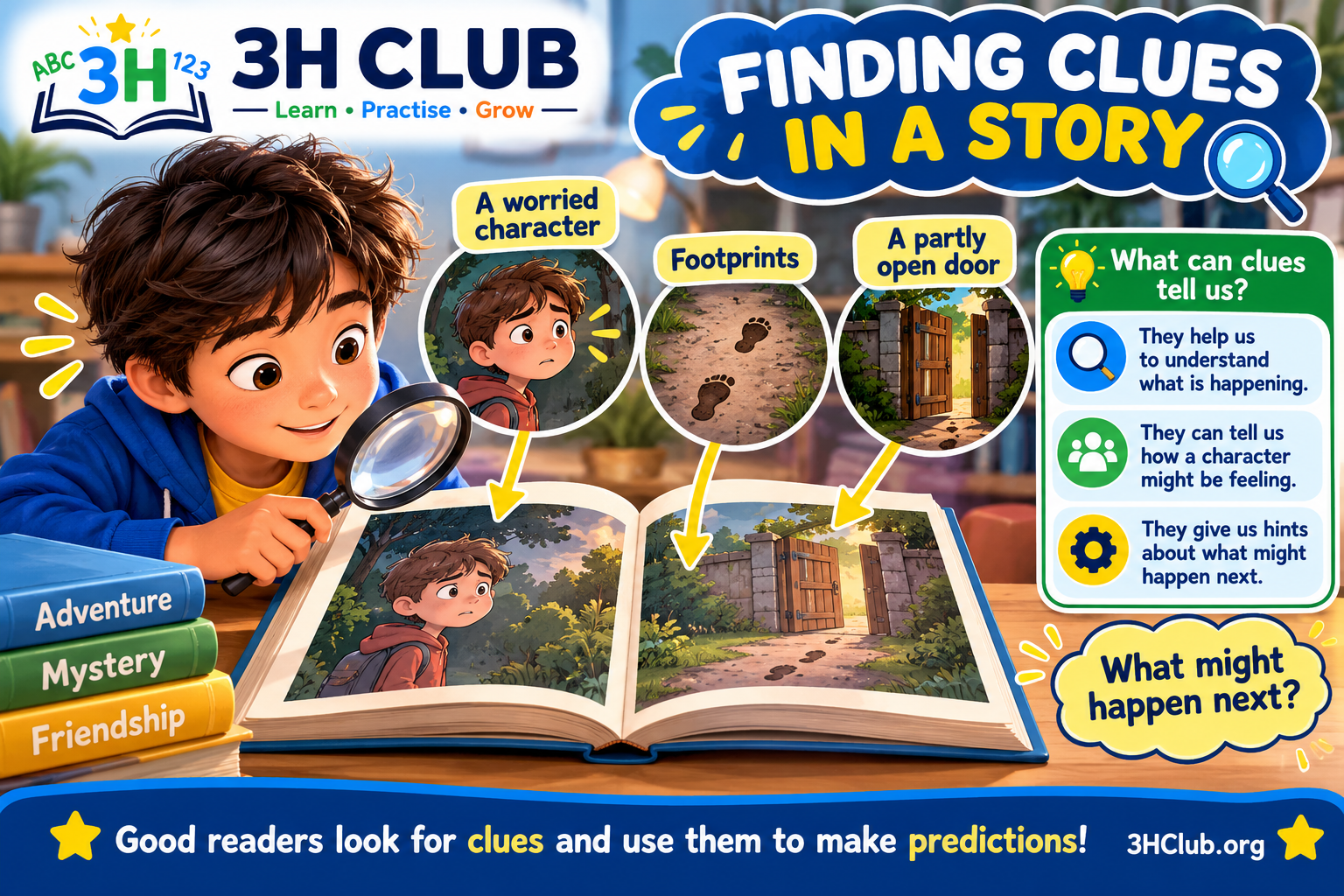
Finding Clues in a Story:
🔎 Become a Reading Detective
Have you ever read a story and worked out how a character was feeling without the writer telling you directly? Perhaps a character’s hands were shaking, their voice was quiet, or they kept looking over their shoulder. These small details can help you understand what is happening.
Writers often leave clues for readers to discover. They use words, actions and descriptions to help us understand characters, events and unfamiliar words. When you notice these details and think carefully about what they mean, you become a stronger reader.
At 3HClub, you will learn how to look beyond the words on the page and discover the clues hidden in a story.
⭐⭐ Builders — Ages 8–9
You will practise:
- 🔎 Finding clues in sentences.
- 💭 Understanding characters’ feelings.
- 📚 Using context to understand unfamiliar words.
- 🗣️ Supporting your answers with story details.
Ready to investigate? Let’s look closely at what stories can tell us!
🔎 1. What Are Story Clues?
A story clue is a detail that helps you understand something about a story. It might tell you how a character feels, why something happened or what an unfamiliar word means.
Writers give us clues in different ways.
- Words: The words a writer chooses can suggest a character’s feelings or explain an event.
- Actions: What a character does can reveal what they think or feel.
- Descriptions: Details about people, places and objects can help us picture a scene.
- Dialogue: What characters say can give us information about their thoughts, feelings and plans.
- Context: The words and sentences around an unfamiliar word can help us work out its meaning.
Imagine reading this sentence:
Noah stepped into the dark room. He gripped the door handle, listened carefully and took one small step backwards.
The writer does not say that Noah is frightened. However, his actions give us clues.
He grips the handle, listens carefully and steps backwards. These details suggest that he might be nervous or afraid.
Remember: A good reader does more than read the words. A good reader also thinks about what the details mean.
👀 2. Look Closely at the Words
The words a writer chooses can give you important information. Sometimes, a single word can change how you understand a sentence.
Read these examples.
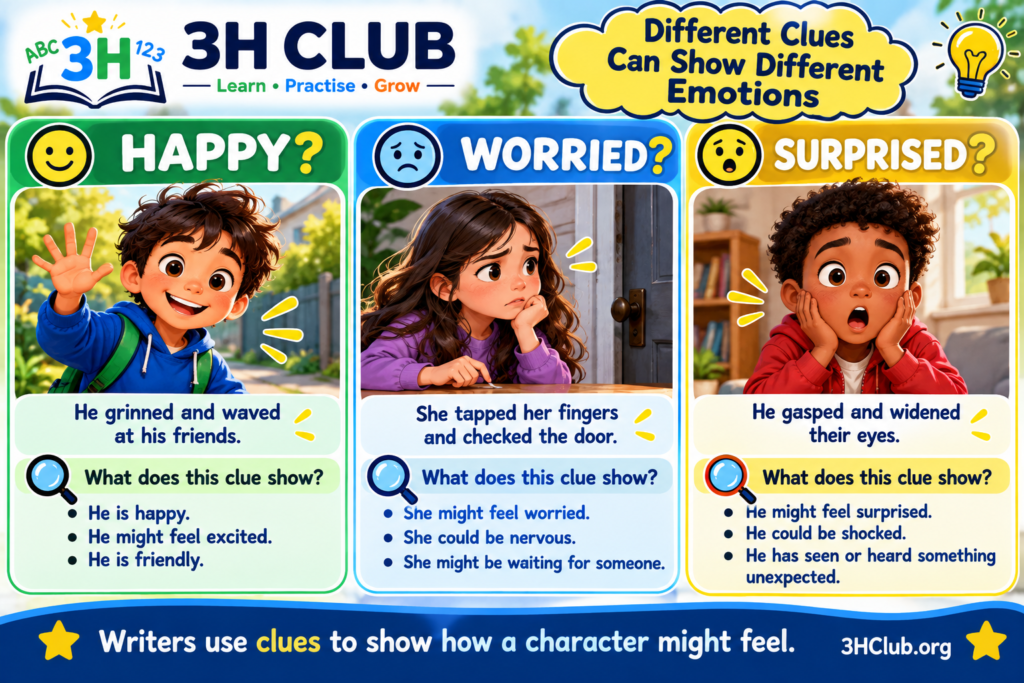
Example 1: A happy character
Amira skipped down the path, humming a cheerful tune. She waved to her neighbours and smiled at the bright flowers.
What clues can you find?
- She skipped down the path.
- She hummed a cheerful tune.
- She waved and smiled.
These details suggest that Amira feels happy or excited.
Example 2: A worried character
Ben stared at the clock. He tapped his fingers on the desk and checked the classroom door for the third time.
What clues can you find?
- Ben keeps looking at the clock.
- He taps his fingers.
- He repeatedly checks the door.
These actions may suggest that Ben is worried, impatient or waiting for someone.
Notice that we cannot know exactly how Ben feels from these clues alone. We use the evidence to choose a sensible answer.
Example 3: A surprised character
When the lights came on, Zoe gasped. Her eyes widened, and she covered her mouth with both hands.
These details suggest that Zoe is surprised. The writer does not need to tell us directly because the actions help us work it out.
Reading tip: Pay attention to action words such as stared, whispered, trembled, rushed, grinned and gasped. They can help you picture what is happening.
💭 3. Understand Characters’ Feelings
Writers do not always tell us exactly how a character feels. Instead, they may show the feeling through actions, speech, thoughts or body language.
Let’s practise with a short passage.
Lily stood beside the school stage, holding her paper tightly. She read the first line of her speech silently, then took a deep breath. When her teacher called her name, Lily walked slowly towards the microphone.
How might Lily be feeling?
She might be nervous because she is about to speak in front of other people.
Which clues support your answer?
- She holds her paper tightly.
- She takes a deep breath.
- She walks slowly towards the microphone.
These details support the idea that Lily may feel nervous. However, she could also be concentrating carefully before her speech.
When you explain a character’s feelings, try to connect your answer to a clue.
Instead of writing:
“Lily is nervous.”
You could write:
“Lily may be nervous because she holds her paper tightly and takes a deep breath before speaking.”
This answer explains both the feeling and the evidence.
🧩 4. Use Context to Understand Unfamiliar Words
Sometimes, you will find a word you have never seen before. You do not always need to stop reading or reach for a dictionary. The words around it may help you work out its meaning.
This is called using context clues.
Let’s look at some examples.
Example 1: A word about temperature
Mia wrapped her hands around the warm mug. The hot chocolate steamed gently, and she blew on it before taking a sip.
What might steamed mean in this sentence?
The clues are:
- The mug contains hot chocolate.
- The drink is warm enough for Mia to blow on it.
- Something rises gently from the drink.
These clues suggest that steamed means giving off visible water vapour because the drink is hot.
Example 2: A word about sound
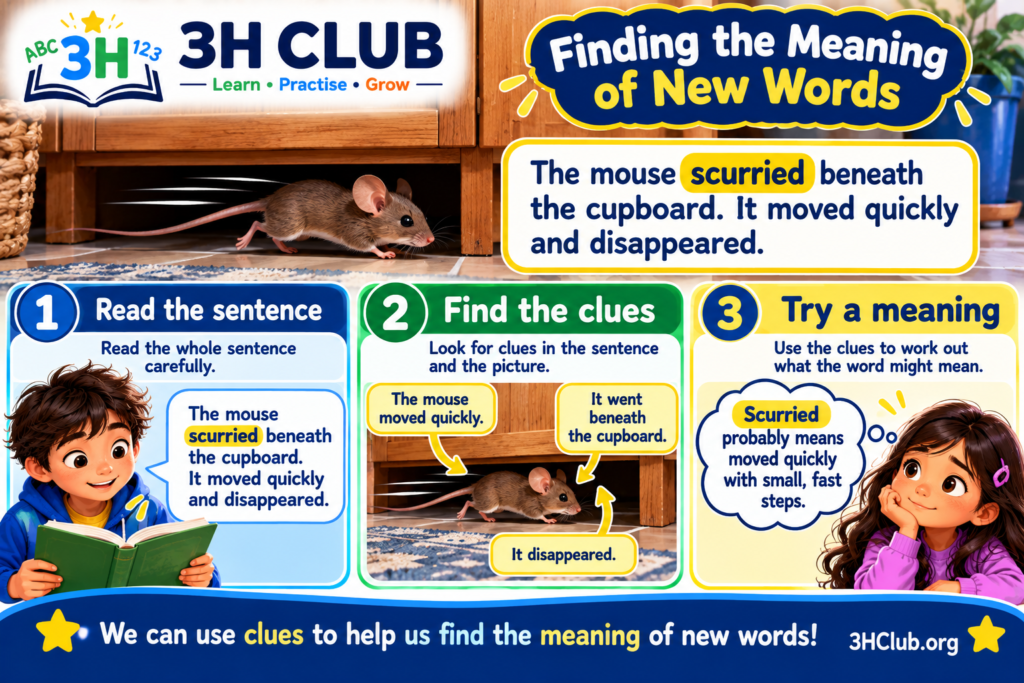
The tiny mouse scurried beneath the cupboard. It moved quickly and disappeared before the cat could reach it.
What might scurried mean?
The clues are that the mouse is tiny, moves quickly and disappears under the cupboard. These details suggest that scurried means moved quickly with short, rapid steps.
Example 3: A word about feelings
When the class announced that she had won the art competition, Hana was delighted. She smiled broadly and hugged her picture.
What might delighted mean?
The clues are her broad smile and the fact that she has won the competition. These details suggest that delighted means very happy or pleased.
Three steps for working out an unfamiliar word
- Read the whole sentence. Do not focus on the unfamiliar word alone.
- Look for nearby clues. Notice actions, descriptions and examples.
- Try a meaning. Replace the unfamiliar word with your guess and see whether the sentence still makes sense.
If the word is still confusing, you can check a dictionary. Context clues help you make a useful first guess, but they do not always tell you the exact meaning.
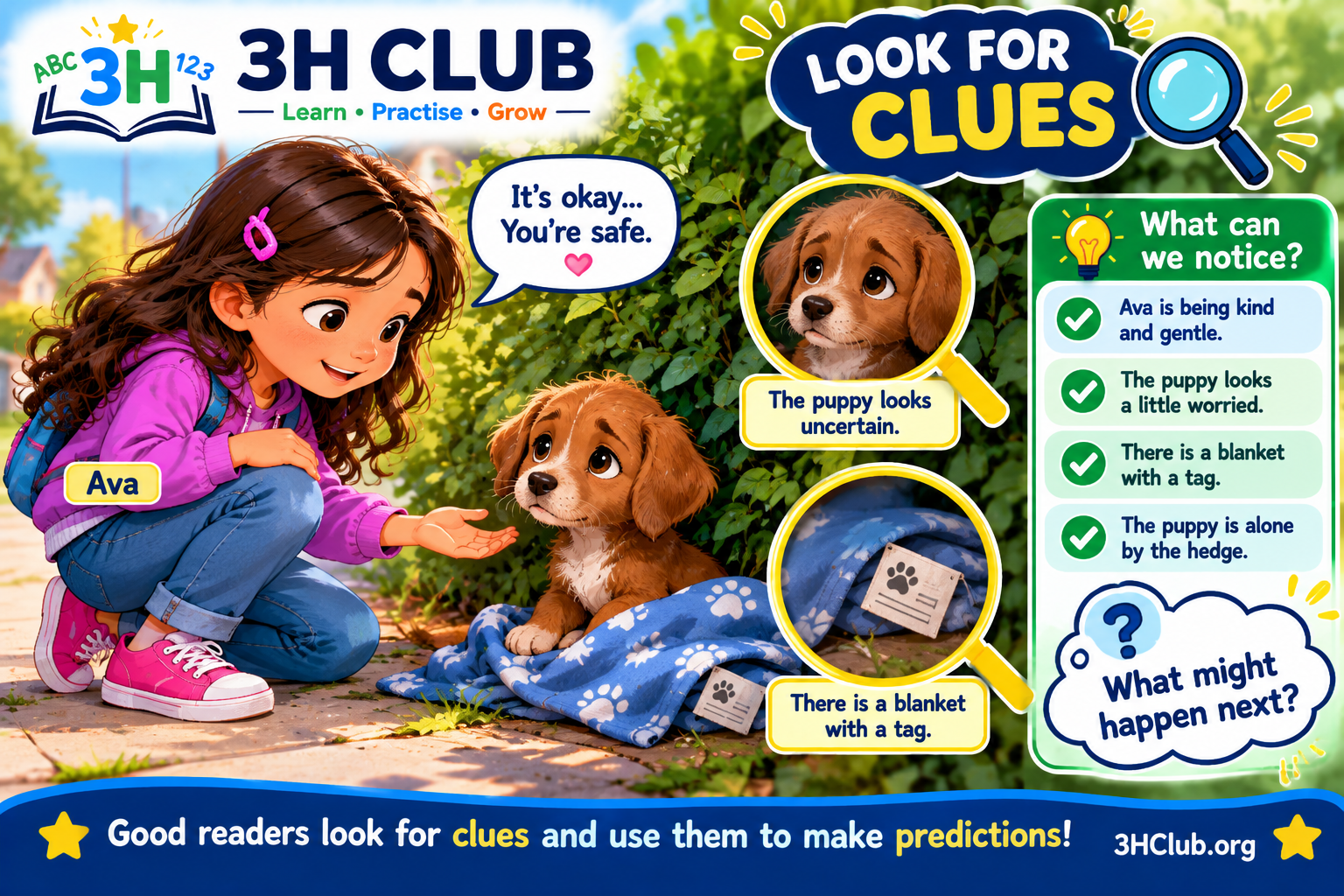
🐶 5. Find Clues in a Story: The Lost Puppy
Let’s use story clues to understand a character and work out what might happen.
Read this short passage:
Ava was walking home when she heard a soft whimper near a hedge. She stopped and looked carefully. A small brown puppy was sitting beneath the leaves. It had no collar and looked frightened. Ava knelt down and spoke gently to it. Then she noticed a phone number on a tag attached to the puppy’s blanket.
Question 1: How might the puppy be feeling?
The puppy might be frightened or unsure.
Which clues support your answer?
- It makes a soft whimper.
- It has no collar.
- The passage says it looks frightened.
The description and the puppy’s sound help us understand how it might feel.
Question 2: How does Ava feel about the puppy?
Ava may feel concerned and want to help it.
Which clues support your answer?
- She stops when she hears the puppy.
- She looks carefully.
- She kneels down and speaks gently.
Her actions suggest that she is being careful and kind.
Question 3: What might Ava do next?
Ava might ask someone for help or use the phone number to contact the puppy’s owner.
The phone number is an important clue because it could help Ava find the person who owns the puppy.
Notice how each answer uses a detail from the passage. You are not simply guessing; you are explaining your thinking.
If you read the complete The Lost Puppy story on 3HClub, look for additional details that help you understand the characters and events. Use the clues in the published story to support your own answers.
🏖️ 6. Find Clues in a Story: A Day at the Beach
Story clues can help you understand what is happening even when the writer does not explain every detail.
Read this passage:
Leo and his family spread their towels on the sand. His sister blew up a beach ball while Leo began building a tall sandcastle. After a while, Leo noticed the waves reaching closer to the castle. He looked at the water, then began digging a small trench around the base.
Question 1: Why might Leo be digging a trench?
He might be trying to protect the sandcastle from the approaching water.
Which clues support your answer?
- The waves are reaching closer.
- Leo looks at the water.
- He digs around the base of the castle.
These details suggest that Leo has noticed the possible danger to his sandcastle.
Question 2: How might Leo feel?
He might be concerned about the sandcastle, especially if he has spent a long time building it.
The passage does not tell us exactly how he feels, so we use the clues to make a reasonable interpretation.
Question 3: What might happen next?
The waves might reach the sandcastle, or Leo’s trench might slow the water for a short time. He may decide to move the castle farther from the waves.
Several predictions are possible. The important thing is to explain how the details support your answer.
You can also read A Day at the Beach Comprehension on 3HClub and practise finding clues in the actual story.

🗣️ 7. Support Your Answers with Story Details
When you answer a reading question, it is useful to explain how you know. A detail from the story can support your answer.
This detail is sometimes called evidence.
Compare these answers.
Question: Why might Lily be nervous?
Answer A: “Because she is nervous.”
Answer B: “Lily might be nervous because she holds her paper tightly and takes a deep breath before speaking.”
Answer B is stronger because it gives details from the passage to support the idea.
You can use these sentence starters:
- “I think … because …”
- “The story says …”
- “One clue is …”
- “This suggests that …”
- “I know this because …”
- “The detail that helped me was …”
Try an example
Omar opened the cupboard and stared at the empty shelf. He checked the shopping bag, then called to his sister, “Have you seen the biscuits?”
Question: What might Omar be looking for?
A strong answer could be:
“Omar might be looking for the biscuits because he checks the cupboard and shopping bag before asking his sister about them.”
The answer connects the idea to two useful details.
Reading detective tip: If someone asks, “How do you know?”, try to point to a word, action or description in the story.
✏️ 8. Builders Activity: Story Clue Investigator
Read each passage carefully. Answer the question and identify the clue that supports your answer.
Activity A: The Windy Day
Priya hurried along the path, holding her hat with one hand. Leaves swirled around her feet, and the branches above her bent in the wind.
- What is the weather probably like?
- Which two clues help you decide?
- Why might Priya be holding her hat?
Activity B: The Forgotten Homework
Marcus opened his schoolbag and frowned. He checked his books twice, then looked at the empty space where his homework folder usually sat. “Oh no,” he whispered.
- How might Marcus be feeling?
- What has he probably discovered?
- Which words or actions support your answer?
Activity C: The Quiet Library
Ella stepped into the library. A student was reading at a table, and another was writing notes. Ella lowered her voice and walked carefully between the shelves.
- Why might Ella lower her voice?
- What does her behaviour suggest about the library?
- Which clues support your answer?
Activity D: The Strange Sound
Just as Ben was getting ready for bed, he heard a scratching sound near the window. He stopped brushing his teeth and listened. The sound came again, followed by a soft flutter.
- What might be making the sound?
- What clues help you make your guess?
- Can you think of another possible explanation?
Activity E: The New Word
After running around the playground, Zara felt exhausted. She sat down on a bench, drank some water and closed her eyes for a moment.
- What do you think exhausted means?
- Which actions help you work out the meaning?
- Write a sentence using the word exhausted.
Activity F: The Birthday Box
Jay entered the room and noticed a large box covered in bright paper. His cousins stood nearby, smiling and whispering. When Jay asked what was inside, they quickly changed the subject.
- What might Jay’s cousins be planning?
- Which details are clues?
- What else could be inside the box?
Check Your Answers
There may be more than one reasonable answer, especially when you explain your thinking.
Activity A: The Windy Day
- It is probably very windy.
- Leaves are swirling, and the branches are bending.
- Priya may be trying to stop her hat from blowing away.
Activity B: The Forgotten Homework
- Marcus may feel worried, upset or frustrated.
- He has probably discovered that his homework folder is missing.
- He frowns, checks his books twice and notices the empty space.
Activity C: The Quiet Library
- She may want to avoid disturbing people who are reading or working.
- The library is probably a quiet place where people study or read.
- The other students are reading and writing, and Ella lowers her voice.
Activity D: The Strange Sound
- It could be a bird, a small animal or something brushing against the window.
- The scratching sound and soft flutter are the clues.
- Other explanations are possible. For example, a loose branch might be brushing against the window.
Activity E: The New Word
- Exhausted means extremely tired.
- Zara sits down, drinks water and closes her eyes after running.
- Example: “After the long walk, I felt exhausted.”
Activity F: The Birthday Box
- They may be preparing a surprise for Jay.
- The bright wrapping paper, smiling cousins and whispering are clues.
- The box could contain a present, a game or something else. Use the story details to explain your idea.
⭐ 9. Extra Challenge: Read Between the Lines
Sometimes, a story clue suggests something without stating it directly. This is often called making an inference.
Read the passage:
The classroom was almost empty. Sam packed his books slowly while the others rushed towards the door. He glanced at the clock and then at the art project on his desk. A large section of the picture was still blank.
Answer these questions:
- What might Sam be thinking about?
- Why might he be packing slowly?
- Which details suggest that he has not finished his art project?
- What might Sam do next?
- Write one sentence explaining your answer with evidence from the passage.
Challenge Answers
- He may be thinking about his unfinished art project.
- He may be deciding whether to finish the project or leave with the others.
- A large section of the picture is still blank.
- He might stay to work on the picture, take it home or ask the teacher for advice.
- Example: “Sam may stay to finish his art project because a large section of the picture is still blank.”
Your answer does not have to match the example exactly. It should make sense and use clues from the passage.
📌 10. Quick Reference: Finding Story Clues
| Key term | Meaning |
|---|---|
| Story clue | A detail that helps you understand a story |
| Context | The words and ideas around a word or event |
| Context clue | A detail that helps you work out an unfamiliar word’s meaning |
| Evidence | Information that supports an answer or idea |
| Inference | An idea you work out from clues and what you already know |
| Character | A person or animal in a story |
| Dialogue | The words characters say |
| Description | Details that help you picture a person, place or event |
Your Reading Detective Checklist
Before you finish a story or answer a reading question, ask yourself:
- 🔎 Have I noticed important words and actions?
- 💭 Have I used the clues to understand the character’s feelings?
- 📚 Have I checked the surrounding sentence for unfamiliar words?
- 🗣️ Can I explain which details support my answer?
- ✅ Does my answer fit the information in the story?
The more you practise, the easier it becomes to notice details and understand what writers are telling you.
❓ Frequently Asked Questions About Finding Story Clues
What are story clues?
Story clues are details in the words, actions, dialogue or descriptions that help you understand what is happening.
How can I tell how a character feels?
Look at what the character says, does, thinks or notices. Their actions and words may suggest feelings such as happiness, fear, sadness or excitement.
What are context clues?
Context clues are words or details around an unfamiliar word that help you work out its meaning.
What is evidence in a story?
Evidence is a detail from the story that supports your answer. It might be a character’s action, something they say or a description written by the author.
What is the difference between a clue and an inference?
A clue is a detail you notice in the story. An inference is an idea you work out by combining clues with what you already know.
What should I do if I am unsure about a clue?
Read the sentence again, look at the surrounding details and think about what fits the story. If you are still unsure, keep reading because the writer may provide more information.
🎉 Keep Learning with 3HClub!
Great work, reading detective! You have practised looking closely at words, noticing characters’ actions, understanding feelings and using context clues to discover the meaning of unfamiliar words.
Remember, stories often give you more information than they say directly. When you notice the details and explain what they mean, you become a more thoughtful and confident reader.
Keep looking, keep questioning and keep discovering the clues hidden in every story.
Learn • Practise • Grow