Making Inferences from a Text:
🔍 Become a Reading Detective!
⭐⭐⭐ CHAMPIONS | Ages 10-11
📚 Subject: English – Reading Comprehension
🎯 Skills: Finding evidence, understanding feelings and motives, drawing conclusions, and explaining inferences.
🌟 Let’s Get Started!
Imagine you are reading a story.
You come across these sentences:
Amira stood beside the classroom door. She kept looking at the clock and tapping her fingers against her schoolbag. When the bell finally rang, she hurried outside.
The writer never tells you that Amira is waiting impatiently.
But can you work it out?
You probably can!
You noticed that Amira kept checking the clock and tapping her fingers. These details suggest that she was eager for something to happen.
You have just made an inference!
Making inferences helps you understand more than the words on the page. It helps you discover what characters might be feeling, why they behave in certain ways, and what the writer wants you to understand.
Ready to become a reading detective?
Let’s investigate!
🎯 What Will You Learn?
By the end of this lesson, you will be able to:
- ✅ Find important clues in a passage.
- ✅ Use what you already know to understand those clues.
- ✅ Work out how a character might be feeling.
- ✅ Suggest why a character behaves in a certain way.
- ✅ Draw sensible conclusions from a text.
- ✅ Explain your inferences using evidence.
💡 Remember: A good reading detective doesn’t make random guesses. Every sensible inference needs clues!
🔵 1. What Is an Inference?
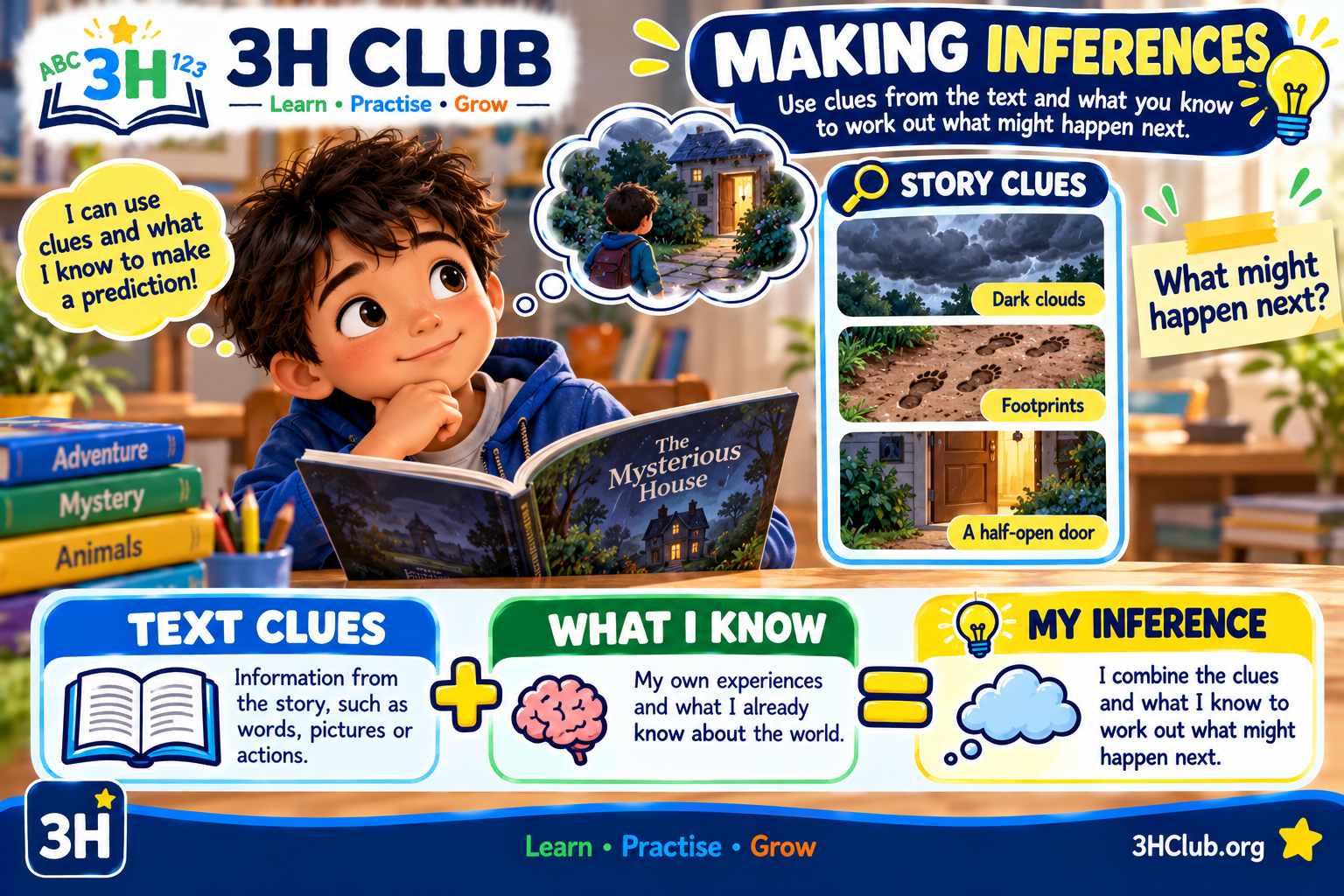
An inference is an idea you work out using clues from a text and what you already know.
Sometimes writers tell you information directly.
Other times, they give you clues and expect you to think about what those clues mean.
📖 Let’s Compare!
The writer tells you directly:
“Leo was frightened.”
You don’t need to make an inference because the writer has already told you how Leo feels.
The writer gives you clues:
“Leo stepped backwards. His hands trembled, and he stared at the enormous shadow moving across the wall.”
The writer hasn’t used the word frightened.
However, Leo’s trembling hands and movements suggest that he may be scared.
You used the clues to make an inference.
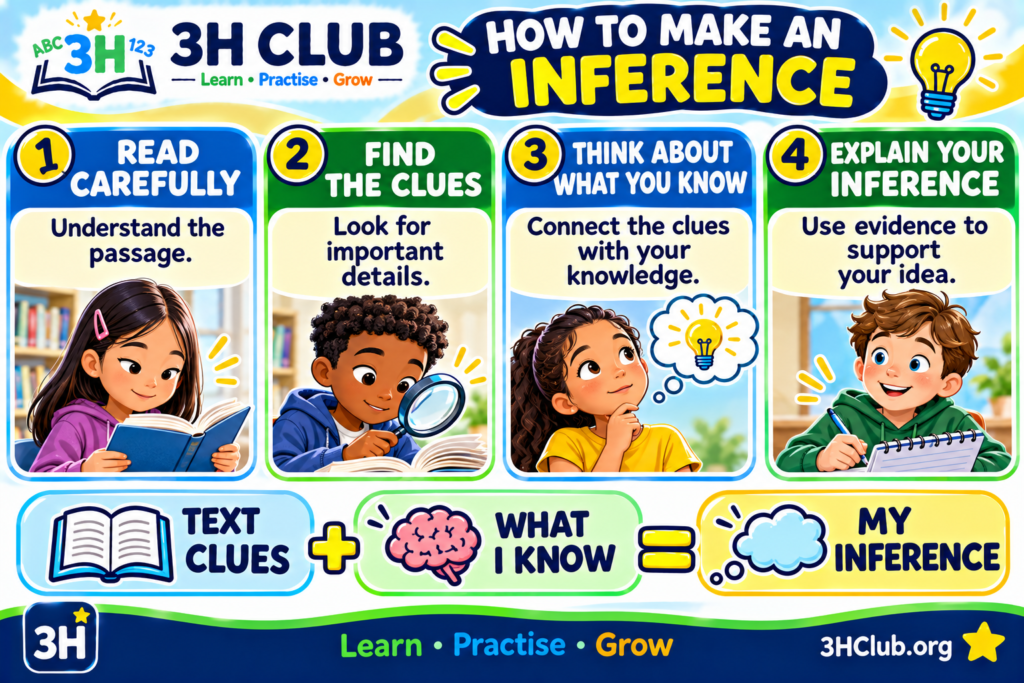
🧠 The Inference Formula
🔍 TEXT CLUES + 🧠 WHAT I KNOW = 💡 MY INFERENCE
Let’s break it down.
🔍 Text clues: What the writer tells you.
🧠 What I know: Information you already understand from experience, reading, or learning.
💡 My inference: A sensible conclusion based on the clues and your knowledge.
🌧️ Example: The Rainy Afternoon
Read this passage:
Jamal looked out of the window. Dark clouds covered the sky. He picked up his umbrella before leaving the house.
Text clues:
- Dark clouds covered the sky.
- Jamal picked up an umbrella.
What I know:
- Dark clouds can mean rain is coming.
- People use umbrellas to stay dry.
My inference:
Jamal probably thinks it might rain.
Notice the word probably.
An inference is a sensible conclusion, but it is not always something we know for certain.
⭐ Reading Tip: Use words such as might, may, probably, and perhaps when you are explaining something that the writer hasn’t confirmed.
🟢 2. Finding Clues in a Passage
Before you can make an inference, you need to find clues.
A clue is a detail that helps you understand something the writer hasn’t explained directly.
Clues can appear in:
- 🗣️ What a character says.
- 🚶 What a character does.
- 😊 A character’s facial expressions.
- 🌳 The setting or surroundings.
- 🎒 Important objects.
- 💭 A character’s thoughts.
- 🔄 Changes in a character’s behaviour.
Let’s practise finding clues.
📖 Example: The Missing Lunchbox
Ella opened her schoolbag and searched through every pocket. She checked beneath her books and looked inside her desk. Then she sighed and rested her head on her hands.
What clues can you find?
Clue 1: Ella searched every pocket.
Clue 2: She checked beneath her books and inside her desk.
Clue 3: She sighed and rested her head on her hands.
🔍 What Can We Infer?
Ella is probably looking for something she cannot find.
She may be feeling disappointed or worried.
The title suggests that she is looking for her lunchbox.
🧠 Why Is This a Sensible Inference?
When people cannot find something important, they often search several places.
Sighing and resting your head on your hands can also suggest frustration or disappointment.
The clues support our conclusion.
⭐ Be Careful!
Could Ella be feeling tired instead?
Possibly!
Sometimes a passage supports more than one inference.
The important thing is to explain your answer using the evidence.
💡 Remember: A strong inference fits the clues. A weak inference ignores them.
🟡 3. Understanding Characters’ Feelings
Writers don’t always tell you how their characters feel.
Instead, they may describe their actions, expressions, or words.
Your job is to notice these details.
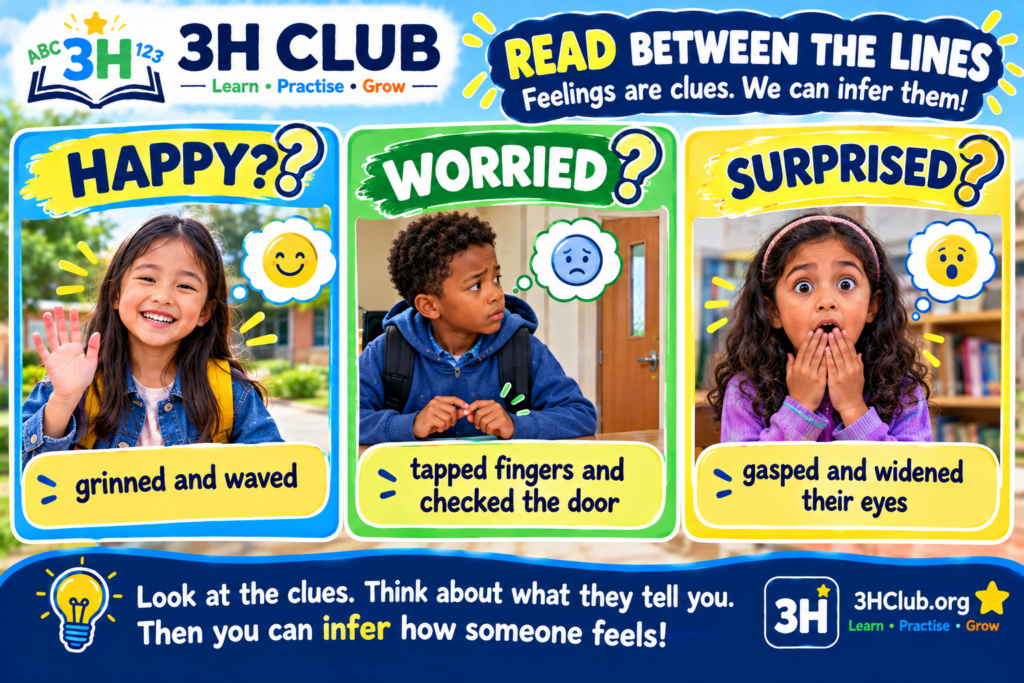
😊 Feelings and Their Clues
| Feeling | Possible clues |
|---|---|
| Happy | Smiling, laughing, jumping with excitement |
| Worried | Frowning, checking the time, biting a lip |
| Surprised | Gasping, widening the eyes, standing still |
| Angry | Clenching fists, speaking sharply, frowning |
| Nervous | Fidgeting, trembling, speaking quietly |
| Proud | Smiling at an achievement, standing tall |
| Disappointed | Sighing, looking down, becoming quiet |
These are helpful clues, but they are not perfect rules.
Someone might smile because they are nervous, or become quiet because they are thinking.
Always consider the whole passage.
📖 Example: The Spelling Competition
When the teacher announced the winner, Nia’s eyes widened. She covered her mouth with both hands and then broke into a huge smile. Her classmates began clapping.
Question: How is Nia probably feeling?
Possible inference: Nia is surprised and happy.
Evidence: Her eyes widened, she covered her mouth, and she smiled.
✏️ Your Turn!
Read this short passage:
Daniel stood outside the headteacher’s office. He looked down at his shoes and twisted the strap of his schoolbag. When his name was called, he took a slow breath before opening the door.
Question 1: How might Daniel be feeling?
Question 2: Which two clues support your answer?
Question 3: Could there be another possible explanation?
Think carefully before checking the answers later.
🟣 4. Understanding Why Characters Do Things
Making inferences isn’t only about feelings.
You can also work out a character’s motive.
A motive is the reason someone does something.
Sometimes the writer explains the reason directly.
Other times, you need to work it out.
📖 Example: The Forgotten Coat
Before leaving for school, Mum looked outside at the grey sky. She handed Noah a raincoat and reminded him to put it in his bag.
Question: Why did Mum give Noah a raincoat?
The passage doesn’t say exactly why.
But we have clues.
Text clue: The sky was grey.
What I know: Grey clouds can mean rain is coming.
My inference: Mum probably thought it might rain and wanted Noah to stay dry.
🧠 Ask Yourself
When a character does something, ask:
“What might have made the character act this way?”
Then look for evidence.
📖 Example: The New Student
During break time, a new student stood alone beside the classroom. Maya noticed him watching the other children play. She walked over and invited him to join her group.
Question: Why did Maya invite the student to play?
Possible inference: Maya may have wanted him to feel welcome.
Evidence: She noticed that he was standing alone and watching the others.
We cannot know exactly what Maya was thinking unless the writer tells us.
However, her actions support this inference.
⭐ Important!
An inference about a character’s motive should be based on what the character says or does.
Don’t invent a reason that has no support in the story.
🐶 5. Making Inferences: A Puppy Adventure
Let’s practise with a short story.
📖 The Puppy by the Hedge
Ava was walking home when she noticed a small brown puppy sitting beside a leafy hedge.
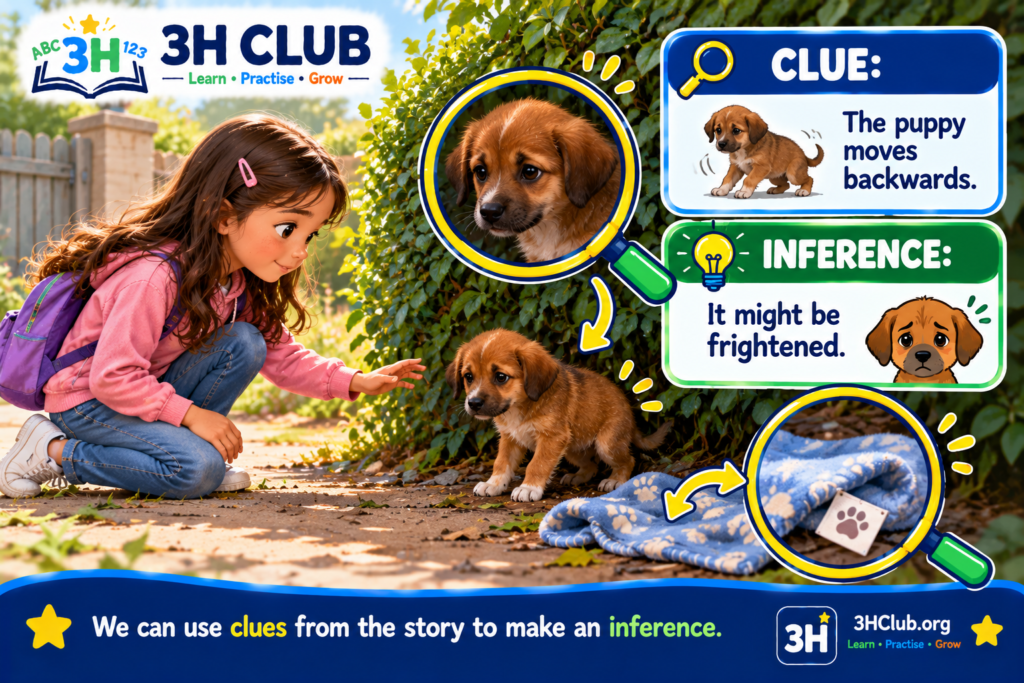
The puppy kept looking towards the road. Its ears were lowered, and it moved backwards when Ava approached.
Ava stopped a short distance away. She crouched down and spoke in a gentle voice.
After a few moments, the puppy took a small step towards her.
Ava noticed a little blanket beside the hedge. She looked around, wondering whether someone might be searching for the puppy.
🔍 Let’s Investigate!
Question 1: How might the puppy be feeling?
The puppy may be frightened or uncertain.
Evidence: Its ears were lowered, and it moved backwards when Ava approached.
Question 2: Why did Ava crouch down and speak gently?
Ava probably wanted to avoid frightening the puppy.
Evidence: She stopped at a distance, crouched down, and used a gentle voice.
Question 3: What might the blanket suggest?
The blanket might suggest that someone had been caring for the puppy.
However, we cannot be certain.
Question 4: Why did Ava look around?
She may have been wondering whether the puppy belonged to someone nearby.
🌟 What Makes These Good Inferences?
Each answer connects an idea to a clue.
We aren’t simply making up events.
We are using information from the passage to draw sensible conclusions.
📚 Connect to The Lost Puppy
If you have read The Lost Puppy, return to the story and investigate:
- How might the puppy be feeling at an important moment?
- Which words or actions support your answer?
- What can you infer about a character’s intentions?
- What does a character do that reveals kindness, worry, or another feeling?
⭐ Challenge: Choose one inference and explain it using a sentence from the story.
🏖️ 6. Making Inferences: A Day at the Beach
Now let’s explore another situation.
📖 The Sandcastle and the Waves
Leo had spent most of the morning building a tall sandcastle with two towers.
His sister stood nearby holding a beach ball.
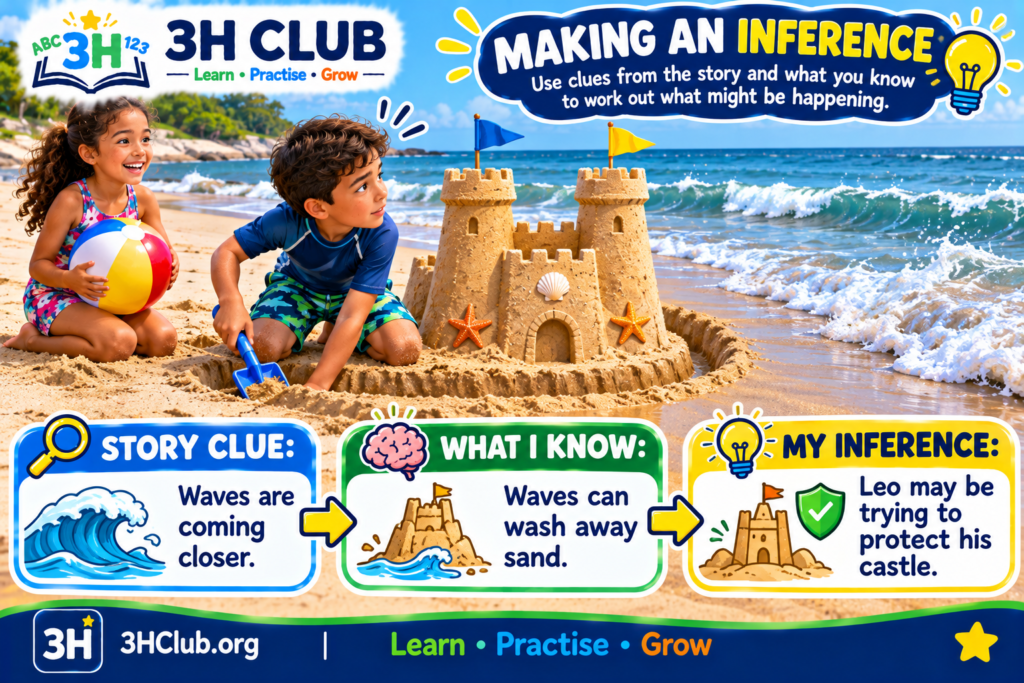
Leo looked towards the sea. The waves were reaching farther up the sand than before.
He quickly picked up his spade and began digging a trench around the castle.
Every few moments, he glanced back at the water.
🔍 What Can You Work Out?
Question 1: Why did Leo begin digging a trench?
Possible inference: Leo probably wanted to protect his sandcastle from the approaching waves.
Evidence: The waves were reaching farther up the beach, and he began digging around the castle.
Question 2: How might Leo be feeling?
Possible inference: Leo may be worried about his sandcastle.
Evidence: He repeatedly looked towards the water.
Question 3: What might happen next?
Possible prediction: A wave might reach the castle.
Evidence: The waves are moving farther up the beach.
💡 Inference or Prediction?
These two reading skills are closely connected.
An inference helps you understand something the writer hasn’t said directly.
A prediction is a sensible idea about what might happen next.
For example:
Inference: Leo is probably worried about his sandcastle.
Prediction: A wave might reach the sandcastle.
Both use clues, but they answer different questions.
📚 Connect to A Day at the Beach
If you have read A Day at the Beach, choose an important moment.
Ask:
- What might a character be thinking?
- What clues reveal the character’s feelings?
- Why might the character have acted in a certain way?
- What can I work out that the writer hasn’t said directly?
Remember to use details from the actual story.
🟠 7. How to Make a Strong Inference
Ready for a useful reading strategy?
Follow these four steps.
🔍 Step 1: Read Carefully
Read the sentence or paragraph.
Pay attention to important details.
🧩 Step 2: Find the Clues
Look for actions, expressions, words, and events that might help you.
🧠 Step 3: Think About What You Know
Ask yourself:
“What do these clues remind me of?”
Use what you know about the world, people, and situations.
💡 Step 4: Make and Explain Your Inference
Put the clues and your knowledge together.
Then explain your answer.
✨ Helpful Sentence Starters
Use these patterns when explaining an inference:
“I think __________ because the text says __________.”
“The character might feel __________ because __________.”
“I can infer that __________ because __________.”
“The clue __________ suggests that __________.”
📖 Example
“Lily smiled as she carefully placed the medal beside her bed.”
Inference: Lily is probably proud of receiving the medal.
Evidence: She smiled and placed the medal somewhere special.
⭐ Remember!
A strong inference has three parts:
MY IDEA + TEXT EVIDENCE + EXPLANATION
You don’t need a very long answer.
You just need to show how the clues support your thinking.
✏️ 8. Activity 1: What Can You Infer?
Read each short passage.
Choose the most sensible inference.
Question 1
Ben zipped up his coat, wrapped a scarf around his neck, and pulled on his gloves before leaving the house.
What can you infer?
A. Ben is going swimming.
B. The weather is probably cold.
C. Ben has lost his schoolbag.
Question 2
Zara stared at the empty plate. She rubbed her stomach and asked when dinner would be ready.
What can you infer?
A. Zara is probably hungry.
B. Zara wants to go outside.
C. Zara is feeling sleepy.
Question 3
The classroom became quiet when the headteacher entered. Several children sat up straight and stopped whispering.
What can you infer?
A. The children were preparing to go swimming.
B. The children noticed that someone important had entered.
C. The children were playing football.
Question 4
Owen opened the envelope. His eyes widened, and he shouted, “I did it!”
What can you infer?
A. Owen probably received exciting news.
B. Owen lost his lunch.
C. Owen is going to sleep.
Question 5
The dog stood beside its empty water bowl and looked towards its owner.
What can you infer?
A. The dog may be thirsty.
B. The dog wants to climb a tree.
C. The dog is reading a book.
🌟 Extra Challenge: Choose two answers and identify the clues that support them.
🧩 9. Activity 2: Match the Clue to the Inference
Match each clue with the most sensible inference.
| Letter | Text Clue |
|---|---|
| A | Mia kept checking the clock and tapping her fingers. |
| B | The boy smiled as he held his certificate. |
| C | Dark clouds gathered, and the wind became stronger. |
| D | The puppy moved backwards and tucked its tail between its legs. |
| E | Sara yawned several times and rubbed her eyes. |
Possible Inferences
| Number | Inference |
|---|---|
| 1 | The weather may become stormy. |
| 2 | The puppy may be frightened. |
| 3 | Sara is probably tired. |
| 4 | Mia may be waiting impatiently. |
| 5 | The boy is probably pleased with his achievement. |
Your Answers
A → _____
B → _____
C → _____
D → _____
E → _____
🔍 10. Activity 3: Find the Evidence
A good inference needs evidence.
Read each passage and answer the questions.
Passage A: The Surprise
When Maya entered the classroom, everyone suddenly stopped talking. Her friends exchanged smiles. A colourful banner was hanging above the board.
Question 1: What might Maya’s friends be planning?
Question 2: Which two clues support your inference?
Passage B: The Broken Window
Ethan stood beside the classroom window. A football lay on the floor near some broken glass. He looked towards the teacher and slowly raised his hand.
Question 1: What might have happened?
Question 2: What evidence supports your answer?
Question 3: Can
you be certain who broke the window?
Passage C: The School Play
Before stepping onto the stage, Olivia took several deep breaths. She looked at the audience, held her script tightly, and whispered, “I can do this.”
Question 1: How might Olivia be feeling?
Question 2: Which clues support your answer?
Question 3: What might Olivia be trying to do by saying, “I can do this”?
📚 11. Activity 4: Reading Detective Challenge
Read this short passage carefully.
🌳 The Mysterious Footprints
Early one morning, Daniel walked into the garden and noticed several muddy footprints leading towards the back gate.
The gate was slightly open.
Daniel remembered that it had rained heavily during the night.
He followed the footprints until they disappeared near the pavement.
Then he noticed that his little sister’s football was missing from beside the garden shed.
Daniel looked around the garden again before going inside to ask his family whether anyone had been outside.
🧠 Answer These Questions
1. What can you infer about the muddy footprints?
2. Why might the footprints be muddy?
3. What might the open gate suggest?
4. Why did Daniel ask his family whether anyone had been outside?
5. Can you conclude that someone took the football? Explain your answer.
⭐ Extra Challenge
Write one inference that is strongly supported by the passage.
Then write one possible explanation that still needs more evidence.
Strong inference:
Possible explanation:
💡 Detective Reminder
A clue may suggest several possibilities.
Do not treat an unconfirmed idea as a fact.
🟢 12. Activity 5: Understanding Feelings and Motives
Read each situation.
Explain what the character might be feeling or thinking.
Situation 1
Ravi watched his best friend walk towards another group of children. He looked down and quietly kicked a small stone.
Question: How might Ravi be feeling?
Evidence: _______________________
Situation 2
Amelia noticed that a younger child was struggling to carry several books. She hurried over and offered to help.
Question: Why might Amelia have helped?
Evidence: _______________________
Situation 3
When the teacher announced that the class would visit the science museum, Marcus grinned and immediately began asking questions.
Question: How might Marcus be feeling?
Evidence: _______________________
Situation 4
Ella carefully checked her homework for a third time before putting it into her schoolbag.
Question: Why might Ella have checked her work several times?
Evidence: _______________________
🌟 Your Challenge
Choose one situation.
Write a complete inference sentence using because.
🏆 13. Final Challenge: The Secret Garden Gate
You’re ready for a longer passage!
Read carefully and look for clues.
📖 The Secret Garden Gate
Every afternoon, Aisha walked past an old wooden gate on her way home from school.
For weeks, the gate had remained closed.
One Tuesday, she noticed that it was slightly open.
Fresh footprints crossed the dusty path, and a small watering can stood beside the entrance.
Aisha could hear a gentle rustling sound from behind the gate.
She stopped and listened.
Then she noticed a row of newly planted flowers growing along the path.
Someone had clearly been caring for the garden.
Aisha smiled and continued walking, wondering who had been working there.
🔍 Your Questions
1. What can you infer about the garden?
2. Which two clues suggest that someone has recently visited it?
3. Why might the watering can be near the entrance?
4. What does the row of newly planted flowers suggest?
5. Why might Aisha have smiled?
6. Can you be certain who opened the gate? Explain why or why not.
⭐ Super Challenge
Write a short paragraph explaining one inference.
Use this structure:
I can infer that __________.
One clue is __________.
Another clue is __________.
These clues suggest __________ because __________.
✅ 14. Check Your Answers!
Let’s see how you did.
Remember that some inference questions can have more than one sensible answer.
The important thing is to support your ideas with evidence.
Activity 1: What Can You Infer?
| Question | Answer | Supporting Clue |
|---|---|---|
| 1 | B | Ben puts on a coat, scarf, and gloves. |
| 2 | A | Zara rubs her stomach and asks about dinner. |
| 3 | B | The children become quiet and sit up straight. |
| 4 | A | Owen’s eyes widen, and he shouts excitedly. |
| 5 | A | The dog stands beside its empty water bowl. |
Activity 2: Match the Clue to the Inference
| Clue | Answer |
|---|---|
| A | 4 |
| B | 5 |
| C | 1 |
| D | 2 |
| E | 3 |
Activity 3: Find the Evidence
Passage A: The Surprise
- Maya’s friends may be planning a celebration or surprise.
- They stop talking, exchange smiles, and have a colourful banner.
Passage B: The Broken Window
- A football may have hit the window.
- The football is near the broken glass.
- No. The passage does not tell us who broke the window.
Passage C: The School Play
- Olivia may be nervous.
- She takes deep breaths, holds her script tightly, and whispers to herself.
- She may be trying to encourage herself and feel more confident.
Activity 4: The Mysterious Footprints
1. Someone may have walked through the garden while the ground was wet.
2. The ground may have been muddy because of the heavy rain.
3. Someone may have opened the gate or passed through it.
4. Daniel may have wanted to find out who had been in the garden.
5. No. The missing football and footprints are clues, but they do not prove that someone took the ball.
Extra Challenge:
Strong inference: Someone or something may have passed through the garden while the ground was muddy.
Possible explanation: A family member may have moved the football.
We would need more evidence to know what actually happened.
Activity 5: Feelings and Motives
| Situation | Possible Inference | Evidence |
|---|---|---|
| 1 | Ravi may feel lonely or disappointed. | He looks down and quietly kicks a stone. |
| 2 | Amelia wants to be helpful. | She notices the younger child struggling and offers help. |
| 3 | Marcus is excited or curious. | He grins and asks questions. |
| 4 | Ella wants to make sure her homework is correct. | She checks it three times. |
Final Challenge: The Secret Garden Gate
1. Someone has probably been caring for the garden.
2. Fresh footprints and a watering can suggest recent activity.
3. Someone may have used it to water the plants.
4. Someone has probably planted flowers recently.
5. Aisha may be pleased to see the garden being cared for or curious about who is working there.
6. No. The passage gives clues that someone has visited, but it does not identify who opened the gate.
⭐ Example Super Challenge Answer
I can infer that someone has recently been looking after the garden. One clue is the watering can beside the entrance. Another clue is the row of newly planted flowers. These clues suggest that someone has been gardening because watering cans and freshly planted flowers are signs of garden care.
🎉 Fantastic detective work!
If your answer was different but you used sensible evidence from the text, it may also be correct.
🌈 15. What Have You Learned?
Let’s review your new reading skills.
🔍 Text Clues
Text clues are details that help you understand something the writer hasn’t said directly.
🧠 What You Already Know
Your knowledge and experiences help you understand the clues.
💡 Inference
An inference is a sensible conclusion based on clues and what you know.
😊 Feelings and Motives
You can use a character’s actions, expressions, and words to understand how they might feel or why they might act in a certain way.
📚 Evidence
Evidence is information from the passage that supports your inference.
⭐ The Golden Rule
A good inference is more than a guess. It is an idea supported by clues!
Remember our formula:
🔍 TEXT CLUES + 🧠 WHAT I KNOW = 💡 MY INFERENCE
🌟 Keep Learning with 3HClub!
You’ve practised finding clues, understanding characters’ feelings, exploring motives, and explaining your conclusions.
These skills will help you become a more thoughtful and confident reader.
📚 Try These Reading Challenges
🐶 The Lost Puppy
Read the story and look for clues about how the puppy or another character might be feeling.
Can you explain your inference using evidence?
🏖️ A Day at the Beach
Look for actions or events that reveal what a character might be thinking.
What can you work out that the writer hasn’t said directly?
⭐ Your Next Reading Challenge
The next time you read a story, stop when you notice an interesting clue.
Ask yourself:
“What is the writer helping me understand without saying it directly?”
Then explain your idea using evidence.
Keep reading, keep investigating, and keep growing!
3H CLUB — Learn • Practise • Grow