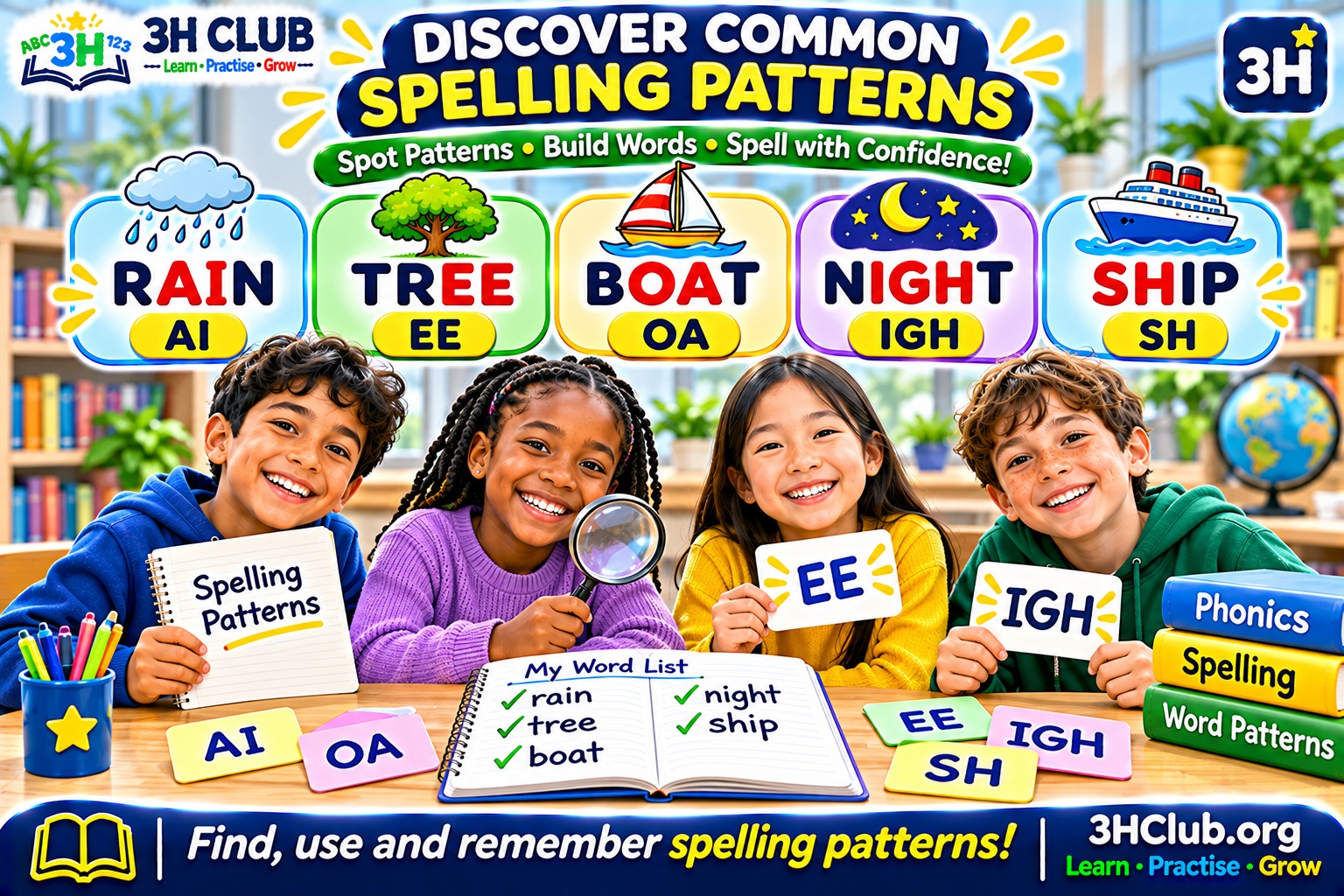
Discover Common Spelling Patterns:
🔤 Read, Spell and Build Words!
⭐⭐ BUILDERS | Ages 8–9
📚 Subject: English – Phonics, Spelling and Reading
🎯 Skills: Recognising spelling patterns, decoding words, vowel teams, consonant digraphs, spelling rules, suffixes and proofreading.
🌟 Welcome, Spelling Detective!
Have you noticed that some words contain the same groups of letters?
Look at these words:
🌧️ rain
🚂 train
🧠 brain
They all contain ai.
Now look at:
🌳 tree
🐝 bee
👀 see
They all contain ee.
These repeating groups of letters are called spelling patterns.
When you learn a spelling pattern, you can use it to read and spell many different words.
You don’t have to learn every word as if you’ve never seen anything like it before!
In this lesson, you’ll investigate spelling patterns, discover useful spelling rules, solve word puzzles and become a more confident reader and writer.
Ready to explore?
Let’s begin!
🎯 What Will You Learn?
By the end of this lesson, you will be able to:
- Recognise common spelling patterns in words.
- Identify consonant digraphs such as sh, ch, th and ck.
- Read and spell words with common vowel teams.
- Recognise silent-e and r-controlled vowel patterns.
- Apply useful spelling rules when adding endings.
- Explore prefixes and suffixes.
- Sort words by their spelling patterns.
- Use patterns to spell unfamiliar words.
- Find and correct spelling mistakes in sentences.
- Read a short passage and answer comprehension questions.
⭐ Your goal: Become a word detective who looks for patterns, thinks about sounds and checks meaning.
🔵 1. What Is a Spelling Pattern?
A spelling pattern is a letter or group of letters that appears in different words in a predictable way.
For example:
light – night – bright
These words all contain igh, which spells the long I sound.
Now try:
boat – coat – float
These words all contain oa, which spells the long O sound.
Why Do Spelling Patterns Matter?
Spelling patterns can help you:
- Read: Recognise familiar groups of letters in new words.
- Spell: Remember how sounds are often written.
- Write: Choose suitable spellings when making sentences.
- Check: Notice when a word doesn’t look quite right.
🧠 Think About It!
What spelling pattern do these words share?
rain – paint – train
Answer: ai.
What about:
sheep – green – feet
Answer: ee.
That’s how spelling detectives work!
⭐ STAGE 1: PATTERN DETECTIVES
Recognise sounds and letter patterns
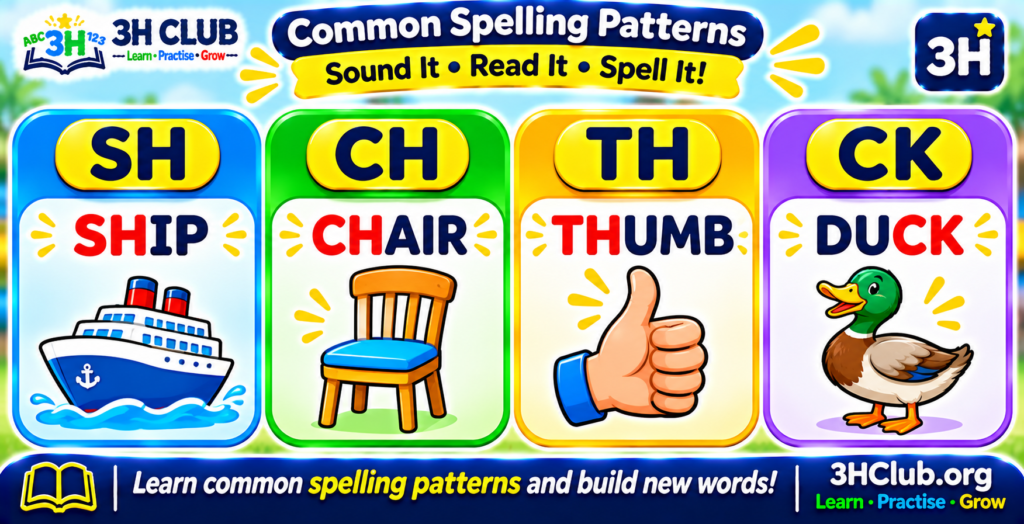
🟢 2. Consonant Digraphs: Two Letters, One Sound
A digraph is two letters working together to represent one sound.
Let’s investigate four common consonant digraphs.
| Pattern | Example Words |
|---|---|
| sh | ship, shop, fish, brush |
| ch | chip, chair, lunch, much |
| th | thin, thick, this, that |
| ck | duck, clock, back, rock |
🚢 SH
The letters sh make one sound in ship.
Try:
shop – shell – wish – fish
🪑 CH
The letters ch make one sound in chair.
Try:
chip – chin – lunch – much
Sometimes ch makes a different sound, as in school. We’ll focus on its common sound for now.
👍 TH
The letters th work together in words such as:
thin – thick – this – that
Listen carefully: the th in thin sounds different from the th in this.
Both sounds use the same spelling pattern.
🦆 CK
The letters ck represent the /k/ sound in:
duck – back – rock – clock
In many short, one-syllable words, ck comes straight after a short vowel.
✏️ Activity 1: Find the Digraph
Underline the digraph in each word.
- ship
- lunch
- thick
- duck
- brush
- clock
✏️ Activity 2: Complete the Word
Choose sh, ch, th or ck.
- fi___ — An animal that swims.
- ___air — Something you sit on.
- du___ — A bird that swims.
- ___in — The opposite of thick.
- ___op — A place where you can buy things.
🟡 3. Vowel Teams: Letters Working Together
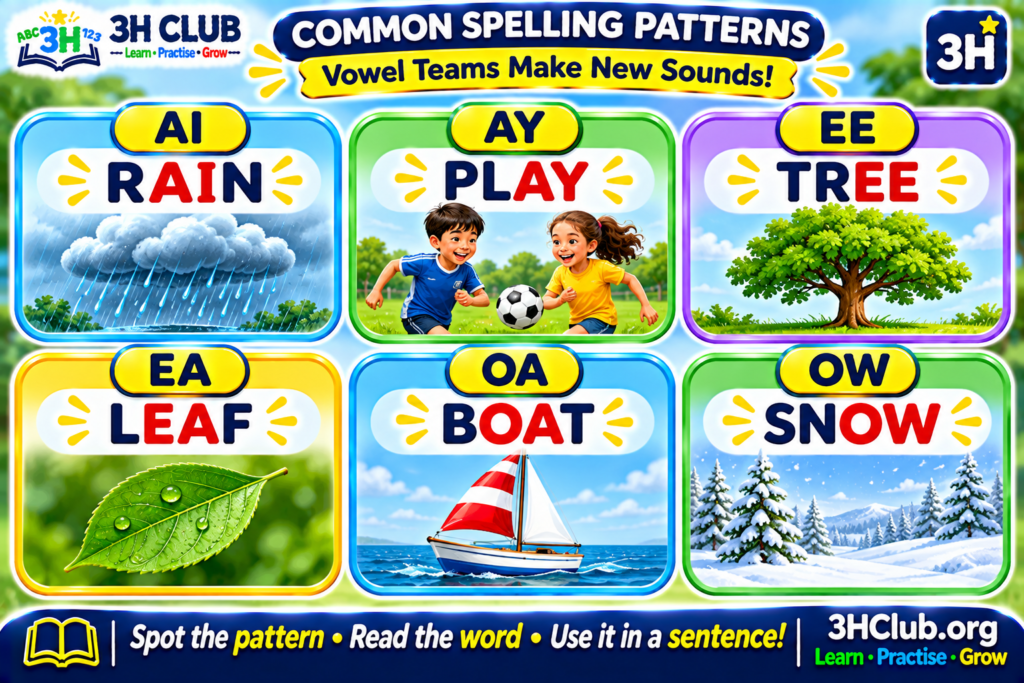
Sometimes two vowel letters work together to represent one vowel sound.
These are called vowel teams.
Look at these common patterns:
| Pattern | Sound | Examples |
|---|---|---|
| ai | Long A | rain, train, paint |
| ay | Long A | day, play, stay |
| ee | Long E | tree, green, feet |
| ea | Long E | sea, leaf, team |
| oa | Long O | boat, coat, road |
| ow | Long O | snow, grow, window |
🌧️ AI and AY
Both patterns can spell the long A sound.
ai: rain, train, paint
ay: day, play, stay
A useful clue is that ai often appears in the middle of a word, while ay often appears at the end.
Compare:
rain – day
train – play
This is a common pattern, not a rule for every word.
🌳 EE and EA
Both can spell the long E sound.
ee: tree, feet, green
ea: sea, leaf, team
Be careful! The letters ea don’t always make long E.
For example, bread and head have a short E sound.
🚣 OA and OW
Both can spell the long O sound.
oa: boat, coat, road
ow: snow, grow, window
But ow can also make a different sound, as in cow.
Good spellers learn the common patterns and notice the exceptions.
✏️ Activity 3: Sort the Vowel Teams
Sort these words by spelling pattern.
rain – day – green – leaf – boat – snow – train – play – feet – team – coat – grow
| ai | ay | ee | ea | oa | ow |
|---|---|---|---|---|---|
| ___ | ___ | ___ | ___ | ___ | ___ |
| ___ | ___ | ___ | ___ | ___ | ___ |
✏️ Activity 4: Choose the Correct Spelling
- The clouds brought heavy (rain / rayn).
- We will (plai / play) outside.
- The grass is (green / grean).
- The (boat / bowt) floated on the water.
- The (snow / snoa) covered the ground.
🟣 4. Silent E and the Long Vowel
You’ve probably met silent e before.
In many words, a final e changes the sound of an earlier vowel.
Compare:
cap → cape
kit → kite
hop → hope
cub → cube
The final e is silent, and the earlier vowel has its long sound.
🔤 More Silent-E Examples
| Short Vowel | Long Vowel |
|---|---|
| tap | tape |
| pin | pine |
| not | note |
| cut | cute |
| mad | made |
Remember: not every word ending in e follows this pattern. Words such as have and give are exceptions.
✏️ Activity 5: Add Silent E
Write the new word.
- cap → _____
- pin → _____
- hop → _____
- cut → _____
- mad → _____
Read each pair aloud and listen for the vowel change.
⭐⭐ STAGE 2: WORD BUILDERS
Use spelling rules and build longer words
🔵 5. R-Controlled Vowels
Sometimes a vowel comes before the letter r, changing its usual sound.
These are called r-controlled vowels.
| Pattern | Examples |
|---|---|
| ar | car, star, park |
| or | corn, fork, storm |
| er | her, fern, term |
| ir | bird, girl, shirt |
| ur | turn, burn, curl |
Notice that er, ir and ur often sound alike.
For example:
her – bird – turn
They have different spellings but similar vowel sounds in many accents.
✏️ Activity 6: Find the Pattern
Write ar, or, er, ir or ur.
- st___ — A bright object in the night sky.
- f___k — Something you use when eating.
- b___d — An animal with feathers.
- t___n — To change direction.
- h___ — A word used to refer to a girl or woman.
💡 Spelling Tip
When several patterns can represent a similar sound, use words you’ve already learned to help you.
You can also check a dictionary.
🟢 6. Word Endings: -ing, -ed and -s
Spelling patterns aren’t only about sounds.
Some endings help tell us when an action happens or how many things there are.
These endings are called suffixes.
A suffix is added to the end of a word.
🏃 The -ing Ending
jump → jumping
play → playing
read → reading
⏰ The -ed Ending
jump → jumped
play → played
paint → painted
The ending -ed often shows that an action happened in the past.
It can sound different in different words:
jumped, played, painted.
📚 The -s Ending
book → books
cat → cats
tree → trees
The ending -s often shows more than one.
✏️ Activity 7: Add the Ending
- jump + ing = _____
- play + ed = _____
- book + s = _____
- paint + ing = _____
- tree + s = _____
- help + ed = _____
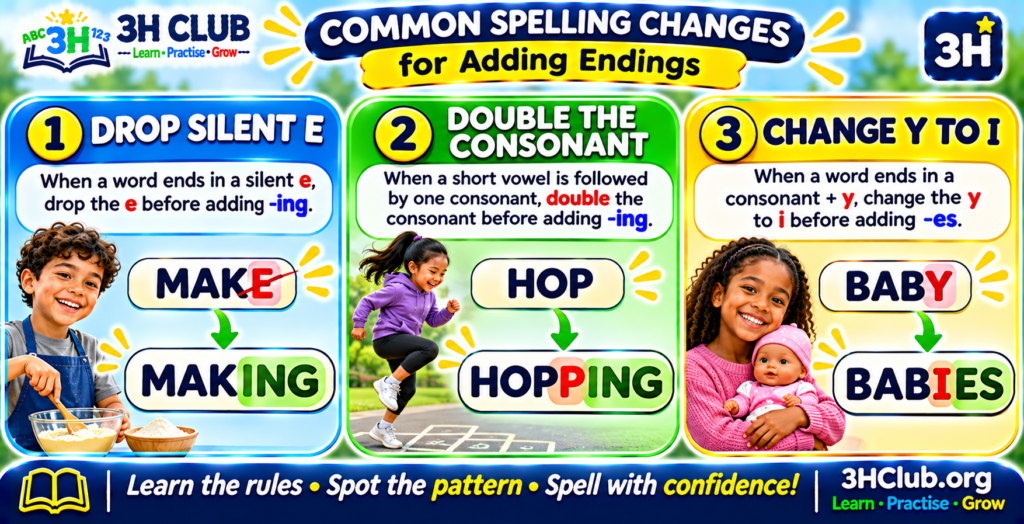
🟡 7. When Spelling Changes Before a Suffix
Sometimes you need to change a word before adding an ending.
Let’s learn three useful patterns.
Rule 1: Drop the Silent E
For many words ending in silent e, remove the e before adding -ing.
make → making
hope → hoping
ride → riding
But keep the e when adding a suffix that begins with a consonant in many common words:
hope → hopeful
Rule 2: Double the Final Consonant
In some short words with one vowel sound followed by one final consonant, double the consonant before -ing or -ed.
hop → hopping
run → running
stop → stopped
Compare:
hoping means wishing for something.
hopping means jumping on one foot or making little jumps.
The spelling changes the meaning!
Not every word doubles its last consonant.
For example:
jump → jumping
Rule 3: Change Y to I
When a word ends with a consonant followed by y, change y to i before adding -es.
baby → babies
puppy → puppies
But when a vowel comes before y, you usually keep the y:
toy → toys
boy → boys
✏️ Activity 8: Apply the Rule
- make + ing = _____
- hop + ing = _____
- stop + ed = _____
- baby + es = _____
- toy + s = _____
- hope + ing = _____
🧩 8. Prefixes: Small Beginnings with Big Meanings
A prefix is a group of letters added to the beginning of a word.
Prefixes can change a word’s meaning.
| Prefix | Meaning | Example |
|---|---|---|
| un- | not or opposite | happy → unhappy |
| re- | again | read → reread |
| dis- | not or opposite | agree → disagree |
| pre- | before | heat → preheat |
🧠 Explore the Meaning
happy → unhappy
If you’re unhappy, you’re not happy.
read → reread
If you reread a book, you read it again.
heat → preheat
If you preheat an oven, you heat it before using it.
✏️ Activity 9: Add a Prefix
- ___happy — Not happy.
- ___read — Read again.
- ___agree — Have a different opinion.
- ___heat — Heat beforehand.
- ___pack — Pack again.
⭐ Think About It!
Spelling isn’t only about sounds.
It’s also about meaning.
Knowing word parts helps you understand new words.
🔍 9. Spot the Pattern in Longer Words
Let’s look at some longer words.
raincoat
sunshine
playground
bedroom
Some longer words are made from two smaller words.
These are called compound words.
For example:
rain + coat = raincoat
sun + shine = sunshine
You can use familiar word parts to read a longer word.
✏️ Activity 10: Break the Word Apart
Write the two smaller words.
- raincoat = _____ + _____
- sunshine = _____ + _____
- playground = _____ + _____
- bedroom = _____ + _____
- toothbrush = _____ + _____
💡 Reading Strategy
When you meet a long word:
- Look for familiar letter patterns.
- Look for prefixes, suffixes or smaller words.
- Read the word in parts.
- Put the parts together.
- Check whether the word makes sense.
⭐⭐⭐ STAGE 3: SPELLING CHAMPIONS
Read, write and solve spelling challenges
📖 10. Reading Passage: A Rainy Day Adventure
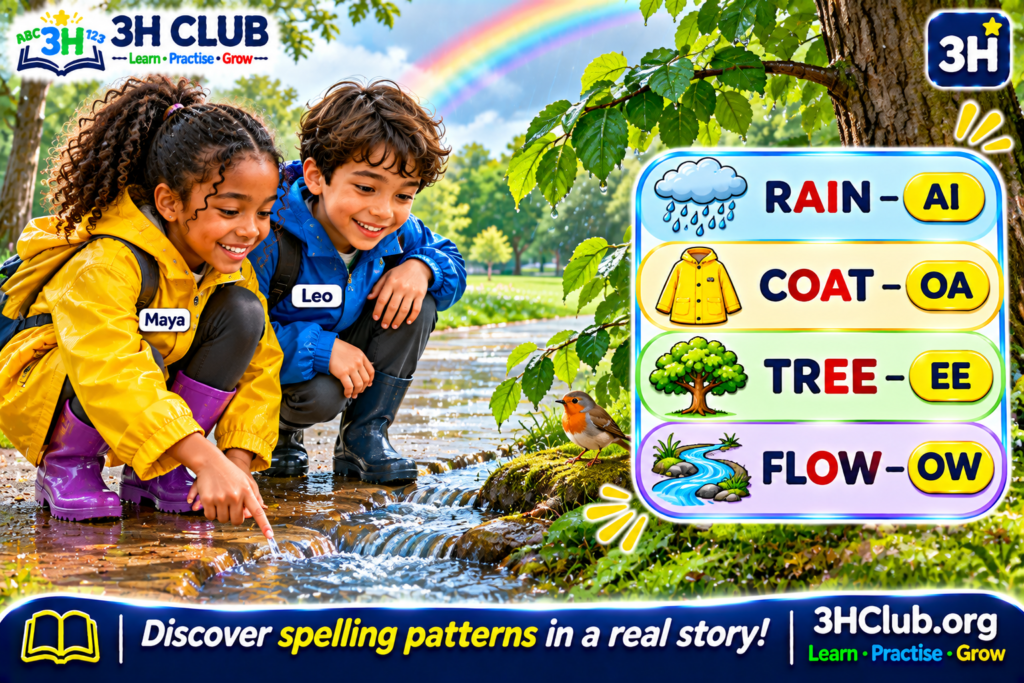
The Rainy Day Discovery
Maya and Leo planned to visit the park on Saturday.
They packed their raincoats because dark clouds were gathering.
Soon, rain began to fall.
“We can still explore,” said Maya.
The children walked along a narrow path beside the trees.
Leo spotted a small bird sitting beneath a leafy branch.
The bird shook its wet feathers.
Maya noticed a tiny stream flowing across the path.
“Look! The rain is making the stream wider,” she said.
They watched the water move around little stones.
After a while, the clouds began to clear.
A rainbow appeared above the trees.
“What an amazing day!” Leo said.
Maya smiled.
They had discovered that even a rainy day could be full of interesting things.
🔤 Spelling Pattern Hunt
Find words from the story containing these patterns:
- ai — rain
- oa — raincoats
- ee — trees
- ow — flowing
- sh — shook
- -ing — gathering
- -ed — packed
Can you find more examples?
🔍 Comprehension Questions
- Where did Maya and Leo plan to go?
- Why did they pack raincoats?
- What animal did Leo see?
- What happened to the stream?
- What appeared when the clouds began to clear?
- What did the children learn about rainy days?
🧠 Think More Deeply
Why do you think the stream became wider?
Think about what happens when rainwater flows into a small stream.
✍️ 11. Become a Spelling Editor
Good writers check their work.
Read these sentences carefully.
Each sentence contains one spelling mistake.
✏️ Activity 11: Fix the Mistake
- The trane moved along the tracks.
- We went to the beech to collect shells.
- The children were hopingg for sunshine.
- The babys were sleeping.
- She was makeing a colourful poster.
- The ship sailed across the see.
Rewrite each sentence with the correct spelling.
⭐ Editor’s Tip
When checking a word, ask:
- Does the word contain a familiar pattern?
- Have I chosen the correct spelling for its meaning?
- Did I apply the suffix rule correctly?
- Can I check the word in a dictionary?
🎲 12. Spelling Pattern Games
Game 1: Word Sort Challenge
Write these words on cards:
rain, day, tree, sea, boat, snow
Sort them into groups:
ai, ay, ee, ea, oa, ow
Then add one more word to each group.
Game 2: Spelling Pattern Bingo
Draw a grid with nine boxes.
Write a different spelling pattern in each box.
Try:
sh, ch, th, ai, ay, ee, oa, ar, ing
Ask someone to read words aloud.
Mark the pattern you hear and recognise.
Can you complete a row?
Game 3: Build a Word Chain
Begin with:
hop
Add an ending:
hopping
Now try:
hope → hoping
Explain why the spellings are different.
Game 4: Pattern Detective Notebook
Choose one spelling pattern each day.
For example:
ee
Find five words containing that pattern.
Write them in your notebook.
Use one in a sentence.
Game 5: Word Meaning Challenge
Compare:
hoping and hopping
Write a sentence for each word.
Make sure the meaning matches the spelling.
🏆 13. Final Spelling Champions Challenge
Let’s test your new skills!
Part A: Name the Pattern
Identify the highlighted spelling pattern in each word.
- rain
- tree
- boat
- ship
- star
- night
Part B: Complete the Word
- tr___n — A vehicle that travels on tracks.
- b___t — A vehicle that travels on water.
- ___air — Something you sit on.
- b___d — An animal with feathers.
- n___t — The time when the sky is dark.
Part C: Add the Correct Ending
- make + ing = _____
- run + ing = _____
- stop + ed = _____
- puppy + es = _____
- play + ed = _____
Part D: Choose the Correct Word
- The children went to the (sea / see).
- I can (sea / see) the mountains.
- The dog is (hoping / hopping) across the grass.
- I am (hoping / hopping) for good weather.
- The (rain / rayn) fell heavily.
Part E: Write Your Own Paragraph
Write four or five sentences about a day outdoors.
Try to include:
- Two words with vowel teams.
- One word with a consonant digraph.
- One word ending in -ing.
- One word ending in -ed.
Underline the spelling patterns you used.
⭐ Bonus Challenge
Explain the difference between:
hoping and hopping
Why does one word have one p while the other has two?
✅ 14. Check Your Answers!
Activity 1: Digraphs
- sh
- ch
- th
- ck
- sh
- ck
Activity 2: Complete the Word
- fish
- chair
- duck
- thin
- shop
Activity 3: Vowel Team Sort
| ai | ay | ee | ea | oa | ow |
|---|---|---|---|---|---|
| rain | day | green | leaf | boat | snow |
| train | play | feet | team | coat | grow |
Activity 4: Correct Spelling
- rain
- play
- green
- boat
- snow
Activity 5: Silent E
- cape
- pine
- hope
- cute
- made
Activity 6: R-Controlled Vowels
- star
- fork
- bird
- turn
- her
Activity 7: Add the Ending
- jumping
- played
- books
- painting
- trees
- helped
Activity 8: Apply the Rule
- making
- hopping
- stopped
- babies
- toys
- hoping
Activity 9: Prefixes
- unhappy
- reread
- disagree
- preheat
- repack
Activity 10: Compound Words
- rain + coat
- sun + shine
- play + ground
- bed + room
- tooth + brush
Reading Passage: Comprehension Answers
- The park.
- Because dark clouds were gathering and rain was expected.
- A small bird.
- It became wider.
- A rainbow.
- Rainy days can still be interesting and full of discoveries.
Think More Deeply: Rainwater flowed into the stream, increasing the amount of water.
Activity 11: Corrected Spellings
- train
- beach
- hoping
- babies
- making
- sea
Final Challenge: Part A
- ai
- ee
- oa
- sh
- ar
- igh
Final Challenge: Part B
- train
- boat
- chair
- bird
- night
Final Challenge: Part C
- making
- running
- stopped
- puppies
- played
Final Challenge: Part D
- sea
- see
- hopping
- hoping
- rain
Final Challenge: Part E
Answers will vary.
Example:
We went to the beach on a sunny day. The waves were crashing against the rocks. My brother was playing near the shore. We collected shells and watched a boat sail past.
Bonus Challenge
Hoping comes from hope. We drop the silent e before adding -ing.
Hopping comes from hop. We double the final p before adding -ing.
These different spellings help us recognise different words and meanings.
🎉 Well done, Spelling Champion!
You have practised recognising, sorting, building and checking words.
Every pattern you learn gives you another useful reading and writing tool.
🌈 15. What Have You Learned?
Let’s review your discoveries.
🔤 Consonant Digraphs
Two letters can work together to represent one consonant sound.
Examples:
sh – ch – th – ck
🌧️ Vowel Teams
Some letter combinations represent vowel sounds.
Examples:
ai – ay – ee – ea – oa – ow
🪄 Silent E
In many words, a final silent e helps an earlier vowel make its long sound.
cap → cape
⭐ R-Controlled Vowels
The letter r can change the sound of a vowel.
Examples:
ar – or – er – ir – ur
✍️ Suffixes
Suffixes are added to the ends of words.
Examples:
-ing, -ed, -s, -es
🧩 Prefixes
Prefixes are added to the beginnings of words.
Examples:
un-, re-, dis-, pre-
🔍 Spelling Rules
Some words change when you add endings.
make → making
hop → hopping
baby → babies
⭐ The Spelling Detective Method
LOOK → LISTEN → FIND THE PATTERN → SPELL → CHECK
🌟 Keep Learning with 3HClub!
You now know that spelling is more than remembering lists of words.
It’s about understanding how letters, sounds, patterns and meanings work together.
Keep a spelling notebook, look for patterns while reading and practise using new words in your writing.
📚 Your Next Learning Adventures
- Read CVC Words
- Discover Short A Words
- Learn Word Families
- Short and Long Vowel Sounds
- Consonant Digraphs
- Vowel Teams
- Prefixes and Suffixes
- Proofreading and Editing Sentences
⭐ Your Spelling Champion Promise
I can recognise common spelling patterns.
I can use patterns to read new words.
I can apply spelling rules.
I can check and correct my writing.
I can keep learning from every word I read!
🎉 Keep discovering, keep practising and keep growing!
3H CLUB — Learn • Practise • Grow