Making a Sentence More Interesting:
✏️ Add Details to Your Writing!
⭐ STARTERS — Ages 6–7
📚 Subject: English – Grammar and Creative Writing
🎯 Skills: Subjects, predicates, adjectives, action words, sentence expansion, word order, punctuation and descriptive writing.
🌟 Hello, Creative Writer!
Look at this sentence:
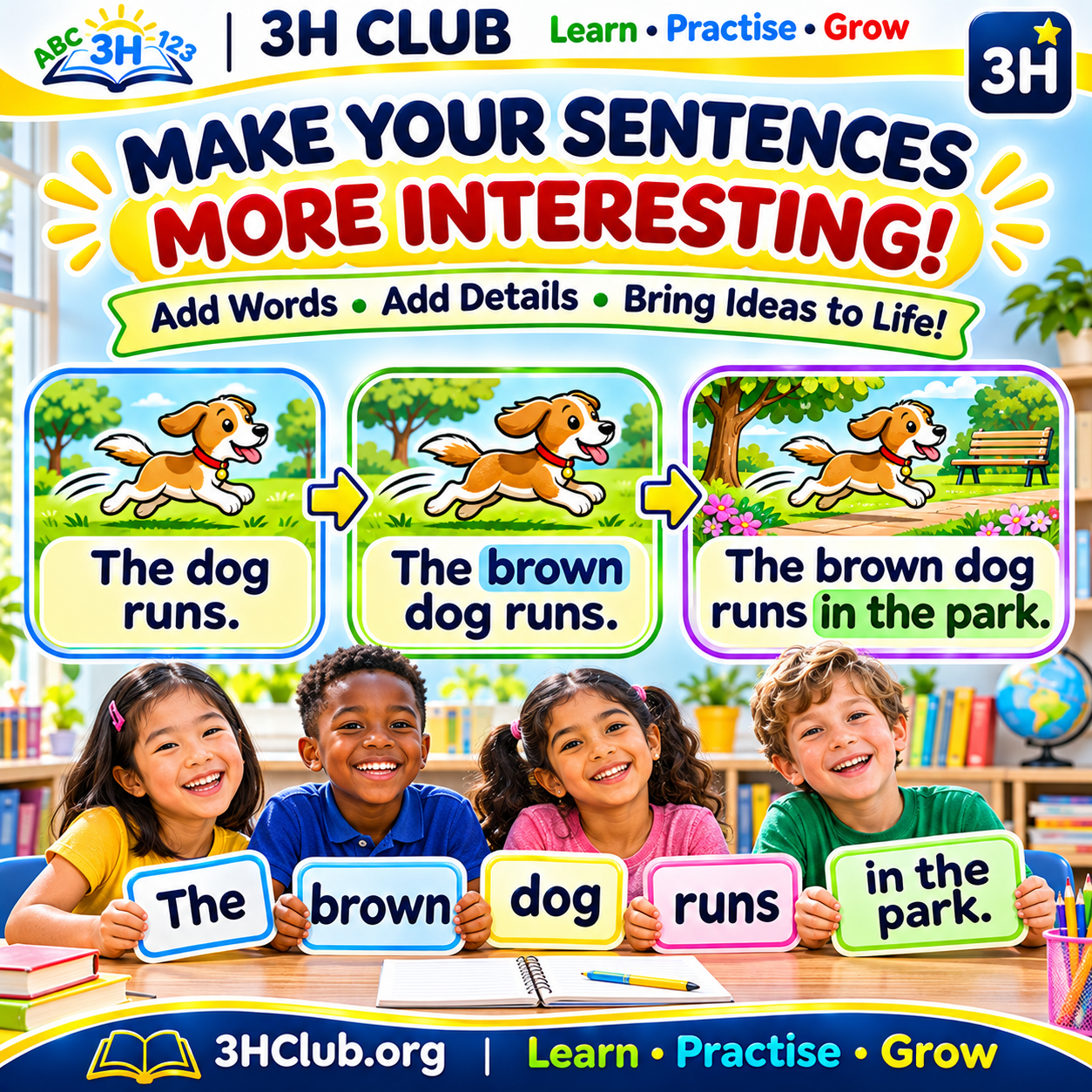
The dog runs.
It is a good sentence. It tells us who the sentence is about and what the dog does.
But what if we want to tell our reader more?
Let’s add a detail!
The brown dog runs.
Now we know what colour the dog is.
Let’s add another detail!
The brown dog runs in the park.
Now we know where the dog runs.
One more detail can make the picture even clearer:
The brown dog runs quickly in the park.
Can you imagine the dog racing across the grass?
That’s the magic of adding details to a sentence!
Today, you’ll learn how to make your writing clearer, more colourful and more interesting.
Ready? Let’s begin!
🎯 What Will You Learn?
By the end of this lesson, you will be able to:
- Recognise the subject and predicate in a simple sentence.
- Explain why a sentence needs to share a complete idea.
- Add describing words to tell readers more.
- Choose interesting action words.
- Add details about where something happens.
- Add details about when something happens.
- Describe how an action happens.
- Improve short sentences without changing their meaning.
- Use capital letters, spaces and punctuation.
- Write your own interesting sentences and a short story.
⭐ Your goal: Write sentences that help your reader imagine what is happening.
⭐ STAGE 1: SENTENCE EXPLORERS
Start with a complete sentence and add describing words
🔵 1. What Makes a Sentence Interesting?
A sentence shares a complete idea.
Look at:
The bird sings.
This is a complete sentence.
It tells us who the sentence is about and what happens.
Now read:
The little bird sings in the tree.
This sentence gives us more information.
We know the bird is little and where it sings.
Both sentences are correct. The second sentence helps us imagine the scene more clearly.
Short Sentences Are Good Too!
A sentence does not need to be long to be interesting.
Look at:
The lion roars!
That’s a short, exciting sentence.
The secret is to choose words that help your reader understand your idea.
🧠 Quick Check
Which sentence gives you more details?
A. The cat sleeps.
B. The fluffy cat sleeps on a soft mat.
Answer: B.
It tells us more about the cat and where it sleeps.
✏️ Activity 1: Which Sentence Tells You More?
Choose A or B.
1.
A. The girl smiles.
B. The happy girl smiles at her friend.
2.
A. The ball rolls.
B. The red ball rolls down the hill.
3.
A. The bird flies.
B. The small bird flies over the trees.
4.
A. Sam eats.
B. Sam eats a juicy apple.
5.
A. The frog jumps.
B. The green frog jumps into the pond.
Explain what extra information each B sentence gives you.
🟢 2. Remember the Subject and Predicate
Before we add details, let’s check that our sentence is complete.
A simple sentence has two important parts:
SUBJECT + PREDICATE = COMPLETE SENTENCE
🟦 The Subject: Who or What?
The subject tells us who or what the sentence is about.
Look at:
The dog runs.
The subject is The dog.
🟩 The Predicate: What Do We Say About It?
The predicate tells us what the subject does, is or experiences.
Look at:
The dog runs.
The predicate is runs.
🧩 Build the Sentence
| Subject | Predicate | Complete Sentence |
|---|---|---|
| The cat | sleeps. | The cat sleeps. |
| Mia | laughs. | Mia laughs. |
| The bird | sings. | The bird sings. |
| The flower | is yellow. | The flower is yellow. |
| My friend | reads a book. | My friend reads a book. |
Now let’s add details.
The cat sleeps.
Becomes:
The sleepy cat sleeps on the sofa.
The subject is now The sleepy cat.
The predicate is sleeps on the sofa.
The new details make the sentence more interesting, but it still has a subject and a predicate.
✏️ Activity 2: Find the Two Parts
Write the subject and predicate.
- The little dog barks.
- Mia reads a funny book.
- The red ball rolls away.
- The happy baby laughs.
- The tall tree sways in the wind.
⭐ Remember
Adding details should not make your sentence confusing.
Keep the subject and predicate working together.
🟡 3. Add Describing Words
A describing word, also called an adjective, tells us more about a noun.
A noun names a person, animal, place or thing.
Look at:
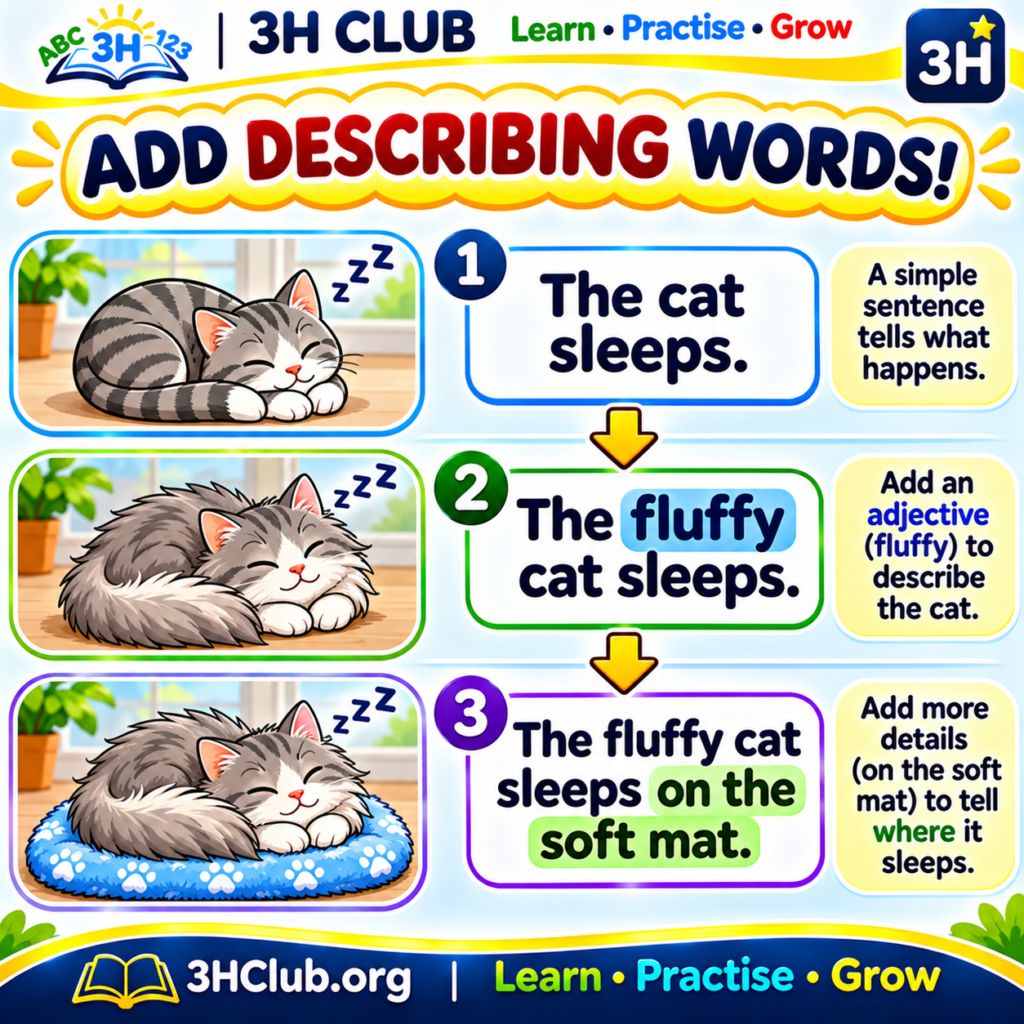
The cat sleeps.
What kind of cat?
The fluffy cat sleeps.
Now we can imagine its soft fur.
🌈 More Describing Words
| Noun | Describing Word | New Phrase |
|---|---|---|
| ball | red | red ball |
| puppy | playful | playful puppy |
| cake | delicious | delicious cake |
| flower | yellow | yellow flower |
| tree | tall | tall tree |
| bag | heavy | heavy bag |
✏️ Activity 3: Add an Adjective
Choose a describing word that makes sense.
Word bank: fluffy, bright, juicy, tiny, colourful
- The _____ kitten sleeps.
- The _____ sun shines.
- Sam eats a _____ apple.
- A _____ ant crawls.
- Mia draws a _____ picture.
✏️ Activity 4: Make It More Interesting
Add one adjective to each sentence.
- The dog runs.
- The flower grows.
- The boy reads.
- The bird sings.
- The cake is on the table.
Example:
The dog runs.
The playful dog runs.
⭐ Writing Tip
Choose describing words that match what you want to say.
You don’t need lots of adjectives. One well-chosen word can make a big difference.
⭐⭐ STAGE 2: DETAIL BUILDERS
Add where, when and how details
🔵 4. Choose Interesting Action Words
A verb can tell us what someone or something does.
Look at:
The boy moves.
Can we choose a word that tells us more clearly how he moves?
The boy skips.
Now we can imagine him taking little skipping steps.
🏃 Action Words
| Simple Action | More Specific Action |
|---|---|
| moves | crawls |
| goes | races |
| looks | peeks |
| eats | nibbles |
| makes a sound | whispers |
| moves in water | swims |
These words do not all mean exactly the same thing.
Choose the word that matches the action you want to describe.
✏️ Activity 5: Choose the Best Action Word
1. A mouse moves quietly under a chair.
Which word could show the movement more clearly?
A. scurries
B. sings
2. A child moves through a pool.
A. swims
B. sleeps
3. A rabbit takes small jumps across the grass.
A. hops
B. reads
4. A child speaks very softly.
A. whispers
B. shouts
5. A hungry puppy eats small bites of food.
A. nibbles
B. flies
⭐ Action Word Challenge
Start with:
The horse moves.
Change moves to a more specific action word.
Possible answer:
The horse gallops.
🟢 5. Tell Where Something Happens
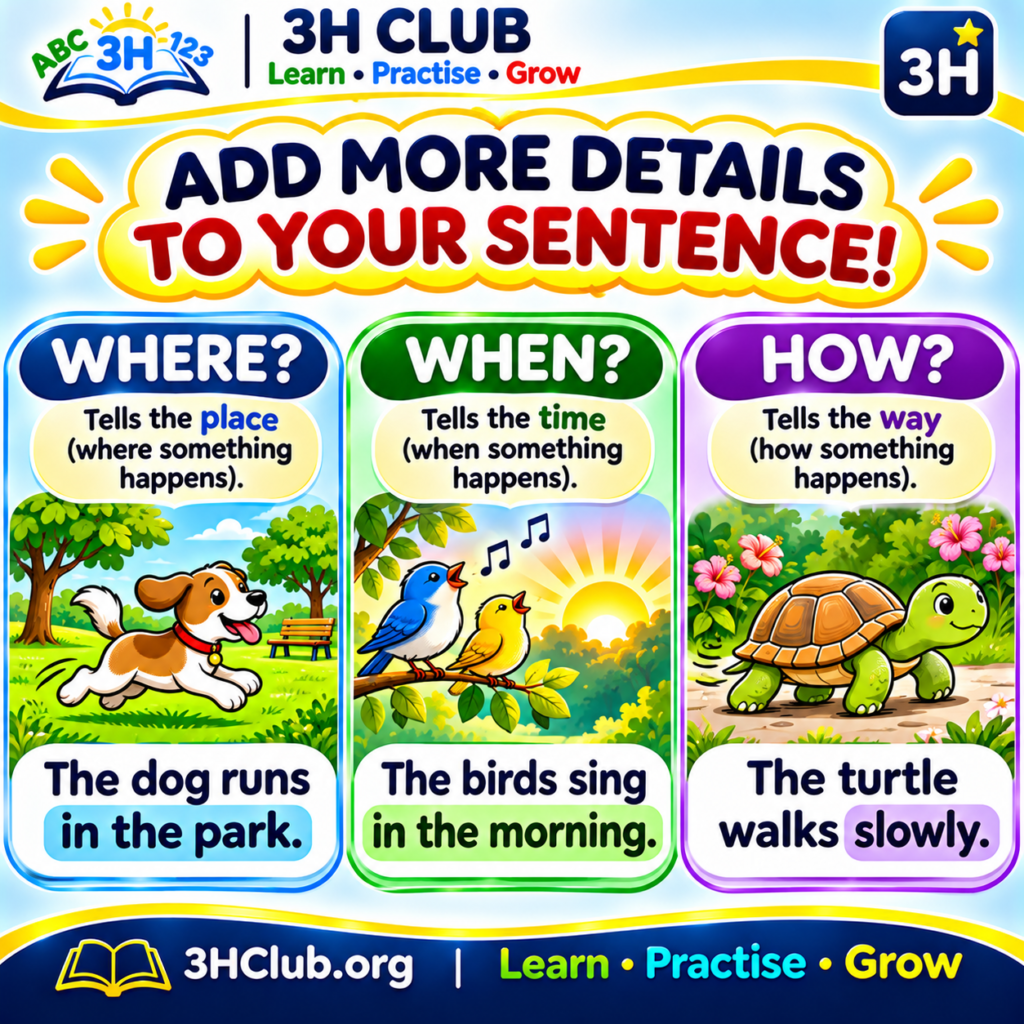
A where detail tells us the place.
Look at:
The dog runs.
Where does the dog run?
The dog runs in the park.
Now we know the place.
🌳 More Examples
The bird sings.
The bird sings in the tree.
The fish swims.
The fish swims in the pond.
Mia reads.
Mia reads on the sofa.
✏️ Activity 6: Add a Where Detail
Complete each sentence.
- The cat sleeps __________.
- The children play __________.
- The bird sits __________.
- Sam reads __________.
- The frog jumps __________.
Where word bank: in the garden, on the mat, in the classroom, on a branch, into the pond
Choose the details that make sense.
🟡 6. Tell When Something Happens
A when detail tells us the time.
Look at:
The birds sing.
When do they sing?
The birds sing in the morning.
Now we know when.
⏰ More Examples
I brush my teeth.
I brush my teeth every morning.
We play outside.
We play outside after school.
The stars shine.
The stars shine at night.
✏️ Activity 7: Add a When Detail
Choose a suitable time phrase.
Word bank: after lunch, in the morning, at night, on Saturday, before bed
- I read a story __________.
- We visit Grandma __________.
- The stars shine __________.
- I eat breakfast __________.
- We play a game __________.
More than one answer may make sense for some sentences.
🧠 Think About It!
Look at:
The dog runs in the park after lunch.
Can you find the where detail?
in the park
Can you find the when detail?
after lunch
You’ve added two useful details to one sentence!
🟣 7. Tell How Something Happens
A how detail tells us the way something happens.
Look at:
The turtle walks.
How does the turtle walk?
The turtle walks slowly.
The word slowly tells us how.
🐢 More Examples
The children laugh.
The children laugh happily.
The girl speaks.
The girl speaks softly.
The boy runs.
The boy runs quickly.
Words such as slowly, happily and quickly are called adverbs when they describe an action.
You don’t need to remember every grammar name yet. Just practise using the words to make your meaning clear.
✏️ Activity 8: Add a How Detail
Choose the word that makes the most sense.
1. The turtle moves _____.
A. slowly
B. loudly
2. The children cheer _____.
A. happily
B. sleepily
3. The girl whispers _____.
A. softly
B. noisily
4. The boy runs _____ to catch the bus.
A. quickly
B. quietly
5. The baby sleeps _____.
A. peacefully
B. angrily
⭐ Remember
You can show how an action happens by choosing a clear action word or by adding a how detail.
The rabbit hops.
The rabbit hops quickly.
Both are complete sentences.
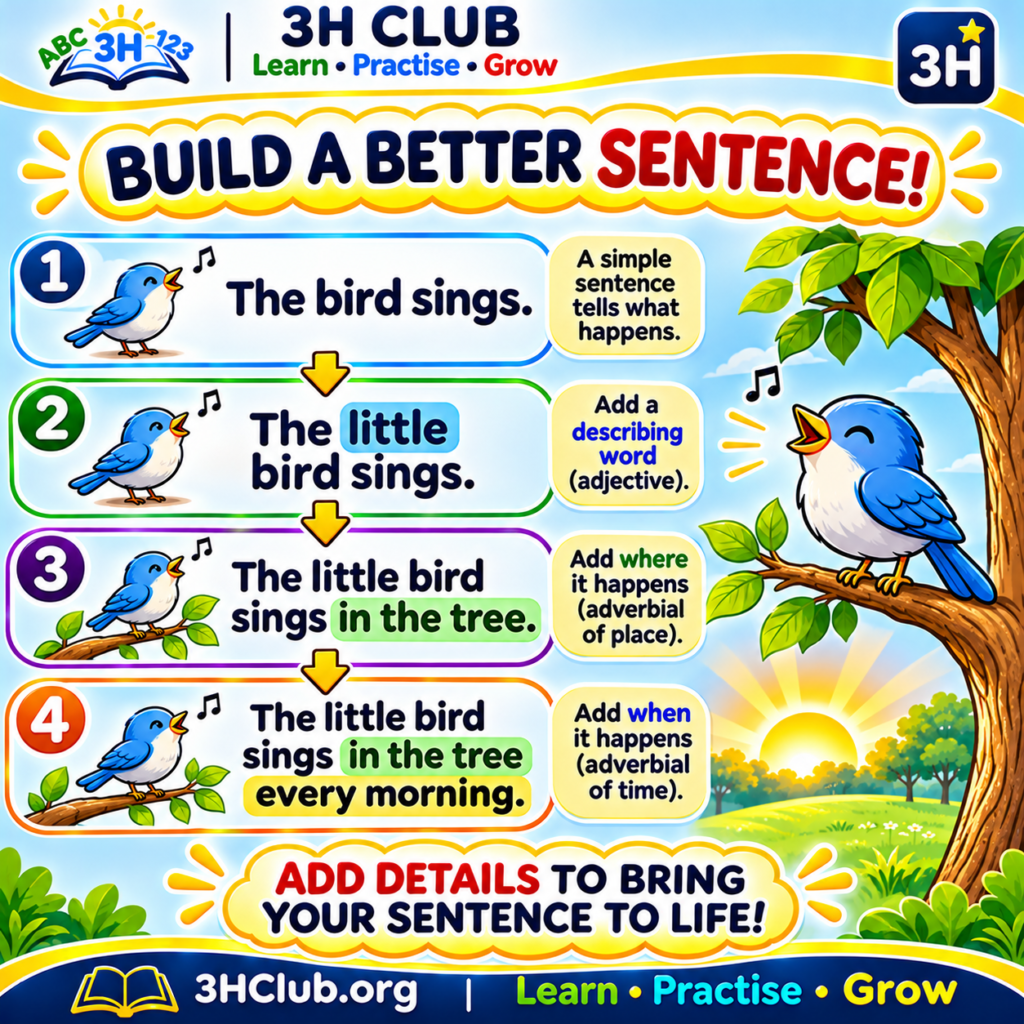
🧩 8. Grow a Sentence Step by Step
Let’s put our new skills together.
Start with:
The bird sings.
Step 1: Add a Describing Word
The little bird sings.
Step 2: Add Where
The little bird sings in the tree.
Step 3: Add When
The little bird sings in the tree every morning.
We’ve grown one short sentence into a longer, clearer sentence!
🌈 Sentence Growth Chart
| Step | Sentence | New Detail |
|---|---|---|
| 1 | The bird sings. | Complete idea |
| 2 | The little bird sings. | What kind? |
| 3 | The little bird sings in the tree. | Where? |
| 4 | The little bird sings in the tree every morning. | When? |
✏️ Activity 9: Grow Your Sentence
Start with:
The dog runs.
Add:
- A describing word.
- A where detail.
- A when or how detail.
Example:
The dog runs.
The brown dog runs.
The brown dog runs in the park.
The brown dog runs quickly in the park.
⭐ A Helpful Reminder
You don’t need to add every kind of detail to every sentence.
Choose the details that help your reader.
A clear short sentence is better than a long, confusing one.
⭐⭐⭐ STAGE 3: CREATIVE SENTENCE STARS
Read, improve and write your own sentences
📖 9. Read a Story: Mia and the Little Puppy
Let’s read a short story.
Look for describing words and details that tell us where, when and how things happen.
🐶 Mia and the Little Puppy
One sunny morning, Mia walked into the garden.
She heard a soft bark near the gate.
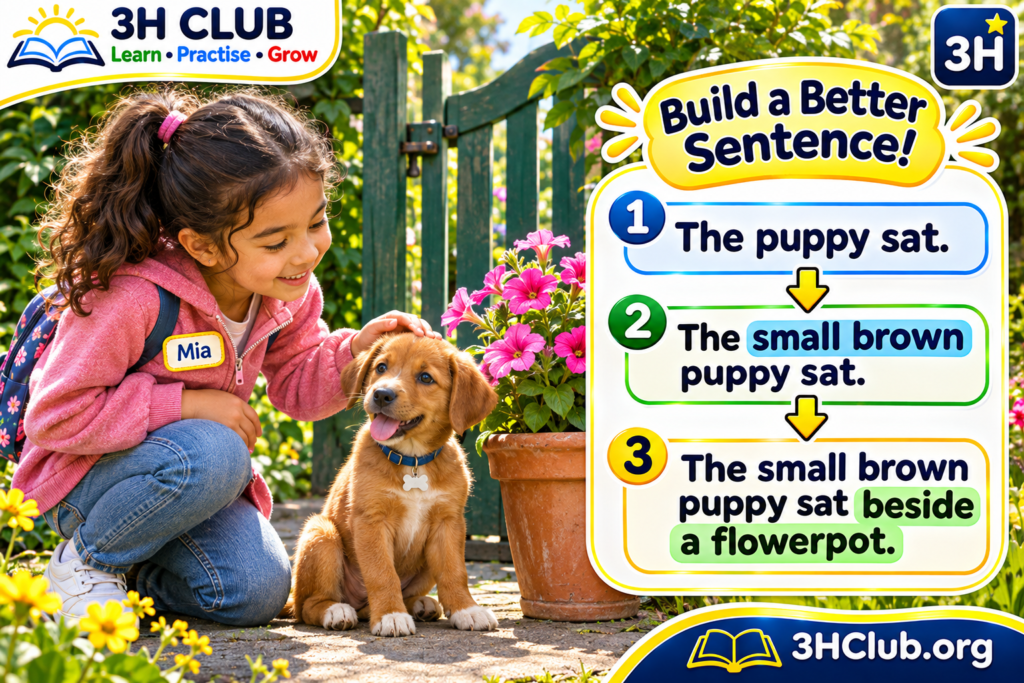
A small brown puppy sat beside a flowerpot.
The puppy looked at Mia with bright eyes.
Mia knelt down slowly.
“Hello, little puppy,” she said.
The puppy wagged its tail happily.
Mia gave the puppy some fresh water.
Soon, the puppy’s owner came through the gate.
“Thank you for helping!” the owner said.
Mia smiled as the puppy trotted home.
🔍 Let’s Explore the Sentences
Look at:
A small brown puppy sat beside a flowerpot.
Subject: A small brown puppy
Predicate: sat beside a flowerpot
Describing words: small, brown
Where detail: beside a flowerpot
Now look at:
The puppy wagged its tail happily.
Subject: The puppy
Predicate: wagged its tail happily
How detail: happily
📖 Reading Questions
- When did Mia walk into the garden?
- Where did Mia hear the bark?
- What colour was the puppy?
- Where was the puppy sitting?
- How did Mia kneel down?
- What did the puppy do when Mia spoke to it?
- What did Mia give the puppy?
- How did the story end?
✏️ Activity 10: Find the Details
Find a word or phrase from the story that answers each question.
- What kind of morning was it?
- What kind of bark did Mia hear?
- What colour was the puppy?
- Where was the puppy sitting?
- How did the puppy wag its tail?
- How did the puppy move home?
🧠 Think About It!
Compare:
The puppy sat.
A small brown puppy sat beside a flowerpot.
Which sentence helps you imagine the scene more clearly?
What extra details can you find?
✍️ 10. Fix and Improve the Sentences
Good writers read their work and look for ways to make it clearer.
Let’s become sentence editors!
✏️ Activity 11: Add Useful Details
Improve each sentence by adding one or two details.
- The dog sleeps.
- The girl reads.
- The ball rolls.
- The bird sings.
- The boy jumps.
Example:
The dog sleeps.
The tired dog sleeps on the sofa.
✏️ Activity 12: Fix the Writing
Rewrite these sentences using capital letters, spaces and correct punctuation.
- the little dog runs in the park
- mia reads a funny book
- thebirdfliesoverthetree
- where is the red ball
- what a beautiful flower
- i saw a tiny frog
⭐ Editing Tip
Ask yourself:
- Does my sentence make sense?
- Can I add a useful detail?
- Did I choose words that match my meaning?
- Did I start with a capital letter?
- Did I leave spaces?
- Did I use the correct ending mark?
🎨 11. Write Your Own Interesting Sentences
Now you’re the writer!
✏️ Activity 13: Imagine a Picture
Imagine a sunny playground.
You can see:
🌳 A tall tree.
🐶 A playful dog.
⚽ A bright football.
👧 Two children playing.
Write four sentences about the picture.
Try to include:
- One describing word.
- One where detail.
- One how detail.
- One when detail.
Example:
The playful dog runs across the grass.
The children kick a bright ball.
A little bird sings in the tall tree.
The children laugh happily after lunch.
✏️ Activity 14: Make a Sentence Ladder
Start with:
The frog jumps.
Write four versions.
- The frog jumps.
- Add a describing word.
- Add where the frog jumps.
- Add how or when the frog jumps.
Example:
The frog jumps.
The green frog jumps.
The green frog jumps into the pond.
The green frog jumps quickly into the pond.
✏️ Activity 15: Write About Your Day
Write three or four sentences about something you did.
Try answering:
- What did you do?
- Where did you do it?
- When did you do it?
- How did you feel?
Example:
Yesterday, I went to the beach.
I built a tall sandcastle near the water.
My little sister helped me happily.
We had a wonderful afternoon.
🎲 12. Fun Sentence-Building Games
🧩 Game 1: Sentence Card Builder
Make three groups of cards.
Subject cards: The cat, The boy, The bird
Action cards: sleeps, runs, sings
Detail cards: on the mat, in the park, in the tree
Choose one card from each group to make a sentence.
Example:
The bird + sings + in the tree
The bird sings in the tree.
Check that your sentence makes sense.
🎯 Game 2: Add One More Detail
Start with:
The dog barks.
Take turns adding one useful detail.
The little dog barks.
The little dog barks at the gate.
Stop when the sentence gives a clear picture.
🔍 Game 3: Detail Detective
Read a sentence from a book.
Ask:
Who or what?
What happens?
Where?
When?
How?
You may not find every detail. That’s fine!
🎨 Game 4: Draw and Describe
Draw an animal doing something.
Write one complete sentence.
Then add two details.
Example:
The rabbit hops.
The fluffy rabbit hops across the grass.
🌟 Game 5: Better Word Challenge
Choose a more specific action word.
The girl moves.
Could she skip, walk, crawl or dance?
Choose one and write a sentence.
The girl skips across the playground.
🏆 13. Final Creative Sentence Stars Challenge
You’ve learnt how to add details to sentences.
Now let’s see what you can do!
Part A: Find the Subject
Write the complete subject.
- The little dog runs.
- The happy girl smiles.
- The red ball rolls away.
- The tiny bird sings.
- My best friend reads a book.
Part B: Find the Predicate
Write the complete predicate.
- The brown cat sleeps on the mat.
- The boy jumps over a puddle.
- Mia reads a funny story.
- The bird flies over the garden.
- The puppy wags its tail happily.
Part C: Find the Detail
Say whether the bold words tell you what kind, where, when or how.
- The fluffy cat sleeps.
- The dog runs in the park.
- We play after school.
- The turtle walks slowly.
- The red ball rolls.
Part D: Make the Sentence Better
Add one or two useful details.
- The cat sleeps.
- The bird flies.
- The boy runs.
- The girl reads.
- The puppy plays.
Part E: Choose the Best Word
- The snail moves (slowly / loudly).
- The girl (whispers / roars) softly to her friend.
- The dog sleeps (on the mat / in the sky).
- The stars shine (at night / inside a bag).
- The rabbit (hops / writes) across the grass.
Part F: Fix the Sentence
Rewrite correctly.
- the brown dog runs in the park
- mia has a beautiful kite
- where is the little puppy
- thecatissleeping
- what a wonderful day
⭐ Final Writing Mission
Write a short story with five sentences.
Choose one idea:
- A puppy in the garden.
- A visit to the beach.
- A rainy afternoon.
- A fun day at the park.
- A lost toy.
Try to include:
- Two describing words.
- One interesting action word.
- One where detail.
- One when detail.
- One how detail.
Remember to use complete sentences and correct punctuation.
✅ 14. Check Your Answers!
Activity 1: Which Sentence Tells You More?
- B — happy; at her friend
- B — red; down the hill
- B — small; over the trees
- B — a juicy apple
- B — green; into the pond
Activity 2: Subjects and Predicates
| Sentence | Subject | Predicate |
|---|---|---|
| The little dog barks. | The little dog | barks |
| Mia reads a funny book. | Mia | reads a funny book |
| The red ball rolls away. | The red ball | rolls away |
| The happy baby laughs. | The happy baby | laughs |
| The tall tree sways in the wind. | The tall tree | sways in the wind |
Activity 3: Add an Adjective
- fluffy
- bright
- juicy
- tiny
- colourful
Activity 4: Make It More Interesting
Answers will vary.
Possible answers:
- The playful dog runs.
- The yellow flower grows.
- The curious boy reads.
- The little bird sings.
- The delicious cake is on the table.
Activity 5: Action Words
- A — scurries
- A — swims
- A — hops
- A — whispers
- A — nibbles
Activity 6: Where Details
Possible answers:
- on the mat
- in the garden
- on a branch
- in the classroom
- into the pond
Activity 7: When Details
Possible answers:
- before bed
- on Saturday
- at night
- in the morning
- after lunch
Activity 8: How Details
- A — slowly
- A — happily
- A — softly
- A — quickly
- A — peacefully
Activity 9: Grow Your Sentence
Answers will vary.
Example:
The playful dog runs quickly in the park after lunch.
Reading Questions: Mia and the Little Puppy
- One sunny morning.
- Near the gate.
- Brown.
- Beside a flowerpot.
- Slowly.
- It wagged its tail happily.
- Fresh water.
- The owner arrived, and the puppy went home.
Activity 10: Find the Details
- sunny
- soft
- brown
- beside a flowerpot
- happily
- trotted
Activity 11: Add Useful Details
Answers will vary.
Possible answers:
- The sleepy dog sleeps under the table.
- The cheerful girl reads a funny story.
- The blue ball rolls across the grass.
- The little bird sings in the morning.
- The excited boy jumps over a puddle.
Activity 12: Fix the Writing
- The little dog runs in the park.
- Mia reads a funny book.
- The bird flies over the tree.
- Where is the red ball?
- What a beautiful flower!
- I saw a tiny frog.
Activities 13–15: Your Own Writing
Answers will vary.
Check that the sentences make sense, include the requested details and use correct punctuation.
Final Challenge: Part A — Subjects
- The little dog
- The happy girl
- The red ball
- The tiny bird
- My best friend
Final Challenge: Part B — Predicates
- sleeps on the mat
- jumps over a puddle
- reads a funny story
- flies over the garden
- wags its tail happily
Final Challenge: Part C — Details
- What kind
- Where
- When
- How
- What kind
Final Challenge: Part D — Improve the Sentences
Answers will vary.
Possible answers:
- The sleepy cat sleeps on the sofa.
- The colourful bird flies over the garden.
- The happy boy runs quickly.
- The curious girl reads a funny book.
- The playful puppy plays in the garden.
Final Challenge: Part E — Best Words
- slowly
- whispers
- on the mat
- at night
- hops
Final Challenge: Part F — Correct Sentences
- The brown dog runs in the park.
- Mia has a beautiful kite.
- Where is the little puppy?
- The cat is sleeping.
- What a wonderful day!
Final Writing Mission
Answers will vary.
Example: A Fun Day at the Park
Yesterday, Mia visited the park.
A playful brown puppy ran across the grass.
Mia threw a bright red ball.
The puppy raced happily after it.
Mia laughed and enjoyed the sunny afternoon.
🎉 Fantastic work, Creative Sentence Star!
You’ve learnt how to start with a complete sentence and add useful details to make your writing clearer and more interesting.
Keep practising. Every sentence is a chance to share something new!
🌈 15. What Have You Learnt?
Let’s review your new writing skills.
🧩 A Sentence Has a Subject and Predicate
The dog runs.
Subject: The dog
Predicate: runs
🎨 Describing Words Tell Us More
The playful dog runs.
🏃 Interesting Action Words Show What Happens
The dog races.
🌳 Where Details Tell Us the Place
The dog races in the park.
⏰ When Details Tell Us the Time
The dog races in the park after lunch.
🐢 How Details Tell Us the Way
The dog races quickly across the grass.
✏️ Good Writers Check Their Sentences
Remember:
COMPLETE IDEA → USEFUL DETAILS → CAPITAL LETTER → SPACES → PUNCTUATION
⭐ The Golden Rule
Start with a complete sentence. Add details that help your reader.
🌟 Keep Learning with 3HClub!
You’ve discovered how to make your sentences more interesting!
You can now choose describing words, use interesting action words and add details about where, when and how things happen.
Next time you write, try reading your sentence aloud.
Ask yourself:
Can my reader imagine what I mean?
If your sentence is clear, you’ve done a great job.
📚 Your Next Learning Adventures
- Write a Sentence for Kids
- Nouns for Kids
- Verbs for Kids
- Adjectives for Kids
- Subject and Predicate
- Basic Punctuation
- The Four Types of Sentences
- Write a Short Story
⭐ Your Creative Writer Promise
I can write a complete sentence.
I can find the subject and predicate.
I can add describing words.
I can choose interesting action words.
I can add where, when and how details.
I can check and improve my writing.
🎉 Keep learning, keep practising and keep growing!
3H CLUB — Learn • Practise • Grow