Beginning, Middle and End of a Story:
📖 Learn How Stories Work!
⭐⭐ BUILDERS — Ages 8–9
📚 Subject: English – Reading Comprehension, Grammar and Creative Writing
🎯 Skills: Story structure, sequencing, characters, setting, problems, solutions, subjects, predicates, story planning and editing.
🌟 Hello, Story Explorer!
Imagine opening a book and reading:
The little boat floated safely back to shore.
You might wonder:
Where did the boat go? Who was in it? What happened before it returned?
You’ve just discovered something important about stories!
A good story helps us understand what happened first, what happened next and how everything ended.
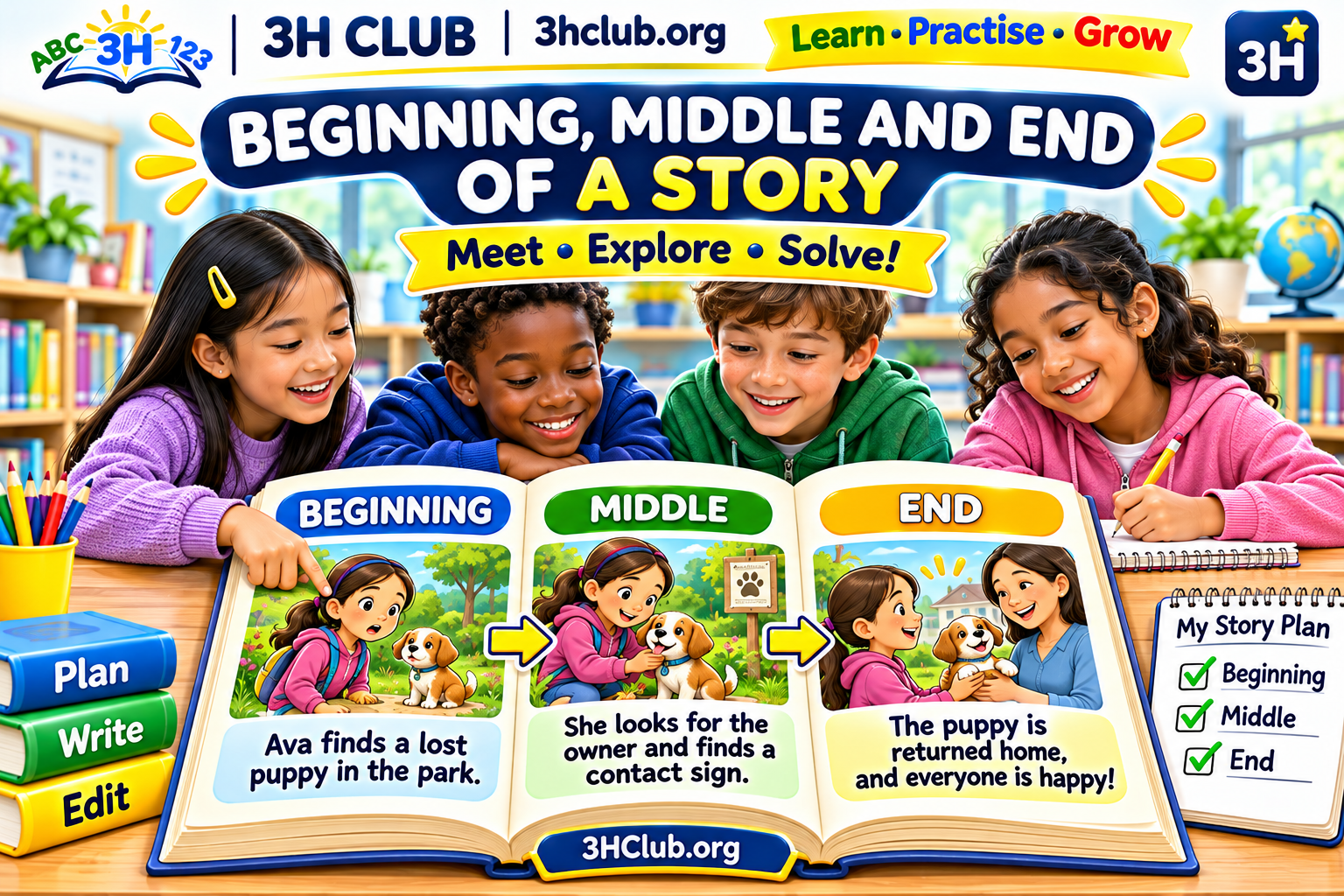
Most simple stories have three main parts:
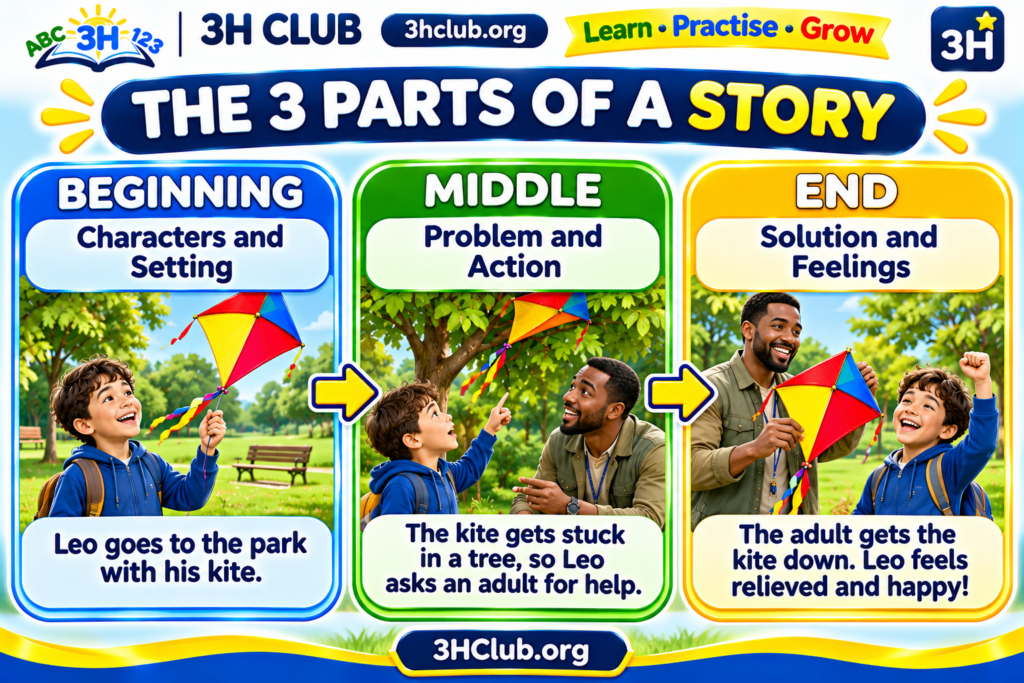
🟦 BEGINNING — Meet the characters and discover where the story takes place.
🟩 MIDDLE — Find out what happens, including a problem or challenge.
🟨 END — Discover how events finish and what changes.
Let’s explore how these parts work together!
🎯 What Will You Learn?
By the end of this lesson, you will be able to:
- Identify the beginning, middle and end of a story.
- Recognise characters and settings.
- Find the main problem or challenge in a story.
- Explain how a problem is solved.
- Put story events in the correct order.
- Identify subjects and predicates in complete sentences.
- Use time-order words to connect events.
- Create a story map.
- Write a story with a clear beginning, middle and end.
- Check and improve your writing.
⭐ Your goal: Tell or write a story that is easy to follow, interesting to read and has a satisfying ending.
⭐ STAGE 1: STORY EXPLORERS
Discover the three main parts of a story
🔵 1. What Is Story Structure?
Story structure is the way a story is organised.
Think about building a house. You need different parts to make the house complete.
A story also needs parts that work together.
🧩 The Three Main Parts
| Story Part | What Happens? | Question to Ask |
|---|---|---|
| 🟦 Beginning | We meet the characters and learn about the setting. | Who is in the story? Where does it begin? |
| 🟩 Middle | Important events happen. A character may face a problem. | What happens? What goes wrong or changes? |
| 🟨 End | We discover what happens after the main events. | How does the story finish? |
🐶 A Very Short Story: The Lost Puppy
BEGINNING
One morning, Ava saw a little brown puppy near her garden gate.
MIDDLE
The puppy looked lost. Ava asked an adult for help, and they looked for its owner.
END
They found the owner nearby. The puppy wagged its tail as it went home.
Notice how the story makes sense in order.
We meet Ava and the puppy, discover the problem, and find out what happens in the end.
✏️ Activity 1: Name the Story Part
Write Beginning, Middle or End.
- We meet a girl named Lily and learn that she lives near a forest.
- Lily discovers that her favourite kite is stuck in a tree.
- An adult helps Lily retrieve the kite safely.
- A boy named Ben prepares for his first football match.
- Ben’s team falls behind, but they keep trying.
- The match finishes, and Ben feels proud of his team’s effort.
⭐ Remember
The beginning introduces the story.
The middle develops the action.
The end shows how things turn out.
🟢 2. The Beginning: Meet the Characters and Setting
The beginning helps your reader enter the story.
It usually introduces:
- Characters: Who is in the story?
- Setting: Where and sometimes when does it happen?
- Situation: What is happening at the start?
🌳 Example: A Surprise in the Garden
On a sunny Saturday morning, Maya stepped into her grandmother’s garden. Colourful flowers grew beside the path. Maya carried a small watering can because she had promised to help care for the plants.
Let’s investigate.
Main character: Maya
Setting: Her grandmother’s garden
Time: A sunny Saturday morning
Starting situation: Maya is helping to care for the plants.
✏️ Activity 2: Find the Beginning Details
Read:
Early one morning, Leo and his sister arrived at the beach. They carried buckets, spades and a picnic basket. The sand was cool beneath their feet.
Answer:
- Who are the characters?
- Where does the story begin?
- When does it begin?
- What have the children brought?
- What might happen next? Make a prediction.
✍️ Try Writing a Beginning
Complete these sentences with your own ideas.
One __________ morning, __________ went to __________.
The place was __________.
Everything seemed __________ until __________.
You have started a story!
🟡 3. The Middle: What Happens Next?
The middle is where the story develops.
Characters do things, make decisions and react to events.
Often, a problem or challenge appears.
A problem does not always need to be dangerous or frightening.
It could be:
- A missing toy.
- A difficult puzzle.
- A sudden change in the weather.
- A disagreement between friends.
- A competition that requires teamwork.
🪁 Example: The Missing Kite
Beginning: Sam takes his new kite to the park.
Middle: A strong gust of wind carries the kite into a tall tree. Sam feels disappointed. He asks a nearby adult for help.
End: The adult helps retrieve the kite safely, and Sam thanks them.
The middle contains the main challenge and shows what Sam does about it.
✏️ Activity 3: Find the Problem
Read each situation and identify the problem.
- Mia is ready to paint, but she cannot find her paintbrush.
- A class plants seeds, but the soil becomes very dry.
- Ben wants to read his book, but the room is too noisy.
- Ava and her friend are building a sandcastle when waves begin moving closer.
- A child practises a song but keeps forgetting one line.
Now choose one problem and suggest a sensible way to solve it.
⭐ Story Tip
A strong middle often shows:
PROBLEM → ACTION → CHANGE
The character faces a challenge, tries something and discovers what happens.
🟣 4. The End: Bring the Story to a Close
The end tells us how the story finishes.
It might show:
- How a problem is solved.
- What happens to the characters.
- How someone feels.
- What a character learns.
- What changes from the beginning.
🌧️ Example: The Rainy Picnic
Beginning: A family plans a picnic in the park.
Middle: Dark clouds gather, and rain begins before they can eat.
End: The family takes the picnic home and enjoys it indoors. Everyone laughs about their unexpected adventure.
The ending connects to the problem and shows how the family responds.
✏️ Activity 4: Choose the Best Ending
Read:
Lena spent the afternoon making a birthday card for her grandfather. Just before the party, she could not find it. She searched her room and asked her brother to help.
Which ending fits best?
A. Lena decided that elephants were interesting animals.
B. Her brother found the card beneath a notebook. Lena smiled and gave it to her grandfather.
C. The moon travelled around Earth.
Explain why you chose your answer.
🔵 5. Build Complete Sentences: Subject and Predicate
Stories are made from sentences.
To tell your story clearly, you need complete sentences that make sense.
Let’s review two useful grammar terms.
🟦 Subject: Who or What?
The subject tells us who or what the sentence is about.
Maya opened the garden gate.
The subject is Maya.
🟩 Predicate: What Is Said About the Subject?
The predicate tells us what the subject does, is or experiences.
Maya opened the garden gate.
The predicate is opened the garden gate.
🧩 Put Them Together
SUBJECT + PREDICATE = COMPLETE SENTENCE
| Subject | Predicate | Complete Sentence |
|---|---|---|
| The little puppy | barked softly. | The little puppy barked softly. |
| Maya | opened the gate. | Maya opened the gate. |
| The children | searched for the ball. | The children searched for the ball. |
| The rain | stopped at last. | The rain stopped at last. |
✏️ Activity 5: Find the Subject and Predicate
Write the complete subject and predicate.
- The excited children entered the playground.
- Maya carried a small basket.
- The strong wind blew across the field.
- The frightened puppy hid beneath a bench.
- The helpful teacher opened the classroom door.
✏️ Activity 6: Complete the Story Sentence
Finish each sentence by adding a predicate.
- The little rabbit __________.
- Maya and Leo __________.
- The dark clouds __________.
- My best friend __________.
- The missing football __________.
Make sure every sentence tells a complete idea.
⭐⭐ STAGE 2: STORY BUILDERS
Put events in order and develop the action
🟢 6. Put Story Events in the Correct Order
A story should follow an order that your reader can understand.
Let’s try a simple example.
🌱 The Growing Seed
Beginning: Nina plants a sunflower seed in a pot.
Middle: She waters it and places it near sunlight. Days pass, and a green shoot appears.
End: The sunflower grows tall, and Nina proudly shows it to her family.
Each event follows naturally from the one before it.
✏️ Activity 7: Sequence the Events
The following events are mixed up.
A. Finally, the children enjoyed the fruit salad they had made.
B. Next, they washed the fruit with adult help.
C. First, Maya and Leo collected apples, bananas and grapes.
D. Then, they carefully cut and mixed the fruit with adult supervision.
Write the letters in the correct order.
✏️ Activity 8: Build a Three-Part Story
Put each event into the correct section.
Events:
- A child discovers a broken bicycle chain.
- An adult helps repair the chain.
- The child prepares to ride to the park.
Beginning: __________
Middle: __________
End: __________
🟡 7. Use Time-Order Words
Time-order words help your reader understand when events happen.
They are especially useful when you’re explaining a sequence.
⏰ Helpful Words and Phrases
| Beginning | Middle | End |
|---|---|---|
| One morning | Later | Finally |
| At first | After a while | In the end |
| Early that day | Suddenly | At last |
| Before long | Next | Eventually |
🐦 Example
One morning, a little bird landed beside Maya’s window.
Suddenly, it spotted a shiny ribbon on the ground.
A few moments later, it picked up the ribbon and flew towards a tree.
Finally, the bird tucked the ribbon into its nest.
Notice how the words help us follow the order.
✏️ Activity 9: Choose a Time-Order Word
Word bank: First, Suddenly, Next, Finally, Later
- __________, we packed our bags for the trip.
- __________, a loud clap of thunder surprised us.
- __________, we found shelter beneath a covered walkway.
- __________, the rain became lighter.
- __________, we continued our journey.
⭐ Writing Tip
Time-order words are helpful, but you do not need one at the start of every sentence.
Choose them when they make your story clearer.
🟣 8. Understand the Problem and Solution
Many stories have a problem and a solution.
A problem is a challenge the character faces.
A solution is a way the problem is resolved.
🐱 Example: The Missing Cat
Problem: A family’s cat is hiding, and nobody knows where it is.
Action: They search the house and listen for sounds.
Solution: They hear a quiet meow and discover the cat sleeping inside an open cupboard.
🔍 Story Thinking Questions
Ask yourself:
- What does the character want?
- What gets in the way?
- What does the character try?
- What happens because of those actions?
- How does the story finish?
✏️ Activity 10: Match Problems and Solutions
| Problem | Possible Solution |
|---|---|
| 1. A child forgets a library book. | A. The children move their game indoors. |
| 2. Rain stops an outdoor game. | B. The child makes a reminder to return the book. |
| 3. Two friends disagree about a game. | C. They listen to each other and agree on a fair choice. |
| 4. A plant’s soil becomes dry. | D. The child waters it appropriately. |
Match each problem with the best solution.
⭐ Challenge
Think of a problem that could happen during a school trip.
Write two different possible solutions.
Which one would make the most interesting story?
🔵 9. Show How Characters Feel
Stories become more engaging when we understand how characters feel.
Look at:
Leo lost his favourite toy.
Now add a feeling:
Leo felt worried when he could not find his favourite toy.
You can also show feelings through actions.
Leo checked every pocket and searched beneath the bench.
His actions help us understand that he wants to find the toy.
😊 Feelings and Clues
| Feeling | Possible Story Clue |
|---|---|
| Happy | She grinned and clapped. |
| Worried | He kept looking towards the door. |
| Excited | She bounced on her toes. |
| Disappointed | He lowered his head and sighed. |
| Proud | She smiled as she showed her finished work. |
✏️ Activity 11: Show the Feeling
Rewrite each sentence to show the character’s feeling through an action.
- Maya was excited.
- Leo was worried.
- Sam was proud.
- Ava was surprised.
- Nina was disappointed.
Example:
Maya was excited.
Maya grinned and hurried towards the playground.
Remember, different people show feelings in different ways.
🟢 10. Plan Your Own Story
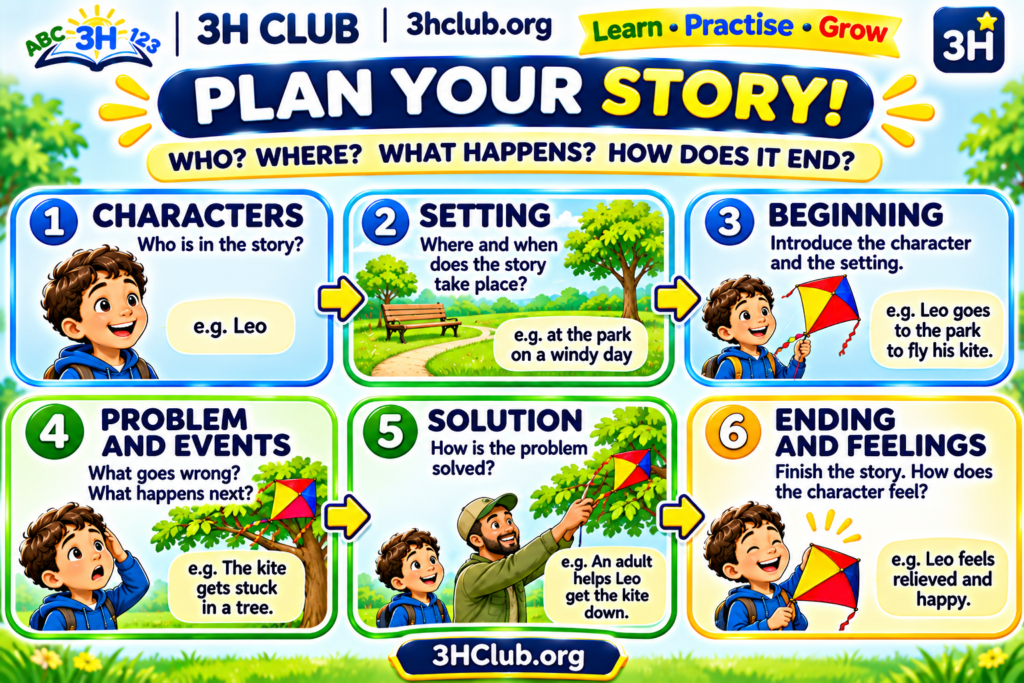
Before writing, make a plan.
You don’t need to write perfect sentences yet. Just collect your ideas.
📝 My Story Planner
Story title: The Lost Football
Characters: Maya and Leo
Setting: A school playground after lunch
Beginning: Maya and Leo are playing football with their friends.
Problem: The ball rolls behind a locked gate.
Middle events: The children stop playing and ask their teacher for help.
Solution: The teacher contacts the caretaker, who safely retrieves the ball.
Ending: The children thank the adults and continue their game.
✏️ Activity 12: Make Your Own Story Map
Choose one story idea:
A. A surprising discovery in the garden.
B. A missing library book.
C. A rainy-day adventure.
D. A school competition.
E. A lost toy at the beach.
Complete:
Title: __________
Main character: __________
Setting: __________
Beginning: __________
Problem: __________
What happens next: __________
Solution: __________
Ending and feelings: __________
Your plan is ready!
⭐⭐⭐ STAGE 3: STORY CHAMPIONS
Read, analyse, write and improve a complete story
📖 11. Reading Story: The Mystery of the Missing Garden Sign
Read this story carefully.
Notice how the beginning, middle and end fit together.
🌻 The Mystery of the Missing Garden Sign
🟦 Beginning
On a bright Monday morning, Maya and Leo arrived at their school garden. Their class had planted sunflowers, beans and tomatoes the week before. A colourful wooden sign usually stood beside the path. It said, WELCOME TO OUR GARDEN.
But today, the sign was missing.
“That’s strange,” said Maya. “It was here on Friday.”
Leo looked around the garden. There were small marks in the soft soil near the path.
“Maybe someone moved it,” he suggested.
🟩 Middle
Maya and Leo told their teacher what they had found. Together, they looked around the garden.
First, they checked behind the watering cans.
Next, they searched near the garden shed.
Then, Leo noticed a splash of blue paint on the ground.
“Our sign has blue letters!” he said.
The teacher followed the paint marks towards the covered walkway.
There, beside a workbench, stood the missing sign.
The school caretaker was repairing one of its wooden legs.
“I noticed it was loose on Friday,” the caretaker explained. “I brought it here so I could fix it safely.”
Maya and Leo smiled with relief. The sign had not been stolen or lost after all.
🟨 End
Later that afternoon, the caretaker returned the repaired sign to the garden.
Maya and Leo helped their teacher choose a safe place for it beside the path.
The sign looked brighter than ever.
“Now everyone will know where our garden is,” said Leo.
Maya smiled proudly. Their garden was ready to welcome visitors again.
🔍 Explore the Story
| Story Element | What We Discover |
|---|---|
| Characters | Maya, Leo, their teacher and the caretaker |
| Setting | The school garden and nearby covered walkway |
| Beginning | Maya and Leo discover that the garden sign is missing |
| Problem | Nobody knows where the sign has gone |
| Middle | They search for clues and ask for help |
| Solution | They discover the caretaker has been repairing the sign |
| End | The repaired sign returns to the garden |
📖 Reading Comprehension Questions
- When did Maya and Leo notice the sign was missing?
- Where did the sign usually stand?
- What had their class planted?
- What did Leo notice in the soil?
- Who helped the children search?
- What clue did Leo find near the shed?
- Where was the missing sign?
- Why had the caretaker moved it?
- How did Maya and Leo feel when they discovered what happened?
- What happened at the end of the story?
✏️ Activity 13: Beginning, Middle or End?
Identify the story part.
- The children notice the sign is missing.
- Leo discovers a splash of blue paint.
- The caretaker explains why the sign was moved.
- The repaired sign returns to the garden.
- Maya and Leo arrive at school on Monday morning.
✏️ Activity 14: Find the Subject and Predicate
Write the complete subject and predicate in each sentence.
- The colourful sign stood beside the path.
- Leo noticed a splash of blue paint.
- The helpful caretaker repaired the wooden sign.
- Maya and Leo smiled with relief.
- The repaired sign returned to the garden.
🧠 Think More Deeply
- Why might the author have included the blue paint clue?
- How would the story change if Maya and Leo never asked their teacher for help?
- Why does the ending feel connected to the beginning?

✍️ 12. Write Your Own Three-Part Story
Now it’s your turn to become the author.
Use the story map you made earlier.
Step 1: Write the Beginning
Introduce your main character and setting.
You might start with:
One sunny morning…
After school on Friday…
During our class trip…
Tell your reader enough to understand where the story begins.
Step 2: Develop the Middle
Introduce a problem or challenge.
Show what the character does.
You might use:
Suddenly…
A few moments later…
The next thing they noticed was…
Make sure events follow a sensible order.
Step 3: Write the End
Show how the story finishes.
Explain what happens to the characters.
You might use:
Finally…
At last…
By the end of the day…
✏️ Activity 15: Write a Three-Paragraph Story
Write a story of approximately 12–18 sentences, divided into three paragraphs.
Paragraph 1 — Beginning: Introduce the characters, setting and starting situation.
Paragraph 2 — Middle: Describe the problem, important events and actions.
Paragraph 3 — End: Show the solution, outcome and feelings.
Your story should include:
- A title.
- At least two characters or one well-developed main character.
- A clear setting.
- A problem or challenge.
- Events in a sensible order.
- A believable ending.
- Complete sentences with correct punctuation.
The sentence count is a guide, not a strict rule.
🔍 13. Improve Your Story
Writing a first draft is only the beginning.
Good writers reread their stories and make improvements.
First Draft
Ben went to the park. He lost his ball. He looked for it. He found it. He was happy.
The events make sense, but the story could give us more details.
Improved Version
One sunny afternoon, Ben took his new football to the park. He kicked it across the grass, but it rolled behind a large bush. Ben searched carefully around the playground. At last, he spotted the ball beneath some leaves. He picked it up and smiled with relief.
What Improved?
- We know when the story happens.
- We can imagine the setting.
- The problem is clearer.
- The character takes action.
- The ending shows a feeling.
✏️ Activity 16: Improve the Story
Rewrite this short story with more useful details.
Sara went outside. She saw a bird. The bird was hurt. She got help. The bird was safe.
Try to add:
- A clearer setting.
- A describing word.
- A sentence showing Sara’s feelings.
- A safe action involving an adult.
- An ending that explains what happened.
Remember to keep the events sensible. A child should not handle an injured wild animal without appropriate adult or professional help.
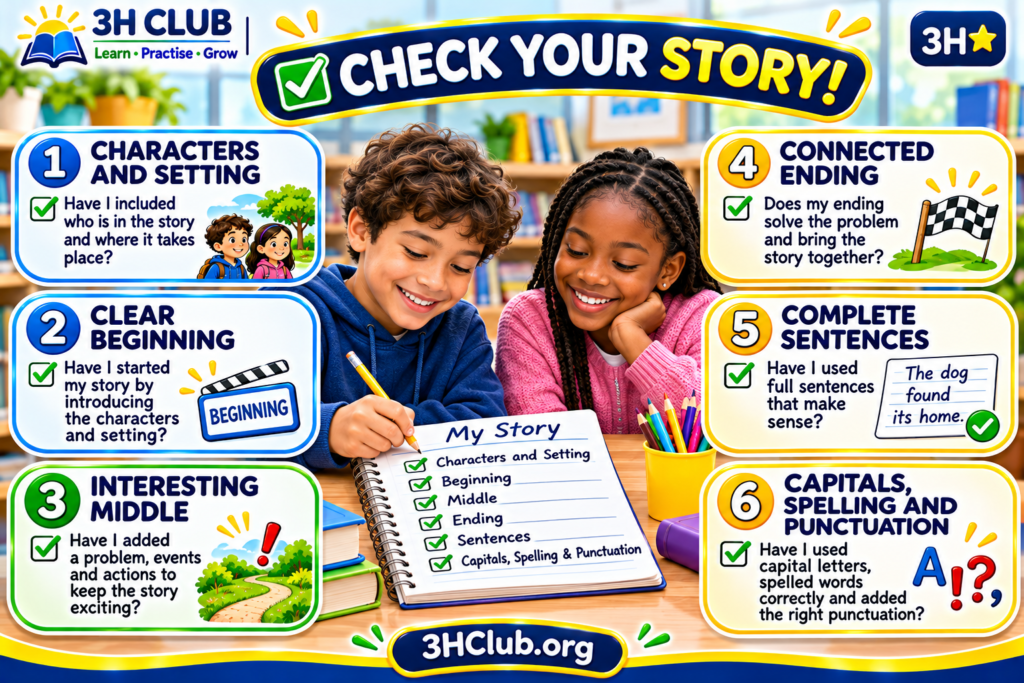
🎲 14. Five Fun Story Structure Games
🧩 Game 1: Story Card Shuffle
Write the beginning, middle and end of a short story on three cards.
Mix them up.
Put them back in order.
Explain how you knew which card came first.
🔍 Game 2: Story Detective
Choose a storybook.
Find:
- The main character.
- The setting.
- The main problem.
- An important event.
- The ending.
Tell a friend how the three parts connect.
🎭 Game 3: Act Out a Story
Work with a friend or family member.
Act out:
Beginning: A child prepares for a picnic.
Middle: Rain begins unexpectedly.
End: The picnic moves indoors.
Use actions and dialogue to show what happens.
🎨 Game 4: Draw Three Scenes
Fold a sheet of paper into three sections.
Label them:
BEGINNING | MIDDLE | END
Draw one important event in each section.
Write a complete sentence beneath every picture.
🌟 Game 5: Change the Ending
Choose a familiar story.
Imagine a different ending.
Would the characters make another choice?
Would the problem be solved differently?
Write your new ending and explain how it still connects to the rest of the story.
🏆 15. Final Story Champions Challenge
Let’s see what you have learnt!
Part A: Story Structure
Match each part to its purpose.
- Beginning
- Middle
- End
A. Shows how events finish.
B. Introduces characters and setting.
C. Develops the action and challenge.
Part B: Find the Story Part
- A girl discovers an old map in her grandfather’s cupboard.
- She follows clues and finds a locked wooden box.
- Her grandfather helps open the box, revealing family photographs.
Label each event.
Part C: Put Events in Order
A. The children thank the librarian for finding their missing book.
B. Two friends visit the library to return a book.
C. They realise the book is missing and search their bags.
D. The librarian discovers that the book was left on a reading table.
Write the correct order.
Part D: Subject and Predicate
Find the subject and predicate.
- The curious girl opened the small box.
- The children searched beneath the table.
- Their teacher explained the mystery.
Part E: Choose a Solution
Problem: The class’s poster falls from the display board just before visitors arrive.
Write two possible solutions.
Choose the one that would work best in your story.
Part F: Improve the Ending
Read:
The children found their missing puppy.
Write two more sentences that make a satisfying ending.
Explain how the characters feel and what happens next.
⭐ Final Creative Writing Mission
Write an original story called:
The Unexpected Discovery
Your story must have:
BEGINNING: Who discovers something? Where and when?
MIDDLE: What is discovered? What problem or surprise follows?
END: What happens next? How does everything finish?
Use a story planner first, then write your story.
Read it aloud when you’re finished.
✅ 16. Check Your Answers!
Activity 1: Name the Story Part
- Beginning
- Middle
- End
- Beginning
- Middle
- End
Activity 2: Beginning Details
- Leo and his sister.
- At the beach.
- Early one morning.
- Buckets, spades and a picnic basket.
- Answers will vary. Example: They might build a sandcastle.
Activity 3: Find the Problem
- Mia cannot find her paintbrush.
- The soil is very dry.
- The room is too noisy for Ben to read comfortably.
- Waves are approaching the sandcastle.
- The child keeps forgetting a line of the song.
Possible solutions will vary.
Activity 4: Best Ending
B. Her brother finds the card, and Lena gives it to her grandfather.
It solves the missing-card problem and connects to the birthday celebration.
Activity 5: Subjects and Predicates
| Sentence | Subject | Predicate |
|---|---|---|
| The excited children entered the playground. | The excited children | entered the playground |
| Maya carried a small basket. | Maya | carried a small basket |
| The strong wind blew across the field. | The strong wind | blew across the field |
| The frightened puppy hid beneath a bench. | The frightened puppy | hid beneath a bench |
| The helpful teacher opened the classroom door. | The helpful teacher | opened the classroom door |
Activity 6: Complete the Sentence
Answers will vary.
Possible answers:
- The little rabbit hopped across the grass.
- Maya and Leo played a game.
- The dark clouds covered the sky.
- My best friend helped me find my bag.
- The missing football was under a bench.
Activity 7: Sequence the Events
C → B → D → A
Activity 8: Build a Story
Beginning: The child prepares to ride to the park.
Middle: The child discovers a broken bicycle chain.
End: An adult helps repair the chain.
Activity 9: Time-Order Words
- First
- Suddenly
- Next
- Later
- Finally
Activity 10: Problems and Solutions
- B
- A
- C
- D
Activity 11: Show the Feeling
Answers will vary.
Possible answers:
- Maya grinned and bounced on her toes.
- Leo kept checking his pockets and looking around.
- Sam smiled as he showed everyone his finished model.
- Ava opened her eyes wide and gasped.
- Nina sighed and looked down at her unfinished picture.
Activity 12: Story Map
Answers will vary.
Check that the events follow a sensible order and that the ending connects to the problem.
Reading Comprehension: The Missing Garden Sign
- Monday morning.
- Beside the garden path.
- Sunflowers, beans and tomatoes.
- Small marks in the soft soil.
- Their teacher.
- A splash of blue paint.
- Beside a workbench near the covered walkway.
- One of its wooden legs was loose, so the caretaker was repairing it.
- Relieved and happy.
- The repaired sign returned to the garden.
Activity 13: Story Parts
- Beginning
- Middle
- Middle
- End
- Beginning
Activity 14: Subjects and Predicates
| Sentence | Subject | Predicate |
|---|---|---|
| The colourful sign stood beside the path. | The colourful sign | stood beside the path |
| Leo noticed a splash of blue paint. | Leo | noticed a splash of blue paint |
| The helpful caretaker repaired the wooden sign. | The helpful caretaker | repaired the wooden sign |
| Maya and Leo smiled with relief. | Maya and Leo | smiled with relief |
| The repaired sign returned to the garden. | The repaired sign | returned to the garden |
Think More Deeply: Suggested Answers
- The blue paint is a clue that helps the children find the sign.
- Without asking their teacher, the children might not discover where the sign went.
- The story begins with a missing sign and ends with the sign safely returned.
Activity 15: Three-Paragraph Story
Answers will vary.
Check for a clear beginning, developed middle, connected ending, complete sentences and correct punctuation.
Activity 16: Improve the Story
Possible answer:
One afternoon, Sara noticed a small bird sitting quietly beside a garden path. One wing seemed injured, and Sara felt worried. She called her father, who kept everyone at a safe distance and contacted a local wildlife rescue service. A trained rescuer arrived and carefully collected the bird. Sara felt relieved to know that the bird would receive proper care.
Final Challenge: Part A
- B
- C
- A
Final Challenge: Part B
- Beginning
- Middle
- End
Final Challenge: Part C
B → C → D → A
Final Challenge: Part D
| Sentence | Subject | Predicate |
|---|---|---|
| The curious girl opened the small box. | The curious girl | opened the small box |
| The children searched beneath the table. | The children | searched beneath the table |
| Their teacher explained the mystery. | Their teacher | explained the mystery |
Final Challenge: Part E
Answers will vary.
Possible solutions:
- Ask a teacher to help secure the poster again.
- Place the poster safely on a display table where visitors can see it.
Final Challenge: Part F
Possible answer:
The children cheered when the puppy returned to its owner. They watched happily as it wagged its tail and settled into its favourite blanket.
Final Creative Writing Mission: Example Story
The Unexpected Discovery
One Saturday morning, Maya visited her grandmother’s garden. She loved exploring the colourful flowers and watching butterflies. While watering the plants, she noticed something shiny beneath a large leaf.
Maya moved the leaf carefully and discovered a small metal box. She called her grandmother, who helped her open it. Inside were several old photographs and a tiny silver key. Her grandmother smiled with surprise. She explained that the photographs showed her family when she was young.
Together, they looked through the pictures and listened to stories from long ago. Maya discovered that the key belonged to an old keepsake drawer in the house. Her grandmother opened the drawer and showed her more family treasures. Maya realised that an ordinary morning had turned into a special adventure.
🎉 Excellent work, Story Champion!
You’ve learnt how stories begin, develop and end. You’ve also practised sequencing events, solving problems, writing complete sentences and improving your storytelling.
🌈 17. What Have You Learnt?
🟦 The Beginning Introduces the Story
We meet the characters and discover the setting.
🟩 The Middle Develops the Action
Important events happen, and characters often face challenges.
🟨 The End Brings the Story to a Close
We discover the outcome and how the characters feel or change.
🧩 Complete Sentences Help Tell the Story
SUBJECT + PREDICATE = COMPLETE SENTENCE
⏰ Time-Order Words Help Readers Follow Events
First → Next → Later → Finally
📝 A Story Map Helps You Plan
CHARACTERS + SETTING → PROBLEM + EVENTS → SOLUTION + ENDING
🔍 Good Writers Improve Their Work
PLAN → WRITE → READ → IMPROVE → CHECK
🌟 Keep Learning with 3HClub!
You now know how to recognise the beginning, middle and end of a story.
You can introduce characters, describe a setting, develop a problem, organise events and write an ending that makes sense.
The next time you read a story, ask yourself:
Who is the story about?
Where does it happen?
What changes in the middle?
How does it end?
And when you write your own story, remember that each part has an important job.
📚 Your Next Learning Adventures
- How to Write a Paragraph for Kids
- Write a Sentence for Kids
- Making a Sentence More Interesting
- Subject and Predicate
- The Four Types of Sentences
- Main Idea and Supporting Details
- Making Predictions
- Making Inferences
- Cause and Effect
⭐ Your Story Champion Promise
I can identify the beginning of a story.
I can explain what happens in the middle.
I can recognise a clear ending.
I can put events in the correct order.
I can write complete sentences.
I can plan and improve my own stories.
Keep reading, keep writing and keep growing!
3H CLUB — Learn • Practise • Grow