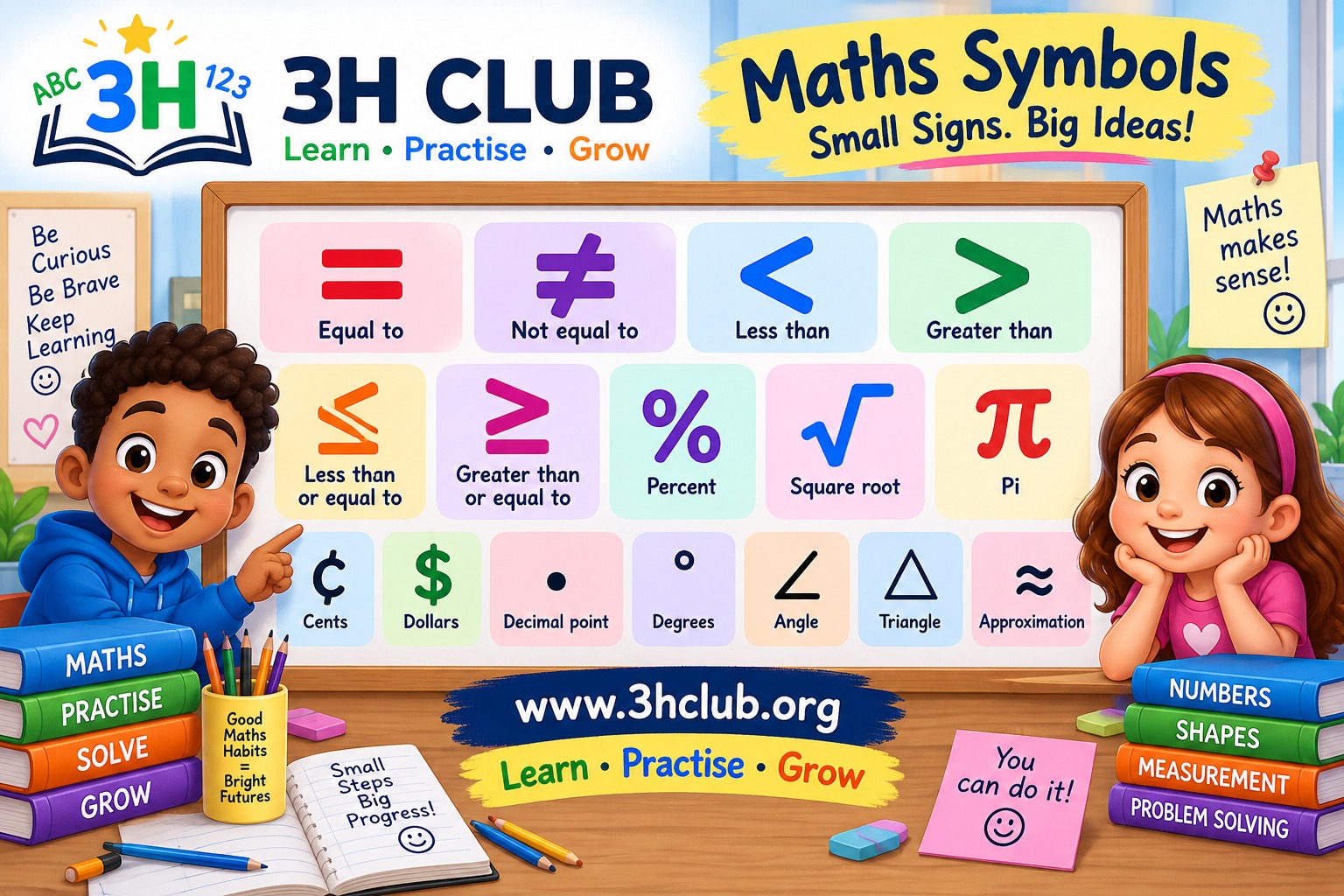
Maths Symbols: Learn What the Signs Mean
A simple guide to maths symbols for children aged 6–11
Maths uses special symbols to help us say things quickly.
Instead of writing:
“Five is greater than three”
we can write:
5 > 3
Much quicker!
In this lesson, you will learn some of the most useful maths symbols, what they mean, and how to use them.
🎯 What You Will Learn
By the end of this lesson, you should be able to:
- recognise common maths symbols;
- explain what each symbol means;
- compare numbers using <, > and =;
- recognise symbols used for money, decimals and percentages;
- recognise some geometry symbols;
- answer simple symbol questions.
🟰 1. The Equal Sign
= means Equal To
The equal sign tells us that the amount on one side is the same as the amount on the other side.
Examples:
2 + 3 = 5
10 = 10
6 + 4 = 5 + 5
💡 Think of = as saying “is the same as.”
🚫 2. The Not Equal Sign
≠ means Not Equal To
We use ≠ when two values are not the same.
Examples:
4 ≠ 7
2 + 2 ≠ 5
10 ≠ 8
🐊 3. Less Than and Greater Than
These two symbols are very important:
| Symbol | Meaning | Example |
|---|---|---|
| < | Less than | 3 < 7 |
| > | Greater than | 9 > 4 |
< means Less Than
3 < 8
This means:
3 is less than 8.
> means Greater Than
10 > 6
This means:
10 is greater than 6.
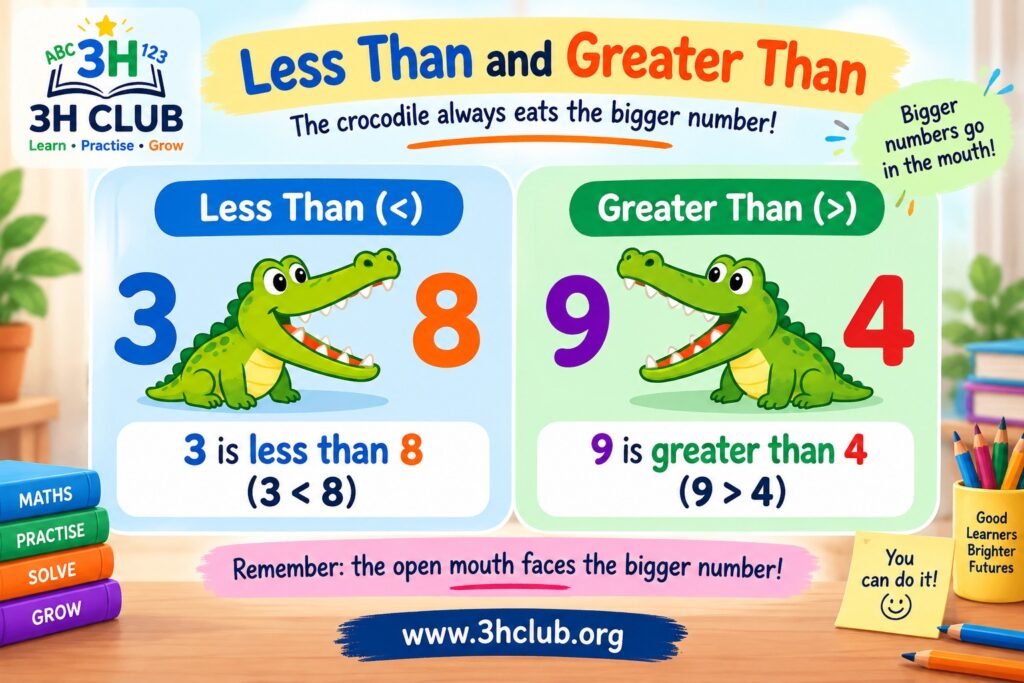
🐊 Easy Way to Remember
Imagine the symbol is a hungry crocodile mouth.
The crocodile always wants to eat the bigger number.
3 < 8
The open mouth points towards 8 because 8 is bigger.
Crocodile Less Than and Greater Than Guide
⚖️ 4. Less Than or Equal To
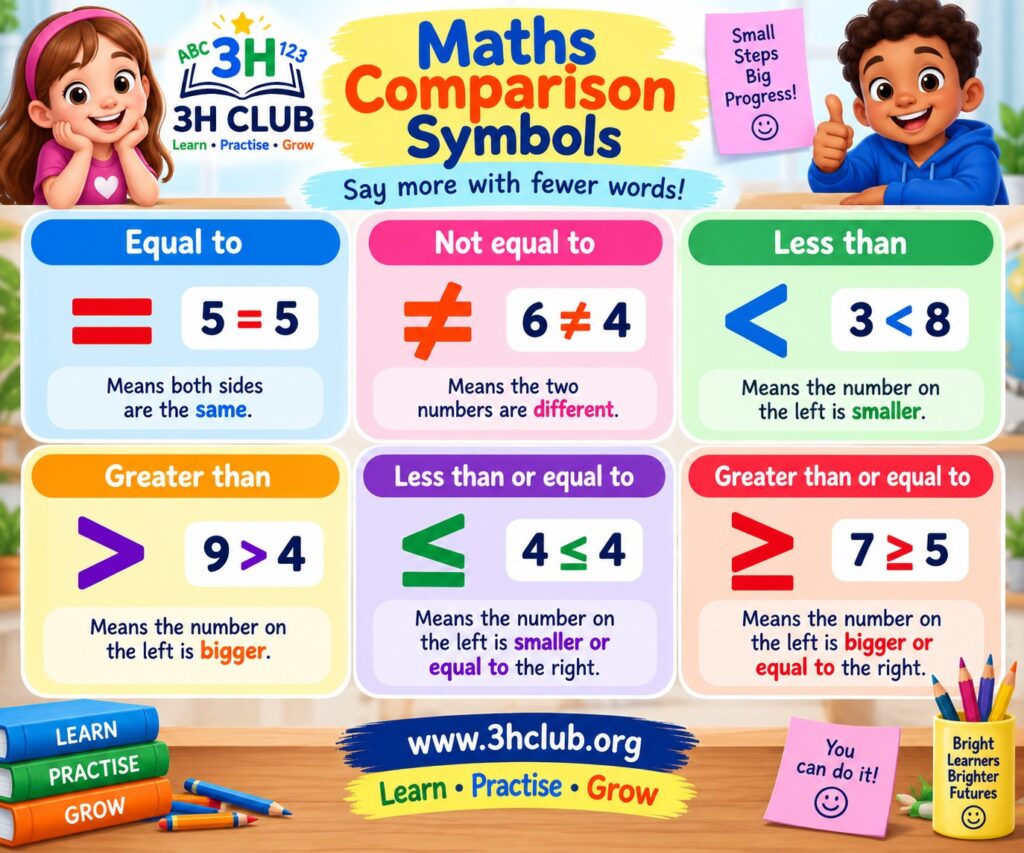
≤ means Less Than or Equal To
This means the number can be smaller than OR exactly equal to another number.
For example:
x ≤ 10
x could be:
4, 5, 6, 7, 8, 9 or 10
Example
7 ≤ 10 ✅
10 ≤ 10 ✅
12 ≤ 10 ❌
⚖️ 5. Greater Than or Equal To
≥ means Greater Than or Equal To
This means the number can be greater than OR exactly equal to another number.
For example:
x ≥ 5
x could be:
5, 6, 7, 8, 9, 10…
Examples
8 ≥ 5 ✅
5 ≥ 5 ✅
3 ≥ 5 ❌
🧠 Remember These Four
| Symbol | Read It As |
|---|---|
| < | less than |
| > | greater than |
| ≤ | less than or equal to |
| ≥ | greater than or equal to |
Another useful way to say them
≥ can also mean “not less than.”
≤ can also mean “not more than.”
Maths Comparison Symbols Chart
💰 6. Money Symbols
Maths symbols are also used when working with money.
¢ means Cents
For example:
50¢
means 50 cents.
$ means Dollars
For example:
$10
means ten dollars.
You might see:
$5.50
That means:
5 dollars and 50 cents.
🔵 7. The Decimal Point
. means Decimal Point
A decimal point separates whole numbers from parts of a whole.
For example:
2.5
means:
2 and 5 tenths
You will often see decimal points when using money.
$3.75
🌡️ 8. The Degree Symbol
° means Degrees
The degree symbol can be used when measuring temperature.
For example:
25°C
means:
25 degrees Celsius
It is also used when measuring angles.
For example:
90°
is a right angle.
💯 9. Percentage
% means Percent
Percent means “out of 100.”
For example:
50%
means:
50 out of 100
or
one half.
Examples
100% = all of something
50% = half
25% = one quarter
📐 10. The Angle Symbol
∠ means Angle
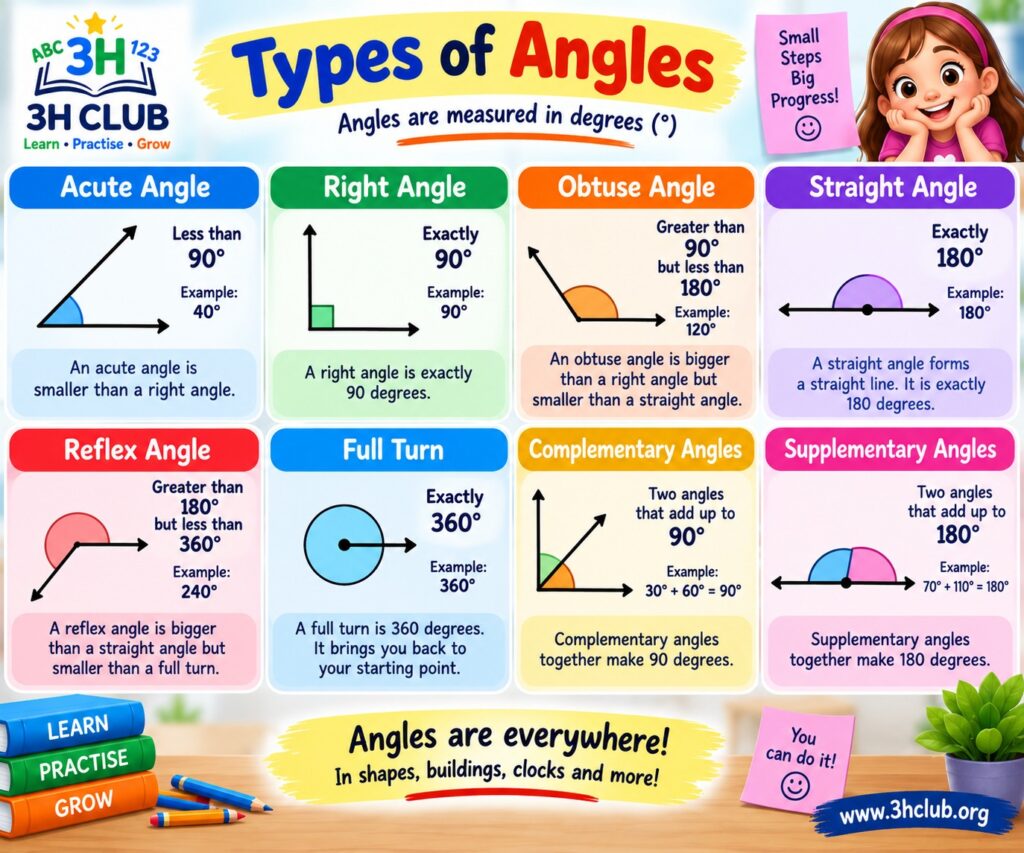
An angle is formed when two lines meet.
For example:
∠ABC
means:
angle ABC
Types of Angles for Children
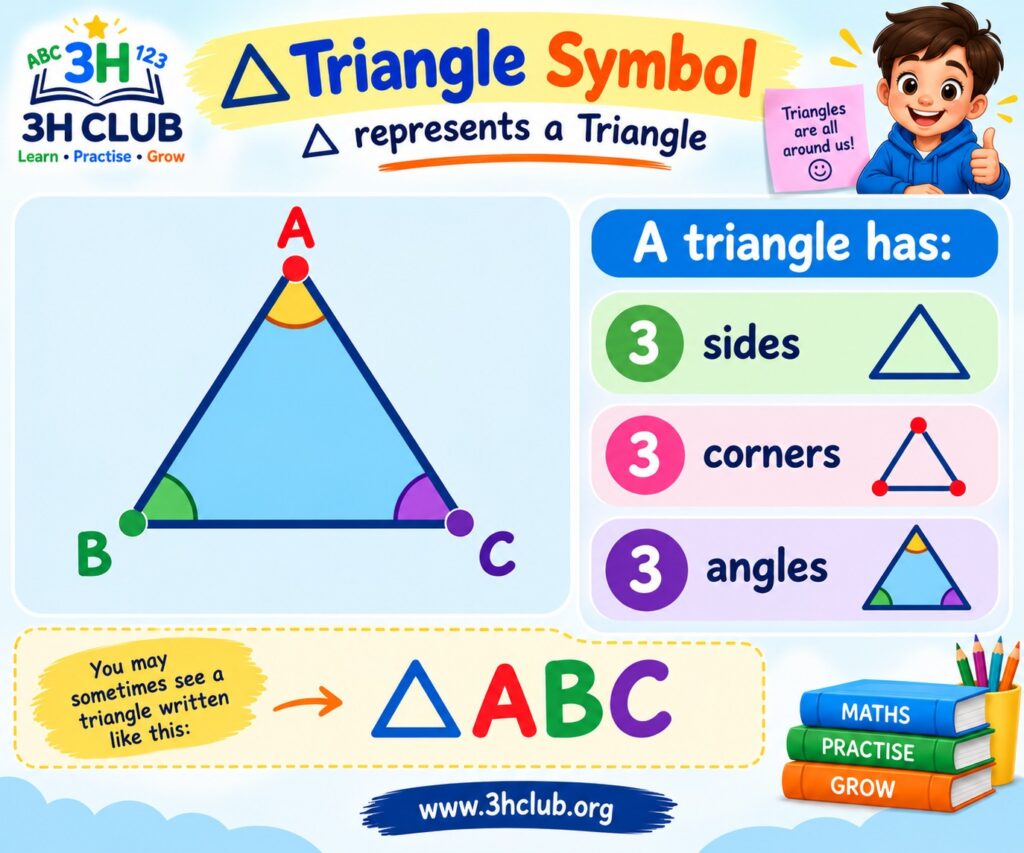
🔺 11. Triangle Symbol
△ represents a Triangle
A triangle has:
- 3 sides
- 3 corners
- 3 angles
You may sometimes see a triangle represented using:
△ABC
√ 12. Square Root
√ means Square Root
This is usually introduced to older primary-school children.
The square root asks:
“What number multiplied by itself gives this number?”
For example:
√9 = 3
because:
3 × 3 = 9
Another example:
√16 = 4
because:
4 × 4 = 16
🥧 13. Pi
π means Pi
Pi is a special number used when working with circles.
Its value begins:
π ≈ 3.14
You do not need to memorise lots of digits.
For most introductory work, remember:
π ≈ 3.14
The uploaded learning material also uses pi in its circle formula section.
🔍 14. Approximately Equal To
≈ means Approximately Equal To
Sometimes an answer is very close to a number but is not exactly the same.
We use:
≈
For example:
π ≈ 3.14
This means:
Pi is approximately 3.14.
⭐ Maths Symbols Quick Reference
| Symbol | Meaning | Example |
|---|---|---|
| = | Equal to | 5 + 5 = 10 |
| ≠ | Not equal to | 4 ≠ 9 |
| < | Less than | 3 < 8 |
| > | Greater than | 8 > 3 |
| ≤ | Less than or equal to | 5 ≤ 7 |
| ≥ | Greater than or equal to | 10 ≥ 8 |
| ¢ | Cents | 50¢ |
| $ | Dollars | $10 |
| . | Decimal point | 4.5 |
| ° | Degrees | 25°C |
| % | Percent | 50% |
| ∠ | Angle | ∠ABC |
| △ | Triangle | △ABC |
| √ | Square root | √9 = 3 |
| π | Pi | π ≈ 3.14 |
| ≈ | Approximately | 9.8 ≈ 10 |
🎮 Your Turn!
Choose the correct symbol.
Question 1
5 __ 5
Which symbol belongs in the space?
= < >
Question 2
4 __ 9
= < >
Question 3
12 __ 7
= < >
Question 4
Which symbol means not equal to?
= ≠ >
Question 5
Which symbol means percent?
$ % °
Question 6
Which symbol means approximately equal to?
≈ = √
Question 7
Fill in the missing symbol:
8 __ 8
Question 8
Fill in the missing symbol:
6 __ 10
Question 9
Fill in the missing symbol:
15 __ 9
Question 10
What does this mean?
20°C
A. 20 centimetres
B. 20 degrees Celsius
C. 20 cents
✅ Answers
1. =
2. <
3. >
4. ≠
5. %
6. ≈
7. =
8. <
9. >
10. B — 20 degrees Celsius
🏆 Challenge Time
Can you fill in the correct symbol?
25 __ 19
13 __ 13
6 __ 12
100 __ 99
45 __ 45
Bonus
What does this mean?
π ≈ 3.14
Answer:
Pi is approximately equal to 3.14.
👨👩👧 Grown-Up Tip
For younger learners, start with only:
= ≠ < >
Once your child understands these confidently, introduce:
≤ ≥
Older learners can then explore:
% ∠ √ π ≈
This avoids introducing too many unfamiliar symbols at once.
🌟 Remember
Maths symbols are like a special maths language.
Once you learn what each symbol means, maths becomes much easier to read.
Learn it. Practise it. Grow! 🌱
