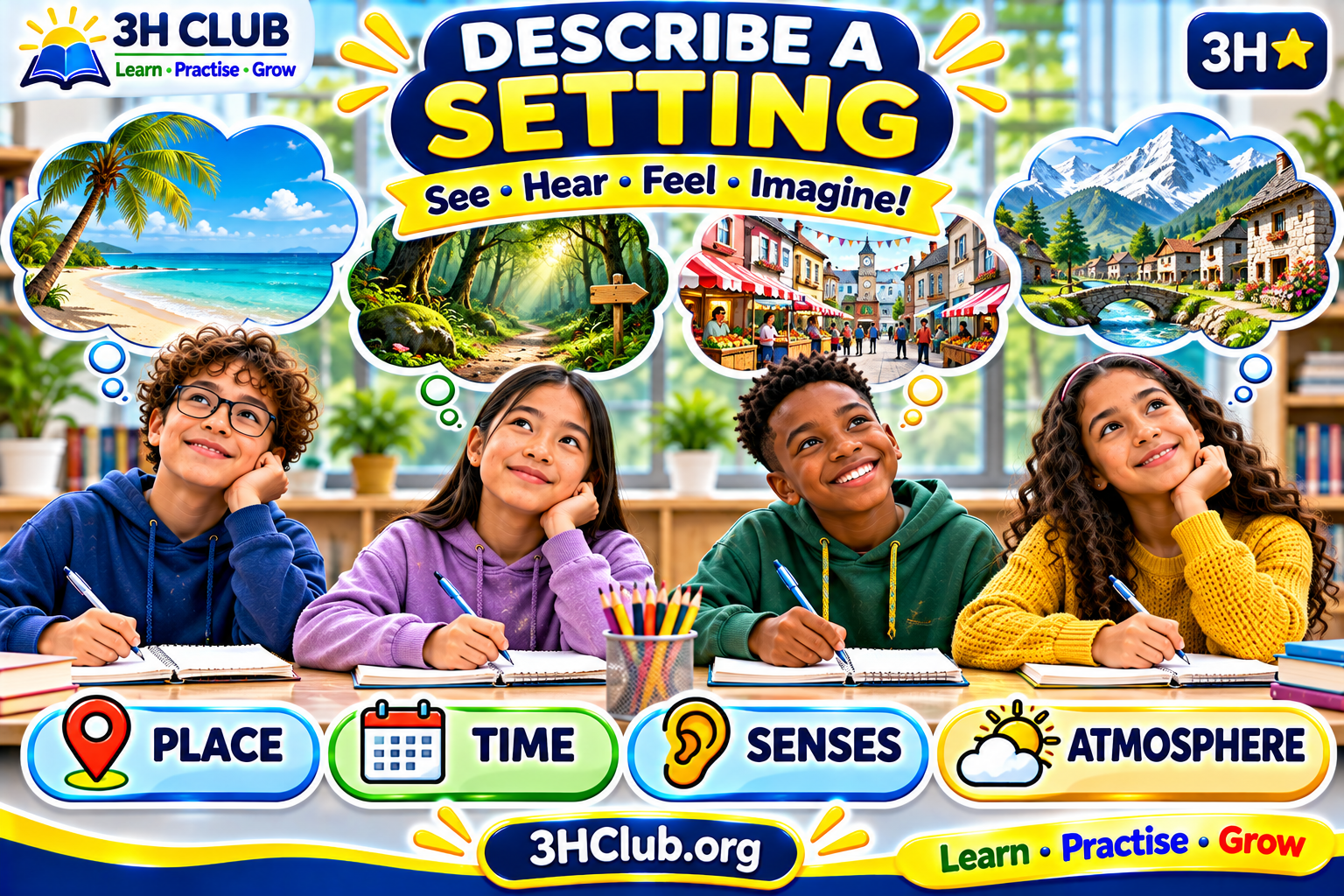
Describe a Setting:
🌍 Bring Your Story World to Life!
⭐⭐⭐ CHAMPIONS — Ages 10–11
📚 Subject: English – Creative Writing, Grammar and Storytelling
🎯 Skills: Setting descriptions, sensory language, atmosphere, figurative language, precise vocabulary, subjects, predicates, paragraph writing and editing.
🌟 Hello, Creative Writer!
Imagine opening a story and reading:
Maya walked through the forest.
You know where Maya is, but can you picture the forest?
Now read this:
Maya followed a narrow path beneath towering trees. Sunlight slipped between the branches, and damp leaves crunched beneath her boots.
Can you imagine the place more clearly?
Let’s add a little mystery:
Maya followed a narrow path beneath towering trees. Sunlight slipped between the branches, and damp leaves crunched beneath her boots. Somewhere ahead, a wooden gate creaked, although there was no wind.
Now you can picture the forest, hear its sounds and sense that something unusual might happen.
That’s the power of describing a setting!
A well-written setting can make a place feel peaceful, exciting, mysterious, crowded, cheerful or even frightening.
Today, you’ll discover how writers turn ordinary places into memorable story worlds.
You’ll also learn how to build clear sentences, choose powerful details and create descriptions that help your story move forward.
Ready to explore?
Let’s begin!
🎯 What Will You Learn?
By the end of this lesson, you will be able to:
- Explain what a story setting is.
- Identify where and when a story takes place.
- Describe settings using sensory details.
- Choose precise nouns, verbs and adjectives.
- Identify subjects and predicates in descriptive sentences.
- Expand simple sentences without losing clarity.
- Use similes and personification effectively.
- Create different moods and atmospheres.
- Show how settings affect characters.
- Organise setting details into descriptive paragraphs.
- Analyse setting descriptions in a model story.
- Plan, write and edit your own setting description.
⭐ Your goal: Create a setting that readers can imagine clearly and that adds something meaningful to your story.
⭐ STAGE 1: SETTING EXPLORERS
Understand place, time and descriptive sentences
🔵 1. What Is a Story Setting?
The setting is the place and time in which a story happens.
A setting can tell readers:
- Where the characters are.
- When the events happen.
- What the surroundings are like.
- How the place feels.
- How the environment might affect the story.
A setting could be real or imaginary.
It might be a classroom, rainforest, fishing village, busy city, desert, underwater world or distant planet.
🌴 Example: A Coastal Village
Early on Saturday morning, fishing boats rested beside the wooden jetty. Colourful houses stood along the narrow road, and the salty breeze drifted through the village.
Where: A coastal village.
When: Early on Saturday morning.
What can we see? Fishing boats, colourful houses and a wooden jetty.
What can we feel or smell? A salty breeze.
Possible atmosphere: Calm and peaceful.
✏️ Activity 1: Setting Detective
Read:
Just before sunset, Daniel arrived at the old railway station. Weeds grew between the cracked paving stones, and a loose sign rattled above the empty platform.
Answer:
- Where does the scene take place?
- When does it happen?
- Name two details that help you picture the setting.
- What sound might Daniel hear?
- What mood does the setting suggest?
- Which detail could make a reader curious?
⭐ Remember
A setting is not just a location name.
It’s the world your characters experience.
🟢 2. Explore the Five Senses
One way to create vivid descriptions is to think about the five senses.
They are:
Sight, hearing, smell, touch and taste.
You don’t need to use all five in every paragraph.
Choose the senses that make the setting feel real and suit the scene.
👀 Sight
What can your character see?
Bright fishing boats rocked gently beside the harbour.
👂 Hearing
What sounds fill the place?
Waves splashed against the stone wall.
👃 Smell
What scents might be noticeable?
The smell of freshly baked bread drifted from the nearby shop.
✋ Touch
What does the character physically feel?
Warm sand pressed beneath Leo’s feet.
👅 Taste
Can the character taste something naturally connected to the scene?
After biting into a juicy mango, Amira tasted its sweet juice.
Taste is most useful when the character is actually eating, drinking or experiencing a believable taste.
✏️ Activity 2: Sensory Sorting
Identify the main sense used in each sentence.
- The bell rang across the courtyard.
- The rough stone wall scratched Maya’s palm.
- The golden sunlight lit the hilltops.
- The smell of cinnamon filled the kitchen.
- Kai tasted the sweet pineapple juice.
✏️ Activity 3: Sensory Setting Map
Choose one place:
A. A rainforest after rain.
B. A crowded outdoor market.
C. A beach at sunrise.
D. An old library.
Write at least one detail for four different senses.
Then use your favourite three details to write a short descriptive paragraph.
⭐ Writing Tip
Sensory details should belong naturally in your setting.
Don’t force a smell, taste or sound into a scene just to complete a list.

🟡 3. Choose Precise Words
Strong descriptions often use precise words.
A precise word gives the reader a clearer picture.
Compare:
The building was big.
The enormous stone building towered above the narrow street.
The second sentence gives us more information about the building’s size, material and surroundings.
Powerful Nouns
Instead of place, you might write:
harbour, courtyard, pathway, meadow, marketplace, cave or valley.
Precise Verbs
Instead of went, you might write:
hurried, wandered, climbed, crept, marched or stumbled.
Instead of made a noise, you might write:
rattled, whispered, splashed, rustled or echoed.
Useful Adjectives
Adjectives can describe the qualities of nouns.
Examples:
cracked pavement, narrow alley, misty valley, crowded market, weathered door.
But too many adjectives can make a sentence difficult to read.
Compare
Overloaded: The huge, enormous, gigantic, massive, ancient, old building stood there.
Improved: The enormous stone building stood at the end of the deserted street.
The improved sentence is clearer.
✏️ Activity 4: Word Upgrade
Replace the general word or phrase with something more precise.
- The big tree stood beside the river.
- The leaves made a noise in the wind.
- Maya went along the narrow path.
- The nice flowers grew beside the gate.
- The old door made a noise as it opened.
✏️ Activity 5: Choose the Stronger Description
Choose the description that helps you imagine the scene more clearly.
- A. The road was there.
B. The winding road disappeared between the green hills. - A. The market was busy.
B. Traders called across the crowded market as shoppers moved between colourful stalls. - A. It was a nice day.
B. Golden sunlight warmed the quiet courtyard.
Explain why each chosen sentence is more effective.
🔵 4. Build Descriptions with Subjects and Predicates
Clear setting descriptions depend on complete sentences.
A sentence usually has a subject and a predicate.
🟦 Subject — Who or What?
The subject tells us who or what the sentence is about.
The tall palm trees swayed beside the beach.
Subject: The tall palm trees
🟩 Predicate — What Is Said About the Subject?
The predicate tells us what the subject does, is or experiences.
The tall palm trees swayed beside the beach.
Predicate: swayed beside the beach
🧩 Subject + Predicate
| Subject | Predicate | Complete Sentence |
|---|---|---|
| The silver moon | shone above the village. | The silver moon shone above the village. |
| Gentle waves | splashed against the rocks. | Gentle waves splashed against the rocks. |
| The narrow pathway | disappeared into the forest. | The narrow pathway disappeared into the forest. |
| A distant bell | echoed through the town. | A distant bell echoed through the town. |
| The marketplace | was crowded with shoppers. | The marketplace was crowded with shoppers. |
✏️ Activity 6: Find the Subject and Predicate
Identify the complete subject and predicate.
- The ancient trees surrounded the quiet lake.
- A cool breeze moved through the open window.
- The colourful market stalls lined the busy street.
- Tiny raindrops glittered on the leaves.
- The narrow bridge stretched across the river.
✏️ Activity 7: Complete the Description
Add a predicate to each subject.
- The distant mountains __________.
- A narrow footpath __________.
- The wooden shutters __________.
- Brightly coloured boats __________.
- The empty playground __________.
Make sure your sentences express complete thoughts.
🟢 5. Expand a Simple Setting Sentence
You can begin with a simple sentence and gradually add useful details.
Step 1: Start with a Complete Sentence
The river flowed.
Subject: The river
Predicate: flowed
Step 2: Add a Precise Description
The wide river flowed.
Step 3: Add a Place Detail
The wide river flowed between the green hills.
Step 4: Add a Sensory Detail
The wide river flowed between the green hills, its rushing water echoing through the valley.
Each step adds information while keeping the main idea clear.
✏️ Activity 8: Sentence Expansion
Expand these sentences in stages.
- The wind blew.
- The market opened.
- The forest was quiet.
- The waves crashed.
- The street was empty.
For each sentence, add:
- One precise describing word.
- One place or time detail.
- One useful sensory detail.
⭐ Sentence Tip
Longer doesn’t always mean better.
Your goal is a clear sentence that helps the reader imagine something important.
⭐⭐ STAGE 2: SETTING DESIGNERS
Create atmosphere, movement and meaning
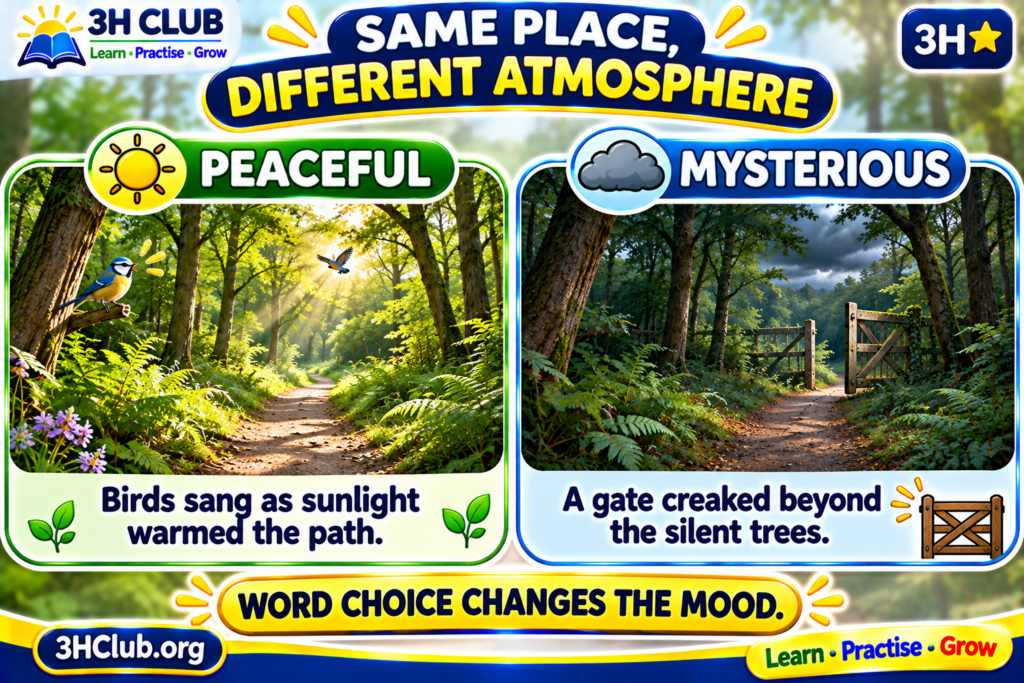
🟣 6. What Is Atmosphere?
Atmosphere is the feeling or mood created by a setting.
The same place can feel different depending on the details a writer chooses.
🌳 A Peaceful Forest
Sunlight filtered through the trees. Birds sang above the quiet path, and a gentle breeze stirred the ferns.
This setting feels calm and welcoming.
🌳 A Mysterious Forest
Dark branches stretched across the narrow path. Somewhere in the distance, a twig snapped. The trees stood silent.
This setting feels mysterious and tense.
Both descriptions could be about the same forest.
The atmosphere changes because the writer chooses different details.
✏️ Activity 9: Mood Detective
Identify the most likely atmosphere.
- Colourful lanterns glowed while cheerful music filled the square.
- The abandoned corridor echoed with slow, uneven footsteps.
- Soft waves rolled onto the shore beneath a golden sunrise.
- Thunder rumbled as dark clouds gathered above the valley.
- Children laughed while bright flags fluttered over the playground.
Word bank: peaceful, cheerful, mysterious, tense, joyful
Some words can overlap. Explain which details support your choice.
✏️ Activity 10: Change the Mood
Describe the same garden in two different ways.
Version A: Make the garden feel peaceful.
Version B: Make the garden feel mysterious.
Use three or four sentences for each version.
Try changing the light, sounds, movement and word choices.
🔵 7. Use Similes to Create Pictures
A simile compares two things using like or as.
Similes help readers imagine something in a fresh way.
Examples
The lake shone like polished glass.
The clouds drifted across the sky like enormous white sails.
The old gate creaked like a tired wooden ship.
A good simile makes the description clearer or more memorable.
✏️ Activity 11: Create Similes
Complete these similes.
- The moon glowed like __________.
- The rain sounded like __________.
- The mist covered the valley like __________.
- The river twisted like __________.
- The stars sparkled like __________.
⭐ Simile Tip
Choose comparisons that make sense.
A surprising comparison can be effective, but it should still help your reader imagine the scene.
🟢 8. Try Personification
Personification gives human-like actions or qualities to something that is not human.
Writers often use it to describe nature, buildings or objects.
Examples
The wind whispered through the trees.
The old house watched over the empty street.
The waves danced along the shore.
The wind doesn’t literally whisper, and a house doesn’t really watch.
These expressions create imaginative pictures.
✏️ Activity 12: Personification Challenge
Write one sentence using personification for each.
- The wind.
- The sun.
- The river.
- The old wooden gate.
- The rain.
Example: The rain drummed impatiently on the roof.
⭐ Remember
Figurative language is a tool, not a requirement.
A clear, direct sentence may work better than a simile or personification.
🟡 9. Show How the Setting Affects the Character
A setting can influence what a character does, feels or decides.
Imagine a character crossing a bridge.
Example A: Safe and Sunny
Warm sunlight covered the wooden bridge. Daniel crossed slowly, stopping to admire the clear river below.
Example B: Windy and Difficult
Strong winds shook the wooden bridge. Daniel gripped the railing and moved carefully towards the other side.
The setting changes Daniel’s actions.
✏️ Activity 13: Setting and Reaction
Choose a setting and describe how a character reacts.
- A crowded market.
- A dark cave.
- A peaceful beach.
- A stormy hillside.
- A quiet library.
Write three sentences:
Sentence 1: Describe the setting.
Sentence 2: Show the character’s reaction.
Sentence 3: Explain or suggest what the character does next.
⭐ Writing Tip
Instead of always telling the reader that a place is frightening or exciting, show how the character responds to it.
🟣 10. Move from Wide View to Small Details
Writers sometimes describe a setting as though they are moving a camera.
They begin with the wider scene, then focus on something specific.
🎥 Example: The Harbour
Wide view: The harbour stretched along the edge of the town.
Closer view: Fishing boats rocked beside the wooden jetty.
Small detail: A frayed blue rope tapped against a weathered post.
Character connection: Maya followed the sound and noticed a folded note caught beneath the rope.
The description gradually guides our attention towards something important.
✏️ Activity 14: The Setting Camera
Choose one location:
- A rainforest.
- A school courtyard.
- A mountain village.
- A seaside market.
Write four sentences following this sequence:
- Wide view: What does the whole place look like?
- Closer view: What is happening in one part?
- Small detail: What does your character notice?
- Story connection: Why might the detail matter?
⭐⭐⭐ STAGE 3: SETTING MASTERS
Analyse, write and improve powerful descriptions
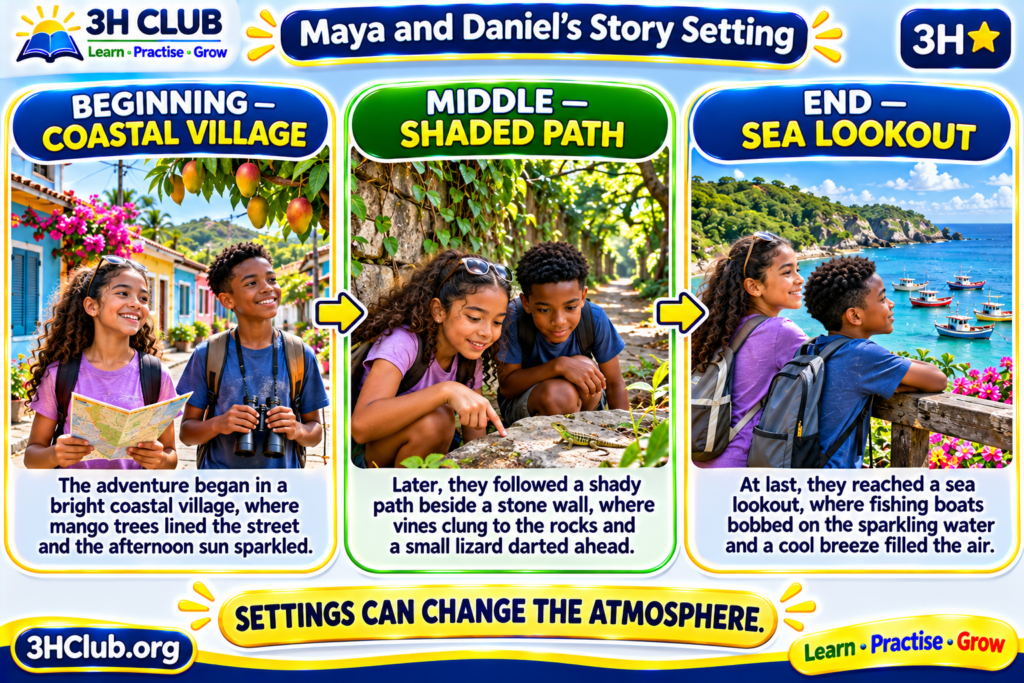
📖 11. Model Story: The Path Beyond the Mango Trees
Read the following story carefully.
Pay attention to how the setting helps create atmosphere and guides the characters towards a discovery.
🌳 The Path Beyond the Mango Trees
Beginning: A Familiar Place
The afternoon sun shone over the small coastal village. Brightly painted houses stood beside the winding road, and the salty breeze carried the distant sound of waves.
Maya and Daniel were helping Maya’s grandmother tidy the garden behind her house.
Beyond the garden fence, several tall mango trees shaded a narrow path.
“I’ve never walked along that path,” Daniel said.
Maya glanced towards the trees.
“Grandma says it leads to an old lookout point,” she replied. “We could ask if we’re allowed to explore it.”
A few minutes later, with permission and clear directions from Maya’s grandmother, they set off together.
Middle: The Changing Path
At first, the path felt welcoming.
Golden sunlight slipped through the leaves. Small birds called from the branches, and the air smelled of damp earth and ripe mangoes.
Maya stepped over a fallen branch.
“Look at these old stones,” she said, pointing towards the edge of the path.
The stones formed a low wall that disappeared beneath thick green vines.
As the children walked farther, the trees grew closer together. The sunlight faded, and the air became cooler.
A sudden rustle came from the bushes.
Daniel stopped.
“Did you hear that?”
Maya nodded. She listened carefully.
A small lizard darted across the path and vanished beneath a rock.
Daniel laughed quietly.
“I thought it was something much bigger!”
They continued, following the directions they had been given.
Soon, the path curved around a rocky hillside.
Through a gap in the trees, Maya noticed something pale against the dark stones.
It was a weathered wooden sign.
End: The Lookout
The sign pointed towards a short set of stone steps.
At the top stood an old lookout platform, safely enclosed by a sturdy railing.
Beyond it, the sea stretched towards the horizon.
Fishing boats dotted the sparkling water, and white waves curled around the rocky shore.
For a moment, neither child spoke.
“It’s beautiful,” Daniel whispered.
Maya smiled.
The narrow path had seemed mysterious beneath the trees, but it had led them to a wonderful view of the village and the sea.
She took out her notebook and began sketching the coastline.
🔍 Setting Detective
| Story Element | Evidence |
|---|---|
| Main setting | A coastal village and a wooded path |
| Time | Afternoon |
| Peaceful atmosphere | Sunlight, birdsong and sea breeze |
| Mysterious atmosphere | Fading light, close trees and rustling bushes |
| Sight details | Painted houses, vines, old stones and fishing boats |
| Sound details | Waves, birds and rustling bushes |
| Smell details | Damp earth and ripe mangoes |
| Touch or temperature | Cooler air beneath the trees |
| Character reaction | Daniel stops when he hears rustling |
| Setting change | Open village → shaded path → coastal lookout |
📖 Reading Comprehension Questions
- Where does the story begin?
- What are Maya and Daniel doing?
- What lies beyond the garden fence?
- Why do they ask Maya’s grandmother before exploring?
- Name two sensory details from the beginning of the walk.
- How does the atmosphere change as they move farther along the path?
- What causes Daniel to stop?
- What actually makes the rustling sound?
- What do the children discover near the hillside?
- What can they see from the lookout?
- Why is the final setting different from the middle of the story?
- Which descriptive sentence is your favourite, and why?
✏️ Activity 15: Find the Writer’s Techniques
Find an example of:
- A sight detail.
- A sound detail.
- A smell detail.
- A temperature detail.
- A precise verb.
- A sentence that creates mystery.
- A detail that shows the setting affecting a character.
- A sentence that creates a peaceful atmosphere.
✏️ Activity 16: Subject and Predicate Challenge
Identify the complete subject and predicate.
- The afternoon sun shone over the village.
- Several tall mango trees shaded the narrow path.
- Golden sunlight slipped through the leaves.
- A small lizard darted across the path.
- Fishing boats dotted the sparkling water.
🧠 Think More Deeply
- Why does the writer begin with a familiar, welcoming setting?
- How does the change in light affect the atmosphere?
- Why is the rustling sound effective even though it comes from a harmless lizard?
- How does the final view reward the characters’ exploration?
- Would the story feel different if it happened at night?
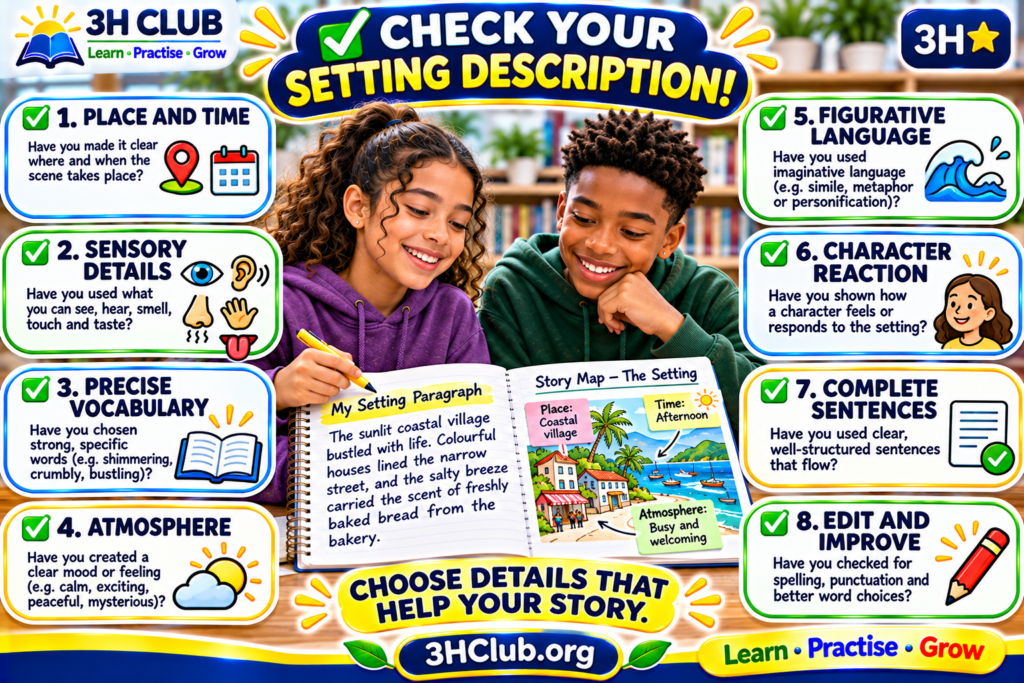
✍️ 12. Plan Your Own Setting Description
Before you write, decide what kind of place you want to create.
📝 My Setting Planner
Setting name: The Forgotten Garden
Place: Behind an old village library
Time: Late afternoon
Weather: Warm with a light breeze
Atmosphere: Peaceful but slightly mysterious
Sight: Tall sunflowers, mossy stones, a narrow wooden gate
Sound: Rustling leaves and distant birds
Smell: Damp earth and flowering plants
Touch: Rough wood beneath the character’s fingers
Important detail: A tiny silver bell hanging beside the gate
Character’s reaction: Curious but cautious
Possible story event: The bell rings even though nobody touches it
✏️ Activity 17: Create Your Setting Plan
Choose a location:
A. A deserted lighthouse beside the sea.
B. A busy market just before a festival.
C. A mountain village after snowfall.
D. A tropical rainforest after heavy rain.
E. A hidden courtyard behind an old building.
Complete:
Place: __________
Time: __________
Weather or lighting: __________
Atmosphere: __________
Three sight details: __________
Two sound details: __________
One smell or touch detail: __________
An important object or feature: __________
Character’s reaction: __________
What might happen here: __________
🟢 13. Organise Your Description into a Paragraph
A strong setting paragraph usually focuses on one clear idea or scene.
You can organise it in a helpful order:
1. Establish the place and time.
2. Describe the wider surroundings.
3. Add a few important sensory details.
4. Focus on a meaningful object, action or change.
5. Connect the setting to the character or story.
Example: The Forgotten Garden
Late in the afternoon, Maya stepped into the forgotten garden behind the village library. Tall sunflowers leaned over the narrow path, while moss-covered stones surrounded a small fountain. A gentle breeze rustled the leaves, carrying the fresh smell of damp earth. Near the far wall, a tiny silver bell hung beside a wooden gate. Maya reached towards the bell, but before she touched it, a soft ringing sound filled the garden.
Why Does This Paragraph Work?
- It introduces the place and time.
- It gives the reader a clear picture.
- It includes sound and smell.
- It focuses on one unusual detail.
- It connects the setting to Maya’s actions.
- It creates curiosity.
✏️ Activity 18: Write a Setting Paragraph
Using your planner, write six to eight sentences.
Include:
- A clear place and time.
- At least three sensory details.
- Two precise verbs.
- A consistent atmosphere.
- One important object or feature.
- A character’s reaction.
Try to keep your details connected rather than listing everything in the setting.
🟡 14. Combine and Vary Your Sentences
If every sentence has the same pattern, your description may sound repetitive.
Repetitive Version
The forest was dark. The trees were tall. The path was narrow. The wind was cold.
Improved Version
Tall trees surrounded the narrow forest path. Beneath their branches, the fading light left deep shadows across the ground. A cold wind moved through the leaves.
The improved version varies the sentence structure and connects related details.
Sentence Combining
Two sentences:
The rain stopped. The streets glistened.
Combined sentence:
When the rain stopped, the streets glistened.
In the combined sentence, the streets is the subject of the main clause, and glistened is its predicate.
The opening clause, When the rain stopped, also contains a subject and a predicate, but it depends on the main clause to complete the thought.
✏️ Activity 19: Improve Sentence Flow
Rewrite each pair as one clear sentence.
- The sun disappeared. The valley grew darker.
- The waves crashed. The rocks became wet.
- The market opened. The streets filled with shoppers.
- The wind grew stronger. The leaves scattered.
- The rain ended. The birds began to sing.
You can use words such as when, as, while, after or because.
Check that the relationship between events makes sense.
🔍 15. Edit and Improve Your Setting Description
Good writers don’t stop after their first draft.
They read their work again and decide what to improve.
First Draft
The beach was nice. The water was blue. The sand was hot. There were boats.
Improved Draft
Morning sunlight sparkled across the turquoise water. Small fishing boats rocked beyond the gentle waves, and the warm sand shifted beneath Leo’s feet. From the nearby jetty came the steady tapping of ropes against wooden posts.
What Improved?
The writer:
- Replaced general words with precise descriptions.
- Added movement and sound.
- Included a touch detail.
- Varied sentence beginnings.
- Helped the reader picture a specific place.
✏️ Activity 20: Setting Editor
Improve this description:
The forest was big. The trees were green. It was quiet. Maya walked. She saw a house.
Try to include:
- A clearer time of day.
- More precise nouns and verbs.
- Two sensory details.
- A consistent atmosphere.
- An interesting description of the house.
- A character reaction.
🎲 16. Five Fun Setting Description Games
🎯 Game 1: Sensory Detective
Choose a place you know well.
Write five clues about it without naming the place.
Use sight, sound, smell or touch.
Ask someone to guess your setting.
🎭 Game 2: Mood Switch
Describe a school corridor in three sentences.
First, make it feel cheerful.
Then rewrite it to feel mysterious.
Notice how your word choices change.
🧩 Game 3: Setting Word Challenge
Choose one general word:
big, nice, went, loud, old
Replace it with a more precise word in a descriptive sentence.
Explain how your new word improves the picture.
🎥 Game 4: Setting Camera
Imagine a camera moving through a place.
Write:
- One wide-view sentence.
- One closer-view sentence.
- One small-detail sentence.
- One sentence showing why the detail matters.
🌦️ Game 5: Weather Changes Everything
Choose one location.
Describe it on a sunny day.
Then describe the same location during heavy rain.
How do the sounds, colours, movement and character reactions change?
🏆 17. Final Setting Champions Challenge
Part A: Setting Knowledge
Choose the correct answer.
1. What does a story setting describe?
A. Only the main character’s name.
B. Where and when the story happens, and what the surroundings are like.
C. Only the ending of the story.
2. What is atmosphere?
A. The feeling or mood created by the setting.
B. The number of characters in a story.
C. The title of a story.
3. Why do writers use sensory details?
A. To make every sentence longer.
B. To help readers imagine and experience the setting.
C. To avoid describing the characters.
Part B: Identify the Sense
Write the main sense.
- The wooden floor creaked beneath Maya’s feet.
- The sweet smell of ripe mangoes filled the air.
- The stone steps felt cold beneath Daniel’s hands.
- Bright lanterns glowed above the market.
- The warm soup tasted of pumpkin and herbs.
Part C: Figurative Language
Identify each sentence as a simile, personification or literal description.
- The lake shone like a mirror.
- The wind whispered through the branches.
- The stone wall surrounded the garden.
- The clouds drifted like white sails.
- The old gate groaned in the wind.
Part D: Subject and Predicate
Identify the complete subject and predicate.
- The enormous waves crashed against the rocks.
- A narrow pathway wound through the valley.
- The ancient clock tower stood above the square.
- Soft golden sunlight covered the garden.
Part E: Create Atmosphere
Rewrite this sentence to create a mysterious mood:
The house stood beside the road.
Add two useful details.
Part F: Improve the Description
Rewrite this paragraph:
The town was busy. There were shops. People walked around. It was hot.
Use:
- More precise vocabulary.
- Two sensory details.
- A clear atmosphere.
- Complete sentences.
⭐ Final Creative Writing Mission
Write a setting description titled:
The Place Nobody Had Explored
Your description should include:
- A clear place and time.
- An interesting atmosphere.
- At least three sensory details.
- Precise nouns and verbs.
- One simile or example of personification, if it improves your writing.
- A character reacting to the surroundings.
- A small detail that could lead to a story.
Aim for two paragraphs of approximately six to eight sentences each.
In the first paragraph, introduce the wider setting.
In the second paragraph, focus on a detail that changes the atmosphere or catches the character’s attention.
Then read your work aloud and edit it.
✅ 18. Check Your Answers!
Activity 1: Setting Detective
- An old railway station.
- Just before sunset.
- Cracked paving stones, weeds and a loose sign.
- The rattling sign.
- Possible answer: Lonely, mysterious or abandoned.
- Possible answer: The empty platform or the loose sign.
Activity 2: Sensory Sorting
- Hearing.
- Touch.
- Sight.
- Smell.
- Taste.
Activity 3: Sensory Setting Map
Answers will vary.
Possible example:
The rainforest glistened after the rain. Water dripped from broad leaves, and damp earth scented the cool air. A bright green frog rested beside the muddy path.
Activity 4: Word Upgrade
Possible answers:
- The enormous tree stood beside the river.
- The leaves rustled in the wind.
- Maya crept along the narrow path.
- Bright wildflowers grew beside the gate.
- The old door creaked as it opened.
Activity 5: Stronger Descriptions
- B.
- B.
- B.
Each provides more specific details than the alternative.
Activity 6: Subjects and Predicates
| Complete Subject | Complete Predicate |
|---|---|
| The ancient trees | surrounded the quiet lake |
| A cool breeze | moved through the open window |
| The colourful market stalls | lined the busy street |
| Tiny raindrops | glittered on the leaves |
| The narrow bridge | stretched across the river |
Activity 7: Complete the Description
Possible answers:
- The distant mountains rose above the valley.
- A narrow footpath wound between the trees.
- The wooden shutters rattled in the wind.
- Brightly coloured boats rocked beside the jetty.
- The empty playground stood silent beneath the cloudy sky.
Activity 8: Sentence Expansion
Possible answer:
Original: The wind blew.
Expanded: The cold evening wind swept through the narrow street, rattling the loose wooden shutters.
Other answers will vary.
Activity 9: Mood Detective
Possible answers:
- Cheerful.
- Mysterious.
- Peaceful.
- Tense.
- Joyful.
Activity 10: Change the Mood
Answers will vary.
Peaceful example: Warm sunlight fell across the garden. Butterflies moved between the flowers, and a gentle breeze stirred the leaves.
Mysterious example: Long shadows covered the garden path. A wooden gate creaked behind the tall hedges, although no one was nearby.
Activity 11: Similes
Possible answers:
- The moon glowed like a silver lantern.
- The rain sounded like hundreds of tiny footsteps.
- The mist covered the valley like a soft grey blanket.
- The river twisted like a winding ribbon.
- The stars sparkled like scattered diamonds.
Activity 12: Personification
Possible answers:
- The wind whispered through the trees.
- The sun smiled down on the village.
- The river hurried towards the sea.
- The old wooden gate groaned as it opened.
- The rain danced across the rooftop.
Activity 13: Setting and Reaction
Answers will vary.
Possible answer:
Thunder echoed above the rocky hillside. Maya pulled her raincoat closer and looked towards the shelter. She hurried along the marked path before the rain grew heavier.
Activity 14: Setting Camera
Answers will vary.
Possible example:
The mountain village rested between two green valleys. Small houses surrounded the central square. Beside the fountain, an old wooden sign leaned against a stone wall. Maya noticed that someone had painted a fresh arrow on the sign.
Reading Comprehension: The Path Beyond the Mango Trees
- A small coastal village, in Maya’s grandmother’s garden.
- Helping tidy the garden.
- Tall mango trees and a narrow path.
- To make sure exploring the path is permitted and safe.
- Possible answers: Golden sunlight, birdsong, damp earth or ripe mangoes.
- It becomes cooler, darker and more mysterious.
- A rustling sound in the bushes.
- A small lizard.
- A weathered wooden sign pointing towards stone steps.
- The sea, fishing boats, waves and coastline.
- The lookout is open, bright and peaceful, while the shaded path feels enclosed and mysterious.
- Answers will vary.
Activity 15: Writer’s Techniques
Possible answers:
- Brightly painted houses.
- Birds calling from the branches.
- The smell of damp earth and ripe mangoes.
- The air becomes cooler.
- Darted, glanced or vanished.
- The trees grow closer together and the sunlight fades.
- Daniel stops when he hears the rustling.
- The sea sparkles beyond the lookout.
Activity 16: Subjects and Predicates
| Complete Subject | Complete Predicate |
|---|---|
| The afternoon sun | shone over the village |
| Several tall mango trees | shaded the narrow path |
| Golden sunlight | slipped through the leaves |
| A small lizard | darted across the path |
| Fishing boats | dotted the sparkling water |
Activity 17: Setting Planner
Answers will vary. Check that the chosen sensory details and atmosphere suit the place.
Activity 18: Setting Paragraph
Answers will vary. Look for a clear location, connected details, complete sentences and a consistent mood.
Activity 19: Improve Sentence Flow
Possible answers:
- As the sun disappeared, the valley grew darker.
- As the waves crashed against the rocks, water splashed across their surfaces.
- When the market opened, the streets filled with shoppers.
- As the wind grew stronger, the leaves scattered across the path.
- After the rain ended, the birds began to sing.
Activity 20: Setting Editor
Possible answer:
Late in the afternoon, Maya followed a narrow path through the enormous forest. Tall trees stretched above her, blocking much of the fading sunlight. Dry leaves crunched beneath her boots, and a cool breeze moved through the branches. Beyond a cluster of moss-covered rocks stood a small wooden house with cracked windows. Maya stopped, wondering why someone had built a house so far from the village.
Final Challenge: Part A
- B.
- A.
- B.
Final Challenge: Part B
- Hearing.
- Smell.
- Touch.
- Sight.
- Taste.
Final Challenge: Part C
- Simile.
- Personification.
- Literal description.
- Simile.
- Personification.
Final Challenge: Part D
| Complete Subject | Complete Predicate |
|---|---|
| The enormous waves | crashed against the rocks |
| A narrow pathway | wound through the valley |
| The ancient clock tower | stood above the square |
| Soft golden sunlight | covered the garden |
Final Challenge: Part E
Possible answer:
The abandoned house stood beside the empty road, its dark windows hidden behind tangled vines. A loose shutter tapped against the wall in the evening wind.
Final Challenge: Part F
Possible answer:
The busy town square shimmered beneath the midday sun. Colourful market stalls lined the narrow streets, while traders called out to passing shoppers. The smell of freshly baked bread drifted from a nearby bakery. Bright umbrellas sheltered people from the heat.
⭐ Final Creative Writing Mission: Example
The Place Nobody Had Explored
Late in the afternoon, Maya stood at the edge of a forgotten valley. Tall green hills surrounded the narrow entrance, and a shallow stream twisted between moss-covered stones. The air smelled of damp earth and wildflowers. Above her, birds circled in the golden sunlight. A gentle breeze moved through the long grass, making it ripple like waves across a green sea. Maya adjusted her backpack and followed the stream towards a cluster of ancient trees.
Beyond the trees, the valley grew strangely quiet. The sunlight faded beneath the thick branches, and the ground became cool and soft. Maya noticed a line of flat stones leading towards a rocky wall. At the end of the stones stood a narrow wooden door, almost hidden beneath climbing vines. She stopped and listened. From somewhere behind the door came a soft, steady tapping sound. Maya leaned closer, wondering who—or what—could be on the other side.
🎉 Excellent work, Setting Champion!
You’ve learnt how to describe places, create atmosphere, strengthen sentences and use setting details to support a story.
🌈 19. What Have You Learnt?
🌍 Setting Creates a Story World
It tells us where and when the story happens and helps readers imagine the surroundings.
👀 Sensory Details Bring Places to Life
Use sight, sound, smell, touch and taste when they naturally fit the scene.
✏️ Precise Words Create Clear Pictures
Choose specific nouns, verbs and adjectives instead of adding unnecessary words.
🌦️ Atmosphere Shapes How a Place Feels
Light, weather, sound and word choice can make a setting peaceful, cheerful, tense or mysterious.
🎭 Settings Can Affect Characters
Surroundings can influence a character’s actions, feelings and decisions.
🧩 Complete Sentences Support Strong Writing
SUBJECT + PREDICATE = COMPLETE SENTENCE
⭐ The Setting Description Formula
PLACE + TIME + SENSORY DETAILS + ATMOSPHERE + STORY PURPOSE = A MEMORABLE SETTING
This is a helpful planning guide, not a rule that every description must follow exactly.
🌟 Keep Learning with 3HClub!
You now have the skills to turn an ordinary place into a setting that readers can imagine.
Remember:
Choose a clear place and time.
Notice the details that matter.
Use precise words.
Create an atmosphere.
Show how your character experiences the setting.
And revise your sentences until every detail has a purpose.
📚 Your Next Learning Adventures
- Create a Story Character
- How to Write a Story Opening
- Beginning, Middle and End of a Story
- How to Write a Paragraph for Kids
- Making a Sentence More Interesting
- Subject and Predicate
- Adjectives for Kids
- Making Inferences
- Cause and Effect
- Writing a Story Ending
⭐ Your Setting Writer Promise
I can describe a place clearly.
I can use sensory details.
I can choose precise vocabulary.
I can create atmosphere.
I can connect setting to character.
I can write complete sentences.
I can edit and improve my descriptions.
Keep imagining, exploring and writing!
3H CLUB — Learn • Practise • Grow