Factorization for Kids:
🔢 Learn Factors, Factor Pairs and Prime Numbers!
⭐ Starters — Ages 6–7 | ⭐⭐ Builders — Ages 8–9 | ⭐⭐⭐ Champions — Ages 10–11
📚 Subject: Mathematics – Numbers, Multiplication, Division and Factorization
🎯 Skills: Equal groups, arrays, factor pairs, divisibility, prime and composite numbers, factor trees, prime factorization, highest common factor and problem-solving.
🌟 Hello, Young Mathematician!
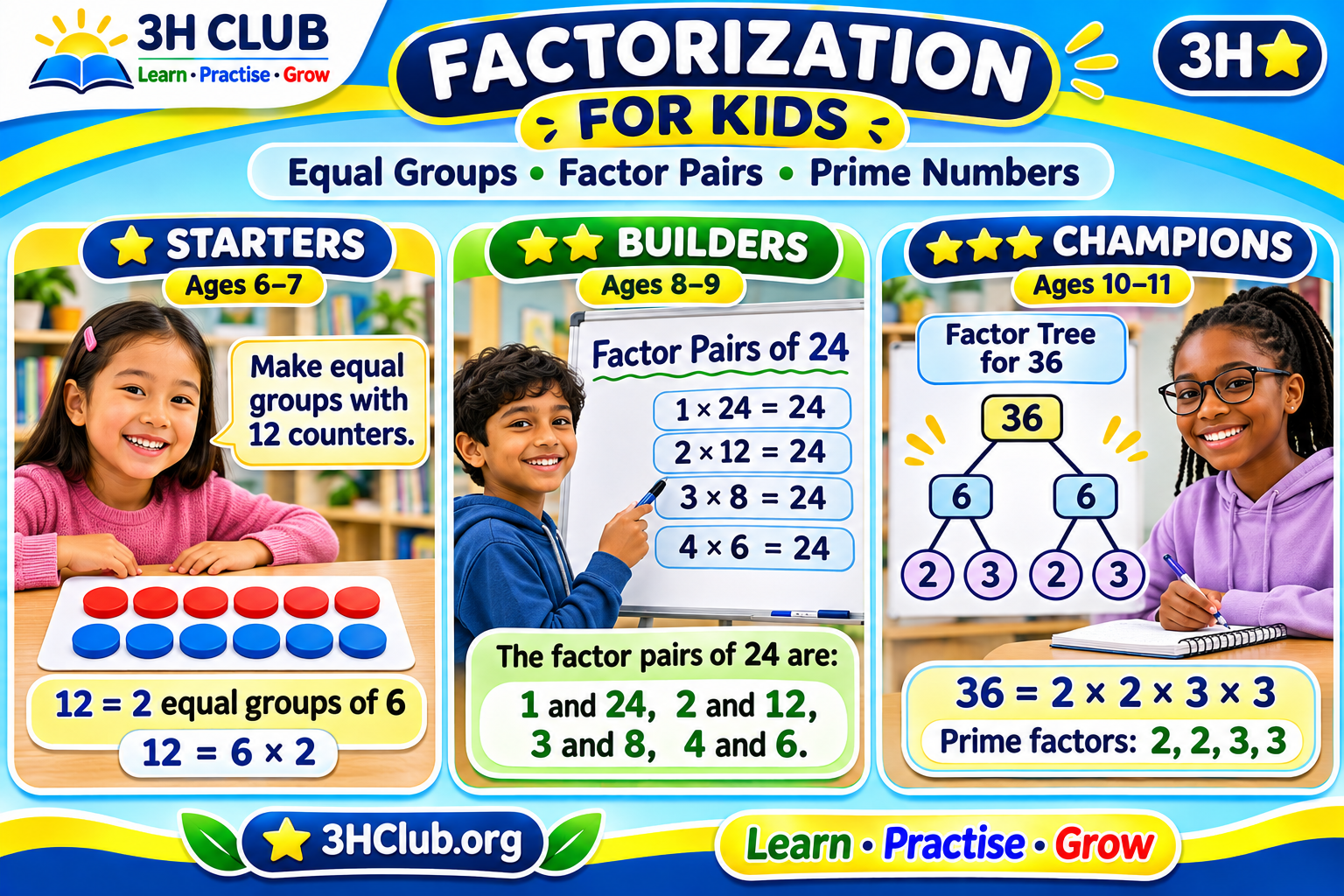
Imagine you have 12 colourful counters.
You could arrange them in:
- 1 row of 12.
- 2 rows of 6.
- 3 rows of 4.
Each arrangement uses exactly 12 counters.
That means:
1 × 12 = 12
2 × 6 = 12
3 × 4 = 12
You’ve discovered three different factor pairs!
Factorization is about finding the numbers that multiply together to make another number.
As your maths skills grow, you’ll learn to use factors to solve puzzles, organise objects into equal groups and understand larger numbers.
Are you ready to explore?
Let’s begin!
🎯 What Will You Learn?
By the end of this lesson, you will be able to:
- Make equal groups and arrays.
- Recognise multiplication as repeated equal groups.
- Find simple factor pairs.
- List the factors of a number.
- Explain the difference between factors and multiples.
- Recognise prime and composite numbers.
- Use divisibility rules.
- Build factor trees.
- Write numbers as products of prime factors.
- Find the highest common factor of two numbers.
- Solve real-life factorization problems.
⭐ Your maths mission: Discover how numbers fit together through multiplication and division.
⭐ STAGE 1: STARTERS — AGES 6–7
🌈 Discover Equal Groups and Simple Factors
🟢 1. What Are Equal Groups?
An equal group has the same number of objects as every other group.
Imagine you have six apples.
You can make:
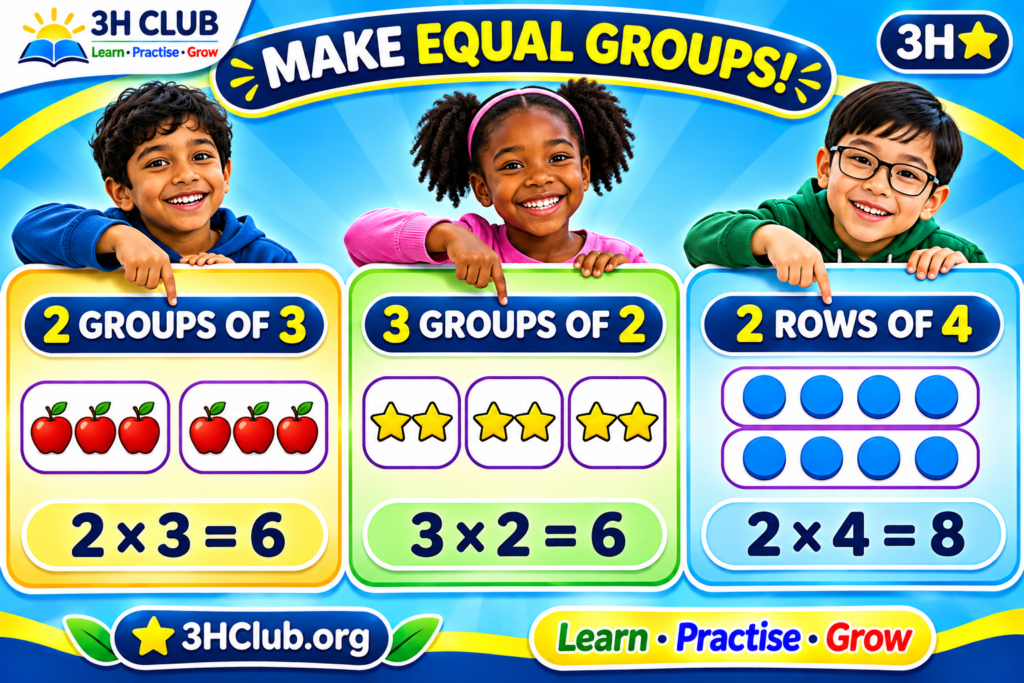
2 groups of 3 apples
🍎🍎🍎 | 🍎🍎🍎
There are three apples in each group.
We can write:
2 × 3 = 6
You could also make:
3 groups of 2 apples
🍎🍎 | 🍎🍎 | 🍎🍎
That gives:
3 × 2 = 6
Both arrangements use six apples.
✏️ Activity 1: Count the Groups
Find the total number of objects.
- 2 groups of 2 stars.
- 3 groups of 2 pencils.
- 2 groups of 4 buttons.
- 4 groups of 2 shells.
- 3 groups of 3 counters.
⭐ Starter Tip: Count the objects in one group, then count how many groups there are.
🔵 2. Make Arrays
An array is an arrangement of objects in equal rows and columns.
Look at these counters:
🔵 🔵 🔵 🔵
🔵 🔵 🔵 🔵
There are:
2 rows of 4
So:
2 × 4 = 8
You can turn the arrangement around to see:
4 × 2 = 8
The total stays the same.
✏️ Activity 2: Draw an Array
Draw dots to show:
- 2 rows of 3.
- 3 rows of 3.
- 2 rows of 5.
- 4 rows of 2.
Write the multiplication sentence for each array.
🟡 3. Meet Your First Factor Pairs
A factor pair is two whole numbers that multiply to make a chosen number.
Let’s explore 10.
1 × 10 = 10
2 × 5 = 10
The factor pairs of 10 are:
1 and 10
2 and 5
These numbers are called factors of 10.
✏️ Activity 3: Complete the Pairs
Fill in the missing numbers.
- 2 × ___ = 6
- 2 × ___ = 8
- 3 × ___ = 9
- 2 × ___ = 10
- 3 × ___ = 12
✏️ Activity 4: Factor Pair Match
Match each number to a correct factor pair.
| Number | Factor Pair Choices |
|---|---|
| 6 | 2 and 4 / 2 and 3 |
| 8 | 2 and 4 / 3 and 4 |
| 10 | 2 and 5 / 3 and 5 |
| 12 | 3 and 4 / 3 and 5 |
🟣 4. Use Factors to Share Equally
You have 12 stickers.
Can you share them equally between:
2 children?
12 ÷ 2 = 6
Each child gets 6 stickers.
3 children?
12 ÷ 3 = 4
Each child gets 4 stickers.
5 children?
12 ÷ 5 does not give a whole number of stickers to each child.
So 5 is not a factor of 12.
A whole number is a factor of 12 if it divides 12 exactly, leaving no remainder.
✏️ Activity 5: Sharing Challenge
Share the objects equally.
- 8 sweets between 2 children.
- 10 counters between 5 children.
- 12 pencils between 3 children.
- 6 oranges between 2 baskets.
- 9 buttons between 3 boxes.
How many go in each group?
🎲 Starter Maths Game: Build the Number
Choose a number from:
4, 6, 8, 9, 10 or 12.
Use counters, blocks or drawings to make different equal-row arrangements.
For each arrangement:
- Count the rows.
- Count the objects in each row.
- Write a multiplication sentence.
⭐ Starter Challenge: Can you find two different factor pairs for 12?
⭐⭐ STAGE 2: BUILDERS — AGES 8–9
🧩 Explore Factors, Multiples and Prime Numbers
🔵 5. What Is a Factor?
A factor is a whole number that divides another whole number exactly, without a remainder.
For example:
3 × 4 = 12
So 3 and 4 are factors of 12.
But 12 has more factors!
Let’s find them all.
| Factor Pair | Multiplication |
|---|---|
| 1 and 12 | 1 × 12 = 12 |
| 2 and 6 | 2 × 6 = 12 |
| 3 and 4 | 3 × 4 = 12 |
Therefore, the positive factors of 12 are:
1, 2, 3, 4, 6 and 12
✏️ Activity 6: List the Factors
Find all the positive factors of:
- 8
- 10
- 15
- 16
- 18
- 20
Write the factor pairs first to help you.
🟢 6. Find Factor Pairs Systematically
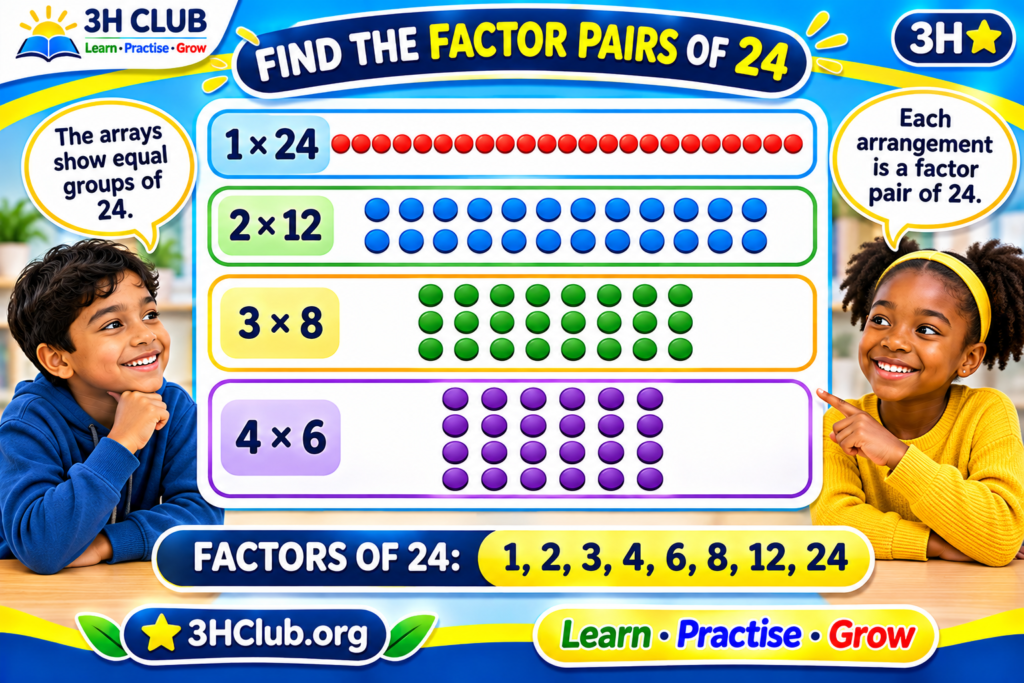
Let’s find the factor pairs of 24.
Start with 1:
1 × 24 = 24
Try 2:
2 × 12 = 24
Try 3:
3 × 8 = 24
Try 4:
4 × 6 = 24
The next successful pair would repeat one we’ve already found.
So the factor pairs are:
(1, 24), (2, 12), (3, 8), (4, 6)
The factors of 24 are:
1, 2, 3, 4, 6, 8, 12, 24
✏️ Activity 7: Factor Pair Detective
Find every positive factor pair of:
- 14
- 21
- 28
- 30
- 36
⭐ Builder Tip: Start with 1 and work upwards so you don’t miss any pairs.
🟡 7. Factors and Multiples: What’s the Difference?
Factors and multiples are connected, but they are not the same.
Factors divide a number exactly.
Multiples are numbers you get by multiplying a number by whole numbers.
For example:
Factors of 12:
1, 2, 3, 4, 6, 12
First five positive multiples of 3:
3, 6, 9, 12, 15
Notice that:
3 is a factor of 12.
12 is a multiple of 3.
✏️ Activity 8: Factor or Multiple?
Answer each question.
- Is 4 a factor of 20?
- Is 20 a multiple of 4?
- Is 6 a factor of 25?
- Is 30 a multiple of 5?
- Is 7 a factor of 42?
- Is 18 a multiple of 4?
Explain one answer using multiplication or division.
🟣 8. Discover Prime Numbers
A prime number is a whole number greater than 1 that has exactly two positive factors:
1 and itself.
For example:
7 has only two positive factors:
1 and 7
So 7 is prime.
The first ten prime numbers are:
2, 3, 5, 7, 11, 13, 17, 19, 23, 29
What Is a Composite Number?
A composite number is a whole number greater than 1 that has more than two positive factors.
For example:
12 is composite because it has six positive factors.
Important Facts
- 1 is neither prime nor composite.
- 2 is the only even prime number.
- Every even whole number greater than 2 is composite.
✏️ Activity 9: Prime or Composite?
Classify:
- 2
- 4
- 7
- 9
- 11
- 15
- 17
- 21
- 23
- 1
🔵 9. Discover Common Factors
Two numbers can share some factors.
Let’s compare 12 and 18.
Factors of 12:
1, 2, 3, 4, 6, 12
Factors of 18:
1, 2, 3, 6, 9, 18
Their common factors are:
1, 2, 3 and 6
The largest is 6.
This is called the highest common factor, or HCF.
You may also see it called the greatest common factor (GCF).
✏️ Activity 10: Common Factor Challenge
Find the common factors of:
- 8 and 12.
- 10 and 15.
- 12 and 20.
- 18 and 24.
- 16 and 28.
Then circle the HCF of each pair.
🎲 Builder Maths Game: Factor Bingo
Create a bingo card containing nine numbers between 1 and 30.
Ask someone to call out clues such as:
- A factor of 18.
- A multiple of 5.
- A prime number greater than 10.
- A common factor of 12 and 20.
Cross off a number only if it matches the clue.
The first player to complete a row wins.
⭐ Builder Challenge: Explain why every number you cross off is correct.
⭐⭐⭐ STAGE 3: CHAMPIONS — AGES 10–11
🏆 Master Prime Factorization and Factor Trees
🔵 10. What Is Prime Factorization?
Prime factorization means writing a whole number greater than 1 as a product of prime numbers.
A product is the answer to a multiplication.
For example:
12 = 2 × 2 × 3
All three factors are prime numbers.
So this is the prime factorization of 12.
Compare:
12 = 3 × 4
This is a factorization, but it is not a complete prime factorization because 4 is composite.
We must break 4 into:
2 × 2
Therefore:
12 = 2 × 2 × 3
✏️ Activity 11: Complete the Prime Factorization
Fill in the missing prime numbers.
- 6 = 2 × ___
- 10 = 2 × ___
- 15 = 3 × ___
- 18 = 2 × 3 × ___
- 20 = 2 × 2 × ___
- 30 = 2 × 3 × ___
🟢 11. Build a Factor Tree
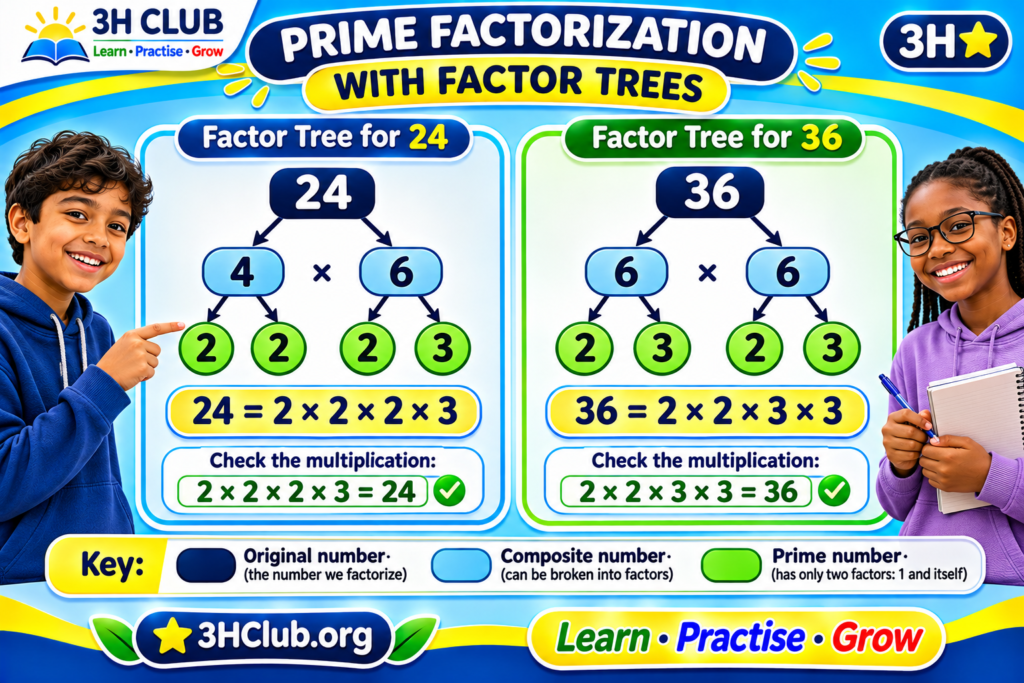
A factor tree breaks a composite number into smaller factors until every branch ends in a prime number.
Let’s factorize 36.
First:
36 = 6 × 6
Then:
6 = 2 × 3
And the other 6 is also:
6 = 2 × 3
Our factor tree is:
        36
       /  \
      6    6
     / \  / \
    2  3 2  3
All the final numbers are prime.
Therefore:
36 = 2 × 2 × 3 × 3
We can check:
2 × 2 × 3 × 3 = 36
✏️ Activity 12: Draw Your Own Factor Trees
Find the prime factorization of:
- 12
- 18
- 24
- 40
- 48
- 60
Draw a factor tree for each.
🟡 12. Learn Divisibility Rules
Divisibility rules help you decide whether one whole number divides another exactly.
| Divisor | Quick Rule | Example |
|---|---|---|
| 2 | The last digit is even. | 48 |
| 3 | The digits add to a multiple of 3. | 123 → 1 + 2 + 3 = 6 |
| 4 | The number formed by the last two digits is divisible by 4. | 316 → 16 is divisible by 4 |
| 5 | The last digit is 0 or 5. | 75 |
| 6 | The number is divisible by both 2 and 3. | 54 |
| 9 | The digits add to a multiple of 9. | 729 → 7 + 2 + 9 = 18 |
| 10 | The last digit is 0. | 120 |
These rules help you find factor pairs and start factor trees.
✏️ Activity 13: Divisibility Detective
Decide whether each statement is true or false.
- 84 is divisible by 2.
- 135 is divisible by 5.
- 123 is divisible by 3.
- 217 is divisible by 9.
- 96 is divisible by 4.
- 150 is divisible by 6.
- 340 is divisible by 10.
Explain your answers using the rules.
🟣 13. Use Exponents to Write Prime Factors
When the same prime factor appears several times, we can use an exponent.
For example:
2 × 2 × 2 = 2³
Read this as two cubed or two to the power of three.
The small 3 tells you to multiply three 2s together.
Now look at 72.
72 = 2 × 2 × 2 × 3 × 3
Using exponents:
72 = 2³ × 3²
Check:
8 × 9 = 72
✏️ Activity 14: Write Using Exponents
Rewrite each prime factorization using exponents where useful.
- 2 × 2 × 3
- 2 × 2 × 2 × 5
- 3 × 3 × 5
- 2 × 2 × 3 × 3
- 2 × 2 × 2 × 2 × 3
Then work out the number represented by each product.
🔵 14. Find the Highest Common Factor Using Prime Factors
Let’s find the HCF of 24 and 36.
Prime factorize each number:
24 = 2 × 2 × 2 × 3
36 = 2 × 2 × 3 × 3
Choose the prime factors that appear in both factorizations, matching each occurrence only once.
They share:
2 × 2 × 3
Multiply:
2 × 2 × 3 = 12
Therefore:
HCF(24, 36) = 12
Why Is This Useful?
Imagine you have:
- 24 blue beads.
- 36 yellow beads.
You want to make the greatest possible number of identical bead packs, using every bead and giving each pack the same number of each colour.
You can make 12 packs.
Each pack contains:
24 ÷ 12 = 2 blue beads
36 ÷ 12 = 3 yellow beads
✏️ Activity 15: HCF Challenge
Find the HCF using prime factors.
- 12 and 18.
- 20 and 30.
- 24 and 40.
- 36 and 48.
- 45 and 60.
🟢 15. Factorization and Fractions
Factors can help you simplify fractions.
Consider:
12/18
The HCF of 12 and 18 is 6.
Divide both the numerator and denominator by 6.
12 ÷ 6 = 2
18 ÷ 6 = 3
So:
12/18 = 2/3
The fraction has the same value, but it is now in its simplest form.
✏️ Activity 16: Simplify the Fractions
Use common factors to simplify:
- 6/9
- 8/12
- 10/15
- 12/16
- 18/24
- 20/30
🟡 16. Solve Real-Life Factor Problems
Factorization helps when organising objects into equal groups.
Example 1: Classroom Teams
A class has 24 learners.
They need teams of equal size, with no one left out.
Possible team sizes include:
1, 2, 3, 4, 6, 8, 12 and 24.
If each team has 4 learners:
24 ÷ 4 = 6 teams
Example 2: Gift Packs
You have:
- 18 pencils.
- 30 erasers.
You want to make as many identical packs as possible, using all the supplies.
The HCF of 18 and 30 is 6.
You can make:
6 packs
Each pack has:
3 pencils and 5 erasers.
✏️ Activity 17: Real-Life Maths
- There are 32 chairs. Can they be arranged into 4 equal rows? How many chairs will be in each row?
- There are 27 counters. Can they be arranged into 5 equal rows without leftovers?
- A teacher has 20 red pencils and 30 blue pencils. What is the greatest number of identical packs that can be made using every pencil?
- There are 36 learners. Give three possible team sizes greater than 1 and less than 36.
- A gardener has 24 flower seedlings and wants equal rows with no seedlings left over. Find four possible row sizes.
🟣 17. Can Two Different Factor Trees Give the Same Answer?
Yes!
You can start a factor tree using different factor pairs.
For 24:
Method A
24 = 4 × 6
= 2 × 2 × 2 × 3
Method B
24 = 3 × 8
= 3 × 2 × 2 × 2
Both give the same prime factors:
2 × 2 × 2 × 3
The order may change, but the prime factorization is the same.
This important property is called the uniqueness of prime factorization.
✏️ Activity 18: Two Trees, One Answer
Find two different starting factor pairs for each number, then complete both factor trees.
- 18
- 24
- 30
- 36
- 48
Check that each pair of trees finishes with the same prime factors.
🏆 Champions Maths Game: Prime Factor Race
Choose a composite number between 12 and 100.
Challenge a friend to:
- Find a factor pair.
- Draw a factor tree.
- Circle every prime factor.
- Write the prime factorization.
- Multiply the factors to check.
Award one point for each correct step.
⭐ Extra Challenge: Find a different factor tree that produces the same prime factors.
🎲 FUN FACTORIZATION GAMES FOR EVERY LEVEL
🎯 Game 1: Equal Group Builder
Best for Starters
Use 12 counters.
Make as many different rectangular arrays as you can.
Write the multiplication sentence for each.
🧩 Game 2: Factor Pair Memory
Best for Builders
Write numbers on one set of cards and matching factor pairs on another.
Examples:
18 ↔ 3 × 6
20 ↔ 4 × 5
28 ↔ 4 × 7
Turn the cards over and try to find matching pairs.
🔍 Game 3: Prime Number Hunt
Best for Builders
Write the numbers 1–30.
Circle every prime number.
Explain why 1 is not prime.
🌳 Game 4: Factor Tree Challenge
Best for Champions
Choose 48, 60, 72 or 90.
Create a factor tree and check your answer.
🏅 Game 5: HCF Team Challenge
Best for Champions
Choose two numbers.
Find their factors and identify the HCF.
Then create a sharing or grouping problem that uses your answer.
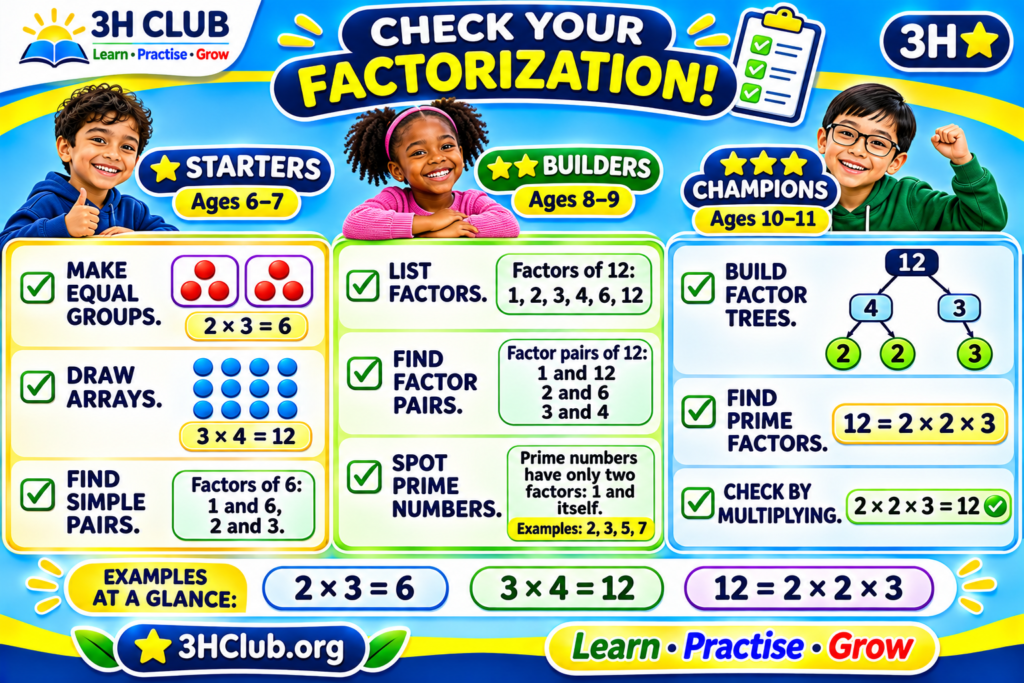
🏆 THE FINAL FACTORIZATION CHALLENGE
Choose your learning level, or try the next level when you’re ready.
⭐ Part A: Starters Challenge
- What is 2 × 4?
- Complete: 3 × ___ = 12.
- How many groups of 3 can you make from 9 counters?
- Is 2 a factor of 10?
- Draw an array showing 2 × 5.
⭐⭐ Part B: Builders Challenge
- List all the positive factors of 18.
- Find all factor pairs of 20.
- Is 17 prime or composite?
- List the first five positive multiples of 6.
- Find the HCF of 12 and 16.
⭐⭐⭐ Part C: Champions Challenge
- Find the prime factorization of 48.
- Draw a factor tree for 72.
- Write the prime factorization of 90 using exponents.
- Find the HCF of 36 and 60.
- Simplify 24/36.
- Explain why 1 is neither prime nor composite.
- Find two different factor trees for 60.
- A club has 40 blue counters and 56 green counters. What is the greatest number of identical packs that can be made using all the counters?
📝 CHECK YOUR ANSWERS!
⭐ Starters Answers
Activity 1
Activity 2
- 2 × 3 = 6.
- 3 × 3 = 9.
- 2 × 5 = 10.
- 4 × 2 = 8.
Drawings should show the correct number of equal rows and objects.
Activity 3
Activity 4
- 6 → 2 and 3.
- 8 → 2 and 4.
- 10 → 2 and 5.
- 12 → 3 and 4.
Activity 5
- 4 sweets.
- 2 counters.
- 4 pencils.
- 3 oranges.
- 3 buttons.
⭐⭐ Builders Answers
Activity 6: Factors
| Number | Positive Factors |
|---|---|
| 8 | 1, 2, 4, 8 |
| 10 | 1, 2, 5, 10 |
| 15 | 1, 3, 5, 15 |
| 16 | 1, 2, 4, 8, 16 |
| 18 | 1, 2, 3, 6, 9, 18 |
| 20 | 1, 2, 4, 5, 10, 20 |
Activity 7: Factor Pairs
- 14: (1, 14), (2, 7).
- 21: (1, 21), (3, 7).
- 28: (1, 28), (2, 14), (4, 7).
- 30: (1, 30), (2, 15), (3, 10), (5, 6).
- 36: (1, 36), (2, 18), (3, 12), (4, 9), (6, 6).
Activity 8: Factor or Multiple?
- Yes.
- Yes.
- No.
- Yes.
- Yes.
- No.
Activity 9: Prime or Composite?
| Number | Classification |
|---|---|
| 2 | Prime |
| 4 | Composite |
| 7 | Prime |
| 9 | Composite |
| 11 | Prime |
| 15 | Composite |
| 17 | Prime |
| 21 | Composite |
| 23 | Prime |
| 1 | Neither |
Activity 10: Common Factors and HCF
| Numbers | Common Factors | HCF |
|---|---|---|
| 8 and 12 | 1, 2, 4 | 4 |
| 10 and 15 | 1, 5 | 5 |
| 12 and 20 | 1, 2, 4 | 4 |
| 18 and 24 | 1, 2, 3, 6 | 6 |
| 16 and 28 | 1, 2, 4 | 4 |
⭐⭐⭐ Champions Answers
Activity 11: Prime Factorization
Activity 12: Factor Trees
- 12 = 2 × 2 × 3.
- 18 = 2 × 3 × 3.
- 24 = 2 × 2 × 2 × 3.
- 40 = 2 × 2 × 2 × 5.
- 48 = 2 × 2 × 2 × 2 × 3.
- 60 = 2 × 2 × 3 × 5.
Activity 13: Divisibility
- True.
- True.
- True.
- False.
- True.
- True.
- True.
For 217, the digit sum is 2 + 1 + 7 = 10, which is not divisible by 9.
Activity 14: Exponents
| Prime Factorization | Exponent Form | Number |
|---|---|---|
| 2 × 2 × 3 | 2² × 3 | 12 |
| 2 × 2 × 2 × 5 | 2³ × 5 | 40 |
| 3 × 3 × 5 | 3² × 5 | 45 |
| 2 × 2 × 3 × 3 | 2² × 3² | 36 |
| 2 × 2 × 2 × 2 × 3 | 2⁴ × 3 | 48 |
Activity 15: HCF
- HCF(12, 18) = 6.
- HCF(20, 30) = 10.
- HCF(24, 40) = 8.
- HCF(36, 48) = 12.
- HCF(45, 60) = 15.
Activity 16: Simplify Fractions
- 6/9 = 2/3.
- 8/12 = 2/3.
- 10/15 = 2/3.
- 12/16 = 3/4.
- 18/24 = 3/4.
- 20/30 = 2/3.
Activity 17: Real-Life Maths
- Yes, 8 chairs in each row.
- No, 27 cannot be divided into 5 equal whole-number rows without leftovers.
- 10 packs, each containing 2 red and 3 blue pencils.
- Possible team sizes include 2, 3, 4, 6, 9, 12 and 18; any three are correct.
- Possible row sizes include 1, 2, 3, 4, 6, 8, 12 and 24; any four are correct.
Activity 18: Two Factor Trees
Possible starting pairs:
- 18 = 2 × 9 or 3 × 6 → 2 × 3 × 3.
- 24 = 3 × 8 or 4 × 6 → 2 × 2 × 2 × 3.
- 30 = 2 × 15 or 3 × 10 → 2 × 3 × 5.
- 36 = 4 × 9 or 6 × 6 → 2 × 2 × 3 × 3.
- 48 = 6 × 8 or 4 × 12 → 2 × 2 × 2 × 2 × 3.
🏆 Final Challenge Answers
⭐ Starters
-
-
- 3 groups.
- Yes.
- Two rows of five objects, making 10 altogether.
⭐⭐ Builders
- 1, 2, 3, 6, 9, 18.
- (1, 20), (2, 10), (4, 5).
- Prime.
- 6, 12, 18, 24, 30.
-
⭐⭐⭐ Champions
- 48 = 2⁴ × 3.
- 72 = 2³ × 3².
- 90 = 2 × 3² × 5.
- HCF(36, 60) = 12.
- 24/36 = 2/3.
- The number 1 has only one positive factor, so it is neither prime nor composite.
- Possible starting pairs: 60 = 6 × 10 or 60 = 4 × 15. Both produce 2 × 2 × 3 × 5.
- 8 identical packs, each containing 5 blue counters and 7 green counters.
🎉 Well done, Factorization Champion!
🌈 WHAT HAVE YOU LEARNT?
⭐ Starters
You discovered that:
- Equal groups contain the same number of objects.
- Arrays show multiplication.
- Factor pairs multiply to make a number.
⭐⭐ Builders
You learnt that:
- Factors divide a number exactly.
- Factor pairs help you list all factors.
- Multiples are numbers in multiplication sequences.
- Prime numbers have exactly two positive factors.
- Composite numbers have more than two positive factors.
⭐⭐⭐ Champions
You mastered:
- Prime factorization.
- Factor trees.
- Divisibility rules.
- Exponent notation.
- Highest common factors.
- Simplifying fractions.
- Real-life factor problems.
⭐ The Factorization Formula
FACTOR PAIRS → FACTORS → PRIME FACTORS → FACTOR TREES → PROBLEM-SOLVING
🌟 KEEP LEARNING WITH 3HCLUB!
Mathematics becomes easier when you recognise how numbers are connected.
Every time you practise multiplication, division or equal grouping, you’re strengthening your understanding of factors.
Keep experimenting with arrays.
Keep looking for number patterns.
Keep checking your answers.
And remember: every challenging maths problem is another chance to grow.
📚 Your Next Maths Adventures
Explore these related topics on 3HClub.org:
- Multiplication for Kids
- Division for Kids
- Multiplication Tables
- Factors and Multiples
- Prime and Composite Numbers
- Fractions for Kids
- Simplifying Fractions
- Highest Common Factor
- Maths Symbols: Learn What the Signs Mean
⭐ Your Factorization Promise
I can make equal groups.
I can find factor pairs.
I can list factors.
I can recognise prime numbers.
I can build factor trees.
I can check my calculations.
I can use factorization to solve problems.
3H CLUB — Learn • Practise • Grow