Counting for Kids:
Learn Numbers, Skip Counting and Number Patterns
3HClub.org | Maths for Kids | Ages 6–11
Learn • Practise • Grow
Have you ever counted how many shells you collected at the beach, how many steps you took to reach the playground, or how many days remain until your birthday?
You were using maths!
Counting is one of the first maths skills you learn, but it is also one of the most important. It helps you understand numbers, recognise patterns, compare quantities and solve everyday problems.
As your confidence grows, you will discover that counting is not just about saying 1, 2, 3. You can count forwards, backwards, in equal steps, and even with fractions, decimals and negative numbers.
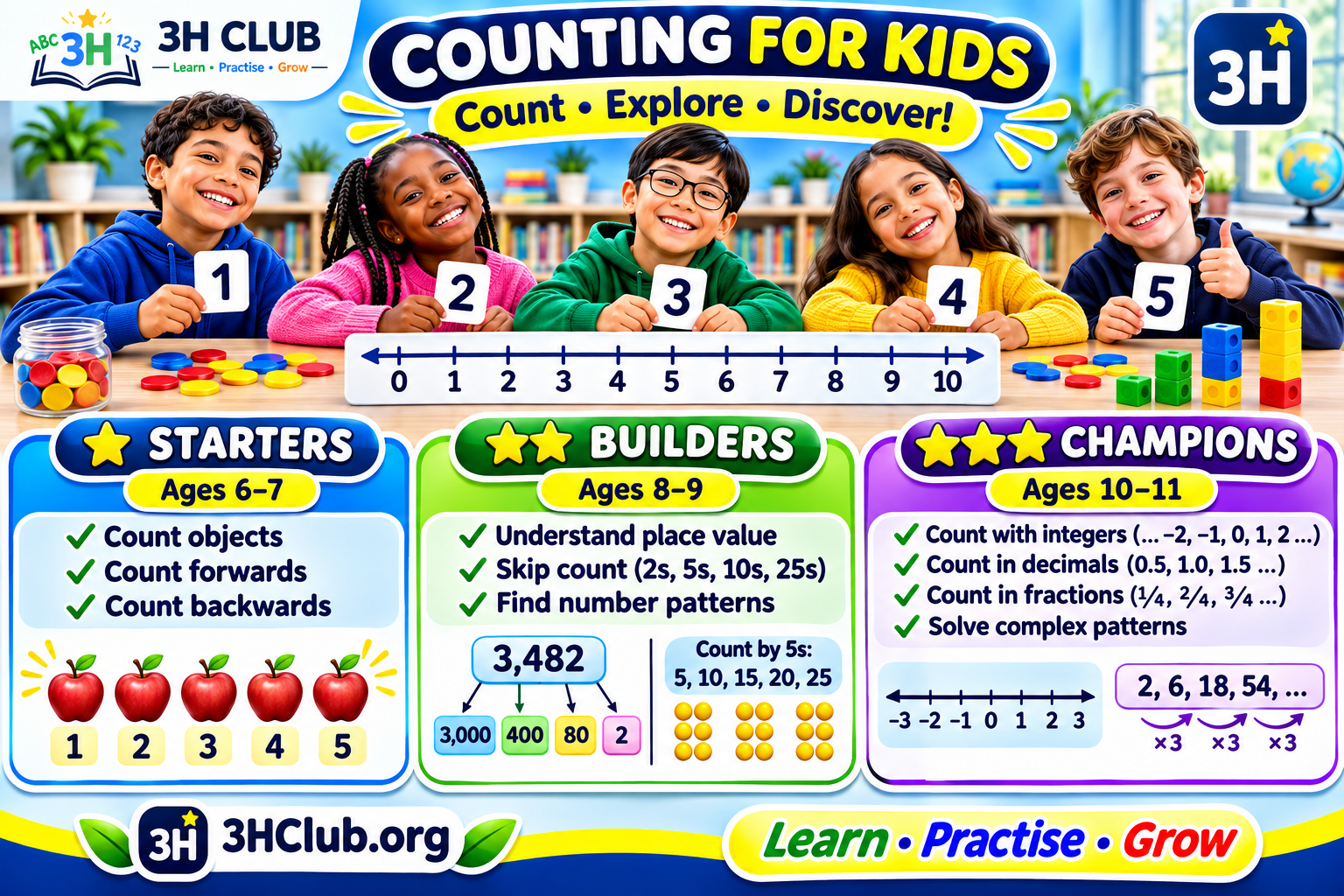
In this 3HClub lesson, you will explore counting at three different levels:
-
⭐ Starters (Ages 6–7): Count objects, recognise numbers, count forwards and backwards, and make equal groups.
-
⭐⭐ Builders (Ages 8–9): Explore larger numbers, place value, skip counting and number patterns.
-
⭐⭐⭐ Champions (Ages 10–11): Investigate negative numbers, decimals, fractions, complex sequences and counting strategies.
Choose the level that feels right for you. You can always return to an earlier section for practice or move ahead when you’re ready.
What Is Counting?
Counting means saying numbers in order or finding out how many objects are in a group.
Imagine you have five mangoes.
🥭
1
🥭
2
🥭
3
🥭
4
🥭
5
1, 2, 3, 4, 5 — Five mangoes altogether!
When you count objects, you give each object one counting number. The last number you say tells you how many objects there are altogether.
This is called one-to-one correspondence and cardinality. Those are big mathematical words for two simple ideas: count each object once, and use the final number to tell how many there are.
Different Ways to Count
| Counting method | Example |
|---|---|
| Forwards | 1, 2, 3, 4, 5 |
| Backwards | 10, 9, 8, 7, 6 |
| In twos | 2, 4, 6, 8, 10 |
| In fives | 5, 10, 15, 20, 25 |
| In tens | 10, 20, 30, 40, 50 |
| In hundreds | 100, 200, 300, 400 |
| With decimals | 0.5, 1.0, 1.5, 2.0 |
Each counting method helps you understand numbers in a different way.
⭐ Starters — Ages 6–7
Count • Recognise • Compare!
Welcome, Starter! Let’s discover how numbers help us describe the things around us.
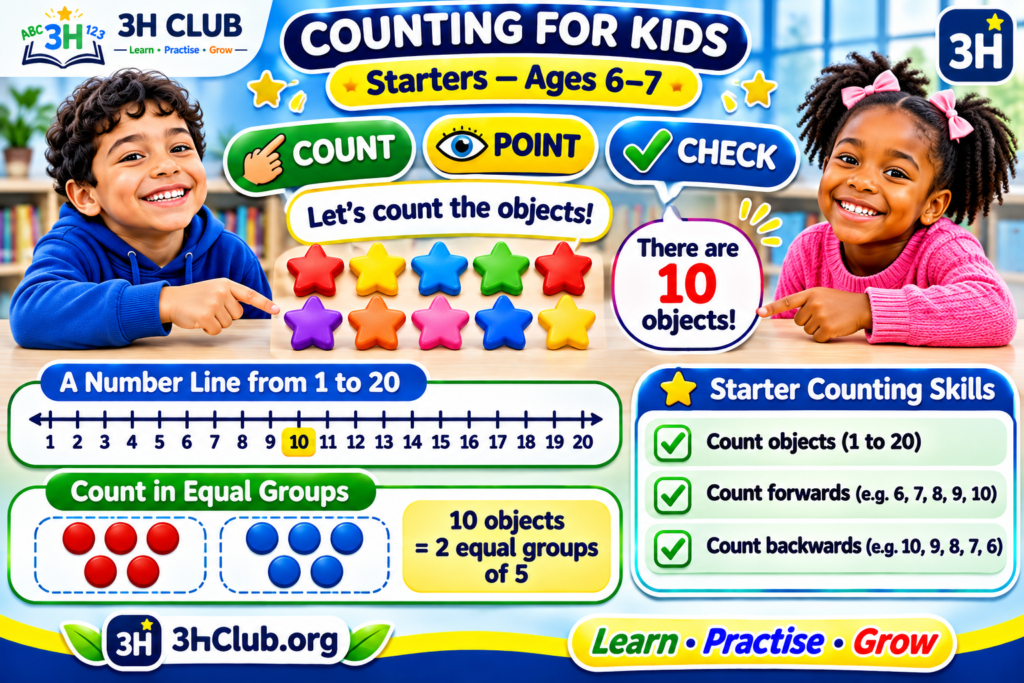
1. Count Objects from 1 to 20
You can count toys, pencils, shells, flowers, buttons and many other objects.
To count correctly, remember these three steps:
-
Point to the first object and say “one”.
-
Move to the next object and say “two”. Continue giving each object one number.
-
Say the final number to tell how many objects you counted.
Look at these numbers:
| 1 | 2 | 3 | 4 | 5 |
| 6 | 7 | 8 | 9 | 10 |
| 11 | 12 | 13 | 14 | 15 |
| 16 | 17 | 18 | 19 | 20 |
Try it! Collect 12 safe objects, such as building blocks. Arrange them in a row and count each one.
Now move the blocks into a circle and count again.
Did the total change?
No! Moving objects around does not change how many there are, provided none are added or taken away.
2. Count Forwards and Backwards
Counting forwards means moving to the next number.
5 → 6 → 7 → 8 → 9
Counting backwards means moving to the previous number.
9 → 8 → 7 → 6 → 5
You can use a number line to help you see the order.
Explore the Number Line
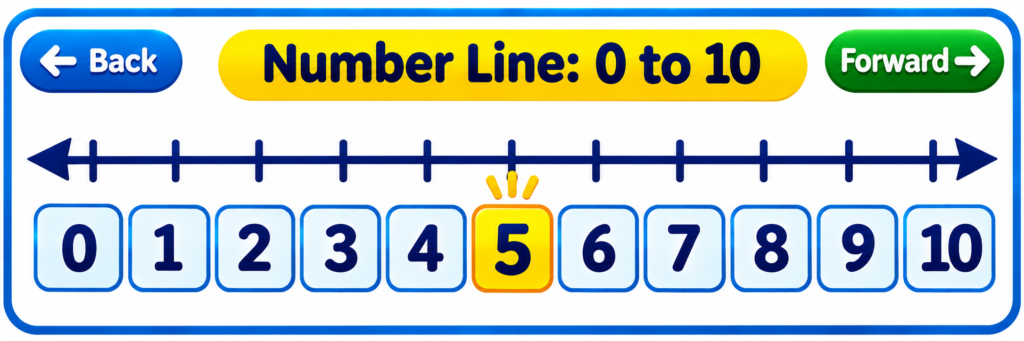
Counting backwards helps you understand subtraction. Counting forwards helps you understand addition.
For example, start at 4 and count forwards three steps:
5, 6, 7.
You reach 7, so 4 + 3 = 7.
3. Count in Twos, Fives and Tens
Sometimes it is quicker to count objects in groups.
Imagine you have four pairs of socks. Each pair contains two socks.
Count in twos:
2, 4, 6, 8
You have eight socks altogether.
You can also count in fives:
5, 10, 15, 20
Or tens:
10, 20, 30, 40, 50
This is called skip counting.
4. Compare Numbers
Counting helps you decide which group has more, fewer or the same number of objects.
For example:
-
8 is greater than 5: 8 > 5
-
3 is less than 7: 3 < 7
-
6 is equal to 6: 6 = 6
When two groups contain the same number of objects, they have equal quantities.
5. Make Equal Groups
Suppose you have 12 counters.
You can arrange them into three equal groups of four.
3 Groups of 4 = 12
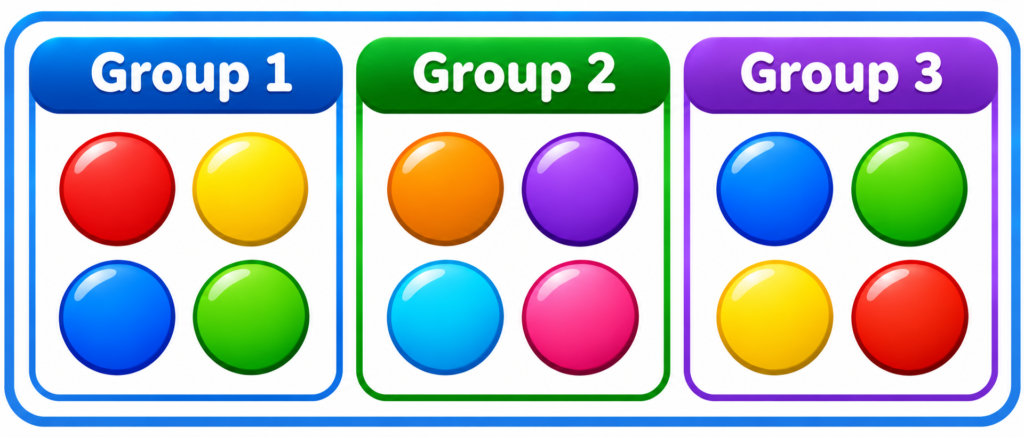
Equal groups help you prepare for multiplication.
⭐ Starters — Have a Go!
Try these questions before checking your answers.
Check Your Counting
1. What number comes after 16?
2. What number comes before 10?
3. What comes next? 2, 4, 6, 8, …
4. How many counters are in 3 groups of 4?
0 / 4 correct Try again
⭐⭐ Builders — Ages 8–9
Explore • Group • Find Patterns!
You already know how to count small groups of objects. Now let’s use counting to explore bigger numbers and discover useful mathematical patterns.
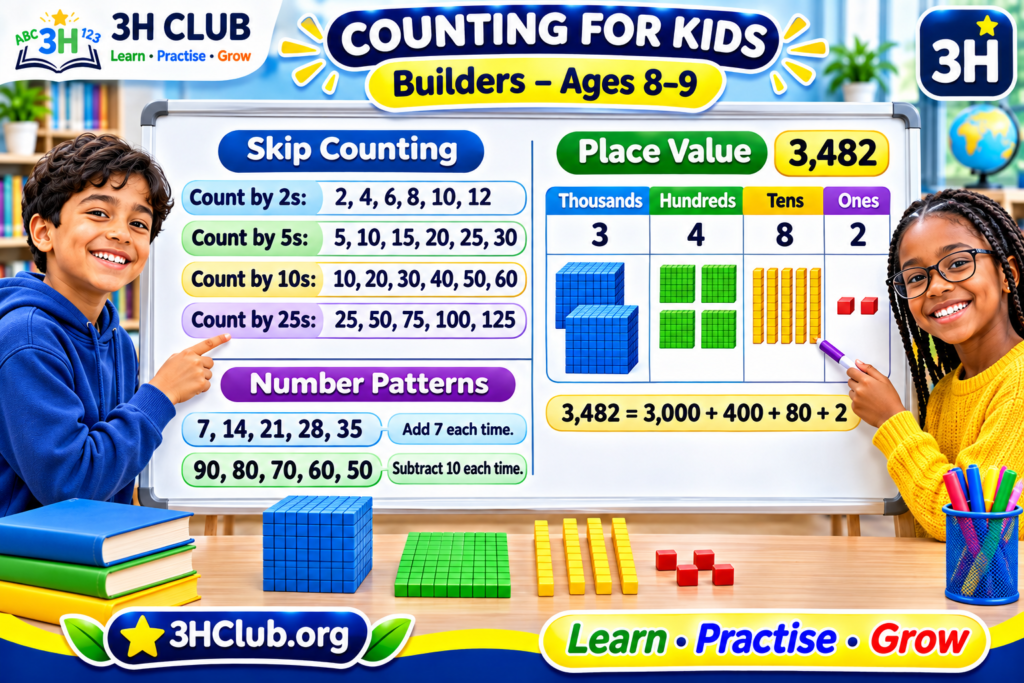
1. Understand Place Value
The position of a digit tells you its value.
Look at 4,582.
| Place | Digit | Value |
|---|---|---|
| Thousands | 4 | 4,000 |
| Hundreds | 5 | 500 |
| Tens | 8 | 80 |
| Ones | 2 | 2 |
4,582 = 4,000 + 500 + 80 + 2
Understanding place value makes it easier to count in hundreds and thousands.
For example:
2,300 → 2,400 → 2,500 → 2,600
Each step increases by 100.
2. Practise Skip Counting
Skip counting means increasing or decreasing by the same amount each time.
Count by Number pattern
2s 2, 4, 6, 8, 10
3s 3, 6, 9, 12, 15
4s 4, 8, 12, 16, 20
5s 5, 10, 15, 20, 25
10s 10, 20, 30, 40, 50
25s 25, 50, 75, 100, 125
For example, if you have six bags containing five marbles each, count in fives:
5, 10, 15, 20, 25, 30.
There are 30 marbles altogether.
3. Discover Number Patterns
A number pattern follows a rule.
Look at:
7, 14, 21, 28, 35
What is the rule?
Each number increases by 7.
Now try this:
100, 90, 80, 70, 60
Each number decreases by 10.
Some patterns are easier to recognise when you write the difference between neighbouring numbers.
Counting across hundreds or thousands can feel challenging at first.
Try counting forwards in 50s:
850, 900, 950, 1,000, 1,050
Or backwards in hundreds:
1,500, 1,400, 1,300, 1,200
Notice what happens when the number crosses a thousand.
You can use place value to check each step.
5. Use Counting to Solve Problems
Imagine a school library has seven shelves, with eight books on each shelf.
You could count in eights:
8, 16, 24, 32, 40, 48, 56.
There are 56 books altogether.
You can also use multiplication:
7 × 8 = 56
Counting and multiplication work together!
⭐⭐ Builders — Number Pattern Challenge
Test Your Pattern Skills
1. What comes next? 15, 30, 45, 60, …
2. What is the value of 6 in 3,642?
3. What comes before 1,000 when counting backwards in 25s?
4. What is 9 groups of 5?
0 / 4 correct Try again
⭐⭐⭐ Champions — Ages 10–11
Investigate • Reason • Solve!
Counting becomes even more interesting when you work with numbers that are not whole, numbers below zero and sequences that follow more complicated rules.
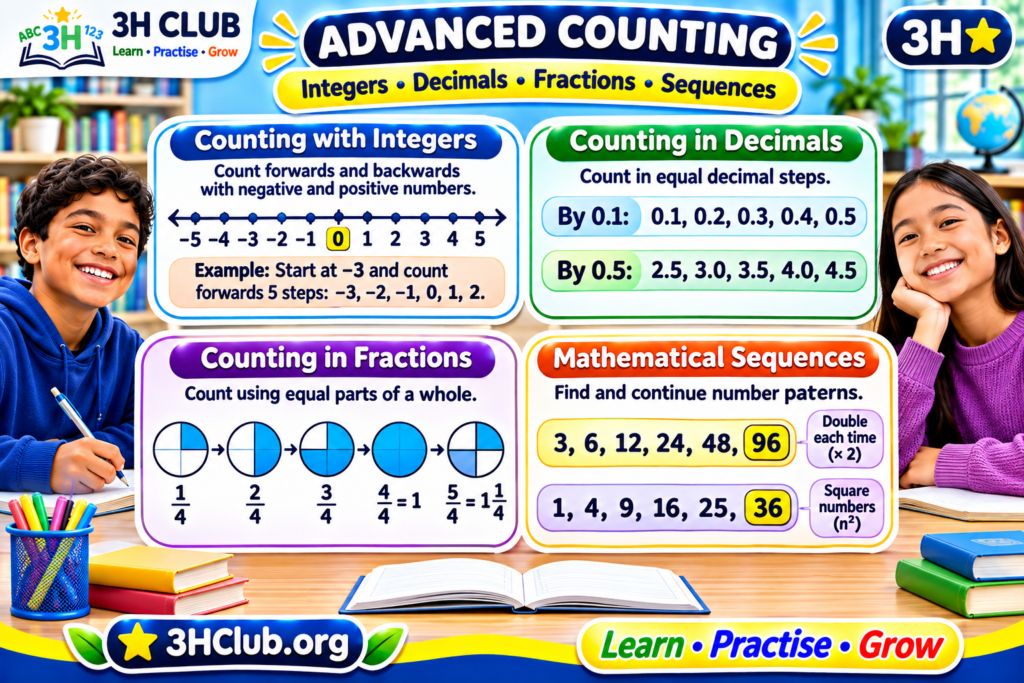
1. Count with Positive and Negative Numbers
Integers include positive whole numbers, negative whole numbers and zero.
For example:
−5, −4, −3, −2, −1, 0, 1, 2, 3, 4, 5
Negative numbers are less than zero.
You may see them when reading temperatures, describing positions below sea level or calculating changes.
Suppose the temperature is −2°C and rises by 5°C.
Count forwards five steps:
−1, 0, 1, 2, 3.
The new temperature is 3°C.
So:
−2 + 5 = 3
2. Count Using Decimals
Decimals let you count amounts smaller than one whole.
For example, counting in tenths:
0.1, 0.2, 0.3, 0.4, 0.5
Counting in halves:
0.5, 1.0, 1.5, 2.0, 2.5
Counting in quarters:
0.25, 0.50, 0.75, 1.00, 1.25
Decimals are useful when measuring lengths, masses and capacities.
3. Count Using Fractions
You can count in equal fractional parts.
For example, count in quarters:
Four quarters make one whole.
Five quarters make one whole and one quarter.
Fractions help you count parts of shapes, portions of food and measurements.
4. Investigate Multiplicative Patterns
Not every pattern increases by adding the same amount.
Consider:
3, 6, 12, 24, 48
Each number is multiplied by 2.
The next number is:
48 × 2 = 96.
Now look at:
2, 6, 18, 54
Each number is multiplied by 3.
The next number is:
54 × 3 = 162.
These are multiplicative patterns.
5. Explore Square Numbers
Square numbers are made by multiplying a whole number by itself.
Number Calculation Square number
1 1 × 1 1
2 2 × 2 4
3 3 × 3 9
4 4 × 4 16
5 5 × 5 25
6 6 × 6 36
So the sequence of square numbers begins:
1, 4, 9, 16, 25, 36
You can recognise these numbers by imagining counters arranged into perfect square arrays.
6. Solve Real-Life Counting Challenges
Imagine you are helping prepare 144 exercise books for a school event.
Each box holds 12 books.
How many boxes do you need?
You can count in twelves:
12, 24, 36, 48, 60, 72, 84, 96, 108, 120, 132, 144.
You counted 12 groups.
So:
144 ÷ 12 = 12
You need 12 boxes.
Counting helps you understand division because division asks how many equal groups fit into a quantity.
⭐⭐⭐ Champions — Challenge Yourself
Test Your Mathematical Reasoning
1. What comes next? −8, −4, 0, 4, …
2. What comes next? 1.25, 1.50, 1.75, …
3. What is the next square number after 36?
4. What comes next? 4, 12, 36, 108, …
0 / 4 correct
Try again
Counting Skills Checklist
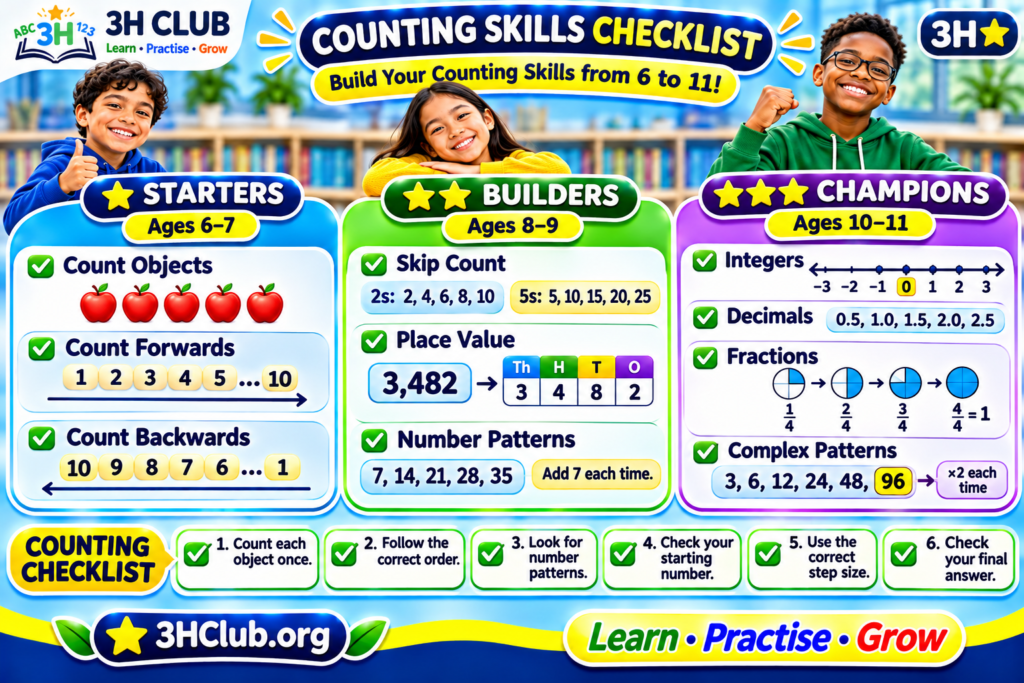
Counting accurately becomes easier when you follow a clear method.
CHECK YOUR COUNTING!
1. COUNT EACH OBJECT ONCE
2. FOLLOW THE NUMBER ORDER
3. CHECK YOUR STARTING NUMBER
4. IDENTIFY THE COUNTING STEP
5. LOOK FOR PATTERNS
6. CHECK YOUR FINAL ANSWER
Why Is Counting Important?
Counting is useful far beyond the classroom.
You use counting when you check how much money you have, calculate how many items you need, follow a timetable, measure ingredients, or work out a score.
It also forms the foundation for addition, subtraction, multiplication, division and more advanced mathematical ideas.
The more confidently you count, the easier it becomes to understand how numbers work together.
Frequently Asked Questions About Counting
What is counting in maths?
Counting means following numbers in order or finding out how many objects are in a group.
What is skip counting?
Skip counting means counting in equal steps, such as 2, 4, 6, 8 or 5, 10, 15, 20.
Why is counting backwards useful?
Counting backwards helps you understand subtraction, countdowns and the order of numbers.
How does counting help with multiplication?
Multiplication involves equal groups. Skip counting helps you find the total in those groups.
Can you count using decimals and fractions?
Yes. You can count in steps such as 0.5, 1.0, 1.5 or one quarter, two quarters and three quarters.
Keep Practising with 3HClub!
Well done! You have explored counting from simple objects to challenging number sequences.
Remember that strong maths skills grow through practice. You can count objects around you, invent your own number patterns, challenge a friend or explain how you solved a problem.
Every new counting skill helps you become a more confident mathematician.
Learn • Practise • Grow
Nouns for Kids — 3HClub.orgFor the six maths topics above, link to the corresponding published 3HClub articles after confirming their exact WordPress URLs. This avoids creating broken internal links.
4. External Educational Links
These three resources complement the counting lesson:
-
Math Is Fun — Counting — Explore counting and number sequences.
-
Topmarks — Counting Games — Practise early counting through interactive games.
-
Khan Academy — Maths — Continue learning number concepts and mathematical skills.