Number Bonds to 10:
Easy Practice for Kids
3HClub.org | Maths for Kids | ⭐ Starters — Ages 6–7
Learn • Practise • Grow
Have you ever wondered how many more apples you need to make 10? Or how many fingers you have left if you hold up 6?
You can solve these questions using number bonds to 10!
Number bonds are special number pairs that fit together to make a whole number. When you learn the pairs that make 10, adding and subtracting becomes much easier.
In this lesson, you will learn how to:
-
Find two numbers that add up to 10.
-
Use fingers, counters and pictures to make 10.
-
Complete missing-number problems.
-
Use number bonds to help with addition and subtraction.
-
Practise with fun activities and challenges.
Ready to discover the number pairs that make 10? Let’s get started!
What Are Number Bonds to 10?
A number bond shows how two smaller numbers join together to make a whole number.
For example:
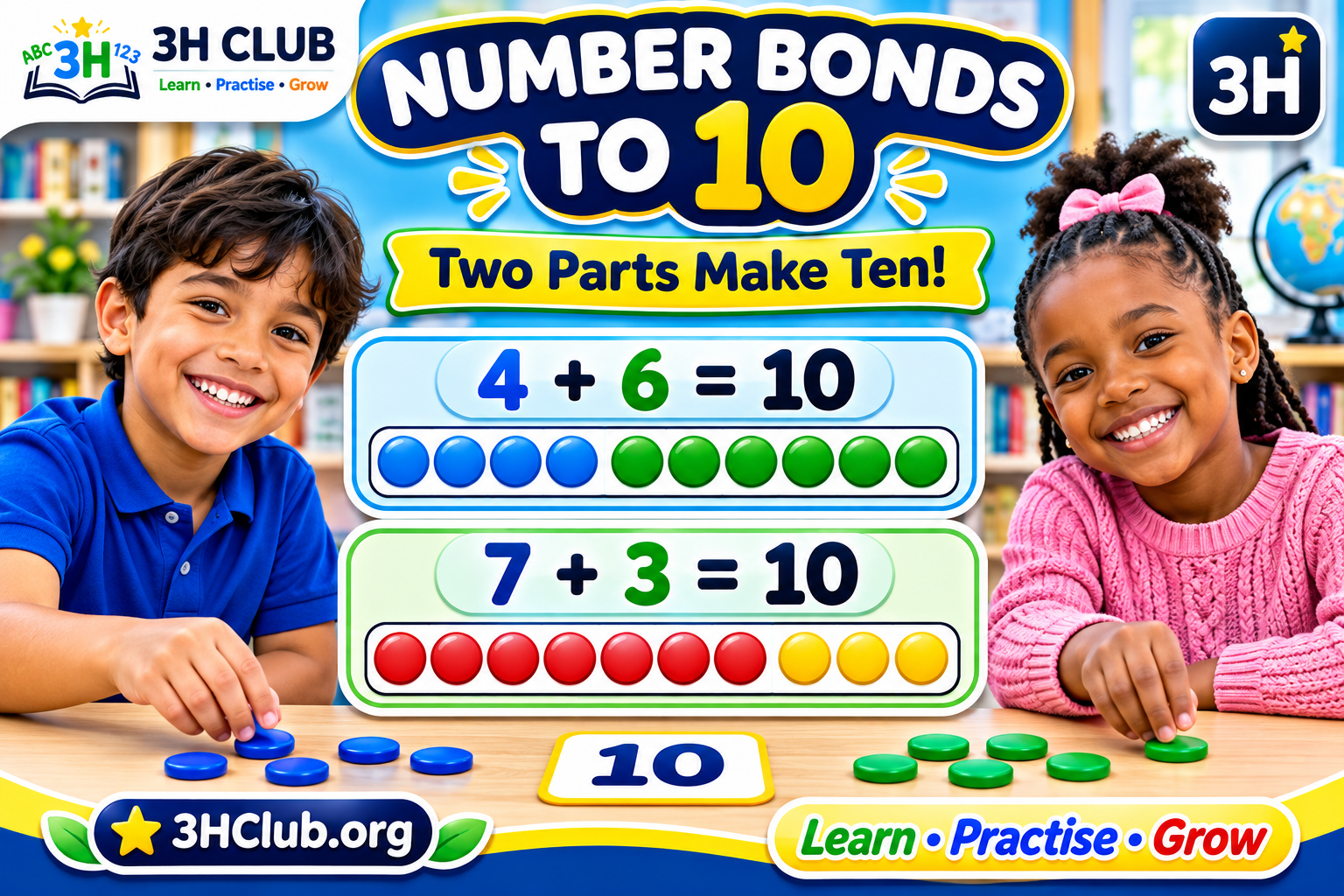
Example: 4 + 6 = 10
🔵 🔵 🔵 🔵 🟢 🟢 🟢 🟢 🟢 🟢
4 blue counters + 6 green counters = 10 counters
The numbers 4 and 6 are a number bond to 10 because they add up to 10.
That means:
4 + 6 = 10
You can also turn the numbers around:
6 + 4 = 10
The answer stays the same!
This happens because you can add numbers in either order without changing their total.
Learn All the Number Bonds to 10
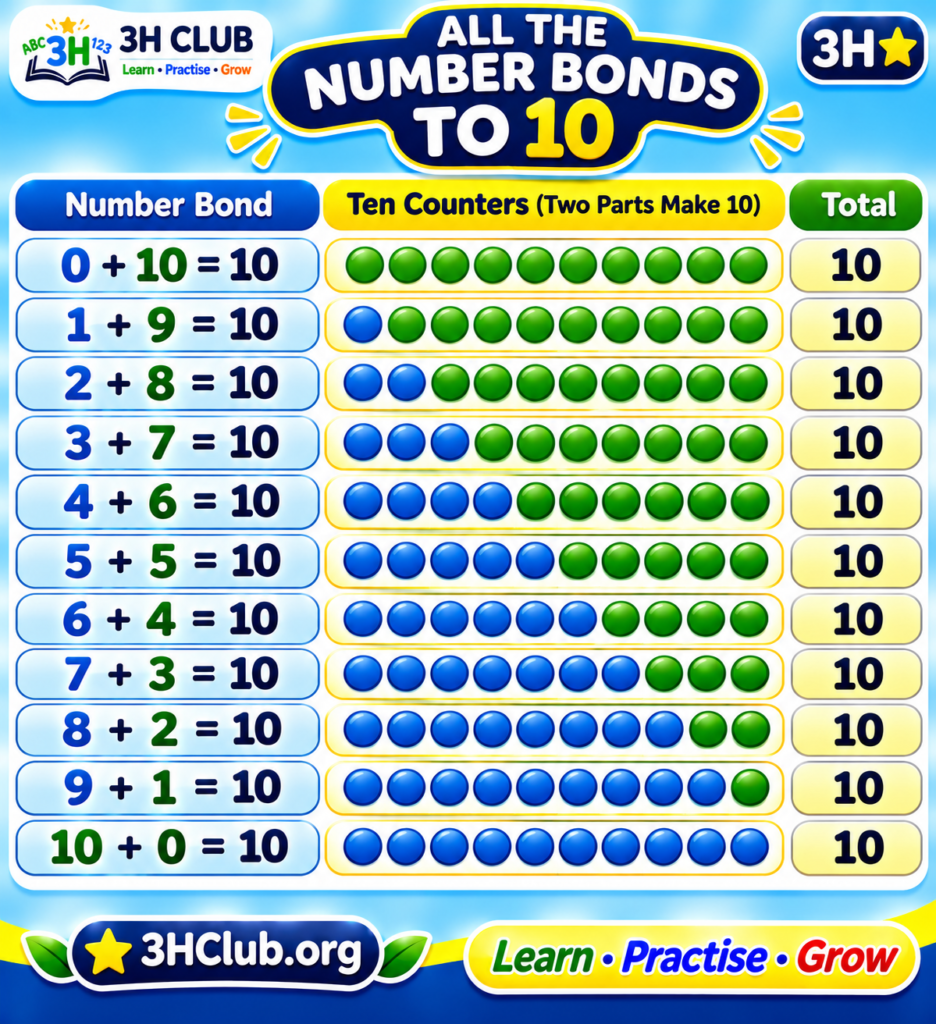
Here are the number pairs that make 10.
| First number | Second number | Number bond |
|---|---|---|
| 0 | 10 | 0 + 10 = 10 |
| 1 | 9 | 1 + 9 = 10 |
| 2 | 8 | 2 + 8 = 10 |
| 3 | 7 | 3 + 7 = 10 |
| 4 | 6 | 4 + 6 = 10 |
| 5 | 5 | 5 + 5 = 10 |
| 6 | 4 | 6 + 4 = 10 |
| 7 | 3 | 7 + 3 = 10 |
| 8 | 2 | 8 + 2 = 10 |
| 9 | 1 | 9 + 1 = 10 |
| 10 | 0 | 10 + 0 = 10 |
Notice something interesting?
The first number increases by 1 while the second number decreases by 1. The total always stays at 10.
There are six different pairs if we do not count reversed pairs separately.
⭐ Starters — Ages 6–7
1. Make 10 with Your Fingers
Your hands are perfect counting tools because you have ten fingers altogether.
Try this activity.
-
Hold up all ten fingers.
-
Fold down three fingers.
-
Count how many fingers are still standing.
-
You should see seven fingers.
That means:
3 + 7 = 10
Now fold down six fingers. How many are still standing?
Four!
6 + 4 = 10
Try different combinations. Each time, your folded fingers and raised fingers will add up to ten.
2. Make 10 with Colourful Counters
Find ten small objects. You could use buttons, blocks, bottle tops or counters.
Place some on one side of your desk and the rest on the other side.
For example:
Make 10 with Counters
Blue group
4
Green group
6
4 + 6 = 10
Four blue counters and six green counters
make ten!
3HClub.org | Learn • Practise • Grow
3. Use a Ten-Frame
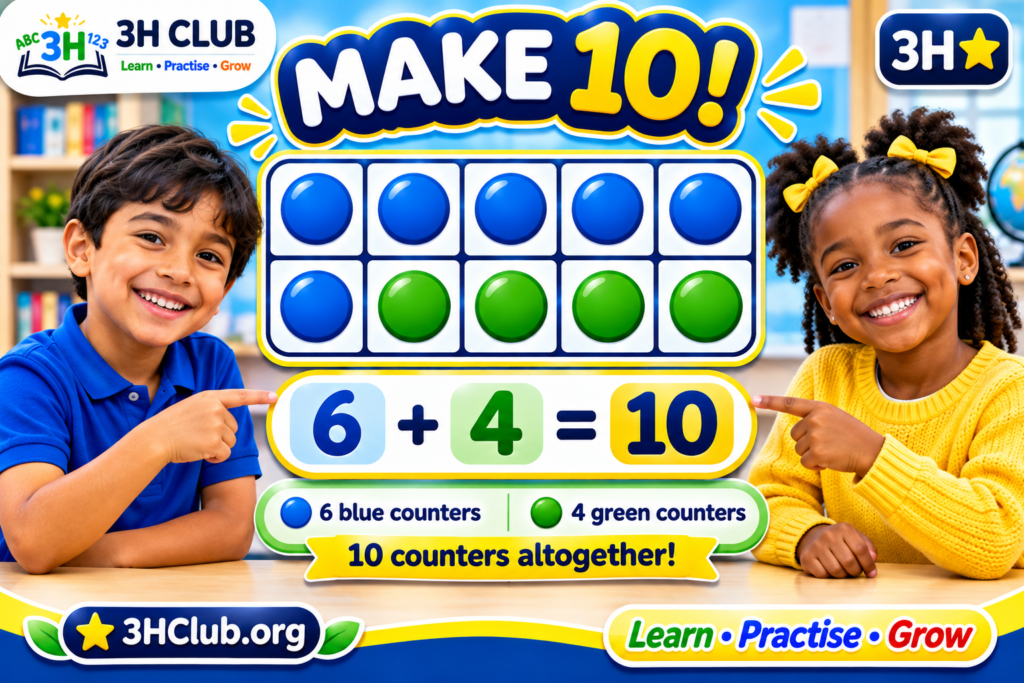
A ten-frame is a rectangle with ten small spaces arranged in two rows of five.
You can use it to see how many spaces are filled and how many are empty.
Example: 6 + 4 = 10
| 🔵 | 🔵 | 🔵 | 🔵 | 🔵 |
| 🔵 | ⚪ | ⚪ | ⚪ | ⚪ |
Six spaces are filled, and four spaces are empty.
6 + 4 = 10
If six spaces are filled, four spaces are empty.
6 + 4 = 10
The empty spaces tell you how many more you need to make ten.
Example: 8 + 2 = 10
| 🔵 | 🔵 | 🔵 | 🔵 | 🔵 |
| 🔵 | 🔵 | 🔵 | ⚪ | ⚪ |
Eight spaces are filled, and two spaces are empty.
8 + 2 = 10
The empty spaces tell you how many more you need to make ten.
6 + 4 = 10
The empty spaces tell you how many more you need to make ten.
4. Use a Number Bond Diagram
A number bond diagram shows one whole number connected to two parts.
Two Parts Make One Whole
7 + 3 = 10
The whole number is 10. Its two parts are 7 and 3.
You can change the parts, but they must still add up to ten.
5. Find the Missing Number
Sometimes one part of a number bond is missing.
For example:
8 + ? = 10
Think: How many more do I need to make ten?
Start at 8 and count on:
9, 10.
You counted two more numbers.
So:
8 + 2 = 10
Try another one:
? + 5 = 10
The missing number is 5 because:
5 + 5 = 10
6. Use Number Bonds for Subtraction
Number bonds help with taking away, too!
If you know:
4 + 6 = 10
Then you also know:
10 − 4 = 6
and
10 − 6 = 4
These addition and subtraction facts belong to the same number family.
You can use the number bond to check your subtraction answer.
Fun Number Bonds to 10 Activities
Now that you know how number bonds work, it’s time to practise!
Activity 1: Find the Missing Partner
Each number has a partner that helps it make 10.
Choose a number and find its missing partner.
Find My Number Partner!
7 + ? = 10
How many more make ten?
Find My Number Partner!
How many more make ten?
Choose the missing number.
Make two sets of number cards from 0 to 10.
Mix the cards and turn them face up.
Find two cards that add up to 10. For example, you could match 2 with 8 or 4 with 6.
When you find a matching pair, say the full number sentence aloud:
“Two plus eight equals ten!”
Try to find all six different pairs.
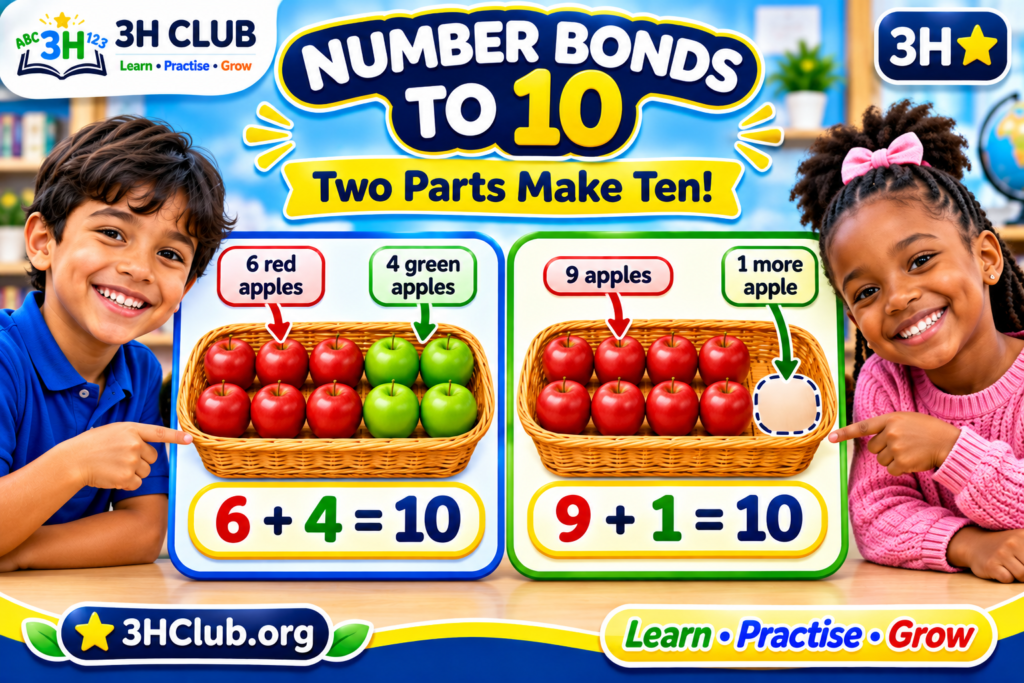
Activity 3: The Missing Apples
Imagine you have a basket that can hold exactly 10 apples.
There are 6 apples in the basket.
How many more apples can you add?
6 + 4 = 10
You can add four more apples!
Now imagine there are 9 apples in the basket. You need just one more to make ten.
⭐ Number Bonds to 10 Practice Quiz
Let’s see how much you have learned!
Read each question carefully. You can use your fingers, counters or a ten-frame if you need help.
Can You Make 10?
1. 2 + ? = 10
2. 5 + ? = 10
3. ? + 3 = 10
4. 10 − 6 = ?
5. Which pair makes 10?
6. 9 + ? = 10
7. ? + 0 = 10
8. 10 − 8 = ?
Check all my answers Try the quiz again
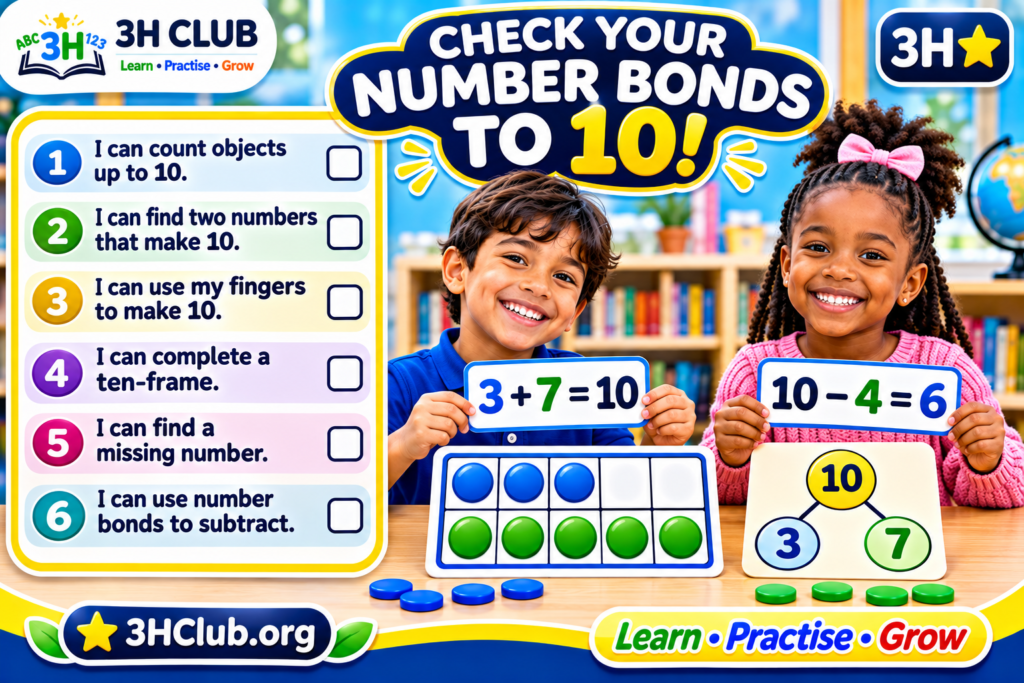
Check Your Number Bonds to 10!
Before you finish, see how many of these skills you can do.
My Number Bonds Checklist
1. I CAN COUNT OBJECTS UP TO 10
2. I CAN FIND TWO NUMBERS THAT MAKE 10
3. I CAN USE MY FINGERS TO MAKE 10
4. I CAN COMPLETE A TEN-FRAME
5. I CAN FIND A MISSING NUMBER
6. I CAN USE NUMBER BONDS TO SUBTRACT
0 of 6 skills checked
Why Are Number Bonds to 10 Important?
Number bonds to 10 help you become quicker and more confident when working with numbers.
When you know that 8 + 2 = 10, you can use that fact to solve bigger addition problems.
For example:
8 + 5 = ?
You know that 8 needs 2 more to make 10.
Break 5 into 2 and 3.
8 + 2 = 10
10 + 3 = 13
So:
8 + 5 = 13
This is called the make-ten strategy.
You will use this helpful skill as you learn to add larger numbers.
Frequently Asked Questions About Number Bonds to 10
What is a number bond to 10?
A number bond to 10 is a pair of numbers that add together to make 10. For example, 4 and 6 are a number bond to 10.
How many number bonds to 10 are there?
There are six different pairs if you count each pair only once: 0 and 10, 1 and 9, 2 and 8, 3 and 7, 4 and 6, and 5 and 5. If you count reversed pairs separately, there are eleven ordered combinations.
What is the easiest way to learn number bonds to 10?
Try using your fingers, colourful counters or a ten-frame. Practise a few pairs each day until you recognise them without counting every object.
Can number bonds help with subtraction?
Yes! If you know 7 + 3 = 10, you also know 10 − 7 = 3 and 10 − 3 = 7.
Do I need to remember every number bond?
Learning the pairs will make your maths easier. Start by using pictures and objects. With regular practice, you will begin to remember them naturally.
Keep Learning with 3HClub.org!
Well done, Number Bond Star!
You have learned how to find number pairs that make 10, use a ten-frame, solve missing-number problems and connect addition with subtraction.
Remember:
Two parts join together to make one whole.
Keep practising your number bonds, and soon you will be ready to use them in bigger maths challenges.
Learn • Practise • Grow
4. External Educational Resources
These three external resources are suitable for a short “More Ways to Practise” section.
-
Topmarks – Addition and Subtraction Games — Interactive maths practice for young learners.
-
Math Is Fun – Introduction to Addition — Simple explanations of addition and number combinations.
-
Khan Academy – Early Maths — Additional counting, addition and subtraction lessons.