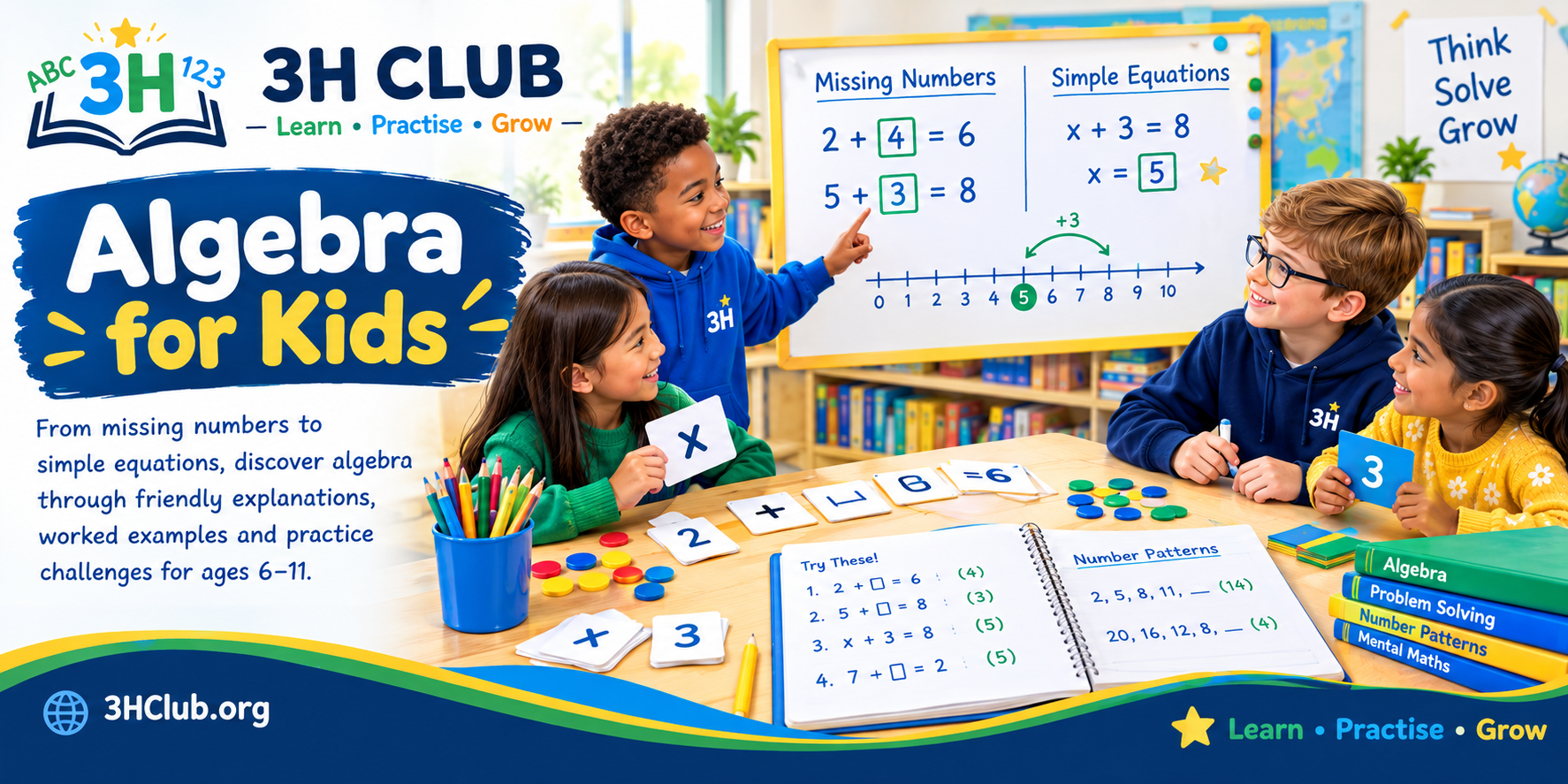
Algebra for Kids
Learn About Missing Numbers, Patterns and Equations
Have you ever solved a number puzzle by working out which number is missing? Then you have already started learning algebra!
Algebra is a part of maths that uses numbers, letters and symbols to help us solve problems. It helps us discover missing values, describe number patterns and understand how numbers work together.
You do not need to know everything at once. In this guide, you will build your algebra skills step by step, from simple missing-number puzzles to solving equations.
⭐ Starters — Ages 6–7
⭐⭐ Builders — Ages 8–9
⭐⭐⭐ Champions — Ages 10–11
Ready to become an algebra problem-solver? Let’s begin!
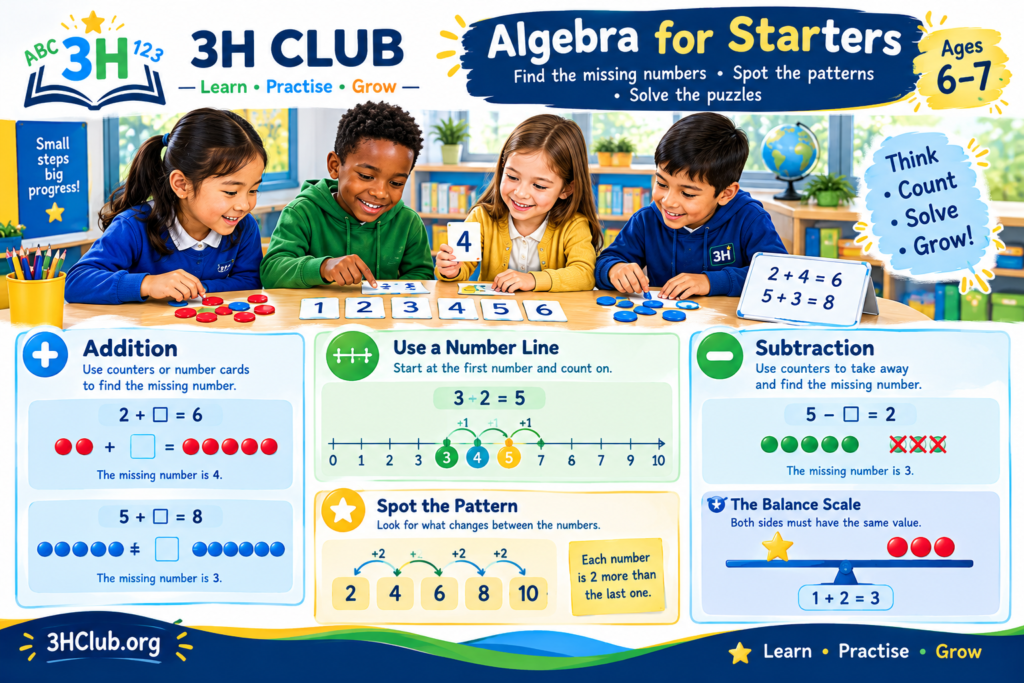
⭐ Starters — Ages 6–7: Discover Missing Numbers
What Is Algebra?
Imagine you have 3 apples, and someone gives you some more. Now you have 5 apples.
How many apples did you receive?
🍎 🍎 🍎 + ❓ ❓ = 🍎 🍎 🍎 🍎 🍎
You can work it out by counting: you had 3 apples and need 2 more to make 5.
We can write:
3 + 2 = 5
Algebra often starts with puzzles like this. Instead of showing every number, we leave a space for the number we need to find.
Find the Missing Number
A missing number is a number that has been left out of a calculation. Your job is to discover what belongs in the space.
Look at these examples:
- 2 + □ = 6
- 5 + □ = 8
- 9 − □ = 4
The square, or box, stands for a number we do not know yet.
Let’s solve the first one:
2 + □ = 6
Start at 2 and count on until you reach 6: 3, 4, 5, 6.
You counted four steps, so the missing number is 4.
2 + 4 = 6
Now try the others:
- 5 + □ = 8 → the missing number is 3.
- 9 − □ = 4 → the missing number is 5.
Great work! You are already thinking like an algebra learner.
Use Objects to Solve Puzzles
You can use counters, cubes, buttons or drawings to help you find a missing number.
Suppose you see:
□ + 3 = 7
Place 3 counters on the table. Add more counters until you have 7 altogether.
You need 4 more counters.
So:
4 + 3 = 7
The missing number is 4.
You can also solve the puzzle by counting backwards from 7 three steps: 6, 5, 4.
Understand the Equals Sign
The equals sign (=) means that the amounts on both sides have the same value.
For example:
4 + 2 = 6
The left side has a value of 6, and the right side is also 6.
You can think of the equals sign like a balanced seesaw. Both sides must have the same value.
Here is another example:
5 + 1 = 4 + 2
Both sides equal 6, so the statement is correct.
Remember: the equals sign does not simply mean “write the answer next.” It tells you that both sides have the same value.
Discover Number Patterns
Algebra also helps you understand patterns.
Look at this sequence:
2, 4, 6, 8, __
Each number increases by 2. The next number is 10.
Now try this pattern:
5, 10, 15, 20, __
Each number increases by 5. The next number is 25.
When you spot the rule, you can predict what comes next.
Try each question before checking the answers.
- Fill in the missing number: 2 + □ = 5.
- Fill in the missing number: 4 + □ = 9.
- Fill in the missing number: 8 − □ = 3.
- What number comes next? 1, 2, 3, 4, __.
- What number comes next? 3, 6, 9, 12, __.
- Is this statement true or false? 3 + 2 = 4 + 1.
- There are 4 birds on a fence. Some more arrive, and now there are 7. How many birds arrived?
Answers
- 3
- 5
- 5
- 5
- 15
- True — both sides equal 5.
- 3 birds
Starters challenge: I am thinking of a number. When I add 4 to it, the answer is 10. What is my number?
Answer: 6, because 6 + 4 = 10.
⭐⭐ Builders — Ages 8–9: Letters, Expressions and Simple Equations
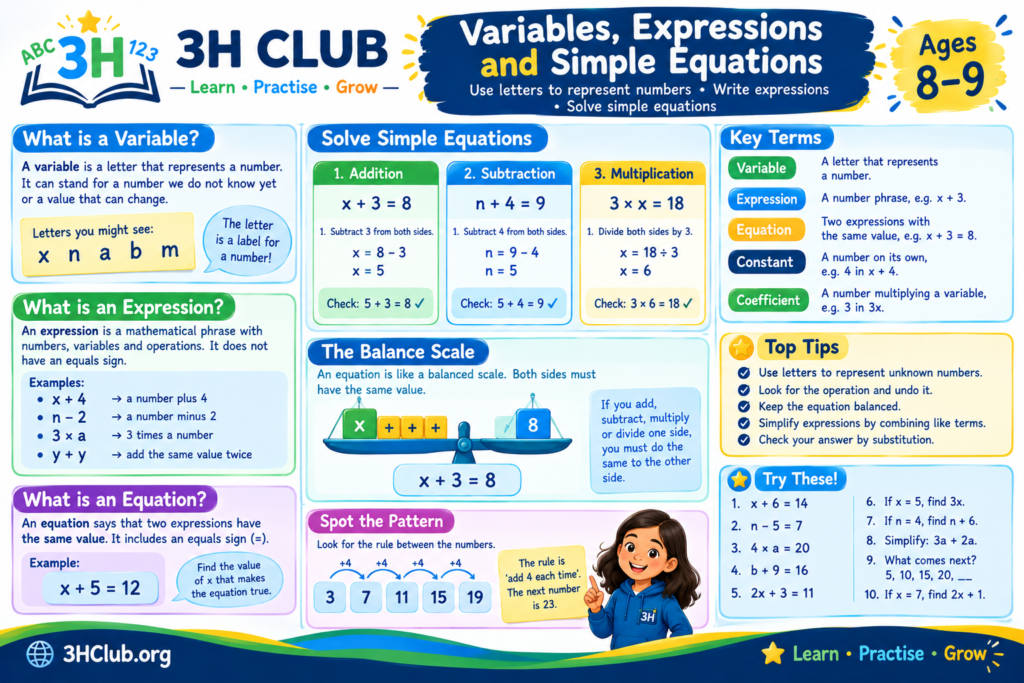
You have already solved missing-number puzzles. Now you can learn a useful algebra trick: using letters to stand for numbers.
What Is a Variable?
A variable is a letter or symbol that represents a number. It can stand for a number we do not know yet, or for a value that can change.
For example:
x + 3 = 8
The letter x represents the missing number.
What number plus 3 equals 8?
Since 5 + 3 = 8, we know that:
x = 5
The letter does not have to be x. You could use a, b, n or another letter.
For example:
n + 4 = 9
Here, n = 5.
Think of a variable as a label on a mystery box. The label tells you that a number is inside, and your task is to discover its value.
What Is an Algebraic Expression?
An algebraic expression is a mathematical phrase made using numbers, variables and operations. It does not have to contain an equals sign.
For example:
- x + 4 means a number plus 4.
- n − 2 means a number minus 2.
- 3 × a means 3 multiplied by a number.
- y + y means adding the same value twice.
Expressions can describe calculations without telling you the final answer.
Suppose you have some stickers. You receive 5 more stickers, and you do not yet know how many you started with.
If the starting number is s, the total is:
s + 5
If you started with 7 stickers, then s = 7, and the total would be 7 + 5 = 12 stickers.
Substitute a Number into an Expression
To substitute means to replace a letter with its value.
Suppose a = 6.
What is a + 4?
Replace a with 6:
6 + 4 = 10.
So, a + 4 = 10 when a = 6.
Try another example.
If n = 3, calculate 2 × n.
Replace n with 3:
2 × 3 = 6.
The answer is 6.
Here is an important algebra shortcut. Instead of writing the multiplication sign, algebra often writes a number directly beside a letter.
For example:
- 3a means 3 × a.
- 5n means 5 × n.
- 2x means 2 × x.
So if x = 4, then 2x = 2 × 4 = 8.
What Is an Equation?
An equation is a mathematical statement that says two expressions have the same value. It includes an equals sign.
For example:
x + 5 = 12
This equation tells us that x plus 5 equals 12. We need to find the value of x that makes the statement true.
We can solve it by asking: “What number plus 5 equals 12?”
The answer is 7.
x = 7
Check your answer:
7 + 5 = 12 ✓
The equation is balanced because both sides have the same value.
Solve Equations by Using the Opposite Operation
You can solve simple equations by undoing the operation.
If a number has 5 added to it, subtract 5 to work backwards.
Example 1:
x + 5 = 12
Subtract 5 from 12:
12 − 5 = 7
Therefore, x = 7.
Example 2:
x − 4 = 9
Ask yourself: “What number minus 4 equals 9?”
Add 4 to 9:
9 + 4 = 13
Therefore, x = 13.
Example 3:
3 × x = 18
Ask: “What number multiplied by 3 equals 18?”
18 ÷ 3 = 6
Therefore, x = 6.
You can check each answer by putting it back into the original equation.
Follow the Rule in a Number Pattern
Look at this sequence:
4, 7, 10, 13, 16, …
Each number increases by 3.
The rule is: add 3 each time.
What comes next?
16 + 3 = 19.
Now look at this pattern:
2, 4, 8, 16, …
Each number doubles. The next number is 32.
Some patterns increase by adding the same amount, while others use multiplication or a different rule. Look closely at the numbers to discover what is happening.
⭐⭐ Builders Practice Time!
- If x = 4, what is x + 6?
- If n = 5, what is 3 × n?
- Solve: a + 7 = 15.
- Solve: b − 6 = 8.
- Solve: 4 × c = 20.
- If y = 3, calculate 2y + 1.
- What number comes next? 6, 10, 14, 18, __.
- Write an expression for “a number, p, plus 9.”
- A notebook costs $4. If you buy n notebooks, write an expression for the total cost.
Answers
- 10
- 15
- a = 8
- b = 14
- c = 5
- 7, because 2 × 3 + 1 = 7.
- 22
- p + 9
- 4n dollars
Builders challenge: A number is multiplied by 2, and then 3 is added. The result is 17. What is the number?
Write the equation:
2x + 3 = 17
Subtract 3 from 17:
17 − 3 = 14
Divide 14 by 2:
14 ÷ 2 = 7
Answer: x = 7.
⭐⭐⭐ Champions — Ages 10–11: Solve Equations and Use Algebra Rules
You are ready to work with more challenging algebra. You will learn how to solve equations step by step, simplify expressions and use algebra to solve real-life problems.
Understand the Parts of Algebra
There are a few useful terms to know.
- Variable: A letter representing a number, such as x or n.
- Expression: A mathematical phrase, such as 3x + 4.
- Equation: A statement showing that two expressions have the same value, such as 3x + 4 = 19.
- Constant: A number that stands on its own in an expression, such as 4 in 3x + 4.
- Coefficient: The number multiplying a variable. In 3x, the coefficient is 3.
You do not need to memorise all these words immediately. As you solve more problems, they will become easier to recognise.
Solve Two-Step Equations
Some equations need more than one step.
Consider:
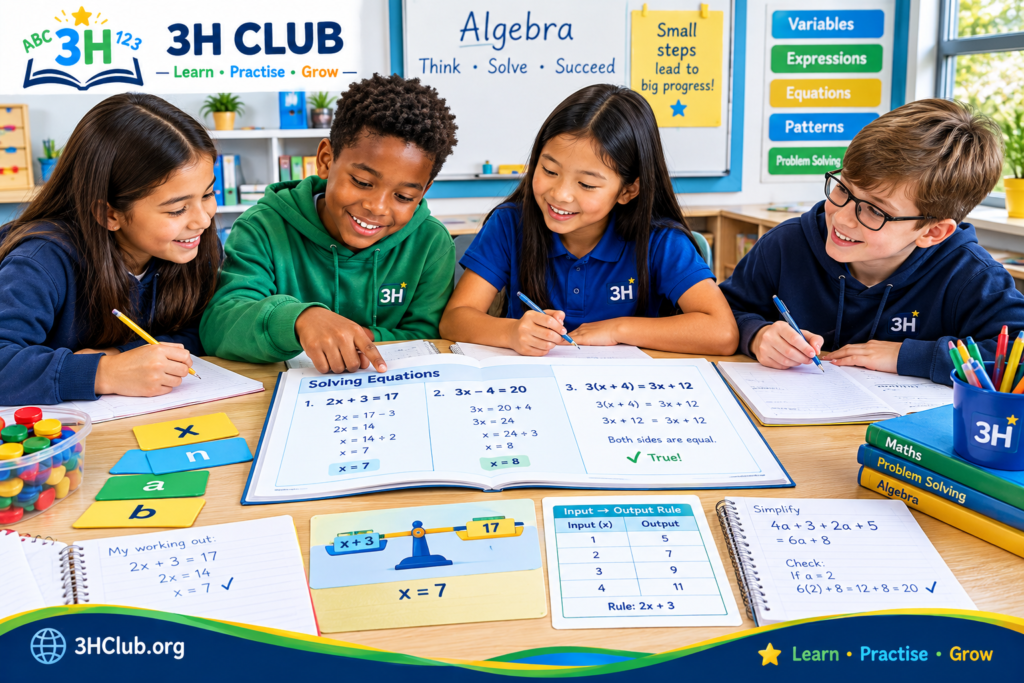
2x + 3 = 17
We want to find x by itself.
Step 1: Undo the addition.
Subtract 3 from both sides:
2x + 3 − 3 = 17 − 3
This gives:
2x = 14
Step 2: Undo the multiplication.
Divide both sides by 2:
x = 14 ÷ 2
So:
x = 7
Step 3: Check the answer.
Put 7 into the original equation:
2 × 7 + 3 = 14 + 3 = 17.
It works!
The key idea is to keep the equation balanced. Whatever operation you use on one side, you must use on the other side as well.
Solve an Equation with Subtraction
Try this equation:
3x − 4 = 20
First, add 4 to both sides:
3x = 24
Next, divide both sides by 3:
x = 8
Check:
3 × 8 − 4 = 24 − 4 = 20.
Therefore, x = 8.
Simplify Expressions
Sometimes you can make an expression shorter by combining like terms.
Like terms have the same variable raised to the same power. At this level, you can start by combining terms containing the same letter.
For example:
3x + 2x = 5x
Why? Because 3 lots of x plus 2 more lots of x make 5 lots of x.
You can also simplify:
4a + 3 + 2a + 5
First, collect the terms containing a:
4a + 2a = 6a
Then collect the ordinary numbers:
3 + 5 = 8
The simplified expression is:
6a + 8
Remember that 6a means 6 × a. It is not the same as 6 + a.
Here is another example:
7y − 2y = 5y
You have 7 lots of y and take away 2 lots of y, leaving 5 lots of y.
However, you cannot combine unlike terms such as 3x + 4 into 7x. The x represents a value, while 4 is a separate number.
Use the Distributive Property
The distributive property helps you multiply a number by everything inside brackets.
For example:
3(x + 4)
This means 3 multiplied by the whole quantity x + 4.
Multiply 3 by each term:
3 × x = 3x
3 × 4 = 12
Therefore:
3(x + 4) = 3x + 12
Try another example:
2(a + 5) = 2a + 10
This property is useful when simplifying expressions and solving more complicated equations.
Turn Words into Algebra
Algebra can help you turn a word problem into a mathematical statement.
Here are some common examples:
| Words | Algebra |
|---|---|
| A number plus 6 | x + 6 |
| A number minus 4 | x − 4 |
| Five times a number | 5x |
| A number divided by 3 | x ÷ 3 or x/3 |
| Twice a number, plus 7 | 2x + 7 |
| Three less than a number | x − 3 |
Read carefully. “Three less than a number” means start with the number and subtract 3. It does not mean 3 − x.
Solve a Real-Life Problem
A games club charges $5 to join and $3 for each game you play. Your total cost is $20.
How many games did you play?
Let g represent the number of games.
The total cost is:
5 + 3g = 20
Subtract 5 from both sides:
3g = 15
Divide both sides by 3:
g = 5
Answer: You played 5 games.
Check:
$5 joining fee + (5 × $3) = $20.
The equation matches the story, and the answer makes sense.
Explore Input and Output Rules
Algebra can describe a rule that changes an input into an output.
Imagine a machine that multiplies every number by 2 and then adds 1.
| Input | Rule | Output |
|---|---|---|
| 1 | 1 × 2 + 1 | 3 |
| 2 | 2 × 2 + 1 | 5 |
| 3 | 3 × 2 + 1 | 7 |
| 4 | 4 × 2 + 1 | 9 |
The rule can be written as:
Output = 2x + 1
Here, x is the input.
If the input is 6:
2 × 6 + 1 = 13.
The output is 13.
This is one way algebra describes patterns and relationships between numbers.
⭐⭐⭐ Champions Practice Time!
- Solve: x + 12 = 29.
- Solve: 5y = 45.
- Solve: 3a − 6 = 18.
- Solve: 4b + 5 = 29.
- Simplify: 4x + 3x.
- Simplify: 5a + 2 + 3a + 6.
- Expand: 4(x + 3).
- If n = 5, calculate 3n + 7.
- A cinema ticket costs $6, and a booking fee of $2 is added to the total. Write an expression for the cost of n tickets.
- A number is multiplied by 4 and then 6 is added. The result is 30. Find the number.
Answers
- x = 17
- y = 9
- a = 8
- b = 6
- 7x
- 8a + 8
- 4x + 12
- 22
- 6n + 2 dollars
- 4x + 6 = 30; 4x = 24; x = 6.
Champions challenge: A rectangle has a length of x + 3 centimetres and a width of x centimetres. Its perimeter is 26 cm. Find the value of x and the rectangle’s length and width.
The perimeter of a rectangle is twice the length plus twice the width.
2(x + 3) + 2x = 26
Expand the brackets:
2x + 6 + 2x = 26
Combine like terms:
4x + 6 = 26
Subtract 6:
4x = 20
Divide by 4:
x = 5
The width is 5 cm, and the length is 5 + 3 = 8 cm.
Answer: x = 5, width = 5 cm, length = 8 cm.
Quick Algebra Reference
| Term | Meaning | Example |
|---|---|---|
| Variable | A letter representing a number | x |
| Expression | Numbers and operations, possibly with variables | x + 4 |
| Equation | Two expressions set equal | x + 4 = 9 |
| Constant | A number on its own | 4 in x + 4 |
| Coefficient | A number multiplying a variable | 3 in 3x |
| Simplify | Write an expression in a shorter equivalent form | 2x + 3x = 5x |
| Substitute | Replace a variable with its value | If x = 2, then x + 5 = 7 |
Five Tips for Becoming an Algebra Star
- Read carefully. Work out what the question is asking you to find.
- Write down the rule. Use an equation or expression to represent the problem.
- Take one step at a time. Do not rush through several operations at once.
- Keep equations balanced. Apply the same operation to both sides when solving equations.
- Check your answer. Substitute your answer into the original equation to see whether it works.
Algebra is not about guessing a mystery number. It is about using patterns, operations and logical steps to discover the answer.
Frequently Asked Questions
1. What is algebra in simple words?
Algebra is a part of maths that uses numbers, letters and symbols to describe relationships and solve problems. It can help you find missing numbers, understand patterns and solve equations.
2. Why do we use letters in algebra?
Letters such as x, y and n can stand for numbers. They are useful when we do not know a value yet or when a rule works for many different numbers.
3. What is the difference between an expression and an equation?
An expression, such as x + 4, describes a calculation. An equation, such as x + 4 = 10, says that two values are equal and can be solved to find the unknown.
4. How do I solve a simple algebra equation?
Work out which operation is being used with the unknown, then use the opposite operation to undo it. For example, x + 6 = 14 becomes x = 14 − 6, so x = 8. Check your answer in the original equation.
5. What does 3x mean?
The expression 3x means 3 multiplied by x. If x = 4, then 3x = 3 × 4 = 12.
6. Is algebra useful in real life?
Yes! Algebra can help you work out costs, compare prices, find missing measurements, describe patterns and solve problems involving quantities that change.
7. What should I learn before algebra?
It helps to understand addition, subtraction, multiplication, division, number patterns and the equals sign. If these skills are still new, start with the Starters section and build your confidence gradually.
Keep Learning with 3HClub!
Well done! You have explored missing numbers, variables, expressions, equations, number patterns and algebra rules.
Keep practicing at your own pace. Every equation you solve helps you become a more confident mathematical thinker.
3HClub.org — Learn • Practice • Grow