The Math Swapping Game!
A Simple Guide for Kids
Learn • Practice • Grow with 3HClub.org
Have you ever used a letter to stand for a number in maths? You might have seen something like (x + 3) or (2a). These are examples of algebra, where letters can represent numbers.
But what happens when you are told what the letter is worth?
That is where substitution comes in!
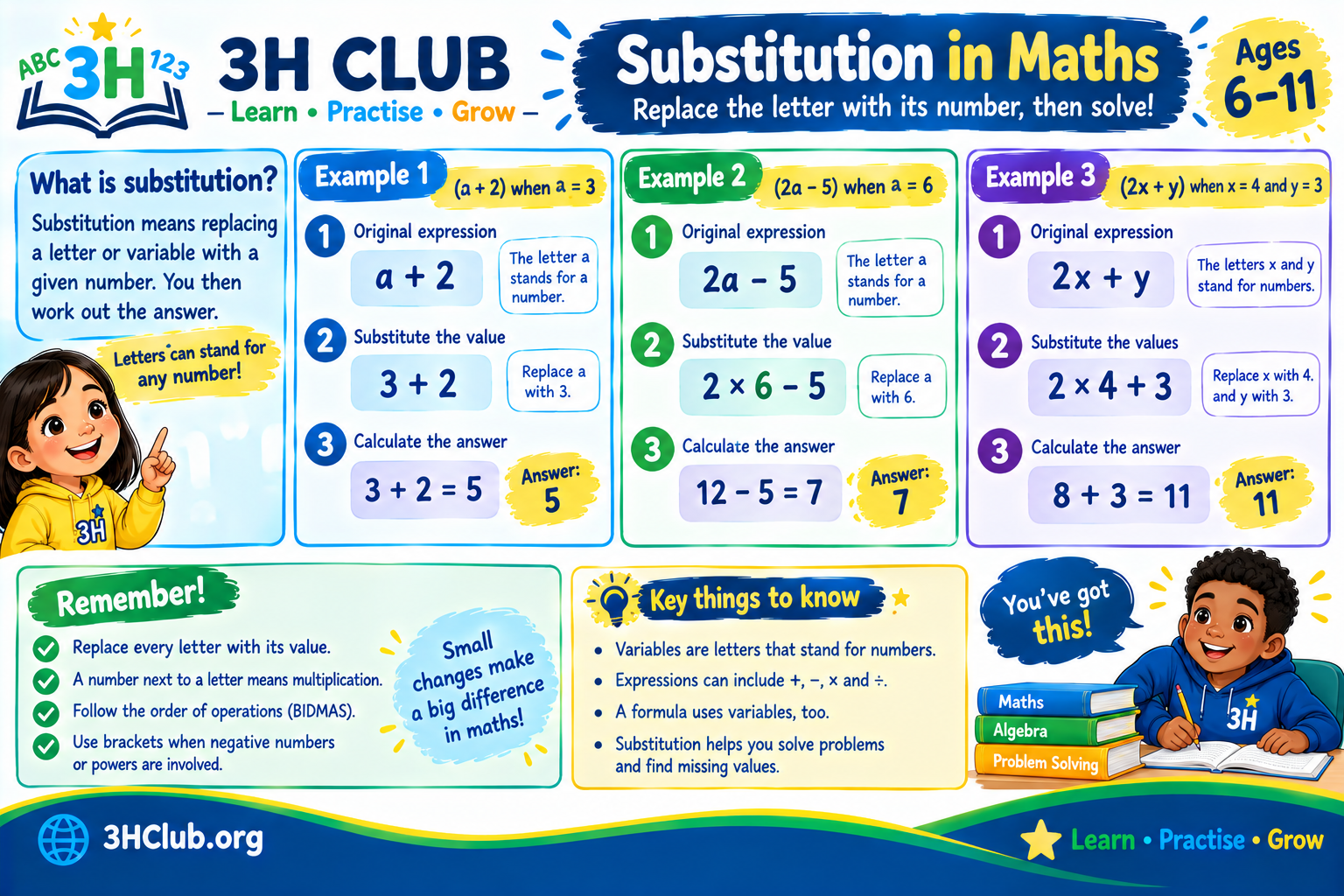
In maths, substitution means replacing a letter or variable with a given number. Once you have replaced the letter, you can work out the answer.
In this guide, you will learn how substitution works, practice using it in simple expressions, and discover how it can help you solve more challenging maths problems.
Ready to give it a try? Let’s get started!
⭐ Starters — Ages 6–7: What Is Substitution?
What does substitution mean?
Substitution is a big word for a simple idea: swap one thing for another.
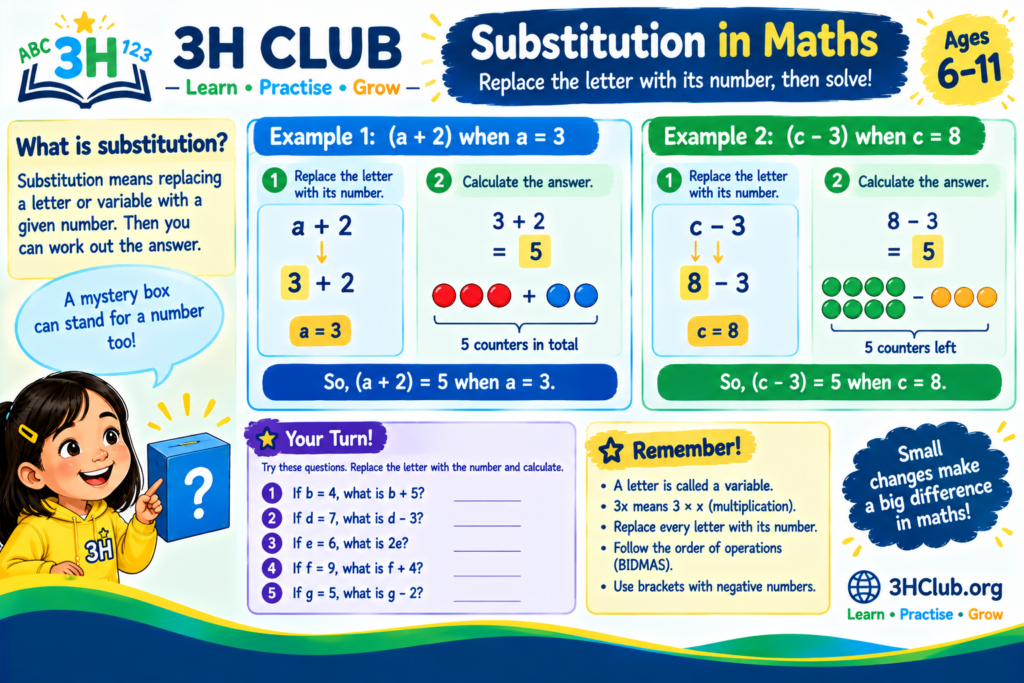
Imagine that a mystery box stands for the number 4.
If you see:
□ + 2
and you know the box is worth 4, you can replace the box with 4.
4 + 2 = 6
That is substitution! You replaced the box with its number and worked out the answer.
As you learn more maths, you will often see letters used instead of boxes.
Letters can stand for numbers
A letter in maths can represent a number. This letter is called a variable.
For example, if (a = 3), the letter (a) stands for 3.
Look at this expression:
(a + 2)
We know that (a = 3), so we replace (a) with 3.
[
a+2=3+2=5
]
The answer is 5.
Remember: the letter is not always the same number. If we are told that (a = 6) in a different question, we use 6 instead.
Let’s practice together
Example 1: Find (b + 4) when (b = 2).
Step 1: Replace (b) with 2.
(2 + 4)
Step 2: Add the numbers.
(2 + 4 = 6)
Answer: 6
Example 2: Find (c – 3) when (c = 8).
Replace (c) with 8:
(8 – 3 = 5)
Answer: 5
Your turn: Starters practice
Try these questions. Remember to replace the letter with the number you are given.
- If (a = 4), what is (a + 3)?
- If (b = 7), what is (b – 2)?
- If (c = 5), what is (c + 1)?
- If (d = 9), what is (d – 4)?
- If (m = 2), what is (m + 6)?
Check your answers
- (4 + 3 = 7)
- (7 – 2 = 5)
- (5 + 1 = 6)
- (9 – 4 = 5)
- (2 + 6 = 8)
Brilliant work! You have learned the first step of substitution: replacing a letter with its value.
⭐⭐ Builders — Ages 8–9: Substitution with Multiplication and Division
Now that you understand the basics, it is time to explore expressions that include more than one operation.
You will also learn an important algebra rule: when a number is written next to a letter, it usually means multiplication.
What does (3x) mean?
In algebra, (3x) means:
[
3\times x
]
It does not mean the number thirty-something, and it does not mean (3 + x). It means 3 multiplied by (x).
If (x = 4), then:
[
3x=3\times4=12
]
So, when (x = 4), the value of (3x) is 12.
Here are some other examples:
- (2a) means (2 \times a).
- (5b) means (5 \times b).
- (xy) means (x \times y).
When you substitute numbers for the letters, make sure you keep the correct operation.
How to substitute into an expression
Follow these three steps:
- Find the value: Look at the number given for each letter.
- Replace the letter: Put the number in its place.
- Calculate: Work out the new expression carefully.
Let’s see how it works.
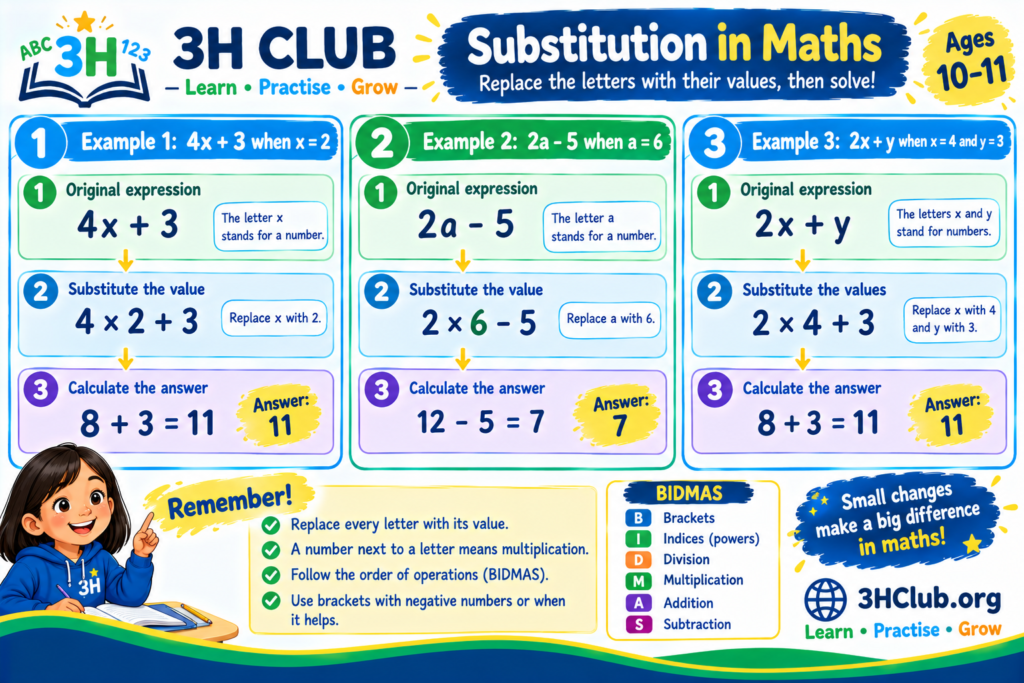
Example 1: Find (4x + 3) when (x = 2).
Step 1: Replace (x) with 2.
(4 \times 2 + 3)
Step 2: Multiply first.
(8 + 3)
Step 3: Add.
[
8+3=11
]
Answer: 11
Example 2: Find (2a – 5) when (a = 6).
Replace (a) with 6:
(2 \times 6 – 5)
Multiply first:
(12 – 5 = 7)
Answer: 7
Example 3: Find (b \div 3) when (b = 18).
Replace (b) with 18:
(18 \div 3 = 6)
Answer: 6
What if there is more than one letter?
Some expressions contain two or more variables. That simply means you need to replace each letter with its own value.
Example: Find (a + b) when (a = 5) and (b = 3).
Replace both letters:
(5 + 3 = 8)
Answer: 8
Now try a multiplication example.
Find (2x + y) when (x = 4) and (y = 3).
Replace each letter:
(2 \times 4 + 3)
Multiply first:
(8 + 3 = 11)
Answer: 11
A useful reminder: the order of operations
When an expression has more than one operation, you must calculate in the correct order.
For example:
[
2\times3+4
]
Multiply first:
[
6+4=10
]
The answer is 10, not 14.
A useful rule to remember is BIDMAS:
- B — Brackets
- I — Indices, such as squares
- D — Division
- M — Multiplication
- A — Addition
- S — Subtraction
Division and multiplication have the same priority, as do addition and subtraction. When operations have the same priority, work from left to right.
You can learn more about algebra in our Algebra for Kids guide.
Your turn: Builders practice
Substitute the given values and calculate each answer.
- Find (3x + 2) when (x = 4).
- Find (5a – 6) when (a = 3).
- Find (y \div 4 + 2) when (y = 12).
- Find (2m + n) when (m = 5) and (n = 4).
- Find (3p – q) when (p = 6) and (q = 7).
- Find (2 \times (x + 3)) when (x = 2).
Check your answers
- (3 \times 4 + 2 = 12 + 2 = 14)
- (5 \times 3 – 6 = 15 – 6 = 9)
- (12 \div 4 + 2 = 3 + 2 = 5)
- (2 \times 5 + 4 = 10 + 4 = 14)
- (3 \times 6 – 7 = 18 – 7 = 11)
- (2 \times (2 + 3) = 2 \times 5 = 10)
Keep going! You can now substitute values into expressions with several operations and more than one variable.
⭐⭐⭐ Champions — Ages 10–11: Substitution in More Challenging Maths
You are ready to take substitution a step further! You can use it to calculate the value of longer expressions, explore number rules and work with formulas.
The key idea stays the same: replace each variable with its given value, then calculate using the correct order of operations.
Substituting into expressions with powers
A power tells you how many times a number is multiplied by itself.
For example:
[
x^2=x\times x
]
This is called (x) squared.
If (x = 5), then:
[
x^2=5^2=5\times5=25
]
Notice that (5^2) means (5 \times 5), not (5 \times 2).
Let’s use a more challenging expression.
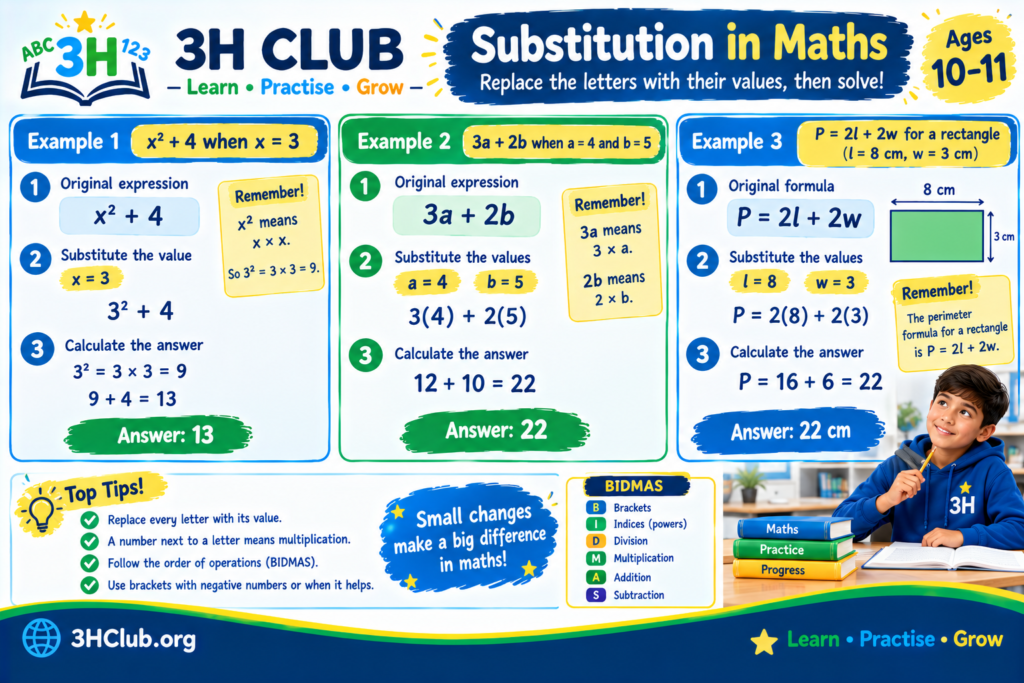
Example 1: Find (x^2 + 4) when (x = 3).
Replace (x) with 3:
(3^2 + 4)
Calculate the square first:
(9 + 4 = 13)
Answer: 13
Example 2: Find (2a^2 – 3) when (a = 4).
Replace (a) with 4:
(2 \times 4^2 – 3)
Calculate the square:
(2 \times 16 – 3)
Multiply:
(32 – 3 = 29)
Answer: 29
Substituting negative numbers
Sometimes a variable can stand for a negative number. Brackets can help you substitute negative values clearly.
For example, if (x = -3), find (x + 8).
Replace (x) with (-3):
[
(-3)+8=5
]
Answer: 5
Now consider (x^2) when (x = -3).
[
x^2=(-3)^2=(-3)\times(-3)=9
]
Answer: 9
The brackets show that the whole negative number is being squared. Remember that a negative number multiplied by another negative number gives a positive result.
Substitution with two variables
Let’s try an expression with two variables and more than one operation.
Example: Find (3a + 2b) when (a = 4) and (b = 5).
Step 1: Replace both variables.
(3 \times 4 + 2 \times 5)
Step 2: Multiply.
(12 + 10)
Step 3: Add.
[
12+10=22
]
Answer: 22
Always check that you have replaced every occurrence of each variable. If the same letter appears twice, use the same given value each time.
Using substitution in formulas
A formula is a mathematical rule that shows how quantities are connected.
For example, the perimeter of a rectangle can be found using:
[
P=2l+2w
]
Here:
- (P) is the perimeter.
- (l) is the length.
- (w) is the width.
Imagine a rectangle with a length of 8 cm and a width of 3 cm.
We know:
(l = 8) and (w = 3)
Substitute these values into the formula:
[
P=2(8)+2(3)
]
Multiply:
[
P=16+6
]
Add:
[
P=22\text{ cm}
]
The perimeter is 22 cm.
Substitution helps you use a formula with real measurements. You can explore other number skills in our Maths Symbols for Kids guide.
How to avoid common substitution mistakes
Even confident mathematicians can make mistakes. These tips can help you check your work.
1. Replace every letter.
If you are working with (2x + y), and (x = 3), (y = 4), replace both letters:
(2 \times 3 + 4)
2. Remember that a number beside a letter means multiplication.
(4x) means (4 \times x), not (4 + x).
3. Follow the order of operations.
For (3^2 + 2), calculate the square first:
(9 + 2 = 11)
4. Use brackets when substituting negative numbers or when they make the calculation clearer.
If (x = -4), then (x^2 = (-4)^2 = 16).
5. Check whether your answer makes sense.
If you substitute (x = 2) into (5x), the answer should be (5 \times 2 = 10). An answer of 7 would suggest that you may have added instead of multiplied.
Your turn: Champions practice
Show your working as you solve each problem.
- Find (4x + 7) when (x = 5).
- Find (3a^2) when (a = 2).
- Find (2m + 3n) when (m = 6) and (n = 4).
- Find (x^2 – 5) when (x = 6).
- Find (2p + q^2) when (p = 3) and (q = 4).
- A rectangle has length (l = 9) cm and width (w = 4) cm. Use (P = 2l + 2w) to find its perimeter.
- Find (x + 10) when (x = -3).
- Find (x^2) when (x = -5).
Check your answers
- (4 \times 5 + 7 = 20 + 7 = 27)
- (3 \times 2^2 = 3 \times 4 = 12)
- (2 \times 6 + 3 \times 4 = 12 + 12 = 24)
- (6^2 – 5 = 36 – 5 = 31)
- (2 \times 3 + 4^2 = 6 + 16 = 22)
- (P = 2(9) + 2(4) = 18 + 8 = 26\text{ cm})
- ((-3) + 10 = 7)
- ((-5)^2 = (-5) \times (-5) = 25)
Excellent effort! You have used substitution with powers, negative numbers, two variables and a formula. These are useful skills as you continue learning algebra.
Quick Reference: Substitution Rules
| What to remember | Example |
|---|---|
| Replace the letter with its value | (x + 3), when (x = 4), becomes (4 + 3) |
| A number beside a letter means multiply | (3x) means (3 \times x) |
| Replace every variable | (a + b), when (a = 2) and (b = 5), becomes (2 + 5) |
| Follow the order of operations | (2 \times 3 + 4 = 10) |
| Brackets help with negative values | If (x = -3), then (x^2 = (-3)^2 = 9) |
| Formulas can use substituted values | (P = 2l + 2w), with (l = 5), (w = 2), gives (P = 14) |
Frequently Asked Questions About Substitution in Maths
What does substitution mean in maths?
Substitution means replacing a letter or variable with a given value. You then calculate the expression using the usual maths rules.
Why do we use letters in maths?
Letters help us write rules and expressions that work for different numbers. For example, (x + 3) can represent adding 3 to any number that (x) stands for.
What does (4x) mean?
It means (4 \times x). If (x = 6), then (4x = 4 \times 6 = 24).
What is the difference between an expression and a formula?
An expression combines numbers, variables and operations, such as (3x + 2). A formula is a rule that connects quantities, often using an equals sign, such as (P = 2l + 2w) for the perimeter of a rectangle.
Do I have to use brackets when substituting?
Brackets are especially helpful when replacing a variable with a negative number or when they make the order of operations clearer. For example, if (x = -4), then (x^2 = (-4)^2 = 16).
Is substitution the same as solving an equation?
Not always. In basic substitution, you replace a variable with a value you already know and calculate the result. Solving an equation means finding a value that makes the equation true. Substitution can also help you check whether a proposed solution works.
What should I do if there are two or more variables?
Replace each variable with its matching value. For example, if (a = 3) and (b = 4), then (2a + b = 2 \times 3 + 4 = 10).
Learn • Practise • Grow with 3HClub.org!