Addition & Subtraction for Kids
Learn with Easy Examples
Addition and subtraction are two of the most useful maths skills you can learn. You use them when counting toys, sharing snacks, saving money, keeping score and working out how many things you have left.
In this guide, you will learn step by step, starting with simple number facts and moving towards larger calculations and tricky word problems. Choose your learning level, follow the examples and have a go at the activities.
⭐ Starters — Ages 6–7
⭐ Builders — Ages 8–9
⭐ Champions — Ages 10–11
Let’s get started!
⭐ Starters — Ages 6–7: Adding and Taking Away
What Is Addition?
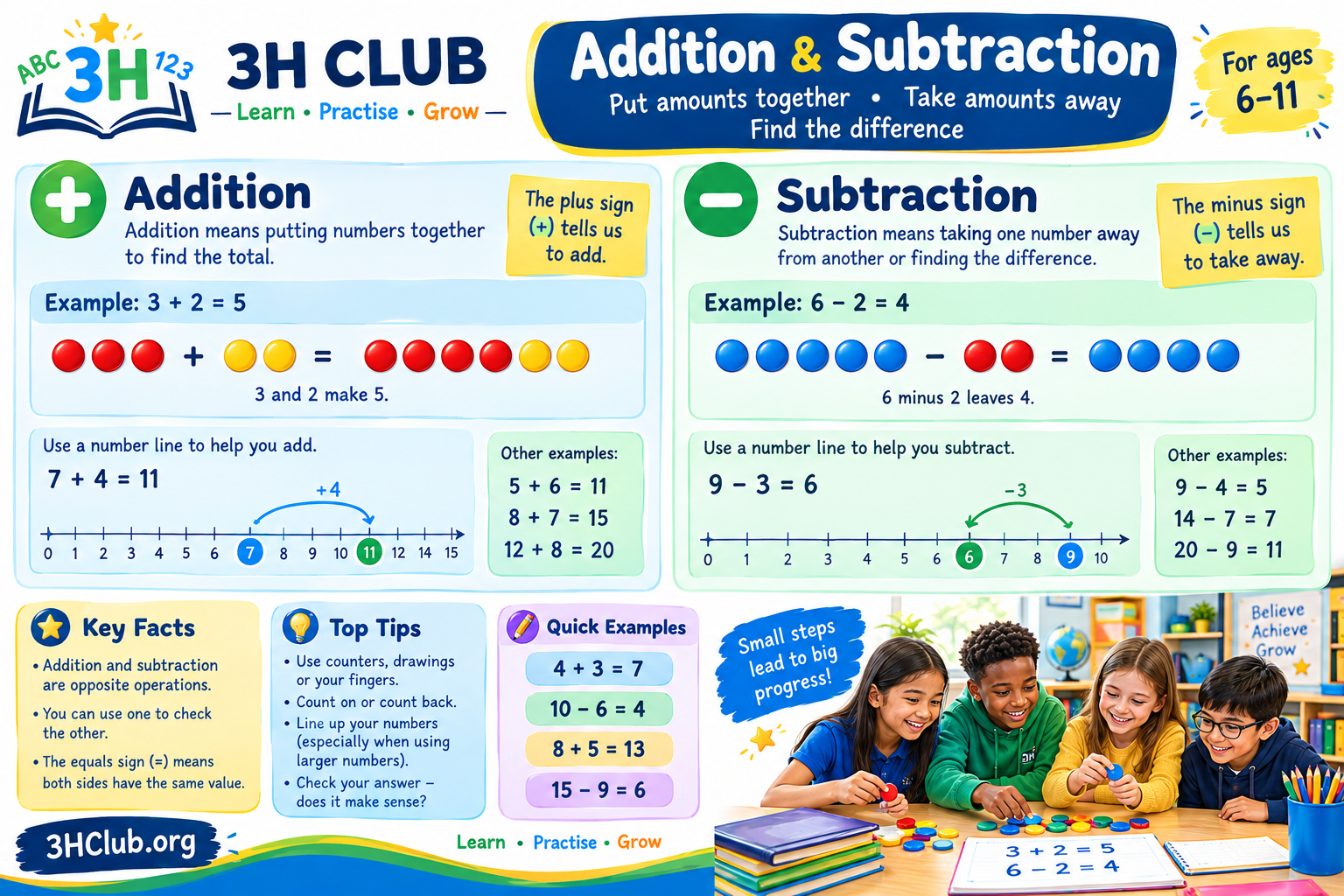
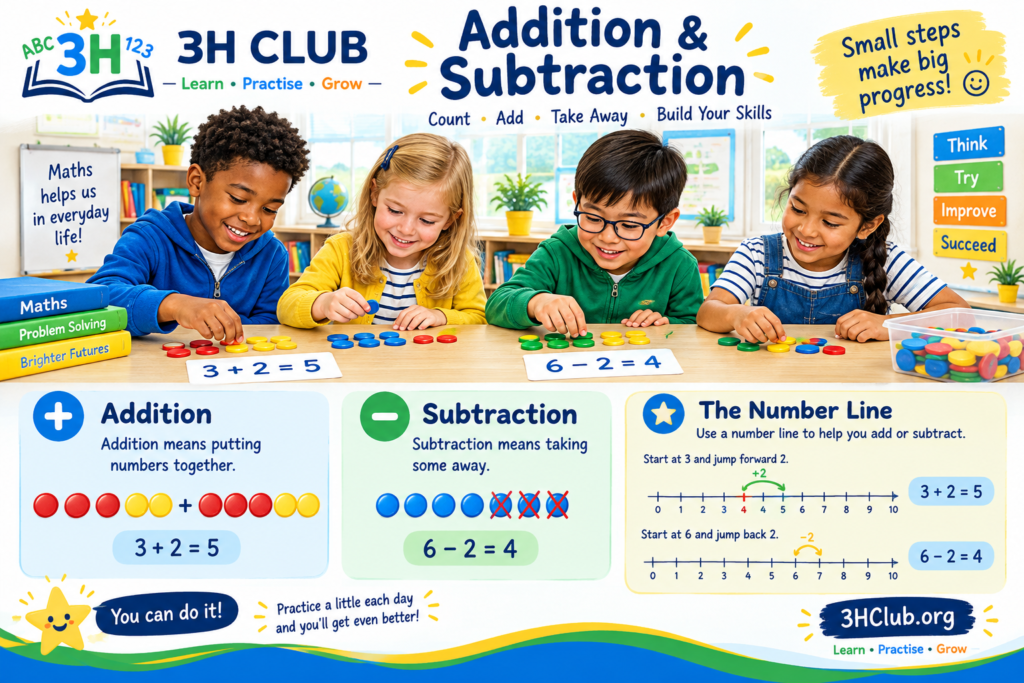
Addition means putting numbers together to find the total.
The plus sign (+) tells us to add.
Imagine you have 3 apples and a friend gives you 2 more. How many apples do you have altogether?
🍎 🍎 🍎 + 🍎 🍎 = 5 apples
We can write this as:
3 + 2 = 5
We say, “Three plus two equals five.”
The equals sign (=) means that both sides have the same value. In this example, 3 + 2 has the same value as 5.
Try Counting On
You do not always need to count from one. You can start with the bigger number and count on.
For example, to work out 5 + 3:
- Start at 5.
- Count on three more numbers: 6, 7, 8.
- The answer is 8.
So, 5 + 3 = 8.
You can practice counting on with your fingers, counters, building blocks or a number line.
Learn Your Number Bonds
Number bonds are pairs of numbers that make another number.
Here are some number bonds that make 10:
| Number | Number bond | Total |
|---|---|---|
| 1 | 9 | 10 |
| 2 | 8 | 10 |
| 3 | 7 | 10 |
| 4 | 6 | 10 |
| 5 | 5 | 10 |
Knowing number bonds helps you add quickly and confidently.
For example, if you know that 6 + 4 = 10, you can use that fact to help you work out 6 + 5. The answer is one more than 10, so it is 11.
What Is Subtraction?
Subtraction means taking one number away from another or finding the difference between two numbers.
The minus sign (−) tells us to subtract.
Imagine you have 6 biscuits and eat 2 of them. How many biscuits are left?
🍪 🍪 🍪 🍪 🍪 🍪 − 🍪 🍪 = 4 biscuits
We write:
6 − 2 = 4
We say, “Six minus two equals four.”
Count Back to Subtract
You can count backwards to help you subtract.
Let’s work out 9 − 3.
- Start at 9.
- Count backwards three numbers: 8, 7, 6.
- The answer is 6.
So, 9 − 3 = 6.
A number line can help you see the jumps backwards.
Example: Start at 8 and jump back 4 steps. You land on 4.
Therefore, 8 − 4 = 4.
Addition and Subtraction Work Together
Addition and subtraction are opposite operations. You can use one to check the other.
Look at this fact family:
- 4 + 3 = 7
- 3 + 4 = 7
- 7 − 4 = 3
- 7 − 3 = 4
If you know that 4 + 3 = 7, you also know that 7 − 3 = 4.
⭐ Starters Practice Time!
Try these questions before checking the answers.
- What is 2 + 4?
- What is 5 + 5?
- What is 7 − 3?
- What is 10 − 6?
- Fill in the missing number: 3 + ___ = 8.
- Fill in the missing number: 9 − ___ = 5.
- You have 4 toy cars and get 3 more. How many toy cars do you have now?
- There are 8 birds on a fence. Three fly away. How many birds remain?
Answers
- 6
- 10
- 4
- 4
- 5
- 4
- 7 toy cars
- 5 birds
Starters challenge: You have 5 red counters and 4 blue counters. How many counters do you have altogether? If you give away 3 counters, how many remain?
Answer: 5 + 4 = 9; 9 − 3 = 6 counters remain.
⭐⭐ Builders — Ages 8–9: Bigger Numbers and Regrouping
You already know how to add and subtract small numbers. Now it is time to use those skills with two-digit and three-digit numbers.
Understand Place Value
Before working with bigger numbers, remember that each digit has a place value.
In the number 47:
- 4 represents 4 tens, which is 40.
- 7 represents 7 ones, which is 7.
So, 47 = 40 + 7.
In the number 326:
- 3 represents 300.
- 2 represents 20.
- 6 represents 6.
So, 326 = 300 + 20 + 6.
Understanding place value helps you line up digits correctly when using written methods.
How to Add Two-Digit Numbers
Let’s calculate:
34 + 25
Break each number into tens and ones.
- Tens: 30 + 20 = 50
- Ones: 4 + 5 = 9
- Total: 50 + 9 = 59
Therefore, 34 + 25 = 59.
You can also use the column method:
  34
+ 25
----
  59
Write the ones underneath the ones and the tens underneath the tens. Add the ones first, followed by the tens.
Addition with Regrouping
What happens when the ones add up to 10 or more?
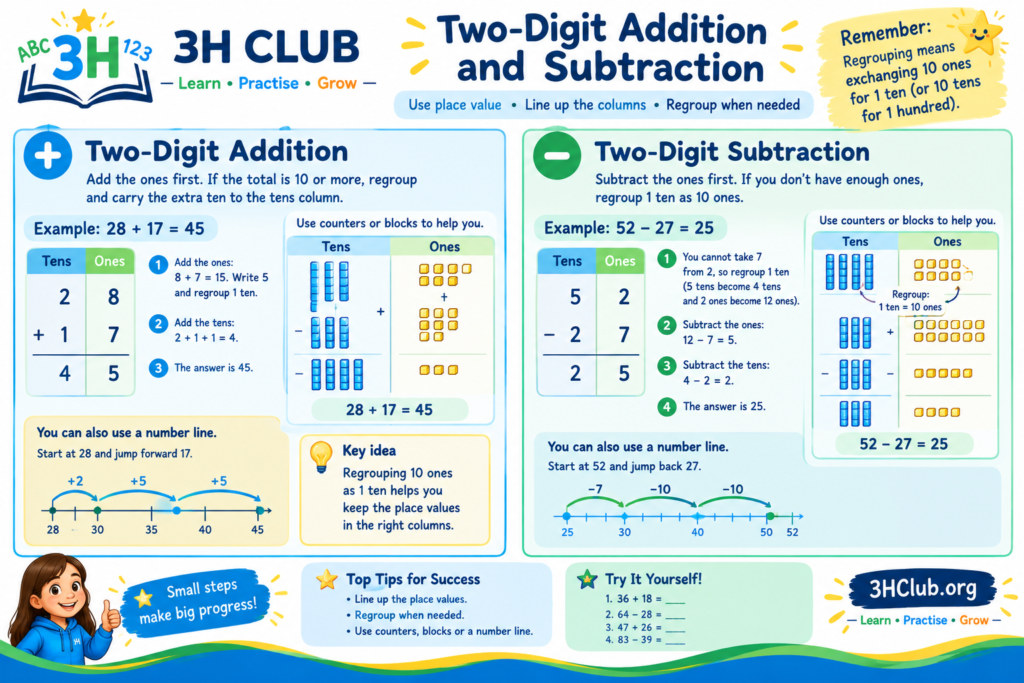
Let’s calculate 28 + 17.
   ¹
  28
+ 17
----
45- Add the ones: 8 + 7 = 15.
- Write 5 in the ones column.
- Regroup 10 ones as 1 ten, and carry that ten into the tens column.
- Add the tens: 2 + 1 + 1 = 4 tens.
- The answer is 45.
Regrouping means exchanging 10 ones for 1 ten. It helps us keep the place values correct.
How to Subtract Two-Digit Numbers
Let’s work out 68 − 24.
- Ones: 8 − 4 = 4
- Tens: 6 − 2 = 4
Therefore, 68 − 24 = 44.
  68
- 24
----
  44
Subtraction with Regrouping
Sometimes there are not enough ones to subtract. When this happens, you can regroup one ten as 10 ones.
Let’s calculate 52 − 27.
  ⁴ ¹²
  5 2
- 2 7
-----
  2 5
Here is what happens:
- You cannot subtract 7 ones from 2 ones.
- Exchange 1 ten for 10 ones. The 5 tens become 4 tens, and the 2 ones become 12 ones.
- Subtract the ones: 12 − 7 = 5.
- Subtract the tens: 4 − 2 = 2.
- The answer is 25.
You may hear this method called borrowing or exchanging. Regrouping helps you subtract accurately while keeping the value of the number the same.
Use Addition to Check Subtraction
You can check a subtraction answer by adding the answer to the number you took away.
For example:
52 − 27 = 25
Check: 25 + 27 = 52
The calculation works, so your answer is correct.
Add and Subtract Three-Digit Numbers
The same place-value rules work with hundreds, tens and ones.
Example:
246 + 132
- Hundreds: 200 + 100 = 300
- Tens: 40 + 30 = 70
- Ones: 6 + 2 = 8
Add the parts: 300 + 70 + 8 = 378.
Now try a subtraction:
475 − 213 = 262
You can check by adding: 262 + 213 = 475.
Use a Number Line
A number line is helpful when you want to calculate mentally.
To work out 46 + 28:
- Start at 46.
- Jump forward 20 to reach 66.
- Jump forward 8 to reach 74.
The answer is 74.
For subtraction, you can jump backwards or count forwards to find the difference.
For example, to calculate 72 − 48, count up from 48 to 72:
- 48 to 50 is 2.
- 50 to 70 is 20.
- 70 to 72 is 2.
Add the jumps: 2 + 20 + 2 = 24.
⭐⭐ Builders Practice Time!
- Calculate 36 + 42.
- Calculate 57 + 28.
- Calculate 84 − 31.
- Calculate 73 − 46.
- Calculate 245 + 123.
- Calculate 600 − 275.
- Fill in the missing number: ___ + 35 = 82.
- A school has 128 storybooks and buys 46 more. How many storybooks does it have now?
- A shop has 250 balloons and sells 87. How many balloons remain?
Answers
- 78
- 85
- 53
- 27
- 368
- 325
- 47
- 174 storybooks
- 163 balloons
Builders challenge: A charity collects 175 cans on Monday and 238 cans on Tuesday. It sends 196 cans to a food bank. How many cans are left?
Answer: 175 + 238 = 413; 413 − 196 = 217 cans.
⭐⭐⭐ Champions — Ages 10–11: Accurate Calculations and Problem-Solving
You are ready to take your addition and subtraction skills further. At this level, you will work with larger numbers, use estimation to check your answers and solve problems that require more than one step.
Add Larger Numbers
When adding numbers with several digits, line up the place values carefully. Start with the ones column and move towards the left, regrouping when a column totals 10 or more.
Example:
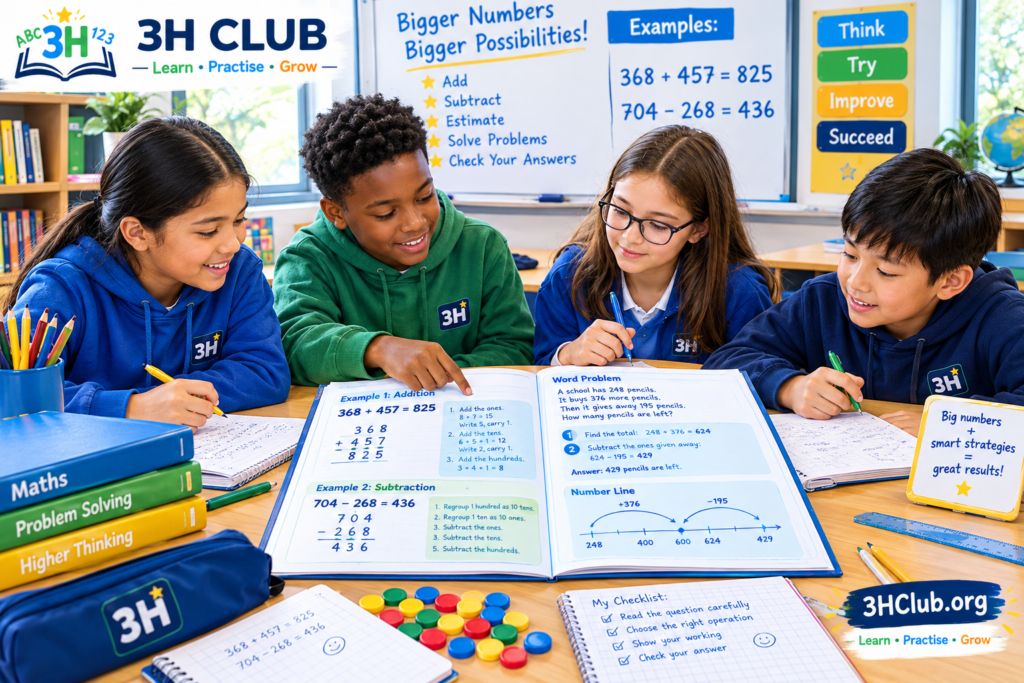
368 + 457
   ¹ ¹
   368
+  457
------
   825
Work through each column:
- Ones: 8 + 7 = 15. Write 5 and regroup 1 ten.
- Tens: 6 + 5 + 1 = 12. Write 2 and regroup 1 hundred.
- Hundreds: 3 + 4 + 1 = 8.
- The answer is 825.
Always check that your regrouped digits have moved into the correct column.
Subtract Larger Numbers
Let’s calculate 704 − 268.
  704
- 268
-----
  436
This calculation needs regrouping across place values because there are no tens in 704.
- Exchange 1 hundred for 10 tens. The number now has 6 hundreds and 10 tens.
- Exchange 1 ten for 10 ones. There are now 9 tens and 14 ones.
- Subtract the ones: 14 − 8 = 6.
- Subtract the tens: 9 − 6 = 3.
- Subtract the hundreds: 6 − 2 = 4.
- The answer is 436.
Check by adding: 436 + 268 = 704.
Estimate Before You Calculate
Estimation means finding an answer that is close to the exact answer. It helps you decide whether your calculation is reasonable.
Suppose you need to calculate 398 + 204.
Round each number to the nearest hundred:
- 398 is about 400.
- 204 is about 200.
- 400 + 200 = 600.
Now calculate exactly:
398 + 204 = 602
The exact answer, 602, is close to the estimate of 600.
Estimation is especially useful when a question asks for an approximate answer or when you want to check that you have not made a major mistake.
Choose a Mental Maths Strategy
You do not always need a written column method. Sometimes it is quicker to break numbers apart or adjust them.
Strategy 1: Break numbers into parts
For 236 + 142:
- 200 + 100 = 300
- 30 + 40 = 70
- 6 + 2 = 8
Total: 300 + 70 + 8 = 378.
Strategy 2: Make a friendly number
For 499 + 36, think of 499 as 500 − 1.
- 500 + 36 = 536
- 536 − 1 = 535
Strategy 3: Count up to find a difference
For 1,000 − 685, count from 685 to 1,000:
- 685 to 700 = 15
- 700 to 1,000 = 300
- 15 + 300 = 315
Choose the method that makes the calculation easiest to follow. You should still be able to explain why it works.
Solve Two-Step Word Problems
Some problems require two calculations. Read carefully to find out what happens first and what happens next.
Example: A school fair
A school sells 248 tickets on Friday and 376 tickets on Saturday. On Sunday, 195 tickets are refunded. How many tickets remain sold?
Step 1: Find the total tickets sold on Friday and Saturday.
248 + 376 = 624
Step 2: Subtract the refunded tickets.
624 − 195 = 429
Answer: 429 tickets remain sold.
A useful approach is to:
- Read the question carefully.
- Identify the important information.
- Decide which operation to use first.
- Work through each step.
- Check that your final answer matches the question.
Words such as altogether or in total can suggest addition, while left, remaining or difference can suggest subtraction. However, do not rely on keywords alone. Think about what is actually happening in the problem.
Remember the Order of the Steps
In a multi-step problem, the order matters.
For example, a class has 325 sheets of paper. It uses 78 sheets in the morning and 96 sheets in the afternoon.
You could calculate:
325 − 78 = 247
Then:
247 − 96 = 151
So, 151 sheets remain.
You could also add the sheets used first:
78 + 96 = 174
Then subtract:
325 − 174 = 151
Both methods give the same answer.
⭐⭐⭐ Champions Practice Time!
- Calculate 586 + 279.
- Calculate 1,204 + 687.
- Calculate 900 − 456.
- Calculate 1,000 − 738.
- Estimate 497 + 302 by rounding each number to the nearest hundred. Then find the exact answer.
- A library has 1,250 books. It buys 175 more books and then removes 238 damaged books. How many books remain?
- A sports club has 486 members. Another 127 people join, and then 89 members leave. How many members does the club have now?
- Fill in the missing number: 675 + ___ = 1,000.
Answers
- 865
- 1,891
- 444
- 262
- Estimate: 500 + 300 = 800. Exact answer: 497 + 302 = 799.
- 1,250 + 175 = 1,425; 1,425 − 238 = 1,187 books.
- 486 + 127 = 613; 613 − 89 = 524 members.
- 325
Champions challenge: A community project has a budget of $2,500. It spends $685 on supplies and $1,275 on equipment. How much money is left?
Answer: $685 + $1,275 = $1,960; $2,500 − $1,960 = $540 left.
Quick Reference: Addition and Subtraction
| Maths symbol | Name | What it tells you | Example |
|---|---|---|---|
| + | Plus | Put amounts together | 5 + 3 = 8 |
| − | Minus | Take away or find a difference | 8 − 3 = 5 |
| = | Equals | Both sides have the same value | 4 + 4 = 8 |
| ( \approx ) | Approximately equal to | The values are close, but may not be exact | 398 + 204 ≈ 600 |
Five Tips for Success
- Know your number bonds. They make mental maths easier.
- Understand place value. Keep ones, tens, hundreds and thousands in the correct columns.
- Regroup carefully. Check where each exchanged ten or hundred belongs.
- Estimate when useful. A quick estimate can help you spot an answer that is far too large or too small.
- Check your work. Addition can check subtraction, and subtraction can check addition.
Remember, mistakes are part of learning. If an answer does not seem right, go back through your steps and try again.
Frequently Asked Questions
1. What is addition?
Addition is the process of combining two or more numbers to find a total. For example, 4 + 3 = 7.
2. What is subtraction?
Subtraction means taking an amount away or finding the difference between numbers. For example, 9 − 4 = 5.
3. What is the difference between addition and subtraction?
Addition combines amounts, while subtraction takes away an amount or compares two amounts to find the difference. They are opposite operations and can be used to check each other.
4. What does regrouping mean?
Regrouping means exchanging one place-value unit for an equivalent amount in the next smaller place. For example, 1 ten can be exchanged for 10 ones. This helps you complete addition and subtraction calculations accurately.
5. How can I get better at mental maths?
Practice number bonds, count forwards and backwards, break numbers into smaller parts, and try making friendly numbers such as 10, 100 or 1,000. Regular short practice sessions can help you become faster and more confident.
6. How can I check an addition answer?
You can use subtraction to check addition. For example, if 26 + 18 = 44, check by calculating 44 − 18. If the answer is 26, your addition is correct.
7. How can I check a subtraction answer?
Add the number you subtracted to your answer. For example, if 53 − 29 = 24, check that 24 + 29 = 53.