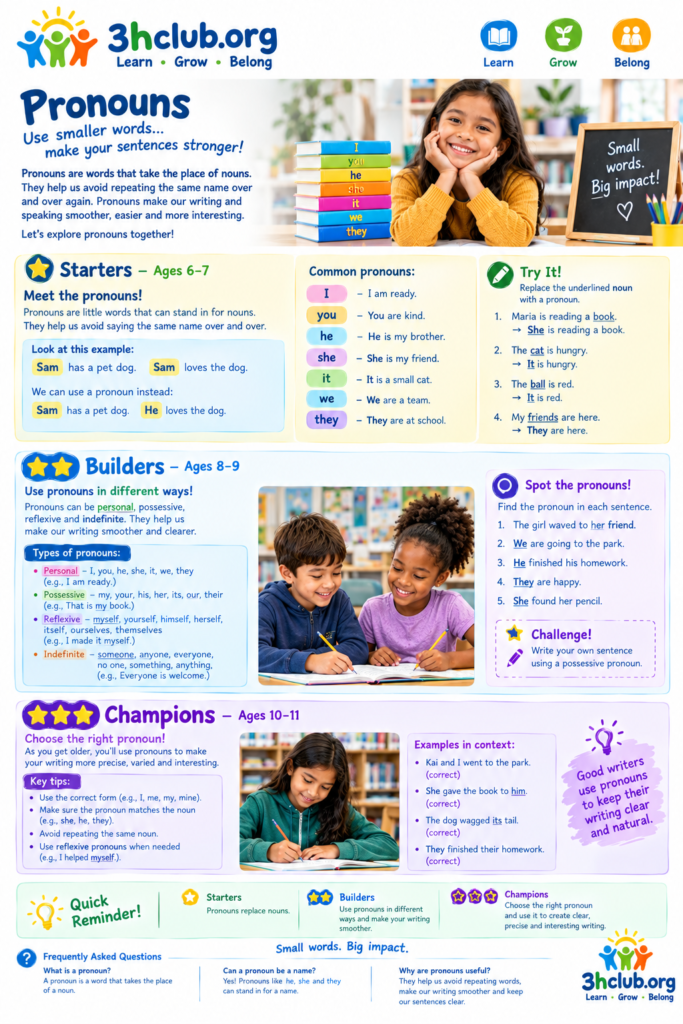
Pronouns for Kids
Small words can make a big difference!
Have you ever noticed how often we use someone’s name when we talk or write?
Mia went to the library. Mia found a book. Mia sat down because Mia wanted to read.
That sounds repetitive, doesn’t it?
We can make it smoother:
Mia went to the library. She found a book. She sat down because she wanted to read.
The words she and her are pronouns.
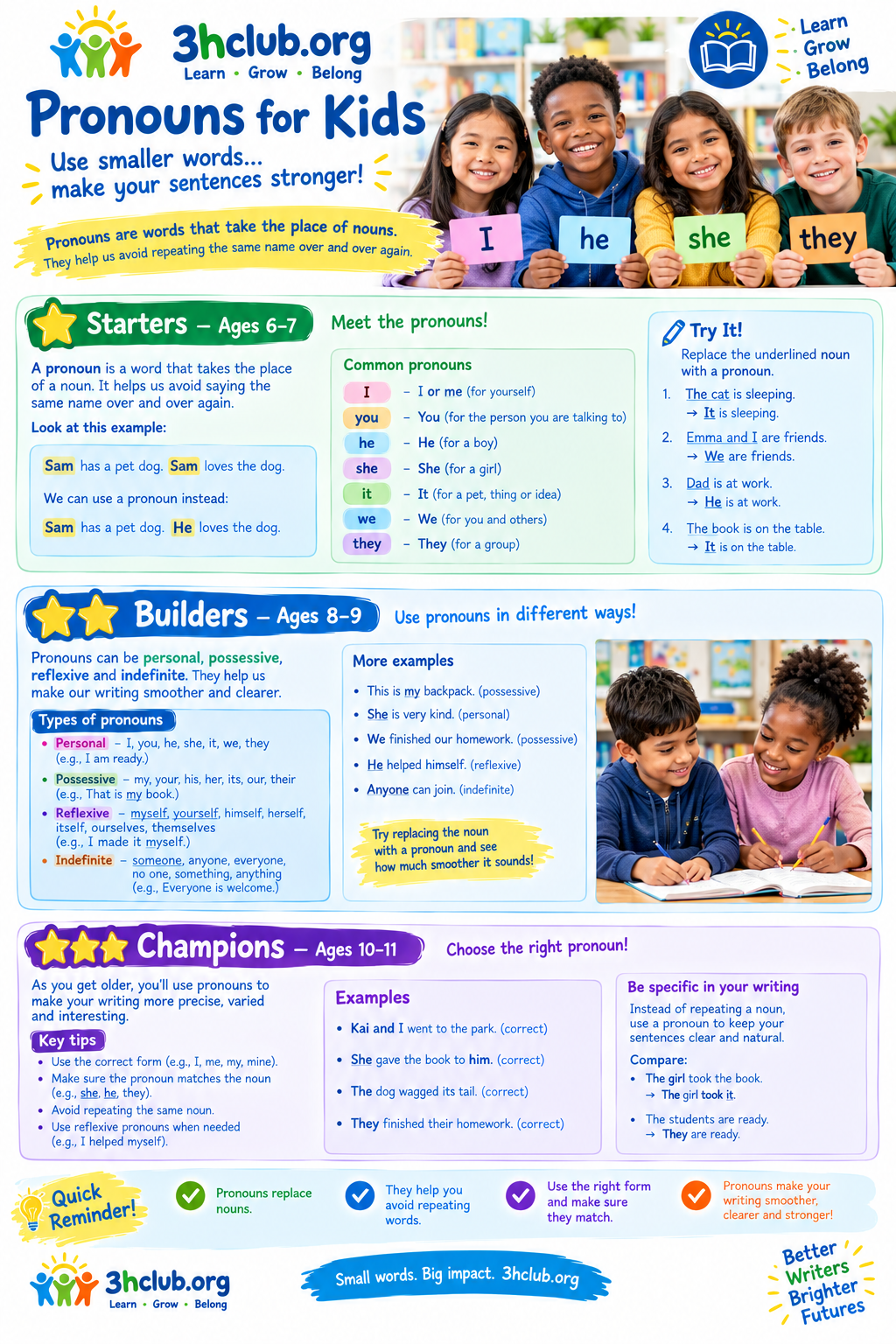
A pronoun is a word that takes the place of a noun. Pronouns help us avoid repeating the same names and words again and again.
In this lesson, you’ll learn about pronouns step by step.
⭐ Starters — Ages 6–7
⭐⭐ Builders — Ages 8–9
⭐⭐⭐ Champions — Ages 10–11
Ready? Let’s explore pronouns!
⭐ Starters — Ages 6–7
Meet the Pronouns!
A pronoun is a word that can take the place of a noun.
Remember, a noun can be a person, animal, place, thing, or idea.
Look at this example:
Sam has a dog. Sam loves the dog.
We can use a pronoun instead:
Sam has a dog. He loves the dog.
The word he takes the place of Sam.
That’s what pronouns do!
Common Pronouns
Here are some pronouns you will see and use often:
| Pronoun | Example |
|---|---|
| I | I am ready. |
| you | You are kind. |
| he | He is my brother. |
| she | She is my friend. |
| it | It is a small cat. |
| we | We are a team. |
| they | They are at school. |
Let’s see some of them in sentences.
I like reading.
You are my friend.
He plays football.
She likes music.
It is raining.
We are learning.
They are laughing.
Why Do We Need Pronouns?
Imagine saying:
The children went outside. The children played a game. The children laughed. The children came back inside.
That’s a lot of repeating!
We can use they instead:
The children went outside. They played a game. They laughed. They came back inside.
Much smoother!
Pronouns help our sentences sound natural.
Pronouns Can Replace Names
Look at these examples.
Liam is hungry. He wants lunch.
Emma is reading. She loves her book.
The puppy is tired. It is sleeping.
Maya and Noah are friends. They play together.
The pronoun refers back to the noun or name.
Try It! ✏️
Replace the bold noun with a pronoun.
- Maria is reading a book. → She is reading a book.
- The cat is sleeping. → ______ is sleeping.
- Dad is at work. → ______ is at work.
- The ball is red. → ______ is red.
- My friends are here. → ______ are here.
Answers
- It
- He
- It
- They
Pronoun Hunt 🔎
Look around you.
Can you find something you could describe with it?
Can you think of a person you could describe with he or she?
Can you think of a group of people you could describe with they?
Now make a sentence using one of your pronouns.
They are playing a game.
Excellent!
⭐⭐ Builders — Ages 8–9
Use Pronouns in Different Ways
You’ve learned that pronouns can replace nouns.
Now let’s go further.
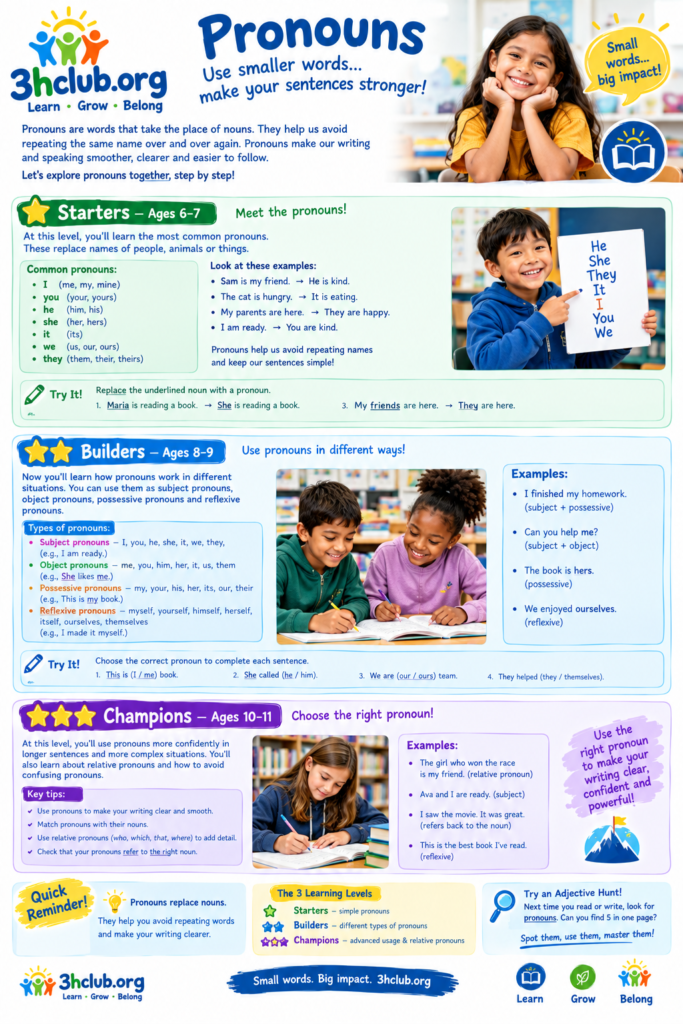
Pronouns can do different jobs in a sentence. Some show who is doing something, some show who receives an action, and others show ownership or refer back to the person doing the action.
Let’s explore them.
Personal Pronouns
Personal pronouns can refer to people, animals, or things.
Some common personal pronouns are:
I, you, he, she, it, we, they
For example:
She finished her homework.
They went to the park.
We are ready.
He opened the door.
You have already been using these!
Subject and Object Pronouns
Now you are ready for a useful grammar idea.
A subject pronoun tells us who is doing the action.
She kicked the ball.
She is doing the kicking.
Some subject pronouns are:
I, you, he, she, it, we, they
An object pronoun usually receives the action.
Mia helped him.
The teacher called us.
Dad gave her the book.
Common object pronouns include:
me, you, him, her, it, us, them
Compare:
He helped me.
I helped him.
The pronoun changes depending on its job in the sentence.
Possessive Pronouns
Possessive pronouns show ownership.
For example:
This is my book.
That pencil is mine.
The blue bag is hers.
The football is theirs.
Some possessive forms include:
my, your, his, her, its, our, their, mine, yours, hers, ours, theirs
Look at the difference:
That is my jacket.
That jacket is mine.
Both sentences show ownership, but the pronouns are used differently.
Reflexive Pronouns
Sometimes the person doing the action is also receiving the action.
That’s when we can use a reflexive pronoun.
Examples include:
myself, yourself, himself, herself, itself, ourselves, yourselves, themselves
Look at these examples:
I made the cake myself.
She taught herself to draw.
He hurt himself while playing.
We enjoyed ourselves at the party.
The reflexive pronoun points back to the person or people who are doing the action.
Indefinite Pronouns
Some pronouns don’t refer to one particular person or thing.
These are called indefinite pronouns.
Examples include:
someone, somebody, anyone, everyone, nobody, no one, something, anything
For example:
Someone left a backpack.
We don’t know exactly who.
Everyone is welcome.
This means all the people in the group.
Something smells delicious.
We don’t know exactly what it is.
Try It! ✏️
Choose the pronoun that makes the sentence correct.
- Maya and (I / me) went to the park.
- This is (my / mine) book.
- The dog wagged (its / it’s) tail.
- We are ready. (They / We) can begin.
- I helped (him / he) with his homework.
Answers
- I
- my
- its
- We
- him
Remember: it’s means it is, while its shows ownership.
It’s raining.
The dog wagged its tail.
Make Your Writing Smoother
Read this paragraph:
Ava went to the kitchen. Ava opened the cupboard. Ava took out a bowl. Ava put the bowl on the table.
Now try it with pronouns:
Ava went to the kitchen. She opened the cupboard. She took out a bowl. She put it on the table.
Much better!
Pronouns help your writing flow without repeating the same nouns over and over.
⭐⭐⭐ Champions — Ages 10–11
Choose the Right Pronoun
By now, you know that pronouns can replace nouns.
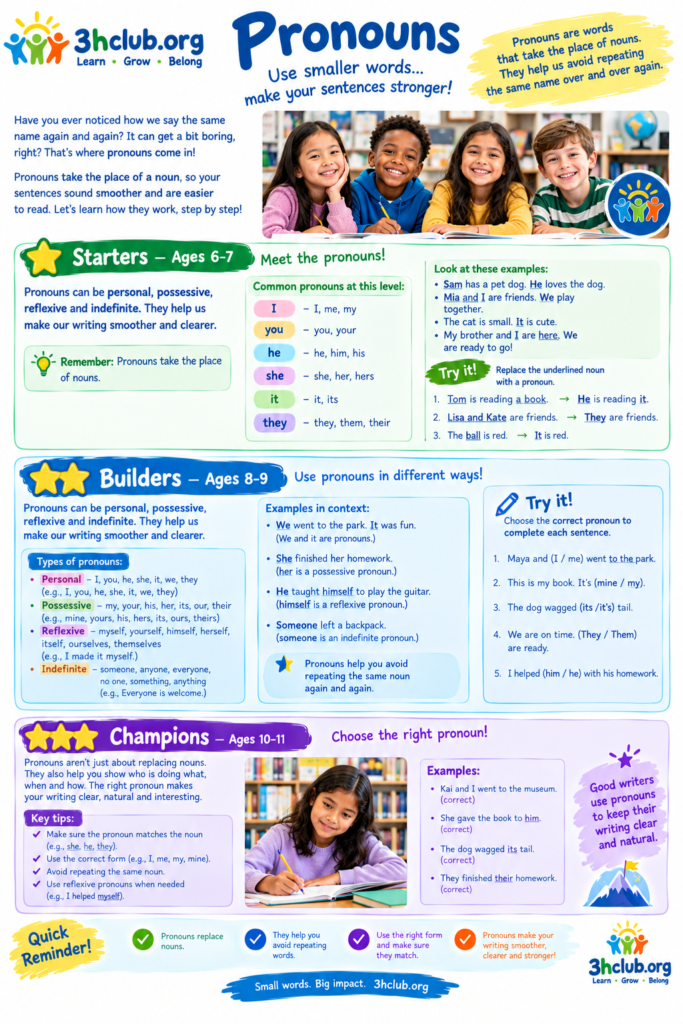
At the Champions level, you’ll start thinking more carefully about which pronoun is correct, what it refers to, and how it affects the meaning of your writing.
Good writers don’t simply use pronouns to avoid repetition. They choose them carefully so that every sentence stays clear.
Make Sure Your Pronoun Matches
A pronoun should match the noun it refers to.
For example:
The girl finished her homework.
The boys finished their homework.
The dog wagged its tail.
Maria and I finished our project.
The pronoun needs to make sense with the noun.
Keep the Meaning Clear
Pronouns are useful, but sometimes they can create confusion.
Look at this sentence:
When Maya spoke to Emma, she was laughing.
Who was laughing—Maya or Emma?
The pronoun she isn’t clear enough here.
We could rewrite it:
When Maya spoke to Emma, Maya was laughing.
Or:
Maya was laughing when she spoke to Emma.
Good writers check that readers can easily tell what each pronoun refers to.
Subject or Object?
At this level, you’ll also need to choose the correct form.
Compare:
I went to the museum.
The teacher gave the tickets to me.
We use I as the subject.
We use me as the object.
Here are some useful pairs:
| Subject | Object |
|---|---|
| I | me |
| he | him |
| she | her |
| we | us |
| they | them |
For example:
She called him.
They helped us.
He invited her.
What About “You and I”?
This is a common place where writers get confused.
Look at:
Sam and I went to the park.
This is correct because Sam and I are doing the action.
But:
The teacher spoke to Sam and me.
This is correct because Sam and me receive the action.
Here’s a useful trick:
Take the other person out of the sentence.
Sam and I went to the park.
becomes:
I went to the park.
Not:
Me went to the park.
For the second sentence:
The teacher spoke to Sam and me.
becomes:
The teacher spoke to me.
That helps you choose the right form.
Relative Pronouns
Champions can also explore relative pronouns.
Common relative pronouns include:
who, whom, whose, which, that
They can connect extra information to a noun.
For example:
The girl who won the race is my friend.
The word who connects information about the girl.
Another example:
I found the book that you were looking for.
The word that connects the extra information to the book.
Relative pronouns can help you create more detailed and interesting sentences.
Pronouns Can Connect Ideas
Compare these sentences:
I met a scientist. The scientist studies volcanoes.
We can combine them:
I met a scientist who studies volcanoes.
That’s more concise and gives us the information in one smooth sentence.
Another example:
We visited a museum. The museum opened last year.
Becomes:
We visited a museum that opened last year.
That’s one of the ways pronouns can make writing more efficient.
Avoid Unnecessary Repetition
Look at this paragraph:
The team entered the competition. The team had practiced for weeks. The team felt confident because the team knew the routine.
We can improve it:
The team entered the competition. They had practiced for weeks and felt confident because they knew the routine.
The second version is smoother.
But remember: don’t replace every noun with a pronoun.
Sometimes repeating a noun makes your writing clearer.
The goal is not to use as many pronouns as possible.
The goal is to use the right pronouns in the right places.
Champions’ Challenge ⭐⭐⭐
Improve this paragraph:
Olivia picked up Olivia’s notebook because Olivia needed Olivia’s notes for Olivia’s science project.
That sounds very repetitive!
Try:
Olivia picked up her notebook because she needed her notes for her science project.
Now make it even more natural if you can.
Think about which nouns need to stay and which ones can become pronouns.
Pronoun Detective 🔎
Read each sentence and identify the pronoun.
1.
They walked to the library.
Pronoun: they
2.
Marcus gave her the book.
Pronoun: her
3.
I finished the project myself.
Pronoun: I, myself
4.
The artist who painted the mural lives nearby.
Pronoun: who
5.
The blue bicycle is mine.
Pronoun: mine
Excellent detective work!
Pronouns in Everyday Life
Pronouns are everywhere.
You use them when you talk to your friends.
I am ready.
You use them when you tell a story.
She ran down the path.
You use them when you describe something.
It is beautiful.
You use them when you write about a group.
They finished the project.
And you use them when you show ownership.
That backpack is mine.
Once you know what to look for, you’ll start spotting pronouns everywhere—in books, stories, conversations, signs, websites, and your own writing.
Try a Pronoun Hunt! 🔎
Choose a book, story, magazine, or article.
Find five pronouns.
Write them down.
Then ask yourself:
- What noun does each pronoun refer to?
- What job is the pronoun doing?
- Is it a subject, object, possessive, reflexive, or relative pronoun?
- Does the pronoun make the sentence clearer?
- Could you rewrite the sentence without repeating the noun?
For an extra challenge, find:
- one personal pronoun
- one possessive pronoun
- one reflexive pronoun
- one object pronoun
- one relative pronoun
Quick Pronoun Reminder 💡
⭐ Starters
Pronouns can take the place of nouns.
Sam is happy. He is smiling.
⭐⭐ Builders
Pronouns can do different jobs.
She helped him with his work.
⭐⭐⭐ Champions
Choose pronouns carefully so your writing stays clear.
The girl who won the race is my friend.
Remember:
Pronouns are small words with a big job!
They help you avoid repetition, connect ideas, and make your writing smoother.
Keep spotting them when you read.
Keep using them when you write.
And keep challenging yourself to make every sentence clearer.
Small words. Big impact.
3HClub.org — Learn • Grow • Belong
Frequently Asked Questions
What is a pronoun?
A pronoun is a word that takes the place of a noun.
Sarah is happy. She is smiling.
Why do we use pronouns?
Pronouns help us avoid repeating the same nouns and names.
What are some common pronouns?
Common pronouns include I, you, he, she, it, we, they, me, him, her, us, and them.
What is a possessive pronoun?
A possessive pronoun shows ownership.
Examples include mine, yours, his, hers, ours, and theirs.
What is a reflexive pronoun?
A reflexive pronoun refers back to the person or people doing the action.
Examples include myself, yourself, himself, herself, ourselves, and themselves.
What is a relative pronoun?
A relative pronoun connects extra information to a noun.
Common examples include who, whom, whose, which, and that.
Can a pronoun be confusing?
Yes. If it isn’t clear which noun the pronoun refers to, a reader may become confused. Good writers check that their pronouns have clear references.