Conjunction For Kids
Small Words. Big Connections.
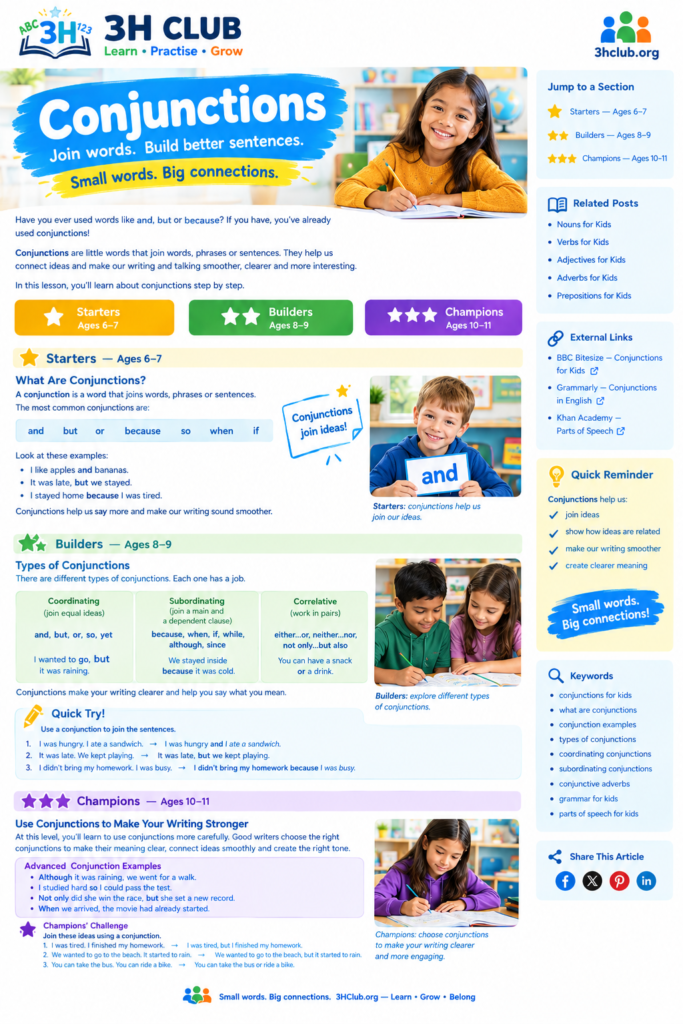
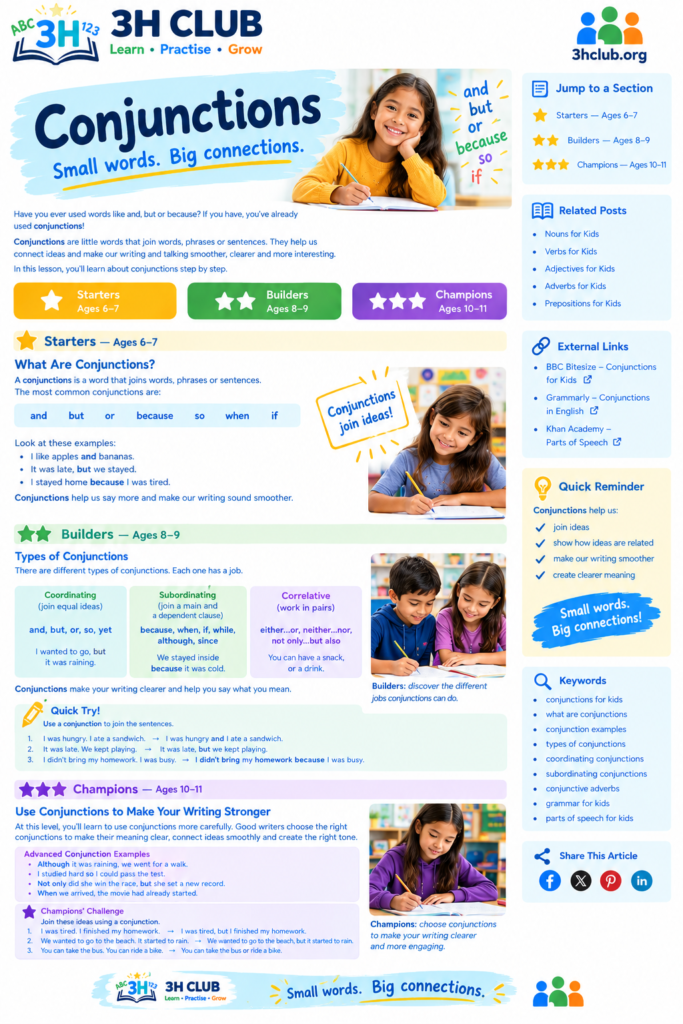
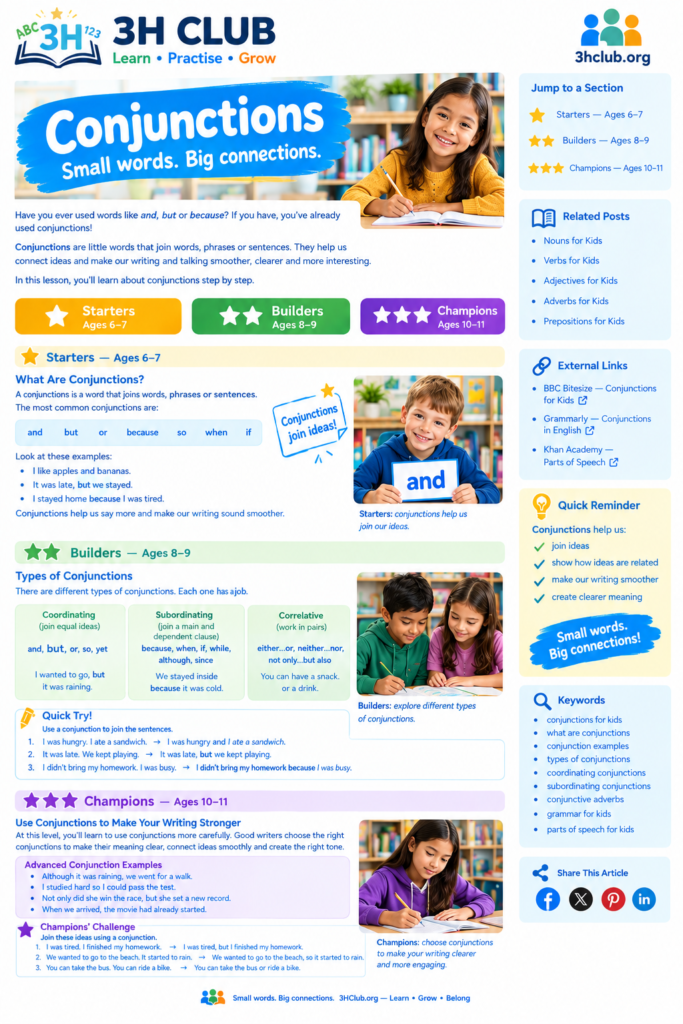
Have you ever used words like and, but, or, because, or so? If you have, you have already used conjunctions!
Conjunctions are words that connect words, phrases, or clauses. They help us show how ideas fit together and make our speaking and writing smoother, clearer, and more interesting.
In this lesson, you’ll learn about conjunctions step by step — starting with simple joining words and building up to choosing conjunctions carefully in your own writing.
⭐ Starters — Ages 6–7
What Is a Conjunction?
A conjunction is a word that joins things together.
You can think of a conjunction as a word bridge. It helps one idea connect to another.
Some common conjunctions are:
and • but • or • because • so • when • if
Look at These Examples
- I like apples and bananas.
- The puppy is small but strong.
- Would you like juice or water?
- I stayed home because I was tired.
- It was raining, so we took an umbrella.
The conjunction helps us understand how the ideas are connected.
Conjunctions Make Sentences Smoother
Look at these two sentences:
I like apples. I like bananas.
We can join the ideas:
I like apples and bananas.
The word and connects the two ideas.
Here is another example:
The sun was shining. It was cold.
We can write:
The sun was shining, but it was cold.
The word but tells us that the two ideas are different.
🧩 Try It!
Choose the best conjunction.
1. Mia likes cats ___ dogs.
and / but
2. I was hungry, ___ I ate my lunch.
so / or
3. Do you want red ___ blue?
or / because
4. Sam wore a coat ___ it was cold.
because / and
Answers
- and
- so
- or
- because
Join the Sentences
Can you join each pair?
1. I have a pencil. I have an eraser.
→ I have a pencil and an eraser.
2. The sun was shining. It was cold.
→ The sun was shining, but it was cold.
3. I was tired. I went to bed early.
→ I was tired, so I went to bed early.
Now make one of your own!
Write two short sentences and join them using and, but, or, because, or so.
🔎 Conjunction Hunt
Look around you and find three conjunctions in something you read today.
You might find them in a:
- book
- comic
- story
- game
- sign
- website
Can you explain what each conjunction connects?
⭐⭐ Builders — Ages 8–9
At the Builders level, you’re ready to discover that conjunctions do more than simply join words.
Different conjunctions can show different relationships between ideas.
Three Types of Conjunctions
There are three useful groups to know:
- Coordinating conjunctions
- Subordinating conjunctions
- Correlative conjunctions
Let’s explore them.
1. Coordinating Conjunctions
Coordinating conjunctions connect ideas that have equal importance.
A useful way to remember the seven coordinating conjunctions is FANBOYS:
- F — for
- A — and
- N — nor
- B — but
- O — or
- Y — yet
- S — so Khan Academy
AND — adds information
Mia packed her notebook and her pencils.
BUT — shows contrast
I wanted to play outside, but it was raining.
OR — gives a choice
Would you like an apple or a banana?
SO — shows a result
It was raining, so we stayed inside.
YET — shows an unexpected contrast
The puzzle was difficult, yet I kept trying.
2. Subordinating Conjunctions
Subordinating conjunctions connect a main idea with a dependent idea.
They can show:
- reason — because, since
- time — when, before, after, while
- condition — if, unless
- contrast — although
Examples:
We stayed inside because it was cold.
When the bell rang, the children packed their books.
If you practice, you can improve.
Although it was raining, we went for a walk.
A dependent clause cannot normally stand alone as a complete sentence. It needs a main clause to complete the thought.
3. Correlative Conjunctions
Correlative conjunctions work as pairs.
Common pairs include:
- both … and
- either … or
- neither … nor
- not only … but also
Examples:
Both Liam and Zoe enjoy reading.
You can choose either apples or oranges.
Neither answer nor explanation was correct.
She is not only clever but also creative.
These pairs connect ideas that have equal importance and should normally connect matching grammatical structures. Khan Academy
✏️ Quick Try!
Choose a conjunction that makes each sentence work.
1. I was hungry, ___ I ate a sandwich.
2. It was late, ___ we kept playing.
3. I didn’t bring my homework ___ I was busy.
4. ___ you practice, you will become more confident.
Possible Answers
- so
- but
- because
- If
Sometimes more than one conjunction can work. The important thing is to choose one that gives the sentence the meaning you want.
🧱 Build a Better Sentence
Start with:
The dog barked.
Now add another idea:
The dog barked because it heard a noise.
Try changing the conjunction:
The dog barked, but the cat stayed quiet.
The dog barked, so we looked outside.
Notice what happened?
Changing the conjunction can change the relationship between the ideas.
That is one reason conjunctions are so useful.
Comma Tip
When a coordinating conjunction joins two complete sentences, a comma normally goes before the conjunction.
I wanted to play outside, but it started raining.
Maya finished her project, and she checked her answers.
When the conjunction simply joins words or short phrases, you usually do not need a comma.
I packed pencils and crayons.
Would you like apples or oranges?
This is the standard comma pattern for independent clauses joined by coordinating conjunctions. Purdue OWL
⭐⭐⭐ Champions — Ages 10–11
Now you’re ready to use conjunctions more carefully.
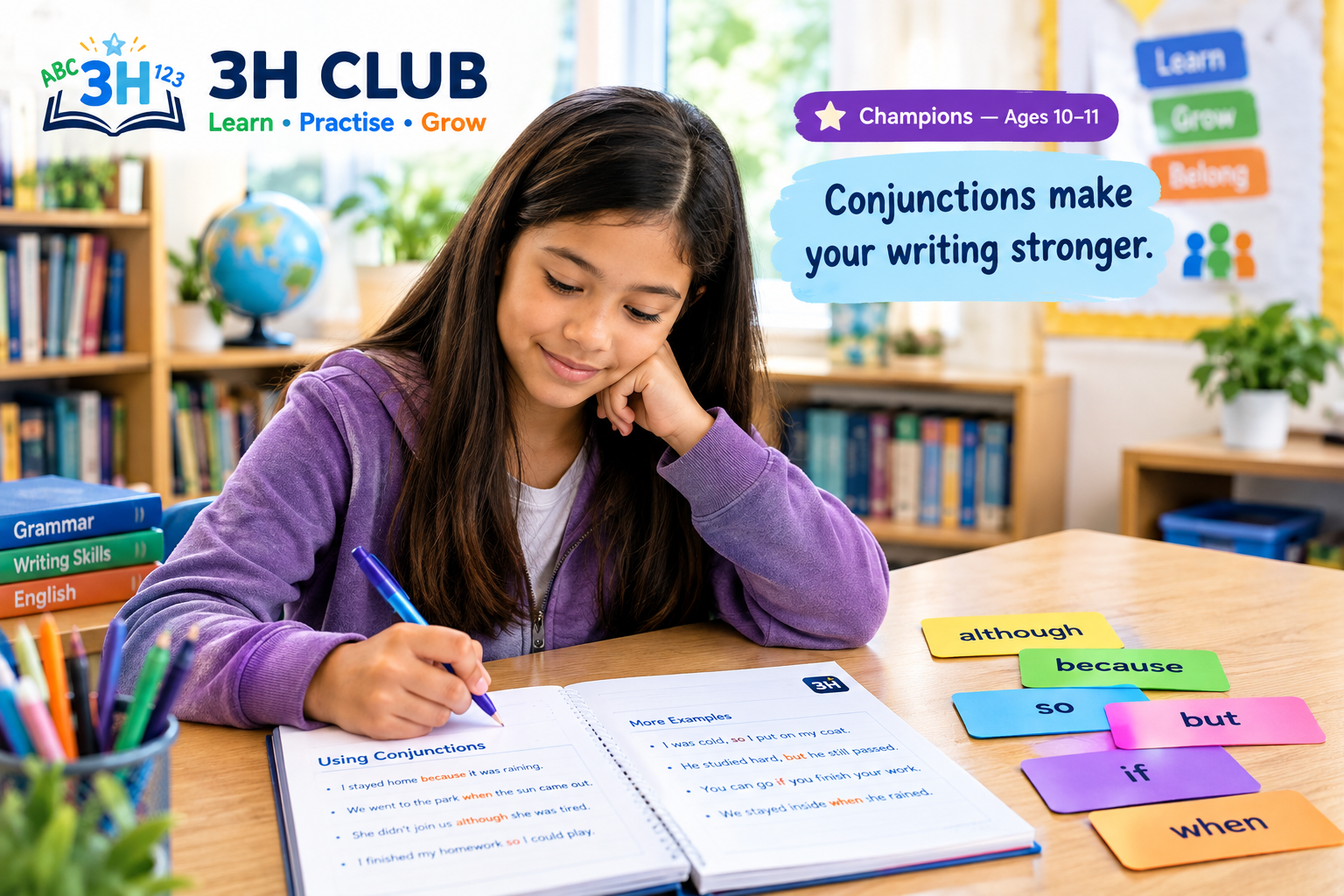
Strong writers do not simply choose a conjunction because it sounds good. They choose one that shows the exact relationship between ideas.
Choose the Conjunction That Shows the Meaning
➕ Addition
Use and when you want to add related information.
I finished my project and checked my work.
↔️ Contrast
Use but, yet, or although when ideas contrast.
I was tired, but I finished my reading.
Although it was raining, we went for a walk.
💡 Reason
Use because or since to explain why something happened.
I took an umbrella because the clouds were dark.
➡️ Result
Use so to show what happened as a result.
The road was flooded, so we took another route.
🔐 Condition
Use if or unless to show a condition.
If you practice, your writing will improve.
We won’t leave unless everyone is ready.
⏰ Time
Use when, before, after, or while to show when something happens.
After I finished my homework, I read a book.
While I was reading, my brother was drawing.
Compound Sentences
A compound sentence joins two independent clauses, often using a coordinating conjunction.
An independent clause expresses a complete thought and can stand on its own.
For example:
I finished my homework.
I watched television.
We can join them:
I finished my homework, and I watched television.
The comma and coordinating conjunction help connect the two complete ideas correctly. Purdue OWL
Dependent Clauses
A dependent clause cannot stand alone as a complete sentence.
For example:
Because I was tired
That makes us expect more information.
Add a main clause:
Because I was tired, I went to bed early.
When a dependent clause comes first, a comma is commonly used to separate it from the main clause. Purdue OWL
Compare:
Although it was raining, we went outside.
We went outside although it was raining.
The meaning is similar, but the punctuation changes depending on the order.
Correlative Conjunctions and Parallel Structure
Correlative conjunctions work in pairs, so both parts need to work together.
For example:
She likes both reading and drawing.
The two activities have matching forms: reading and drawing.
Another example:
You can either walk or ride.
Both connected parts use verbs.
This is called parallel structure. It means that the parts connected by the conjunction have a similar grammatical shape. Khan Academy
🎯 Champions’ Challenge
Join each pair of ideas using a conjunction that clearly shows the relationship.
1. I was tired. I finished my homework.
→ I was tired, but I finished my homework.
2. We wanted to go to the beach. It started to rain.
→ We wanted to go to the beach, but it started to rain.
3. You can take the bus. You can ride a bike.
→ You can take the bus or ride a bike.
4. The test was difficult. I had studied carefully.
→ Although the test was difficult, I had studied carefully.
Now write three of your own sentences:
- one using a coordinating conjunction
- one using a subordinating conjunction
- one using a correlative conjunction pair
Can you make each conjunction show a different relationship?
🔎 Conjunction Detective
Choose a paragraph from a book, magazine, story, or website.
Step 1
Circle every conjunction you find.
Step 2
Ask what each conjunction connects.
Step 3
Ask what relationship it shows.
Is it showing:
- addition?
- contrast?
- reason?
- result?
- choice?
- time?
- condition?
Step 4
Try replacing one conjunction with another.
Does the meaning change?
You are no longer just spotting conjunctions — you are thinking about why the writer chose each one.
✍️ Make Your Writing Stronger
Imagine you write:
The storm was coming. We stayed inside.
That works, but you can make the relationship clearer:
The storm was coming, so we stayed inside.
Or:
We stayed inside because the storm was coming.
Or:
Although the storm was coming, we went outside briefly.
Each conjunction creates a slightly different meaning.
That is the power of a well-chosen conjunction.
🌎 Conjunctions in Everyday Life
You use conjunctions more often than you might realize.
You might say:
I wanted to play but I had homework.
Or:
I finished my homework so I could play.
Or:
If the weather is good, we can go outside.
You will find conjunctions in conversations, books, stories, instructions, songs, articles, emails, and almost every kind of writing.
Small words can make a big difference because they show how ideas fit together.
🧠 Quick Conjunction Reminder
Conjunctions help you:
- add information — and
- show contrast — but, yet, although
- explain a reason — because, since
- show a result — so
- give a choice — or
- show a condition — if, unless
- show time — when, before, after, while
- connect balanced ideas — both…and, either…or
⭐ Remember
Small words. Big connections.
The next time you read or write a sentence, look for the words that connect the ideas. You may discover that conjunctions are doing some very important work!
❓ Frequently Asked Questions
What is a conjunction?
A conjunction is a word that connects words, phrases, or clauses.
What are some common conjunctions?
Common conjunctions include and, but, or, so, because, if, when, and although.
What are FANBOYS?
FANBOYS is a memory aid for the seven coordinating conjunctions:
for, and, nor, but, or, yet, so. Khan Academy
What are subordinating conjunctions?
Subordinating conjunctions connect a dependent clause to a main clause and can show relationships such as reason, time, condition, or contrast.
What are correlative conjunctions?
Correlative conjunctions work in pairs, such as both…and, either…or, neither…nor, and not only…but also. Khan Academy
Why are conjunctions important?
Conjunctions help you connect ideas, show relationships between them, and create smoother, clearer writing.