Basic Punctuation for Kids
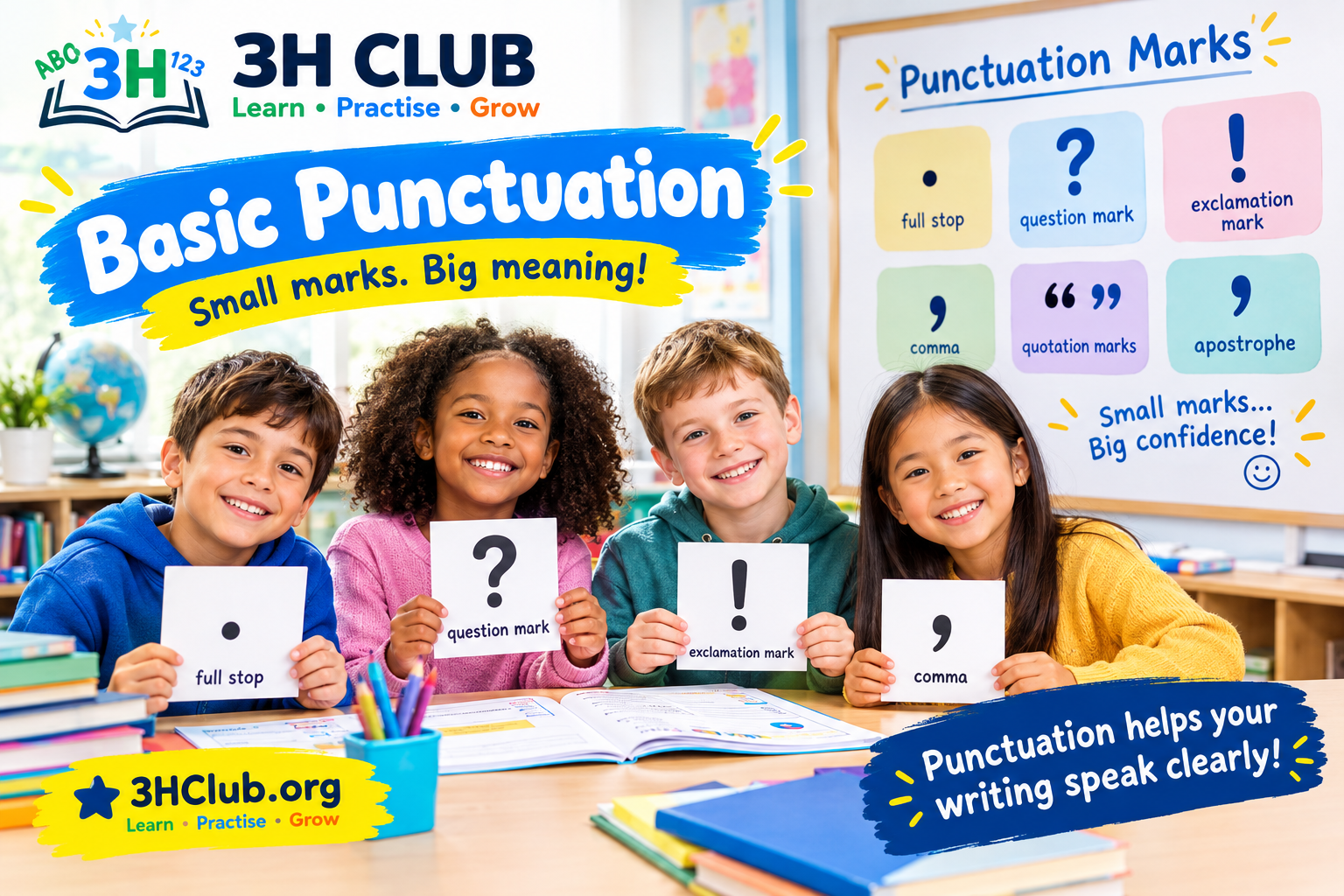
Punctuation helps your writing speak clearly.
It tells your reader when to stop, when to ask a question, when to pause, and when words are being spoken.
Imagine reading this:
Where are you going I am going to the park
Now add punctuation:
“Where are you going?”
“I am going to the park.”
Much easier to read!
Punctuation marks are small, but they do an important job. As you move from Starters to Builders to Champions, you will learn how to use more punctuation marks and how they can change the meaning and rhythm of your writing.
⭐ Starters — Ages 6–7
What Is Punctuation?
Punctuation is a group of special marks we use in writing.
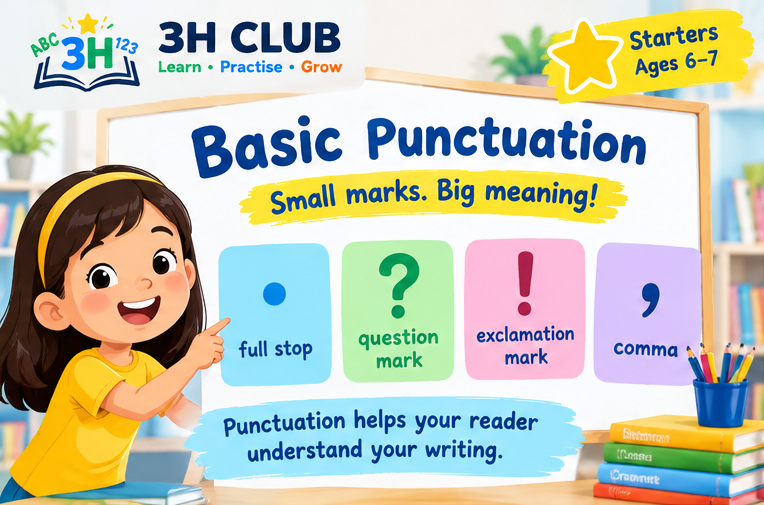
Some of the punctuation marks you will see most often are:
| Mark | Name | What it does |
|---|---|---|
| . | Full stop / period | Ends a statement |
| ? | Question mark | Ends a question |
| ! | Exclamation mark | Shows strong feeling |
| , | Comma | Shows a small pause or separates items |
| ‘ | Apostrophe | Shows missing letters or belonging |
| “ ” | Quotation marks | Show someone’s exact words |
You do not need to learn everything at once. Let’s start with the marks you will use most often.
The Full Stop or Period (.)
A full stop, also called a period, usually comes at the end of a statement.
It tells your reader:
“This thought is finished.”
Examples:
- The dog is sleeping.
- I like chocolate.
- We went to the beach.
- My brother plays football.
Think of the full stop as a little stop sign for a sentence.
Remember:
A sentence should not just keep going and going and going without showing the reader where the thought ends.
The Question Mark (?)
A question mark goes at the end of a question.
Examples:
- What is your name?
- Where is my book?
- Are you ready?
- Can we play outside?
When you see a question mark, you know that the writer is asking something.
Try reading these aloud:
You have a pencil.
Do you have a pencil?
The punctuation helps you know how to read each sentence.
Starters: Punctuation marks help your reader understand your writing.
The Exclamation Mark (!)
An exclamation mark shows strong feeling, excitement, surprise, or a strong command.
Examples:
- Wow!
- That was amazing!
- Look out!
- Stop!
- We won!
An exclamation mark can make your writing sound energetic.
But remember: you do not need one after every sentence.
I have a new book!
makes sense if you are very excited.
I have a new book.
is perfectly fine if you are simply telling someone about it.
The Comma (,)
A comma can help separate things in a list.
For example:
I packed a pencil, ruler, notebook and book.
The commas help your reader see the different items.
More examples:
- I like apples, bananas and grapes.
- We saw lions, monkeys and zebras.
- My favorite colors are blue, green and yellow.
A comma can also help show a small pause:
Yes, I can help.
After school, I went outside.
Try It! Which Mark Belongs?
Choose ., ?, or !
- What is your favorite animal
- I have a blue backpack
- Watch out
- Where are my shoes
- We won the game
Answers:
- What is your favorite animal ?
- I have a blue backpack .
- Watch out !
- Where are my shoes ?
- We won the game !
Punctuation Detective 🔎
Can you find the punctuation marks?
Mia asked, “Can I borrow your pencil?”
Look carefully.
- , = comma
- “ ” = quotation marks
- ? = question mark
Punctuation gives the reader clues about what is happening.
⭐ Starters: Quick Reminder
. = Stop the sentence.
? = Ask a question.
! = Show strong feeling.
, = Separate items or show a small pause.
You are already using punctuation every time you write a sentence!
⭐⭐ Builders — Ages 8–9
Now that you know the basic punctuation marks, you can start using them more carefully.
Good punctuation does more than end sentences. It can organize ideas, show pauses, make meaning clearer and tell the reader who is speaking.
The Four Main Punctuation Marks to Master
1. Full Stops (.)
Use a full stop at the end of most statements and commands.
Statements:
The library closes at five.
Commands:
Please close the door.
A full stop tells your reader that the sentence has reached its natural ending.
2. Question Marks (?)
Use a question mark when the sentence is asking a direct question.
Where did you put the football?
Did you finish your homework?
Why is the sky blue?
Be careful not to put a question mark after every sentence that contains a question word.
For example:
I wonder where my book is.
This is not a direct question, so it ends with a full stop.
3. Exclamation Marks (!)
Use an exclamation mark when a sentence shows strong emotion or a forceful command.
That was incredible!
Watch out!
What a fantastic goal!
Strong writing does not need lots of exclamation marks. Using one carefully can make it much more effective.
Compare:
We won the match!!!
with:
We won the match!
The second sentence is usually stronger because the punctuation is controlled.
4. Commas (,)
Commas have several important jobs.
Commas in Lists
Use commas to separate three or more items in a list.
I packed a sandwich, an apple, a bottle of water and a notebook.
The colors were red, orange, yellow and green.
Commas After an Opening Word or Phrase
A comma can follow an introductory word or phrase.
First, we checked the answers.
After lunch, we went outside.
Luckily, nobody was hurt.
Commas When Speaking Directly to Someone
A comma can separate the name of the person you are speaking to.
Mia, can you help me?
Thank you, Daniel.
This small comma can make your meaning much clearer.
Apostrophes (‘)
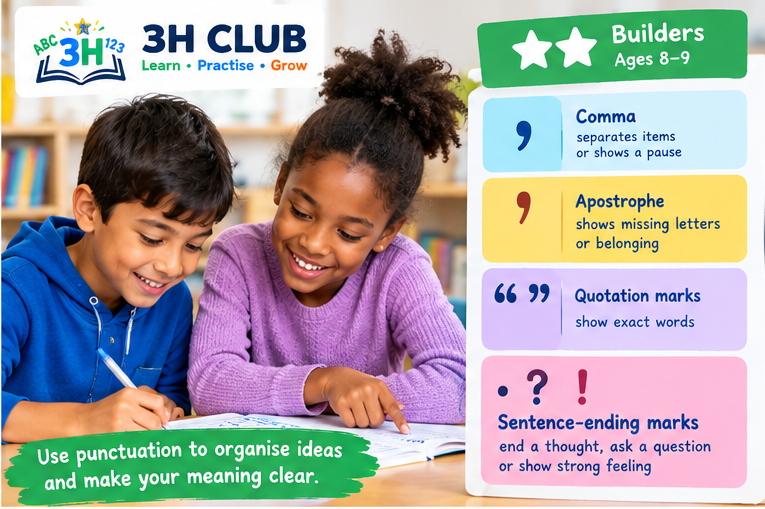
The apostrophe has two especially useful jobs.
Apostrophes in Contractions
A contraction joins words together and leaves out some letters.
Examples:
- do not → don’t
- cannot → can’t
- I am → I’m
- we are → we’re
- they are → they’re
The apostrophe shows where some of the letters have been left out.
I am ready.
I’m ready.
Both sentences are correct. The second uses a contraction.
Apostrophes to Show Belonging
An apostrophe can also show that something belongs to someone or something.
Maya’s book
means the book belongs to Maya.
the dog’s bowl
means the bowl belongs to the dog.
the teacher’s desk
means the desk belongs to the teacher.
Be careful: an apostrophe does not normally make an ordinary word plural.
Correct:
three books
Not:
three book’s
Quotation Marks (“ ”)
Quotation marks can show the exact words someone says.
“I am ready,” said Leo.
“Where are you going?” asked Maya.
Quotation marks help your reader see:
These are the speaker’s exact words.
When writing dialogue, remember that the punctuation belongs with the spoken words.
“That is my favorite book!” said Sam.
Build the Sentence
Look at this sentence without punctuation:
what are you doing after school
What punctuation does it need?
Answer:
What are you doing after school?
Now try this one:
I bought apples bananas oranges and grapes
Answer:
I bought apples, bananas, oranges and grapes.
The punctuation makes the sentence much easier to read.
Builders’ Punctuation Challenge
Add the missing punctuation.
- Where is your notebook
- I packed pencils paper rulers and crayons
- Wow that was an amazing goal
- Ella said “I finished my project”
- Don’t forget your lunch
- After school we went to the library
Answers
- Where is your notebook ?
- I packed pencils, paper, rulers and crayons .
- Wow, that was an amazing goal !
- Ella said, “I finished my project.”
- Don’t forget your lunch .
- After school, we went to the library .
Punctuation Can Change Meaning
Punctuation is not just about making your writing look neat.
It can change what a sentence means.
Look at:
Let’s eat, Grandma.
The comma tells us that someone is talking to Grandma.
Without the comma:
Let’s eat Grandma.
the sentence appears to say something very different!
That’s why punctuation matters. It helps your reader understand exactly what you mean.
⭐⭐⭐ Champions — Ages 10–11
You already know the main punctuation marks. Now it is time to become more precise.
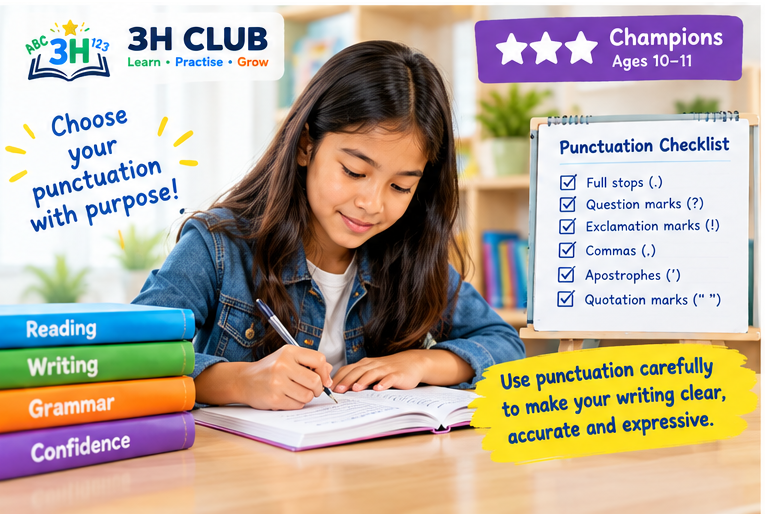
At this level, punctuation is not just about remembering a rule. It is about making deliberate choices that help your reader follow your ideas.
Punctuation Helps Control the Flow of Writing
Think about punctuation as a set of signals.
- A full stop brings an idea to an end.
- A question mark tells the reader that a direct question has been asked.
- An exclamation mark adds strong feeling or force.
- A comma separates or organizes parts of a sentence.
- An apostrophe can show missing letters or possession.
- Quotation marks show exact spoken words.
Good writers choose punctuation based on what they want the reader to understand.
Using Commas More Carefully
You already know that commas can separate items in a list.
We bought bread, cheese, apples and milk.
But commas have other jobs too.
Commas After Introductory Phrases
Before the match, we warmed up.
In the morning, I walked to school.
Without warning, the lights went out.
The comma separates the opening part of the sentence from the main idea.
Commas with Direct Address
Compare:
Let’s help Jack.
with:
Let’s help, Jack.
These sentences have different meanings.
In the second sentence, Jack is the person being spoken to.
Another example:
Thank you, Maya.
Maya, could you pass me the book?
The comma helps the reader understand who is being addressed.
Avoiding the Comma Splice
Here is an important rule for stronger writing.
Do not join two complete sentences with only a comma.
❌ I finished my homework, I went outside.
There are several ways to fix it.
Use a full stop:
I finished my homework. I went outside.
Use a conjunction:
I finished my homework, so I went outside.
Use a semicolon:
I finished my homework; I went outside.
You do not need to use semicolons all the time. At your level, the most important thing is to recognize when a comma alone is not enough to join two complete sentences.
Apostrophes: Two Different Jobs
Apostrophes can be confusing because they do two different things.
Job 1: Contractions
I am → I’m
she is → she’s
they have → they’ve
could not → couldn’t
Job 2: Possession
the girl’s bicycle
the dog’s collar
James’s notebook
The first shows missing letters.
The second shows belonging.
Watch Out for Its and It’s
This is a common punctuation challenge.
It’s
It’s is a contraction of it is or sometimes it has.
It’s raining.
= It is raining.
Its
Its shows possession.
The bird spread its wings.
A useful test is to replace it’s with it is.
It’s cold.
It is cold. ✔️
But:
The dog wagged it’s tail.
The dog wagged it is tail. ❌
So the correct sentence is:
The dog wagged its tail.
Quotation Marks and Dialogue
When you write a story, quotation marks help your reader recognize spoken words.
“Are you coming with us?” asked Noah.
“Yes,” replied Mia. “I’ll be there in five minutes.”
Notice how punctuation works with the dialogue.
Quotation marks surround the spoken words, while the rest of the sentence tells us who is speaking.
Quotation marks can also be used when you include exact words from another source, although the rules for longer quotations become more advanced.
For more detailed punctuation guidance, you can explore Purdue OWL’s punctuation guide and its quotation mark guide.
Punctuation and Meaning
One of the most useful things to remember is this:
Punctuation can change the way a reader understands your words.
Compare:
No more homework!
with:
No, more homework.
The comma changes the way the sentence is understood.
Another example:
Let’s eat, Grandma.
The comma makes it clear that Grandma is being spoken to.
As you become a stronger writer, start asking yourself:
What do I want my reader to understand?
Then choose the punctuation that helps make that meaning clear.
Champions Challenge 🏆
Add the missing punctuation to this paragraph:
On Saturday Maya asked “Can you come to the park with me”
“Yes” said Leo “but I need to finish my homework first”
After lunch they packed water snacks a football and a book
“Let’s go” said Maya “We’re ready”
Answer
On Saturday, Maya asked, “Can you come to the park with me?”
“Yes,” said Leo, “but I need to finish my homework first.”
After lunch, they packed water, snacks, a football and a book.
“Let’s go,” said Maya. “We’re ready!”
Now look at how much information the punctuation gives the reader.
It shows:
- where the questions end
- who is speaking
- where the pauses occur
- where the list items are separated
- where sentences finish
- which words show excitement
That’s what makes punctuation powerful.
Punctuation Detective 🔎
Become a punctuation detective while you read.
Choose a page from a book and look for:
- . full stops
- ? question marks
- ! exclamation marks
- , commas
- ‘ apostrophes
- “ ” quotation marks
Then ask yourself:
Why did the writer use that mark?
For example:
“Are you coming?” asked Leo.
The question mark tells you that Leo is asking something.
The quotation marks tell you that these are Leo’s exact words.
The comma helps separate the spoken words from asked Leo.
The more you notice punctuation while reading, the more naturally you will begin to use it in your own writing.
Write Like a Champion
When you finish writing, do not only check your spelling.
Become your own editor.
Ask:
Sentence endings
Does every sentence have the correct ending mark?
Questions
Did I use a question mark for each direct question?
Commas
Have I used commas where they help separate ideas or items?
Apostrophes
Did I use apostrophes correctly in contractions and possessives?
Dialogue
Did I use quotation marks around spoken words?
Meaning
Does my punctuation help the reader understand exactly what I mean?
Great writers do not simply write and stop. They read, check, improve and polish.
Punctuation in Everyday Writing
You use punctuation more often than you might realize.
You can find it in:
- books and stories
- school assignments
- text messages
- emails
- signs
- comics
- instructions
- websites
- birthday cards
- captions and notes
Next time you read something, pause and notice the punctuation.
Ask:
What is this mark telling me?
That simple question can help you become a more confident reader and writer.
⭐⭐⭐ Quick Punctuation Review
| Punctuation | Name | Main job |
|---|---|---|
| . | Full stop / period | Ends a statement or command |
| ? | Question mark | Ends a direct question |
| ! | Exclamation mark | Shows strong feeling or force |
| , | Comma | Separates or organizes parts of a sentence |
| ‘ | Apostrophe | Shows contractions or possession |
| “ ” | Quotation marks | Show exact spoken words |
Remember:
Punctuation is there to help your reader.
When your punctuation is clear, your ideas become easier to understand.
Frequently Asked Questions About Basic Punctuation
What is punctuation?
Punctuation is a system of marks used in writing to organize sentences and help readers understand meaning.
What are the three main sentence-ending punctuation marks?
The three most common are the full stop (.), question mark (?), and exclamation mark (!).
When do I use a comma?
Commas have several jobs. They can separate items in a list, follow some introductory words or phrases, separate a person being directly addressed, and help organise parts of a sentence.
What does an apostrophe do?
An apostrophe has two common jobs. It can show missing letters in contractions, such as don’t, and it can show possession, such as Maya’s book.
What are quotation marks used for?
Quotation marks can show the exact words someone says.
“I am ready,” said Sam.
Should I use an exclamation mark after every exciting sentence?
No. Exclamation marks are most effective when they are used purposefully to show strong feeling, surprise or force. Too many can make writing feel noisy.
Why is punctuation important?
Punctuation helps readers understand where ideas begin and end, how sentences should be read, who is speaking, and what the writer means.