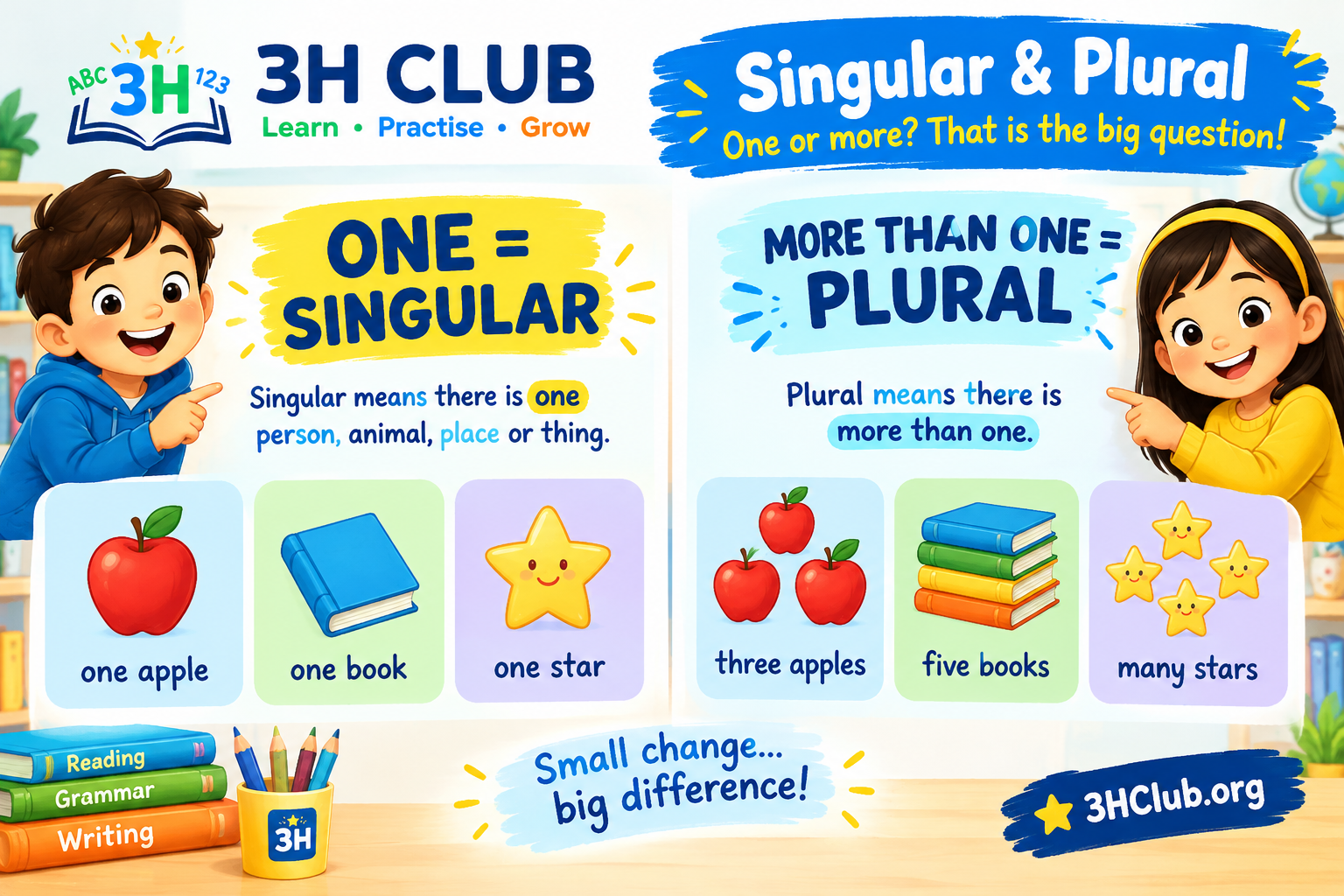
Singular & Plural for Kids
One or more? That is the big question!
Look at these two sentences:
I have one pencil.
I have three pencils.
The word pencil changes to pencils because we are talking about more than one.
This is the difference between singular and plural.
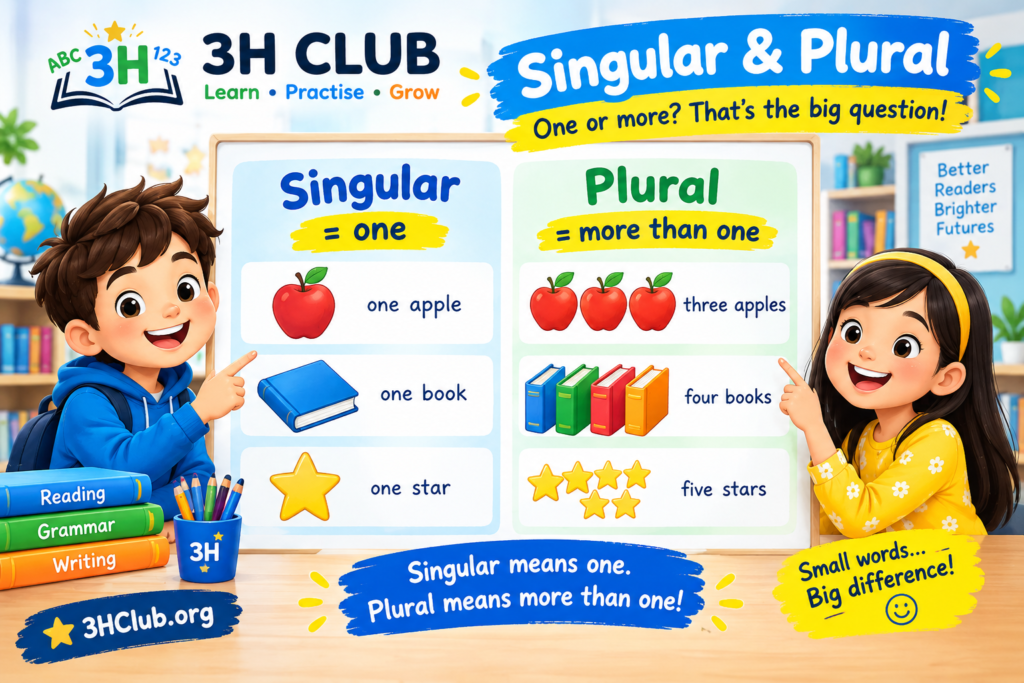
- Singular means one.
- Plural means more than one.
As you move through the three 3HClub levels, you will learn how to recognize singular and plural nouns, form regular plurals, spot irregular plurals, and use them correctly in sentences.
⭐ Starters — Ages 6–7
What Does Singular Mean?
Singular means there is one person, animal, place or thing.
Examples:
- one cat
- one book
- one apple
- one teacher
- one house
We can often use a or an before a singular noun.
a dog
a pencil
an apple
an elephant
Singular = one. ☝️
What Does Plural Mean?
Plural means there is more than one.
Examples:
- two cats
- five books
- three apples
- four teachers
- many houses
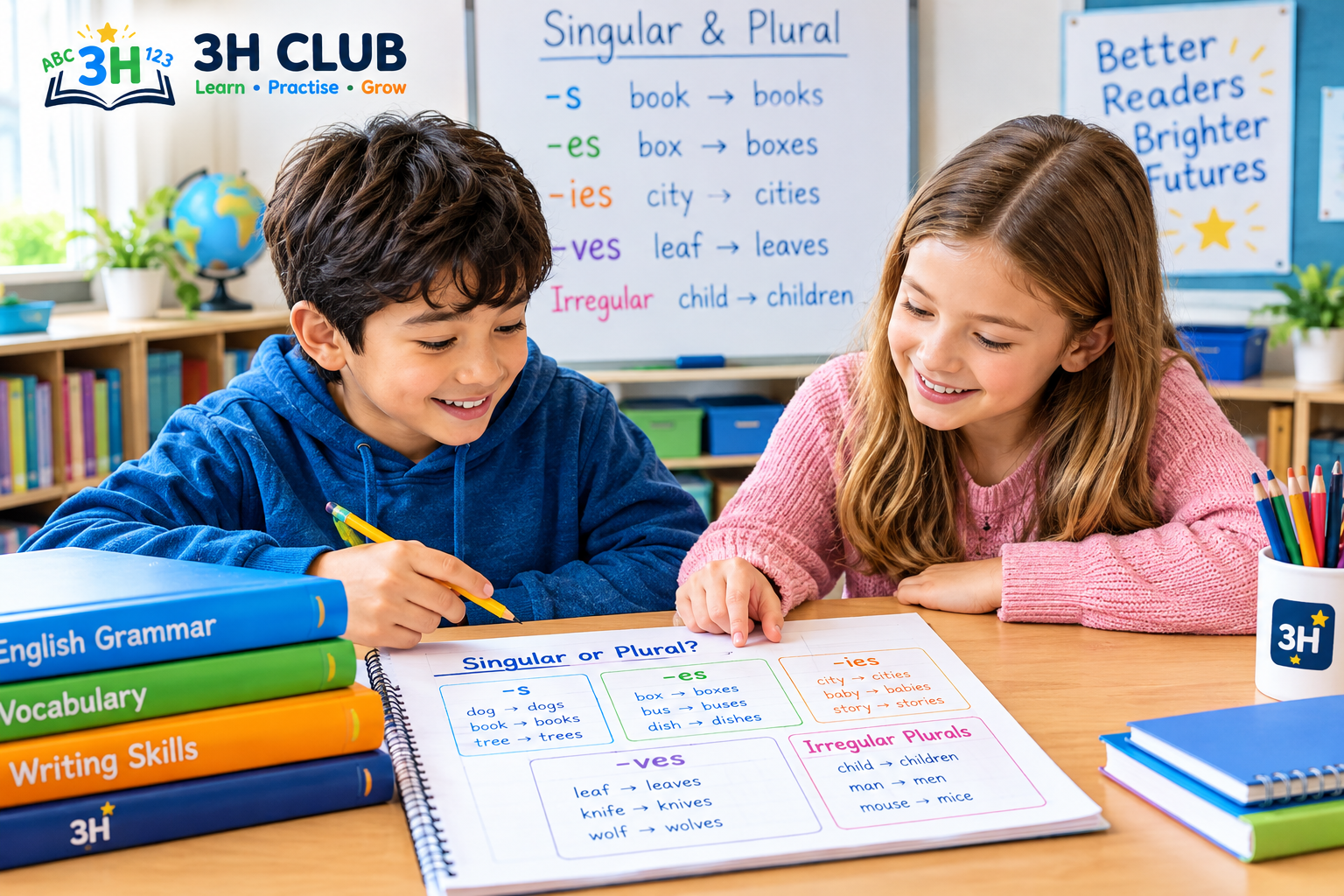
Most nouns become plural by adding -s.
| Singular | Plural |
|---|---|
| cat | cats |
| book | books |
| pencil | pencils |
| ball | balls |
| star | stars |
So:
one cat → two cats
one book → three books
one star → many stars
This is one of the most useful plural rules to learn first. Khan Academy
One or More?
Look carefully.
Singular
one bird 🐦
Plural
two birds 🐦🐦
The noun changes from bird to birds.
Try these:
one apple → two _______
Answer: apples
one car → three _______
Answer: cars
one tree → five _______
Answer: trees
Great work!
Add -s to Make Many Nouns Plural
For many nouns, simply add -s.
- dog → dogs
- chair → chairs
- flower → flowers
- shoe → shoes
- friend → friends
- book → books
Remember:
One = singular
More than one = plural
Some Words Need -es
Some nouns need -es instead of just -s.
For example:
- bus → buses
- box → boxes
- dish → dishes
- brush → brushes
- watch → watches
You will often see -es with nouns ending in s, x, z, ch or sh. LearnEnglish Kids
Look at the difference:
one box
two boxes
one dish
three dishes
Let’s Play: One or More?
Read each pair.
- one cat — three cats
- one book — two books
- one bus — four buses
- one box — five boxes
- one brush — two brushes
Can you spot the plural noun each time?
Singular or Plural?
Write S for singular or P for plural.
- dogs
- apple
- books
- pencil
- houses
- tree
Answers
- dogs — P
- apple — S
- books — P
- pencil — S
- houses — P
- tree — S
Look for Clues
Some words can help you decide whether a noun is singular or plural.
Singular clues:
- one
- a
- an
- this
- that
one dog
a book
this pencil
Plural clues:
- two
- three
- many
- these
- those
two dogs
many books
these pencils
These little words give you clues about whether you are talking about one or more than one.
⭐ Starters Quick Challenge
Change each singular noun into a plural noun.
- cat → _______
- book → _______
- ball → _______
- bus → _______
- box → _______
- dish → _______
Answers
- cats
- books
- balls
- buses
- boxes
- dishes
⭐ You are becoming a singular-and-plural expert!
⭐⭐ Builders — Ages 8–9
Now you know the basic idea:
singular = one
plural = more than one
But English has several patterns for making nouns plural.
Let’s explore them.
Rule 1: Add -s
For many nouns, add -s.
| Singular | Plural |
|---|---|
| dog | dogs |
| tree | trees |
| pencil | pencils |
| game | games |
| teacher | teachers |
This is the most common plural pattern.
Rule 2: Add -es
Add -es to many nouns ending in:
s, x, z, ch, sh
Examples:
| Singular | Plural |
|---|---|
| bus | buses |
| box | boxes |
| quiz | quizzes |
| church | churches |
| brush | brushes |
Why do we add -es?
It makes the word easier to say.
box → boxes
brush → brushes
church → churches
Rule 3: Words Ending in Consonant + y
Some nouns ending in y change when they become plural.
If a consonant comes before the y, change:
y → i
and add -es.
Examples:
- baby → babies
- city → cities
- story → stories
- party → parties
- puppy → puppies
So:
one baby
two babies
But watch out!
If a vowel comes before the y, usually just add -s.
- toy → toys
- boy → boys
- key → keys
- day → days
Compare:
baby → babies
boy → boys
This is an important pattern to notice. LearnEnglish Kids
Rule 4: Some Words Ending in f or fe
Some nouns change f or fe to ves.
Examples:
- leaf → leaves
- knife → knives
- wolf → wolves
- wife → wives
But here is something important:
Not every word ending in f or fe follows this pattern.
For example:
roof → roofs
chief → chiefs
English has exceptions, so you need to learn some words individually. Khan Academy
Irregular Plural Nouns
Now we reach some of the most interesting nouns.
An irregular plural does not follow the usual plural pattern.
You cannot simply add -s.
Look at these:
| Singular | Plural |
|---|---|
| child | children |
| person | people |
| man | men |
| woman | women |
| mouse | mice |
| tooth | teeth |
| foot | feet |
| goose | geese |
For example:
one child
three children
Not:
❌ three childs
Some irregular plurals change the word completely. LearnEnglish Kids
Some Plurals Do Not Change
Here is another interesting group.
Some nouns have the same form when they are singular and plural.
For example:
one sheep
five sheep
The word sheep stays the same.
Other examples include:
- one deer → two deer
- one fish → many fish
- one aircraft → several aircraft
The number of the noun is understood from the rest of the sentence.
The sheep is in the field.
The sheep are in the field.
Singular and Plural in Sentences
Singular and plural nouns can affect the rest of a sentence.
Compare:
The cat is sleeping.
The cats are sleeping.
The noun changes from cat to cats, and the verb changes from is to are.
Another example:
The boy plays football.
The boys play football.
This is called subject-verb agreement: the subject and verb need to match in number. Khan Academy
This or These?
Singular and plural can also help you choose the right word.
Singular:
This book is interesting.
That apple is red.
Plural:
These books are interesting.
Those apples are red.
A useful way to remember it:
this / that → one
these / those → more than one
Builders’ Challenge
Choose the correct word.
- The dog is / are barking.
- The dogs is / are barking.
- These book / books are new.
- This pencil / pencils is mine.
- Two child / children are playing.
- Three box / boxes are on the table.
Answers
- The dog is barking.
- The dogs are barking.
- These books are new.
- This pencil is mine.
- Two children are playing.
- Three boxes are on the table.
Plural Detective 🔎
Look around you.
Can you find:
- one thing?
- two things?
- three things?
- a word ending in -s?
- a word ending in -es?
- an irregular plural?
Try making your own sentences.
For example:
There is one pencil on my desk.
There are four pencils in my pencil case.
⭐⭐⭐ Champions — Ages 10–11
You have learned the main plural patterns. Now it is time to become more precise.
English plurals are mostly predictable, but there are exceptions. Strong writers learn to recognize the pattern and notice when a word does something different.
Regular and Irregular Plurals
A regular plural follows a familiar pattern.
book → books
box → boxes
city → cities
An irregular plural does not follow the usual pattern.
child → children
mouse → mice
person → people
foot → feet
Knowing the difference helps you choose the correct form when writing.
Khan Academy’s grammar materials also group plural nouns into regular and irregular patterns, including -s, -es, -ies, -ves and several irregular forms. Khan Academy
A Closer Look at Plural Rules
1. Most nouns → -s
book → books
computer → computers
garden → gardens
friend → friends
2. Many nouns ending in s, x, z, ch or sh → -es
bus → buses
fox → foxes
quiz → quizzes
lunch → lunches
brush → brushes
3. Consonant + y → ies
city → cities
story → stories
country → countries
library → libraries
But:
boy → boys
toy → toys
journey → journeys
The difference is the letter before y.
4. Some f/fe words → ves
leaf → leaves
knife → knives
life → lives
But remember:
roof → roofs
chief → chiefs
So don’t assume that every f or fe word changes to ves.
Irregular Plurals You Should Know
Some common irregular plurals are worth learning as pairs.
| Singular | Plural |
|---|---|
| child | children |
| person | people |
| man | men |
| woman | women |
| mouse | mice |
| goose | geese |
| tooth | teeth |
| foot | feet |
Try saying them aloud.
one mouse → two mice
one tooth → many teeth
one person → several people
The plural form sometimes changes the vowel inside the word.
When Singular and Plural Look the Same
Some nouns do not change at all.
one deer → two deer
one sheep → ten sheep
one fish → many fish
This means you cannot always identify a plural noun just by looking for an s.
You need to look at the whole sentence.
One sheep is standing near the gate.
Six sheep are standing near the gate.
The words one and six, and the verbs is and are, give you important clues.
Singular and Plural Verb Agreement
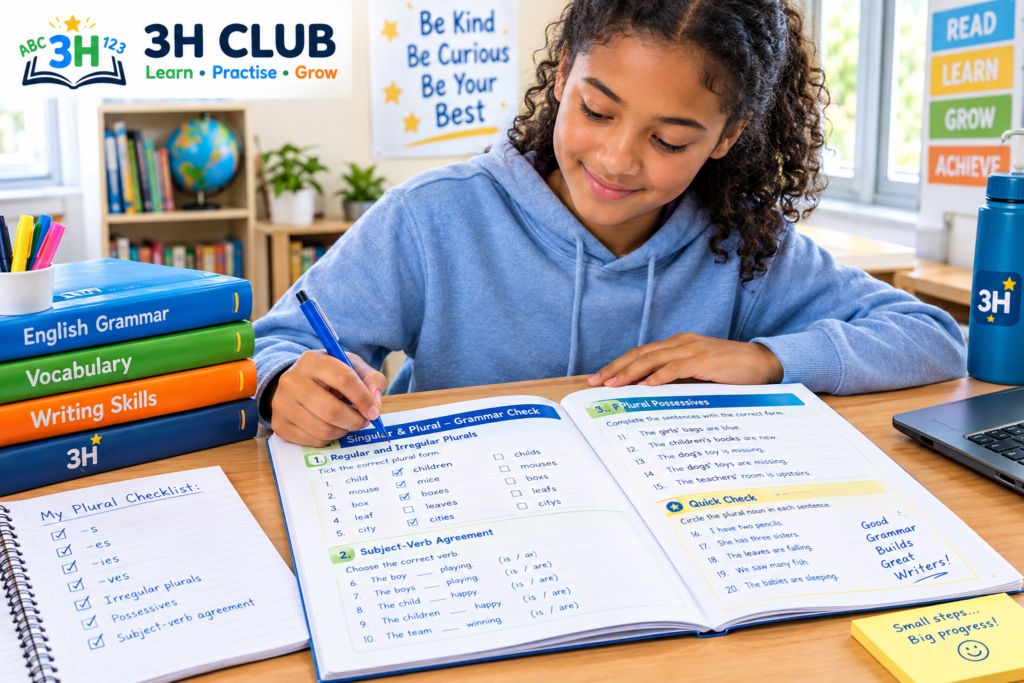
A singular noun usually needs a singular verb, while a plural noun usually needs a plural verb.
Compare:
The bird is flying.
The birds are flying.
And:
The child plays outside.
The children play outside.
A useful checking trick is:
Step 1
Find the subject.
Step 2
Ask: Is it one or more than one?
Step 3
Choose the verb that matches.
This can help you catch mistakes when you edit your writing. Khan Academy
Don’t Confuse Plurals with Possessives
This is an important writing skill.
A plural noun means more than one.
The girls are laughing.
A possessive noun shows belonging.
The girl’s bag is blue.
Notice the difference:
girls = more than one girl
girl’s = something belongs to one girl
You do not normally use an apostrophe simply to make a noun plural.
❌ apple’s
✅ apples
❌ book’s
✅ books
The apostrophe has a different job. Khan Academy
A Plural Possessive
Once you understand the difference, you can go one step further.
If a plural noun already ends in s, the apostrophe usually comes after the s when showing possession.
the girls’ bags
This means the bags belong to the girls.
Compare:
the girl’s bag
= one girl owns the bag
the girls’ bags
= more than one girl owns the bags
This is a useful distinction to notice as your writing becomes more advanced.
Articles: A, An and Plural Nouns
Singular and plural nouns also affect the words we put before them.
For example:
a book
an apple
But we don’t normally use a or an before a regular plural noun.
books
apples
three books
some apples
The British Council’s children’s grammar resources also teach learners to use a/an with singular nouns and words such as some with plural nouns. LearnEnglish Kids
Champions Challenge 🏆
Choose the correct form in each sentence.
1.
There are three _______ on the shelf.
book / books
2.
The _______ are playing in the garden.
child / children
3.
My two _______ are broken.
tooth / teeth
4.
The _______ is sleeping.
baby / babies
5.
Those _______ belong to me.
box / boxes
6.
The _______ are running across the field.
sheep / sheeps
7.
The _______ tails are fluffy.
foxes / fox’s
Answers
- books
- children
- teeth
- baby
- boxes
- sheep
- foxes
Singular & Plural Editing Challenge
Can you find the mistakes?
There are three childs in the garden.
One of the childs has two foot.
The other childrens are holding box’s.
The box’s are full of toy.
Correct version:
There are three children in the garden.
One of the children has two feet.
The other children are holding boxes.
The boxes are full of toys.
Look at what changed:
- childs → children
- foot → feet
- box’s → boxes
- toy → toys
Notice that boxes and toys are plural, not possessive.
Singular & Plural in Everyday Life
You use singular and plural nouns all the time.
Think about your day.
At breakfast:
one bowl
two spoons
three pieces of fruit
At school:
one teacher
many students
several books
At the park:
one ball
two children
many trees
At home:
one computer
two chairs
several books
Once you start noticing singular and plural nouns around you, grammar becomes much easier to understand.
Become a Singular & Plural Detective 🔎
Choose a book, magazine or website and look for ten nouns.
Write them in two columns:
| Singular | Plural |
|---|---|
| one book | three books |
| one child | two children |
| one box | four boxes |
Then challenge yourself:
Can you find an irregular plural?
Can you find a word ending in -es?
Can you find a word ending in -ies?
Can you find a plural noun that does not end in -s?
This is a great way to practice without turning grammar into a guessing game.
⭐⭐⭐ Quick Review
Before you finish, remember these key ideas:
Singular
One
one dog
one child
one box
Plural
More than one
two dogs
three children
four boxes
Common plural patterns
Add -s:
book → books
Add -es:
box → boxes
Change consonant + y to -ies:
city → cities
Some f/fe words change to -ves:
leaf → leaves
Some plurals are irregular:
child → children
mouse → mice
Some nouns stay the same:
sheep → sheep
And always remember:
A plural noun does not need an apostrophe just because it is plural.
Frequently Asked Questions About Singular & Plural
What does singular mean?
Singular means one person, animal, place, thing or idea.
one book
What does plural mean?
Plural means more than one.
two books
How do I make most nouns plural?
For many nouns, add -s.
cat → cats
When do I add -es?
Many nouns ending in s, x, z, ch or sh take -es.
box → boxes
brush → brushes
What happens to nouns ending in consonant + y?
Usually change y to i and add -es.
baby → babies
city → cities
Are all plural nouns made by adding s?
No. Some have different patterns or are irregular.
child → children
mouse → mice
Some nouns do not change:
sheep → sheep
Is “childs” correct?
No. The correct plural of child is children.
Is “sheeps” correct?
Usually no. The plural of sheep is sheep.
one sheep → five sheep
Do plural nouns need apostrophes?
No. A plural noun normally does not need an apostrophe.
books ✔️
book’s ❌
An apostrophe is used for other purposes, such as showing possession.
Why is learning singular and plural important?
Knowing whether you are talking about one or more than one helps you choose the correct noun form and can also help you choose the correct verb.