Champions Grammar Practice Paper
Grammar Practice for Kids Ages 10–11
Welcome, Grammar Champion!
You have built your grammar skills. Now it is time to put them to the test!
This practice paper challenges you to identify different parts of speech, use verb tenses accurately, understand clauses, improve sentence structure and edit punctuation. Some questions ask you to explain or rewrite sentences, so read carefully and think about how each word works.
You do not need to rush. Good grammar is about making your meaning clear, not simply getting to the end quickly.
- Level: ⭐⭐⭐ Champions
- Age group: 10–11 years
- Total marks: 20
- Suggested time: 35–45 minutes
- You will practice: Word classes, tenses, subject–verb agreement, clauses, conjunctions, punctuation and sentence editing.
⭐ Your challenge: Complete all 20 questions. Each question is worth 1 mark.
Part 1: Parts of Speech
Question 1 — Identify the word class
Read the sentence.
The exhausted runner crossed the finish line confidently.
Which word is an adverb?
A. exhausted
B. runner
C. crossed
D. confidently
Your answer: __________
Question 2 — Understand the pronoun
Read the sentence.
Although Priya and Daniel were tired, they finished the project.
What noun phrase does the pronoun they refer to?
Your answer: __________________________________
Question 3 — Choose the correct word
Complete the sentence with the correct word.
The instructions were explained _____ so that everyone could understand them.
A. clear
B. clearly
C. clearest
D. clarity
Your answer: __________
Part 2: Verbs and Tenses
Question 4 — Choose the correct tense
Complete the sentence.
By the time the match began, the players _____ their warm-up.
A. finish
B. have finished
C. had finished
D. will finish
Your answer: __________
Question 5 — Subject–verb agreement
Choose the correct verb.
Neither of the two answers _____ correct.
A. are
B. were
C. is
D. have been
Your answer: __________
Question 6 — Correct the verb
The sentence contains a verb error. Rewrite it correctly.
Yesterday, we go to the museum and learned about ancient Egypt.
Your corrected sentence:
Question 7 — Active or passive voice?
Read the sentence.
The winning story was written by Aisha.
Is the sentence written in the active voice or the passive voice?
Your answer: ____________________
Part 3: Clauses and Sentence Structure
Question 8 — Identify the independent clause
Read the sentence.
Although the sky was cloudy, the children continued their game.
Write down the independent clause.
Your answer: __________________________________
Question 9 — Find the dependent clause
Read the sentence.
We stayed indoors because the storm was getting stronger.
Which words form the dependent clause?
Your answer: __________________________________
Question 10 — Simple, compound or complex?
Read the sentence.
Lena finished her homework, and she packed her schoolbag.
Is this a simple, compound or complex sentence?
Your answer: ____________________
Question 11 — Improve the sentence
Combine these two sentences into one complex sentence using the conjunction although.
The path was steep. We continued walking.
Your sentence:
Part 4: Punctuation and Editing
Question 12 — Correct the punctuation
Rewrite the sentence using correct punctuation.
where did you put the book asked Marcus
Your corrected sentence:
Question 13 — Use the apostrophe correctly
Choose the sentence that correctly shows that the books belong to several students.
A. The student’s books were on the desk.
B. The students books’ were on the desk.
C. The students’ books were on the desk.
D. The students’s books were on the desk.
Your answer: __________
Question 14 — Correct the capital letters
Rewrite the sentence with all necessary capital letters.
last august, my cousin travelled from barbados to london.
Your corrected sentence:
Question 15 — Add a colon
Rewrite the sentence using a colon correctly.
You will need three things a ruler, a pencil and an eraser.
Your corrected sentence:
Part 5: Conjunctions and Meaning
Question 16 — Choose the best conjunction
Complete the sentence.
_____ the task was difficult, the team worked together and completed it.
A. Because
B. Although
C. Unless
D. Before
Your answer: __________
Question 17 — Explain the difference
Compare these sentences.
- I wanted to go outside, but it was raining.
- I wanted to go outside because it was raining.
In the first sentence, what relationship does but show between the two ideas?
A. A reason
B. A contrast
C. A time sequence
D. A condition
Your answer: __________
Part 6: Grammar Detective
Question 18 — Find and correct the errors
This sentence contains two grammar errors.
Each of the players have brought their boots.
Rewrite the sentence using standard subject–verb agreement and a suitable pronoun.
Your corrected sentence:
Question 19 — Fix the sentence fragment
The following is not a complete sentence.
Because the train was delayed.
Rewrite it so that it becomes a complete sentence. You may add an independent clause.
Your sentence:
Question 20 — Edit a short paragraph
Read the paragraph carefully.
yesterday, maya and her brother visits the science centre. they saw an amazing robot, and asked how it worked.
Rewrite the paragraph with the correct capital letters, verb forms and punctuation.
Your corrected paragraph:
🎯 Before You Check Your Answers
Take a final look at your work.
- Have you checked that every verb matches its subject?
- Have you used the correct tense?
- Can you tell an independent clause from a dependent clause?
- Have you checked apostrophes, commas and other punctuation?
- Do your rewritten sentences make sense and express the intended meaning?
When you are ready, continue to the answer key.
Answer Key: Champions Grammar Practice
Each question is worth 1 mark. For questions that ask you to rewrite a sentence, award the mark when the required correction is accurate and the sentence is complete.
| Question | Answer | Marks |
|---|---|---|
| 1 | D. confidently | 1 |
| 2 | Priya and Daniel | 1 |
| 3 | B. clearly | 1 |
| 4 | C. had finished | 1 |
| 5 | C. is | 1 |
| 6 | Yesterday, we went to the museum and learned about ancient Egypt. | 1 |
| 7 | Passive voice | 1 |
| 8 | The children continued their game. | 1 |
| 9 | because the storm was getting stronger | 1 |
| 10 | Compound sentence | 1 |
| 11 | Although the path was steep, we continued walking. | 1 |
| 12 | “Where did you put the book?” asked Marcus. | 1 |
| 13 | C. The students’ books were on the desk. | 1 |
| 14 | Last August, my cousin travelled from Barbados to London. | 1 |
| 15 | You will need three things: a ruler, a pencil and an eraser. | 1 |
| 16 | B. Although | 1 |
| 17 | B. A contrast | 1 |
| 18 | Each of the players has brought their boots. | 1 |
| 19 | Example: Because the train was delayed, we arrived late. | 1 |
| 20 | Yesterday, Maya and her brother visited the science center. They saw an amazing robot and asked how it worked. | 1 |
Notes for marking
Question 8: The independent clause is the children continued their game. It can stand alone as a complete thought.
Question 9: The dependent clause is because the storm was getting stronger. It gives a reason but does not stand alone as a complete sentence in this context.
Question 10: This is a compound sentence because it joins two independent clauses with and.
Question 18: The singular subject each takes has. The singular their is acceptable in standard modern English when the person’s gender is not specified.
Question 19: Accept any complete, sensible sentence that includes the original dependent clause and adds an independent clause.
Question 20: Award the mark when the capital letters and verb forms are corrected and the paragraph is punctuated appropriately. Removing the comma before and asked is the cleanest version because the same subject, they, carries on through the coordinated verbs saw and asked.
Total: 20 marks
How Did You Do?
- 18–20 marks — Outstanding work! You have shown strong grammar knowledge and careful editing skills.
- 15–17 marks — Excellent progress! You understand many important grammar rules. Review any questions you missed.
- 11–14 marks — Good effort! You are building your skills. Practice clauses, tenses and punctuation to strengthen your understanding.
- 0–10 marks — Keep learning! Challenging questions take practice. Review the rules, try a few examples and give the paper another go.
These score bands are for practice and encouragement. They are not a formal assessment.
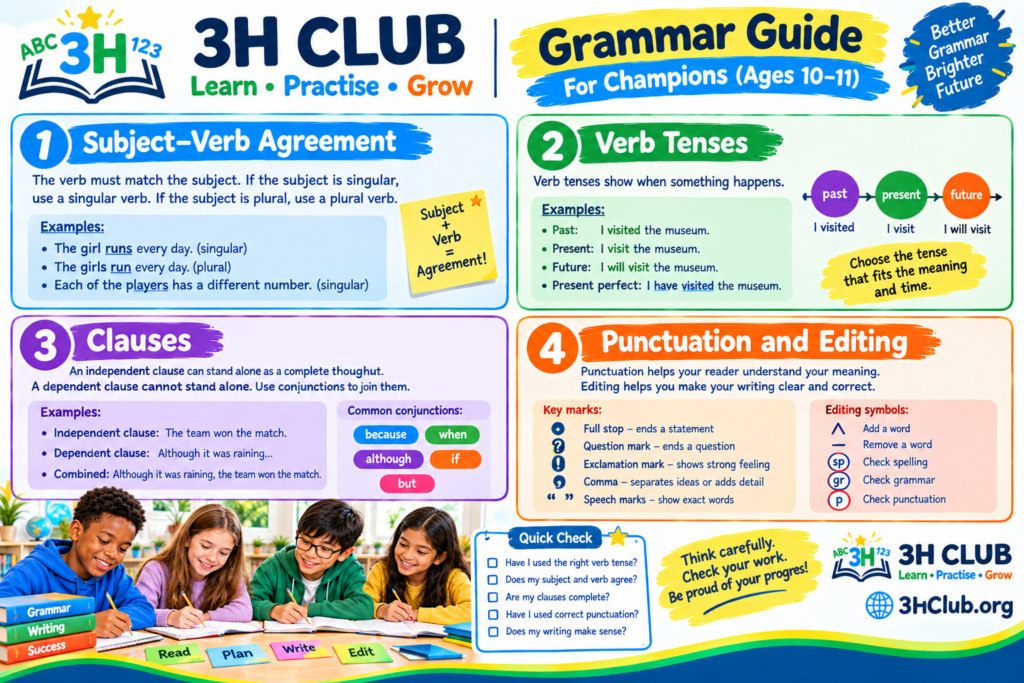
Quick Grammar Reference for Champions
Keep these reminders handy as you practice.
1. Parts of speech
- Nouns name people, places, things or ideas.
- Pronouns take the place of nouns or noun phrases.
- Verbs express actions, states or events.
- Adjectives describe nouns.
- Adverbs can modify verbs, adjectives or other adverbs.
- Prepositions show relationships such as place, direction or time.
- Conjunctions join words, phrases or clauses.
2. Verb tenses
Verb tenses help show when something happens.
- Past: We visited the museum.
- Present: We visit the museum regularly.
- Future: We will visit the museum tomorrow.
- Past perfect: We had finished before the bell rang.
Choose the tense that matches the meaning and time of the sentence.
3. Subject–verb agreement
The verb must agree with its subject.
- The player runs quickly.
- The players run quickly.
- Each of the players has a pair of boots.
When a sentence contains extra words between the subject and the verb, identify the true subject before choosing the verb.
4. Independent and dependent clauses
An independent clause expresses a complete thought and can stand alone.
The team won the match.
A dependent clause does not express a complete thought on its own in the sentence.
Although the team played well…
Together, the clauses can make a complete sentence:
Although the team played well, it lost the match.
5. Punctuation
- A full stop ends a statement.
- A question mark ends a direct question.
- An exclamation mark shows strong feeling or emphasis.
- An apostrophe can show possession or missing letters.
- A colon can introduce a list or explanation when the sentence structure supports it.
- Speech marks show the exact words spoken in direct speech.
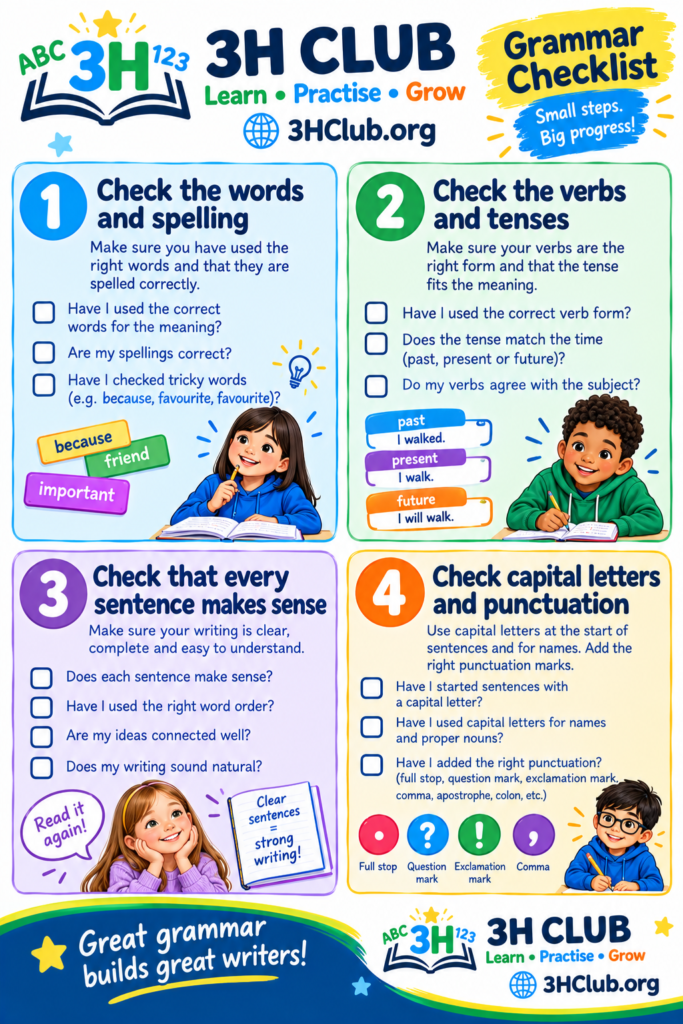
6. Editing strategy
When editing a paragraph, work through it in stages:
- Check spelling and word choice.
- Check verb forms and subject–verb agreement.
- Check that each sentence is complete and clear.
- Check capital letters and punctuation.
- Read the paragraph again to make sure it means what you intend.