Shapes for Kids:
Learn About 2D and 3D Shapes
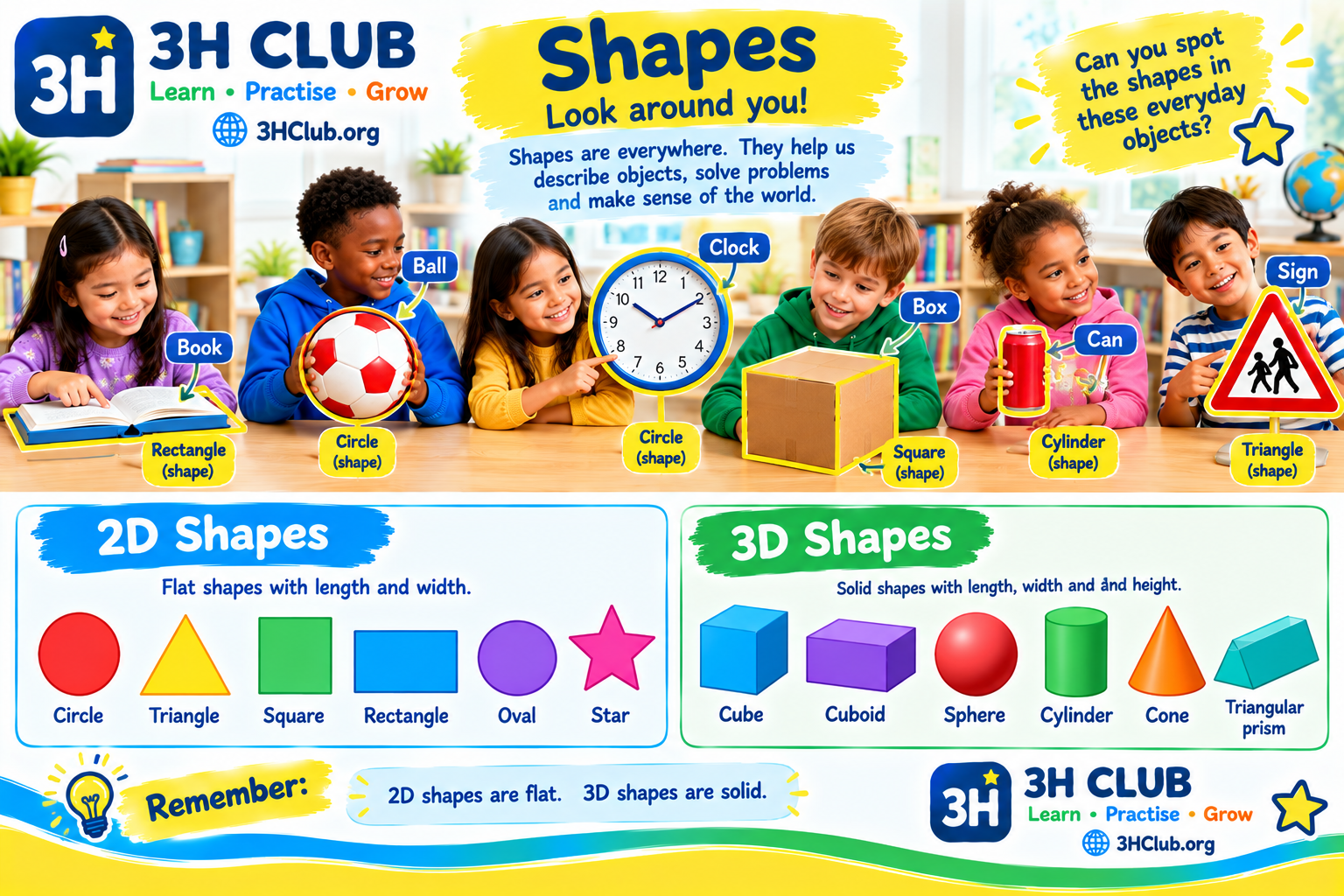
Look around you. Can you spot a circle on a clock, a rectangle on a book, or a triangle on a road sign? What about a ball, a cereal box or a can of food?
Shapes are everywhere! They help us describe objects, understand patterns and solve problems in maths. Some shapes are flat, while others have length, width and height.
In this guide, you’ll discover different shapes, learn their names and properties, and explore how to recognise, compare and describe them.
⭐ Starters — Ages 6–7
⭐⭐ Builders — Ages 8–9
⭐⭐⭐ Champions — Ages 10–11
Ready to explore? Let’s get started!
What You’ll Learn
- How to recognise and name common shapes.
- The difference between 2D and 3D shapes.
- How to count sides, corners, edges and vertices.
- How to describe shapes using their properties.
- How to explore symmetry, faces and nets.
- How shapes connect to area, perimeter and everyday objects.
What Is a Shape?
A shape describes the form or outline of something. Shapes can be found in nature, buildings, toys, books and many other objects.
In maths, we often group shapes into two main categories:
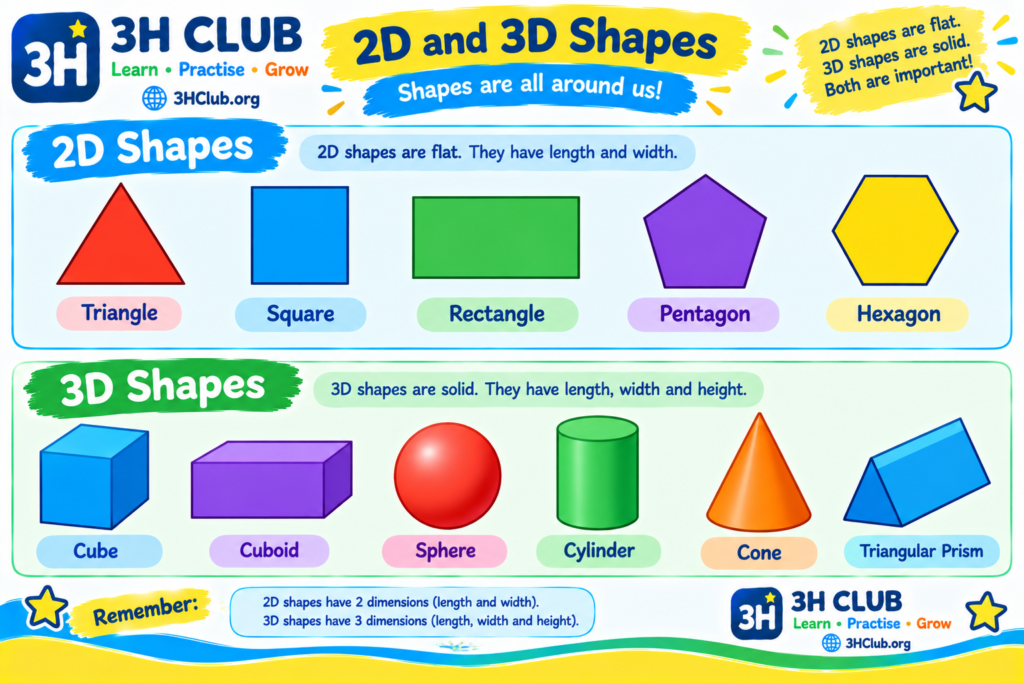
- 2D shapes are flat. They have length and width.
- 3D shapes are solid. They have length, width and height.
A square is a 2D shape. A cube is a 3D shape. A square is flat, while a cube is a solid object with square faces.
You can use shapes to describe objects around you. A door is usually shaped like a rectangle, a coin has a circular face, and a football is approximately spherical.
⭐ Starters — Ages 6–7
1. Meet the Basic 2D Shapes
A 2D shape is flat, like a drawing on a piece of paper. Let’s learn some common 2D shapes.
Circle
A circle is round. It has no straight sides and no corners.
You can find circles on clocks, coins and some plates.
Triangle
A triangle has three straight sides and three corners.
A triangular road sign is one example of a triangle-shaped object.
Square
A square has four equal sides and four corners. Each corner is a right angle.
A square tile or a square sticky note can help you recognise this shape.
Rectangle
A rectangle has four sides and four right-angle corners. Opposite sides are equal in length.
Books, doors and many screens have a rectangular shape.
Oval
An oval is a rounded shape that looks like a stretched circle. It has no straight sides or corners.
An egg is a familiar example of an oval-like shape.
Star
A star shape has points around its outline. The number of points depends on the kind of star.
You might see star shapes on stickers, decorations and drawings.
2. Count Sides and Corners
A side is a straight edge of a flat shape. A corner is where two sides meet.
Let’s count:
| Shape | Straight sides | Corners |
|---|---|---|
| Circle | 0 | 0 |
| Triangle | 3 | 3 |
| Square | 4 | 4 |
| Rectangle | 4 | 4 |
A circle has no straight sides or corners. A triangle has three sides and three corners. A square and a rectangle each have four sides and four corners.
Try it! Draw a triangle, square and rectangle. Use your finger to trace each side, then count the corners.
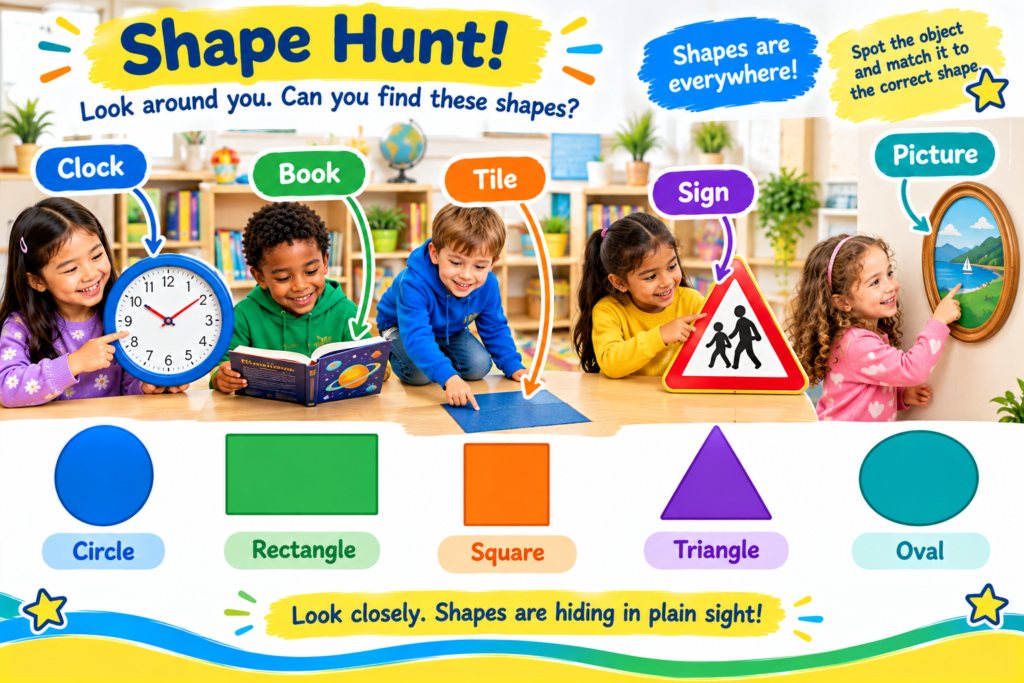
3. Find Shapes Around You
Become a shape detective!
Look for:
- A circle on a clock or plate.
- A rectangle on a book or door.
- A square on a floor tile.
- A triangle on a sign or pattern.
- An oval on a picture or design.
Objects can have different shapes depending on how you look at them. For example, a can has a circular top but is a cylinder when you look at the whole object.
Starters Shape Hunt
4. Starters Practice
A. Fill in the missing numbers.
- A triangle has ______ sides.
- A square has ______ corners.
- A circle has ______ straight sides.
- A rectangle has ______ sides.
B. Choose the correct answer.
- Which shape is round and has no corners: a circle or a triangle?
- Which shape has three sides: a square or a triangle?
- What shape is a book usually: a circle or a rectangle?
Answers
- 3
- 4
- 0
- 4
- A circle
- A triangle
- A rectangle
Well done! You can now recognise several common 2D shapes and describe them by their sides and corners.
⭐⭐ Builders — Ages 8–9
5. Explore More 2D Shapes
You already know circles, triangles, squares and rectangles. Now let’s explore more shapes and their properties.
Pentagon
A pentagon has five straight sides and five corners.
Hexagon
A hexagon has six straight sides and six corners. Some floor tiles and honeycomb patterns use hexagons.
Octagon
An octagon has eight straight sides and eight corners. A stop sign is often shaped like an octagon.
Parallelogram
A parallelogram is a four-sided shape with both pairs of opposite sides parallel. Opposite sides are also equal in length.
Rhombus
A rhombus is a four-sided shape with all four sides equal in length. Its angles do not all have to be right angles.
A square is a special kind of rectangle and a special kind of rhombus because it has four equal sides and four right angles.
6. What Is a Polygon?
A polygon is a flat, closed shape made from straight line segments.
Triangles, squares, rectangles, pentagons, hexagons and octagons are all polygons.
A circle is not a polygon because its outline is curved. An open shape is not a polygon because its sides do not enclose a complete region.
Here is a useful way to remember some polygon names:
| Number of sides | Name |
|---|---|
| 3 | Triangle |
| 4 | Quadrilateral |
| 5 | Pentagon |
| 6 | Hexagon |
| 7 | Heptagon |
| 8 | Octagon |
| 10 | Decagon |
A quadrilateral is any polygon with four sides. Squares, rectangles, parallelograms and rhombuses are all quadrilaterals.
7. Discover 3D Shapes
Unlike 2D shapes, 3D shapes are solid. They have length, width and height.
Let’s explore some common 3D shapes.
Cube
A cube has:
- 6 square faces.
- 12 edges.
- 8 vertices.
A vertex is a point where edges meet. A small toy building block may be shaped like a cube.
Cuboid
A cuboid has six rectangular faces. It has 12 edges and 8 vertices.
Many cereal boxes and books are approximately cuboid-shaped.
Sphere
A sphere is round in every direction, like a ball. It has no flat faces, straight edges or vertices.
Cylinder
A cylinder has two parallel circular faces and one curved surface. A can is a familiar example.
Cone
A cone has one circular base and one curved surface that narrows to a vertex. An ice-cream cone is a familiar example.
Triangular prism
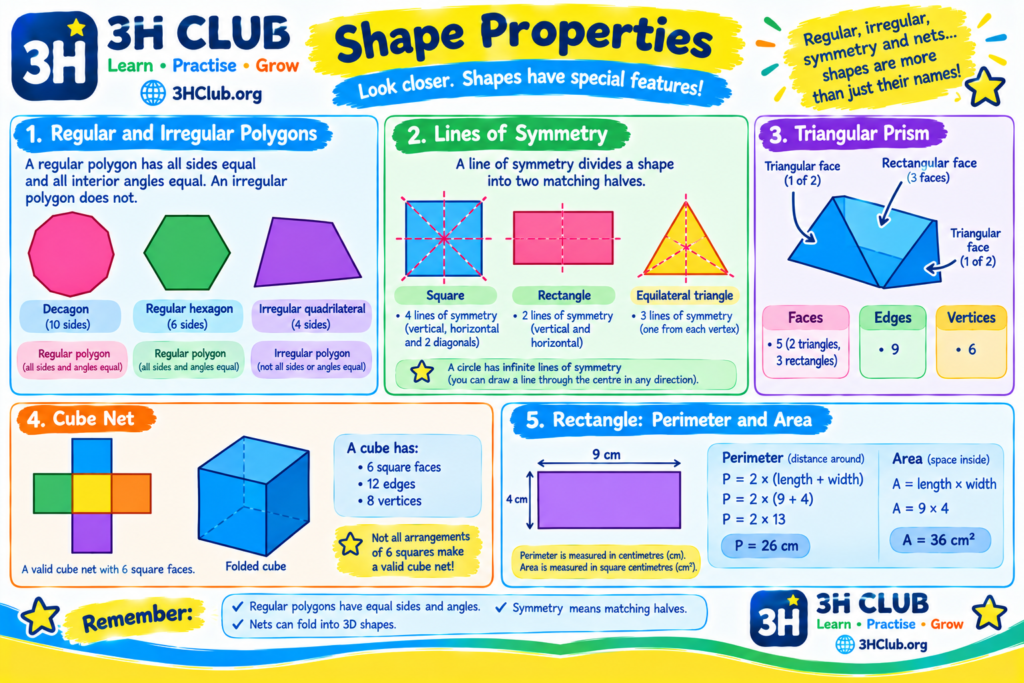
A triangular prism has two matching triangular faces and three rectangular faces. It has 5 faces, 9 edges and 6 vertices.
Discover 2D and 3D Shapes
8. Faces, Edges and Vertices
When describing 3D shapes, three words are especially useful.
- A face is a flat surface of a 3D shape.
- An edge is where two faces meet, or the boundary between faces.
- A vertex is a point where edges meet. The plural is vertices.
For example, a cube has six square faces. Each face meets another along an edge, and the edges meet at eight vertices.
| 3D shape | Faces | Edges | Vertices |
|---|---|---|---|
| Cube | 6 | 12 | 8 |
| Cuboid | 6 | 12 | 8 |
| Triangular prism | 5 | 9 | 6 |
| Square-based pyramid | 5 | 8 | 5 |
For this table, faces are the flat surfaces. A sphere has no flat faces, edges or vertices.
9. Builders Practice
A. Name each shape.
- A polygon with five sides.
- A polygon with eight sides.
- A solid shape with six square faces.
- A solid shape with two circular faces and one curved surface.
- A four-sided polygon with all sides equal in length.
B. Answer these questions.
- Is a circle a polygon? Explain why.
- How many edges does a cube have?
- How many vertices does a cuboid have?
- What is the difference between a 2D shape and a 3D shape?
Answers
- Pentagon
- Octagon
- Cube
- Cylinder
- Rhombus
- No. A circle has a curved outline, not straight sides.
- 12
- 8
- A 2D shape is flat and has length and width. A 3D shape is solid and has length, width and height.
⭐⭐⭐ Champions — Ages 10–11
10. Understand Shape Properties
At this level, you can describe shapes by more than their names. You can compare side lengths, angles, parallel lines, symmetry and the way shapes fit together.
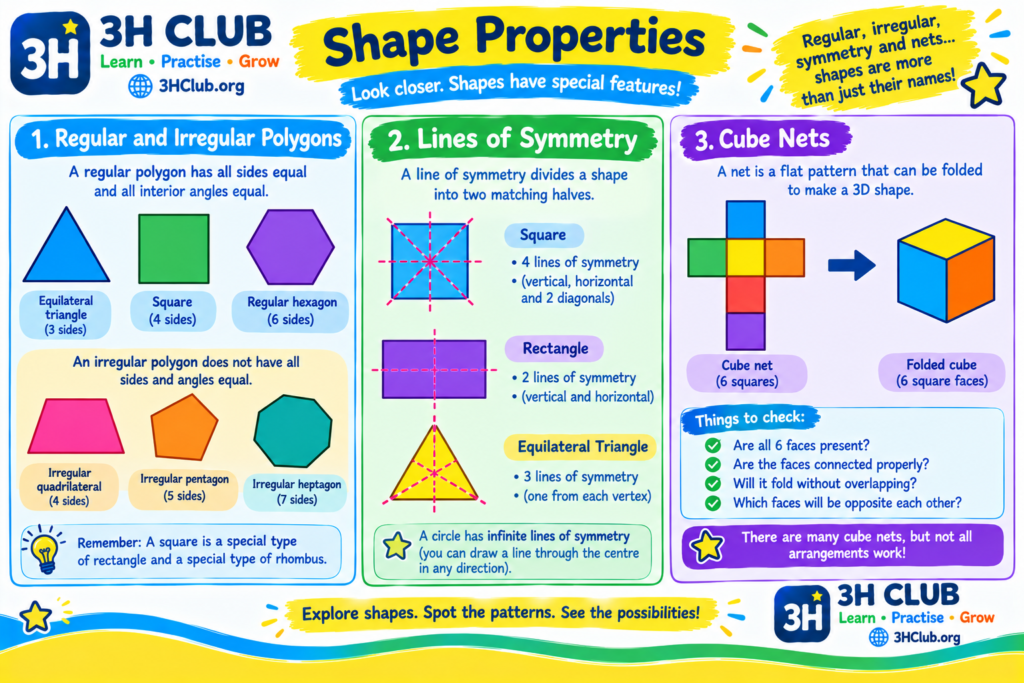
Regular and irregular polygons
A regular polygon has all sides equal in length and all interior angles equal.
An equilateral triangle is a regular triangle. A square is a regular quadrilateral.
An irregular polygon does not have all sides and all interior angles equal.
For example, a rectangle that is not a square is an irregular quadrilateral because its angles are equal, but its four sides are not all equal.
Parallel and perpendicular lines
Parallel lines stay the same distance apart and never meet, even if they are extended.
Perpendicular lines meet at a right angle of 90°.
A rectangle has two pairs of parallel opposite sides. Adjacent sides are perpendicular because they meet at right angles.
These properties help you recognise and classify shapes more accurately.
11. Explore Symmetry
A shape has line symmetry if you can fold it along a line so that both halves match exactly. The line is called a line of symmetry.
Examples:
- A square has 4 lines of symmetry.
- A non-square rectangle has 2 lines of symmetry.
- An equilateral triangle has 3 lines of symmetry.
- A circle has infinitely many lines of symmetry because every diameter gives a line of symmetry.
Some shapes have rotational symmetry, too. A shape has rotational symmetry if it looks the same after a turn of less than 360°.
A square looks the same after a 90° turn, so it has rotational symmetry of order 4.
12. Explore 3D Shape Nets
A net is a flat pattern that can be folded to make a 3D shape.
For example, a cube net contains six squares arranged so they can fold into the six faces of a cube. A cuboid net contains six rectangles, although some faces may be squares.
Nets help you understand how a 3D shape is built from flat faces.
When studying a net, ask yourself:
- Are all the required faces present?
- Are the faces connected in a way that allows them to fold?
- Will any faces overlap when folded?
- Which faces will be opposite each other?
Not every arrangement of six squares makes a valid cube net. The squares must be arranged so that they fold together without overlapping.
Champions Shape Properties
13. Connect Shapes to Area and Perimeter
Shapes are useful in many areas of maths.
Perimeter is the total distance around a 2D shape. To find it, add the lengths of its outside edges.
For a rectangle:
[ P = 2 x {length} + {width} ]
If a rectangle is 8 cm long and 3 cm wide:
[ P = 2 x ( 8 + 3 ) = 22 cm ]
Area measures the space inside a 2D shape. For a rectangle:
[ A = {length} x {width} ]
Using the same rectangle:
[ A = 8 x 3 = 24 cm} ² ]
Notice the units are different. Perimeter is measured in centimetres, while area is measured in square centimetres.
You can explore these topics in more detail in our related guides to Perimeter for Kids and Area for Kids.
14. Champions Shape Challenge
Try these problems. Sketch a shape if it helps you work out the answer.
- What is the name of a polygon with ten sides?
- A regular hexagon has six equal sides. What else is equal in a regular hexagon?
- How many lines of symmetry does a square have?
- How many edges and vertices does a triangular prism have?
- A rectangle measures 9 cm by 4 cm. Find its perimeter.
- Find the area of the same rectangle.
- A shape looks the same after a 180° turn. What type of symmetry does this show?
- Why is a circle not a polygon?
- What is a net used for?
- A square and a rectangle both have four right angles. What additional property makes a square different from a rectangle that is not a square?
Answers and explanations
- A decagon.
- All its interior angles are equal.
- Four.
- Nine edges and six vertices.
- (P = 2 x ( 9 + 4 ) =26 cm ).
- ( A = 9 x 4 = 36cm² ).
- Rotational symmetry. A 180° turn is less than a full turn and brings the shape into a matching position.
- A circle has a curved outline rather than straight sides.
- A net is a flat pattern that can fold into a 3D shape.
- A square has four equal sides. A rectangle that is not a square has opposite sides equal, but not all four sides equal.
Shape Challenge
Common Shape Mistakes to Avoid
- Confusing 2D and 3D: A square is flat; a cube is solid.
- Mixing up sides and corners: A triangle has three sides and three vertices.
- Thinking all four-sided shapes are squares: A quadrilateral can have many different forms.
- Calling every four-sided shape a rectangle: Rectangles have four right angles; other quadrilaterals may not.
- Forgetting what makes a regular polygon: All sides and all interior angles must be equal.
- Mixing up faces, edges and vertices: Faces are surfaces, edges are where faces meet, and vertices are corner points.
- Confusing area and perimeter: Area measures space inside a shape; perimeter measures the distance around it.
If you find one of these tricky, revisit the section and try the examples again. Every time you practise, you build your understanding.
Frequently Asked Questions
What is a shape?
A shape describes the form or outline of something. In maths, shapes can be flat 2D figures or solid 3D objects.
What is the difference between 2D and 3D shapes?
A 2D shape has length and width. A 3D shape has length, width and height, so it occupies space.
What is a polygon?
A polygon is a closed, flat shape made from straight line segments. Triangles, squares, pentagons and hexagons are examples.
How many sides does a hexagon have?
A hexagon has six straight sides and six vertices.
What is the difference between a cube and a cuboid?
A cube has six square faces. A cuboid has six rectangular faces; some cuboids have square faces, but not every face needs to be square.
What are faces, edges and vertices?
Faces are surfaces, edges are where faces meet, and vertices are points where edges meet.
What is symmetry in shapes?
Symmetry means that parts of a shape match in a particular way. Line symmetry means a shape can be divided into matching halves by a line.
Why are shapes important in maths?
Shapes help us describe objects, understand space, solve geometry problems and calculate measurements such as area and perimeter.
Keep Learning with 3HClub.org
You’ve explored 2D and 3D shapes, learnt their properties and discovered how geometry connects to other maths topics.
Keep looking for shapes around you.
Try describing an object using its sides, faces, corners or symmetry.
You might be surprised by how much maths you can find in everyday life!
3H CLUB — Learn • Practise • Grow