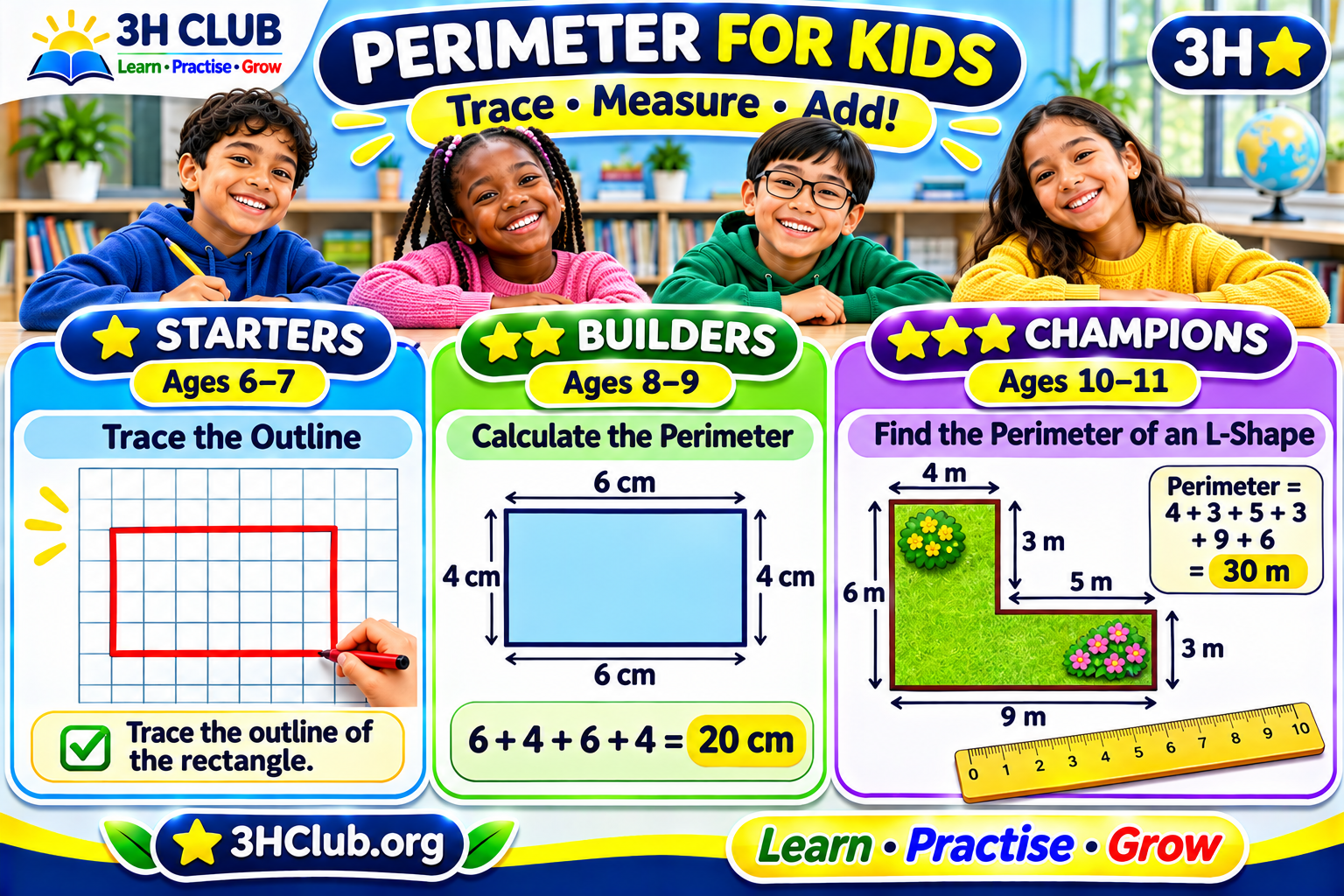
Perimeter for Kids:
📏Learn to Measure Around Shapes!
⭐ Starters — Ages 6–7 | ⭐⭐ Builders — Ages 8–9 | ⭐⭐⭐ Champions — Ages 10–11
📚 Subject: Mathematics – Measurement and Geometry
🎯 Skills: Shape boundaries, counting units, adding side lengths, perimeter formulas, missing lengths, composite shapes, metric conversions and real-life problem-solving.
🌟 Hello, Young Mathematician!
Imagine you’re decorating a picture frame with colourful ribbon.
You want the ribbon to go all the way around the outside edge.
How much ribbon will you need?
Or perhaps you’re designing a garden and want to build a fence around it.
How long should the fence be?
These are perimeter problems!
Perimeter is the total distance around the boundary of a flat shape.
You can discover perimeter by tracing shapes, counting units and adding side lengths.
As your maths skills grow, you’ll learn shortcuts, solve puzzles and even design your own gardens and playgrounds.
Let’s begin your perimeter adventure!
🎯 What Will You Learn?
By the end of this lesson, you’ll be able to:
- Explain what perimeter means.
- Trace the boundary of a shape.
- Count perimeter units on a square grid.
- Add side lengths to calculate perimeter.
- Find the perimeter of squares and rectangles.
- Choose suitable measurement units.
- Distinguish between perimeter and area.
- Calculate missing side lengths.
- Find the perimeter of composite shapes.
- Convert between metric length units.
- Solve practical measurement problems.
- Check whether your answers make sense.
⭐ Your maths mission: Learn to measure the distance around shapes accurately and confidently!
⭐ STAGE 1: STARTERS — AGES 6–7
🌈 Discover the Distance Around Shapes
🟢 1. What Is Perimeter?
The perimeter of a flat shape is the total distance around its outside boundary.
Think about walking around the edge of a playground.
You start at one corner, follow the outside edge and return to where you began.
The distance you have travelled around the playground is its perimeter.
You can also imagine:
- Putting ribbon around a rectangular card.
- Placing a border around a picture.
- Walking around a small garden.
- Tracing the edge of a book cover.
⭐ Starter Tip: Perimeter means around, not inside.
✏️ Activity 1: Find the Perimeter
Which situations involve measuring perimeter?
- Putting ribbon around a picture frame.
- Finding how much paint covers a wall.
- Measuring fencing around a garden.
- Finding how much carpet covers a floor.
- Measuring the distance around a playground.
Write perimeter or not perimeter.
🔵 2. Trace the Outside Edge
Choose a square or rectangular piece of paper.
Put your finger at one corner.
Slowly trace all the way around the edge until you return to your starting point.
You have followed the shape’s boundary.
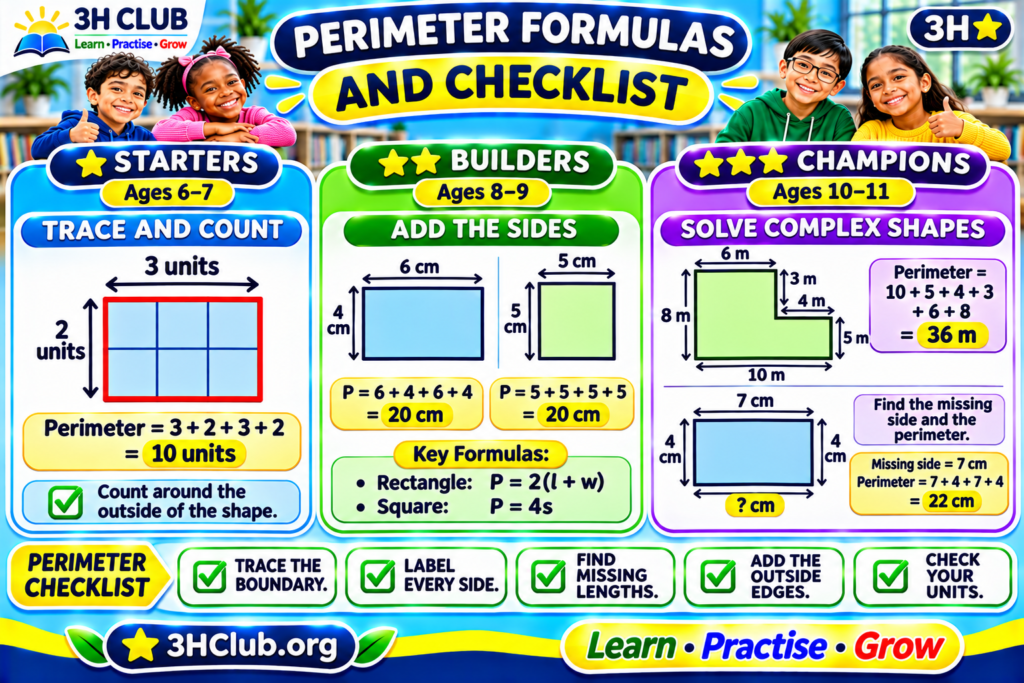
Now imagine a rectangle drawn on squared paper.
Its sides measure:
- Top: 4 units.
- Right: 2 units.
- Bottom: 4 units.
- Left: 2 units.
Add the distances:
4 + 2 + 4 + 2 = 12 units
The perimeter is 12 units.
✏️ Activity 2: Trace and Add
Find the perimeter of each shape.
- Square: 2, 2, 2, 2 units.
- Rectangle: 3, 2, 3, 2 units.
- Square: 4, 4, 4, 4 units.
- Rectangle: 5, 1, 5, 1 units.
- Triangle: 3, 3, 3 units.
Remember to count every side exactly once.
🟡 3. Count Perimeter Units on a Grid
A square grid can help you measure perimeter.
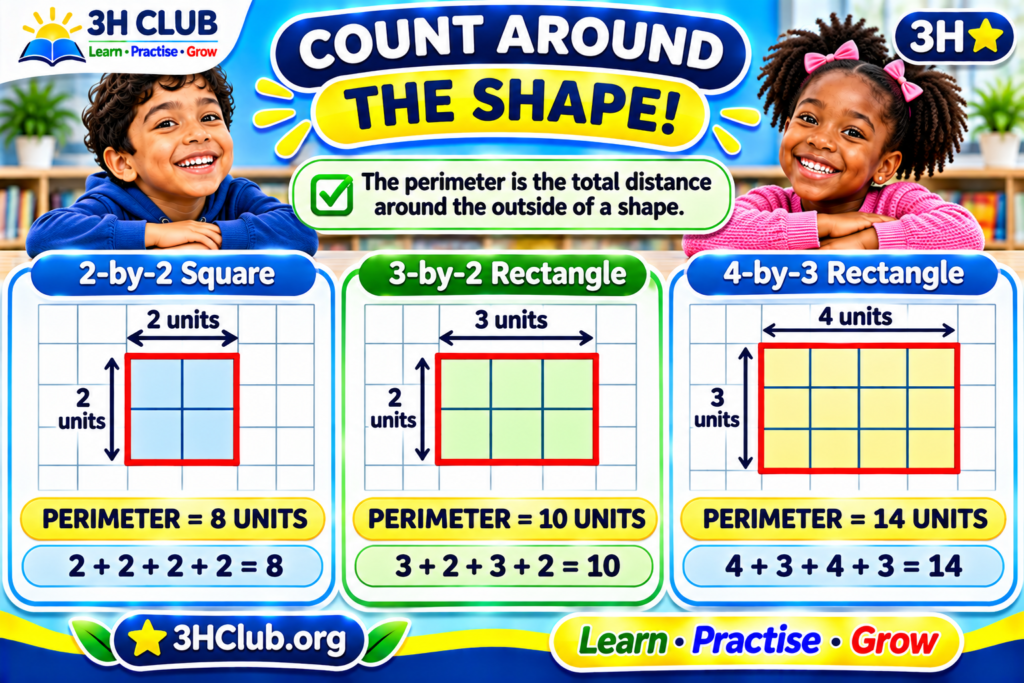
Suppose a rectangle is 3 grid units long and 2 grid units wide.
Walk around its edges:
3 + 2 + 3 + 2 = 10 units
Its perimeter is 10 units.
Notice that you count the grid lengths around the outside, not the squares inside.
✏️ Activity 3: Grid Perimeter Practice
Draw each rectangle on square grid paper. Each grid-square side is one unit long.
- 2 units by 2 units.
- 3 units by 2 units.
- 4 units by 2 units.
- 5 units by 3 units.
- 6 units by 1 unit.
Trace the outside boundary and count the units.
🟣 4. Compare Perimeters
Two shapes can have different perimeters.
Imagine two squares:
Square A: Each side is 2 units.
Perimeter:
2 + 2 + 2 + 2 = 8 units
Square B: Each side is 4 units.
Perimeter:
4 + 4 + 4 + 4 = 16 units
Square B has the greater perimeter.
✏️ Activity 4: Which Perimeter Is Greater?
Compare the measurements.
- 8 units and 12 units.
- 15 units and 10 units.
- 16 units and 16 units.
- 20 units and 18 units.
- 14 units and 22 units.
Use greater than, less than or equal to.
🟢 5. Make Shapes with the Same Perimeter
Different shapes can have the same perimeter.
A rectangle measuring 4 units by 2 units has perimeter:
4 + 2 + 4 + 2 = 12 units
A rectangle measuring 5 units by 1 unit has perimeter:
5 + 1 + 5 + 1 = 12 units
The shapes look different, but their perimeters are equal.
✏️ Activity 5: Build a Perimeter
Using squared paper:
- Draw a rectangle with perimeter 8 units.
- Draw a rectangle with perimeter 10 units.
- Draw two different rectangles with perimeter 12 units.
- Draw a square with perimeter 16 units.
- Explain how two different rectangles can have the same perimeter.
🎲 Starters Game: Perimeter Walk
Use a small toy figure and square grid paper.
Draw a rectangle, then move the toy along each outer grid edge.
Count one unit for every grid edge travelled.
⭐ Bonus: Try a different rectangle with the same perimeter.
⭐⭐ STAGE 2: BUILDERS — AGES 8–9
🧩 Calculate Perimeter Using Addition and Multiplication
🔵 6. Measure Perimeter in Length Units
Perimeter measures distance, so we use length units.
Common units include:
- Millimetres (mm).
- Centimetres (cm).
- Metres (m).
- Kilometres (km).
Choose a unit that suits the object.
| Object | Suitable Unit |
|---|---|
| Small sticker | mm or cm |
| Notebook cover | cm |
| Classroom | m |
| Garden | m |
| Long walking route | km |
Perimeter is measured in units such as cm or m, not square units.
✏️ Activity 6: Choose the Unit
Choose cm, m or km.
- Perimeter of a notebook.
- Perimeter of a small garden.
- Perimeter of a large park.
- Perimeter of a rectangular photograph.
- Distance around a very large nature reserve.
More than one unit may be reasonable if you explain your choice.
🟢 7. Find the Perimeter of a Rectangle
A rectangle has four right angles.
Its opposite sides are equal in length.
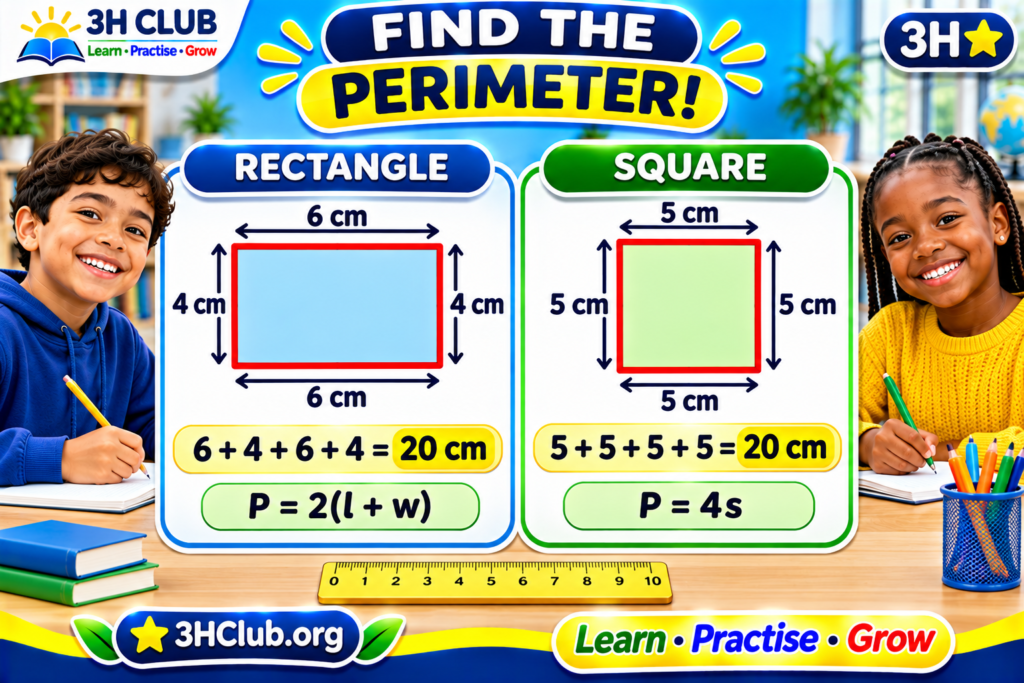
Suppose a rectangle is:
6 cm long
4 cm wide
Add all four sides:
6 + 4 + 6 + 4 = 20 cm
You can also use a shortcut.
📏 Rectangle Perimeter Formula
Perimeter = 2 × (length + width)
Or:
P = 2(l + w)
For our rectangle:
P = 2 × (6 + 4)
P = 2 × 10 = 20 cm
✏️ Activity 7: Rectangle Perimeter Practice
Find the perimeter.
- 4 cm × 3 cm.
- 7 cm × 2 cm.
- 8 cm × 5 cm.
- 10 cm × 6 cm.
- 12 cm × 4 cm.
- 15 cm × 9 cm.
Write every answer in centimetres.
🟡 8. Find the Perimeter of a Square
A square has four equal sides.
You can add the same side length four times.
Or use multiplication!
📏 Square Perimeter Formula
Perimeter = 4 × side length
Or:
P = 4s
Worked Example
A square has sides measuring 5 cm.
P = 4 × 5 = 20 cm
✏️ Activity 8: Square Perimeter Challenge
Find the perimeter of squares with side lengths:
- 2 cm.
- 4 cm.
- 6 cm.
- 7 cm.
- 9 cm.
- 12 cm.
🟣 9. Perimeter and Area Are Different
Perimeter and area describe different properties of a shape.
Perimeter measures the distance around the boundary.
Area measures the space inside.
Imagine a rectangular garden measuring 6 m by 4 m.
Perimeter
6 + 4 + 6 + 4 = 20 m
You would need 20 metres of fencing to surround the whole garden, ignoring any gaps or gates.
Area
6 × 4 = 24 m²
The garden covers 24 square metres of ground.
Remember
PERIMETER = AROUND
AREA = INSIDE
✏️ Activity 9: Perimeter or Area?
Choose the correct measurement.
- Ribbon around a picture frame.
- Carpet covering a bedroom floor.
- Fencing around a vegetable garden.
- Paint covering a flat wall.
- Border around a rectangular poster.
- Grass covering a lawn.
🔵 10. Find the Perimeter of Other Polygons
A polygon is a closed flat shape made from straight line segments.
To find its perimeter, add the lengths of all its sides.
Triangle Example
A triangle has sides measuring:
5 cm, 7 cm and 8 cm.
Perimeter:
5 + 7 + 8 = 20 cm
Regular Pentagon Example
A regular pentagon has five equal sides.
Each side measures 4 cm.
Perimeter:
5 × 4 = 20 cm
For any regular polygon:
Perimeter = number of sides × side length
✏️ Activity 10: Polygon Perimeters
Find the perimeter.
- Triangle: 3 cm, 4 cm, 5 cm.
- Triangle: 6 cm, 6 cm, 6 cm.
- Quadrilateral: 4 cm, 5 cm, 6 cm, 7 cm.
- Regular pentagon: each side 3 cm.
- Regular hexagon: each side 5 cm.
- Regular octagon: each side 4 cm.
🟢 11. Solve Real-Life Perimeter Problems
Example 1: A Garden Fence
A rectangular garden is 8 m long and 5 m wide.
Perimeter:
2 × (8 + 5) = 26 m
You would need 26 metres of fencing to surround it completely.
Example 2: Ribbon Around a Card
A rectangular card measures 30 cm by 20 cm.
Perimeter:
2 × (30 + 20) = 100 cm
You need 100 cm of ribbon for one complete border, before allowing extra for joins or decoration.
✏️ Activity 11: Everyday Perimeter
- A rectangular table measures 2 m by 1 m. Find its perimeter.
- A square flower bed has sides of 4 m. Find its perimeter.
- A rectangular playground measures 20 m by 12 m. Find its perimeter.
- A triangular sign has sides of 40 cm, 50 cm and 60 cm. Find its perimeter.
- A rectangular photograph measures 25 cm by 15 cm. Find its perimeter.
🟡 12. Design Shapes with a Fixed Perimeter
Sometimes you know the perimeter and need to find possible dimensions.
Suppose a rectangle has a perimeter of 24 cm.
Then:
2 × (length + width) = 24
So:
length + width = 12
Possible whole-number dimensions include:
- 1 cm × 11 cm.
- 2 cm × 10 cm.
- 3 cm × 9 cm.
- 4 cm × 8 cm.
- 5 cm × 7 cm.
- 6 cm × 6 cm.
Each has a perimeter of 24 cm.
✏️ Activity 12: Rectangle Designer
Find three different whole-number length-and-width pairs for rectangles with:
- Perimeter 16 cm.
- Perimeter 20 cm.
- Perimeter 28 cm.
Draw one rectangle from each set.
🎲 Builders Game: Perimeter Architect
Choose a target perimeter such as 20 cm.
Draw as many different rectangles with whole-number side lengths as possible.
Check each using:
P = 2(l + w)
⭐ Bonus: Which rectangle has the greatest area?
⭐⭐⭐ STAGE 3: CHAMPIONS — AGES 10–11
🏆 Master Missing Sides, Composite Shapes and Perimeter Problems
🔵 13. Find a Missing Side Length
You can use perimeter to calculate an unknown side.
Worked Example: Rectangle
A rectangle has a perimeter of 34 cm.
Its length is 10 cm.
Find its width.
Start with:
P = 2(l + w)
Substitute the values:
34 = 2(10 + w)
Divide by 2:
17 = 10 + w
Subtract 10:
w = 7 cm
Check:
10 + 7 + 10 + 7 = 34 cm
Worked Example: Square
A square has perimeter 48 cm.
All four sides are equal.
48 ÷ 4 = 12 cm
Each side is 12 cm.
✏️ Activity 13: Missing Measurement Challenge
Find the missing side.
- Rectangle: perimeter 30 cm, length 9 cm. Find the width.
- Rectangle: perimeter 44 cm, width 8 cm. Find the length.
- Rectangle: perimeter 60 cm, length 18 cm. Find the width.
- Square: perimeter 36 cm. Find the side length.
- Square: perimeter 100 cm. Find the side length.
- Equilateral triangle: perimeter 45 cm. Find each side length.
🟢 14. Calculate the Perimeter of Composite Shapes
A composite shape is formed by joining simpler shapes.
You might see an L-shaped garden, a stepped building plan or an irregular playground.
To find its perimeter:
- Trace the complete outside boundary.
- Identify every outside side.
- Find any missing side lengths.
- Add the outside lengths.
- Do not include internal dividing lines.
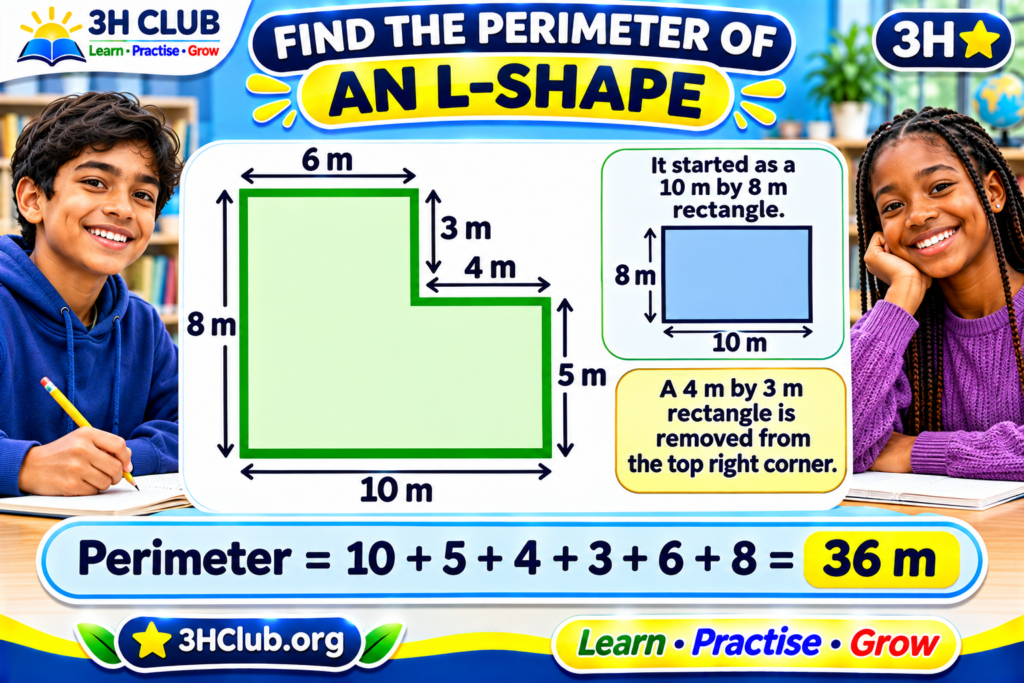
Worked Example: An L-Shaped Garden
Imagine an L-shaped garden made by removing a rectangular corner from a larger rectangle.
The large rectangle measures:
10 m wide and 8 m high
A rectangular corner measuring:
4 m wide and 3 m high
is removed from the top-right corner.
The outside boundary now has six segments:
- Bottom: 10 m.
- Right lower side: 5 m.
- Inner horizontal step: 4 m.
- Inner vertical step: 3 m.
- Top remaining side: 6 m.
- Left side: 8 m.
Add them:
10 + 5 + 4 + 3 + 6 + 8 = 36 m
The perimeter is 36 m.
Notice that removing this corner did not change the total perimeter of the original rectangle. The removed outer lengths were replaced by equal inner step lengths.
That is a useful pattern for this particular type of corner cut-out.
✏️ Activity 14: Composite Shape Challenge
Each question describes a rectangle with a smaller rectangular corner removed. Find the perimeter of the remaining L-shaped shape.
- Outer rectangle 8 cm × 6 cm; top-right corner removed is 3 cm × 2 cm.
- Outer rectangle 12 m × 9 m; top-right corner removed is 4 m × 3 m.
- Outer rectangle 15 cm × 10 cm; top-right corner removed is 5 cm × 4 cm.
- Outer rectangle 20 m × 12 m; top-right corner removed is 6 m × 5 m.
- Outer rectangle 14 cm × 8 cm; top-right corner removed is 2 cm × 3 cm.
Draw each L-shape and label all six outside edges before calculating.
🟡 15. Convert Perimeter Units
Sometimes a problem uses different length units.
You must convert them before adding.
Important Metric Conversions
10 mm = 1 cm
100 cm = 1 m
1,000 m = 1 km
Worked Example
A rectangle measures:
2 m long
50 cm wide
Convert 2 m to centimetres:
2 m = 200 cm
Now calculate:
P = 2 × (200 + 50)
P = 500 cm
Or:
P = 5 m
Both answers represent the same perimeter.
✏️ Activity 15: Convert and Calculate
- Convert 3 m to cm.
- Convert 450 cm to m.
- Convert 2.5 km to m.
- A rectangle is 1 m long and 40 cm wide. Find its perimeter in cm.
- A square has sides of 250 cm. Find its perimeter in metres.
- A rectangular field measures 0.5 km by 200 m. Find its perimeter in metres.
⭐ Champion Tip: Convert all side lengths into the same unit before calculating.
🟣 16. Investigate Perimeter and Area
Two rectangles can have the same perimeter but different areas.
Consider these rectangles.
Rectangle A: 8 cm × 2 cm.
Perimeter:
2 × (8 + 2) = 20 cm
Area:
8 × 2 = 16 cm²
Rectangle B: 6 cm × 4 cm.
Perimeter:
2 × (6 + 4) = 20 cm
Area:
6 × 4 = 24 cm²
Both have perimeter 20 cm, but their areas are different.
What About a Square?
A 5 cm × 5 cm square has:
Perimeter:
4 × 5 = 20 cm
Area:
5 × 5 = 25 cm²
Among rectangles with a fixed perimeter, a square gives the greatest area.
✏️ Activity 16: Same Perimeter, Different Area
Draw rectangles with whole-number side lengths and a perimeter of 24 cm.
- Find four different dimension pairs.
- Calculate the area of each.
- Identify which has the greatest area.
- Explain what you notice.
🔵 17. Find Missing Sides in Irregular Shapes
Sometimes you must use the shape’s total width or height to work out missing edges.
Imagine a step-shaped figure.
Its total width is 12 cm.
One horizontal section measures 7 cm.
The other horizontal section completing that width must be:
12 − 7 = 5 cm
Likewise, if the total height is 9 cm and one vertical section is 4 cm, the remaining section is:
9 − 4 = 5 cm
These missing lengths help you calculate the complete outside perimeter.
✏️ Activity 17: Missing Edges
Find the missing length.
- Total width 15 cm; one horizontal section 9 cm.
- Total height 12 m; one vertical section 5 m.
- Total width 20 cm; one horizontal section 13 cm.
- Total height 18 m; one vertical section 11 m.
- Total width 25 cm; one horizontal section 16 cm.
Assume the two sections together span the stated total width or height without overlapping.
🟢 18. Solve Real-Life Perimeter Problems
Example 1: A School Garden
A rectangular school garden measures 18 m by 12 m.
Perimeter:
2 × (18 + 12) = 60 m
If a 2 m wide gate replaces part of the fence, the length of fencing needed is:
60 − 2 = 58 m
Example 2: A Running Track
A rectangular walking route measures 80 m by 50 m.
One lap is:
2 × (80 + 50) = 260 m
Three laps cover:
3 × 260 = 780 m
Example 3: Decorative Border
A rectangular poster measures 45 cm by 30 cm.
Its perimeter is:
2 × (45 + 30) = 150 cm
If ribbon is sold in 1 m lengths, two pieces would provide enough ribbon in total, assuming they can be joined and no extra length is needed.
✏️ Activity 18: Real-Life Problem-Solving
- A rectangular garden is 14 m by 9 m. Find its perimeter.
- A square courtyard has sides of 11 m. Find its perimeter.
- A rectangular field measures 60 m by 35 m. How far is one lap around its boundary?
- A rectangular garden has perimeter 50 m and length 15 m. Find its width.
- A rectangular playground measures 25 m by 18 m. A 3 m gate replaces part of the boundary fence. How much fencing is needed?
- A runner completes four laps of a rectangular track measuring 40 m by 20 m. How far does the runner travel?
🟡 19. Explore Perimeter with Variables
A variable is a letter that represents a number.
Suppose a rectangle has:
Length = x + 3 cm
Width = x cm
Its perimeter is:
P = 2[(x + 3) + x]
Combine the terms:
P = 2(2x + 3)
So:
P = 4x + 6
If x = 5:
P = 4(5) + 6
P = 26 cm
This is an introduction to using algebra in geometry.
✏️ Activity 19: Perimeter with Variables
- A square has side length x cm. Write its perimeter in terms of x.
- A rectangle has length x + 2 cm and width x cm. Write its perimeter in terms of x.
- A rectangle has length 2x cm and width x cm. Write its perimeter in terms of x.
- If a square has side length x = 7 cm, find its perimeter.
- A rectangle has length x + 4 cm and width x cm. Find its perimeter when x = 6.
🟣 20. Avoid Common Perimeter Mistakes
Here are five mistakes to watch for.
Mistake 1: Confusing perimeter with area
Perimeter measures around a shape.
Area measures inside it.
Mistake 2: Forgetting a side
Make sure you’ve counted every outer edge.
Mistake 3: Adding an internal dividing line
For composite shapes, count only the outside boundary.
Mistake 4: Mixing units
Convert metres and centimetres to the same unit before adding.
Mistake 5: Using square units
Perimeter is a length. Write cm, m or another length unit, not cm² or m².
✏️ Activity 20: Correct the Mistake
Correct each statement.
- A rectangle measuring 6 cm by 4 cm has perimeter 24 cm.
- A square with sides of 5 cm has perimeter 25 cm.
- A triangle with sides 3 cm, 4 cm and 5 cm has perimeter 12 cm².
- A rectangle measuring 2 m by 50 cm has perimeter 104 cm.
- Perimeter measures the amount of space inside a shape.
🎲 FIVE FUN PERIMETER GAMES
🎯 Game 1: Trace the Boundary
Best for Starters
Draw shapes on grid paper.
Use a coloured pencil to trace their outside edges.
Count the units around each shape.
🧩 Game 2: Perimeter Match
Best for Builders
Make cards with dimensions and matching perimeters.
Examples:
3 cm × 4 cm ↔ 14 cm
5 cm × 6 cm ↔ 22 cm
7 cm × 2 cm ↔ 18 cm
Match the cards and explain each calculation.
🏡 Game 3: Design a Garden
Best for Builders
Draw a rectangular garden.
Label its length and width.
Calculate the fencing needed to surround it.
🔍 Game 4: Composite Shape Detective
Best for Champions
Draw an L-shaped figure on grid paper.
Label the outer edges.
Find missing side lengths.
Calculate its perimeter.
🏆 Game 5: Perimeter and Area Challenge
Best for Champions
Choose a perimeter such as 32 cm.
Draw several rectangles with that perimeter.
Calculate their areas.
Which rectangle covers the greatest area?
🏆 THE FINAL PERIMETER CHALLENGE
Choose your level or challenge yourself to try the next one!
⭐ Part A: Starters Challenge
- What does perimeter measure?
- A square has sides of 3 units. Find its perimeter.
- A rectangle has sides 4, 2, 4 and 2 units. Find its perimeter.
- Which perimeter is greater: 12 units or 16 units?
- Draw a rectangle with perimeter 10 units.
⭐⭐ Part B: Builders Challenge
- Find the perimeter of a rectangle measuring 9 cm by 5 cm.
- Find the perimeter of a square with sides of 8 cm.
- A triangle has sides of 7 cm, 9 cm and 10 cm. Find its perimeter.
- A rectangular garden measures 12 m by 7 m. How much fencing surrounds it completely?
- Explain the difference between perimeter and area.
⭐⭐⭐ Part C: Champions Challenge
- A rectangle has perimeter 54 cm and length 16 cm. Find its width.
- A square has perimeter 84 cm. Find its side length.
- A rectangle measuring 18 m by 12 m has a 5 m by 4 m corner removed. Find the perimeter of the remaining L-shape.
- A rectangle measures 2 m by 75 cm. Find its perimeter in centimetres.
- Two rectangles measure 8 cm by 4 cm and 9 cm by 3 cm. Compare their perimeters and areas.
- A rectangular field measures 40 m by 25 m. A 5 m gate replaces part of the fence. How much fencing is needed?
- A rectangle has length x + 5 cm and width x cm. Write an expression for its perimeter.
- Design two different rectangles with perimeter 36 cm and calculate their areas.
📝 CHECK YOUR ANSWERS!
⭐ Starters Answers
Activity 1
- Perimeter.
- Not perimeter.
- Perimeter.
- Not perimeter.
- Perimeter.
Activity 2
- 8 units.
- 10 units.
- 16 units.
- 12 units.
- 9 units.
Activity 3
- 8 units.
- 10 units.
- 12 units.
- 16 units.
- 14 units.
Activity 4
- 8 is less than 12.
- 15 is greater than 10.
- 16 is equal to 16.
- 20 is greater than 18.
- 14 is less than 22.
Activity 5
Possible answers:
- 2 units × 2 units.
- 3 units × 2 units.
- 4 units × 2 units and 5 units × 1 unit.
- Square with sides of 4 units.
- Different lengths and widths can add to the same total distance around the shape.
⭐⭐ Builders Answers
Activity 6: Choose the Unit
- cm.
- m.
- m or km, depending on the park.
- cm.
- km.
Activity 7: Rectangle Perimeter
- 14 cm.
- 18 cm.
- 26 cm.
- 32 cm.
- 32 cm.
- 48 cm.
Activity 8: Square Perimeter
- 8 cm.
- 16 cm.
- 24 cm.
- 28 cm.
- 36 cm.
- 48 cm.
Activity 9: Perimeter or Area?
- Perimeter.
- Area.
- Perimeter.
- Area.
- Perimeter.
- Area.
Activity 10: Polygon Perimeters
- 12 cm.
- 18 cm.
- 22 cm.
- 15 cm.
- 30 cm.
- 32 cm.
Activity 11: Everyday Perimeter
- 6 m.
- 16 m.
- 64 m.
- 150 cm.
- 80 cm.
Activity 12: Rectangle Designer
Possible whole-number dimension pairs:
Perimeter 16 cm: 1 × 7, 2 × 6, 3 × 5, 4 × 4.
Perimeter 20 cm: 1 × 9, 2 × 8, 3 × 7, 4 × 6, 5 × 5.
Perimeter 28 cm: 1 × 13, 2 × 12, 3 × 11, 4 × 10, 5 × 9, 6 × 8, 7 × 7.
Any three different valid pairs for each perimeter are correct.
⭐⭐⭐ Champions Answers
Activity 13: Missing Measurements
- 6 cm.
- 14 cm.
- 12 cm.
- 9 cm.
- 25 cm.
- 15 cm.
Activity 14: Composite Shapes
For these rectangular corner cut-outs, the perimeter remains equal to the perimeter of the original rectangle.
- 28 cm.
- 42 m.
- 50 cm.
- 64 m.
- 44 cm.
Activity 15: Unit Conversions
- 300 cm.
- 4.5 m.
- 2,500 m.
- 280 cm.
- 10 m.
- 1,400 m.
Activity 16: Same Perimeter, Different Area
Possible answers:
| Dimensions | Perimeter | Area |
|---|---|---|
| 2 cm × 10 cm | 24 cm | 20 cm² |
| 3 cm × 9 cm | 24 cm | 27 cm² |
| 4 cm × 8 cm | 24 cm | 32 cm² |
| 6 cm × 6 cm | 24 cm | 36 cm² |
The 6 cm × 6 cm square has the greatest area.
Activity 17: Missing Edges
- 6 cm.
- 7 m.
- 7 cm.
- 7 m.
- 9 cm.
Activity 18: Real-Life Problems
- 46 m.
- 44 m.
- 190 m.
- 10 m.
- 83 m of fencing.
- 480 m.
Activity 19: Variables
- 4x cm.
- 4x + 4 cm.
- 6x cm.
- 28 cm.
- 32 cm.
Activity 20: Correct the Mistake
- Correct perimeter = 20 cm.
- Correct perimeter = 20 cm.
- Correct perimeter = 12 cm, not 12 cm².
- Correct perimeter = 500 cm.
- Perimeter measures the distance around the outside boundary.
🏆 FINAL CHALLENGE ANSWERS
⭐ Starters
- The distance around the boundary of a flat shape.
- 12 units.
- 12 units.
- 16 units.
- Possible answer: rectangle measuring 3 units by 2 units.
⭐⭐ Builders
- 28 cm.
- 32 cm.
- 26 cm.
- 38 m.
- Perimeter measures around the boundary; area measures the space inside.
⭐⭐⭐ Champions
- 11 cm.
- 21 cm.
- 60 m.
- 550 cm.
- Both perimeters are 24 cm. Their areas are 32 cm² and 27 cm² respectively.
- 125 m of fencing.
- P = 4x + 10 cm.
- Possible answers: 10 cm × 8 cm, area 80 cm²; and 12 cm × 6 cm, area 72 cm². Both perimeters are 36 cm.
🎉 Excellent work, Perimeter Champion!
🌈 WHAT HAVE YOU LEARNT?
⭐ Starters
You discovered that:
- Perimeter is the distance around a shape.
- You can trace the boundary to find it.
- You can count units along the outside edges.
- Different shapes can have the same perimeter.
⭐⭐ Builders
You learnt that:
- Perimeter uses length units.
- Rectangle perimeter = 2 × (length + width).
- Square perimeter = 4 × side length.
- You can find the perimeter of any polygon by adding its side lengths.
- Perimeter and area measure different things.
⭐⭐⭐ Champions
You mastered:
- Missing side lengths.
- Composite-shape perimeters.
- Metric unit conversions.
- Real-life fencing and distance problems.
- Perimeter and area investigations.
- Simple algebraic perimeter expressions.
⭐ Your Perimeter Formula Summary
| Shape | Formula |
|---|---|
| Any polygon | Add all outside side lengths |
| Rectangle | P = 2(l + w) |
| Square | P = 4s |
| Equilateral triangle | P = 3s |
| Regular polygon | P = number of sides × side length |
| Composite shape | Add all outside boundary lengths |
🌟 KEEP LEARNING WITH 3HCLUB!
Now you know how to measure the distance around shapes.
You can use perimeter to design gardens, measure picture frames, calculate walking routes and solve geometry problems.
Remember:
TRACE the outside boundary.
MEASURE every side.
ADD the side lengths.
CHECK the units.
MAKE SURE your answer makes sense.
📚 Your Next Maths Adventures
- Shapes for Kids.
- Measurement for Kids.
- Addition for Kids.
- Multiplication for Kids.
- Division for Kids.
- Area for Kids.
- Angles for Kids.
- Factorization for Kids.
- Maths Symbols: Learn What the Signs Mean.
⭐ Your Perimeter Promise
I can explain what perimeter means.
I can count units around shapes.
I can calculate rectangle and square perimeters.
I can tell perimeter and area apart.
I can find missing side lengths.
I can measure composite shapes.
I can solve practical perimeter problems.
3H CLUB — Learn • Practise • Grow