Multiplication & Division
A Fun Guide for Kids
Have you ever shared sweets equally with friends, counted the wheels on a group of bicycles, or worked out how many pencils are in several boxes? You were already using multiplication and division!
Multiplication helps you find the total when you have equal groups. Division helps you share a quantity equally or find out how many groups you can make.
These two maths skills are connected. Once you understand one, you can use it to help solve the other.
In this guide, you’ll learn step by step, from making equal groups to solving bigger number problems. Start at your learning level, practise each skill and challenge yourself when you’re ready.
⭐ Starters — Ages 6–7: Equal Groups and Sharing
1. What Is Multiplication?
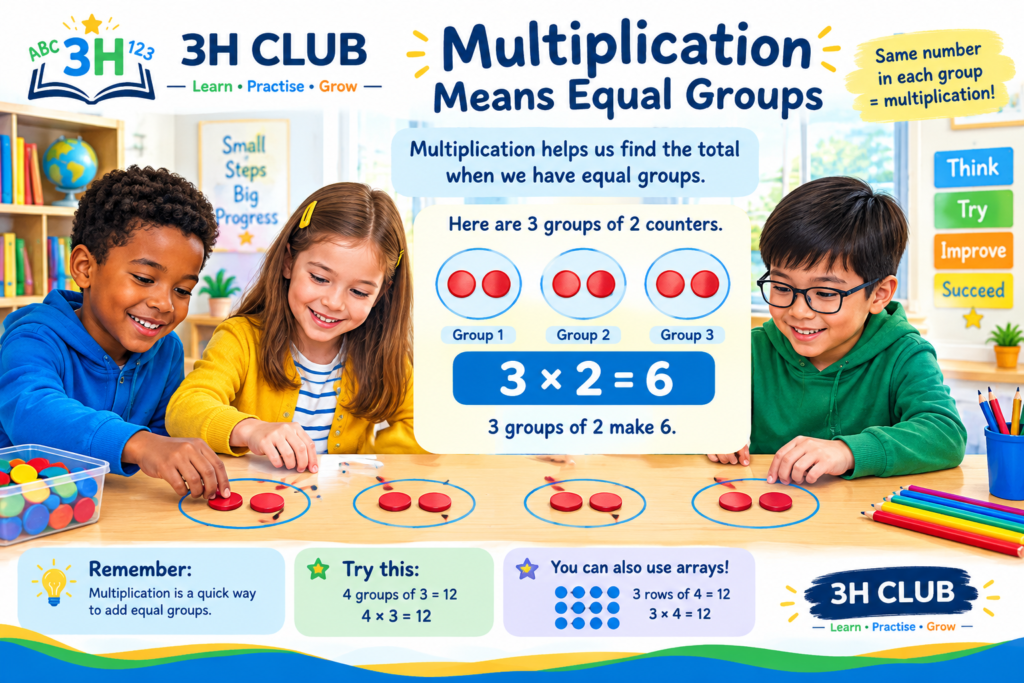
Multiplication is a quick way to add equal groups.
Imagine you have 3 plates, with 2 strawberries on each plate.
You could count all the strawberries:
2 + 2 + 2 = 6
Or you could multiply:
3 × 2 = 6
This means 3 groups of 2 make 6.
The multiplication sign is ×. We say it as “times”.
Here are some more examples:
- 2 groups of 3 make 6: 2 × 3 = 6
- 4 groups of 2 make 8: 4 × 2 = 8
- 3 groups of 4 make 12: 3 × 4 = 12
Multiplication is useful whenever groups have the same number of objects.
2. Arrays: Rows and Columns
An array is a neat arrangement of objects in rows and columns. Arrays help you see multiplication clearly.
Imagine 3 rows of 4 dots:
● ● ● ●
● ● ● ●
● ● ● ●
There are 3 rows, with 4 dots in each row.
So:
3 × 4 = 12
You can also count 4 columns of 3 dots. That gives:
4 × 3 = 12
Both calculations have the same answer.
Arrays make it easier to count larger groups without counting every object one by one.
3. What Is Division?
Division helps you share objects equally or split them into equal groups.
Imagine you have 8 biscuits to share between 2 friends. If each friend gets the same number, how many biscuits does each friend receive?
Share them one at a time:
- Give one biscuit to each friend.
- Keep sharing until all 8 biscuits are used.
- Each friend gets 4 biscuits.
We write this as:
8 ÷ 2 = 4
The division sign is ÷. We say it as “divided by”.
Here are more examples:
- 6 ÷ 2 = 3
- 10 ÷ 2 = 5
- 12 ÷ 3 = 4
Division helps us share fairly and count equal groups.
4. Sharing and Grouping
There are two useful ways to think about division.
Sharing: You know how many groups there are and want to find out how many objects go in each group.
Example: Share 12 crayons equally among 3 children.
12 ÷ 3 = 4
Each child gets 4 crayons.
Grouping: You know how many objects go in each group and want to find out how many groups you can make.
Example: You have 12 crayons and put 3 crayons in each pot.
12 ÷ 3 = 4
You can fill 4 pots.
Both problems use the same calculation, but the question you are answering is different.
5. Multiplication and Division Work Together
Multiplication and division are opposites. This means a multiplication fact can help you solve a division problem.
Look at this fact:
3 × 4 = 12
You can use it to find two division facts:
12 ÷ 3 = 4
12 ÷ 4 = 3
These related calculations are called a fact family.
Another example:
- 2 × 5 = 10
- 5 × 2 = 10
- 10 ÷ 2 = 5
- 10 ÷ 5 = 2
Learning multiplication facts can make division much easier.
6. Starters Practice
Try these questions. You can use counters, drawings or your fingers to help.
A. Multiplication
- There are 2 bags with 3 apples in each bag. How many apples are there altogether?
- What is 4 × 2?
- What is 3 × 5?
B. Division
- Share 8 sweets equally between 2 children. How many does each child get?
- What is 12 ÷ 3?
- You have 10 toy cars. Put 2 cars in each group. How many groups can you make?
C. Think about it
- If 4 × 3 = 12, what is 12 ÷ 4?
- Which calculation would help you find the total in 5 groups of 2?
Check your answers:
- 6 apples.
- 4 sweets each.
- 5 groups.
- 5 × 2 = 10.
⭐ Starters Challenge
You have 15 counters.
- First, arrange them into 3 equal groups. How many counters are in each group?
- Now arrange them into 5 equal groups. How many counters are in each group?
Answers:
- 15 ÷ 3 = 5 counters in each group.
- 15 ÷ 5 = 3 counters in each group.
Great work! You now know how multiplication builds equal groups and division shares them out.
⭐⭐ Builders — Ages 8–9: Times Tables and Division Facts
You’re ready to work with bigger numbers, learn useful times-table patterns and solve division problems with confidence.
1. Learn Your Multiplication Tables
Times tables help you calculate quickly without counting every object.
Here are some useful multiplication facts:
| × | 2 times table | 5 times table | 10 times table |
|---|---|---|---|
| 1 | 2 | 5 | 10 |
| 2 | 4 | 10 | 20 |
| 3 | 6 | 15 | 30 |
| 4 | 8 | 20 | 40 |
| 5 | 10 | 25 | 50 |
| 6 | 12 | 30 | 60 |
| 7 | 14 | 35 | 70 |
| 8 | 16 | 40 | 80 |
| 9 | 18 | 45 | 90 |
| 10 | 20 | 50 | 100 |
You do not need to learn every table in one day. Practice a few at a time, and return to the ones you find tricky.
2. Spot Times-Table Patterns
Patterns can make multiplication easier.
The 2 times table: The answers are even numbers.
2, 4, 6, 8, 10, 12, 14 …
The 5 times table: The answers end in 0 or 5.
5, 10, 15, 20, 25, 30 …
The 10 times table: The answers end in 0.
10, 20, 30, 40, 50, 60 …
The 4 times table: You can double a number, then double the answer.
For example, 4 × 6 means double 6, then double again:
6 doubled is 12.
12 doubled is 24.
So 4 × 6 = 24.
Finding patterns helps you work out facts you have not memorized yet.
3. Multiplication Can Be Switched Around
When you multiply two whole numbers, you can switch their order and still get the same answer.
For example:
3 × 6 = 18
6 × 3 = 18
This is called the commutative property of multiplication.
It means you can use the fact you remember best.
However, division does not work in the same way:
18 ÷ 3 = 6
But 3 ÷ 18 does not equal 6.
Be careful when switching numbers in a calculation!
4. Use Multiplication to Solve Division
If you know your times tables, division becomes easier.
Imagine you need to solve:
24 ÷ 6 = ?
Ask yourself: “Six times what makes 24?”
6 × 4 = 24
Therefore:
24 ÷ 6 = 4
Try another:
35 ÷ 5 = ?
Ask: “Five times what makes 35?”
5 × 7 = 35
Therefore:
35 ÷ 5 = 7
This method is especially helpful when the division has no remainder.
5. What Is a Remainder?
Sometimes a number cannot be divided into equal whole-number groups without anything left over.
That leftover amount is called a remainder.
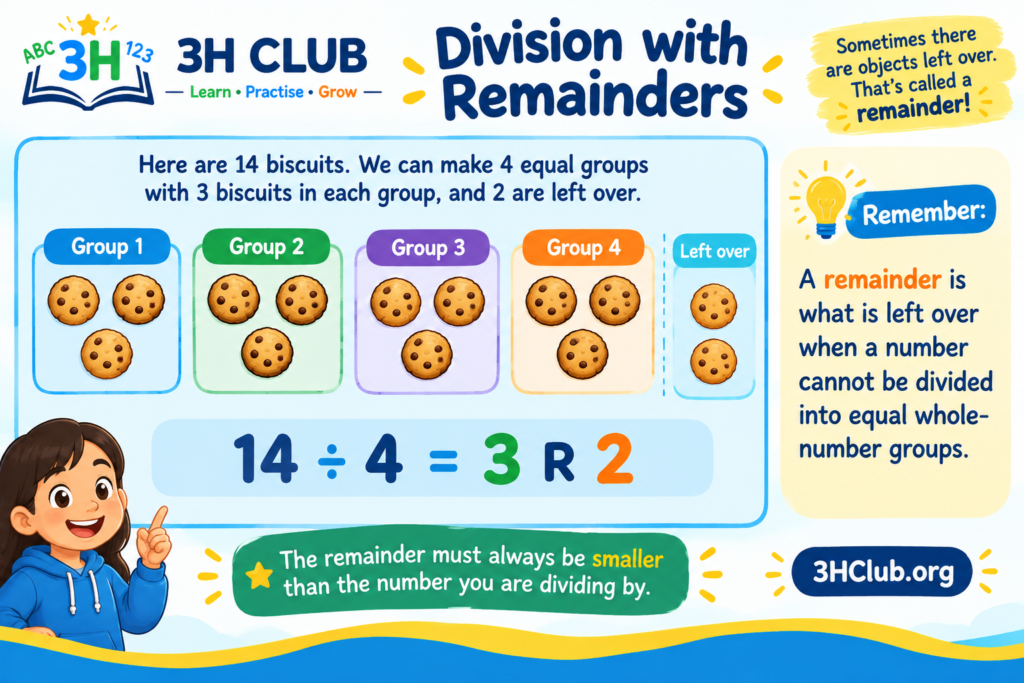
Imagine 14 biscuits shared among 4 children.
Each child can receive 3 biscuits:
4 × 3 = 12
There are 2 biscuits left.
We write:
14 ÷ 4 = 3 remainder 2
You may also see this written as 14 ÷ 4 = 3 R 2.
Check the answer:
4 groups of 3 make 12, and 2 are left over.
12 + 2 = 14
The remainder must be smaller than the number you are dividing by. In this example, the remainder is 2, which is smaller than 4.
6. Multiplying Bigger Numbers
You can use place value to multiply larger numbers.
Let’s calculate:
23 × 4
Split 23 into 20 and 3.
20 × 4 = 80
3 × 4 = 12
Now add the answers:
80 + 12 = 92
So:
23 × 4 = 92
This is called splitting a number into parts. It helps you understand what happens when you multiply a two-digit number.
Another example:
31 × 3
30 × 3 = 90
1 × 3 = 3
90 + 3 = 93
Therefore, 31 × 3 = 93.
7. Word Problems: Choose the Right Operation
Read a problem carefully before deciding whether to multiply or divide.
Example 1: Multiplication
A classroom has 6 tables. Each table has 4 chairs. How many chairs are there altogether?
6 × 4 = 24
There are 24 chairs.
Example 2: Division
A baker packs 36 rolls equally into 6 bags. How many rolls go in each bag?
36 ÷ 6 = 6
There are 6 rolls in each bag.
Example 3: Division with a remainder
A coach has 23 players and puts 5 players in each team. How many full teams can be made, and how many players are left?
5 × 4 = 20
23 − 20 = 3
The coach can make 4 full teams, with 3 players left over.
8. Builders Practice
A. Times tables
- 7 × 4 = ?
- 8 × 6 = ?
- 9 × 5 = ?
- 10 × 7 = ?
B. Division
- 42 ÷ 6 = ?
- 56 ÷ 8 = ?
- 32 ÷ 4 = ?
C. Remainders
- Calculate 17 ÷ 5. Give your answer with a remainder.
- Calculate 26 ÷ 4. Give your answer with a remainder.
D. Word problems
- There are 8 boxes with 6 books in each box. How many books are there altogether?
- Forty-five stickers are shared equally among 5 children. How many stickers does each child receive?
- A sports club has 29 players. If each team needs 4 players, how many full teams can be made, and how many players are left?
Check your answers:
-
- 3 remainder 2.
- 6 remainder 2.
- 48 books.
- 9 stickers each.
- 7 full teams, with 1 player left over.
⭐⭐ Builders Challenge
A school orders 7 packs of pencils. Each pack contains 24 pencils.
- How many pencils are there altogether?
- The school shares all the pencils equally among 6 classrooms. How many pencils does each classroom receive?
Answer:
First, multiply:
24 × 7 = 168 pencils.
Then divide:
168 ÷ 6 = 28 pencils.
Each classroom receives 28 pencils.
⭐⭐⭐ Champions — Ages 10–11: Bigger Calculations and Problem-Solving
Now you can use multiplication and division to tackle larger numbers, estimate answers and solve problems that need more than one step.
1. Multiply Two-Digit Numbers
You can multiply a two-digit number by another number by splitting it into tens and ones.
Let’s calculate:
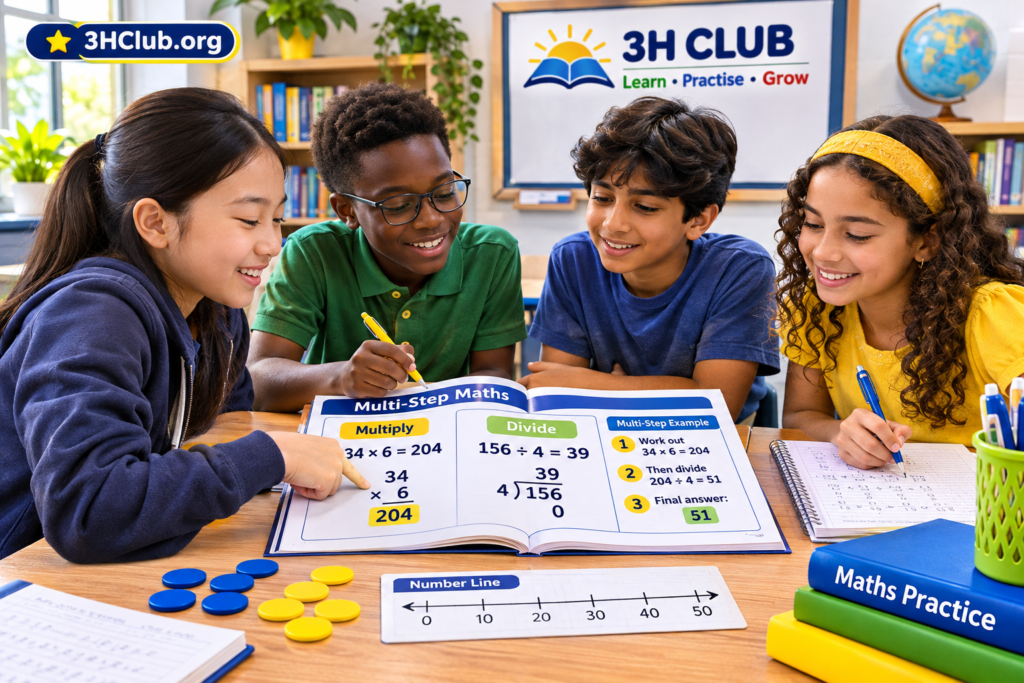
34 × 6
Split 34 into 30 and 4.
30 × 6 = 180
4 × 6 = 24
Add the two answers:
180 + 24 = 204
So:
34 × 6 = 204
This method is sometimes called the partitioning method.
You can also use a written column method. The important thing is to keep the tens and ones in the correct place.
2. A Written Method for Multiplication
Let’s work through 27 × 4.
First multiply the ones:
7 × 4 = 28
Write 8 in the ones place and carry 2 tens.
Next multiply the tens:
2 tens × 4 = 8 tens.
Add the 2 tens carried over:
8 tens + 2 tens = 10 tens.
That gives 108.
Therefore:
27 × 4 = 108
Always check the place value of each digit. Carrying or regrouping helps keep the calculation accurate.
3. Divide Larger Numbers
You can use multiplication facts to divide larger numbers, too.
Let’s solve:
156 ÷ 4
Break 156 into parts that are easy to divide:
- 120 ÷ 4 = 30
- 36 ÷ 4 = 9
Add the answers:
30 + 9 = 39
So:
156 ÷ 4 = 39
Check your result by multiplying:
39 × 4 = 156
The check works, so the answer is correct.
4. Understanding Long Division
Long division is a written method that helps you divide larger numbers step by step.
Let’s solve 168 ÷ 4.
- Divide 16 by 4. The answer is 4.
- Bring down the 8.
- Divide 8 by 4. The answer is 2.
The answer is:
168 ÷ 4 = 42
Check by multiplying:
42 × 4 = 168
When you use long division, keep each step lined up carefully. If a step leaves a remainder, carry it forward as you continue.
5. Estimation: Is Your Answer Reasonable?
Estimation means finding an answer that is close to the exact answer. It helps you check whether your calculation makes sense.
Suppose you need to calculate:
49 × 6
You can estimate by rounding 49 to 50:
50 × 6 = 300
The exact answer is:
49 × 6 = 294
The answer 294 is close to 300, so the estimate was useful.
Now consider:
198 ÷ 4
Round 198 to 200:
200 ÷ 4 = 50
The exact answer is 49 remainder 2, or 49.5 if expressed as a decimal.
The estimate of 50 helps you see that the answer is reasonable.
Remember: An estimate is not usually the exact answer. It is a quick way to check your work.
6. Multiplication and Division with Zero and One
Zero and one have special rules.
Multiplying by 1
Any number multiplied by 1 stays the same.
- 8 × 1 = 8
- 1 × 35 = 35
Multiplying by 0
Any number multiplied by 0 equals 0.
- 9 × 0 = 0
- 0 × 125 = 0
Dividing by 1
Any number divided by 1 stays the same.
- 12 ÷ 1 = 12
- 87 ÷ 1 = 87
Dividing zero by a non-zero number
Zero divided by a non-zero number equals zero.
- 0 ÷ 5 = 0
- 0 ÷ 12 = 0
But remember: you cannot divide by zero. Division by zero is undefined, so calculations such as 8 ÷ 0 do not have a valid answer.
7. Multiplication and Division in Everyday Life
These operations help you solve real problems.
Shopping: If one notebook costs $4 and you buy 6 notebooks, the total is 6 × $4 = $24.
Cooking: If a recipe uses 200 grams of flour and you make 3 batches, you need 3 × 200 = 600 grams.
Travel: If a bus travels 45 kilometres each hour for 3 hours at a constant speed, it travels 45 × 3 = 135 kilometres.
Sharing: If 96 books are divided equally among 8 shelves, each shelf holds 96 ÷ 8 = 12 books.
Choosing the correct operation is just as important as doing the calculation correctly.
8. Multi-Step Word Problems
Some problems need more than one calculation. Read the question carefully and work out which step to do first.
Example: A school trip
There are 4 buses. Each bus carries 36 children. The children are divided equally into 6 groups when they arrive.
How many children are there altogether, and how many children are in each group?
Step 1: Find the total number of children.
4 × 36 = 144
Step 2: Share the children into 6 equal groups.
144 ÷ 6 = 24
There are 144 children altogether, with 24 children in each group.
9. Champions Practice
Try these questions. Show your working so you can see how you reached each answer.
A. Multiplication
- 46 × 7 = ?
- 125 × 8 = ?
- 34 × 12 = ?
B. Division
- 252 ÷ 6 = ?
- 432 ÷ 8 = ?
- 197 ÷ 5 = ? Give your answer with a remainder.
C. Estimation and checking
- Estimate 61 × 5 by rounding 61 to the nearest ten. Then calculate the exact answer.
- A learner calculates 48 × 6 and gets 288. Is the answer correct? Show how you can check it.
D. Multi-step problems
- A shop receives 9 boxes of oranges. Each box contains 24 oranges. The shop sells 56 oranges. How many oranges remain?
- A teacher has 144 pencils. She puts 12 pencils in each pack. How many packs can she make?
- A sports club has 7 teams, with 18 players on each team. If all the players are divided equally into 9 training groups, how many players are in each group?
Check your answers:
-
- 1,000.
- 39 remainder 2.
- Estimate: 60 × 5 = 300. Exact answer: 61 × 5 = 305.
- Yes. 48 × 6 = 288, and 288 ÷ 6 = 48.
- 9 × 24 = 216; 216 − 56 = 160 oranges.
- 144 ÷ 12 = 12 packs.
- 7 × 18 = 126 players; 126 ÷ 9 = 14 players per group.
⭐⭐⭐ Champions Challenge
A community centre orders 18 packs of notebooks. Each pack contains 25 notebooks. The centre gives 96 notebooks to one school and shares the rest equally among 6 other schools.
- How many notebooks were ordered?
- How many notebooks remain after 96 are given away?
- How many notebooks does each of the 6 schools receive?
Answer:
Step 1: Calculate the total.
18 × 25 = 450 notebooks.
Step 2: Subtract the notebooks given away.
450 − 96 = 354 notebooks.
Step 3: Share the remaining notebooks equally.
354 ÷ 6 = 59 notebooks.
Each of the 6 schools receives 59 notebooks.
Well done! You have used multiplication, subtraction and division to solve a multi-step problem.
Multiplication and Division Quick Reference
| Skill | What it means | Example |
|---|---|---|
| Multiplication | Finding the total in equal groups | 4 × 3 = 12 |
| Division | Sharing or grouping equally | 12 ÷ 3 = 4 |
| Array | Objects arranged in rows and columns | 3 rows of 4 = 12 |
| Fact family | Related multiplication and division facts | 3 × 4 = 12; 12 ÷ 3 = 4 |
| Remainder | What is left after making equal whole-number groups | 14 ÷ 4 = 3 R 2 |
| Estimate | An answer close to the exact answer | 49 × 6 is about 50 × 6 = 300 |
| Product | The answer to a multiplication calculation | 5 × 6 = 30 |
| Quotient | The answer to a division calculation | 30 ÷ 5 = 6 |
Frequently Asked Questions
1. What is multiplication?
Multiplication is a way to find the total of equal groups. For example, 4 groups of 3 make 12, so 4 × 3 = 12.
2. What is division?
Division helps you split a quantity into equal groups or find out how many groups can be made. For example, 12 ÷ 3 = 4.
3. How are multiplication and division connected?
They are inverse operations. If 5 × 4 = 20, then 20 ÷ 5 = 4 and 20 ÷ 4 = 5.
4. What is a remainder?
A remainder is the amount left over when a number cannot be divided into equal whole-number groups. For example, 11 ÷ 3 = 3 remainder 2.
5. What is the easiest way to learn times tables?
Practice a few tables at a time. Use arrays, skip-counting, number patterns, flashcards and short practice sessions. Use a known multiplication fact to work out an unfamiliar one.
6. How can I check a division answer?
Multiply the quotient by the divisor. If there is a remainder, add it to the result. For example, 17 ÷ 5 = 3 remainder 2, and 3 × 5 + 2 = 17.
7. Can I divide by zero?
No. Division by zero is undefined. You can divide zero by a non-zero number, but you cannot divide a number by zero.
8. Where do we use multiplication and division in everyday life?
We use them when sharing objects, shopping, cooking, measuring, arranging items into groups, working with time and solving many other real-world problems.
Keep Practicing and Growing!
You have explored multiplication and division from simple equal groups to bigger calculations and multi-step challenges.
Keep practicing your times tables, drawing arrays, checking your division answers and explaining how you solved a problem. If a question feels difficult, break it into smaller steps and try again.
Every calculation you practice helps you build confidence and stronger maths skills!
Explore More on 3HClub.org
- Types of Numbers — explore number groups, patterns and properties.
- Maths Symbols: Learn What the Signs Mean — learn how to read and use important maths signs.
- Understanding Time: Seconds, Minutes, Hours, Days & Years — practise time and unit conversions.
More Maths Practice
- Khan Academy: Multiplication and Division — explore lessons and practice activities on multiplication, division and related facts.
- Math Is Fun: Division — learn about equal sharing, fact families and remainders.
- Math Is Fun: Basic Operations — review multiplication, division and other basic operations.
Keep asking questions, practicing and exploring. You’re building skills that will help you in maths and in everyday life!