Types of Numbers
A Fun Guide for Kids
Numbers are all around you! You use them to count your toys, share snacks, keep score in games, read the time and measure how far you travel.
But did you know that numbers can belong to different groups? Some numbers are even, some are odd, and others are prime, composite or square numbers. Each type has its own special rule.
In this guide, you’ll explore the different types of numbers step by step. Start with the basics, practise what you learn, and move on to bigger challenges when you’re ready!
⭐ Starters — Ages 6–7: Getting to Know Numbers
1. What Are Numbers?
Numbers help us describe how many things there are, how much something weighs, how long something takes or where something belongs in a sequence.
Look around you. You might see:
- 3 books on a table.
- 5 fingers on one hand.
- 7 days in a week.
- 12 months in a year.
Numbers help us make sense of the world.
2. Counting Numbers and Zero
When you count objects, you usually start with 1:
1, 2, 3, 4, 5, 6, 7, 8, 9, 10 …
These are called counting numbers.
But what if you have no apples in your basket? You can use zero (0) to show that there are none.
The numbers 0, 1, 2, 3, 4, 5 and so on are called whole numbers.
Remember:
- 0 means none.
- 1 means one.
- 2 means two.
- 3 means three.
Zero is a number, too!
3. Even Numbers
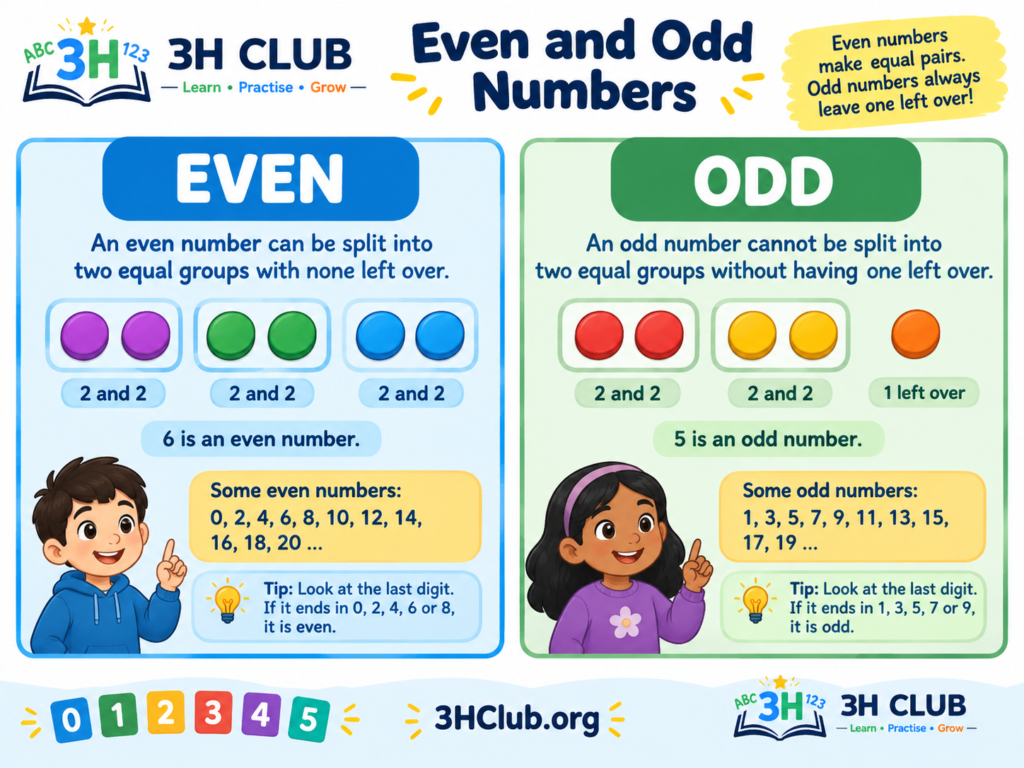
An even number can be split into two equal groups with none left over.
Imagine you have 6 counters. You can share them equally between two people, giving each person 3 counters.
That means 6 is an even number.
Some even numbers are:
0, 2, 4, 6, 8, 10, 12, 14, 16, 18, 20 …
A helpful trick is to look at the last digit. Whole numbers ending in 0, 2, 4, 6 or 8 are even.
Examples:
- 14 is even because it ends in 4.
- 28 is even because it ends in 8.
- 40 is even because it ends in 0.
4. Odd Numbers
An odd number cannot be split into two equal groups without having one left over.
Imagine you have 5 counters. You can give 2 counters to each of two people, but 1 counter remains.
That means 5 is an odd number.
Some odd numbers are:
1, 3, 5, 7, 9, 11, 13, 15, 17, 19 …
Whole numbers ending in 1, 3, 5, 7 or 9 are odd.
Examples:
- 13 is odd because it ends in 3.
- 27 is odd because it ends in 7.
- 35 is odd because it ends in 5.
5. Spot the Number Type!
Try these quick questions.
- Is 8 even or odd?
- Is 11 even or odd?
- Which number is even: 15 or 16?
- Which number is odd: 20 or 21?
- Is zero even or odd?
Check your answers:
- 8 is even.
- 11 is odd.
- 16 is even.
- 21 is odd.
- Zero is even.
⭐ Starters Challenge
Look at these numbers:
3, 4, 7, 10, 12, 15, 18, 21
Write them in two groups: even numbers and odd numbers.
Answer:
- Even: 4, 10, 12, 18
- Odd: 3, 7, 15, 21
Great work! You can now recognise even and odd numbers.
⭐⭐ Builders — Ages 8–9: Discovering Number Patterns
You already know how to spot even and odd numbers. Now let’s explore how numbers can be grouped using multiplication and division.
1. Factors: Numbers That Fit Exactly
A factor is a whole number that divides another whole number exactly, with no remainder.
Let’s look at the number 12.
You can make 12 using these multiplication facts:
- 1 × 12 = 12
- 2 × 6 = 12
- 3 × 4 = 12
The numbers 1, 2, 3, 4, 6 and 12 are all factors of 12.
We can write the factors of 12 like this:
Factors of 12: 1, 2, 3, 4, 6, 12
Try another example. The factors of 10 are:
1, 2, 5, 10
Each of these numbers divides 10 exactly.
2. Multiples: Numbers in a Times Table
A multiple is the answer you get when you multiply a number by a whole number.
For example, the multiples of 4 are:
4, 8, 12, 16, 20, 24, 28, 32 …
You find them by counting in fours or multiplying 4 by 1, 2, 3, 4 and so on.
The multiples of 5 are:
5, 10, 15, 20, 25, 30 …
Notice that 20 is a multiple of both 4 and 5.
Remember the difference:
- Factors divide a number exactly.
- Multiples are the numbers you reach when you multiply.
3. Prime Numbers
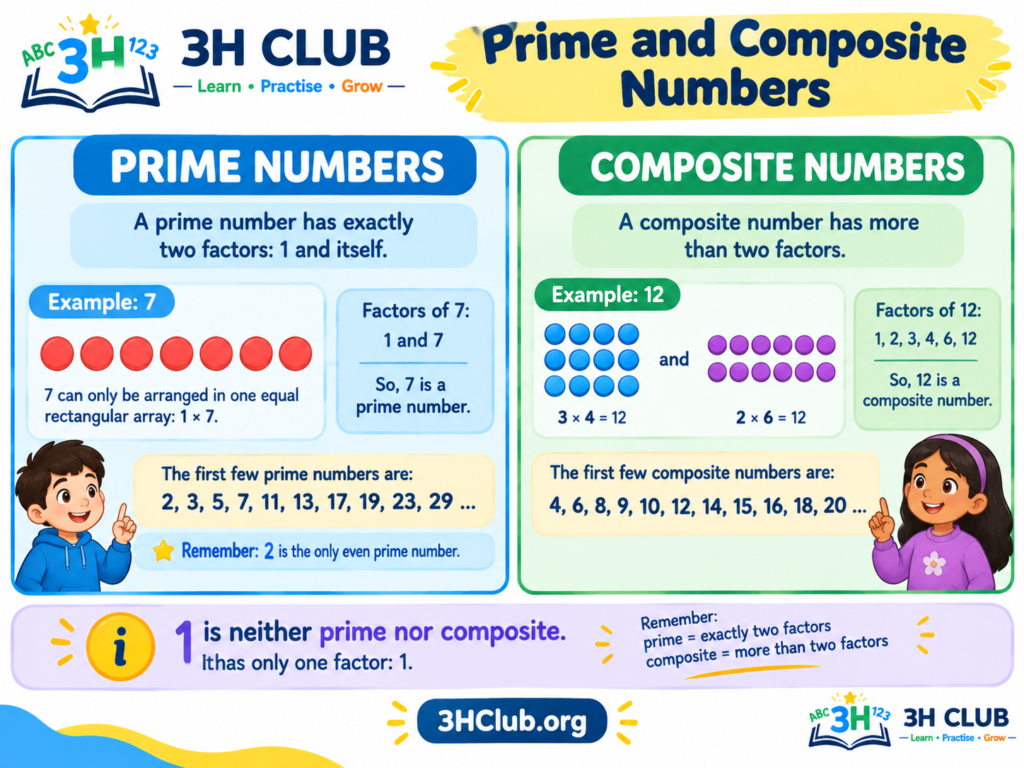
A prime number is a whole number greater than 1 that has exactly two factors: 1 and itself.
For example, 7 has just two factors:
1 and 7
That makes 7 a prime number.
The first few prime numbers are:
2, 3, 5, 7, 11, 13, 17, 19, 23, 29 …
Look carefully at the number 2. It is the only even prime number. Every other even number greater than 2 can be divided exactly by 2, so it has more than two factors.
What about 1? It has only one factor, so it is neither prime nor composite.
4. Composite Numbers
A composite number is a whole number greater than 1 that has more than two factors.
For example, 8 has these factors:
1, 2, 4, 8
It has four factors, so 8 is composite.
Other composite numbers include:
4, 6, 8, 9, 10, 12, 14, 15, 16, 18, 20 …
Let’s compare 5 and 6:
- 5 has factors 1 and 5 only. It is prime.
- 6 has factors 1, 2, 3 and 6. It is composite.
A number can be odd and composite, too! For example, 9 is odd, but its factors are 1, 3 and 9. That makes it composite.
5. Square Numbers
A square number is the answer you get when you multiply a whole number by itself.
For example:
- 1 × 1 = 1
- 2 × 2 = 4
- 3 × 3 = 9
- 4 × 4 = 16
- 5 × 5 = 25
So the square numbers begin:
1, 4, 9, 16, 25, 36, 49, 64, 81, 100 …
Why are they called square numbers? You can arrange that number of objects into a perfect square with the same number of rows and columns.
For example, 9 counters can be arranged in 3 rows of 3.
We can write this as 3 × 3 = 9, or 3² = 9. The small raised 2 means that 3 is multiplied by itself.
6. Triangular Numbers
Some numbers can be arranged in a triangle.
The first few triangular numbers are:
1, 3, 6, 10, 15, 21 …
Here is how they grow:
- 1 dot makes the first triangle.
- Add 2 dots to make 3.
- Add 3 more dots to make 6.
- Add 4 more dots to make 10.
Each time, you add the next counting number.
Triangular numbers are a fun way to explore patterns using dots, counters or drawings.
7. Builders Practice
A. Factors and multiples
- Write all the factors of 8.
- Write the first five positive multiples of 3.
- Is 15 a multiple of 5?
B. Prime and composite numbers
- Is 11 prime or composite?
- Is 12 prime or composite?
- Is 1 prime, composite or neither?
C. Special number patterns
- Is 16 a square number?
- What is the next square number after 25?
- What is the next triangular number after 10?
Check your answers:
- 1, 2, 4, 8.
- 3, 6, 9, 12, 15.
- Yes, because 5 × 3 = 15.
- Prime.
- Composite.
- Neither.
- Yes, because 4 × 4 = 16.
- 36, because 6 × 6 = 36.
- 15, because 10 + 5 = 15.
⭐⭐ Builders Challenge
Sort these numbers into the groups that fit them:
2, 9, 11, 16, 25, 27, 36
Find the even numbers, prime numbers, composite numbers and square numbers. Some numbers belong in more than one group.
Answer:
- Even: 2, 16, 36
- Prime: 2, 11
- Composite: 9, 16, 25, 27, 36
- Square: 9, 16, 25, 36
Did you notice that 2 is both even and prime? And 36 is both even, composite and a square number? Number types are not always separate groups.
⭐⭐⭐ Champions — Ages 10–11: Exploring Number Properties
Ready for a deeper challenge? You’ve learnt how to recognise number types. Now you can use their properties to solve problems, explain patterns and make connections.
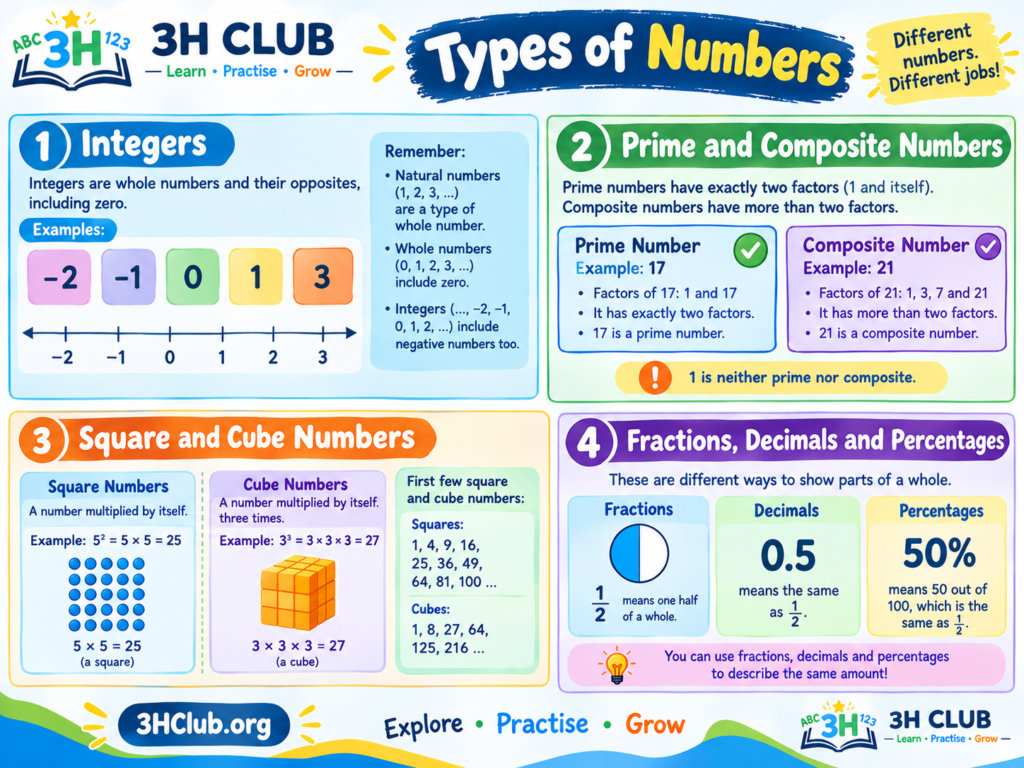
1. Natural Numbers, Whole Numbers and Integers
Different maths topics use different groups of numbers.
Natural numbers are the counting numbers:
1, 2, 3, 4, 5, …
In many school maths contexts, whole numbers include zero as well as the counting numbers:
0, 1, 2, 3, 4, 5, …
Integers include positive whole numbers, zero and negative whole numbers:
…, −3, −2, −1, 0, 1, 2, 3, …
Negative numbers are useful when describing temperatures below zero, money owed or floors below ground level.
For example, −3 is less than −1 because it is farther to the left on a number line.
A quick way to remember:
- Natural numbers: counting numbers starting at 1.
- Whole numbers: zero and the counting numbers.
- Integers: whole numbers and their negative partners.
Some textbooks use slightly different conventions for the term natural numbers, so always follow the definition given in your lesson.
2. Prime and Composite Numbers: Look at the Factors
Prime and composite numbers are classified by their factors, not by whether they are odd or even.
A prime number greater than 1 has exactly two factors. A composite number greater than 1 has more than two.
Consider 17:
- 1 × 17 = 17
- No other pair of whole numbers greater than 1 makes 17.
So 17 is prime.
Now consider 21:
- 1 × 21 = 21
- 3 × 7 = 21
The factors of 21 are 1, 3, 7 and 21. Therefore, 21 is composite.
Prime numbers from 1 to 30:
2, 3, 5, 7, 11, 13, 17, 19, 23, 29
Every other whole number from 2 to 30 is composite.
Remember two important facts:
- 1 is neither prime nor composite.
- 2 is the only even prime number.
3. How to Test Whether a Number Is Prime
You do not need to try every possible factor when checking larger numbers. Start with small prime numbers and use what you know.
Let’s test 29.
- It is not divisible by 2 because it is odd.
- It is not divisible by 3 because its digits add to 11, and 11 is not divisible by 3.
- It is not divisible by 5 because it does not end in 0 or 5.
- It is not divisible by 7 because 7 × 4 = 28, leaving 1.
No prime number up to the square root of 29 divides it exactly, so 29 is prime.
For numbers you meet at this level, you can often begin by checking divisibility by 2, 3 and 5, then investigate other possible factors.
4. Square Numbers and Cube Numbers
Square numbers come from multiplying a number by itself:
- 4² = 4 × 4 = 16
- 7² = 7 × 7 = 49
- 10² = 10 × 10 = 100
Cube numbers come from multiplying a number by itself three times:
- 2³ = 2 × 2 × 2 = 8
- 3³ = 3 × 3 × 3 = 27
- 4³ = 4 × 4 × 4 = 64
- 5³ = 5 × 5 × 5 = 125
The first few positive square numbers are:
1, 4, 9, 16, 25, 36, 49, 64, 81, 100 …
The first few positive cube numbers are:
1, 8, 27, 64, 125, 216 …
Notice that 64 is both a square number and a cube number:
8 × 8 = 64
and
4 × 4 × 4 = 64
A number can belong to several types at once.
5. Fractions, Decimals and Percentages
Not every number you use is a whole number. Fractions, decimals and percentages can represent parts of a whole.
Fractions show equal parts of a whole. For example, ¾ means three out of four equal parts.
Decimals use a decimal point to show parts of a whole. For example, 0.5 means one half.
Percentages describe an amount out of 100. For example, 50% means 50 out of 100, which is equal to one half.
These three representations can describe the same amount:
½ = 0.5 = 50%
You will use these number forms when working with money, measurements, scores, discounts and data.
6. Rational and Irrational Numbers: A First Look
A rational number can be written as a fraction of two integers, with a denominator that is not zero.
Examples include:
- ½
- ¾
- 5, which can be written as 5/1
- 0.25, which can be written as ¼
An irrational number cannot be written exactly as a fraction of two integers. Its decimal digits continue without ending or settling into a repeating pattern.
For example, π (pi) is approximately 3.14159, but its decimal expansion continues without repeating in a fixed pattern.
You may also meet √2, which is irrational. By contrast, √9 = 3, which is rational.
These ideas are a first introduction to a bigger number system. You do not need to master every detail yet; the important thing is to recognize that numbers can be described in different ways.
7. Champions Practice
A. Number groups
- Is −4 a whole number, an integer, or both?
- Is 31 prime or composite?
- Why is 1 neither prime nor composite?
B. Square and cube numbers
- Calculate 9².
- Calculate 3³.
- Give one number that is both a square number and a cube number.
C. Number representations
- Write ¾ as a decimal.
- Write 25% as a fraction in its simplest form.
- Is 0.5 rational or irrational? Explain.
D. Think carefully
- Can an odd number be composite? Give an example.
- Can a number be even, composite and a square number at the same time? Give an example.
- Explain the difference between a factor and a multiple.
Check your answers:
- −4 is an integer, but it is not a whole number under the definition used in this article.
- 31 is prime; its only positive factors are 1 and 31.
- It has only one positive factor, while prime numbers have exactly two and composite numbers have more than two.
- 64 is both a square and a cube number.
- 0.75.
- ¼.
- Rational, because 0.5 = ½.
- Yes. For example, 9 is odd and composite because its factors are 1, 3 and 9.
- Yes. For example, 16 is even, composite and a square number because 4 × 4 = 16.
- A factor divides a number exactly; a multiple is the result of multiplying a number by a whole number.
⭐⭐⭐ Champions Challenge
A number is greater than 1 and less than 30. It is odd, composite and a square number.
Which number is it?
Answer: 9. It is odd, its factors are 1, 3 and 9, and it is a square number because 3 × 3 = 9.
Now try this one: Find a number below 100 that is both a square number and a cube number.
Answer: 64, because 8 × 8 = 64 and 4 × 4 × 4 = 64. (1 is also a square and cube number if you include it.)
Quick Number Types Reference
| Number type | What it means | Examples |
|---|---|---|
| Natural number | Counting number, starting at 1 in this article | 1, 2, 3, 4 |
| Whole number | Zero and positive counting numbers | 0, 1, 2, 3 |
| Integer | Positive and negative whole numbers, including zero | −2, −1, 0, 1, 2 |
| Even number | Divisible by 2 with no remainder | 0, 2, 4, 6 |
| Odd number | Not divisible by 2 with no remainder | 1, 3, 5, 7 |
| Prime number | A whole number greater than 1 with exactly two positive factors | 2, 3, 5, 7 |
| Composite number | A whole number greater than 1 with more than two positive factors | 4, 6, 8, 9 |
| Square number | A number made by multiplying a whole number by itself | 1, 4, 9, 16 |
| Cube number | A number made by multiplying a whole number by itself three times | 1, 8, 27, 64 |
| Fraction | A way to represent part of a whole or a ratio | ½, ¾ |
| Decimal | A number written using a decimal point | 0.5, 1.25 |
| Percentage | An amount out of 100 | 25%, 50% |
Remember: these groups can overlap. For example, 16 is even, composite and a square number.
Frequently Asked Questions About Types of Numbers
1. What are the main types of numbers children learn first?
Children often begin with counting and whole numbers, then learn even and odd numbers. As they progress, they explore factors, multiples, prime and composite numbers, square numbers and other number patterns.
2. What is the difference between even and odd numbers?
Even numbers can be divided by 2 without a remainder. Odd numbers leave a remainder of 1 when divided by 2. For whole numbers, an even number ends in 0, 2, 4, 6 or 8; an odd number ends in 1, 3, 5, 7 or 9.
3. What is the difference between prime and composite numbers?
A prime number greater than 1 has exactly two positive factors: 1 and itself. A composite number greater than 1 has more than two positive factors.
4. Is 1 a prime number?
No. The number 1 has only one positive factor, so it is neither prime nor composite.
5. Is 2 a prime number?
Yes. The factors of 2 are 1 and 2, so it is prime. It is also the only even prime number.
6. Can a number belong to more than one type?
Yes! For example, 9 is odd, composite and a square number. The number 36 is even, composite and a square number.
7. What is the difference between a factor and a multiple?
A factor divides a number exactly. A multiple is found by multiplying a number by a whole number. For example, 3 is a factor of 12, while 12 is a multiple of 3.
8. Why are number types useful?
They help you notice patterns, calculate more efficiently, understand multiplication and division, and solve problems in areas such as fractions, measurements and data.