Subject & Predicate for Kids
A Simple Guide to the Two Main Parts of a Sentence
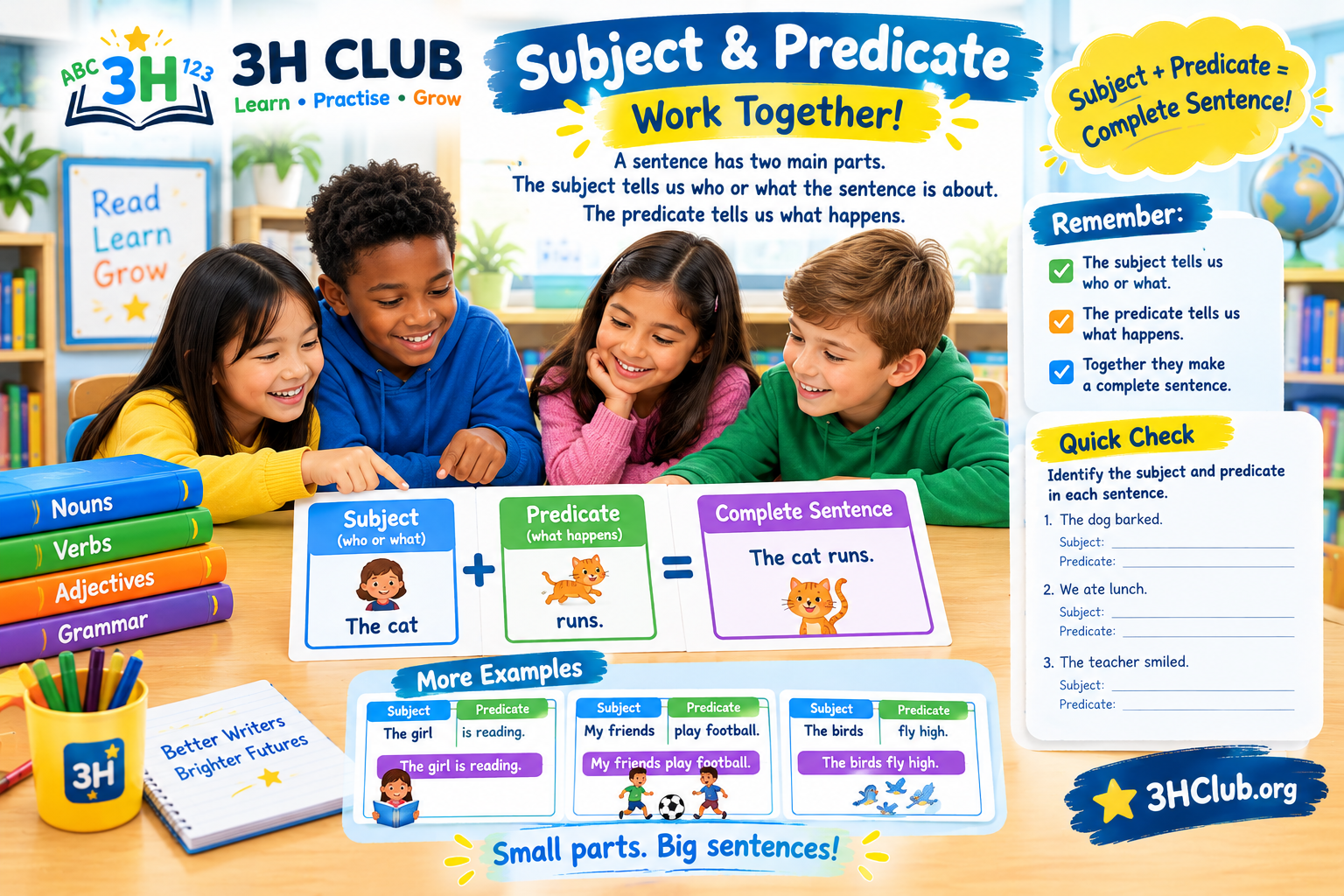
Every complete sentence has a job to do.
It tells us who or what we are talking about and what that person, animal, place, or thing is doing, being, or having.
That is where the subject and predicate come in.
Look at this sentence:
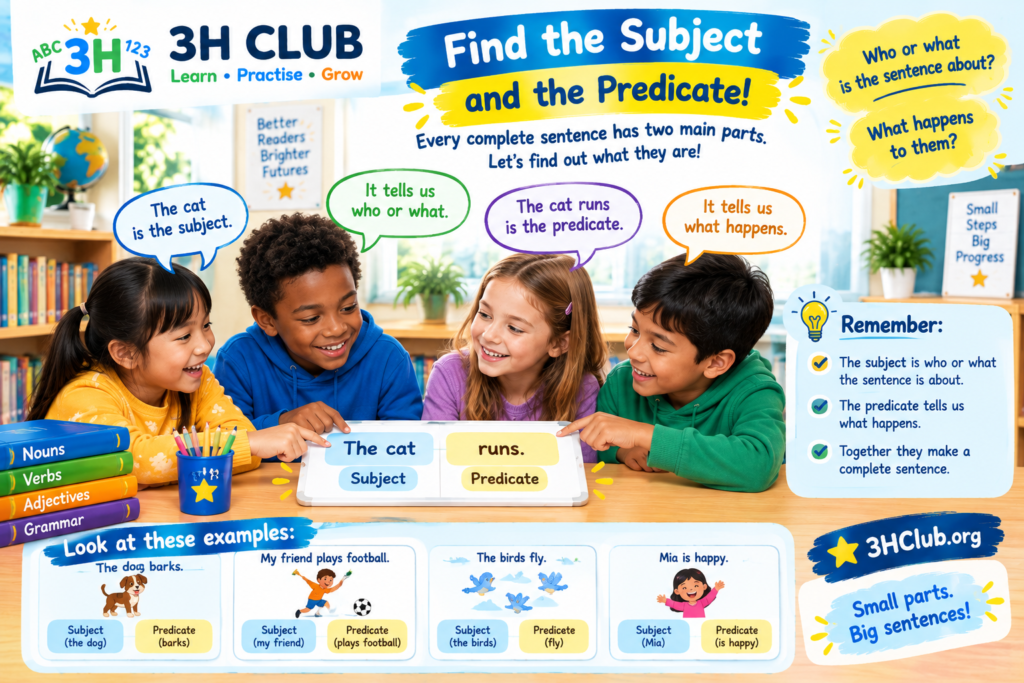
The dog barked.
🐶 The dog = the subject
🔊 barked = the predicate
Put them together and you have a complete thought!
In this guide, you’ll learn how to spot subjects and predicates, build your own sentences, and become more confident at checking how sentences work.
🔎 Quick Answer
What is a subject?
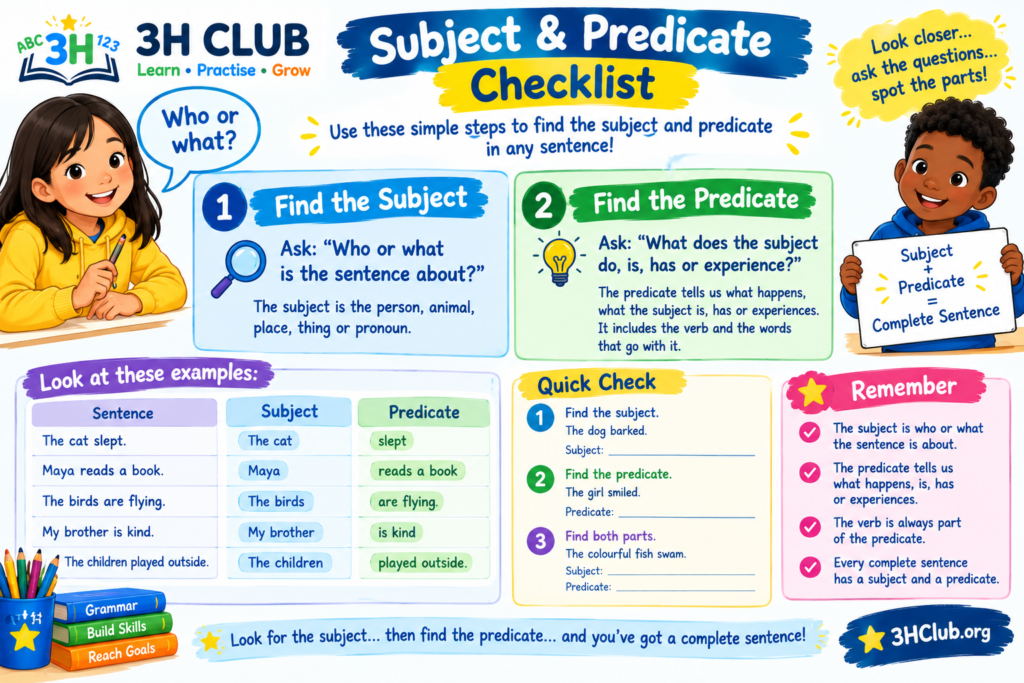
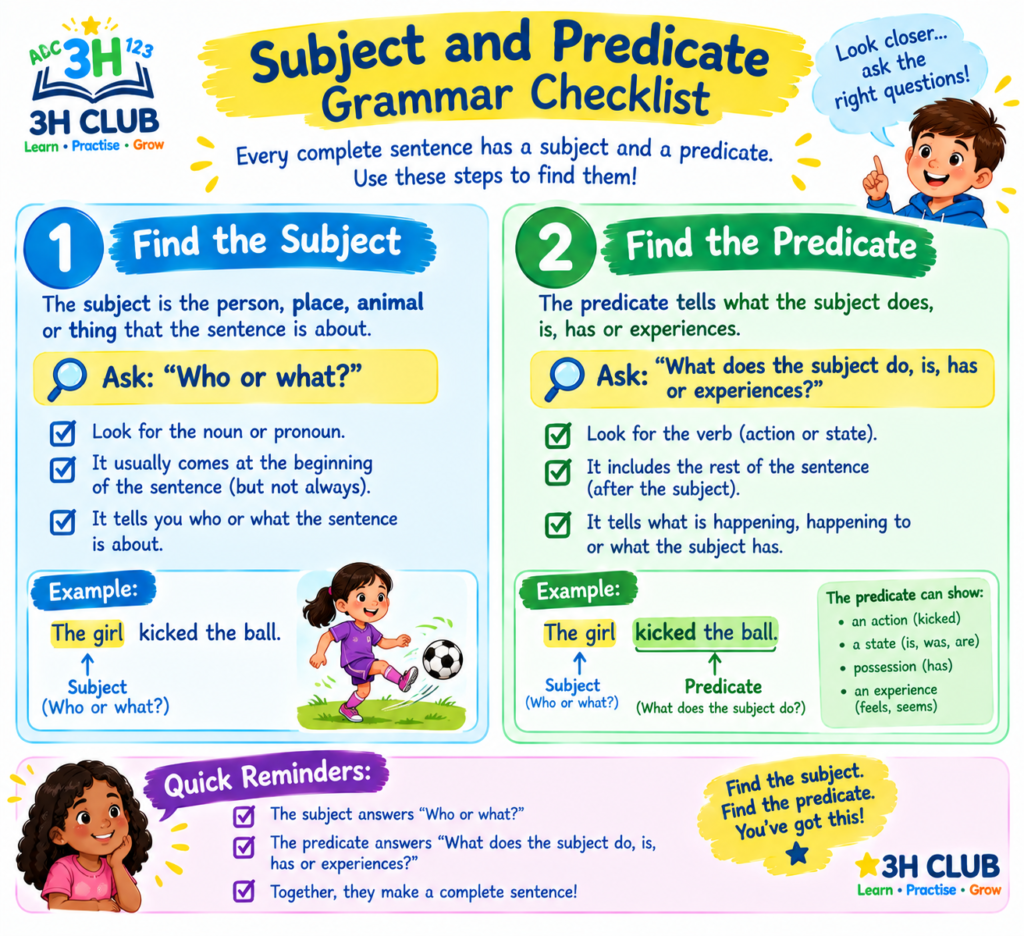
The subject is the person, animal, place, thing, or pronoun that the sentence is about.
What is a predicate?
The predicate tells us what the subject does, is, has, or experiences. It includes the verb and the words that go with it.
For example:
Maya reads a book.
👧 Maya = subject
📖 reads a book = predicate
A useful way to remember it is:
SUBJECT + PREDICATE = COMPLETE SENTENCE Khan Academy
👀 Try This
Read this sentence:
The children played outside.
Ask yourself:
Who or what is the sentence about?
👉 The children.
That is the subject.
Now ask:
What did the children do?
👉 played outside.
That is the predicate.
Great! You have found both parts.
🧩 A Sentence Has Two Main Parts
Think of a sentence like a team.
The subject introduces the person, animal, thing, or idea.
The predicate tells us what happens.
| Subject | Predicate |
|---|---|
| The cat | jumped. |
| My brother | laughed loudly. |
| The birds | flew across the sky. |
| Sofia | is happy. |
| Our class | learned a new rule. |
Notice that the predicate does not always describe an action.
In:
Sofia is happy.
Sofia is the subject.
is happy is the predicate.
The verb is tells us about Sofia’s state rather than an action. Khan Academy
⭐ Starters — Ages 6–7
Let’s Find the Subject!
Around ages 6–7
Ready to become a sentence detective?
Let’s start with the easiest question:
Who or what is the sentence about?
The answer is usually the subject.
Look at:
The rabbit hops.
Who is the sentence about?
🐰 The rabbit!
So:
The rabbit = subject
Now look at:
The rabbit hops.
What does the rabbit do?
👉 hops
So:
hops = predicate
⭐ Remember
Subject = who or what
Predicate = what happens
🐶 Find the Subject
Look at these sentences.
1. The dog runs.
Who runs?
👉 The dog
2. The baby smiles.
Who smiles?
👉 The baby
3. The birds fly.
What flies?
👉 The birds
4. My teacher talks.
Who talks?
👉 My teacher
The subject can be one word or several words.
For example:
The little dog barked.
The whole subject is The little dog.
🏃 Find the Predicate
Now let’s look at the other part.
The dog runs.
What does the dog do?
👉 runs
So runs is the predicate.
Try these:
| Sentence | Predicate |
|---|---|
| The cat sleeps. | sleeps |
| Ben laughs. | laughs |
| The birds fly. | fly |
| My sister sings. | sings |
| The baby smiles. | smiles |
🔵 Subject or Predicate?
Let’s play a quick sorting game!
Is the bold part the subject or the predicate?
1. The rabbit jumps.
👉 Subject
2. The rabbit jumps.
👉 Predicate
3. My friend smiled.
👉 Subject
4. My friend smiled.
👉 Predicate
5. The colorful birds flew away.
👉 Subject
6. The colorful birds flew away.
👉 Predicate
Well done!
🧱 Build a Sentence
A sentence needs its two main parts.
Try putting these together:
The boy + kicked the ball.
The boy kicked the ball.
Now try:
The cat + sat on the mat.
The cat sat on the mat.
And:
The children + laughed together.
The children laughed together.
You just built complete sentences!
🎯 Starters Activity: Find the Subject and Predicate
1. Find the subject.
The bird sang.
A. bird
B. sang
C. the
2. Find the predicate.
The girl smiled.
A. girl
B. smiled
C. the
3. Find both parts.
The puppy chased the ball.
Subject: __________
Predicate: __________
4. Find both parts.
My brother plays football.
Subject: __________
Predicate: __________
5. Find both parts.
The flowers are beautiful.
Subject: __________
Predicate: __________
✏️ Your Turn
Write one sentence of your own.
Subject: ____________________
Predicate: ____________________
Full sentence: __________________________________
✅ Check Your Answers
- bird
- smiled
- Subject: The puppy — Predicate: chased the ball
- Subject: My brother — Predicate: plays football
- Subject: The flowers — Predicate: are beautiful
For Question 6, your answer can be different from everyone else’s. That’s the fun of writing!
⭐ Starters Tip
When you’re trying to find the subject, ask:
“Who or what is this sentence about?”
Then ask:
“What is that subject doing, being, or experiencing?”
That will often lead you straight to the predicate.
⭐⭐ Builders — Ages 8–9
Discover How Subjects and Predicates Work
Around ages 8–9
You already know that a sentence has a subject and a predicate.
Now let’s look more closely at how they work.
Consider:
The clever fox jumped over the fence.
The subject is:
The clever fox
The predicate is:
jumped over the fence
The predicate contains the verb jumped and the other words that complete the idea.
So don’t always look for just one word.
A subject or predicate can be a group of words.
🔤 The Complete Subject
The complete subject includes all the words that tell us who or what the sentence is about.
Look at:
The small brown dog barked loudly.
The complete subject is:
👉 The small brown dog
The main word in that subject is dog.
But the words the, small, and brown help describe which dog we mean.
🔊 The Complete Predicate
The complete predicate includes the verb and all the words that tell us what the subject does, is, or experiences.
Look at:
The small brown dog barked loudly at the gate.
The complete predicate is:
👉 barked loudly at the gate
The main verb is:
👉 barked
The other words give us more information.
🔍 Main Subject and Main Verb
Sometimes a sentence contains lots of words, but you can still find the important parts.
Look at:
The excited children in our class cheered for their team.
The main subject is:
👉 children
The main verb is:
👉 cheered
The complete subject is:
👉 The excited children in our class
The complete predicate is:
👉 cheered for their team
This is useful when sentences become longer.
🧠 Watch Out for Other Nouns
A sentence can contain more than one noun.
That does not mean every noun is the subject.
Look at:
Maya opened the window.
There are two nouns:
- Maya
- window
But which one is doing the action?
👉 Maya.
So:
Maya = subject
opened the window = predicate
window is part of the predicate. It is not the subject.
A noun can appear in different parts of a sentence, so look at the job it is doing.
🔗 Subject + Verb Agreement
Your subject and verb need to work together.
Compare:
The boy runs every morning.
and:
The boys run every morning.
The subject changes from singular to plural, so the verb changes too.
Another example:
The dog is happy.
The dogs are happy.
The subject helps determine the correct verb form.
❓ What About Questions?
Questions can make subject and predicate a little trickier.
Look at:
Is the puppy sleeping?
The words are arranged differently from:
The puppy is sleeping.
But the puppy is still the subject.
And is sleeping tells us what is happening.
As your grammar skills grow, you’ll learn how word order can change while the parts of a sentence still have important jobs.
🛠️ Fix the Sentence
Sometimes a sentence has a subject but is missing its predicate.
For example:
The bright yellow bird.
Does that tell us a complete thought?
Not yet.
We know what the sentence is about, but we don’t know what the bird does.
Add a predicate:
The bright yellow bird sang.
Now we have a complete sentence.
A sentence can also have a predicate-like part without clearly telling us who or what it belongs to.
Ran across the playground.
Who ran?
We don’t know.
Add a subject:
The children ran across the playground.
Now the sentence is complete.
A complete sentence needs the parts needed to express a complete thought.
🎯 Builders Activity
1. Find the complete subject.
The noisy parrot copied my words.
2. Find the complete predicate.
The noisy parrot copied my words.
3. Find the subject and predicate.
My best friend loves science.
Subject: ____________________
Predicate: ____________________
4. Find the subject and predicate.
The children in the playground were laughing.
Subject: ____________________
Predicate: ____________________
5. Which word is the main subject?
The tall basketball players practiced after school.
A. tall
B. basketball
C. players
D. school
6. Which sentence has correct subject-verb agreement?
A. The dog run quickly.
B. The dogs runs quickly.
C. The dogs run quickly.
7. Complete the sentence.
The colorful butterflies __________________________.
8. Add a subject.
____________________ raced across the field.
✅ Check Your Answers
- The noisy parrot
- copied my words
- Subject: My best friend — Predicate: loves science
- Subject: The children in the playground — Predicate: were laughing
- players
- C. The dogs run quickly.
7–8. Answers will vary.
🕵️ Plural Detective
Read each sentence carefully.
A.
The girls carried their books.
Subject: The girls
Predicate: carried their books
B.
The girl carried her books.
Subject: The girl
Predicate: carried her books
Notice what changed?
The subject changed from girl to girls.
The verb changed from carried? No!
Why?
Because the past-tense verb carried works with both singular and plural subjects here.
This is an important lesson:
Subject-verb agreement depends on the verb form being used.
Not every verb changes when the subject changes.
⭐⭐ Builders Tip
Don’t simply look for the first noun in a sentence.
Instead:
- Find the verb.
- Ask who or what is connected to that verb.
- Find the complete subject.
- Everything in the predicate works with the verb to complete the idea.
That method becomes especially useful when sentences get longer.
⭐⭐⭐ Champions — Ages 10–11
Take Your Subject & Predicate Skills Further
Around ages 10–11
You’ve learned the basic pattern:
Subject + Predicate = sentence
Now it’s time to look more carefully at what happens inside each part.
This matters because strong readers and writers don’t just read individual words. They notice how words work together.
🧩 Simple Subjects
The simple subject is the main word or group of words naming who or what the sentence is about.
Look at:
The energetic young athlete won the race.
The complete subject is:
The energetic young athlete
The simple subject is:
athlete
The extra words describe the athlete.
🔊 Simple Predicates
The simple predicate is the main verb or verb phrase.
Look at:
The energetic young athlete won the race.
The complete predicate is:
won the race
The simple predicate is:
won
So we can break it down like this:
| Part | Example |
|---|---|
| Complete subject | The energetic young athlete |
| Simple subject | athlete |
| Simple predicate | won |
| Complete predicate | won the race |
This gives you a much clearer picture of how the sentence is built.
🧠 Don’t Let Extra Words Trick You
Longer sentences can hide the subject.
Try this:
The box of colorful pencils is on the desk.
Which word is the main subject?
👉 box
Not pencils.
The phrase of colorful pencils gives us more information about the box.
The verb is:
👉 is
So the sentence is built around:
The box + is on the desk.
This is important when checking subject-verb agreement. The nearest noun is not always the subject. Khan Academy
👥 Compound Subjects
Sometimes two or more subjects share the same predicate.
For example:
Liam and Sofia played chess.
There are two people in the subject:
Liam + Sofia
Together, they form a compound subject.
The predicate is:
played chess
Another example:
The cat and the dog slept.
The compound subject is:
The cat and the dog
The predicate is:
slept
🏃 Compound Predicates
A subject can also do more than one thing.
Look at:
Maya opened her book and started reading.
The subject is:
Maya
The predicate contains two actions:
opened her book
and
started reading
Another example:
The puppy jumped and barked.
Subject:
The puppy
Predicate:
jumped and barked
This gives your writing more variety without needing to repeat the subject.
🔗 Subject-Verb Agreement: Look Carefully
Subject-verb agreement means that the subject and verb should match in number and person.
For example:
The student works hard.
The students work hard.
But be careful when extra words appear between the subject and the verb.
Look at:
The box of pencils is on the table.
Not:
❌ The box of pencils are on the table.
The main subject is box, which is singular.
The phrase of pencils does not change the number of the subject.
🧠 The Predicate Is More Than an Action
It’s tempting to think:
Predicate = action
But that is not always true.
Look at:
The sky is blue.
Subject:
The sky
Predicate:
is blue
There isn’t an action such as running or jumping.
The predicate tells us something about the subject.
Another example:
My brother is tired.
Subject:
My brother
Predicate:
is tired
So remember:
The predicate tells us what the subject does, is, has, or experiences.
🧱 Subject and Predicate in Different Sentences
Statement
The children finished their project.
Subject: The children
Predicate: finished their project
Question
Did the children finish their project?
The word order changes, so questions can require more careful thinking.
Command
Close the door.
Commands are interesting because the subject you is often understood rather than written.
The full idea is:
You close the door.
But English normally leaves you unstated in an ordinary command.
So not every sentence displays its subject in the same way.
✍️ Subject & Predicate in Your Writing
Understanding subjects and predicates can help you improve your own writing.
Compare:
The boy ran.
This is correct, but it is very simple.
Now add useful details:
The excited boy ran quickly across the playground.
The subject becomes:
The excited boy
The predicate becomes:
ran quickly across the playground
You haven’t changed the basic sentence structure.
You’ve simply made the idea more interesting.
🚦 Avoid Sentence Fragments
A sentence fragment is an incomplete piece of writing that does not express a complete thought.
For example:
❌ The colorful birds.
We know what the writer is talking about, but what about the birds?
Try:
✅ The colorful birds flew over the garden.
Now we have a subject and predicate.
Another fragment:
❌ Ran across the garden.
Who ran?
Try:
✅ The puppy ran across the garden.
Learning to identify subjects and predicates is a useful way to spot sentence fragments.
🎯 Champions Challenge
1. Find the complete subject and complete predicate.
The young scientist carefully recorded the results.
Subject: ______________________________
Predicate: _____________________________
2. Find the simple subject.
The box of old photographs was under the bed.
Simple subject: __________________
3. Find the simple predicate.
The box of old photographs was under the bed.
Simple predicate: __________________
4. Find the compound subject.
Maya and Daniel built a model volcano.
Compound subject: __________________
5. Find the compound predicate.
The puppy barked and wagged its tail.
Compound predicate: __________________
6. Choose the correct verb.
The group of students ___ ready.
A. are
B. is
7. Choose the correct verb.
The students in the classroom ___ quietly.
A. works
B. work
8. Is this a complete sentence?
The bright red kite.
A. Yes
B. No
9. Repair the fragment.
Ran across the football field.
10. Identify the subject and predicate.
The children in our neighborhood planted flowers in the garden.
Subject: __________________________________
Predicate: ________________________________
✅ Champions Challenge Answers
- Subject: The young scientist
Predicate: carefully recorded the results - box
- was
- Maya and Daniel
- barked and wagged its tail
- B. is
- B. work
- B. No
- Example: The children ran across the football field.
- Subject: The children in our neighborhood
Predicate: planted flowers in the garden
🕵️ Sentence Detective Challenge
Ready for a harder one?
Read:
The colorful collection of shells from the beach was displayed on the classroom table.
There are several nouns:
- collection
- shells
- beach
- classroom
- table
But which noun is the main subject?
👉 collection
Why?
Because the sentence is about the collection.
The words of shells from the beach give us more information about that collection.
Now check the verb:
👉 was
Why was rather than were?
Because collection is singular.
This is exactly the kind of thinking strong grammar detectives use.
🌟 Why Subjects and Predicates Matter
Understanding subjects and predicates helps you:
- build complete sentences
- identify sentence fragments
- choose the correct verb
- understand how sentences are organized
- write clearer sentences
- edit your own work
- become a more confident reader
Once you can see how a sentence is built, longer sentences become much easier to understand.
⭐⭐⭐ Champions Tip
When a sentence looks complicated, don’t panic.
Break it into parts.
1. Find the main verb.
2. Ask who or what is connected to that verb.
3. Find the complete subject.
4. Find the complete predicate.
5. Check that the subject and verb agree.
6. Read the whole sentence again.
That’s a powerful editing habit.
🧠 Big Subject & Predicate Challenge
Think you’re becoming a sentence expert?
Let’s find out!
⭐ 1. Find the subject.
The rabbit hopped across the garden.
⭐ 2. Find the predicate.
The rabbit hopped across the garden.
⭐ 3. Find both parts.
My sister loves reading.
⭐⭐ 4. Find the complete subject.
The three noisy birds landed on the fence.
⭐⭐ 5. Find the complete predicate.
The three noisy birds landed on the fence.
⭐⭐ 6. Find the simple subject.
The basket of apples is on the table.
⭐⭐ 7. Find the simple predicate.
The basket of apples is on the table.
⭐⭐⭐ 8. Find the compound subject.
Liam and his cousin played football.
⭐⭐⭐ 9. Find the compound predicate.
The children laughed and cheered.
⭐⭐⭐ 10. Choose the correct verb.
The group of dancers ___ ready.
A. are
B. is
⭐⭐⭐ 11. Find the subject and predicate.
The bright stars in the night sky looked beautiful.
⭐⭐⭐ 12. Fix the fragment.
The little girl with the red backpack.
✅ Big Challenge Answers
- The rabbit
- hopped across the garden
- Subject: My sister — Predicate: loves reading
- The three noisy birds
- landed on the fence
- basket
- is
- Liam and his cousin
- laughed and cheered
- B. is
- Subject: The bright stars in the night sky — Predicate: looked beautiful
- Answers will vary. Example: The little girl with the red backpack walked to school.
How did you do?
Every sentence you take apart makes it easier to understand how English works. 🌟
📌 Subject & Predicate — Remember This!
👤 Subject: tells who or what the sentence is about.
🔊 Predicate: tells what the subject does, is, has, or experiences.
🧩 Complete subject: includes all the words that name or describe the subject.
🏃 Complete predicate: includes the verb and the words connected to it.
🔤 Simple subject: the main word naming the subject.
⚡ Simple predicate: the main verb or verb phrase.
👥 Compound subject: two or more subjects sharing a predicate.
🔗 Compound predicate: two or more actions or verb parts connected to the same subject.
🌟 Most Important Questions
When you’re checking a sentence, ask:
“Who or what is the sentence about?”
Then ask:
“What does that subject do, have, experience, or seem to be?”
Those two questions can help you find the subject and predicate.
🔤 Keep Learning Grammar
Great work! You now know how subjects and predicates fit together.
But sentences contain many other useful building blocks.
You can continue your grammar journey one step at a time:
Nouns → Pronouns → Verbs → Adjectives → Subject & Predicate → Simple Sentences → Punctuation
Explore related 3HClub lessons:
❓ Subject & Predicate Questions & Answers
What is a subject for kids?
A subject is the person, animal, place, thing, or pronoun that a sentence is about.
For example:
The dog barked.
The dog is the subject.
What is a predicate for kids?
A predicate tells us what the subject does, is, has, or experiences.
For example:
The dog barked loudly.
barked loudly is the predicate.
What is the difference between a subject and a predicate?
The subject tells us who or what the sentence is about.
The predicate tells us what happens or gives information about the subject.
The girl opened the door.
The girl = subject
opened the door = predicate
Does every sentence have a subject and predicate?
Most ordinary complete sentences can be understood as having a subject and predicate, but some constructions—especially commands—can have an understood subject.
For example:
Sit down!
The subject you is understood:
You sit down!
So the subject does not always have to appear as a written word.
Can the subject be more than one word?
Yes!
The small brown dog barked.
The complete subject is:
The small brown dog
The main subject word is dog.
Can the predicate be more than one word?
Absolutely.
The small brown dog barked loudly at the gate.
The complete predicate is:
barked loudly at the gate
Can a sentence have two subjects?
Yes. When two or more subjects share a predicate, they form a compound subject.
Maya and Liam played chess.
Can a sentence have two predicates?
Yes. A subject can have a compound predicate.
Maya laughed and smiled.
The predicate contains two actions:
laughed and smiled.
How can I find the subject?
First find the main verb.
Then ask:
Who or what is doing, being, having, or experiencing what the verb describes?
That will often help you find the subject.
How can I find the predicate?
Find the subject first.
Then look for the verb and the words that tell you what the subject does, is, has, or experiences.
🌟 Final Grammar Reminder
A strong sentence has a clear structure.
The children learned grammar.
👧🧒 Subject: The children
📚 Predicate: learned grammar
The next time you read a sentence, become a Sentence Detective.
Ask:
Who or what? 🔎
What happens? 💡
Then check how the two parts work together.
You’ve got this! Keep learning, keep practicing, and keep growing. 🌟