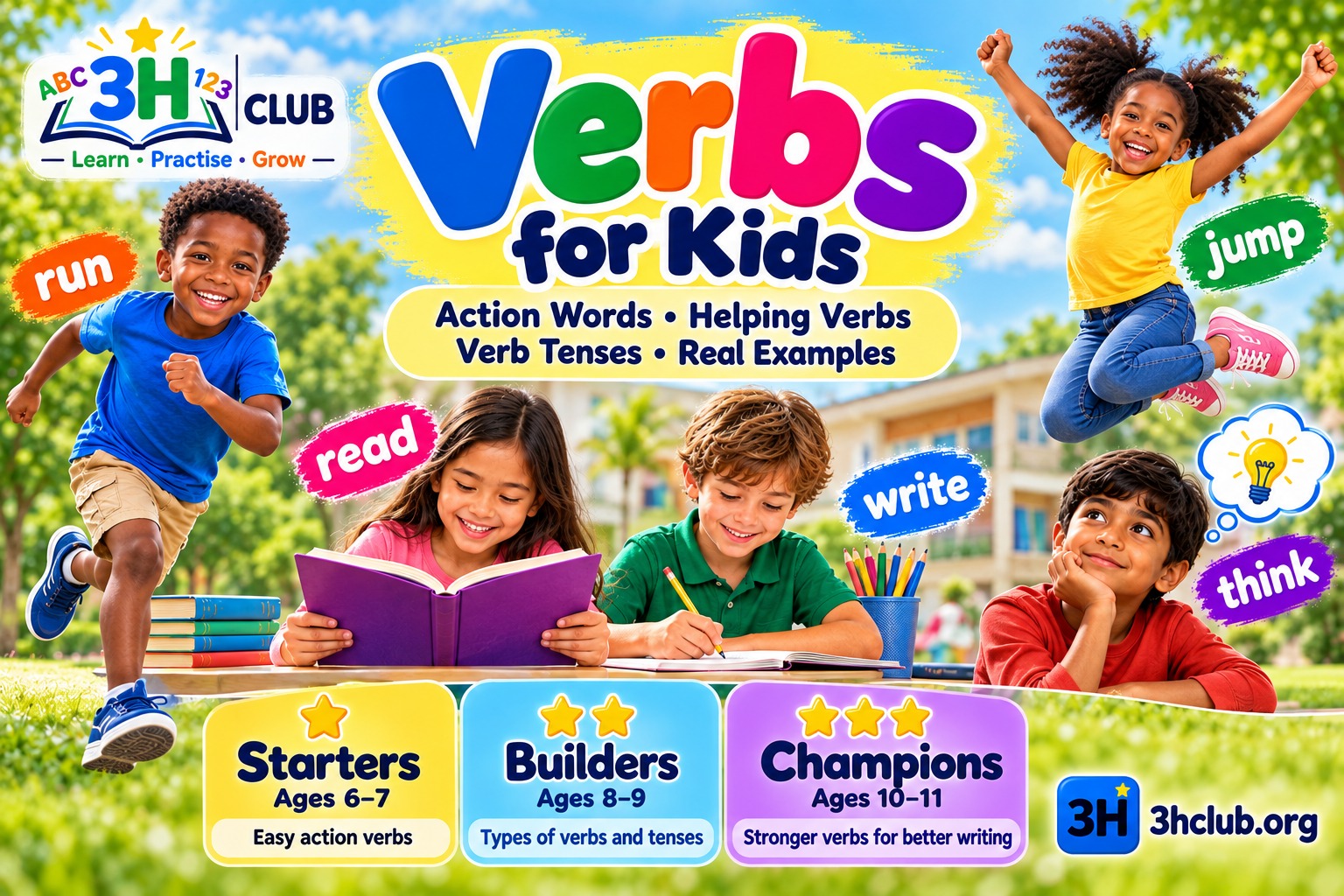
Verbs for Kids
Action Words, Helping Verbs & Verb Tenses
Words can do different jobs in a sentence.
Some words name people, places, animals, and things. Those are nouns.
Other words tell us what someone does, what happens, or what someone or something is.
Those words are called verbs.
You use verbs all the time:
run • laugh • read • think • is • have • play • write
In this lesson, you’ll start with easy action verbs and work your way up to helping verbs, verb tenses and choosing stronger verbs.
⭐ Starters — Ages 6–7
⭐⭐ Builders — Ages 8–9
⭐⭐⭐ Champions — Ages 10–11
⚡ Quick Answer: What Is a Verb?
A verb is a word that tells us about an action or a state.
Look at these sentences:
Mia jumps.
The word jumps tells us what Mia does.
The dog sleeps.
The word sleeps tells us what the dog does.
But not every verb is an action:
Sam is happy.
Here, is is also a verb. It tells us about Sam’s state.
🧠 Remember
VERB = ACTION OR STATE
That simple rule will help you spot lots of verbs.
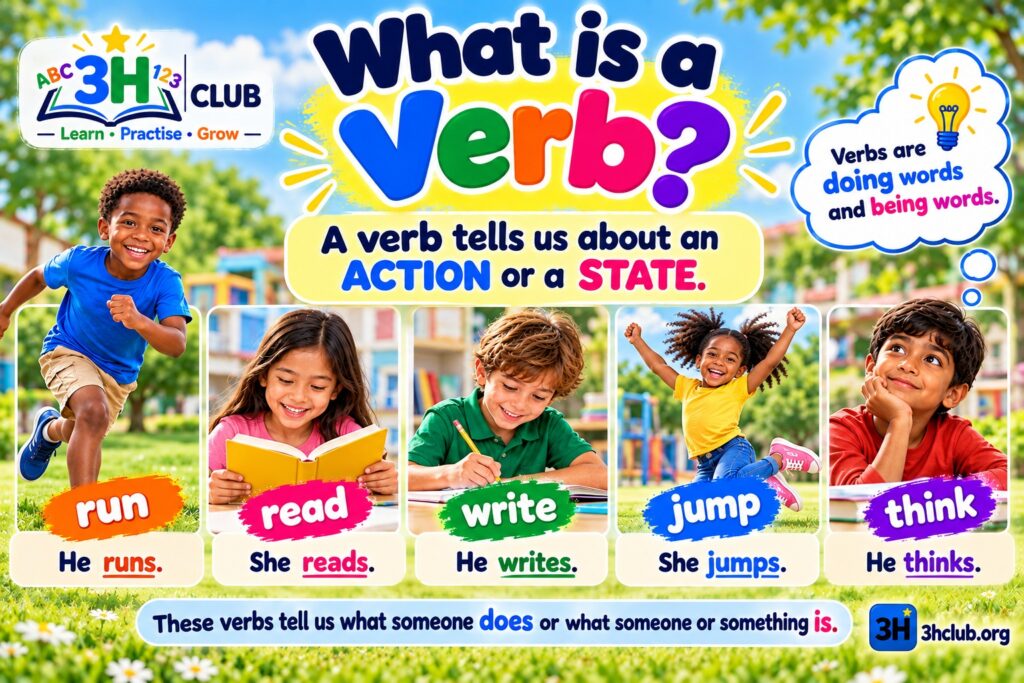
Verbs can tell us what someone does or what someone or something is.
▶️ Jump To
⭐ Starters: Action Verbs
⭐⭐ Builders: Different Types of Verbs
⭐⭐⭐ Champions: Powerful Verbs and Tenses
🧠 Verb Checklist
🏆 Big Verb Challenge
❓ Questions & Answers
✏️ Try This!
Can you find the verb in each sentence?
1. The rabbit hops.
2. Ava reads.
3. We laugh.
4. Dad cooks.
Say the word that tells you what happens.
Answers
- hops
- reads
- laugh
- cooks
🌟 If you found them, you’ve already started spotting verbs!
⭐ Starters — Ages 6–7
Action Verbs
Let’s begin with the easiest verbs to spot.
An action verb tells you what someone or something does.
You can:
run
jump
eat
read
write
swim
dance
draw
These are all verbs because they show actions.
Look at the difference:
The girl → Who?
The girl jumps. → What does she do?
Jumps is the verb.
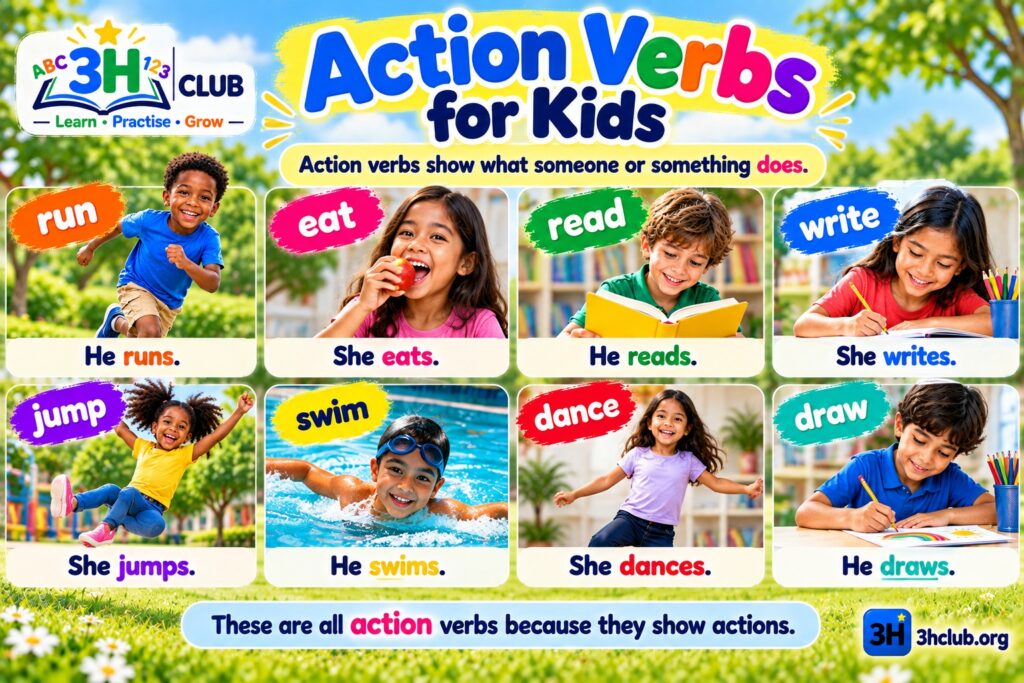
Action verbs tell us what someone or something does.
Can Animals Use Verbs Too?
Absolutely!
The bird flies.
The fish swims.
The cat sleeps.
The horse runs.
The animal is the noun.
The action it performs is the verb.
The cat sleeps.
cat = noun
sleeps = verb
That is one reason nouns and verbs work so well together.
👀 Spot the Verb
Which word is the verb?
The frog jumps.
Is it:
frog or jumps?
It’s jumps because that tells us what the frog does.
Try another:
Leo kicks the ball.
Leo is a noun.
ball is a noun.
kicks is the verb.
⭐ Starters Tip: Ask yourself, “What is happening?”
⭐⭐ Builders — Ages 8–9
You already know that many verbs describe actions.
Now you’re ready to discover something important:
Not all verbs are action words.
Verbs can have several different jobs.
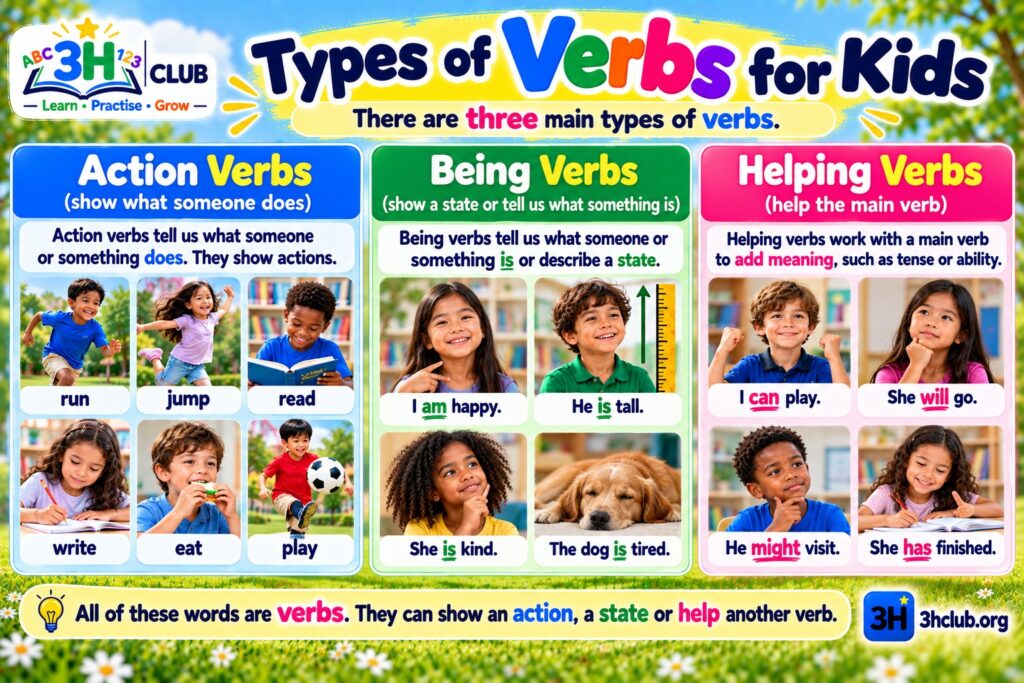
Three Useful Types of Verbs
1. Action Verbs
These show actions.
run • climb • whisper • write • build
Sofia writes a story.
2. Being Verbs
These tell us what someone or something is or describe its state.
Common examples include:
am • is • are • was • were • be
I am ready.
The puppy is sleepy.
They were excited.
The words am, is and were do not show physical actions, but they are still verbs.
3. Helping Verbs
Sometimes a verb gets some help from another verb.
She is running.
running is the main verb.
is helps it.
We will play tomorrow.
play is the main verb.
will is helping it.
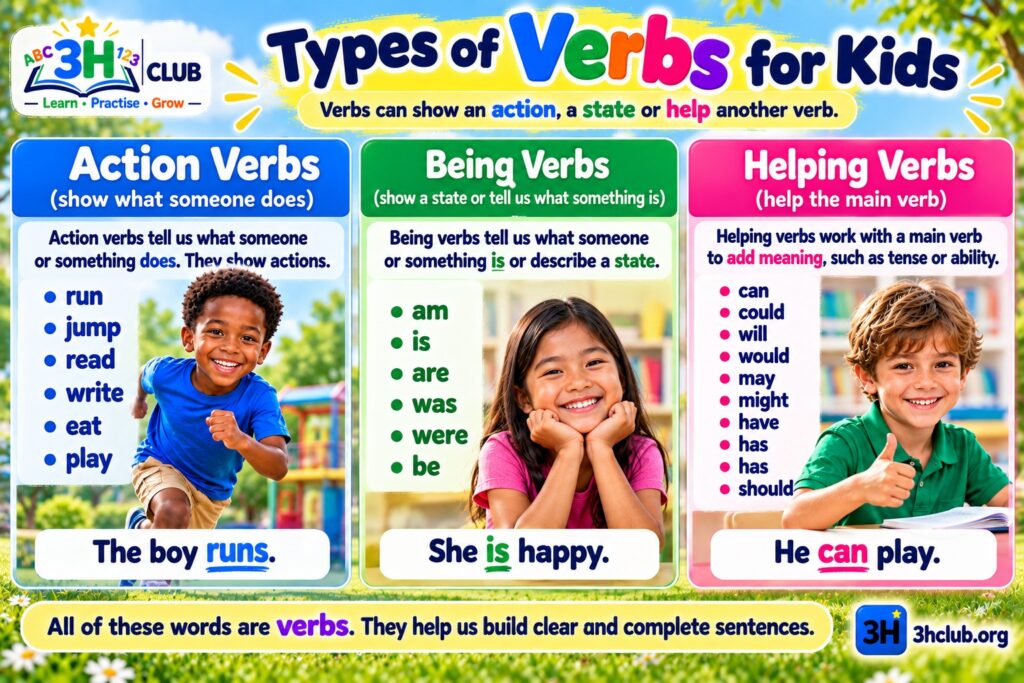
Verbs can show actions and states, and some verbs help other verbs.
Being Verbs
Being verbs may be less obvious because you cannot always see them happening.
Look at these examples:
I am happy.
He is tall.
They are friends.
Try removing the verbs:
I happy. ❌
He tall. ❌
Something important is missing.
The being verb helps the sentence make sense.
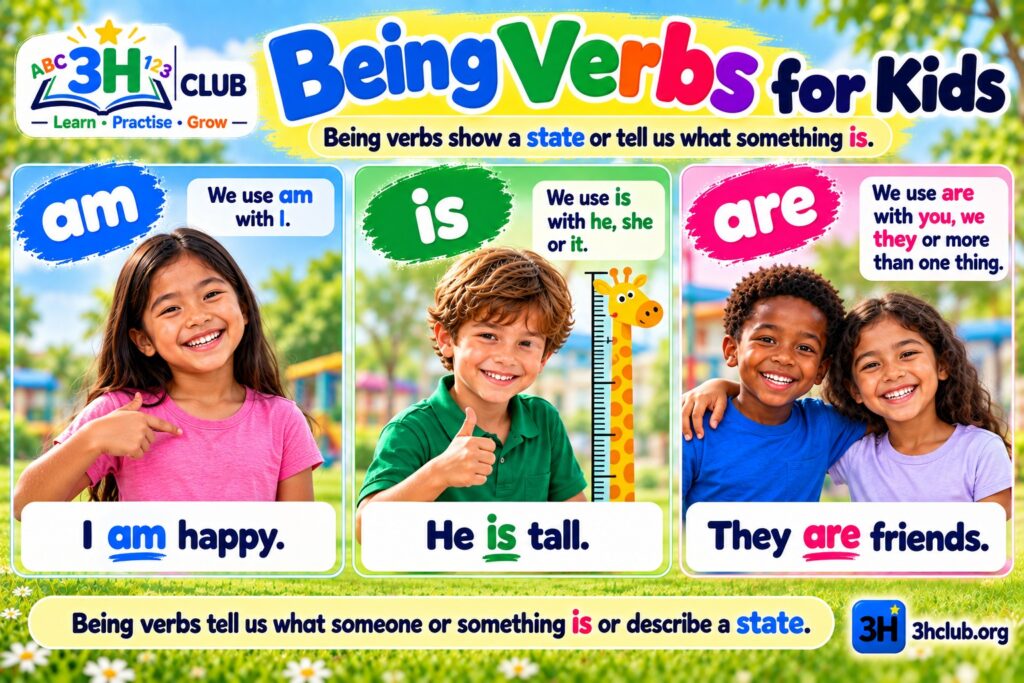
Verbs can show actions and states, and some verbs help other verbs.
Helping Verbs
A helping verb works with another verb.
Look closely:
I can dance.
can = helping verb
dance = main verb
He will play.
will = helping verb
play = main verb
She has finished.
has = helping verb
finished = main verb
Other helping verbs you may meet include:
could • may • might • should • would • have • has • had
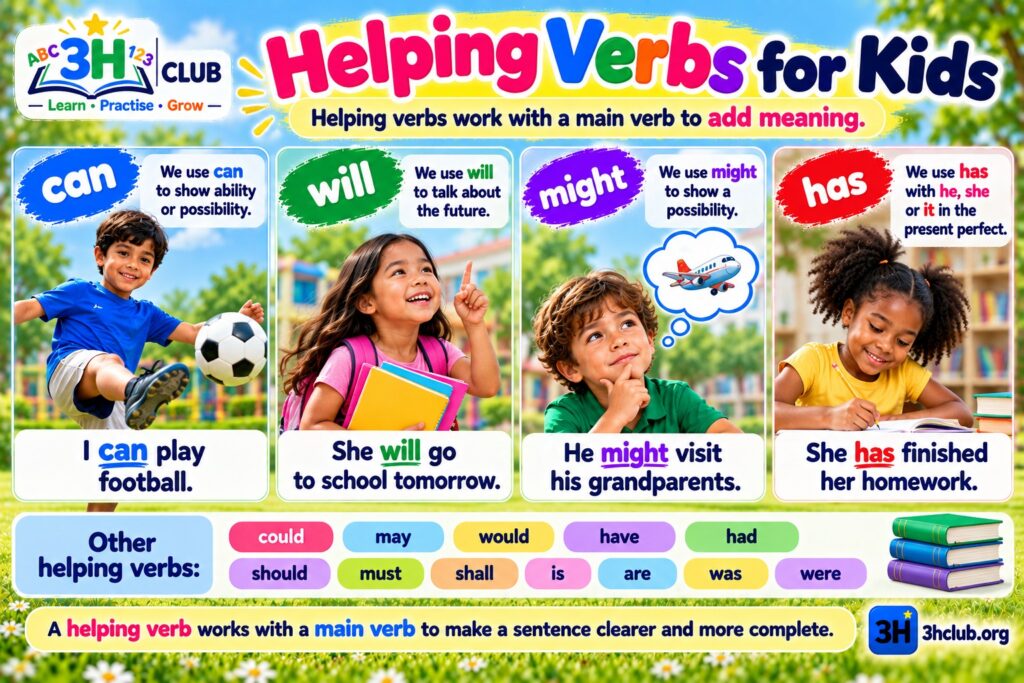
Verbs can show actions and states, and some verbs help other verbs.
⏰ Verbs Can Tell Us When
Verbs can change to show when something happens.
This is called tense.
Think of three points on a timeline:
PAST ← PRESENT → FUTURE
Past
Something already happened.
Yesterday, I walked to school.
Present
Something is happening now or happens regularly.
I walk to school.
Future
Something will happen later.
Tomorrow, I will walk to school.
Notice how the verb changes.
walked → walk → will walk
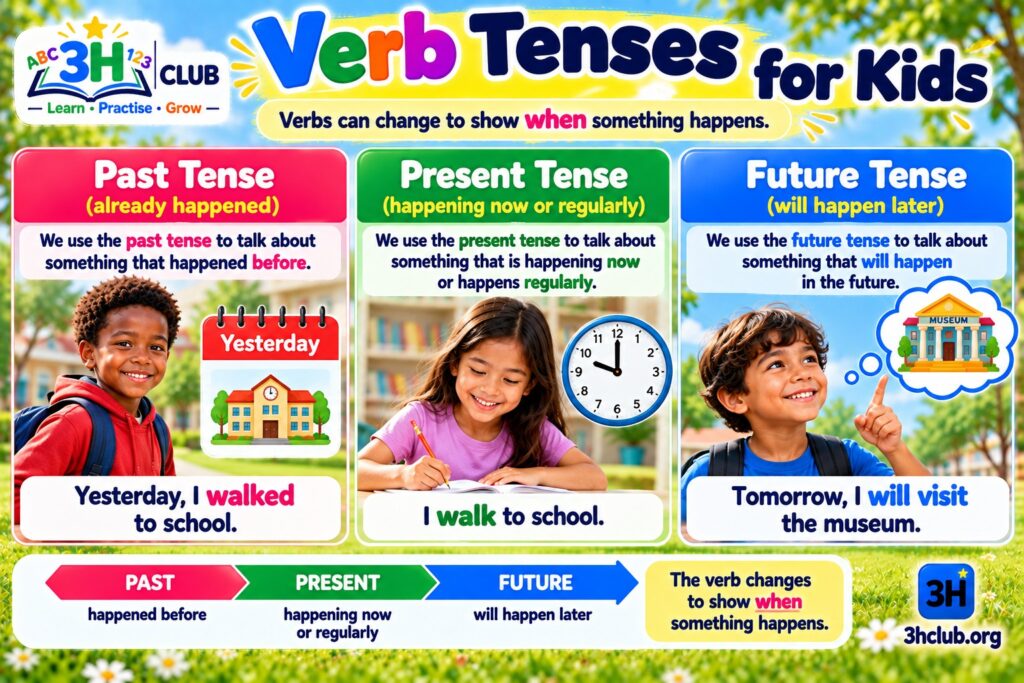
Verb tense helps tell us when something happens.
⭐⭐⭐ Champions — Ages 10–11
You’ve learned how to identify several kinds of verbs.
Now let’s make those verbs work harder.
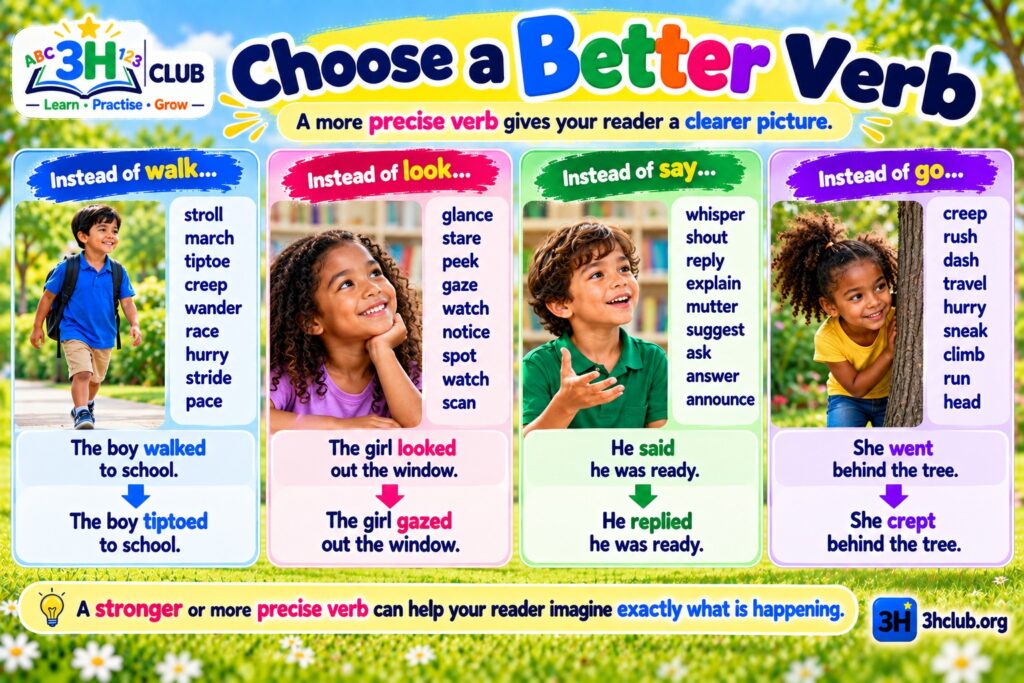
Choose Stronger Verbs
Some verbs give the reader much more information than others.
Compare:
The girl walked across the room.
with:
The girl tiptoed across the room.
Both sentences describe movement, but tiptoed creates a clearer picture.
Instead of:
walk
you might choose:
stroll • march • creep • wander • race
Instead of:
look
you could choose:
glance • stare • peek • gaze
Instead of:
said
you might sometimes choose:
whispered • shouted • replied • muttered
The best verb depends on what is actually happening.
Why Strong Verbs Improve Writing
Imagine this sentence:
The lion went towards its prey.
Now compare:
The lion crept towards its prey.
Crept tells us how the lion moved.
That’s useful information packed into one verb.
Strong verbs can make your writing more precise, not merely longer.
Verbs Can Be More Than One Word
This is an important Champions idea.
Sometimes the complete verb contains more than one word.
Maya is reading.
The team has finished.
We will be travelling tomorrow.
These are called verb phrases.
In:
Maya is reading.
is helps the main verb reading.
Together, is reading forms the verb phrase.
So when you’re looking for verbs in more advanced sentences, don’t assume there will always be just one verb word.
Subject–Verb Agreement
The subject and verb need to work together correctly.
Compare:
The dog runs. ✔
The dogs run. ✔
But:
The dogs runs. ❌
Sounds wrong, doesn’t it?
Another example:
She plays football.
They play football.
As sentences become longer, remember to check that your subject and verb agree.
🧠 Verb Checklist
When checking your writing, ask:
✓ Does my sentence show an action or state?
✓ Have I used the correct verb tense?
✓ Does my verb agree with the subject?
✓ Could I use a stronger or more precise verb?
✓ Do I need a helping verb?
✓ Does the whole sentence make sense?
Use the verb checklist when checking and improving your sentences.
🏆 Big Verb Challenge
Ready to test yourself?
Find the verb or verb phrase in each sentence.
1. The tiny mouse scurried under the table.
2. Ava is reading her new book.
3. We will visit the museum tomorrow.
4. The children were excited.
5. Marcus carefully carried the glass.
Now try one more challenge.
Can you improve this sentence?
The dog went across the garden.
You might write:
The dog raced across the garden.
or:
The dog crept across the garden.
or:
The dog bounded across the garden.
There isn’t always one perfect verb. Choose the verb that best matches what you want your reader to imagine.
Answers
1. scurried
2. is reading
3. will visit
4. were
5. carried
🏆 Champion Tip: Don’t just find the verb. Ask what information that verb gives you.
🌟 Remember This
A verb is one of the most important building blocks of a sentence.
Start with this:
VERB = ACTION OR STATE
Then build your knowledge:
⭐ Starters: Find action verbs.
⭐⭐ Builders: Learn action, being and helping verbs and begin using tenses.
⭐⭐⭐ Champions: Recognise verb phrases, check subject–verb agreement and choose precise verbs.
Once you can control your verbs, you can make your sentences clearer, stronger and much more interesting.
📚 Keep Learning Grammar
You now know about nouns and verbs.
Next in the Starters grammar pathway is:
Adjectives → Simple Sentences → Basic Punctuation
This creates an important progression:
NOUN + VERB → SENTENCE
Birds fly.
Then an adjective can add more information:
Colourful birds fly.
That is how your grammar skills begin working together.
Next lesson CTA: [LEARN ABOUT ADJECTIVES →] once the Adjectives article is published.
❓ Questions & Answers About Verbs
What is a verb for kids?
A verb is a word that tells us about an action or state. In The dog runs, the word runs is the verb.
What are five examples of verbs?
Five easy examples are run, jump, eat, read and write.
Is “is” a verb?
Yes. Is is a form of the verb be. In The cat is sleepy, is is a verb even though it does not describe a physical action.
What is an action verb?
An action verb tells us what someone or something does, such as run, kick, swim, laugh or write.
What is a helping verb?
A helping verb works with a main verb. In She can swim, can is the helping verb and swim is the main verb.
What are past, present and future tense?
Verb tense helps show when something happens. Past describes something that happened before, present describes something happening now or regularly, and future describes something that will happen later.
How can I find the verb in a sentence?
First ask, “What is happening?” Then look for the word or words showing an action or state. Remember that some verbs, such as am, is, are, was and were, do not describe visible actions.