Adjectives for Kids
Adjectives are describing words that make your sentences more interesting, more detailed, and easier to picture.
Think about a dog.
You could simply say:
The dog ran.
But what if you said:
The fluffy, brown dog ran across the wide, green field.
Now you can picture the dog and the field much more clearly!
Words such as fluffy, brown, wide, and green are adjectives.
At 3HClub.org, you will learn about adjectives step by step. Start with the ⭐ Starters level, move on to ⭐⭐ Builders, and then challenge yourself with ⭐⭐⭐ Champions.
⭐ Starters — Ages 6–7
What Is an Adjective?
An adjective is a word that describes a noun or tells us more about it.
Remember, a noun is a person, place, animal, thing, or idea.
Adjectives can tell us things like:
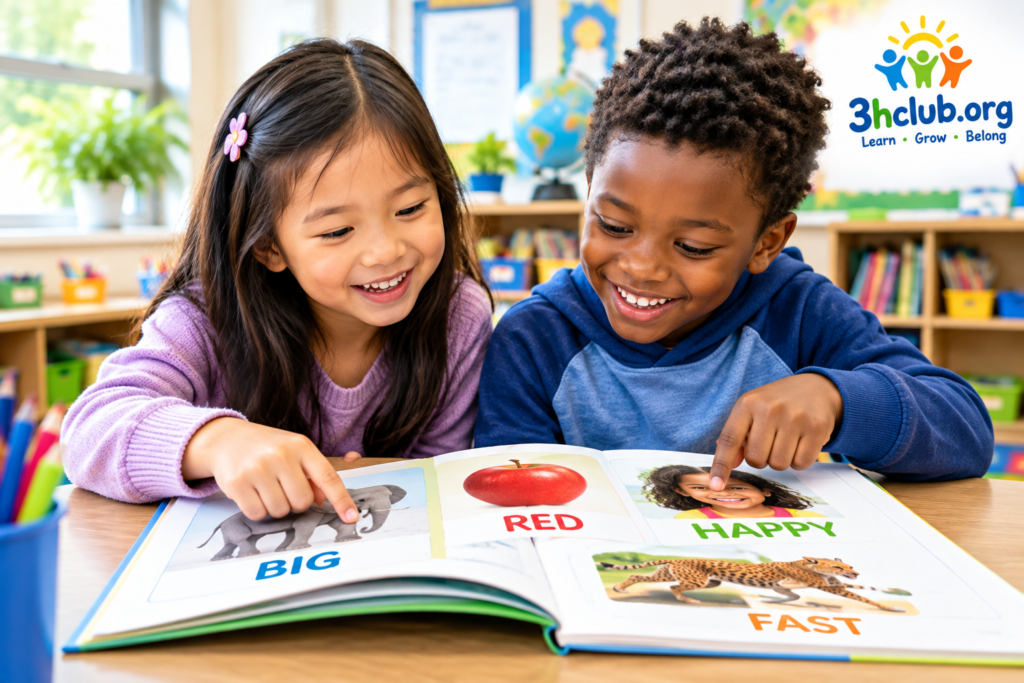
- what something looks like — red, shiny, round
- what size it is — big, tiny, tall
- what it feels like — soft, rough, smooth
- what something is like — happy, noisy, friendly
- how many there are — three, several, many
Look at these examples:
- a big dog
- a red ball
- a happy child
- a tiny kitten
- a shiny star
The adjective gives us extra information about the noun.
Adjectives Help Us Picture Things
Imagine someone says:
I saw a bird.
You know that there was a bird, but you don’t know much about it.
Now try:
I saw a small, blue bird.
Much better!
The words small and blue help you build a picture in your mind.
That’s one reason adjectives are so useful when you are reading and writing.
Find the Adjective
Can you spot the adjective in each sentence?
- The yellow bus stopped outside.
- We found a tiny shell.
- My puppy has soft fur.
- The happy girl smiled.
- I ate a crunchy apple.
The adjectives are:
yellow • tiny • soft • happy • crunchy
Great job!
Try It Yourself ⭐
Look around you.
Can you find:
- something blue?
- something small?
- something soft?
- something round?
- something shiny?
Now use one of your adjectives in a sentence.
For example:
I have a small pencil.
Or:
The blue book is on the table.
A Quick Adjective Challenge
Add an adjective to each sentence.
The ______ cat jumped.
I found a ______ rock.
The ______ flower smelled lovely.
We saw a ______ bird.
There can be more than one right answer!
A cat could be sleepy, fluffy, black, playful, or tiny.
That’s the fun of adjectives: you get to choose words that make your meaning clearer.
⭐⭐ Builders — Ages 8–9
Adjectives Give More Information
Now that you know what adjectives are, let’s take a closer look at how they work.
An adjective can make a sentence more precise.
Compare these two sentences:
The car moved down the road.
The bright red car moved quickly down the road.
The second sentence gives us a much clearer picture.
The adjectives bright and red describe the car.
Where Do Adjectives Go?
Adjectives often appear before a noun.
For example:
- a clever student
- a cold drink
- a beautiful garden
- a large elephant
The adjective comes before the noun it describes.
But adjectives can also appear after a linking verb such as is, are, was, or were.
For example:
The elephant is enormous.
The children were excited.
The soup was hot.
In these sentences, enormous, excited, and hot describe the subject.
Adjectives Can Compare Things
Adjectives can also help us compare people, animals, places, or things.
Look at these three forms:
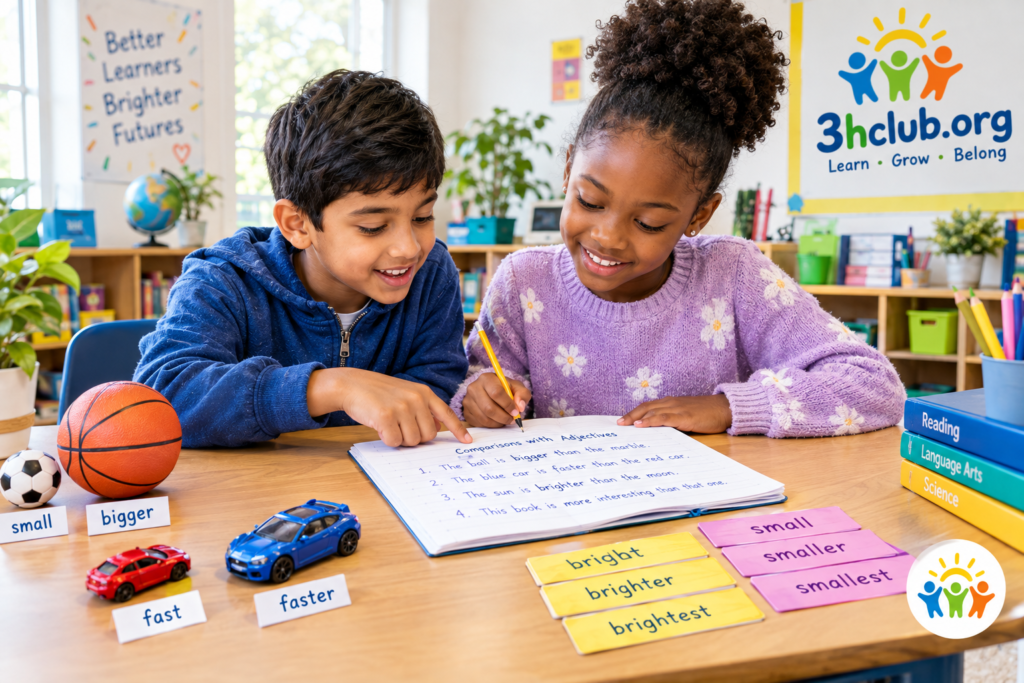
small → smaller → smallest
bright → brighter → brightest
fast → faster → fastest
We use comparative adjectives when comparing two things.
The blue car is faster than the red car.
We use superlative adjectives when comparing three or more things.
The blue car is the fastest car in the race.
More Examples
tall → taller → tallest
Maya is tall.
Jordan is taller than Maya.
Alex is the tallest of the three.
happy → happier → happiest
Sam is happy.
Mia is happier today.
Leo is the happiest person at the party.
Some Adjectives Use “More” and “Most”
Not every adjective simply takes -er or -est.
Some longer adjectives use more and most.
For example:
interesting → more interesting → most interesting
careful → more careful → most careful
exciting → more exciting → most exciting
Try this:
This book is more interesting than that one.
That was the most exciting part of the story!
Make Your Writing More Specific
Good writers choose adjectives carefully.
Instead of:
We went to a house.
Try:
We went to a large, old house.
Instead of:
I saw a bird.
Try:
I saw a bright blue bird sitting on a branch.
Instead of:
The storm arrived.
Try:
The dark, powerful storm arrived suddenly.
Notice that the adjectives don’t just make the sentences longer. They make the sentences clearer.
Builders’ Challenge ⭐⭐
Improve these sentences by adding one or two adjectives.
The dog chased the ball.
We walked through the forest.
She opened the box.
The teacher read a story.
For example:
The playful brown dog chased the bright red ball.
Now your turn!
⭐⭐⭐ Champions — Ages 10–11
Use Adjectives Like a Writing Pro
You already know that adjectives describe nouns.
Now it’s time to think about which adjectives you choose and why you choose them.
Strong writers don’t simply add lots of adjectives to every sentence. They choose precise, useful words that help readers understand exactly what they mean.
Compare:
The man walked into the room.
with:
The nervous, exhausted man quietly walked into the room.
The second sentence gives us clues about the character.
We can imagine how he might look and behave.
Choose Precise Adjectives
Sometimes a simple adjective works perfectly:
The blue sky was clear.
But sometimes a more precise adjective creates a stronger picture:
The cloudless sky stretched above the mountains.
Instead of using a general word such as good, think about what you really mean.
Could it be:
- excellent
- impressive
- helpful
- exciting
- thoughtful
- delicious
- successful
Instead of bad, perhaps you mean:
- unpleasant
- dangerous
- disappointing
- careless
- unfair
- frightening
The best adjective depends on the meaning you want to communicate.
Adjectives Can Create Strong Images
Adjectives are especially useful in stories and descriptive writing.
Compare:
The mountain stood in the distance.
with:
The enormous, snow-covered mountain stood against the clear, purple evening sky.
The second sentence gives the reader much more to imagine.
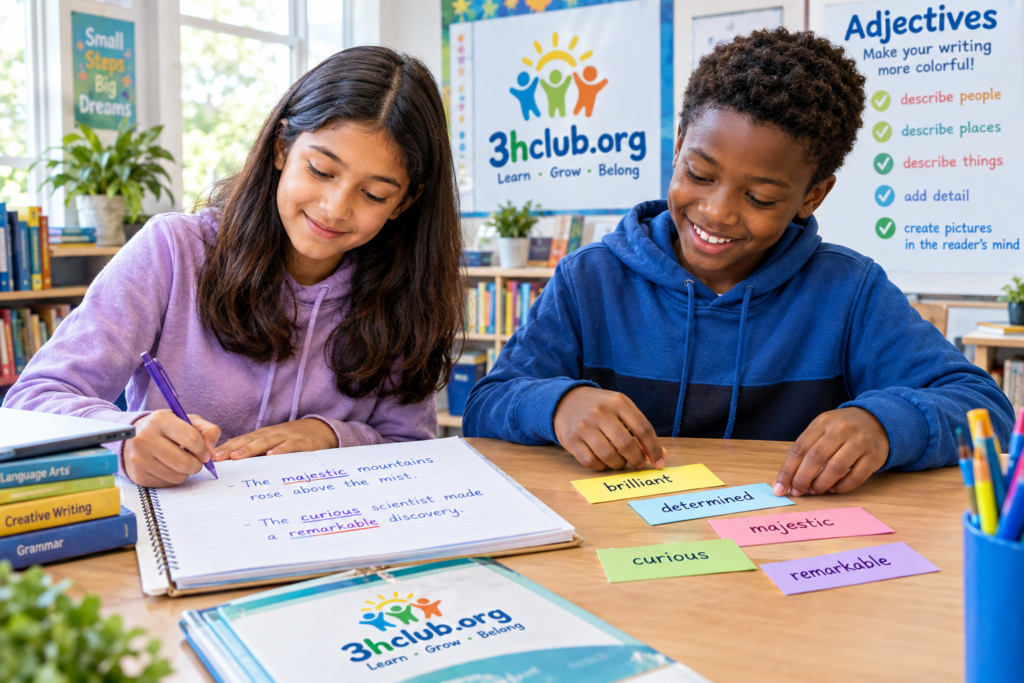
You can use adjectives to describe:
People
The determined runner kept going.
Places
We explored a quiet, mysterious cave.
Animals
A curious, energetic puppy followed us.
Objects
She opened the old, wooden chest.
Feelings and experiences
It was a thrilling, unforgettable adventure.
Be Careful Not to Overload Your Sentence
More adjectives do not always mean better writing.
For example:
The big, enormous, huge, gigantic elephant walked across the field.
That’s too much. The words are repeating almost the same idea.
A stronger sentence might be:
The enormous elephant walked slowly across the field.
Choose the adjective that does the best job.
Precise beats crowded.
Adjective Order
When several adjectives appear before a noun, English usually follows a natural order.
You do not need to memorise every rule straight away, but you may notice patterns such as:
a beautiful little red dress
an interesting old wooden box
three large blue balloons
For example, we would normally say:
a beautiful little red dress
rather than:
a red little beautiful dress.
As you read more, you will begin to notice adjective order naturally.
Adjectives Can Help Show Character
Adjectives can tell us what a character is like without directly explaining everything.
Compare:
Liam walked into the classroom.
with:
The nervous Liam quietly walked into the classroom.
The adjective nervous gives us information about Liam.
You could also write:
The confident Liam walked into the classroom.
Now we imagine something completely different.
One carefully chosen adjective can change the feeling of a sentence.
Champions’ Challenge ⭐⭐⭐
Improve this sentence:
The girl walked into the room.
Can you write three different versions?
Version 1 — Happy
The cheerful girl skipped into the room.
Version 2 — Nervous
The nervous girl slowly entered the room.
Version 3 — Mysterious
The silent, mysterious girl stepped into the room.
Notice how changing the adjectives changes the picture in your mind.
Now create your own!
Adjectives in Everyday Life
You probably use adjectives every day without even thinking about them.
When you say:
“I want the large slice.”
you use an adjective.
When you say:
“That was a funny movie.”
you use an adjective.
When you tell someone:
“Look at that beautiful rainbow!”
you use an adjective.
Adjectives are everywhere—in books, conversations, signs, advertisements, stories, instructions, and even text messages.
Once you start noticing them, you will probably see them all around you.
Try an Adjective Hunt!
Grab a book, magazine, classroom worksheet, or story.
Find five adjectives.
Write them down.
Then answer these questions:
- What noun does each adjective describe?
- Does the adjective describe size, color, feeling, shape, number, appearance, or something else?
- Could you replace it with a more precise adjective?
- Could you use the adjective in your own sentence?
For an extra challenge, find:
- one adjective that describes a person
- one that describes a place
- one that describes an animal
- one that describes an object
- one that describes a feeling
Quick Adjective Reminder
⭐ Starters: Adjectives describe nouns.
a big dog
a red ball
a happy child
⭐⭐ Builders: Adjectives can give more detail and can compare things.
tall → taller → tallest
interesting → more interesting → most interesting
⭐⭐⭐ Champions: Choose precise adjectives to create stronger descriptions.
a determined runner
a mysterious, ancient castle
a bright, peaceful morning
Remember:
Adjectives make your words clearer, stronger, and more interesting!
Keep looking for them when you read, and keep using them when you write.
Small words. Big impact.
3HClub.org — Learn • Grow • Belong
Frequently Asked Questions
What is an adjective?
An adjective is a word that describes a noun or gives us more information about it.
Can an adjective describe a person?
Yes. Words such as kind, funny, clever, tall, and friendly can describe people.
Can adjectives describe animals?
Yes.
The fluffy cat slept on the sofa.
Can a sentence have more than one adjective?
Yes.
She wore a beautiful blue dress.
What are comparative adjectives?
Comparative adjectives compare two things.
The blue car is faster than the red car.
What are superlative adjectives?
Superlative adjectives compare three or more things.
The blue car is the fastest in the race.
Why are adjectives useful?
Adjectives give readers and listeners more information. They help us create clearer pictures, explain ideas, describe people and places, and make our writing more interesting.