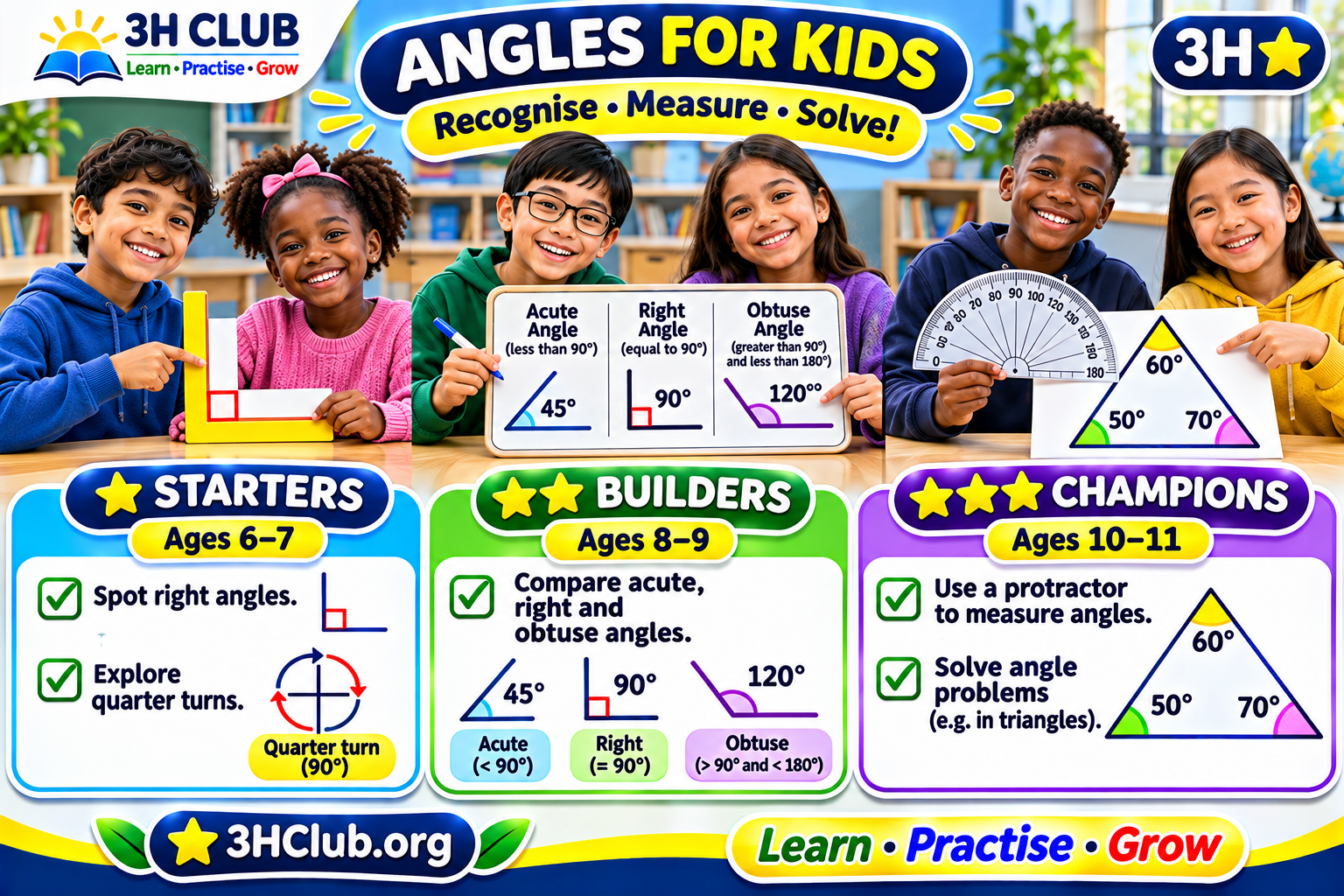
Angles for Kids:
📐 Learn to Recognise, Measure and Solve Angles!
⭐ Starters — Ages 6–7 | ⭐⭐ Builders — Ages 8–9 | ⭐⭐⭐ Champions — Ages 10–11
📚 Subject: Mathematics – Geometry and Measurement
🎯 Skills: Turns, corners, vertices, angle types, degrees, protractors, angle estimation, missing angles, triangles, quadrilaterals and problem-solving.
🌟 Hello, Young Mathematician!
Imagine opening a door.
When the door is closed, it rests against its frame. As you open it, the door turns around its hinges.
That turning movement helps us understand angles.
You can find angles almost everywhere:
- Between the hands of a clock.
- At the corners of a book.
- Where two roads meet.
- In the shapes of rooftops.
- Between the blades of open scissors.
- At the corners of triangles and rectangles.
Angles help us describe turns, measure shapes and understand how objects fit together.
In this lesson, you’ll begin by exploring corners and turns. Then you’ll discover different types of angles, learn to measure them and solve exciting geometry puzzles.
Ready to become an Angle Explorer?
Let’s begin!
🎯 What Will You Learn?
By the end of this lesson, you’ll be able to:
- Recognise angles in everyday objects.
- Describe quarter, half, three-quarter and full turns.
- Identify right angles.
- Understand the vertex and arms of an angle.
- Recognise acute, right, obtuse, straight and reflex angles.
- Measure and draw angles using a protractor.
- Estimate angles before measuring.
- Find missing angles on a straight line and around a point.
- Calculate missing angles in triangles.
- Use angle rules for quadrilaterals.
- Solve real-life angle problems.
- Explain your answers using mathematical reasoning.
⭐ Your mission: Discover how angles help us understand turns, shapes and the world around us.
⭐ STAGE 1: STARTERS — AGES 6–7
🌈 Discover Corners, Directions and Turns
🟢 1. What Is an Angle?
An angle is formed when two rays meet at a common endpoint.
A ray starts at one point and continues in one direction.
The point where the rays meet is called the vertex.
The two rays are called the arms or sides of the angle.
For now, imagine two straight lines meeting at a corner.
The amount of turn from one arm to the other tells you the size of the angle.
Look Around You!
You might spot angles:
- At the corner of a window.
- At the corner of a picture frame.
- Where the hands of a clock meet.
- Between the open blades of scissors.
⭐ Starter Tip: An angle measures a turn, not the length of its arms.
✏️ Activity 1: Angle Hunt
Look around your home or classroom.
Find five objects that show angles.
Write or draw them.
Then answer:
- Which object has a square corner?
- Which object can open to make a changing angle?
- Which object shows an angle between two hands?
🔵 2. Explore Quarter, Half and Full Turns
You can learn about angles by turning your body.
Start by facing forwards.
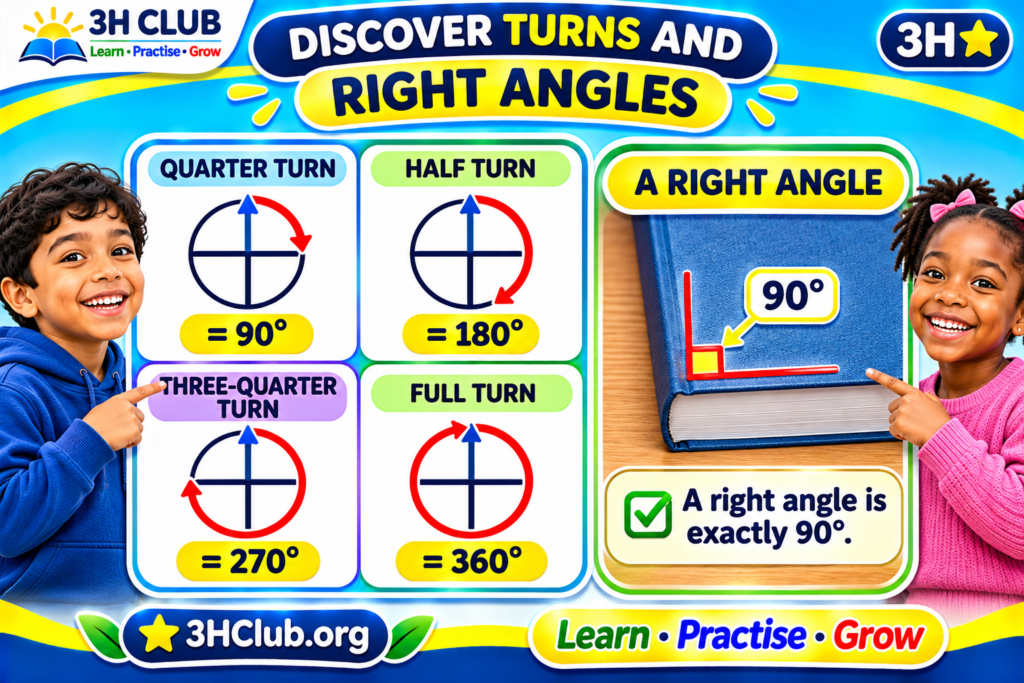
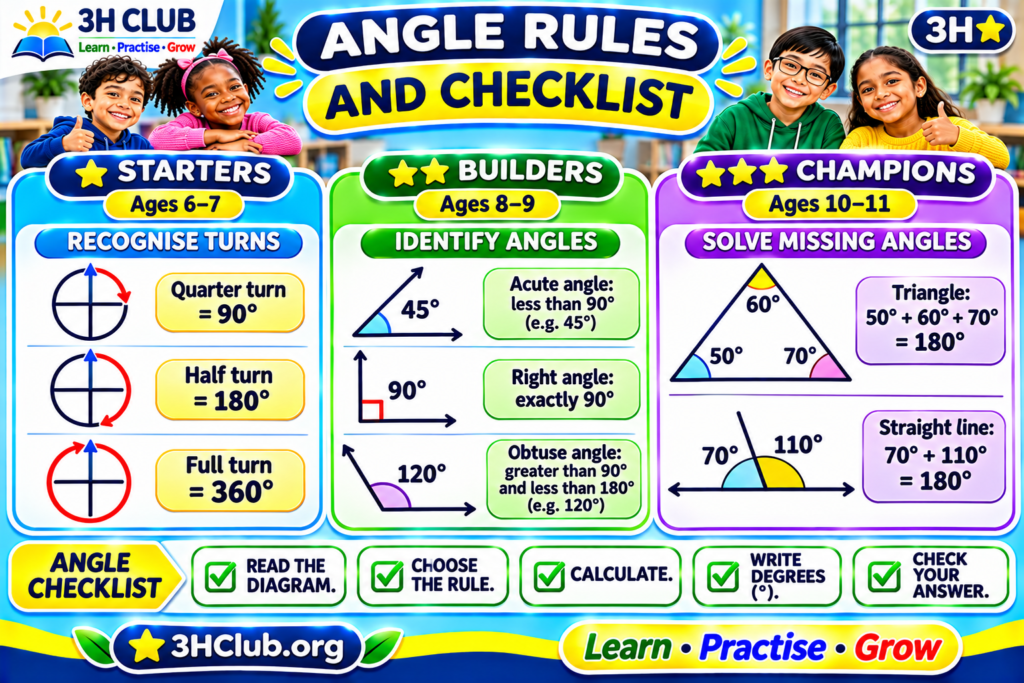
Quarter turn: Turn one quarter of the way around.
Half turn: Turn halfway around.
Three-quarter turn: Turn three quarters of the way around.
Full turn: Turn all the way around and face your original direction.
These turns have special measurements.
| Turn | Angle |
|---|---|
| Quarter turn | 90° |
| Half turn | 180° |
| Three-quarter turn | 270° |
| Full turn | 360° |
The little symbol ° means degrees.
Degrees are units used to measure angles.
✏️ Activity 2: Turn Around!
Begin by facing north.
Make each clockwise turn.
- Quarter turn.
- Half turn.
- Three-quarter turn.
- Full turn.
Which direction are you facing after each turn?
You can use a compass rose or a drawing with north at the top.
🟡 3. Discover Right Angles
A right angle measures exactly 90°.
It looks like the corner of a square or rectangle.
You can find right angles at:
- The corners of many books.
- The corners of rectangular tables.
- The corners of doors.
- The corners of square floor tiles.
Try It!
Fold a rectangular sheet of paper carefully so you can use one of its corners as a right-angle checker.
Place the corner against objects around you.
Does it fit exactly?
✏️ Activity 3: Right Angle Detective
Decide whether each object normally has a right angle.
- Corner of a rectangular notebook.
- Corner of a square tile.
- The sharp tip of a triangular warning sign.
- Corner of a rectangular window.
- The angle between two perpendicular roads.
Explain your choices.
🟣 4. Compare Small and Large Turns
Imagine two doors opening from the same closed position.
Door A turns through a small angle.
Door B turns through a larger angle.
Door B has turned farther.
An angle can become larger even when the door stays the same size.
This teaches us something important:
The size of an angle depends on the amount of turn, not the length of the lines.
✏️ Activity 4: Compare the Turns
Which turn is larger?
- Quarter turn or half turn?
- Half turn or full turn?
- Three-quarter turn or quarter turn?
- Full turn or three-quarter turn?
- Two quarter turns or one half turn?
✏️ Activity 5: Draw Your Turns
On paper, draw arrows showing:
- A quarter turn clockwise.
- A half turn clockwise.
- A quarter turn anticlockwise.
- A full turn.
Label the number of degrees for each.
🎲 Starters Game: Angle Action!
Ask a friend to call out:
Quarter turn!
Half turn!
Full turn!
Make the correct turn with your body.
For an extra challenge, call out the number of degrees instead.
⭐ Bonus: Can you make a three-quarter turn without losing your balance?
⭐⭐ STAGE 2: BUILDERS — AGES 8–9
🧩 Recognise and Measure Different Angles
🔵 5. Learn the Five Main Types of Angles
Angles have different names depending on their sizes.
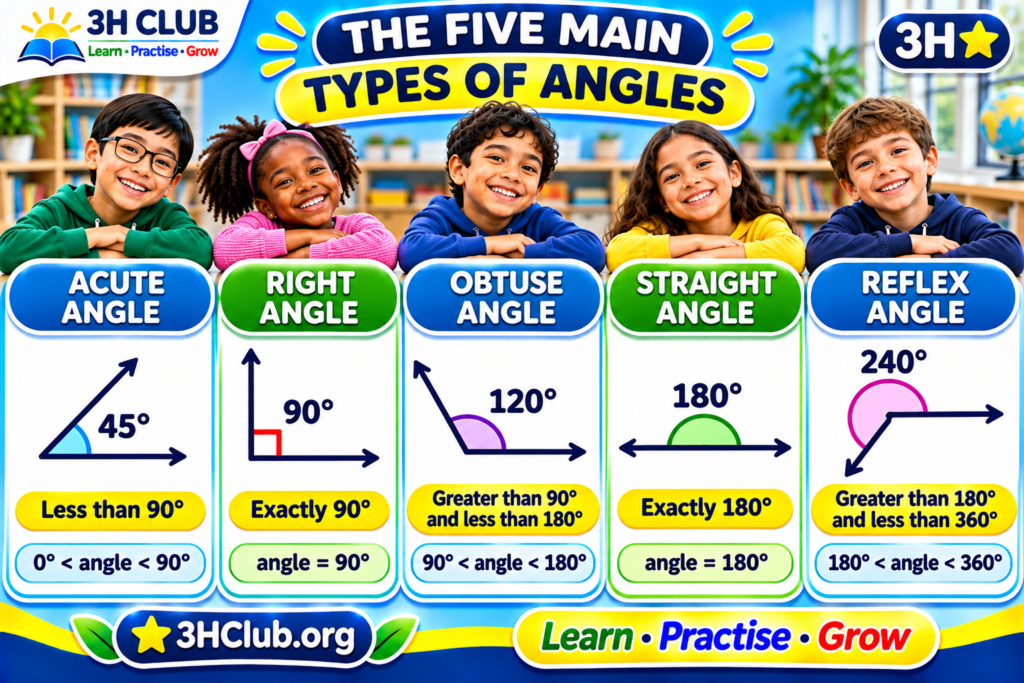
| Angle Type | Measurement |
|---|---|
| Acute | Greater than 0° and less than 90° |
| Right | Exactly 90° |
| Obtuse | Greater than 90° and less than 180° |
| Straight | Exactly 180° |
| Reflex | Greater than 180° and less than 360° |
A complete turn is 360°.
An angle of 0° is called a zero angle.
Examples
45° is acute.
90° is right.
125° is obtuse.
180° is straight.
240° is reflex.
⭐ Remember: An angle of exactly 90° is not acute or obtuse.
✏️ Activity 6: Name the Angle
Classify each angle.
- 30°
- 90°
- 115°
- 180°
- 270°
- 75°
- 160°
- 225°
- 89°
- 91°
🟢 6. Meet the Protractor
A protractor is a tool used to measure and draw angles.
A common semicircular protractor has markings from 0° to 180°.
Many protractors have two numbered scales.
One scale increases clockwise.
The other increases anticlockwise.
You must choose the scale that begins at 0° on the arm you’re measuring from.
How to Measure an Angle
Step 1: Find the vertex.
Step 2: Place the centre mark of the protractor on the vertex.
Step 3: Align one arm with the protractor’s zero-degree baseline.
Step 4: Follow the correct scale from 0° to the second arm.
Step 5: Read and record the angle in degrees.
Example
If the second arm meets the correct scale at 60°, the angle is:
60°
Because 60° is less than 90°, it is an acute angle.
✏️ Activity 7: Measure with a Protractor
Draw these angles carefully using a ruler and protractor:
- 30°
- 45°
- 60°
- 90°
- 120°
- 150°
Then label each as acute, right or obtuse.
🟡 7. Estimate Before Measuring
Before using a protractor, make a sensible estimate.
Use these benchmark angles:
- 45° is half a right angle.
- 90° is a right angle.
- 135° is halfway between 90° and 180°.
- 180° is a straight angle.
Example
An angle looks wider than 90° but much smaller than 180°.
You might estimate:
120°
Then use a protractor to check.
✏️ Activity 8: Angle Estimation
For each description, choose the best estimate.
1. Half a right angle.
A. 45°
B. 90°
C. 180°
2. A straight angle.
A. 60°
B. 180°
C. 270°
3. A little larger than a right angle.
A. 30°
B. 100°
C. 250°
4. A three-quarter turn.
A. 90°
B. 180°
C. 270°
5. An angle halfway between 90° and 180°.
A. 45°
B. 135°
C. 225°
🟣 8. Discover Angles on a Straight Line
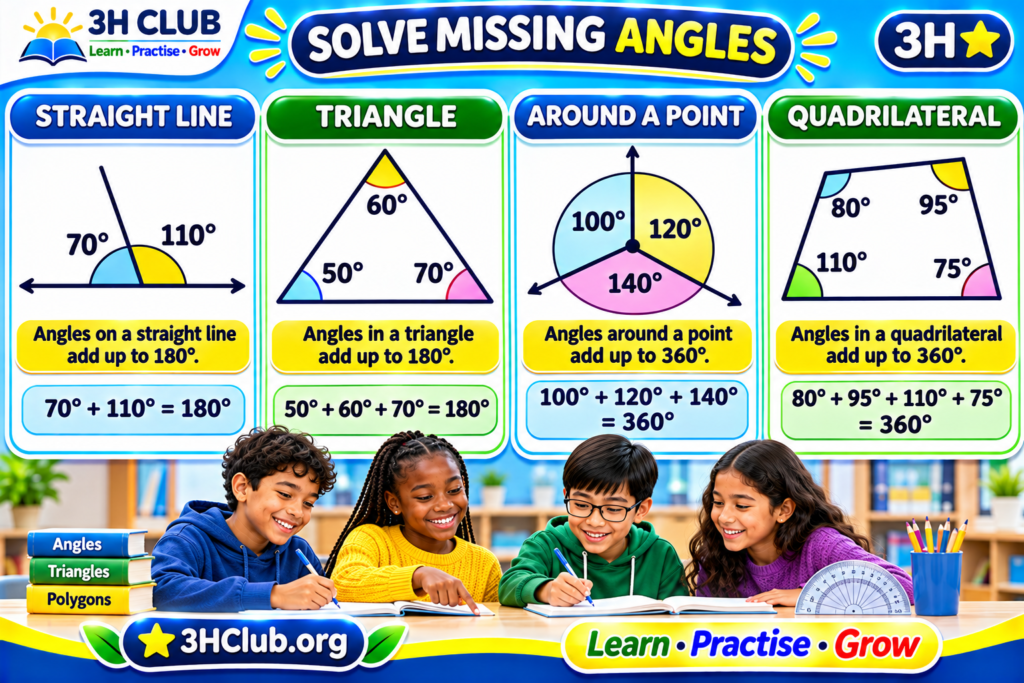
Angles that sit next to one another along a straight line add up to:
180°
Worked Example
Two adjacent angles form a straight angle.
One angle is 70°.
The other is unknown.
70° + ? = 180°
So:
180° − 70° = 110°
The missing angle is 110°.
✏️ Activity 9: Missing Angles on a Straight Line
Find the missing angle.
- 40° + ? = 180°
- 75° + ? = 180°
- 90° + ? = 180°
- 125° + ? = 180°
- 160° + ? = 180°
- 35° + ? = 180°
🔵 9. Angles Around a Point
Angles that fit together around a point make a full turn.
They add up to:
360°
Worked Example
Three angles around a point measure:
100°, 120° and an unknown angle.
100° + 120° + ? = 360°
220° + ? = 360°
? = 140°
✏️ Activity 10: Complete the Full Turn
Find the missing angle.
- 90° + 90° + ? = 360°
- 120° + 100° + ? = 360°
- 60° + 80° + 100° + ? = 360°
- 150° + 110° + ? = 360°
- 45° + 135° + ? = 360°
🟢 10. Discover Angles in Shapes
Different shapes have different angle properties.
Square: Four right angles.
Rectangle: Four right angles.
Triangle: Three interior angles.
Pentagon: Five interior angles.
Hexagon: Six interior angles.
The number of sides does not tell you that every angle is equal. Some shapes are regular, while others are irregular.
✏️ Activity 11: Shape Angle Detective
- How many right angles does a square have?
- How many right angles does a rectangle have?
- How many interior angles does a triangle have?
- How many interior angles does a pentagon have?
- Does every triangle contain a right angle?
- Can a triangle have two right angles?
Explain your last two answers.
🎲 Builders Game: Angle Sorting Challenge
Write these measurements on cards:
25°, 45°, 90°, 110°, 145°, 180°, 210°, 300°.
Sort the cards into:
- Acute.
- Right.
- Obtuse.
- Straight.
- Reflex.
⭐ Bonus: Draw one example of each type.
⭐⭐⭐ STAGE 3: CHAMPIONS — AGES 10–11
🏆 Solve Missing Angles and Geometry Problems
🔵 11. Master Angles in a Triangle
The three interior angles of every triangle add up to:
180°
Worked Example
A triangle has angles:
50°, 60° and an unknown angle.
50° + 60° + ? = 180°
110° + ? = 180°
? = 70°
✏️ Activity 12: Triangle Angle Challenge
Find the missing angle.
- 40°, 60°, ?
- 35°, 75°, ?
- 90°, 35°, ?
- 55°, 55°, ?
- 25°, 85°, ?
- 70°, 45°, ?
Important Triangle Facts
Equilateral triangle: All three interior angles are 60°.
Isosceles triangle: At least two sides are equal, and the angles opposite those sides are equal.
Right-angled triangle: One interior angle is exactly 90°.
Obtuse triangle: One interior angle is greater than 90°.
A triangle cannot contain two right angles or two obtuse angles because its interior angles must total 180°.
🟢 12. Discover Isosceles and Equilateral Triangles
An equilateral triangle has three equal sides and three equal angles.
Each interior angle is:
180° ÷ 3 = 60°
An isosceles triangle has at least two equal sides.
The angles opposite those equal sides are equal.
Worked Example
An isosceles triangle has two equal angles of 50°.
The third angle is:
180° − 50° − 50° = 80°
✏️ Activity 13: Special Triangle Challenge
- What is each angle of an equilateral triangle?
- An isosceles triangle has equal angles of 40°. Find the third angle.
- An isosceles triangle has a third angle of 100°. Find each of the two equal angles.
- A right-angled triangle has another angle of 25°. Find the final angle.
- Can an equilateral triangle contain a right angle? Explain.
🟡 13. Find Angles in Quadrilaterals
A quadrilateral is a four-sided polygon.
Examples include:
- Squares.
- Rectangles.
- Parallelograms.
- Rhombuses.
- Trapeziums.
The four interior angles of every simple quadrilateral add up to:
360°
Worked Example
A quadrilateral has three known interior angles:
80°, 95° and 110°.
Find the fourth angle.
80° + 95° + 110° = 285°
360° − 285° = 75°
The missing angle is 75°.
✏️ Activity 14: Quadrilateral Challenge
Find the missing interior angle.
- 90°, 90°, 90°, ?
- 80°, 100°, 90°, ?
- 75°, 95°, 110°, ?
- 120°, 60°, 120°, ?
- 85°, 105°, 95°, ?
🟣 14. Explore Vertically Opposite Angles
When two straight lines cross, they form four angles.
The angles directly opposite each other are called vertically opposite angles.
Vertically opposite angles are equal.
Example
Two straight lines cross.
One angle is 65°.
The angle directly opposite it is also:
65°
Each adjacent angle is:
180° − 65° = 115°
So the four angles are:
65°, 115°, 65°, 115°
✏️ Activity 15: Crossing Lines
Two straight lines cross.
Find all four angles if one angle measures:
- 40°.
- 75°.
- 90°.
- 125°.
- 150°.
🔵 15. Discover Complementary and Supplementary Angles
Two angles are complementary when their measures add up to 90°.
Example:
30° + 60° = 90°
Two angles are supplementary when their measures add up to 180°.
Example:
110° + 70° = 180°
Complementary and supplementary angles do not have to be next to each other.
✏️ Activity 16: Angle Partners
Find the missing angle.
- Complement of 25°.
- Complement of 70°.
- Complement of 45°.
- Supplement of 35°.
- Supplement of 115°.
- Supplement of 160°.
🟢 16. Explore Angles with Parallel Lines
Two lines are parallel if they lie in the same plane and never meet, even when extended.
A transversal is a line that crosses two or more lines.
When a transversal crosses parallel lines, useful angle relationships appear.
Corresponding Angles
Corresponding angles in matching positions are equal.
Alternate Interior Angles
Alternate interior angles on opposite sides of the transversal are equal when the lines are parallel.
Co-interior Angles
Interior angles on the same side of the transversal add up to 180° when the lines are parallel.
Example
If one corresponding angle is 65°, the matching corresponding angle is also 65°.
If a co-interior angle is 65°, its partner is:
180° − 65° = 115°
✏️ Activity 17: Parallel Line Challenge
Assume two parallel lines are crossed by a transversal.
- One corresponding angle is 70°. Find its matching angle.
- One alternate interior angle is 115°. Find its partner.
- One co-interior angle is 80°. Find its partner.
- One corresponding angle is 125°. Find its matching angle.
- One co-interior angle is 140°. Find its partner.
🟡 17. Solve Real-Life Angle Problems
Angles are useful in many everyday situations.
Example 1: Clock Hands
At exactly 3:00, the minute hand points to 12 and the hour hand points to 3.
The smaller angle between them is:
90°
At exactly 6:00, the smaller angle is:
180°
Example 2: Turning a Robot
A robot faces north.
It turns 90° clockwise.
It now faces east.
Then it turns another 180°.
It faces west.
Example 3: A Triangular Sign
A triangular sign has two interior angles measuring 65° and 55°.
The third angle is:
180° − 65° − 55° = 60°
✏️ Activity 18: Real-Life Angles
- What is the smaller angle between the clock hands at exactly 9:00?
- What is the smaller angle at exactly 12:00?
- A robot faces east and turns 90° anticlockwise. Which direction does it face?
- A triangular sign has angles of 45° and 65°. Find the third angle.
- A door turns through 135° from its closed position. Is this an acute, right or obtuse angle?
🟣 18. Solve Multi-Step Angle Puzzles
Some problems require more than one angle rule.
Puzzle 1: A Triangle on a Straight Line
A triangle has an exterior angle of 120° beside one of its interior angles.
These two angles form a straight line.
So the interior angle is:
180° − 120° = 60°
If another interior angle is 45°, the third angle is:
180° − 60° − 45° = 75°
Puzzle 2: Two Crossing Lines
Two lines cross, forming one angle of 130°.
The vertically opposite angle is 130°.
Each adjacent angle is:
180° − 130° = 50°
✏️ Activity 19: Multi-Step Challenge
- A triangle has an exterior angle of 110° adjacent to an interior angle. Another interior angle is 45°. Find the remaining interior angle.
- Two lines cross. One angle is 35°. Find the other three angles.
- A quadrilateral has three interior angles of 95°, 105° and 70°. Find the fourth.
- An isosceles triangle has a vertex angle of 40°. Find the two equal base angles.
- Three angles around a point are 90°, 125° and an unknown angle. Find the unknown angle.
🔍 19. Avoid Common Angle Mistakes
Mistake 1: Confusing arm length with angle size
Longer arms do not make a larger angle.
Mistake 2: Reading the wrong protractor scale
Always begin with the zero that lines up with your chosen arm.
Mistake 3: Calling 90° acute
Exactly 90° is a right angle.
Mistake 4: Forgetting which angle is marked
Two rays can describe a smaller turn and a larger reflex turn. Check the marked arc.
Mistake 5: Using the wrong total
- Straight angle: 180°.
- Full turn: 360°.
- Triangle interior angles: 180°.
- Quadrilateral interior angles: 360°.
✏️ Activity 20: Correct the Mistake
Correct each statement.
- An angle of 90° is acute.
- An angle of 180° is reflex.
- The interior angles of a triangle add up to 360°.
- The interior angles of a quadrilateral add up to 180°.
- A 270° angle is obtuse.
- A straight angle measures 90°.
🎲 FIVE FUN ANGLE GAMES
🎯 Game 1: Angle Hunt
Best for Starters
Find five angles around your home or classroom.
Draw the objects and circle the angles.
🔄 Game 2: Turn and Point
Best for Starters
Start facing north.
Follow clockwise and anticlockwise turn instructions.
Check your final direction.
🧩 Game 3: Angle Sorting Cards
Best for Builders
Write different angle measurements on cards.
Sort them into acute, right, obtuse, straight and reflex.
📐 Game 4: Protractor Challenge
Best for Builders
Draw five angles using a protractor.
Ask a friend to estimate and measure them.
Compare the measurements.
🏆 Game 5: Missing Angle Detective
Best for Champions
Create a triangle, straight-line or quadrilateral angle puzzle.
Give your friend the known angles.
Ask them to calculate the missing angle and explain the rule.
🏆 THE FINAL ANGLES CHALLENGE
Choose your level, or try a more advanced challenge!
⭐ Part A: Starters
- What is an angle?
- How many degrees are in a quarter turn?
- How many degrees are in a half turn?
- What is a right angle?
- Draw an object that contains a right angle.
⭐⭐ Part B: Builders
- Classify 35°.
- Classify 90°.
- Classify 140°.
- Classify 225°.
- Find the missing angle: 65° + ? = 180°.
- Find the missing angle: 80° + 110° + ? = 360°.
⭐⭐⭐ Part C: Champions
- A triangle has angles of 45° and 75°. Find the third.
- A quadrilateral has angles of 90°, 100° and 85°. Find the fourth.
- Two straight lines cross. One angle is 120°. Find the other three.
- Find the complement of 38°.
- Find the supplement of 125°.
- An isosceles triangle has equal base angles of 65°. Find its vertex angle.
- Two parallel lines are crossed by a transversal. One co-interior angle is 115°. Find its partner.
- A triangle has an exterior angle of 130° adjacent to an interior angle. Another interior angle is 70°. Find the remaining interior angle.
📝 CHECK YOUR ANSWERS!
⭐ Starters Answers
Activity 1
Answers will vary. Examples include a rectangular book, open scissors and a clock.
Activity 2
Starting north and turning clockwise:
- East.
- South.
- West.
- North.
Activity 3
- Yes.
- Yes.
- Not necessarily; a sharp tip is not a right angle.
- Yes.
- Yes.
Activity 4
- Half turn.
- Full turn.
- Three-quarter turn.
- Full turn.
- Equal.
Activity 5
- 90° clockwise.
- 180° clockwise.
- 90° anticlockwise.
- 360°.
Drawings should show the correct directions and turn sizes.
⭐⭐ Builders Answers
Activity 6: Angle Types
| Angle | Type |
|---|---|
| 30° | Acute |
| 90° | Right |
| 115° | Obtuse |
| 180° | Straight |
| 270° | Reflex |
| 75° | Acute |
| 160° | Obtuse |
| 225° | Reflex |
| 89° | Acute |
| 91° | Obtuse |
Activity 7: Protractor Drawing
Drawings should match the requested angles within reasonable measurement accuracy.
30°, 45° and 60° are acute; 90° is right; 120° and 150° are obtuse.
Activity 8: Angle Estimation
- A — 45°.
- B — 180°.
- B — 100°.
- C — 270°.
- B — 135°.
Activity 9: Straight Line
- 140°.
- 105°.
- 90°.
- 55°.
- 20°.
- 145°.
Activity 10: Around a Point
- 180°.
- 140°.
- 120°.
- 100°.
- 180°.
Activity 11: Shape Angles
- Four.
- Four.
- Three.
- Five.
- No.
- No. Two right angles would already total 180°, leaving no room for a third positive interior angle.
⭐⭐⭐ Champions Answers
Activity 12: Triangle Angles
- 80°.
- 70°.
- 55°.
- 70°.
- 70°.
- 65°.
Activity 13: Special Triangles
- 60°.
- 100°.
- 40° and 40°.
- 65°.
- No. Every angle in an equilateral triangle is 60°.
Activity 14: Quadrilaterals
- 90°.
- 90°.
- 80°.
- 60°.
- 75°.
Activity 15: Vertically Opposite Angles
The four angles, in order around the intersection, can be:
- 40°, 140°, 40°, 140°.
- 75°, 105°, 75°, 105°.
- 90°, 90°, 90°, 90°.
- 125°, 55°, 125°, 55°.
- 150°, 30°, 150°, 30°.
Activity 16: Angle Partners
- 65°.
- 20°.
- 45°.
- 145°.
- 65°.
- 20°.
Activity 17: Parallel Lines
- 70°.
- 115°.
- 100°.
- 125°.
- 40°.
Activity 18: Real-Life Angles
- 90°.
- 0°.
- North.
- 70°.
- Obtuse.
Activity 19: Multi-Step Challenge
- 65°.
- 145°, 35° and 145°.
- 90°.
- 70° and 70°.
- 145°.
Activity 20: Correct the Mistake
- 90° is a right angle.
- 180° is a straight angle.
- Triangle interior angles total 180°.
- Quadrilateral interior angles total 360°.
- 270° is a reflex angle.
- A straight angle measures 180°.
🏆 FINAL CHALLENGE ANSWERS
⭐ Starters
- An angle is formed by two rays sharing an endpoint and measures a turn between them.
- 90°.
- 180°.
- An angle measuring exactly 90°.
- Possible answer: a rectangular book corner.
⭐⭐ Builders
- Acute.
- Right.
- Obtuse.
- Reflex.
- 115°.
- 170°.
⭐⭐⭐ Champions
- 60°.
- 85°.
- 60°, 120° and 60°.
- 52°.
- 55°.
- 50°.
- 65°.
- 60° for the interior angle adjacent to the exterior angle, then 50° for the remaining interior angle? Check carefully: 180° − 130° = 50°, so the adjacent interior angle is 50°. The remaining interior angle is 60° because 180° − 50° − 70° = 60°.
🎉 Excellent work, Angle Champion!
🌈 WHAT HAVE YOU LEARNT?
⭐ Starters
You discovered:
- Angles appear in everyday objects.
- Angles describe turns.
- A right angle measures 90°.
- A full turn measures 360°.
⭐⭐ Builders
You learnt:
- How to identify angle types.
- How to use a protractor.
- How to estimate angles.
- Angles on a straight line total 180°.
- Angles around a point total 360°.
⭐⭐⭐ Champions
You mastered:
- Triangle angle sums.
- Special triangle properties.
- Quadrilateral angle sums.
- Vertically opposite angles.
- Complementary and supplementary angles.
- Angle relationships involving parallel lines.
- Multi-step geometry problems.
⭐ Your Angle Rules
| Rule | Total or Relationship |
|---|---|
| Right angle | 90° |
| Straight angle | 180° |
| Full turn | 360° |
| Triangle interior angles | 180° |
| Quadrilateral interior angles | 360° |
| Vertically opposite angles | Equal |
| Complementary angles | Sum to 90° |
| Supplementary angles | Sum to 180° |
| Corresponding angles on parallel lines | Equal |
| Alternate interior angles on parallel lines | Equal |
| Co-interior angles on parallel lines | Sum to 180° |
🌟 KEEP LEARNING WITH 3HCLUB!
Now you know how angles help us describe turns and solve geometry problems.
You can recognise right angles, measure with a protractor and calculate missing angles using mathematical rules.
Remember:
LOOK carefully at the diagram.
IDENTIFY the angle rule.
CALCULATE the missing angle.
CHECK that your answer makes sense.
📚 Your Next Maths Adventures
- Shapes for Kids
- Lines and Line Segments
- Perimeter for Kids
- Area for Kids
- Triangles and Quadrilaterals
- Measurement for Kids
- Maths Symbols: Learn What the Signs Mean
⭐ Your Angle Promise
I can recognise angles.
I can describe turns.
I can identify angle types.
I can use a protractor.
I can calculate missing angles.
I can explain my mathematical thinking.
3H CLUB — Learn • Practise • Grow