Cause and Effect:
🔗 The Champions Challenge
⭐⭐⭐ CHAMPIONS | Ages 10–11
📚 Subject: English – Reading Comprehension
🎯 Skills: Multiple causes, multiple effects, cause-and-effect chains, direct and indirect consequences, signal words, evidence, and critical thinking.
🌟 Welcome to the Champions Challenge!
Imagine this situation.
A school football match has been cancelled.
Why?
Perhaps heavy rain flooded the field.
Maybe strong winds damaged part of the fence.
Or perhaps several players were unable to attend.
Now imagine what happens next.
The players feel disappointed.
The school rearranges the match.
Parents receive a message about the change.
The groundskeeper checks the field for damage.
One cancelled match can have several possible causes and several consequences.
That’s what makes cause and effect so interesting!
At the Builders level, you learned that a cause explains why something happens and an effect explains what happens as a result.
Now you’re ready to investigate more complicated connections.
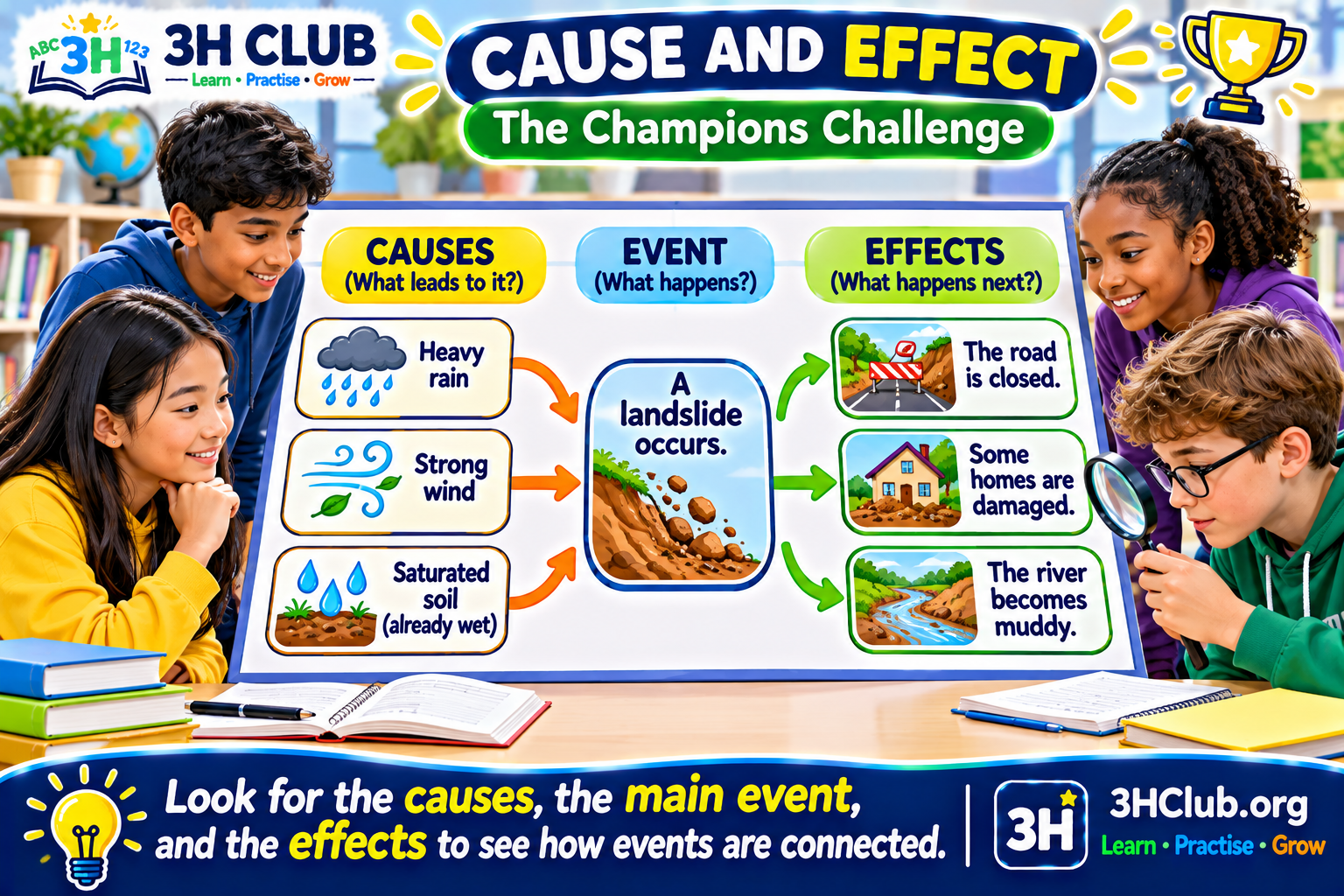
In this Champions lesson, you’ll explore situations where several causes work together, one event produces multiple effects, and a single action starts a chain of consequences.
You’ll also learn to distinguish what a passage proves from what it merely suggests.
Ready to think like a detective, scientist, and problem-solver?
Let’s begin!
🎯 What Will You Learn?
By the end of this lesson, you will be able to:
- ✅ Identify several causes of one event.
- ✅ Recognise several effects of a single cause.
- ✅ Explain how causes and effects form chains.
- ✅ Distinguish direct effects from indirect effects.
- ✅ Recognise immediate and longer-term consequences.
- ✅ Identify cause-and-effect signal words.
- ✅ Separate evidence from assumptions.
- ✅ Explain complex relationships using information from a passage.
- ✅ Evaluate which causes are most important.
🏆 Champions’ Goal: Don’t stop at asking, “What happened?” Investigate why it happened, what contributed to it, and what happened because of it.
🔵 1. A Quick Reminder: What Are Cause and Effect?
A cause is something that makes an event happen or contributes to it.
An effect is something that happens because of a cause.
📖 Simple Example
Heavy rain fell throughout the afternoon, so the playground became muddy.
🌧️ Cause: Heavy rain fell.
🟤 Effect: The playground became muddy.
The connection is straightforward.
CAUSE → EFFECT
But real-life situations are not always that simple.
Sometimes:
- Several causes contribute to one effect.
- One cause produces several effects.
- One effect becomes the cause of another event.
- Some consequences happen immediately.
- Other consequences develop over time.
🧠 Champions’ Thinking Question
If a playground becomes muddy after heavy rain, is the rain always the only cause?
Not necessarily.
The type of soil, drainage system, and amount of grass may also affect how muddy the playground becomes.
This is an important lesson:
One event can have several contributing causes.
🟢 2. Multiple Causes: When Several Things Lead to One Result
Sometimes an event happens because several conditions or actions come together.
These are called multiple causes.
📖 Example: The School Garden
Read this passage:
For several weeks, the school garden received very little rain. Some plants were growing in shallow soil that dried out quickly. During the school holidays, nobody was available to water them regularly. When the children returned, several plants had wilted.
🔍 What Happened?
Several plants wilted.
This is the effect.
🌱 What Caused It?
The passage gives us three contributing causes.
Cause 1: There was very little rain.
Cause 2: Some plants grew in soil that dried out quickly.
Cause 3: Nobody watered the plants regularly during the holidays.
Together, these conditions contributed to the plants wilting.
🧩 Cause-and-Effect Diagram
CAUSE 1: Little rainfall
CAUSE 2: Soil dried out quickly
CAUSE 3: Irregular watering
⬇️
EFFECT: Several plants wilted.
⭐ Important!
Not every cause has the same importance.
Some causes may have a greater influence than others.
For example, a lack of water may be the main reason the plants wilted, while the shallow soil made the problem worse.
When several causes work together, we call them contributing factors.
🏆 Champions’ Challenge
What might have happened if someone had watered the plants regularly?
Possible answer: The plants might have remained healthier despite the dry weather.
However, we cannot be certain because other conditions could still affect their growth.
🟡 3. Multiple Effects: When One Cause Leads to Several Results
A single event can produce more than one consequence.
These are called multiple effects.
📖 Example: A New Bridge
A new bridge opened between two communities that had previously been separated by a wide river.
People could now travel between the communities more quickly. Local businesses began receiving customers from both sides of the river. Emergency vehicles also gained a shorter route between the two areas.
🔍 What Was the Main Cause?
A new bridge opened.
🌉 What Were the Effects?
Effect 1: People could travel more quickly.
Effect 2: Businesses gained access to more customers.
Effect 3: Emergency vehicles had a shorter route.
🧩 Cause-and-Effect Diagram
CAUSE: A new bridge opened.
⬇️
EFFECT 1: Faster travel.
EFFECT 2: More potential customers for businesses.
EFFECT 3: Shorter emergency routes.
💡 Think Deeper
Could the bridge also have less positive effects?
Possibly.
For example, increased traffic might create more noise in nearby areas.
But unless the passage provides evidence of this, it remains a possible consequence, not a confirmed one.
⭐ Reading Tip
When answering questions about multiple effects, separate:
What the passage tells you from what you think might happen.
Both kinds of thinking are useful, but they are not the same.
🟣 4. Cause-and-Effect Chains: When One Event Leads to Another
Sometimes an effect becomes the cause of a new event.
This creates a cause-and-effect chain.
📖 Example: The Library Book
Amara forgot to return her library book on Monday. Because the book was still at home, another student could not borrow it when planned. The librarian contacted Amara, who remembered the book and returned it the next morning.
Let’s follow the events.
1. Amara forgot to return the book.
⬇️
2. The book remained at home.
⬇️
3. Another student could not borrow it as planned.
⬇️
4. The librarian contacted Amara.
⬇️
5. Amara returned the book.
Notice something important.
The book remaining at home was an effect of Amara forgetting it.
But it also became a cause of another student being unable to borrow it.
🧠 A Key Idea
In a cause-and-effect chain, an event can be both:
An effect of something earlier
and
A cause of something later.
🔍 Try It!
Read this chain:
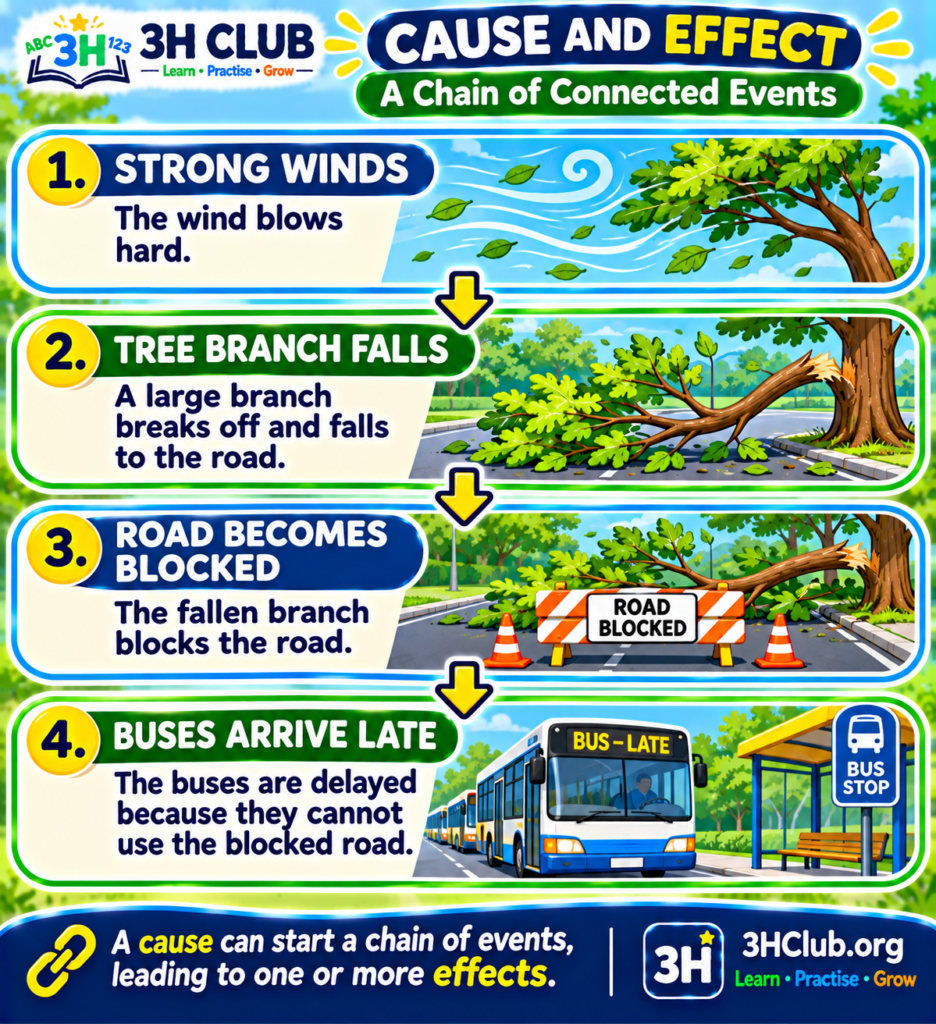
Strong winds knocked down a tree branch. The branch blocked the road. Traffic slowed, causing several buses to arrive late.
Complete the chain:
Strong winds → __________ → __________ → __________
Answer:
Strong winds → Branch falls → Road becomes blocked → Buses arrive late.
⭐ Champions’ Tip
When a passage contains several events, draw arrows between the events that are actually connected.
Don’t assume that every event causes the next one simply because it appears next in the paragraph.
🟠 5. Direct and Indirect Effects
Some consequences happen because of an event without another event in between.
These are called direct effects.
Other consequences happen through a chain of events.
These are called indirect effects.
📖 Example: The Power Cut
During a storm, strong winds damaged an electricity line.
The damage caused a power cut in several streets.
Without electricity, the traffic lights at a nearby junction stopped working.
Traffic officers arrived to direct vehicles, and some drivers experienced delays.
⚡ Direct Effect
The damaged electricity line caused a power cut.
Damaged electricity line → Power cut
🚦 Indirect Effect
Some drivers experienced delays because the power cut affected the traffic lights.
Damaged electricity line → Power cut → Traffic lights stop working → Traffic delays
The delays are an indirect consequence of the damaged line.
🧠 Why Does This Matter?
Recognising direct and indirect effects helps you understand how events are connected.
It also helps you explain complicated situations clearly.
✏️ Your Turn!
Heavy rain caused a river to overflow. Floodwater entered several homes. Families had to move temporarily to safer places.
Question 1: What was a direct effect of the heavy rain?
Question 2: What was an indirect effect of the heavy rain?
Question 3: Explain the chain connecting them.
🔴 6. Immediate and Longer-Term Consequences
Not all effects happen at the same time.
Some happen almost immediately.
Others take days, months, or even years to develop.
📖 Example: Planting Trees
A community planted hundreds of young trees in a neighbourhood.
Possible immediate effects:
- Residents spent time working together.
- Newly planted trees appeared along the streets.
- The community needed to water and care for the young trees.
Possible longer-term effects:
- Mature trees could provide more shade.
- Birds and insects might find additional habitats.
- Tree roots could help reduce soil erosion in some places.
⏰ Immediate Effects
These happen soon after the cause.
📅 Longer-Term Effects
These develop over a longer period.
⭐ Important!
Longer-term effects are not always guaranteed.
For example, newly planted trees will only provide substantial shade later if they survive and grow.
This is why careful readers pay attention to words such as:
may, might, could, probably, and possibly.
These words show that an outcome is uncertain.
🟤 7. Cause-and-Effect Signal Words
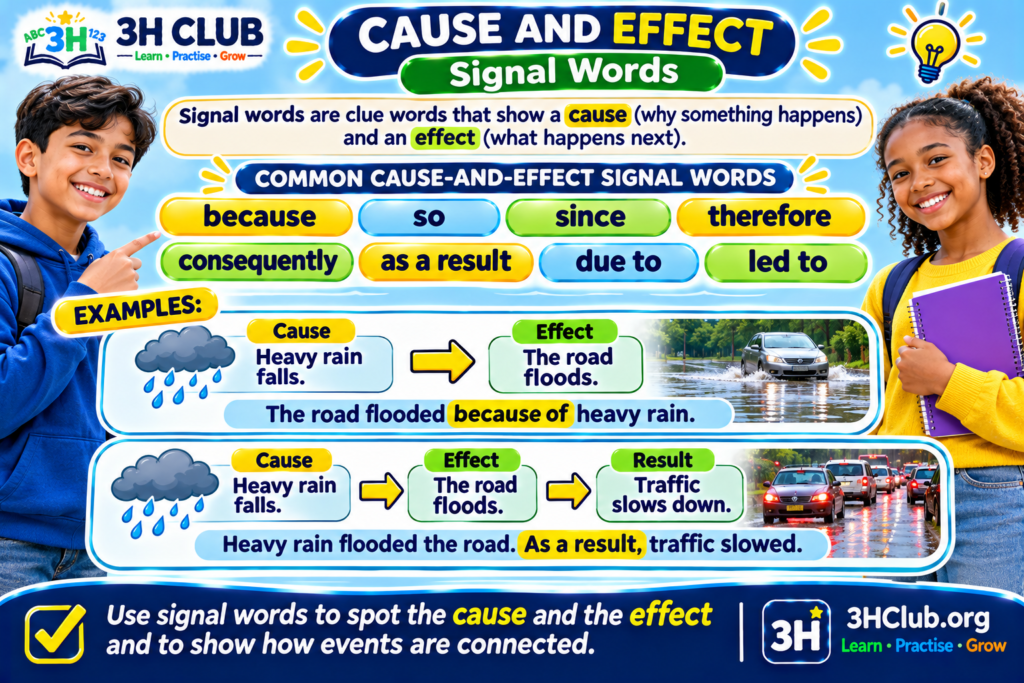
Writers often use special words and phrases to show relationships between events.
These are called signal words.
📚 Common Cause-and-Effect Signal Words
| Signal Word or Phrase | Example |
|---|---|
| because | The match was cancelled because the field was flooded. |
| so | The field was flooded, so the match was cancelled. |
| since | Since the road was closed, drivers used another route. |
| therefore | The bridge was unsafe. Therefore, it was closed. |
| as a result | Heavy rain damaged the path. As a result, it needed repairs. |
| consequently | The bus broke down. Consequently, the passengers arrived late. |
| due to | The event was postponed due to strong winds. |
| caused by | The power cut was caused by damage to an electricity line. |
| led to | The new library led to more opportunities for reading. |
| resulted in | The storm resulted in several fallen trees. |
🧠 Look at the Sentence Order
Cause first:
The road flooded, so the bus was delayed.
Effect first:
The bus was delayed because the road flooded.
Both sentences describe the same relationship.
The cause and effect do not have to appear in a particular order.
⭐ Champions’ Warning
Signal words are helpful, but they do not automatically prove a causal relationship.
You still need to understand the meaning of the passage.
For example:
The children were tired because they had been running.
Here, because clearly introduces the cause.
But in this sentence:
The children enjoyed the game because it was exciting.
The word because explains a reason for their feelings, rather than a physical event.
Both are valid cause-and-effect relationships.
🧪 8. Reading Challenge 1: The River That Changed
🌍 Topic: Nature and the Environment
📖 Read the Passage
The River That Changed
For many years, a river flowed through a small farming community.
During the rainy season, the river sometimes rose above its usual level. However, most of the surrounding land absorbed the extra water.
Over time, several changes took place.
Trees were removed from parts of the riverbank to make space for new buildings. Some open land was covered with roads and concrete surfaces.
These changes affected how rainwater moved through the area.
During a particularly heavy storm, rain fell faster than the ground and drainage systems could absorb or carry it away.
Water flowed into the river, which rose rapidly and overflowed its banks.
Several nearby fields became flooded.
Farmers could not reach some of their crops, and parts of the local road were temporarily closed.
In the following weeks, the community discussed ways to reduce future flood damage.
Possible solutions included improving drainage, protecting vegetation along the riverbank, and creating areas where rainwater could soak into the ground.
🔍 Comprehension Questions
1. What was the main event described in the passage?
2. Identify three factors that contributed to the flooding.
3. Why might removing trees from the riverbank have increased flood risks?
4. What were two direct effects of the river overflowing?
5. What were two consequences for the community?
6. Why did the community discuss improving drainage?
7. Which proposed solution might help rainwater soak into the ground?
8. Explain how human activity and natural weather conditions worked together in this situation.
⭐ Champions’ Challenge
Was the heavy storm the only cause of the flooding?
Explain your answer using evidence.
🏖️ 9. Reading Challenge 2: The Sandcastle Competition
🏝️ Topic: Stories and Everyday Situations
📖 Read the Passage
The Sandcastle Competition
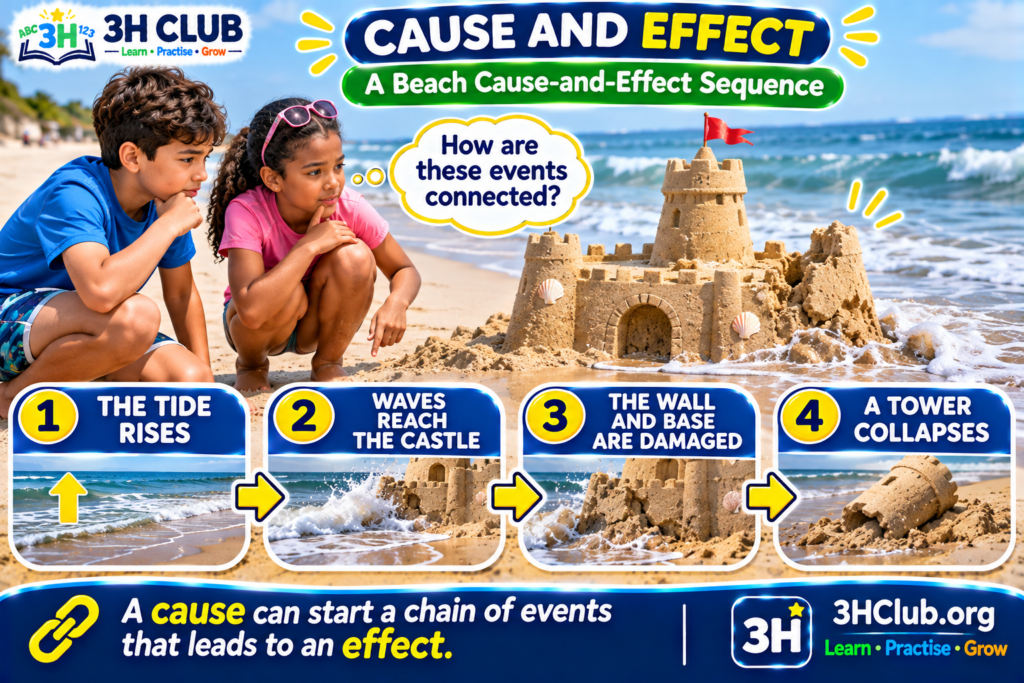
Leo and his sister, Mia, entered a sandcastle-building competition at the beach.
They arrived early and chose a spot close to the water because the sand was damp and easy to shape.
For nearly an hour, they built a large castle with towers, walls, and a deep trench around it.
As the morning continued, the tide began to rise.
The waves gradually reached farther up the beach.
Leo noticed the change and suggested moving their equipment farther inland.
However, they decided to finish decorating the castle first.
A strong wave eventually reached the outer wall.
The wall collapsed, allowing water to flow into the trench.
A second wave washed away part of the castle’s base.
One tower then fell.
Leo and Mia were disappointed, but they quickly began building a smaller castle farther from the water.
This time, they checked the position of the waves before choosing where to build.
🔍 Comprehension Questions
1. Why did Leo and Mia choose a spot close to the water?
2. What natural event threatened their castle?
3. Identify two factors that contributed to the castle being damaged.
4. What was the immediate effect of the first strong wave?
5. How did the first wave contribute to later damage?
6. What happened after the second wave reached the castle?
7. Why did Leo and Mia choose a different location for their next castle?
8. What lesson might the children have learned?
⭐ Champions’ Challenge
Imagine the children had moved the castle-building activity farther inland when Leo first noticed the rising tide.
How might the outcome have been different?
Explain your reasoning.
🐶 10. Reading Challenge 3: The Puppy and the Open Gate
🐾 Topic: Stories, Decisions, and Consequences
📖 Read the Passage
The Puppy and the Open Gate
One afternoon, Max was helping his family carry groceries into the house.
The garden gate had been left open while everyone moved bags from the car.
At the same time, Max’s younger brother was playing with a ball in the garden.
When the ball rolled towards the driveway, the family’s puppy, Toby, chased after it.
Because the gate was open, Toby ran out onto the pavement.
Max noticed the puppy was missing a few minutes later.
He searched the garden and called Toby’s name.
When Toby did not return, Max told his parents.
The family began searching the nearby streets.
Fortunately, a neighbour had seen Toby near a small park and contacted the family.
Toby was safely reunited with them.
Afterwards, Max’s family agreed to keep the gate closed whenever Toby was playing outside.
🔍 Comprehension Questions
1. What was the main event in the passage?
2. Identify two causes that contributed to Toby leaving the garden.
3. What was the direct effect of the gate being open?
4. What happened because Max could not find Toby?
5. How did the neighbour help change the outcome?
6. What was one positive consequence of the experience?
7. Explain the chain of events that led to Toby being reunited with his family.
8. Was the open gate the only factor involved? Explain.
⭐ Champions’ Challenge
Which action might have prevented Toby from leaving the garden?
Support your answer using the passage.
🔬 11. Reading Challenge 4: The Science Experiment
⚗️ Topic: Science and Fair Testing
📖 Read the Passage
Why Did One Plant Grow Faster?
A class wanted to investigate how light affects plant growth.
The children planted bean seeds in identical pots.
They used the same type of soil and gave each pot the same amount of water.
However, the pots were placed in different locations.
One pot was placed near a sunny window.
Another was placed in a cupboard.
After two weeks, the children noticed that the plants had developed differently.
The plant near the window was green and growing steadily.
The plant in the cupboard had pale leaves and a long, weak-looking stem.
The class discussed why the plants looked different.
They knew that plants need light for photosynthesis, the process that allows them to make sugars using light energy.
However, their teacher reminded them that plant growth can also be affected by temperature, water, soil conditions, and other factors.
The children decided that a more carefully controlled experiment would help them understand the role of light.
🔍 Comprehension Questions
1. What question was the class investigating?
2. What conditions did the children try to keep the same?
3. What was different about the plants’ locations?
4. Describe two differences between the plants after two weeks.
5. Why might the plant in the cupboard have looked pale and weak?
6. Why did the teacher mention other factors that affect plant growth?
7. Can the children be completely certain that light caused every difference? Explain.
8. What could the class improve in a future experiment?
⭐ Champions’ Challenge
Explain why scientists try to change only one important factor at a time during a fair test.
🏛️ 12. Reading Challenge 5: The Invention That Changed Communication
📜 Topic: History and Technology
📖 Read the Passage
The Printing Press and Its Effects
Before printing became widespread in Europe, many books were copied by hand.
This process could take a great deal of time.
Books were often expensive and difficult for ordinary people to obtain.
During the fifteenth century, Johannes Gutenberg developed a printing system in Europe using movable metal type and a press.
His system made it possible to produce multiple copies of written material more efficiently.
As printing spread, books became more widely available.
More people gained opportunities to read printed information.
Printed materials also helped ideas travel between towns and countries.
Over time, printing contributed to changes in education, communication, science, and public discussion.
However, these changes did not happen immediately or equally everywhere.
Other factors, including education, language, wealth, and access to books, also influenced who could benefit from printed information.
🔍 Comprehension Questions
1. How were many books copied before printing became widespread in Europe?
2. Why were books often expensive?
3. What did Gutenberg’s printing system make easier?
4. Identify three effects of the spread of printing.
5. Which effects developed over a longer period?
6. Why didn’t everyone benefit equally from printing?
7. Explain how one invention could contribute to several changes in society.
8. Why is it important to recognise other factors besides the printing press?
⭐ Champions’ Challenge
Explain the difference between saying:
“The printing press caused every change in education.”
and
“The printing press contributed to changes in education.”
Which statement is more accurate? Why?
🧠 13. Critical Thinking: Does One Event Really Cause Another?
This is one of the most important Champions skills.
Sometimes two events happen together.
But that does not always mean one caused the other.
📖 Example: Ice Cream and Sunshine
On hot days, more people buy ice cream. On those same days, more people visit the beach.
Does buying ice cream cause people to visit the beach?
No.
Hot weather may encourage both activities.
This means the events are connected to a shared factor.
🔍 Another Example
Every time Maya wears her lucky socks, her football team wins.
Can we conclude that the socks cause the team to win?
No.
The team’s performance depends on many factors, including practice, teamwork, and the other team’s performance.
⭐ Champions’ Rule
Just because two things happen together doesn’t mean one causes the other.
To decide whether a cause-and-effect relationship is reasonable, ask:
- Is there evidence connecting the events?
- Does the explanation make sense?
- Could another factor explain the result?
- Is the conclusion supported by the passage?
- Are we confusing coincidence with cause and effect?
🏆 Quick Challenge
The school installed new computers in September. By December, students’ test scores had improved.
Can we conclude that the computers caused the improvement?
Possible answer: Not from this information alone.
The computers might have helped, but other factors could also have contributed.
For example, students may have practised more or received additional support.
✏️ 14. Activity 1: Identify Multiple Causes
Read each situation.
Find at least two contributing causes.
Question 1
A football match was postponed after heavy rain flooded the pitch and strong winds damaged part of the fence.
Effect: The match was postponed.
Cause 1: _______________________
Cause 2: _______________________
Question 2
The school garden produced fewer vegetables because rainfall was low, some plants were attacked by insects, and several seedlings were planted too close together.
Effect: Fewer vegetables grew.
Cause 1: _______________________
Cause 2: _______________________
Cause 3: _______________________
Question 3
The class arrived late for its museum visit. The bus had experienced mechanical problems, and heavy traffic delayed the journey further.
Effect: The class arrived late.
Cause 1: _______________________
Cause 2: _______________________
🧩 15. Activity 2: Identify Multiple Effects
Read each situation.
Find three effects.
Question 1
A new public library opened in the community. Children gained access to more books, adults attended learning workshops, and families began visiting the library together.
Cause: A new public library opened.
Effect 1: _______________________
Effect 2: _______________________
Effect 3: _______________________
Question 2
Heavy rain damaged several roads. School buses took longer routes, some workers arrived late, and repair teams were called to inspect the damage.
Cause: Heavy rain damaged roads.
Effect 1: _______________________
Effect 2: _______________________
Effect 3: _______________________
🔗 16. Activity 3: Complete the Cause-and-Effect Chains
Chain A: The Missing Homework
Complete the chain.
1. Maya leaves her homework on the kitchen table.
⬇️
2. _______________________
⬇️
3. Maya cannot hand in her homework at school.
⬇️
4. _______________________
Chain B: The Heavy Rain
Complete the chain.
1. Heavy rain falls for several hours.
⬇️
2. _______________________
⬇️
3. The road becomes flooded.
⬇️
4. _______________________
Chain C: The School Fundraiser
Complete the chain.
1. Students organise a successful fundraiser.
⬇️
2. _______________________
⬇️
3. The school buys new library books.
⬇️
4. _______________________
⭐ Extra Challenge
Create your own cause-and-effect chain with at least five connected events.
📝 17. Activity 4: Explain the Connection
Read each situation and answer in complete sentences.
Situation 1
Several trees were removed from a hillside. During heavy rain, loose soil was washed downhill.
Question: How might removing trees have contributed to soil erosion?
Situation 2
A town introduced a new bus service. More residents began using public transport, and some people stopped driving to work every day.
Question: What possible effects could this change have on traffic?
Situation 3
A school introduced a daily reading programme. Students spent more time reading, discovered new vocabulary, and became more confident discussing books.
Question: Explain how one school decision led to several outcomes.
⭐ Champions’ Writing Challenge
Choose one situation.
Write a paragraph explaining:
- The main cause.
- At least two effects.
- How the events are connected.
- Evidence from the passage.
Use at least two cause-and-effect signal words.
🏆 18. Final Champions Challenge: The Community Flood
Read this longer passage carefully.
🌧️ The Community Flood
For many years, the village of Greenbrook had experienced occasional flooding during the rainy season.
However, one year, the flooding was more severe than usual.
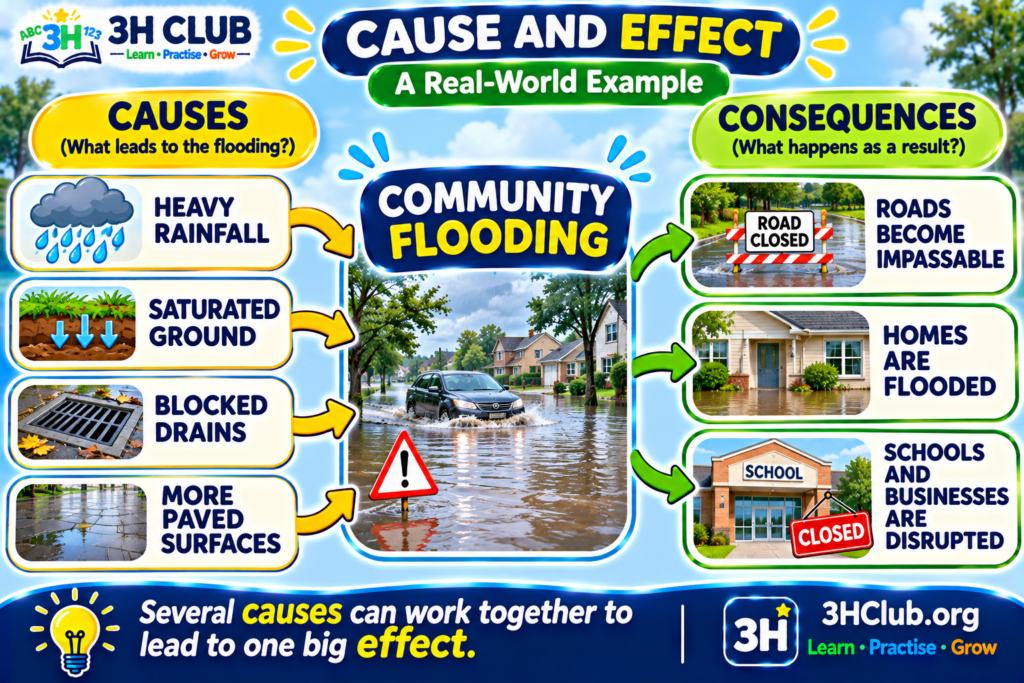
Several weeks of frequent rainfall had already soaked the ground.
When a powerful storm arrived, large amounts of rain fell in a short period.
The village’s drainage channels were partly blocked by leaves and rubbish.
Water could not flow away quickly enough.
At the same time, new buildings and paved surfaces had reduced the amount of open ground where rainwater could soak into the soil.
As the storm continued, water collected along the roads and flowed into nearby homes.
Several streets became impassable.
School buses were unable to complete their normal routes, and some businesses closed temporarily.
Emergency workers helped residents move to safer places.
After the flood, community leaders examined the causes of the damage.
They found that the unusually heavy rainfall had played a major role.
However, blocked drains and reduced areas of absorbent ground had also contributed.
The community began clearing drainage channels, improving waste collection, and planning more green spaces.
These changes were intended to reduce the risk of future flooding.
🔍 Final Challenge Questions
1. What was the main event in the passage?
2. Identify four factors that contributed to the flooding.
3. Which factor was a natural weather event?
4. Which factors involved human activity or changes to the environment?
5. What were three consequences of the flooding?
6. Which consequences happened immediately?
7. What actions did the community take afterwards?
8. Why might clearing drainage channels help reduce future flooding?
9. Why would it be inaccurate to say that blocked drains were the only cause of the flood?
10. Explain how several contributing factors worked together to make the flooding more severe.
⭐⭐⭐ Ultimate Champions Challenge
Write a paragraph of approximately 100–150 words answering this question:
“Why was the Greenbrook flood more severe than usual, and what were its consequences?”
Your paragraph should:
- Identify at least three contributing causes.
- Explain how the causes were connected.
- Describe at least three effects.
- Use evidence from the passage.
- Include at least three cause-and-effect signal words.
- Finish with a sensible conclusion.
✅ 19. Check Your Answers!
Let’s review the challenges.
Remember that some questions allow more than one reasonable answer.
Your explanation should always match the evidence.
🔵 Section 5: Direct and Indirect Effects
1. The river overflowing was a direct effect of the heavy rain.
2. Families having to move temporarily was an indirect effect.
3. Heavy rain → River overflows → Floodwater enters homes → Families move temporarily.
🌍 Reading Challenge 1: The River That Changed
1. The river overflowed and caused flooding.
2. Heavy rainfall, reduced vegetation, and increased paved surfaces contributed.
3. Trees and their roots can help hold soil in place and influence how water moves through the land.
4. Nearby fields flooded, and some roads became covered by water.
5. Farmers could not reach some crops, and local roads were temporarily closed.
6. The community wanted to reduce future flood damage.
7. Creating areas where rainwater can soak into the ground.
8. Heavy rainfall increased the amount of water, while changes to the land affected how water flowed and was absorbed.
Challenge: No. The storm was important, but the passage also describes changes to vegetation and paved surfaces.
🏖️ Reading Challenge 2: The Sandcastle Competition
1. The sand was damp and easy to shape.
2. The rising tide and approaching waves.
3. They built close to the water and delayed moving away from the waves.
4. The outer wall collapsed.
5. The damaged wall allowed water to enter the trench.
6. Water damaged the castle’s base, and a tower collapsed.
7. They wanted to avoid another wave damaging their work.
8. They may have learned to consider the tide before choosing a building spot.
Challenge: The castle might have avoided damage if it had been built farther from the rising water.
🐶 Reading Challenge 3: The Puppy and the Open Gate
1. Toby escaped from the garden and was later found.
2. The gate was open, and Toby chased the rolling ball.
3. Toby was able to run out of the garden.
4. Max told his parents, and the family began searching.
5. The neighbour spotted Toby and contacted the family.
6. The family decided to keep the gate closed when Toby was outside.
7. Toby escaped → Max noticed → Family searched → Neighbour contacted family → Toby returned home.
8. No. The rolling ball and Toby’s decision to chase it also contributed.
Challenge: Keeping the gate closed would probably have prevented Toby from escaping that way.
🔬 Reading Challenge 4: The Science Experiment
1. How light affects plant growth.
2. The soil type, amount of water, and type of pots.
3. One pot was near a sunny window, while the other was in a cupboard.
4. The window plant was green and growing steadily; the cupboard plant was pale with a long, weak-looking stem.
5. The lack of light may have affected its development.
6. Other conditions might also explain some differences.
7. No. Temperature and other factors may have varied between the locations.
8. They could keep temperature and other conditions more consistent, use more plants, and vary only the light exposure.
Challenge: A fair test helps scientists identify whether a particular factor contributes to a result.
🏛️ Reading Challenge 5: The Printing Press
1. Many books were copied by hand.
2. Copying books took considerable time and effort.
3. Producing multiple copies of written material.
4. Books became more widely available, ideas spread more easily, and opportunities to access written information increased.
5. Changes in education, communication, science, and public discussion developed over time.
6. Access depended on factors such as wealth, education, and language.
7. Printing made it easier to produce and distribute written information, contributing to several changes.
8. Other factors influenced who could access and benefit from printed materials.
Challenge: The second statement is more accurate because printing contributed to changes alongside other social and educational factors.
✏️ Activity 1: Multiple Causes
Question 1:
- Heavy rain flooded the pitch.
- Strong winds damaged the fence.
Question 2:
- Low rainfall.
- Insect damage.
- Seedlings planted too close together.
Question 3:
- Mechanical problems with the bus.
- Heavy traffic.
🧩 Activity 2: Multiple Effects
Question 1:
- Children gained access to more books.
- Adults attended workshops.
- Families visited the library together.
Question 2:
- School buses took longer routes.
- Some workers arrived late.
- Repair teams inspected the damage.
🔗 Activity 3: Cause-and-Effect Chains
Chain A:
- Maya leaves her homework at home.
- She arrives at school without it.
- She cannot hand it in.
- She needs to explain the situation to her teacher.
Chain B:
- Heavy rain falls.
- Water collects faster than it drains away.
- The road floods.
- Traffic is delayed or diverted.
Chain C:
- Students organise a fundraiser.
- The fundraiser raises money.
- The school buys library books.
- Students gain access to more reading materials.
📝 Activity 4: Explain the Connection
Situation 1: Removing trees may have reduced the roots holding the soil together, making erosion more likely during heavy rain.
Situation 2: More people using buses could reduce the number of cars on the road, potentially easing traffic.
Situation 3: The reading programme gave students more opportunities to read. As a result, they encountered new vocabulary and became more confident discussing books.
🌧️ Final Champions Challenge: The Community Flood
1. Greenbrook experienced unusually severe flooding.
2. Frequent earlier rainfall, a powerful storm, blocked drains, and increased paved surfaces.
3. Heavy rainfall during the storm.
4. Blocked drains and additional buildings or paved surfaces.
5. Flooded homes, impassable roads, and disrupted school or business activities.
6. Water collecting on roads and entering homes happened during the flooding.
7. The community cleared drains, improved waste collection, and planned green spaces.
8. Clear drains can allow water to flow away more effectively.
9. Several other factors also contributed.
10. The ground was already wet, the storm brought more rain, drains were blocked, and paved surfaces reduced water absorption.
⭐⭐⭐ Example Ultimate Challenge Answer
The Greenbrook flood was more severe than usual because several factors worked together. Frequent rainfall had already soaked the ground, so less water could soak into it when the powerful storm arrived. In addition, drainage channels were partly blocked by leaves and rubbish. More paved surfaces also reduced the amount of open ground that could absorb rainwater. Consequently, water collected on roads and entered nearby homes. Several streets became impassable, and school buses could not complete their usual routes. Some businesses also closed temporarily. As a result, emergency workers helped residents move to safer places. The flood shows how natural weather conditions and changes made by people can combine to increase flood damage. Improving drainage and protecting green spaces may help reduce future risks.
🎉 Excellent work, Champion!
You’ve explored complex relationships, investigated multiple causes and effects, and practised explaining your conclusions with evidence.
🌈 20. What Have You Learned?
Let’s review your new skills.
🔍 Multiple Causes
Several factors can contribute to one event.
🌱 Multiple Effects
One event can produce several consequences.
🔗 Cause-and-Effect Chains
An effect can become the cause of another event.
⚡ Direct Effects
Direct effects happen as a result of a cause without an intermediate event.
🌊 Indirect Effects
Indirect effects develop through one or more connected events.
⏰ Immediate and Longer-Term Effects
Some consequences happen quickly, while others develop over time.
🧠 Evidence and Critical Thinking
A good explanation uses information from the passage and considers other possible causes.
⭐ The Champions’ Golden Rule
DON’T JUST FIND THE CAUSE. INVESTIGATE THE WHOLE CONNECTION.
Ask:
What happened?
Why did it happen?
What other factors contributed?
What happened next?
What evidence supports my explanation?
🌟 Keep Learning with 3HClub!
You’re becoming a stronger reader and a more careful thinker.
Understanding complex cause-and-effect relationships will help you in:
- 📚 English – analysing stories and informational texts.
- 🔬 Science – understanding experiments and natural processes.
- 🌍 Geography – exploring weather, rivers, and environmental changes.
- 🏛️ History – investigating why important events happened.
- 🧠 Everyday life – understanding decisions and their consequences.
📖 Try These Reading Challenges
🐶 The Lost Puppy
Explore the events in the story.
Can you identify several factors that contributed to an important event?
What consequences followed?
🏖️ A Day at the Beach
Look for an event that causes several other things to happen.
Can you explain the chain of consequences?
🏆 Your Next Champions Challenge
Choose a news article, science passage, or historical event.
Create a cause-and-effect diagram showing:
THREE CONTRIBUTING CAUSES
⬇️
ONE MAIN EVENT
⬇️
THREE CONSEQUENCES
Then write a short paragraph explaining the connections.
Remember to support your ideas with evidence.
🔗 Investigate • Connect • Explain • Evaluate
Keep thinking, keep questioning, and keep growing!
3H CLUB — Learn • Practise • Grow