Clauses for Kids
Discover the Building Blocks Inside Sentences
Have you ever wondered how a sentence can hold more than one idea?
Look at this sentence:
Mia smiled because she was happy.
There are two important groups of words inside it:
Mia smiled
because she was happy
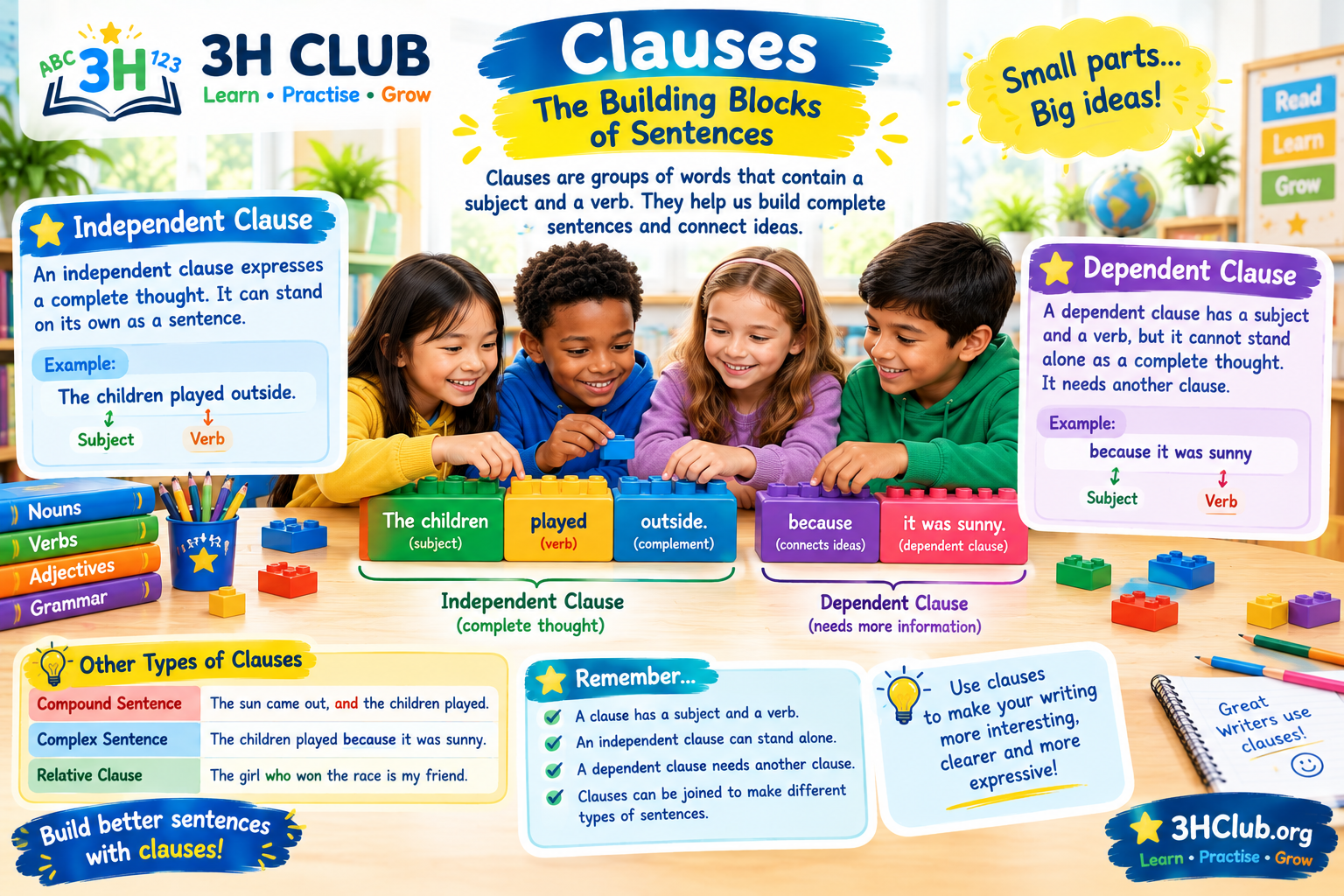
Both groups contain a subject and a verb. They are called clauses.
A clause is one of the building blocks we use to make sentences. Some clauses can stand on their own, while others need another clause to complete their meaning. Khan Academy
In this guide, you’ll learn how to spot clauses, tell different kinds apart, join clauses together, and use them to make your writing more interesting.
🔎 Quick Answer
What is a clause?
A clause is a group of words that contains a subject and a verb.
For example:
The dog barked.
The dog = subject
barked = verb
So The dog barked is a clause.
Can a clause be a complete sentence?
Yes!
Some clauses express a complete thought and can stand alone. These are called independent clauses.
Other clauses do not express a complete thought on their own. These are called dependent clauses.
For example:
The children played.
This makes sense by itself. It is an independent clause.
But:
because the children played
This makes us wonder what happened because they played. It needs more information.
It is a dependent clause. Khan Academy
🌟 A useful way to remember it
Clause = subject + verb
Independent clause = complete thought
Dependent clause = needs help
🧩 Clauses at a Glance
| Type | What it does | Example |
|---|---|---|
| Independent clause | Makes a complete thought | The dog barked. |
| Dependent clause | Needs another clause | because the dog was excited |
| Compound sentence | Joins independent clauses | The dog barked, and the cat ran. |
| Complex sentence | Joins an independent and dependent clause | The cat ran because the dog barked. |
Don’t worry if some of these names look new.
We’ll build your knowledge step by step.
⭐ Starters — Ages 6–7
Meet the Clause!
Around ages 6–7
A clause might sound like a big grammar word, but the idea is quite simple.
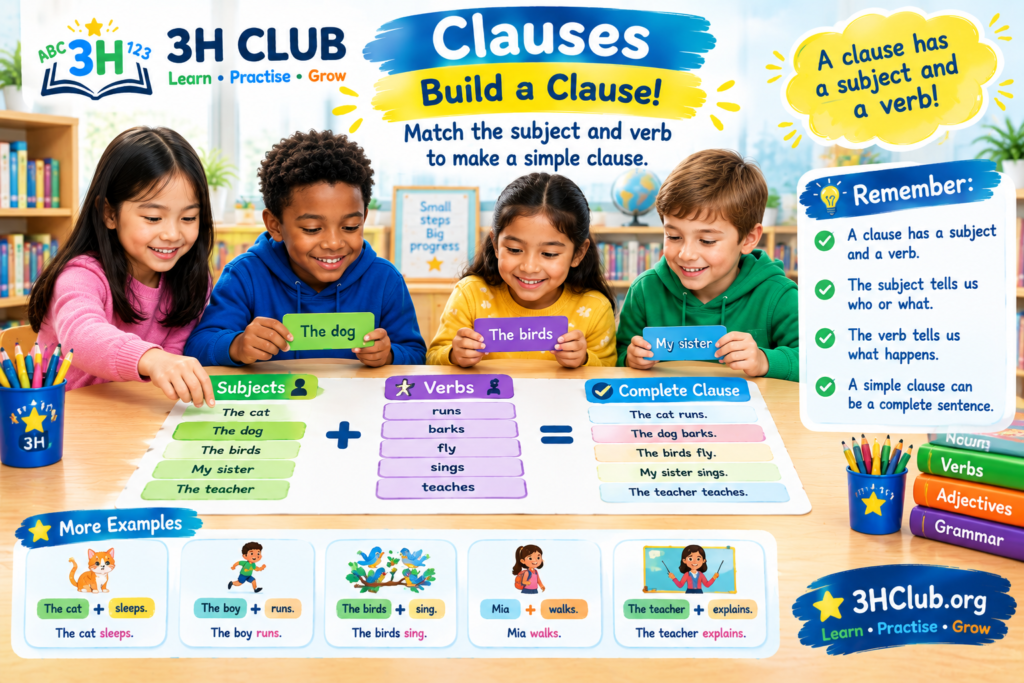
A clause is a word team that includes:
👤 a subject
and
🏃 a verb
Look at:
The cat sleeps.
Who is the sentence about?
👉 The cat
What does the cat do?
👉 sleeps
So:
The cat + sleeps = a clause
🐶 Find the Subject and Verb
Let’s practice.
1. The dog runs.
Subject: the dog
Verb: runs
2. Sam laughs.
Subject: Sam
Verb: laughs
3. The birds fly.
Subject: the birds
Verb: fly
4. My sister sings.
Subject: my sister
Verb: sings
Each one has a subject and a verb.
That means each one is a clause.
🧱 Clauses Can Be Small
A clause doesn’t have to be long.
Birds fly.
That’s a clause.
The little birds fly across the garden.
That’s a clause too.
Both have:
a subject + a verb
The second one simply gives us more information.
💡 Is It a Complete Thought?
Here’s a useful question:
Does it make sense all by itself?
Try:
The children laughed.
Yes!
We know what happened.
Now try:
because the joke was funny
Hmm…
We are waiting for more information.
What happened because the joke was funny?
We need more.
So:
The children laughed = can stand alone.
because the joke was funny = needs another clause.
You’ll learn the grammar names for these at the next levels.
🔗 Join Two Ideas
Sometimes we can connect two clauses.
Look at:
The sun was shining, and the children played outside.
We have:
The sun was shining
the children played outside
The word and joins the two ideas.
Try another:
I wanted to read, but my book was at school.
We have two ideas:
I wanted to read
my book was at school
The word but joins them.
🎯 Starters Activity: Clause or Not?
Look at each group of words.
1. The puppy barked.
A. Clause
B. Not a clause
2. Under the big tree.
A. Clause
B. Not a clause
3. My brother smiled.
A. Clause
B. Not a clause
4. The birds flew away.
A. Clause
B. Not a clause
5. In the blue box.
A. Clause
B. Not a clause
6. The girl opened the door.
A. Clause
B. Not a clause
⭐ Think Carefully
Remember:
A clause has a subject and a verb.
“Under the big tree” tells us where, but it doesn’t have a subject + verb.
So it is not a clause.
🧩 Build a Clause
Can you complete these?
1.
The rabbit ____________.
2.
My friend ____________.
3.
The birds ____________.
4.
Our teacher ____________.
There are lots of possible answers!
For example:
The rabbit hopped.
My friend laughed.
The birds sang.
Our teacher smiled.
🎯 Starters Challenge
Which part contains the subject and verb?
A.
The baby smiled.
Subject: __________
Verb: __________
B.
The children played outside.
Subject: __________
Verb: __________
C.
The colorful butterfly landed.
Subject: __________
Verb: __________
D.
Create your own clause.
Subject: __________________
Verb: __________________
✅ Answers
A. Subject: The baby — Verb: smiled
B. Subject: The children — Verb: played
C. Subject: The colorful butterfly — Verb: landed
D. Your answer can be different!
⭐ Starters Tip
When you see a group of words, ask:
“Can I find a subject?”
Then ask:
“Can I find a verb?”
If you can find both, you may have found a clause.
⭐⭐ Builders — Ages 8–9
Independent and Dependent Clauses
Around ages 8–9
Now you’re ready to learn two important clause names:
Independent clause
An independent clause expresses a complete thought.
It can stand on its own as a sentence.
For example:
The children played outside.
It makes complete sense.
So it is an independent clause.
Dependent clause
A dependent clause contains a subject and a verb, but it does not make a complete thought by itself.
For example:
because the children played outside
You may be thinking:
“What happened because the children played outside?”
It needs another clause.
So it is a dependent clause.
This distinction is one of the most important ideas to learn about clauses. Khan Academy
🟢 Independent = Can Stand Alone
Think of an independent clause as a clause that can stand by itself.
The rain stopped.
Complete thought? ✅
The birds flew away.
Complete thought? ✅
Lena finished her homework.
Complete thought? ✅
These can all stand alone.
🟡 Dependent = Needs a Partner
A dependent clause needs another clause to complete its meaning.
Look at:
because the rain stopped
Does that sound finished?
Not really.
Now add an independent clause:
We went outside because the rain stopped.
Now the idea is complete.
The two clauses are:
We went outside
because the rain stopped
The first is independent.
The second is dependent.
🚦 Look for Clue Words
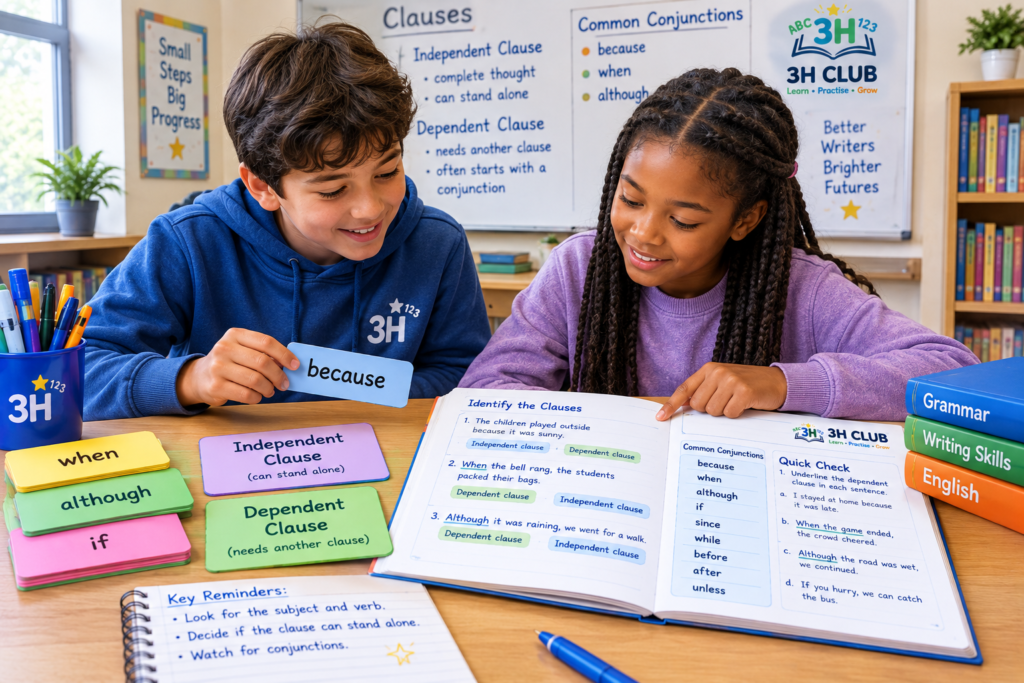
Dependent clauses often begin with words such as:
- because
- when
- if
- although
- since
- while
- before
- after
- unless
These words can signal that the clause needs more information. Khan Academy
For example:
When the bell rang, the students packed their bags.
When the bell rang = dependent clause
the students packed their bags = independent clause
The word when helps connect the two ideas.
🔗 Put the Clauses Together
Try these.
1.
because I was hungry
Add:
I made a sandwich because I was hungry.
2.
when the sun came out
Add:
We went outside when the sun came out.
3.
although it was raining
Add:
The children played football although it was raining.
The dependent clause can come before or after the independent clause.
Compare:
Because it was raining, we stayed inside.
and:
We stayed inside because it was raining.
When a dependent clause comes first, a comma is commonly used to separate it from the independent clause. Khan Academy
✏️ Clause or Phrase?
Here’s a useful difference.
A phrase
A phrase is a group of words that does not contain both a subject and a verb working together as a clause.
Example:
under the table
There is no subject + verb combination.
A clause
The cat slept.
There is:
The cat = subject
slept = verb
So it is a clause.
Compare:
| Group of words | Clause? |
|---|---|
| under the table | ❌ |
| after school | ❌ |
| the dog barked | ✅ |
| when the dog barked | ✅ |
| my sister laughed | ✅ |
This is a handy way to tell them apart.
🧠 One Sentence Can Have More Than One Clause
Look at:
I smiled because my friend told a funny joke.
There are two clauses:
I smiled
and
because my friend told a funny joke
Together, they make one sentence.
That means a sentence can contain more than one clause. Khan Academy
🎯 Builders Activity
1. Independent or dependent?
The dog slept.
2. Independent or dependent?
because the dog was tired
3. Independent or dependent?
when the game ended
4. Independent or dependent?
The players went home.
5. Join the clauses.
because I finished my homework
I watched television.
Write the complete sentence.
6. Join the clauses.
when the rain stopped
We went outside.
Write the complete sentence.
7. Find both clauses.
Maya smiled because she won the race.
Independent clause: ______________________
Dependent clause: ________________________
8. Find both clauses.
When the teacher arrived, the students became quiet.
Dependent clause: ________________________
Independent clause: ______________________
🕵️ Builders Clause Detective
Read this sentence:
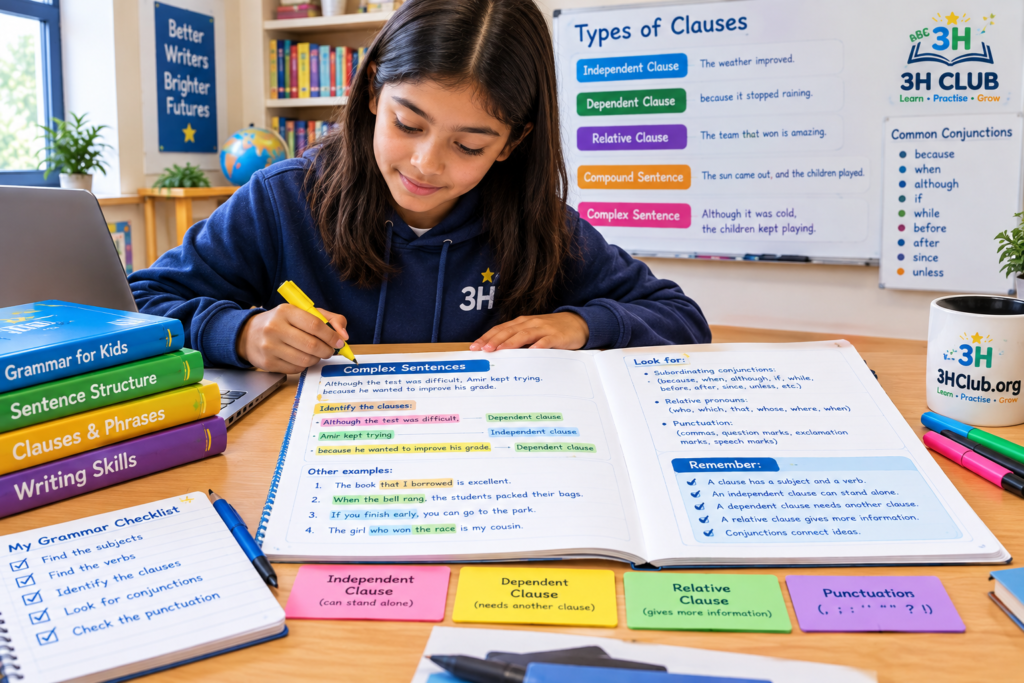
Although the test was difficult, Amir kept trying.
Ask yourself:
Which clause can stand alone?
👉 Amir kept trying.
Which clause needs help?
👉 Although the test was difficult.
The word although signals that the first clause depends on the second.
That’s detective work!
⭐⭐ Builders Challenge
Turn each pair into one sentence.
A.
The birds flew away.
because the dog barked
B.
We stayed inside.
because it was raining
C.
The team celebrated.
when they won the match
D.
Although the puzzle was difficult…
Finish the sentence.
E.
If I finish my work…
Finish the sentence.
✅ Builders Answers
Possible answers:
A. The birds flew away because the dog barked.
B. We stayed inside because it was raining.
C. The team celebrated when they won the match.
D. Answers will vary.
E. Answers will vary.
⭐⭐ Builders Tip
When you are unsure whether a clause is independent or dependent, don’t count the words.
Instead ask:
“Can this group of words stand alone and make a complete thought?”
If yes → independent
If no → dependent
A dependent clause can be long or short. Length does not decide its type. Khan Academy
⭐⭐⭐ Champions — Ages 10–11
Become a Clause Expert
Around ages 10–11
You already know that a clause contains a subject and a verb.
Now let’s look at how writers use clauses to create different sentence structures.
Three important ideas are:
1. Independent clauses
They express complete thoughts.
The team practiced.
2. Dependent clauses
They cannot stand alone.
because the match was tomorrow
3. Combining clauses
Writers join clauses to connect ideas and create more varied sentences.
This is where clauses become especially useful in writing.
🟢 Independent Clauses
An independent clause can stand alone as a complete sentence.
The storm ended.
It contains:
Subject: the storm
Verb: ended
And it expresses a complete thought.
You can also join two independent clauses.
The storm ended, and the children went outside.
The two independent clauses are:
The storm ended
the children went outside
The coordinating conjunction and joins them.
Other coordinating conjunctions include:
but, or, so, yet, for, nor
You may see these remembered as the FANBOYS conjunctions.
🟡 Dependent Clauses
A dependent clause has a subject and a verb, but it cannot stand alone as a complete sentence.
For example:
because the storm ended
Subject:
the storm
Verb:
ended
But the idea feels unfinished.
Now connect it:
The children went outside because the storm ended.
The dependent clause explains why the children went outside.
🔎 Find the Clause Clue
Many dependent clauses begin with a subordinating conjunction.
Here are some common ones:
| Word | Example |
|---|---|
| because | because I was tired |
| when | when the bell rang |
| although | although it was late |
| if | if you finish early |
| while | while the children played |
| since | since we arrived |
| before | before the movie started |
| after | after the rain stopped |
| unless | unless you change your plan |
These words help connect a dependent clause to the main idea. Khan Academy
🧱 Compound Sentences
A compound sentence joins two independent clauses.
For example:
The sun came out, and the children went outside.
Clause 1:
The sun came out.
Clause 2:
The children went outside.
Both can stand alone.
The conjunction and joins them.
Another example:
I wanted to play, but I had homework.
Both sides can stand alone:
I wanted to play.
I had homework.
🏗️ Complex Sentences
A complex sentence contains:
one independent clause + at least one dependent clause
For example:
Because it was raining, we stayed inside.
Dependent clause:
Because it was raining
Independent clause:
we stayed inside
Another example:
We stayed inside because it was raining.
The same two clauses are present, but their order has changed.
When the dependent clause comes first, use a comma to separate it from the independent clause.
When the independent clause comes first, a comma is usually not needed before a following dependent clause. Khan Academy
✨ Make Your Writing More Interesting
Compare these sentences:
The boy was tired. He kept running.
These are two short sentences.
Now connect the ideas:
Although the boy was tired, he kept running.
The second version shows a relationship between the ideas.
The word although tells us that being tired did not stop the boy from running.
Clauses help writers show:
- reasons
- times
- conditions
- contrasts
- results
- extra information
That’s one reason they are such useful building blocks.
🧠 Relative Clauses
Ready for another level?
A relative clause gives more information about a person or thing.
Look at:
The girl who won the race is my cousin.
The relative clause is:
who won the race
It gives us more information about the girl.
Common relative words include:
- who
- which
- that
- whose
- where
- when
For example:
The book that I borrowed is excellent.
The park where we played is nearby.
Relative clauses help you add useful details without creating lots of separate sentences. LearnEnglish – British Council
🔬 Clause Analysis
Let’s examine a longer sentence:
When the bell rang, the students packed their books because the lesson had finished.
This sentence contains three clauses:
Clause 1
When the bell rang
Dependent
Clause 2
the students packed their books
Independent
Clause 3
because the lesson had finished
Dependent
So we can see:
Dependent + Independent + Dependent
The clauses work together to tell one connected idea.
🚧 Watch Out for Sentence Fragments
One common mistake is writing a dependent clause as if it were a complete sentence.
For example:
❌ Because I was hungry.
Something is missing.
Because you were hungry… what happened?
Try:
✅ Because I was hungry, I made a sandwich.
Now the dependent clause is connected to an independent clause.
Another example:
❌ When the game finished.
What happened when the game finished?
Try:
✅ When the game finished, the players shook hands.
A dependent clause on its own can create a sentence fragment. Khan Academy
📝 Don’t Be Fooled by Long Clauses
A long clause isn’t automatically an independent clause.
Look at:
Although the team had practiced every afternoon for several weeks
It’s quite long.
But does it make a complete thought?
No.
We are still waiting to hear what happened.
So it is dependent.
You could complete it:
Although the team had practiced every afternoon for several weeks, they were still nervous before the final.
The important question is not:
“How long is the clause?”
The important question is:
“Does it express a complete thought?”
🎯 Champions Activity
1. Identify the independent clause.
Because the weather improved, the children returned to the playground.
2. Identify the dependent clause.
Because the weather improved, the children returned to the playground.
3. How many clauses are in this sentence?
Maya smiled when she saw her friend.
4. Identify the clauses.
Maya smiled when she saw her friend.
Independent: __________________________
Dependent: ____________________________
5. What type of sentence is this?
The sun was shining, and the birds were singing.
A. Simple
B. Compound
C. Complex
6. What type of sentence is this?
When the sun came out, we went outside.
A. Simple
B. Compound
C. Complex
7. Find the relative clause.
The book that you gave me is fascinating.
8. Fix the fragment.
Although the journey was long.
9. Add a dependent clause.
We went to the beach __________________________.
10. Add an independent clause.
Because I finished my project, __________________________.
✅ Champions Answers
- the children returned to the playground
- Because the weather improved
- Two clauses
- Independent: Maya smiled
Dependent: when she saw her friend - B. Compound
- C. Complex
- that you gave me
- Example: Although the journey was long, we enjoyed the trip.
- Example: We went to the beach because the weather was warm.
- Example: Because I finished my project, I had time to read.
🕵️ The Ultimate Clause Detective
Try this one:
Although Maya was tired, she finished her homework, and she read a chapter of her book before bedtime.
How many clauses can you find?
Clause 1
Although Maya was tired
Dependent
Clause 2
she finished her homework
Independent
Clause 3
she read a chapter of her book
Independent
Clause 4
before bedtime
This last part is not a clause because it does not contain its own subject + verb.
So the sentence contains three clauses, not four.
That is an important reminder:
Don’t count groups of words. Look for subject + verb combinations.
⭐⭐⭐ Champions Tip
When analyzing a complicated sentence:
Step 1: Circle the verbs.
Step 2: Find the subjects connected to those verbs.
Step 3: Separate the clauses.
Step 4: Ask whether each clause can stand alone.
Step 5: Look for conjunctions and other connecting words.
Step 6: Check the punctuation.
This turns a complicated sentence into smaller, easier pieces.
🧠 Big Clause Challenge
Ready for the final challenge?
⭐ 1. Which is a clause?
A. under the table
B. the puppy barked
C. after school
⭐ 2. Which word is the verb?
The birds flew away.
⭐⭐ 3. Is this independent or dependent?
The children laughed.
⭐⭐ 4. Is this independent or dependent?
because the children laughed
⭐⭐ 5. Complete the sentence.
We went outside because __________________________.
⭐⭐ 6. Find both clauses.
I smiled when my friend arrived.
Independent: __________________________
Dependent: ____________________________
⭐⭐⭐ 7. What type of sentence is this?
The rain stopped, and the children ran outside.
⭐⭐⭐ 8. What type of sentence is this?
When the rain stopped, the children ran outside.
⭐⭐⭐ 9. Find the relative clause.
The dog that lives next door is very friendly.
⭐⭐⭐ 10. How many clauses?
When the bell rang, the students packed their books and left the classroom.
⭐⭐⭐ 11. Repair the fragment.
If we finish early.
⭐⭐⭐ 12. Write your own complex sentence.
Use because, when, although, if, or while.
✅ Big Challenge Answers
- B. the puppy barked
- flew
- Independent
- Dependent
- Answers will vary.
- Independent: I smiled
Dependent: when my friend arrived - Compound
- Complex
- that lives next door
- Two clauses
- When the bell rang
- the students packed their books and left the classroom
- Answers will vary. Example:
If we finish early, we can read a book.
- Answers will vary.
📌 Clause Checklist
Before you move on, see how many you can check.
I can…
☐ explain what a clause is.
☐ find the subject in a clause.
☐ find the verb in a clause.
☐ tell the difference between a clause and a phrase.
☐ identify an independent clause.
☐ identify a dependent clause.
☐ recognize common words that introduce dependent clauses.
☐ join clauses to make complete sentences.
☐ recognize a compound sentence.
☐ recognize a complex sentence.
☐ spot a sentence fragment caused by a dependent clause.
☐ identify a relative clause.
☐ use clauses to make my writing more interesting.
That’s a lot of grammar skill! 🌟
🌟 Why Clauses Matter
Clauses help you understand how sentences are built.
They can help you:
- connect ideas
- explain reasons
- show time
- show conditions
- show contrasts
- add details
- avoid sentence fragments
- make your writing more varied
- understand longer sentences when you read
Once you can spot clauses, a long sentence doesn’t have to look confusing.
You can break it into smaller parts and work out what each part is doing.
🔤 Keep Learning Grammar
Clauses connect to many other grammar skills.
If you are learning how sentences are built, these 3HClub lessons make useful companions:
- Nouns for Kids — learn about the words that can act as subjects and appear inside clauses.
- Verbs for Kids — strengthen your understanding of the verbs that clauses need.
- Adjectives for Kids — discover how descriptive words add information to sentences.
- Pronouns for Kids — practice pronouns that can act as subjects.
- 3HClub.org Grammar & Learning — continue exploring English and grammar.
❓ Clauses Questions & Answers
What is a clause?
A clause is a group of words containing a subject and a verb.
For example:
The children laughed.
The children is the subject and laughed is the verb.
What is an independent clause?
An independent clause expresses a complete thought and can stand on its own as a sentence.
The children laughed.
It makes sense by itself.
What is a dependent clause?
A dependent clause contains a subject and a verb but does not express a complete thought on its own.
because the children laughed
It needs another clause.
What is the difference between a phrase and a clause?
A clause contains a subject and a verb.
A phrase does not contain that complete subject-and-verb combination.
under the table = phrase
The cat slept = clause
Can a sentence have more than one clause?
Yes!
For example:
I smiled because my friend told a joke.
This sentence has two clauses:
I smiled
and
because my friend told a joke
What is a compound sentence?
A compound sentence joins two or more independent clauses.
For example:
I finished my homework, and I read a book.
Both clauses can stand alone.
What is a complex sentence?
A complex sentence contains an independent clause and at least one dependent clause.
For example:
Because I finished my homework, I read a book.
Because I finished my homework = dependent clause
I read a book = independent clause
What is a relative clause?
A relative clause gives more information about a person or thing.
For example:
The girl who won the race is my friend.
who won the race gives us more information about the girl.
Relative clauses commonly begin with words such as who, which, that, whose, where, or when. LearnEnglish – British Council
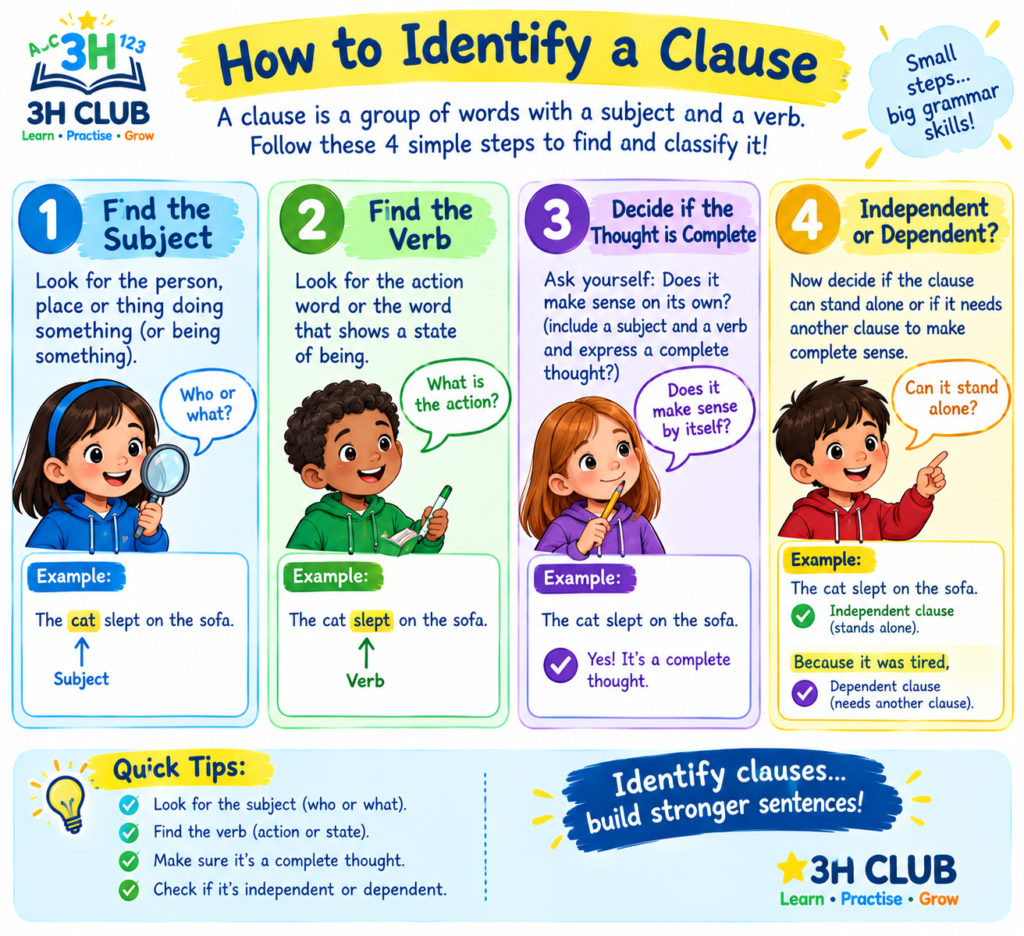
How do I find a clause?
Try these steps:
1. Find the verb.
2. Find the subject connected to it.
3. Put those words together.
4. Ask whether they express a complete thought.
That will help you identify the clause and decide whether it is independent or dependent.
Can a dependent clause be long?
Yes.
A dependent clause can be short or quite long.
Its length does not determine whether it is dependent.
The important question is whether it can express a complete thought by itself. Khan Academy
Why do writers use clauses?
Writers use clauses to connect ideas and show relationships such as time, reason, condition, contrast and more.
Clauses can help writing become clearer, more detailed and more interesting.
🌟 Final Clause Reminder
You don’t need to be nervous about the word clause.
Think of it as a building block.
🧩 Clause
Subject + Verb
🟢 Independent Clause
Subject + Verb + complete thought
🟡 Dependent Clause
Subject + Verb + needs more information
And remember your Sentence Detective questions:
Who or what? 🔎
What is the verb? 🔍
Does the idea make sense by itself? 💡
Keep practicing, and soon you’ll be spotting clauses in your reading and using them naturally in your own writing.
Learn • Practice • Grow! 🌟