Coordinates for Kids
Learn to Find Points on a Grid
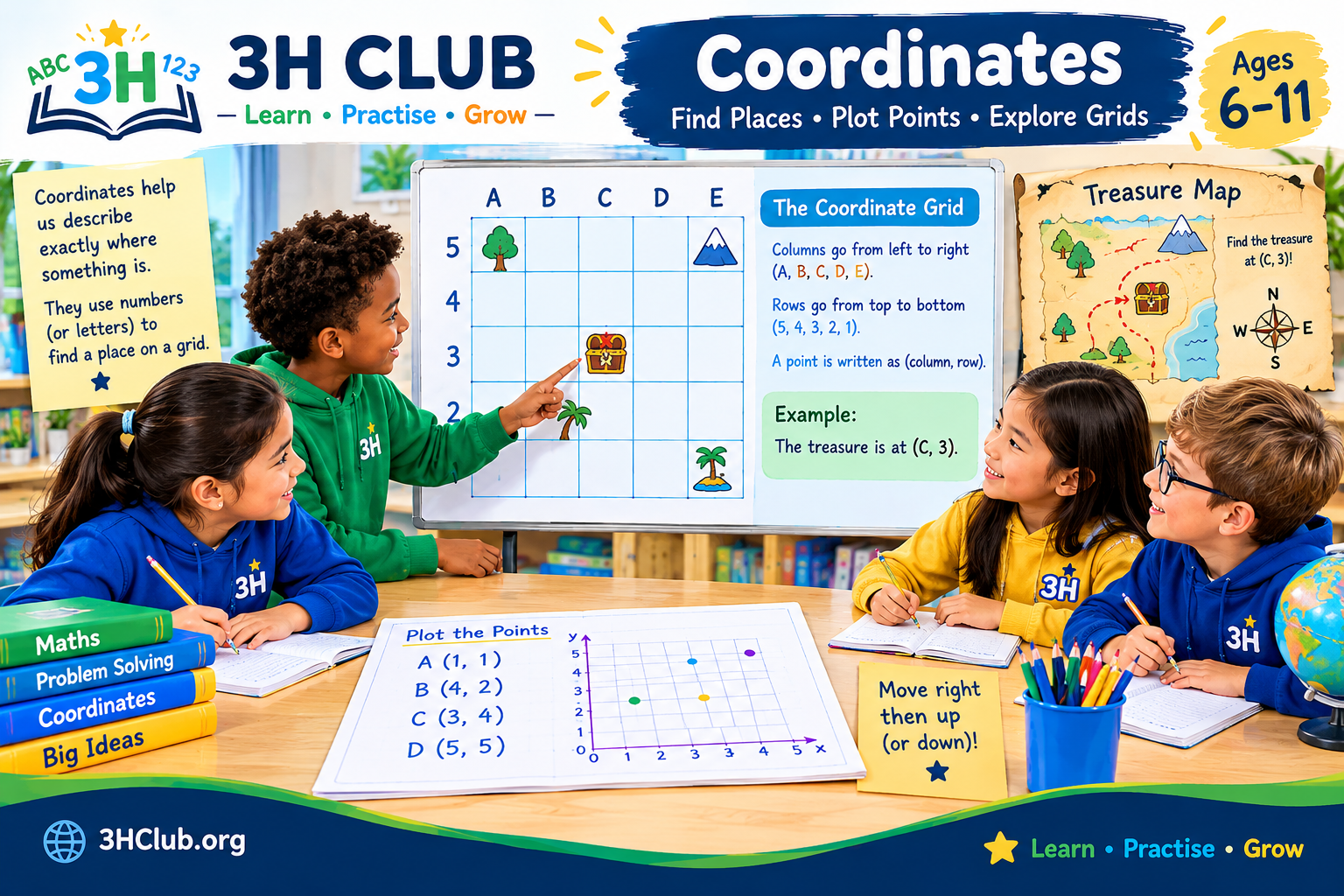
Have you ever followed a treasure map, played a board game or used a map to find a place? You were using an important mathematical idea: coordinates!
Coordinates help us describe exactly where something is. They can show where a treasure is hidden on a grid, where a character should move in a game or where a point belongs on a graph.
At 3HClub, you will learn about coordinates step by step. Start by finding places on a simple grid, then explore number pairs and discover how to plot points on a coordinate plane.
⭐ Starters — Ages 6–7
⭐⭐ Builders — Ages 8–9
⭐⭐⭐ Champions — Ages 10–11
By the end, you will be able to read and use coordinates, plot points, follow grid directions and explore positive and negative numbers.
Let’s find our way around!
⭐ Starters — Ages 6–7: Finding Places on a Grid
What Are Coordinates?
Coordinates are numbers or labels that help us describe the position of something.
Imagine a classroom with rows of desks. If someone asks you to find a particular desk, you might use its row and position to locate it.
A grid works in a similar way. It has rows and columns that help you find a place.
You might use coordinates to find:
- A treasure chest on a treasure map.
- A character on a board game.
- A square on a chessboard.
- A picture on a classroom grid.
- A place on a simple map.
Coordinates make finding places easier because they give us a clear way to describe where something is.
1. Understanding Rows and Columns
A grid is made up of horizontal rows and vertical columns.
- Rows go from left to right.
- Columns go from top to bottom.
Imagine a grid with three rows and four columns. Each square has a position.
Here is a simple example:
| Column 1 | Column 2 | Column 3 | Column 4 | |
|---|---|---|---|---|
| Row 1 | ⭐ | 🐱 | 🌳 | 🚗 |
| Row 2 | 🍎 | 🐶 | 🎈 | 🏠 |
| Row 3 | 🐟 | 🌻 | ⚽ | 🚀 |
Let’s practise finding things.
- The cat is in Row 1, Column 2.
- The dog is in Row 2, Column 2.
- The football is in Row 3, Column 3.
- The rocket is in Row 3, Column 4.
Notice that the row tells you how far down to look, while the column tells you which position to look across.
Remember: Always check how a grid is labelled. Some grids use letters and numbers instead of row and column names.
2. Following Directions on a Grid
You can use directions to move around a grid.
- Move right to go towards the right-hand side.
- Move left to go towards the left-hand side.
- Move up to go towards the top.
- Move down to go towards the bottom.
Imagine your game character starts in the middle of a grid.
If you move two squares right and one square up, you reach a different position.
The important thing is to count each square carefully. Moving two squares means passing across two grid spaces, not simply looking at the second line you see.
3. Using Coordinates to Find Treasure
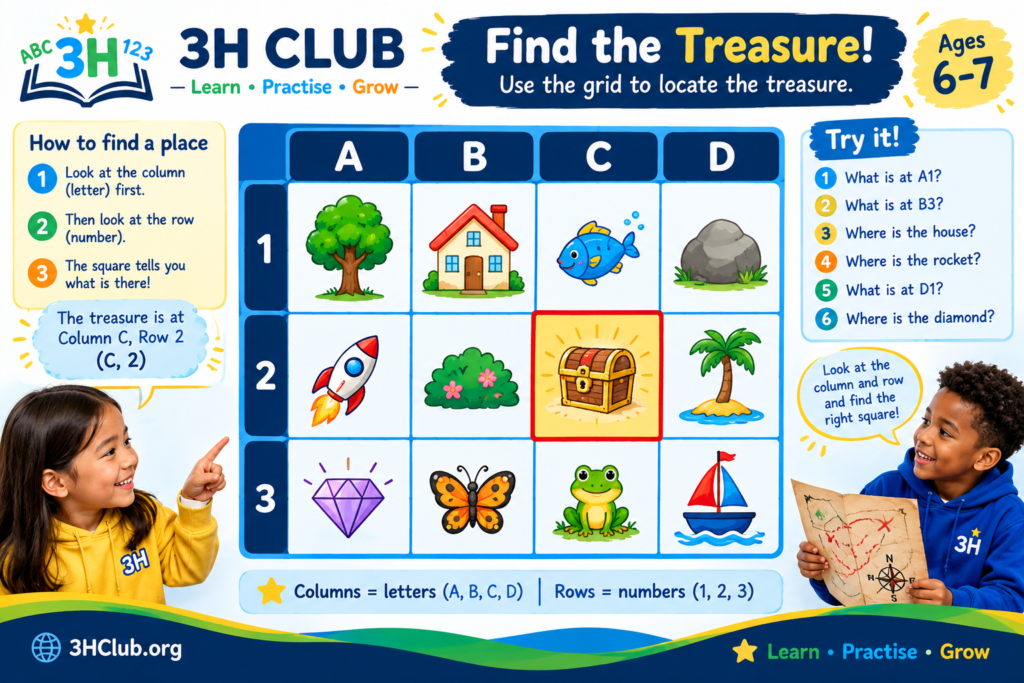
Imagine a treasure map with letters along the top and numbers down the side.
| A | B | C | D | |
|---|---|---|---|---|
| 1 | 🌳 | 🪨 | 🐇 | 🌼 |
| 2 | 🏠 | 🌊 | ⭐ | 🌴 |
| 3 | 🐢 | 🌷 | 🪵 | 💎 |
Suppose the treasure is at D3.
Find Column D, then look at Row 3. You will find the diamond!
This grid uses a letter and a number to identify each square. Other grids may put the number first or use a different labelling system, so always check the instructions.
⭐ Starters Activity: Grid Explorer
Use the grid below to answer the questions.
| A | B | C | D | |
|---|---|---|---|---|
| 1 | 🐱 | 🌟 | 🌳 | 🚗 |
| 2 | 🍎 | 🐶 | 🎈 | 🏠 |
| 3 | 🐟 | ⚽ | 🌻 | 🚀 |
- What is at B1?
- Where can you find the dog?
- What is at D2?
- Which object is at C3?
- If the treasure is at A3, what will you find there?
Check your answers
- A star.
- B2.
- A house.
- A sunflower.
- A fish.
⭐ Your Turn: Draw a Treasure Grid
Draw a grid with four columns and three rows. Fill its squares with objects such as trees, rocks, animals and treasure.
Label the columns A, B, C and D, and the rows 1, 2 and 3.
Now write three clues for someone else to solve, such as:
- Find the tree at C1.
- Find the treasure at D3.
- Find the animal at A2.
You have created your own coordinate treasure hunt!
⭐⭐ Builders — Ages 8–9: Reading and Writing Coordinates
You already know how grids help us locate objects. Now you will learn to describe positions more precisely using ordered pairs and a coordinate grid.
1. What Is a Coordinate Grid?
A coordinate grid is a grid with numbered lines that help us locate points.
On a simple coordinate grid, the horizontal direction is labelled with numbers, and the vertical direction is also labelled with numbers.
The horizontal line is called the x-axis, and the vertical line is called the y-axis.
The two axes meet at a point called the origin. On a standard coordinate plane, the origin is ((0,0)).
The x-axis helps you describe how far left or right a point is. The y-axis helps you describe how far up or down it is.
For now, we will start with positive numbers and points in the top-right part of the grid.
2. What Is an Ordered Pair?
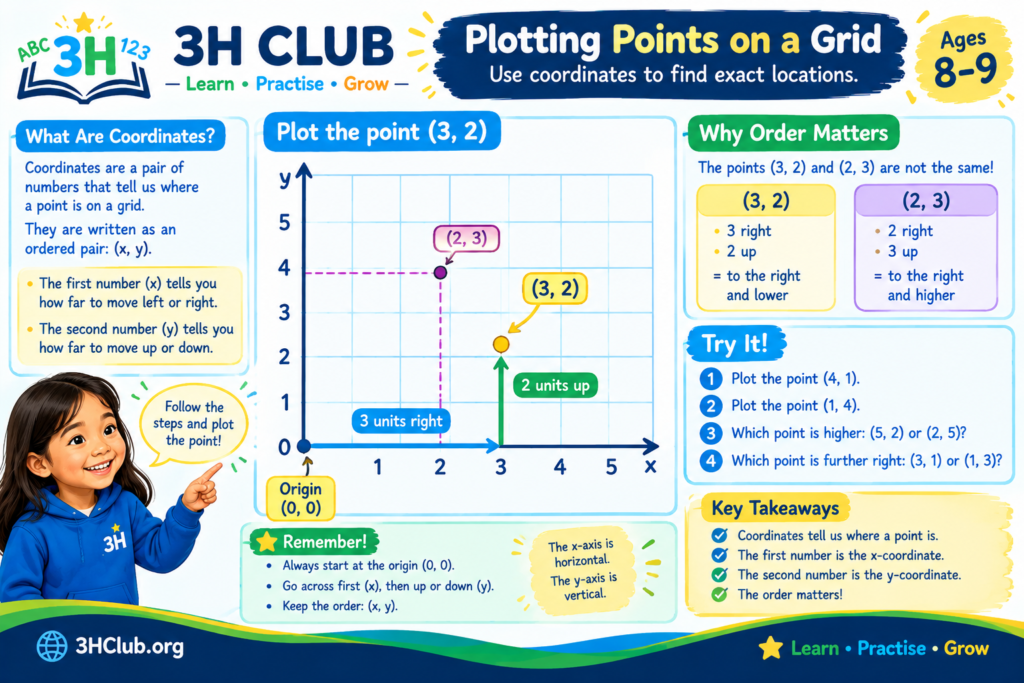
An ordered pair is a pair of numbers written inside brackets, like this:
[
(3,2)
]
The first number tells you the horizontal position, and the second number tells you the vertical position.
So, for the point ((3,2)):
- The first number, 3, tells you to move three units to the right.
- The second number, 2, tells you to move two units up.
Start at the origin ((0,0)), move right three units, then move up two units. Mark your point there.
Remember the order: across first, then up or down.
The pairs ((3,2)) and ((2,3)) are not the same. The first point is three units across and two units up. The second point is two units across and three units up.
3. How to Plot a Point
To plot a point means to mark its position on a coordinate grid.
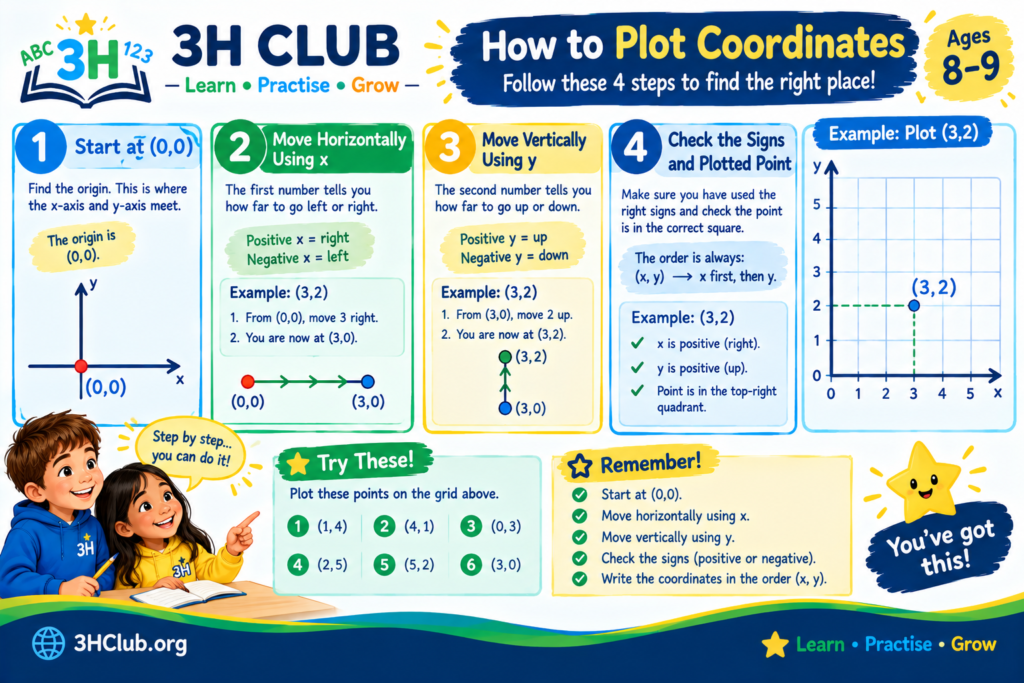
Let’s plot the point ((4,3)).
Step 1: Find the origin, ((0,0)).
Step 2: Move four units to the right along the horizontal direction.
Step 3: From there, move three units up.
Step 4: Mark the point and label it ((4,3)).
You have plotted a point!
Try these examples:
| Coordinate | Move across | Move vertically |
|---|---|---|
| ((2,1)) | 2 right | 1 up |
| ((5,3)) | 5 right | 3 up |
| ((1,4)) | 1 right | 4 up |
| ((4,2)) | 4 right | 2 up |
All these points are in the top-right section of the coordinate plane.
4. How to Read Coordinates
You can also work backwards. Instead of plotting a point, you can look at a marked point and find its coordinates.
Imagine a point is four units to the right and two units up from the origin.
Its coordinates are:
[
(4,2)
]
To read any point, ask yourself:
- How far across is it?
- How far up or down is it?
- Which number comes first?
- Which number comes second?
The horizontal value always comes first in a standard ordered pair, followed by the vertical value.
5. Coordinates in Everyday Life
Coordinates are useful far beyond maths lessons.
Maps: Grid references help people locate places on maps.
Video games: Coordinates can tell a computer where a character or object is on the screen.
Sports: A coach might use a grid to explain where players should stand.
Design: Architects and designers use coordinates to position points and shapes accurately.
Treasure hunts: A set of coordinates can guide you towards a hidden object.
Coordinates help turn a description of a place into a precise location.
⭐⭐ Builders Activity: Plot and Find
Use a coordinate grid that starts at ((0,0)) and has numbered axes from 0 to 6.
Answer these questions:
- Where would you plot the point ((2,4))?
- What are the coordinates of a point that is three units right and one unit up from the origin?
- Which point is farther right: ((2,5)) or ((4,5))?
- Which point is higher: ((3,2)) or ((3,5))?
- Are ((2,4)) and ((4,2)) the same point?
Check your answers
- Two units right and four units up.
- ((3,1)).
- ((4,5)), because its first coordinate is larger.
- ((3,5)), because its second coordinate is larger.
- No. Their horizontal and vertical positions are different.
⭐⭐ Challenge: Make a Coordinate Picture
Draw a coordinate grid from 0 to 6 on both axes.
Plot these points in order:
[
(1,1),\ (1,4),\ (3,4),\ (3,1)
]
Join the points with straight lines, then join the last point to the first.
What shape have you drawn?
Answer: A rectangle, with a width of 2 units and a height of 3 units.
Now add a point at ((2,5)) and label it as the sun above your rectangle. Your grid picture is complete!
⭐⭐⭐ Champions — Ages 10–11: Exploring the Coordinate Plane
You are ready to use coordinates with greater accuracy. In this section, you will explore the origin, axes, negative numbers, quadrants and distances between points.
1. Understanding the Coordinate Plane
A standard coordinate plane is formed by two number lines that cross at right angles.
- The horizontal line is the x-axis.
- The vertical line is the y-axis.
- The point where they meet is the origin, ((0,0)).
The x-axis shows horizontal position, while the y-axis shows vertical position.
Coordinates are written as an ordered pair:
[
(x,y)
]
The first number is the x-coordinate, and the second is the y-coordinate.
For example, the point ((5,2)) is five units to the right of the origin and two units above it.
A point such as ((0,4)) lies on the y-axis because its x-coordinate is zero. A point such as ((3,0)) lies on the x-axis because its y-coordinate is zero.
2. Positive and Negative Coordinates
So far, we have used positive numbers to locate points to the right and above the origin. But a coordinate plane also extends left and down.
- Positive x-values move to the right.
- Negative x-values move to the left.
- Positive y-values move up.
- Negative y-values move down.
Consider these examples:
| Coordinate | How to locate it |
|---|---|
| ((3,2)) | 3 right, 2 up |
| ((-3,2)) | 3 left, 2 up |
| ((-3,-2)) | 3 left, 2 down |
| ((3,-2)) | 3 right, 2 down |
The negative sign changes the direction. It does not mean the point disappears or that the distance is impossible.
For example, ((-3,2)) is three units left and two units up from the origin.
Key reminder: The first coordinate tells you left or right. The second tells you up or down.
3. The Four Quadrants
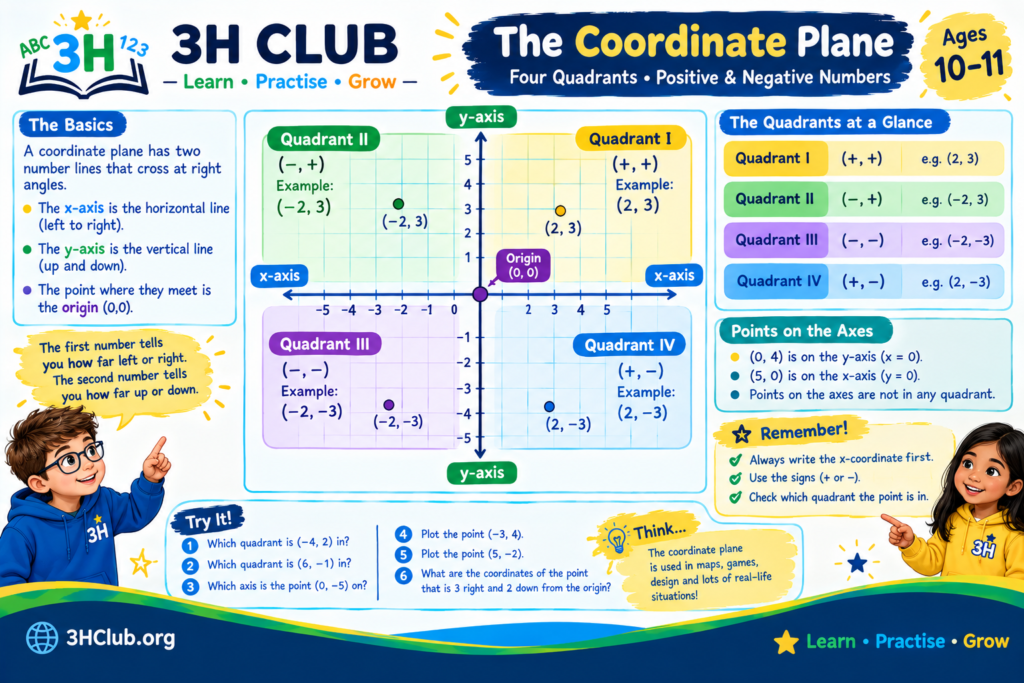
The x-axis and y-axis divide the coordinate plane into four regions called quadrants. They are numbered using Roman numerals.
<text color=”secondary” size=”sm”>The quadrants are named by position, beginning in the top-right and moving anticlockwise.</text>
| Quadrant | Position | Signs of ((x,y)) |
|---|---|---|
| Quadrant I | Top right | ((+,+)) |
| Quadrant II | Top left | ((-,+)) |
| Quadrant III | Bottom left | ((-,-)) |
| Quadrant IV | Bottom right | ((+,-)) |
Let’s look at examples.
- ((2,4)) is in Quadrant I.
- ((-2,4)) is in Quadrant II.
- ((-2,-4)) is in Quadrant III.
- ((2,-4)) is in Quadrant IV.
Points that lie directly on either axis are not inside a quadrant. For example, ((0,3)) lies on the y-axis, and ((-4,0)) lies on the x-axis.
4. Plotting Coordinates in All Four Quadrants
Let’s plot the point ((-4,3)).
Step 1: Start at the origin, ((0,0)).
Step 2: The x-coordinate is (-4), so move four units left.
Step 3: The y-coordinate is (3), so move three units up.
Step 4: Mark the point. It belongs to Quadrant II.
Now try ((3,-2)).
- Move three units right.
- Move two units down.
- Mark the point in Quadrant IV.
Always follow the coordinates in order. Mixing up the numbers or their signs can put your point in the wrong place.
5. Finding the Distance Between Points
Coordinates can help you find distances on a grid.
When two points have the same y-coordinate, they lie on the same horizontal line. The distance between them is the difference between their x-coordinates.
For example, the points ((2,3)) and ((6,3)) are on the same horizontal line.
[
6-2=4
]
They are four units apart.
When two points have the same x-coordinate, they lie on the same vertical line. The distance between them is the difference between their y-coordinates.
For example, the points ((4,1)) and ((4,5)) are on the same vertical line.
[
5-1=4
]
They are also four units apart.
Important: When finding distance along a horizontal or vertical grid line, distance is not negative. Use the positive difference between the two coordinate values.
6. Drawing Shapes with Coordinates
Coordinates are useful for drawing shapes accurately.
Suppose you plot these four points:
[
A(1,1),\ B(5,1),\ C(5,4),\ D(1,4)
]
Join them in order: A to B, B to C, C to D, and D back to A.
You have drawn a rectangle.
Let’s work out its dimensions:
- The bottom edge runs from x = 1 to x = 5, so its length is (5-1=4) units.
- The side runs from y = 1 to y = 4, so its height is (4-1=3) units.
The rectangle is 4 units wide and 3 units high.
You can also use coordinates to find missing vertices, compare side lengths and check whether a shape has been drawn correctly.
7. Common Coordinate Mistakes
Even confident mathematicians check their work. Here are a few mistakes to watch out for.
Reversing the ordered pair. Remember that ((x,y)) means horizontal first, vertical second.
Ignoring a negative sign. A negative x-coordinate means move left; a negative y-coordinate means move down.
Starting from the wrong place. On a standard coordinate plane, begin at the origin, ((0,0)).
Counting grid spaces incorrectly. Count each interval between grid lines, not just the lines themselves.
Putting a point on the wrong axis. A point with x = 0 lies on the y-axis. A point with y = 0 lies on the x-axis.
Assuming every point belongs to a quadrant. Points on the axes do not belong to any of the four quadrants.
A quick check can save you from a small mistake becoming a much bigger one.
⭐⭐⭐ Champions Activity: Coordinate Investigator
Answer each question. Use a coordinate grid if it helps.
- In which quadrant is ((-4,3))?
- In which quadrant is ((5,-2))?
- What is the position of ((-3,-4)) relative to the origin?
- Which axis contains the point ((0,6))?
- What is the horizontal distance between ((2,4)) and ((7,4))?
- What is the vertical distance between ((-2,1)) and ((-2,6))?
- A rectangle has vertices ((1,1)), ((5,1)), ((5,3)) and ((1,3)). What are its width and height?
Check your answers
- Quadrant II.
- Quadrant IV.
- Three units left and four units down; it is in Quadrant III.
- The y-axis.
- (7-2=5) units.
- (6-1=5) units.
- Width (=5-1=4) units; height (=3-1=2) units.
⭐⭐⭐ Extra Challenge: Draw a Coordinate Treasure Map
Create a coordinate grid that includes positive and negative numbers from (-5) to (5) on both axes.
Plot and label these points:
- Treasure: (T(3,2))
- Cave: (C(-3,2))
- Mountain: (M(-2,-3))
- Island: (I(4,-2))
Answer these questions:
- Which quadrant contains the treasure?
- Which quadrant contains the cave?
- Which quadrant contains the mountain?
- Which quadrant contains the island?
- What is the horizontal distance between the treasure and the cave?
Answers
- Quadrant I.
- Quadrant II.
- Quadrant III.
- Quadrant IV.
- The treasure is at x = 3 and the cave is at x = −3. The horizontal distance is (3-(-3)=6) units.
Great work! You have used coordinates to locate points in all four quadrants and calculate a distance across the grid.
Coordinates: Quick Reference Guide
| Key word | Meaning |
|---|---|
| Coordinate | A value used to describe a position |
| Grid | A pattern of crossing lines forming squares |
| Coordinate plane | A plane with two number lines used to locate points |
| Ordered pair | Two coordinates written as ((x,y)) |
| x-coordinate | The first number; horizontal position |
| y-coordinate | The second number; vertical position |
| x-axis | The horizontal number line |
| y-axis | The vertical number line |
| Origin | The point ((0,0)), where the axes meet |
| Quadrant | One of the four regions formed by the axes |
| Plot | To mark a point on a graph |
| Positive number | A number greater than zero |
| Negative number | A number less than zero |
Top Tips for Coordinate Success
- Remember: across first, then up or down.
- Always start at the origin when plotting points on a standard coordinate plane.
- Check the signs of both coordinates before moving.
- Count grid intervals carefully.
- Keep the x-coordinate first and the y-coordinate second.
- Remember that points on the axes are not in any quadrant.
- Use the difference between coordinate values to find horizontal or vertical distances.
- Label points clearly so that your work is easy to understand.
Frequently Asked Questions About Coordinates
What are coordinates in maths?
Coordinates are numbers or labels that describe where something is. On a coordinate plane, an ordered pair tells you the horizontal and vertical position of a point.
What is an ordered pair?
An ordered pair is two numbers written in a particular order, such as ((3,5)). The first number is the x-coordinate, and the second is the y-coordinate.
What is the origin?
The origin is the point where the x-axis and y-axis meet. Its coordinates are ((0,0)).
What is the difference between the x-axis and the y-axis?
The x-axis runs horizontally, from left to right. The y-axis runs vertically, from bottom to top.
What do negative coordinates mean?
A negative x-coordinate means the point is to the left of the origin. A negative y-coordinate means the point is below the origin.
What are the four quadrants?
The four quadrants are the regions formed by the x-axis and y-axis. Quadrant I is top right, Quadrant II is top left, Quadrant III is bottom left, and Quadrant IV is bottom right.
Where are coordinates used in real life?
Coordinates are used in maps, computer games, design, navigation and many areas of science. They help people locate positions accurately and communicate where something belongs.
Keep Learning with 3HClub!
Well done! You have discovered how coordinates work, from simple grid references to ordered pairs and the four quadrants of the coordinate plane.
Keep practising by plotting points, drawing shapes and making your own treasure maps. Each time you use coordinates, you are building skills that will help you with graphs, geometry and more advanced maths.
Keep exploring, keep practising and keep growing with 3HClub!
Learn • Practise • Grow