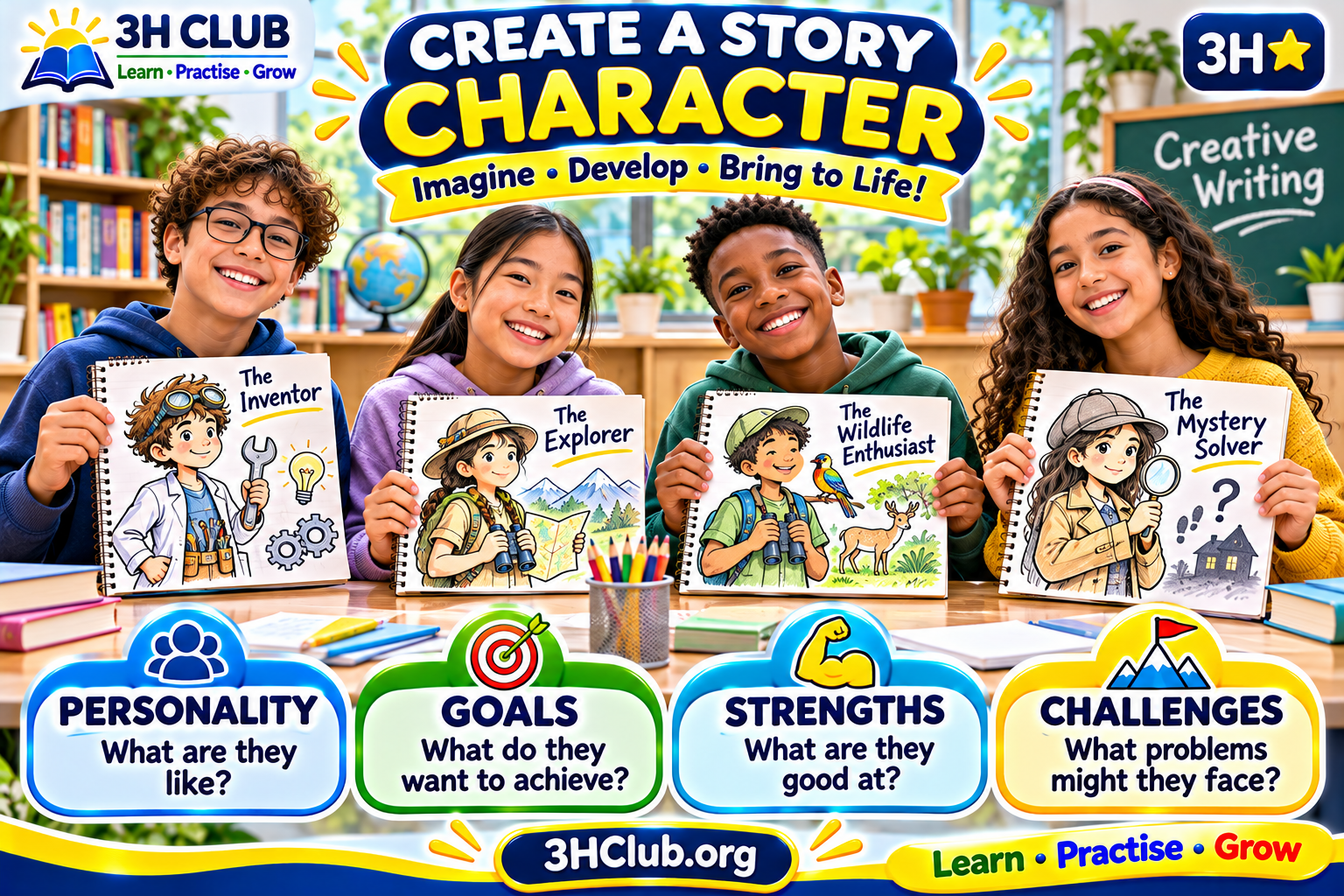
Create a Story Character:
✍️ Bring Your Characters to Life!
⭐⭐⭐ CHAMPIONS — Ages 10–11
📚 Subject: English – Creative Writing, Grammar and Storytelling
🎯 Skills: Character development, personality, motivation, description, dialogue, character arcs, subjects, predicates, inference and editing.
🌟 Hello, Character Creator!
Imagine meeting two characters.
Character A: Alex is a student. Alex likes adventures.
Character B: Alex is an inventive student who keeps a notebook full of unusual ideas. Although Alex loves solving mysteries, speaking in front of other people makes Alex nervous.
Which character would you like to know more about?
Character B gives us more to explore.
What inventions has Alex created? Why does speaking in public feel difficult? What might happen if Alex has to explain an important discovery to a large audience?
A well-developed character can make us ask questions, feel emotions and care about what happens next.
And here’s the exciting part: you can invent a character of your own!
You don’t need to make your character perfect. In fact, characters become more interesting when they have different strengths, weaknesses, hopes and worries.
Today, you’ll learn how to create a character who can grow and change through a story.
Ready to bring someone new to life on the page?
Let’s begin!
🎯 What Will You Learn?
By the end of this lesson, you will be able to:
- Explain what a story character is.
- Identify main and supporting characters.
- Create an original character with a clear personality.
- Describe appearance using carefully chosen details.
- Give a character goals, motivations, strengths and weaknesses.
- Show feelings through actions and dialogue.
- Write complete sentences with subjects and predicates.
- Understand how a character’s choices affect the plot.
- Develop believable relationships and conflicts.
- Plan how a character might change during a story.
- Write, edit and improve a character introduction.
⭐ Your goal: Create an original character who has a personality, a meaningful goal and a reason to act.
⭐ STAGE 1: CHARACTER EXPLORERS
Discover what makes a character interesting
🔵 1. What Is a Story Character?
A character is a person, animal, imaginary creature or other being who takes part in a story.
Characters can be realistic or completely imaginary.
They might be:
- A curious student investigating a mystery.
- A determined athlete preparing for a competition.
- A talking fox searching for its family.
- An inventor trying to solve an everyday problem.
- A young explorer discovering an unfamiliar place.
Characters help stories move forward because they make choices, take actions and respond to events.
Main Characters and Supporting Characters
A main character is central to the story. We often follow their experiences, choices and challenges.
A supporting character plays an important part but is not the story’s main focus.
🌱 Example: The Community Garden Challenge
Main character: Amira, an imaginative student who wants to improve the community garden.
Supporting character: Daniel, her practical friend who enjoys organising projects.
Supporting character: Mrs Lewis, a gardener who offers advice.
Amira drives the main action, but the other characters help shape what happens.
✏️ Activity 1: Identify the Characters
Read:
Zara wanted to enter the school’s invention competition. Her best friend, Kai, offered to help test her ideas. Their science teacher, Mr Thomas, reminded them to record their results carefully.
Answer:
- Who appears to be the main character?
- Name two supporting characters.
- What does the main character want?
- How might the supporting characters help?
- What problem might the main character face?
🟢 2. Give Your Character an Identity
Before writing a story, it helps to know who your character is.
Start with a few basic details.
🪪 Character Identity Card
Name: Maya Bennett
Age: 11
Home: A small coastal town
Interests: Drawing maps, reading mysteries and exploring nature
Favourite object: A notebook filled with sketches and clues
Special skill: Noticing small details that others overlook
Big dream: To become an environmental scientist
These details help us imagine Maya.
However, a character needs more than a name and a list of facts.
We also need to understand how Maya thinks, feels and behaves.
✏️ Activity 2: Invent a Character
Complete your own identity card.
Character name: __________
Age: __________
Where they live: __________
Favourite activity: __________
Something they carry or treasure: __________
An interesting skill: __________
A dream for the future: __________
⭐ Character Tip
You don’t have to include every fact about your character in the finished story.
Choose the details that help your reader understand the character or the plot.
🟡 3. Build a Personality
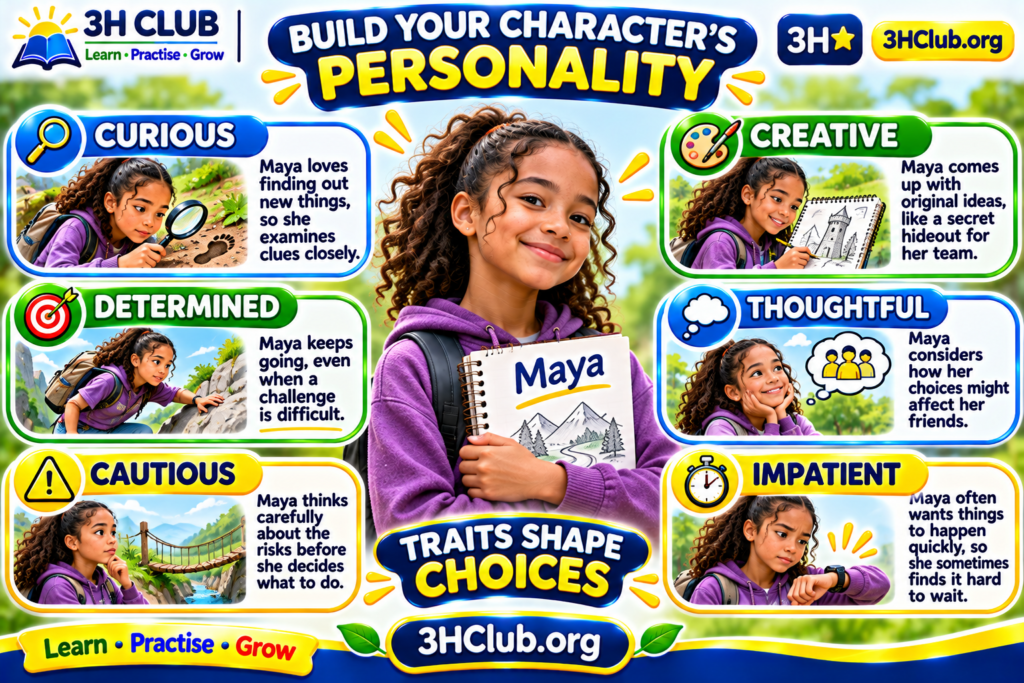
A character’s personality is the combination of qualities that influence how they think, feel and behave.
Your character might be:
Curious, patient, confident, thoughtful, determined, humorous, cautious, imaginative, generous or competitive.
A believable character can have qualities that sometimes seem to pull in different directions.
For example:
Amira is confident when building inventions but nervous when explaining them to an audience.
That makes sense. People can feel confident in one situation and uncertain in another.
Personality in Action
| Personality Trait | How a Character Might Behave |
|---|---|
| Curious | Asks questions and investigates clues |
| Generous | Shares materials and helps others |
| Impatient | Rushes ahead before hearing instructions |
| Determined | Tries a different approach after a setback |
| Cautious | Checks for risks before making a decision |
| Creative | Imagines unusual solutions |
✏️ Activity 3: Show the Trait
Choose the best personality trait.
- Zara tries three designs before finding one that works.
- Daniel gives some of his art supplies to a classmate.
- Maya examines a mysterious footprint and asks where it came from.
- Kai begins a project before reading the instructions.
- Amira checks the bridge carefully before crossing it.
Word bank: curious, generous, impatient, determined, cautious
✏️ Activity 4: Personality Combination
Choose two strengths and one weakness for your character.
Then write three sentences showing how these traits might affect their behaviour.
Example:
Leo is imaginative and determined, but he can be impatient. He loves inventing new games and rarely gives up on a difficult idea. Sometimes, he rushes ahead before listening to his teammates.
🔵 4. Describe Appearance with Purpose
Appearance can help readers picture a character.
You might describe:
- Hair, eyes or facial features.
- Clothing and accessories.
- Posture or movement.
- A distinctive object.
- Expressions that reveal feelings.
But remember: appearance does not automatically tell us someone’s personality.
A character who wears glasses is not necessarily clever. A character who looks confident may still feel nervous.
Instead, use appearance and movement to help readers imagine the scene.
Compare
Basic: Daniel was a boy with a backpack.
Improved: Daniel adjusted his oversized backpack and hurried towards the school gates, his trainers splashing through shallow puddles.
The improved description gives us a clearer picture and shows what Daniel is doing.
✏️ Activity 5: Describe a Character
Write three sentences about your character.
- One sentence about appearance.
- One sentence about movement or expression.
- One sentence about a distinctive object or habit.
Avoid describing every feature at once.
Choose details that matter.
🟣 5. Use Subjects and Predicates to Describe Characters
Strong character writing begins with clear sentences.
A complete sentence usually has a subject and a predicate.
🟦 Subject — Who or What?
The subject tells us who or what the sentence is about.
The young inventor examined the broken machine.
Subject: The young inventor
🟩 Predicate — What Is Said About the Subject?
The predicate tells us what the subject does, is or experiences.
The young inventor examined the broken machine.
Predicate: examined the broken machine
🧩 Subject + Predicate
| Subject | Predicate | Complete Sentence |
|---|---|---|
| Maya | studied the mysterious map. | Maya studied the mysterious map. |
| The nervous explorer | checked her equipment. | The nervous explorer checked her equipment. |
| Daniel and Kai | worked together on the model. | Daniel and Kai worked together on the model. |
| Amira’s invention | made a strange clicking sound. | Amira’s invention made a strange clicking sound. |
| The determined athlete | practised every afternoon. | The determined athlete practised every afternoon. |
✏️ Activity 6: Subject and Predicate Detective
Identify the complete subject and predicate.
- The curious scientist examined the unusual stone.
- Zara carried her invention into the classroom.
- The nervous speaker took a deep breath.
- Daniel and Maya searched the old library.
- The young artist painted a colourful mural.
✏️ Activity 7: Strengthen the Sentence
Improve these simple sentences by adding a useful detail.
- Maya walked.
- Daniel looked.
- Zara spoke.
- The inventor worked.
- The explorer stopped.
Example:
Maya walked.
Maya walked carefully along the narrow forest path.
Make sure each new sentence still has a clear subject and predicate.
⭐⭐ STAGE 2: CHARACTER CREATORS
Give your character goals, motivations and challenges
🟢 6. What Does Your Character Want?
An interesting character usually wants something.
This is called a goal.
A goal gives the character a reason to act.
Your character might want to:
- Win a competition.
- Make a new friend.
- Solve a mystery.
- Protect an important place.
- Learn a difficult skill.
- Repair a friendship.
- Help someone in trouble.
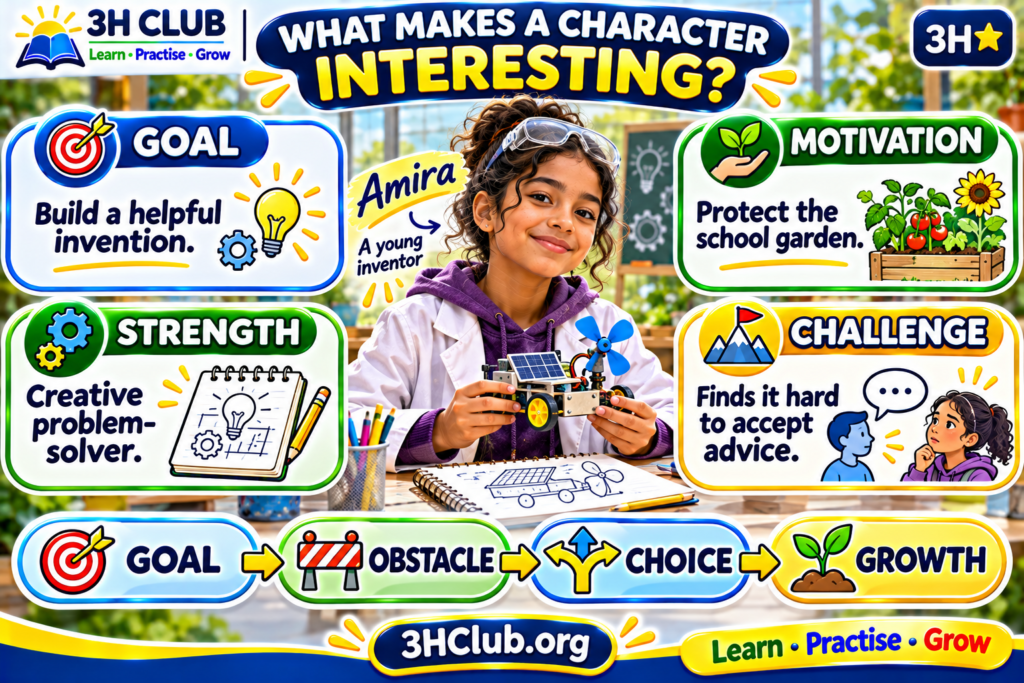
🎯 Example
Character: Amira
Goal: Build a device that helps collect litter from a school garden.
Why it matters: She wants to make the garden safer for wildlife.
Possible problem: Her first design doesn’t work.
Now we have the beginning of a story.
✏️ Activity 8: Give Your Character a Goal
Complete:
My character wants: __________
This matters because: __________
One thing stopping them is: __________
They might try: __________
If they fail, they could: __________
⭐ Remember
A goal helps the story move forward.
A character’s goal can change as they learn something new.
🟡 7. Give Your Character a Strength and a Flaw
A strength is a quality or ability that helps your character.
A flaw is a weakness, habit or difficulty that can sometimes cause problems.
Characters do not need to be perfect to be admirable.
Example: Kai the Explorer
Strength: Kai is brave and observant.
Flaw: He sometimes refuses to ask for help.
Goal: Find the missing route marker on a nature trail.
Challenge: The path becomes confusing.
Possible growth: Kai learns that asking for help can be a sensible choice.
His flaw affects the story because it makes his challenge more difficult.
✏️ Activity 9: Strength, Flaw and Challenge
Choose one combination.
A. A clever inventor who struggles to listen to advice.
B. A brave explorer who sometimes acts too quickly.
C. A thoughtful student who finds it difficult to speak up.
D. A talented athlete who dislikes making mistakes.
Write:
- The character’s strength.
- The character’s flaw.
- A problem that challenges both qualities.
- One possible lesson the character could learn.
🔵 8. Give Your Character a Reason: Motivation
A motivation is the reason behind a character’s actions.
A goal tells us what the character wants.
Motivation helps explain why they want it.
Example
Goal: Maya wants to win the school art competition.
Motivation: She hopes her artwork will encourage people to protect sea turtles.
The motivation makes her goal more meaningful.
✏️ Activity 10: Match Goal and Motivation
Match each goal with the most suitable motivation.
| Goal | Motivation |
|---|---|
| 1. Repair a broken friendship | A. The character wants to protect animals |
| 2. Create a wildlife shelter | B. The character misses spending time with a friend |
| 3. Learn to swim confidently | C. The character wants to feel safer in the water |
| 4. Organise a book donation | D. The character wants more children to enjoy reading |
Then create a new goal and motivation for your own character.
🟣 9. Show Feelings Instead of Only Naming Them
A character’s emotions help readers connect with the story.
You can tell a feeling:
Zara was nervous.
Or you can show it through actions:
Zara twisted the strap of her backpack and glanced towards the crowded stage.
The second version gives readers clues about her feelings.
Feelings and Actions
| Feeling | Possible Clue |
|---|---|
| Excited | Grins and speaks quickly |
| Worried | Checks the same thing several times |
| Disappointed | Sighs and looks down at unfinished work |
| Proud | Smiles while showing a completed project |
| Frustrated | Pushes a notebook aside and pauses |
| Curious | Leans forward to examine something unusual |
These are examples, not rules. People express emotions differently.
✏️ Activity 11: Show the Emotion
Rewrite each sentence to show the feeling through an action.
- Amira was nervous before her presentation.
- Daniel was delighted with his invention.
- Maya was worried about the missing notebook.
- Kai was frustrated by the difficult puzzle.
- Zara was proud of her team’s work.
⭐ Writing Tip
You can combine telling and showing.
Sometimes writing Maya felt disappointed is exactly what your story needs.
The aim is to choose details that make the emotion clear and believable.
🟢 10. Use Dialogue to Reveal Personality
Dialogue is what characters say.
It can show their feelings, opinions, relationships and personality.
💬 Example
“Let’s try again,” Amira said. “The first design didn’t work, but we can improve it.”
This dialogue suggests that Amira is determined and hopeful.
Compare:
“It’s hopeless,” Daniel muttered. “We’ll never finish in time.”
Daniel seems discouraged.
Both characters are responding to the same problem in different ways.
✏️ Activity 12: Character Voices
Two characters discover a locked wooden box.
Character A is adventurous and impatient.
Character B is cautious and thoughtful.
Write one line of dialogue for each character.
Example:
A: “Let’s find a way to open it right now!”
B: “We should find out who owns it before touching anything.”
Use speech marks and correct punctuation.
⭐ Dialogue Tip
Your characters should not all speak in exactly the same way.
Their word choices and reactions can help readers recognise their personalities.
🟡 11. Build Relationships and Conflict
Characters often become more interesting when they interact with others.
A relationship is the connection between characters.
They might be friends, siblings, classmates, teammates, rivals or neighbours.
A conflict is a disagreement, obstacle or struggle that affects the story.
Not every conflict involves an argument.
Sometimes two characters simply have different ideas.
Example: The Science Competition
Amira wants to test a new invention quickly.
Daniel wants to check every measurement first.
Both want the project to succeed, but they disagree about how to proceed.
Their different personalities create a believable challenge.
✏️ Activity 13: Create a Character Pair
Invent two characters who must work together.
Complete:
Character 1: __________
Character 1’s personality: __________
Character 2: __________
Character 2’s personality: __________
Shared goal: __________
Possible disagreement: __________
How they might cooperate: __________
⭐⭐⭐ STAGE 3: CHARACTER MASTERS
Develop characters who grow through a story
🔵 12. Understand Character Growth
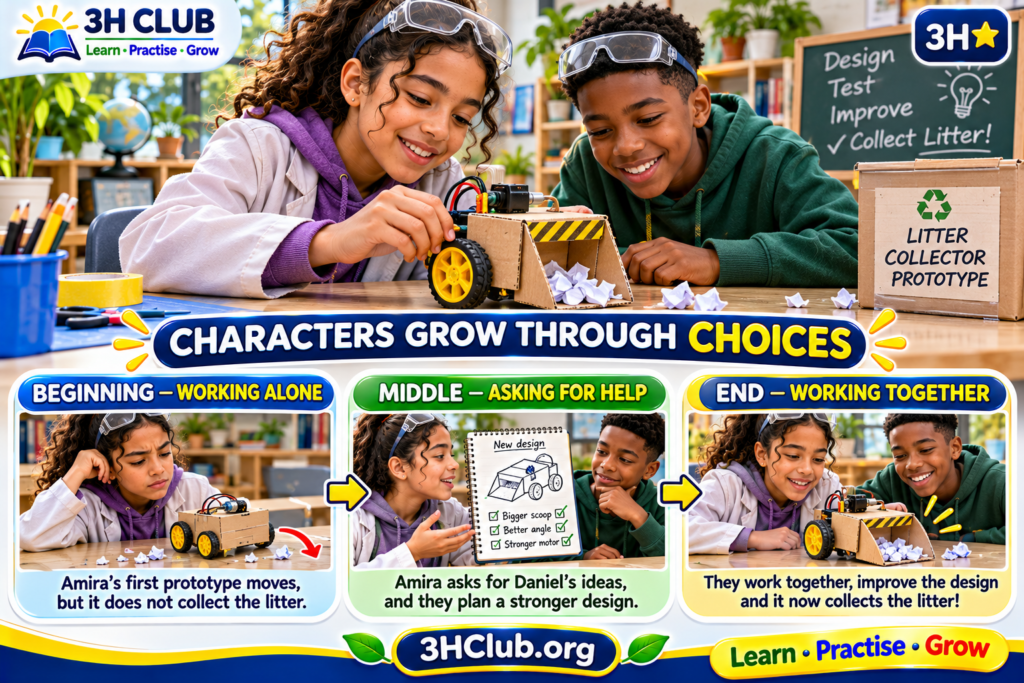
A character arc is the way a character changes, learns or develops during a story.
The change might be large or small.
A character might:
- Become more confident.
- Learn to listen to others.
- Discover that teamwork is useful.
- Understand a friend’s feelings.
- Become more responsible.
- Learn from a mistake.
🌟 Example: Zara’s Character Arc
BEGINNING: Zara is talented but afraid of making mistakes.
MIDDLE: Her invention fails during a practice test. She wants to give up.
TURNING POINT: Her friend encourages her to study the problem and try a different design.
END: Zara learns that mistakes can help her improve.
The challenge changes how Zara thinks.
✏️ Activity 14: Plan Character Growth
Complete:
At the beginning, my character believes: __________
Their main challenge is: __________
A difficult choice they face is: __________
They learn: __________
By the end, they: __________
⭐ Remember
Not every character changes completely.
Sometimes a character keeps the same beliefs but proves them through difficult choices.
🟢 13. Read the Story: The Invention That Wouldn’t Work
Read this story carefully.
Notice how the characters’ goals, strengths, weaknesses and choices affect what happens.
🔧 The Invention That Wouldn’t Work
Beginning
Amira loved inventing things. Her desk was covered with sketches, cardboard models and colourful notes. She could spend hours solving a difficult problem, but she disliked asking other people for advice.
When her school announced a competition to improve the environment, Amira immediately had an idea.
She wanted to design a small machine that could collect lightweight litter from the school garden.
“I can build it myself,” she told her friend Daniel.
Daniel smiled. “I’d be happy to help you test it.”
“Thanks, but I’ve already planned everything,” Amira replied.
Middle
For several afternoons, Amira worked on her invention. She attached wheels to a small frame and built a container for collecting litter.
At last, the machine was ready.
She placed a few clean paper scraps on the classroom floor and switched it on.
The wheels turned, but the machine moved in circles. It pushed the paper scraps away instead of collecting them.
Amira frowned.
“Maybe the wheels need adjusting,” Daniel suggested.
“I know what I’m doing,” Amira replied quickly.
She tried again.
The machine spun in another circle.
Amira stared at her invention. She had worked so hard, yet it wasn’t doing what she had planned.
Daniel waited quietly.
After a moment, Amira took a slow breath.
“Could you help me work out what’s wrong?” she asked.
Together, they examined the design. Daniel noticed that one wheel was attached at a different angle. Amira also realised that the collecting container was too high above the floor.
They adjusted the wheel and lowered the container.
This time, the machine rolled forward and collected several paper scraps.
“It works!” Amira exclaimed.
End
On competition day, Amira and Daniel demonstrated their invention to the judges.
Amira explained how their first design had failed and how they had improved it through testing and teamwork.
Their machine did not win first prize, but the judges praised their careful problem-solving.
As they packed away their project, Daniel grinned.
“Ready for another invention?”
Amira smiled.
“Definitely. But next time, let’s plan it together.”
🔍 Character Detective
| Character Element | Evidence from the Story |
|---|---|
| Main character | Amira |
| Goal | Create a machine that collects lightweight litter |
| Strength | Creative and determined |
| Flaw | Reluctant to accept help |
| Challenge | The machine fails its first tests |
| Turning point | Amira asks Daniel for help |
| Growth | She learns the value of teamwork |
| Supporting character | Daniel, who offers practical advice |
📖 Reading Comprehension Questions
- What does Amira enjoy doing?
- What competition does her school announce?
- What does Amira want her invention to do?
- Why does she refuse Daniel’s help at first?
- What goes wrong during the first test?
- What does Daniel notice about the wheels?
- What other problem do they discover?
- What decision shows that Amira is beginning to change?
- Does the invention win first prize?
- What does Amira learn by the end?
✏️ Activity 15: Find Character Evidence
Find evidence that Amira is:
- Creative.
- Determined.
- Reluctant to accept help.
- Frustrated by failure.
- Willing to change.
Explain your answers using details from the story.
✏️ Activity 16: Subject and Predicate Challenge
Find the complete subject and predicate.
- Amira loved inventing things.
- The small machine moved in circles.
- Daniel noticed the uneven wheel.
- The two friends adjusted the design.
- Their improved invention collected the paper scraps.
🧠 Think More Deeply
- Why is Amira more interesting because she has a flaw?
- How does Daniel help the story move forward?
- Why is the ending satisfying even though Amira doesn’t win?
- What might happen if Amira faces another difficult project?
✍️ 14. Create Your Own Character Profile
Now you’re ready to create an original character.
Use the following profile to plan.
📝 My Character Creator Profile
CHARACTER IDENTITY
Name: __________
Age: __________
Home or setting: __________
Interests: __________
Distinctive habit or object: __________
PERSONALITY
Three personality traits: __________
Greatest strength: __________
Main weakness or flaw: __________
Biggest worry: __________
GOALS AND MOTIVATION
What the character wants: __________
Why it matters: __________
What stands in the way: __________
What the character might lose or gain: __________
RELATIONSHIPS
Important friend or family member: __________
Someone who challenges the character: __________
How these relationships affect their choices: __________
CHARACTER GROWTH
What the character believes at first: __________
What challenge tests that belief: __________
What the character learns: __________
How the character might change: __________
✏️ Activity 17: Complete Your Profile
Create a character who could star in an original story.
Give your character at least:
- A name and age.
- Three personality traits.
- One strength.
- One flaw.
- A meaningful goal.
- A motivation.
- An important relationship.
- A challenge.
- A possible change or lesson.
🟡 15. Write a Character Introduction
A character introduction should help readers understand someone without turning the story into a long list of facts.
Basic Version
Maya was eleven. She was clever and liked mysteries. She was sometimes impatient.
Improved Version
Maya kept a small notebook in her jacket pocket, ready to record anything unusual. She noticed details that other people missed, from broken twigs to muddy footprints. But when she discovered a clue, she often hurried ahead before her friends could catch up.
The improved version shows personality through actions.
✏️ Activity 18: Introduce Your Character
Write a character introduction of six to eight sentences.
Include:
- The character’s name.
- A useful appearance or movement detail.
- A personality trait shown through action.
- A meaningful goal.
- A strength.
- A flaw or worry.
- A hint of a challenge.
You don’t need to reveal every detail from your profile.
Choose what will make your reader interested.
🟣 16. Write a Scene That Reveals Personality
A character becomes believable when we see how they respond to a situation.
Imagine that your character finds a wallet on a park bench.
What do they do?
A thoughtful character might look for a nearby responsible adult to help return it.
An impatient character might rush towards the park office without explaining their plan to their friends.
A cautious character might stop and ask a trusted adult what to do.
Different choices reveal different qualities.
✏️ Activity 19: Put Your Character to the Test
Choose one situation:
A. Your character’s team loses an important competition.
B. A friend accidentally damages something your character made.
C. Your character discovers a mistake in an important project.
D. Your character must speak in front of a large audience.
E. Your character and a friend disagree about a difficult decision.
Write a short scene of eight to twelve sentences.
Show:
- What happens.
- How your character reacts.
- What they say or do.
- How their personality affects their choice.
- What might happen next.
⭐ Challenge
Write the same situation from the point of view of another character.
How does their personality change the scene?
🔍 17. Improve Your Character Writing
Good writers revise their work.
First Draft
Ben was a nice boy. He was clever. He was nervous. He wanted to win the science competition.
This gives us information, but it mostly tells us about Ben.
Improved Version
Ben could solve difficult science puzzles, but speaking in front of his classmates made his stomach tighten. He had spent weeks designing a model bridge for the school competition. As he carried it towards the display table, he checked the joints one final time. Winning would be exciting, but what Ben really wanted was to prove that his careful work had been worthwhile.
The second version reveals:
- Ben’s ability.
- His worry.
- His goal.
- His motivation.
- His behaviour.
✏️ Activity 20: Character Editing Challenge
Improve this description:
Lena was a good student. She liked art. She was shy. She wanted to paint a mural.
Try to show:
- Lena’s artistic skill.
- How she behaves when nervous.
- Why the mural matters to her.
- A challenge she might face.
- A detail that makes her memorable.
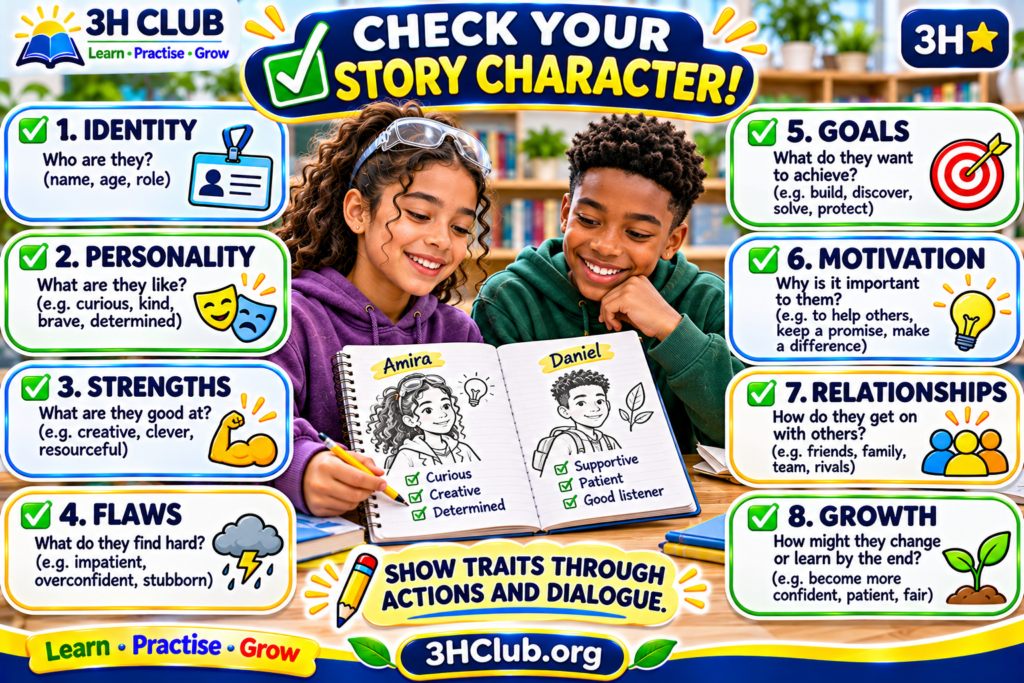
🎲 18. Five Fun Character Creation Games
🎭 Game 1: Personality Swap
Invent two characters with very different personalities.
Place them in the same situation.
How would each character respond?
Example: A mysterious box appears in the classroom.
The curious character wants to investigate.
The cautious character wants to ask a teacher first.
Write two short responses.
🎯 Game 2: Goal and Obstacle
Choose a goal:
- Win a competition.
- Find a missing object.
- Learn a difficult skill.
- Help a friend.
- Protect a special place.
Now invent an obstacle that makes the goal harder to reach.
Explain what your character might do.
💬 Game 3: Guess the Character
Write three lines of dialogue without naming the character’s personality.
Ask someone to guess the character’s traits.
🧩 Game 4: Character Change Cards
Write three cards:
BEFORE
CHALLENGE
AFTER
Create a character arc by filling in each card.
🔍 Game 5: Character Detective
Choose a character from a book you enjoy.
Find:
- One strength.
- One weakness.
- One important goal.
- One difficult decision.
- One way the character changes or stays true to their beliefs.
Use evidence from the story to explain your choices.
🏆 19. Final Character Champions Challenge
Part A: Character Vocabulary
Match the term to its meaning.
- Personality
- Goal
- Motivation
- Flaw
- Character arc
A. A weakness or difficulty that can affect choices.
B. The way a character changes or develops.
C. The reason a character wants something.
D. The qualities that influence how a character behaves.
E. Something a character wants to achieve.
Part B: Show or Tell?
Decide whether each sentence mainly shows or tells a character’s feelings or personality.
- Zara was nervous.
- Zara twisted her pencil and checked the clock again.
- Daniel was generous.
- Daniel offered his last clean sheet of paper to a classmate.
- Maya felt proud.
Part C: Character Motivation
Read:
Leo practised swimming every week because he wanted to feel more confident in the water.
Answer:
- What is Leo’s goal?
- What is his motivation?
- What obstacle might he face?
Part D: Subject and Predicate
Find the complete subject and predicate.
- The determined inventor tested her new design.
- Maya and Daniel solved the difficult puzzle.
- The worried athlete checked his equipment.
- The creative artist painted a colourful mural.
Part E: Character Growth
A character refuses to ask for help because they believe it makes them look weak.
Write:
- A challenge that tests this belief.
- A turning point.
- A possible change in the character.
Part F: Write a Character Scene
Write a scene of ten to fifteen sentences.
Include:
- An original character.
- A clear goal.
- One strength and one flaw.
- An obstacle.
- Dialogue.
- A difficult choice.
- A hint of character growth.
⭐ Final Creative Writing Mission
Write a story titled:
The Choice That Changed Everything
Your main character must face a decision that reveals who they really are.
Beginning: Introduce the character, their goal and a meaningful flaw.
Middle: Show a challenge that forces the character to make a difficult choice.
End: Reveal the consequences and show whether the character changes.
Use your character profile and planner before writing.
✅ 20. Check Your Answers!
Activity 1: Identify the Characters
- Zara.
- Kai and Mr Thomas.
- Enter the school’s invention competition.
- Kai can help test ideas; Mr Thomas can guide careful recording of results.
- Answers vary. Example: Her invention may fail during testing.
Activity 2: Character Identity
Answers will vary.
Activity 3: Personality Traits
- Determined
- Generous
- Curious
- Impatient
- Cautious
Activity 4: Personality Combination
Answers will vary. Check that the actions match the chosen traits.
Activity 5: Describe a Character
Answers will vary. Look for useful, specific details.
Activity 6: Subjects and Predicates
| Subject | Predicate |
|---|---|
| The curious scientist | examined the unusual stone |
| Zara | carried her invention into the classroom |
| The nervous speaker | took a deep breath |
| Daniel and Maya | searched the old library |
| The young artist | painted a colourful mural |
Activity 7: Strengthen the Sentence
Possible answers:
- Maya walked slowly along the narrow garden path.
- Daniel looked carefully beneath the old bench.
- Zara spoke confidently to the judges.
- The inventor worked patiently on the broken machine.
- The explorer stopped when she noticed an unfamiliar footprint.
Activity 8: Character Goal
Answers will vary.
Activity 9: Strength, Flaw and Challenge
Answers will vary.
Possible example:
A clever inventor who dislikes advice might build a machine that fails repeatedly. By listening to a friend, the inventor could discover a better solution.
Activity 10: Goal and Motivation
- B
- A
- C
- D
Activity 11: Show the Emotion
Possible answers:
- Amira held her notes tightly and took a slow breath.
- Daniel grinned as the machine began to work.
- Maya searched every pocket and checked beneath the desk.
- Kai pushed his puzzle aside and sighed.
- Zara smiled as her teammates celebrated their finished project.
Activity 12: Character Voices
Answers will vary.
Activity 13: Character Pair
Answers will vary. Look for a shared goal and believable disagreement.
Activity 14: Character Growth
Answers will vary. Check that the challenge connects to the character’s belief or weakness.
Reading Comprehension: The Invention That Wouldn’t Work
- Inventing things.
- A competition to improve the environment.
- Collect lightweight litter from the school garden.
- She believes she can manage the project herself and dislikes asking for advice.
- The machine moves in circles and pushes the paper away.
- One wheel is attached at a different angle.
- The collecting container is too high above the floor.
- She asks Daniel to help her.
- No.
- That testing, listening and teamwork can improve an idea.
Activity 15: Character Evidence
Possible answers:
- Creative: Amira designs an original litter-collecting machine.
- Determined: She spends several afternoons working on the invention.
- Reluctant to accept help: She initially refuses Daniel’s offer.
- Frustrated: She frowns and stares at the machine after repeated failures.
- Willing to change: She asks Daniel for help and later suggests planning together.
Activity 16: Subjects and Predicates
| Subject | Predicate |
|---|---|
| Amira | loved inventing things |
| The small machine | moved in circles |
| Daniel | noticed the uneven wheel |
| The two friends | adjusted the design |
| Their improved invention | collected the paper scraps |
Think More Deeply
- Amira’s flaw creates a challenge that helps the story develop.
- Daniel offers advice and helps Amira learn to cooperate.
- The ending is satisfying because Amira improves her invention and learns something important.
- In another project, Amira might invite Daniel to help from the beginning.
Activities 17–19
Answers will vary. Use the character profile and checklist to review each response.
Activity 20: Editing Challenge
Possible answer:
Lena filled the pages of her sketchbook with colourful drawings, but she rarely showed them to anyone. When the school announced a mural project, she imagined painting a bright scene that celebrated her community. She wanted everyone to feel welcome when they entered the school. Yet the thought of explaining her idea to the class made her hands tremble. Lena looked at her sketchbook and wondered whether she could find the courage to share her design.
Final Challenge: Part A
- D
- E
- C
- A
- B
Final Challenge: Part B
- Tells
- Shows
- Tells
- Shows
- Tells
Final Challenge: Part C
- Learn to swim confidently.
- He wants to feel more confident in the water.
- Answers vary. Example: He might find a particular swimming skill difficult.
Final Challenge: Part D
| Subject | Predicate |
|---|---|
| The determined inventor | tested her new design |
| Maya and Daniel | solved the difficult puzzle |
| The worried athlete | checked his equipment |
| The creative artist | painted a colourful mural |
Final Challenge: Part E
Possible answer:
Challenge: The character cannot complete a difficult project alone.
Turning point: A friend offers useful advice.
Change: The character learns that asking for help can show good judgement.
Final Challenge: Part F
Answers will vary.
Check that the scene includes a goal, obstacle, choice and evidence of personality.
Final Creative Writing Mission: Example
The Choice That Changed Everything
Zara loved solving puzzles, but she hated admitting when she was wrong. She had been chosen to lead her team’s science project, and she wanted everything to be perfect.
On the morning of the school exhibition, Zara noticed that one measurement on their display was incorrect. Her friend Kai suggested checking the experiment again.
“We don’t have time,” Zara replied. “The judges will be here soon.”
But when she looked at the results, she realised the mistake could change their conclusion.
Zara took a deep breath.
“You’re right,” she told Kai. “We need to fix this.”
Together, they repeated the measurement and corrected their display. The judges arrived just as they finished.
During their presentation, Zara explained how they had discovered and corrected the mistake.
Their team did not receive the highest score, but the judges praised their careful work and honesty.
As they packed away their materials, Kai smiled.
“You handled that well.”
Zara looked at their corrected results.
“I nearly ignored the mistake,” she admitted. “Next time, I’ll listen sooner.”
She had learnt that being a good leader did not mean always being right.
🎉 Excellent work, Character Champion!
You’ve discovered how goals, strengths, flaws, motivations, relationships and choices can turn a simple idea into a believable character.
🌈 21. What Have You Learnt?
🧠 Personality Shapes Behaviour
Your character’s traits influence their choices and reactions.
🎯 Goals and Motivation Drive the Story
GOAL = WHAT THE CHARACTER WANTS
MOTIVATION = WHY THEY WANT IT
⚖️ Strengths and Flaws Create Challenges
A character can be talented and still have something important to learn.
💬 Actions and Dialogue Reveal Personality
Show readers how your character behaves.
🌱 Characters Can Grow
Challenges and choices may change what your character believes or does.
🧩 Complete Sentences Help Readers Understand
SUBJECT + PREDICATE = COMPLETE SENTENCE
⭐ The Character Creator Formula
PERSONALITY + GOAL + MOTIVATION + CHALLENGE + CHOICES = A CHARACTER WORTH FOLLOWING
This is a helpful planning guide, not a rule that every character must follow exactly.
🌟 Keep Learning with 3HClub!
You now have the tools to invent a character who feels interesting and believable.
Remember:
Give your character something to want.
Give them a reason to want it.
Let them face challenges.
Show their personality through actions and dialogue.
And think about how their experiences might help them grow.
📚 Your Next Learning Adventures
- How to Write a Story Opening
- Beginning, Middle and End of a Story
- How to Write a Paragraph for Kids
- Subject and Predicate
- Direct Speech
- Adjectives for Kids
- Making Inferences
- Cause and Effect
- Writing a Story Ending
⭐ Your Character Creator Promise
I can invent an original character.
I can describe personality through actions.
I can create goals and motivations.
I can give my character strengths and weaknesses.
I can use dialogue to reveal feelings.
I can show how challenges lead to choices and growth.
Keep imagining, keep writing and keep growing!
3H CLUB — Learn • Practise • Grow