Direct Speech for Kids
Learn How to Write Exactly What Someone Says
Have you ever written down something someone said?
Maybe your friend said, “That was a brilliant goal!”
Or your teacher asked, “Are you ready to begin?”
When we write a person’s exact words, we use direct speech.
Direct speech helps your reader hear the speaker’s words as if they were there. It is especially useful in stories, conversations, interviews, comics and plays.
In this guide, you’ll learn how direct speech works step by step — from the basics to more advanced punctuation.
💬 What Is Direct Speech?
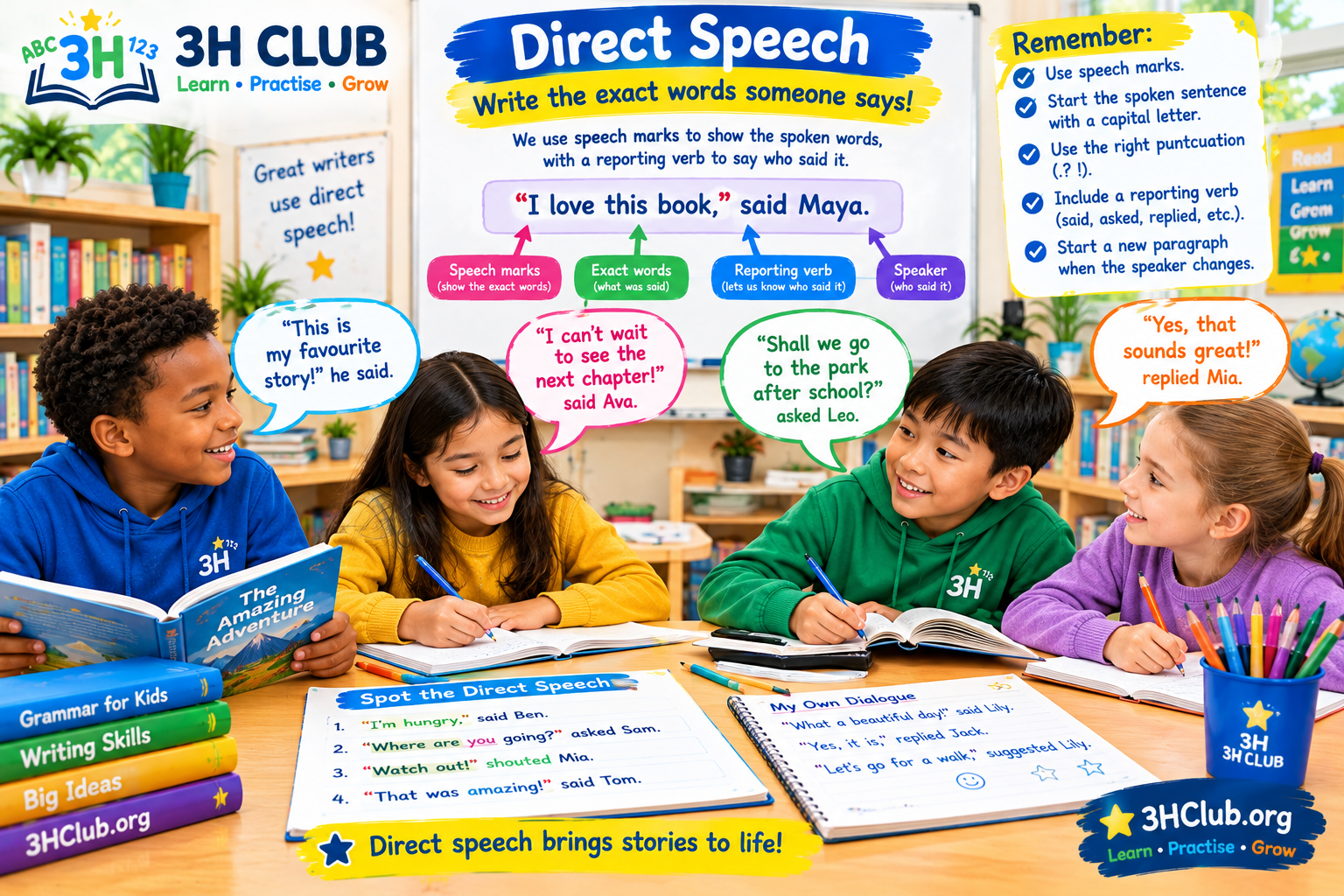
Direct speech is when we write the exact words that someone says.
For example:
Maya said, ‘I found a shell.’
The words ‘I found a shell’ are Maya’s exact words.
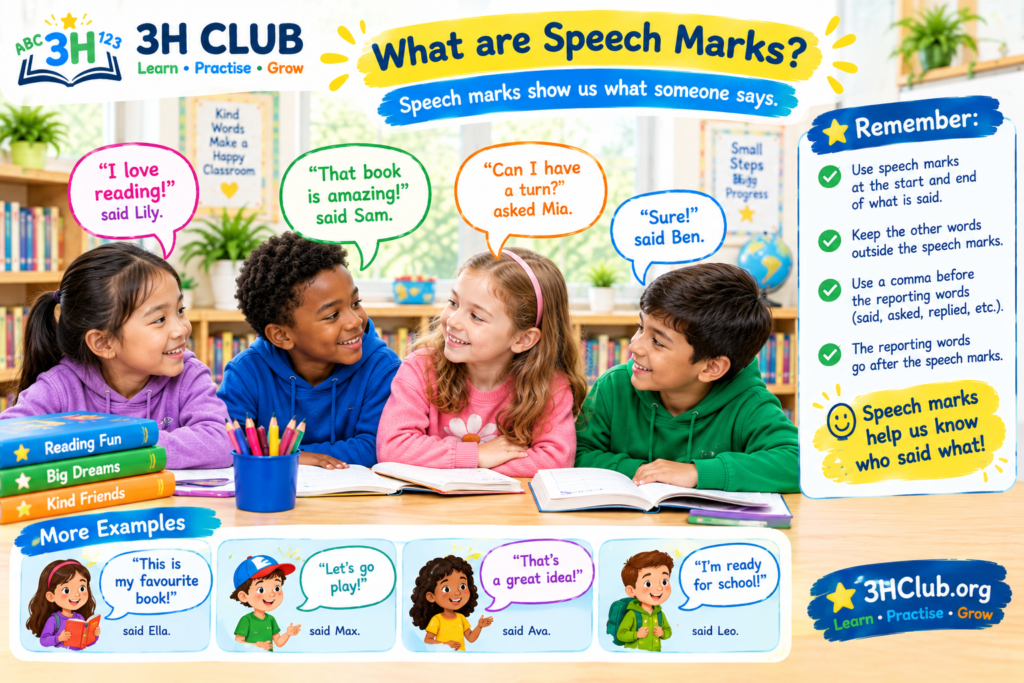
We use speech marks (also called quotation marks) to show which words are being spoken.
Direct speech has three important parts:
Speaker + exact words + reporting words
Maya said, ‘I found a shell.’
- Maya = the speaker
- ‘I found a shell.’ = the exact words
- said = a reporting verb
You may also see direct speech written with double quotation marks:
Maya said, “I found a shell.”
Both single and double quotation marks are used in English. The style can depend on the country or publishing style. British English commonly uses single quotation marks for speech, while American English commonly uses double quotation marks. Khan Academy
For this article, we’ll use single speech marks (‘ ’).
⭐ Quick Answer: What Do I Need to Remember?
When writing direct speech:
- Put the speaker’s exact words inside speech marks.
- Start the spoken sentence with a capital letter.
- Use punctuation carefully.
- Use a reporting verb such as said, asked, shouted or replied.
- Start a new paragraph when a different person speaks.
For example:
‘I love this book,’ said Sam.
‘So do I!’ replied Mia.
Now let’s learn more!
⭐ Starters — Ages 6–7
💬 Meet Direct Speech
Imagine that your friend says:
I like dinosaurs.
If you want to write exactly what your friend said, you can use direct speech:
‘I like dinosaurs,’ said Leo.
The speech marks tell your reader:
“These are Leo’s exact words.”
Remember:
🗣️ Someone speaks → you write their exact words → you put speech marks around them.
🔎 Spot the Spoken Words
Look at this sentence:
Zara said, ‘I can see the moon.’
Which words did Zara actually say?
‘I can see the moon.’
Those are the words inside the speech marks.
The word said tells us that Zara is speaking.
✏️ What Are Speech Marks?
Speech marks look like this:
‘ ’
They go around the words that someone says.
For example:
‘I am hungry,’ said Ben.
The first speech mark comes before the spoken words.
The second speech mark comes after the spoken words.
Think of them like a little frame around the speaker’s words.
Try these:
‘Look at that bird!’ said Ella.
‘Can I have some water?’ asked Noah.
‘This is my favorite game,’ said Aisha.
In each example, the speech marks show us exactly what the person said.
🗣️ Direct Speech Can Be at the Start
The reporting words do not always have to come first.
You can write:
‘I found it!’ shouted Max.
Here, the spoken words come first.
The word shouted tells us who spoke and how they spoke.
🔤 Start Spoken Sentences with a Capital Letter
The first word inside direct speech usually begins with a capital letter when it is a complete sentence.
‘The sun is shining,’ said Lily.
Not:
❌ ‘the sun is shining,’ said Lily.
Instead:
✅ ‘The sun is shining,’ said Lily.
❓ Questions in Direct Speech
Someone can speak a question too.
‘Where is my pencil?’ asked Noah.
The question mark belongs to the spoken question.
Another example:
‘Are you coming with us?’ asked Mia.
Notice that the question mark comes before the closing speech mark.
❗ Excited Words in Direct Speech
Someone might shout, cheer or become excited.
‘We won!’ shouted Amir!
The exclamation mark shows strong feeling.
You could also write:
‘Look out!’ shouted Mia.
‘I did it!’ cheered Noah.
🎯 Starters Activity: Add the Speech Marks
Can you add the missing speech marks?
- I like your drawing, said Ava.
- Look at that butterfly! shouted Leo.
- Can I play too? asked Mia.
- This cake is delicious, said Noah.
Answers
- ‘I like your drawing,’ said Ava.
- ‘Look at that butterfly!’ shouted Leo.
- ‘Can I play too?’ asked Mia.
- ‘This cake is delicious,’ said Noah.
⭐ Starters Tip
When you see words that tell you exactly what someone said, ask yourself:
“Where should the speech marks go?”
That one question will help you become a stronger direct-speech writer.
⭐⭐ Builders — Ages 8–9
Now that you know what direct speech is, it’s time to make your sentences stronger.
You’re going to learn about reporting verbs, commas, punctuation, new paragraphs and dialogue.
🗣️ What Is a Reporting Verb?
A reporting verb tells us how someone spoke or that they spoke.
The most common reporting verb is:
said
But you can choose a more precise verb when it helps the reader understand what happened.
For example:
- said
- asked
- replied
- shouted
- whispered
- called
- explained
- answered
- cried
- agreed
Compare:
‘Stop!’ said Mia.
and
‘Stop!’ shouted Mia.
The second sentence gives us more information about Mia’s voice.
Choose the right verb
‘What time is it?’ ________ Noah.
asked makes sense because Noah is asking a question.
‘Be careful!’ ________ Dad.
warned or shouted could make sense, depending on the situation.
Good writers choose reporting verbs that fit the action.
✏️ Using a Comma with Direct Speech
Look carefully at this example:
‘I found your pencil,’ said Ella.
There is a comma before the closing speech mark because the sentence continues with the reporting words said Ella.
Another example:
‘Let’s go outside,’ said Marcus.
The comma helps separate the spoken words from the reporting part of the sentence.
A common pattern is:
‘Spoken words,’ said the speaker.
For example:
‘The race starts soon,’ said Ben.
Standard dialogue punctuation uses commas to separate speech from a following dialogue tag when the spoken sentence would otherwise end with a full stop. Purdue OWL
❓ Question Marks and Exclamation Marks
A question mark or exclamation mark can replace the comma when the spoken words are a question or exclamation.
Question:
‘Are you ready?’ asked Maya.
Exclamation:
‘We won!’ shouted Jay.
Notice that the question mark or exclamation mark stays with the spoken words.
🧩 Who Is Speaking?
Look at this conversation:
‘Would you like to play?’ asked Mia.
‘Yes, please!’ replied Sam.
We know who is speaking because the writer gives us reporting words.
Sometimes the speaker is obvious from the action:
‘I can’t wait!’ shouted Mia.
📚 Start a New Paragraph When the Speaker Changes
This is one of the most important rules for writing dialogue.
When a different person starts speaking, begin a new paragraph.
For example:
‘Did you finish the project?’ asked Noah.
‘Almost,’ replied Ava. ‘I just need to add the title.’
This makes the conversation much easier to follow.
Imagine if both speakers were put into one large paragraph. It could become difficult to tell who is talking.
Remember:
New speaker = new paragraph.
🔄 Direct Speech and Reported Speech
Direct speech gives us the speaker’s exact words.
Mia said, ‘I am tired.’
Reported speech tells us what Mia said without using her exact words:
Mia said that she was tired.
The first sentence gives us Mia’s actual words.
The second sentence gives us the meaning of what Mia said.
Direct speech keeps the original words, while reported speech usually gives the information in a different form. LearnEnglish – British Council
🧠 Phrase or Direct Speech?
Look at these examples.
A
‘I love swimming,’ said Leo.
This contains direct speech because Leo’s exact words are shown.
B
Leo said that he loved swimming.
This is reported speech.
C
Leo walked to the pool.
This is neither direct nor reported speech.
Being able to spot the difference will help you when you write stories and answers.
🎭 Build a Conversation
Let’s create a short conversation.
First speaker:
‘Have you seen my notebook?’ asked Ella.
Second speaker:
‘It’s on the desk,’ replied Noah.
Third speaker:
‘Oh, thank you!’ said Ella.
Now we have a mini conversation.
Notice the pattern:
Speaker 1 → new paragraph
Speaker 2 → new paragraph
Speaker 3 → new paragraph
This makes the conversation clear.
🔍 Builders’ Direct Speech Detective
What is wrong with this sentence?
‘Where are you going?’ asked Maya. ‘I’m going to the library,’ said Leo.
The punctuation is not the only problem.
There are two different speakers, so the second speaker should begin a new paragraph.
A clearer version is:
‘Where are you going?’ asked Maya.
‘I’m going to the library,’ said Leo.
🎯 Builders Challenge
Add the missing punctuation and paragraph breaks.
1.
i found the missing book said Ella
2.
where did you put my bag asked Noah
3.
watch out shouted Mia
4.
I love this story said Ava
so do I replied Leo
Answers
1.
‘I found the missing book,’ said Ella.
2.
‘Where did you put my bag?’ asked Noah.
3.
‘Watch out!’ shouted Mia.
4.
‘I love this story,’ said Ava.
‘So do I,’ replied Leo.
⭐⭐ Builders Tip
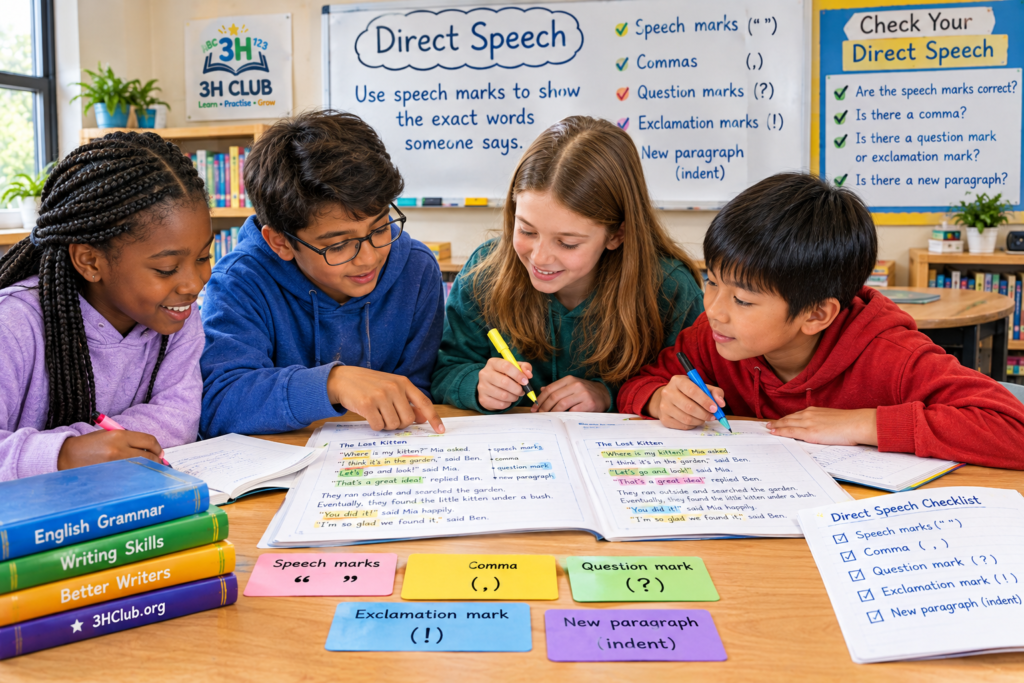
When checking your direct speech, use this checklist:
S — Speech marks
P — Punctuation
E — Exact words
A — Ask who is speaking
K — Keep new speakers in new paragraphs
S-P-E-A-K = a useful way to remember the important parts of dialogue.
⭐⭐⭐ Champions — Ages 10–11
Ready for the next level?
Now you can move beyond simply adding speech marks. You can use direct speech to make writing sound natural, expressive and interesting.
🎬 Direct Speech Brings Stories to Life
Compare these two sentences.
Without direct speech:
Jordan told Maya that he was excited about the competition.
With direct speech:
‘I’m really excited about the competition!’ Jordan told Maya.
The second example lets us hear Jordan’s voice.
Direct speech can show:
- what a character says
- how a character feels
- how characters respond to one another
- questions and answers
- arguments and disagreements
- excitement and surprise
- important information
That is why direct speech is so useful in stories.
🧠 Direct Speech Needs Accurate Punctuation
Consider this example:
‘I think we should leave now,’ said Priya.
There are several things to notice.
1. Speech marks
They show the exact words Priya says.
2. Capital letter
I begins the spoken sentence with a capital letter.
3. Comma
The comma connects the spoken words to the reporting clause.
4. Reporting verb
said tells us that Priya is speaking.
5. Full stop
The sentence ends after the reporting clause.
🗣️ Reporting Verbs Can Add Meaning
The verb said is useful, but you do not always need to use it.
Compare:
‘I don’t believe you,’ said Theo.
‘I don’t believe you,’ whispered Theo.
‘I don’t believe you,’ shouted Theo.
‘I don’t believe you,’ replied Theo.
Each sentence creates a slightly different picture.
A good writer chooses the reporting verb carefully.
Some useful reporting verbs include:
| Reporting verb | What it can suggest |
|---|---|
| asked | someone wants an answer |
| replied | someone answers |
| whispered | someone speaks very quietly |
| shouted | someone speaks loudly |
| explained | someone gives information |
| warned | someone gives a warning |
| suggested | someone offers an idea |
| agreed | someone says yes to an idea |
| called | someone speaks loudly to get attention |
You do not need to use a complicated reporting verb every time. Said is often perfectly good.
🔄 When the Reporting Words Come First
The reporting clause can appear before the direct speech.
Maya asked, ‘Are you coming to the park?’
Notice the comma after asked.
The pattern is:
Speaker + reporting verb, ‘exact words.’
Another example:
Dad said, ‘We need to leave soon.’
🔄 When the Reporting Words Come Last
The reporting clause can also come after the spoken words.
‘We need to leave soon,’ said Dad.
The pattern is:
‘Exact words,’ + reporting clause.
🎯 When the Reporting Words Go in the Middle
Sometimes a writer interrupts a sentence with a reporting clause.
For example:
‘I think,’ said Aisha, ‘we should try again.’
The spoken sentence continues after said Aisha.
This can be useful in stories, but it needs careful punctuation.
Another example:
‘If we hurry,’ whispered Leo, ‘we might catch the bus.’
The reporting words are placed inside the sentence, so punctuation helps the reader understand that the same person is still speaking. Khan Academy
❓ Questions and Exclamations
Be especially careful with question marks and exclamation marks.
The speaker asks a question:
‘What time does the match start?’ asked Noah.
The speaker makes an exclamation:
‘That was incredible!’ shouted Maya.
The punctuation belongs to the spoken words.
💬 Different Speakers, Different Paragraphs
Read this short conversation:
‘Have you packed everything?’ asked Dad.
‘I think so,’ replied Zara.
‘What about your water bottle?’
‘Oh! I forgot it.’
Each new speaker begins a new paragraph.
This rule is extremely useful when writing longer conversations because it helps your reader follow the action.
✍️ Direct Speech in a Story
Direct speech does not have to take over your whole story.
You can mix dialogue with description.
For example:
The classroom became quiet as everyone waited for the results.
‘I think we did really well,’ whispered Aisha.
Noah smiled. ‘I hope so.’
The teacher opened the envelope.
The direct speech helps us experience the moment, while the surrounding writing tells us what is happening.
🧩 Direct Speech vs Reported Speech
Let’s take a closer look.
Direct speech
Amir said, ‘I finished my project.’
These are Amir’s exact words.
Reported speech
Amir said that he had finished his project.
This reports the information without repeating Amir’s exact words.
Direct speech is especially useful when the exact wording matters or when you want your reader to hear the speaker’s voice. LearnEnglish – British Council
🕵️ Champions’ Direct Speech Detective
Can you find the problems?
Example 1
‘i can’t believe we won’ shouted Leo.
There are two problems.
Problem 1: The first word needs a capital letter.
Problem 2: The exclamation mark should show the excitement.
A better version is:
‘I can’t believe we won!’ shouted Leo.
Example 2
‘Are you ready,’ asked Maya?
The question mark is in the wrong place.
The spoken words are the question, so write:
‘Are you ready?’ asked Maya.
Example 3
‘I found it,’ said Sam ‘It was under the table.’
The speech needs clearer punctuation.
A better version is:
‘I found it,’ said Sam. ‘It was under the table.’
The first spoken sentence has ended, so the next sentence begins with a capital letter.
📝 Make Your Dialogue Sound Natural
Real conversations do not always sound like formal essays.
People may say:
‘Well, I’m not sure.’
‘Really?’
‘Yes!’
‘Wait for me!’
Short pieces of speech can make a conversation feel lively.
You can also use contractions when they fit the speaker:
‘I’m ready.’
‘We’ll be there soon.’
‘I can’t find my book.’
The important thing is to make sure the speech sounds natural for the character and situation.
🏆 Champions Challenge: Repair the Dialogue
Rewrite this conversation correctly.
‘did you finish the poster’ asked Ava
yes replied Ben I finished it this morning
‘great’ said Ava ‘can we put it on the wall now’
Answer
‘Did you finish the poster?’ asked Ava.
‘Yes,’ replied Ben. ‘I finished it this morning.’
‘Great,’ said Ava. ‘Can we put it on the wall now?’
Check what changed:
- capital letters
- speech marks
- question mark
- commas
- full stops
- new paragraphs
- punctuation between two sentences spoken by the same person
That’s a lot of grammar work in a small conversation!
🏅 The Ultimate Direct Speech Challenge
Write a short conversation between two characters.
Your conversation should include:
☐ At least two speakers
☐ Speech marks around the spoken words
☐ At least one question
☐ At least one exclamation
☐ At least two different reporting verbs
☐ Correct commas and full stops
☐ A new paragraph whenever the speaker changes
☐ Natural-sounding dialogue
Example
‘Did you bring the map?’ asked Kai.
‘Yes, it’s right here,’ replied Amara.
Kai looked at the map carefully. ‘Are you sure this is the right path?’
‘Absolutely!’ said Amara. ‘Let’s go!’
Now try creating your own.
⭐⭐⭐ Champions Tip
Before you finish a piece of writing with dialogue, read it out loud.
Ask yourself:
Can I tell who is speaking?
Does the conversation sound natural?
Have I used the right punctuation?
Have I started a new paragraph when the speaker changes?
Reading dialogue aloud is a powerful way to spot places where the punctuation or wording needs improving.
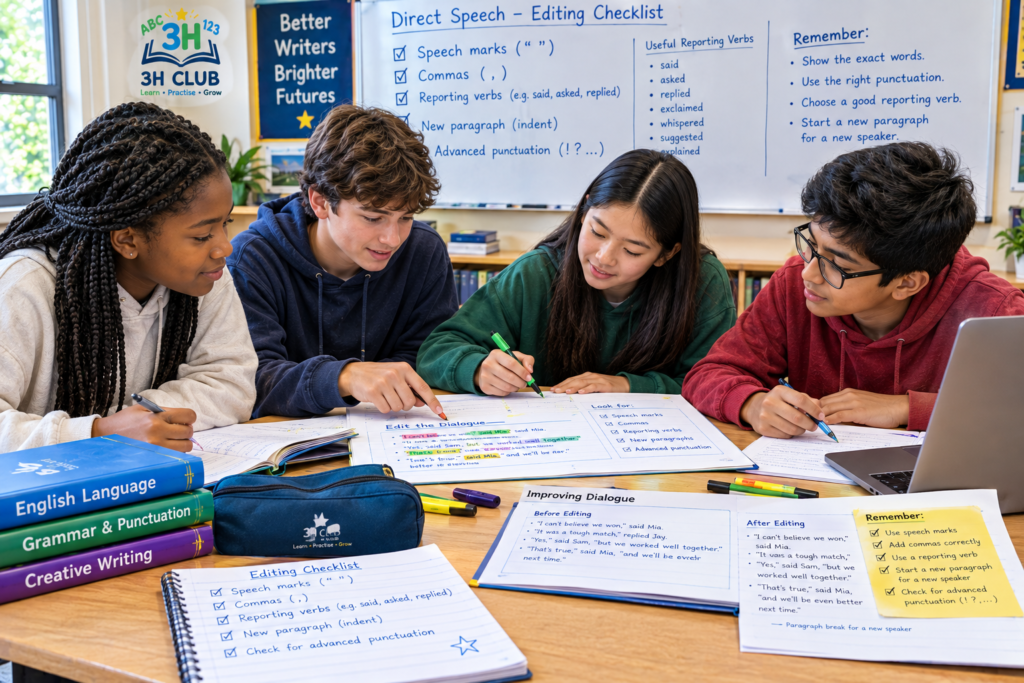
💡 Direct Speech Checklist
Before you finish your writing, check each point.
💬 Speech
☐ Have I written the speaker’s exact words?
☐ Have I placed speech marks around the spoken words?
🔤 Capital letters
☐ Does the spoken sentence begin correctly?
✏️ Punctuation
☐ Have I used commas correctly?
☐ Have I used question marks for questions?
☐ Have I used exclamation marks when appropriate?
☐ Have I used full stops correctly?
🗣️ Speakers
☐ Is it clear who is speaking?
☐ Have I started a new paragraph when the speaker changes?
✨ Writing style
☐ Do my reporting verbs make sense?
☐ Does the dialogue sound natural?
☐ Have I avoided using complicated words just to sound impressive?
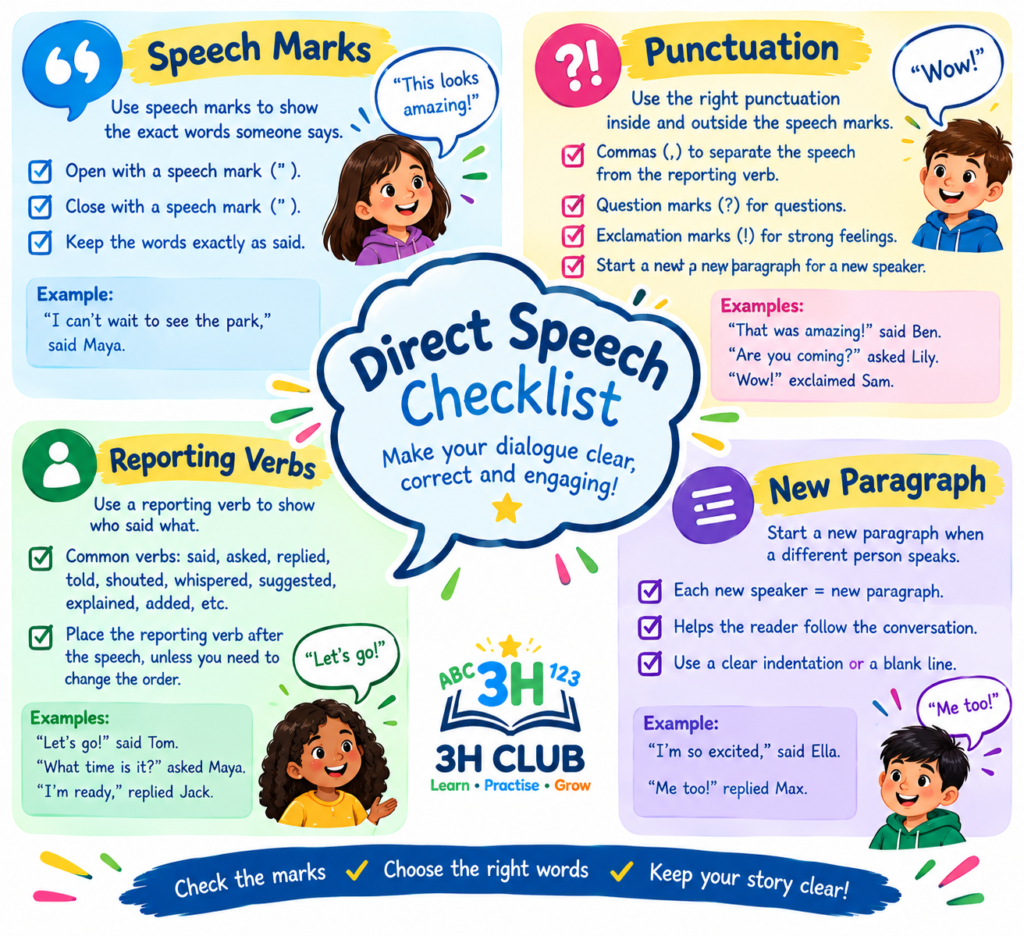
🎯 Why Is Direct Speech Important?
Direct speech helps you become a stronger storyteller and writer.
It allows you to:
- show exactly what a character says
- make stories more exciting
- show feelings and reactions
- create realistic conversations
- make characters sound different from one another
- help readers imagine being part of the scene
When you use direct speech well, your characters don’t just tell the reader what happened.
They can speak for themselves.
📚 Direct Speech Examples to Remember
Here are some useful patterns.
Speech first
‘I love this book,’ said Ella.
Reporting words first
Ella said, ‘I love this book.’
Question
‘Where is the library?’ asked Noah.
Exclamation
‘We won!’ shouted Mia.
Reply
‘Yes, I did,’ replied Sam.
Two speakers
‘Are you ready?’ asked Ava.
‘Almost!’ replied Leo.
Speech with description
Noah looked at the dark sky. ‘I think it’s going to rain.’
Keep these patterns in mind and you’ll have a strong starting point whenever you write dialogue.
🧠 What Have You Learned?
⭐ Starters
You learned that:
- direct speech shows the exact words someone says
- speech marks show the spoken words
- spoken sentences begin with capital letters
- questions need question marks
- excited speech may need an exclamation mark
⭐⭐ Builders
You learned that:
- reporting verbs tell us who spoke
- commas can connect spoken words to reporting words
- different speakers usually begin new paragraphs
- direct speech is different from reported speech
- punctuation helps readers follow a conversation
⭐⭐⭐ Champions
You learned that:
- reporting verbs can add meaning
- direct speech can come before or after reporting words
- reporting words can sometimes appear in the middle of speech
- dialogue needs careful punctuation
- direct speech can make stories more vivid and natural
- reading dialogue aloud can help you edit your writing
❓ Direct Speech FAQs
What is direct speech?
Direct speech is when you write the exact words that someone says.
Example:
‘I am ready,’ said Maya.
What are speech marks?
Speech marks, also called quotation marks, are punctuation marks used to show quoted or spoken words.
For example:
‘Come here,’ called Dad.
Do speech marks go around everything?
No. They go around the words being spoken.
Mia said, ‘I love music.’
The words Mia said are not inside the speech marks.
What is a reporting verb?
A reporting verb tells us about the act of speaking.
Examples include:
said, asked, replied, shouted, whispered, explained and called.
Does every piece of direct speech need “said”?
No. Said is useful and perfectly correct, but other reporting verbs can show more about the way someone speaks.
‘Be careful!’ warned Dad.
Does every new speaker need a new paragraph?
Yes, in normal story dialogue, starting a new paragraph when the speaker changes helps the reader see who is talking. Purdue OWL
Where does the question mark go?
If the spoken words are a question, the question mark belongs with the spoken words.
‘Where are you going?’ asked Maya.
Where does the exclamation mark go?
If the spoken words are an exclamation, the exclamation mark belongs with the spoken words.
‘Watch out!’ shouted Leo.
What is the difference between direct speech and reported speech?
Direct speech gives the speaker’s exact words:
‘I am tired,’ said Ava.
Reported speech gives the meaning without repeating the exact words:
Ava said that she was tired.
Direct and reported speech are two different ways of telling a reader what someone said. LearnEnglish – British Council
🔗 Keep Learning with 3HClub
Once you’ve learned direct speech, these grammar topics can help you become an even stronger writer:
- Nouns for Kids — learn how naming words work.
- Verbs for Kids — explore action and other types of verbs.
- Adjectives for Kids — discover how describing words make writing more interesting.
- Pronouns for Kids — learn how pronouns help your sentences flow.
- 3HClub.org — explore more English learning activities.
⭐ Final Takeaway
Direct speech is all about showing exactly what someone says.
Remember the big ideas:
Exact words → speech marks → correct punctuation → clear speaker → new paragraph when the speaker changes.
Once you can do those things, you can turn a simple story into a conversation that feels real, lively and full of character.
Keep practicing, keep checking your punctuation, and keep writing — your characters have something to say! 🌟