Fact or Opinion?
⚖️ Learn to Tell the Difference!
⭐⭐ BUILDERS | Ages 8–9
📚 Subject: English – Reading Comprehension
🎯 Skills: Identifying facts, recognising opinions, explaining the difference, and sorting statements.
🌟 What Will You Learn?
Have you ever heard someone say, “Chocolate ice cream is the best flavour”?
You might agree. Your friend might prefer strawberry.
But what if someone says, “Ice cream is usually served cold”?
That’s something you can check!
These two statements are different. One is an opinion, and the other is a fact.
Understanding the difference helps you think carefully about what you read and hear.
By the end of this lesson, you will be able to:
- ✅ Identify statements that are facts.
- ✅ Recognise statements that express opinions.
- ✅ Explain why a statement is a fact or an opinion.
- ✅ Sort statements into the correct groups.
- ✅ Use facts and opinions when discussing stories.
💡 Remember: Good readers don’t just read words. They think about what those words mean!
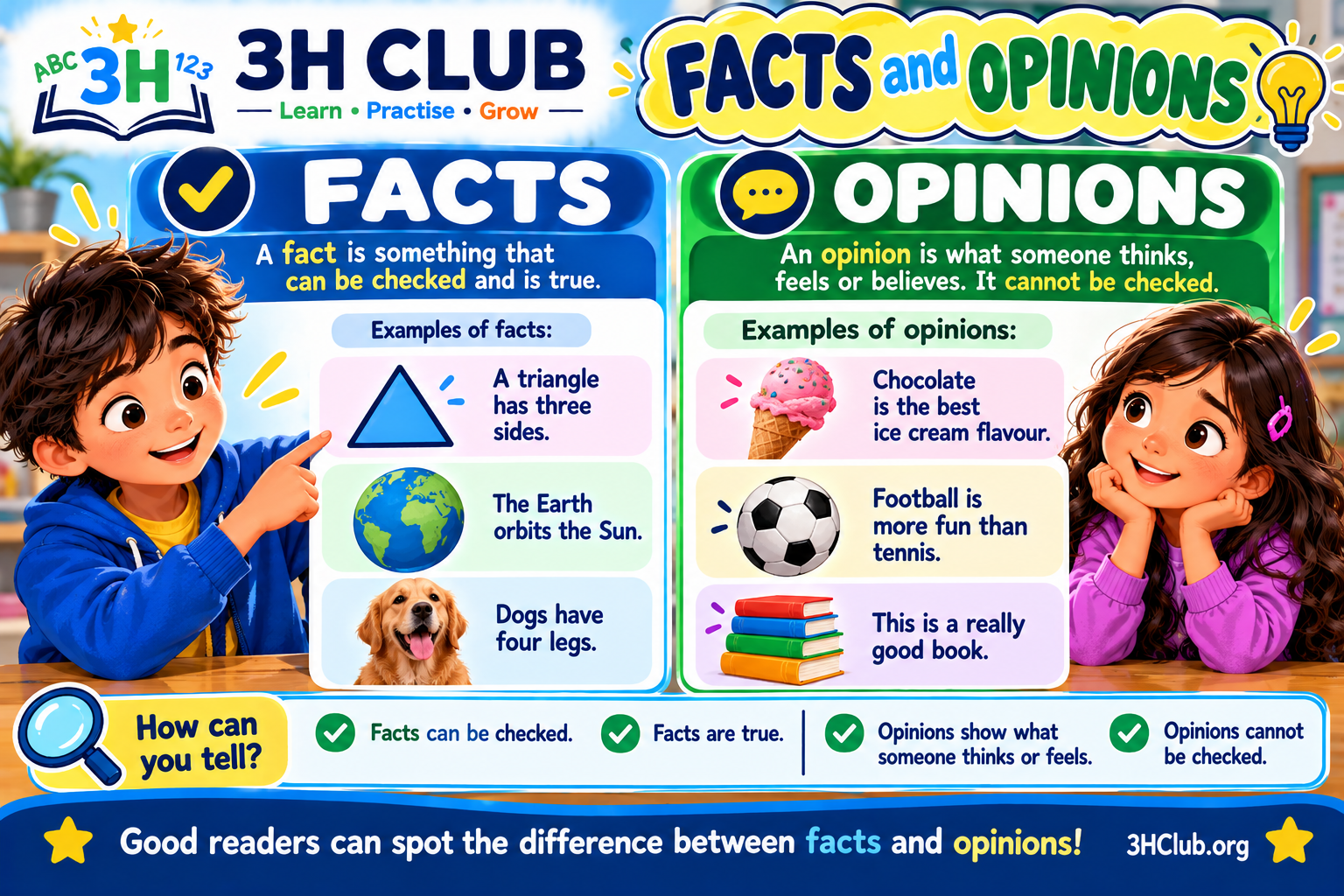
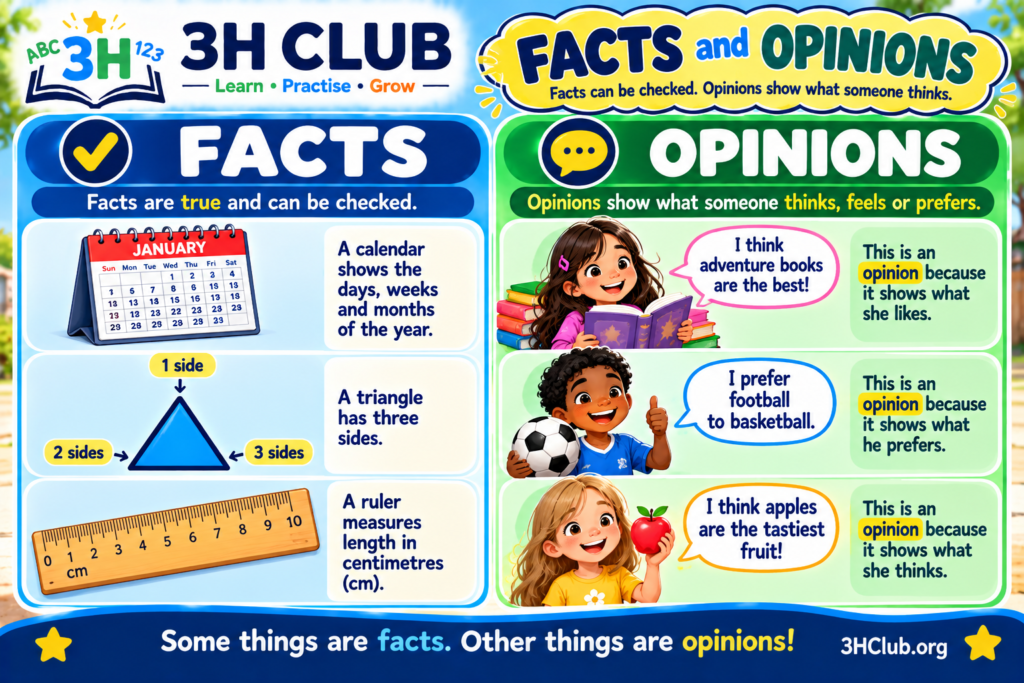
🔵 1. What Is a Fact?
A fact is a statement that can be checked to find out whether it is true or false.
You can often check facts by observing something, measuring it, counting it, or looking for reliable information.
📘 Examples of Facts
| Statement | Why is it a fact? |
|---|---|
| A triangle has three sides. | You can count the sides. |
| A week has seven days. | You can check a calendar. |
| Dogs have four legs. | You can check the usual number of legs dogs have. |
| The Sun is a star. | You can check scientific information. |
| A football is used in some sports. | You can check how the ball is used. |
Notice something important?
Facts can be checked.
You don’t have to like or dislike something for it to be a fact.
🔍 Can a Fact Be Wrong?
Here’s something interesting!
A statement can make a factual claim but still be incorrect.
For example:
“A triangle has four sides.”
This is not true. However, it is still a statement that can be checked.
That makes it an incorrect factual statement, not an opinion.
⭐ Reading Tip: A fact is something that can be checked. Don’t assume that every factual statement you hear is correct!
🟢 2. What Is an Opinion?
An opinion is a statement that tells what someone thinks, feels, believes, or prefers.
People can have different opinions about the same thing.
💬 Examples of Opinions
| Statement | Why is it an opinion? |
|---|---|
| Mangoes are the tastiest fruit. | People prefer different fruits. |
| Football is the most exciting sport. | People enjoy different sports. |
| Rainy days are boring. | Some people enjoy rainy days. |
| Puppies are cuter than kittens. | People have different preferences. |
| Reading is more fun than watching television. | People enjoy different activities. |
These statements express personal views.
Someone might agree with them, while another person might disagree.
💡 Remember: An opinion is not automatically wrong because someone disagrees with it.
People are allowed to have different opinions.
🗣️ Look for Opinion Clue Words
Some words can help you recognise opinions.
Look for:
- best
- worst
- beautiful
- boring
- exciting
- delicious
- favourite
- I think
- I believe
- I prefer
For example:
“The beach is the best place to spend a Saturday.”
The word best suggests a personal preference.
However, be careful! These words are clues, not perfect rules.
Sometimes an opinion can be written without using any of them.
Example: “Summer holidays should be longer.”
This expresses a belief about what should happen.
🟡 3. Fact or Opinion? What’s the Difference?
Let’s compare them.
| 🔵 FACT | 🟢 OPINION |
|---|---|
| Can be checked. | Expresses a personal view or judgement. |
| Can be supported or disproved using evidence. | May be supported by reasons, but people can still disagree. |
| Does not depend on personal taste. | Often depends on what someone likes or believes. |
| Example: A bicycle has two wheels. | Example: Cycling is the best outdoor activity. |
| Example: A year has twelve months. | Example: December is the nicest month. |
🧠 Ask Yourself Two Questions
When you read a statement, ask:
1. Can I check whether this statement is true or false?
If yes, it may be a factual statement.
2. Does this statement tell me what someone thinks, feels, believes, or prefers?
If yes, it may be an opinion.
✨ Let’s Compare!
Statement A: “The puppy has brown fur.”
This is a fact if the puppy’s fur is brown. You can check by looking at the puppy.
Statement B: “The brown puppy is the cutest animal.”
This is an opinion because people may disagree about which animal is cutest.
See the difference?
Both statements describe a puppy, but they tell us different kinds of information.
🐶 4. Fact or Opinion? Let’s Think About a Puppy!
Imagine a child named Ava finds a small puppy near a hedge.
Read these statements:
A. The puppy is sitting beside a hedge.
B. The puppy is the most adorable animal in the neighbourhood.
C. The puppy has a blue collar.
D. Everyone should have a puppy as a pet.
Can you identify the facts and opinions?
🔎 Let’s Investigate
Statement A — FACT
You can check where the puppy is sitting.
Statement B — OPINION
People may have different ideas about which animal is most adorable.
Statement C — FACT
You can check whether the puppy is wearing a blue collar.
Statement D — OPINION
Not everyone believes that having a puppy is the right choice.
📖 Connect Your Learning
If you have read The Lost Puppy, think about the descriptions in that story.
Look for one sentence that tells you something you can check from the story.
Then think of one opinion you could express about a character or event.
For example:
Fact about a story: “The character found a puppy.”
This is a fact about the story only if the event actually happens in the text.
Opinion about a story: “The character made a wonderful decision.”
⭐ Important: When identifying facts in fiction, you can check whether the story actually says something happened. That does not mean the fictional event happened in real life.
💡 Reading Tip: Facts help you understand what happens in a story. Opinions help you explain what you think about it.
🏖️ 5. Fact or Opinion? A Day at the Beach
Imagine a family enjoying a sunny afternoon at the beach.
A boy named Leo is building a sandcastle while his sister plays with a beach ball.
Read these statements:
- Leo is building a sandcastle.
- Building sandcastles is the best beach activity.
- Leo’s sister is holding a beach ball.
- The beach is more exciting than the park.
- The sandcastle has two towers.
- Everyone should visit the beach every weekend.
🧠 Think Before You Answer
Which statements describe something you could check?
Which statements express personal views?
✅ Answers
| Statement | Fact or Opinion? | Explanation |
|---|---|---|
| 1 | Fact | You can check what Leo is doing. |
| 2 | Opinion | People enjoy different beach activities. |
| 3 | Fact | You can check what his sister is holding. |
| 4 | Opinion | Different people prefer different places. |
| 5 | Fact | You can count the towers. |
| 6 | Opinion | People have different ideas about weekend activities. |
These are facts about our imagined scene, not verified details from A Day at the Beach.
If you have read A Day at the Beach, try finding two facts in the actual story and writing one opinion about the events.
mage: A bright beach scene showing Leo building a sandcastle with two towers and his sister holding a colourful beach ball. Include two clearly labelled educational callouts: “FACT: The sandcastle has two towers.” and “OPINION: Building sandcastles is the best beach activity.” Include a small magnifying-glass motif.
Alt text: Beach scene teaching children to distinguish a fact about a sandcastle from an opinion about beach activities.
Caption: 🏖️ Look carefully! Which statements can you check, and which express personal preferences?
🟣 6. Can Opinions Have Reasons?
Yes!
An opinion becomes more useful when you explain why you believe it.
Look at this example:
Opinion: “Reading adventure stories is more enjoyable than reading information books.”
Reason: “I enjoy imagining exciting places and surprising events.”
The reason helps someone understand the opinion.
But it does not turn the opinion into a fact.
🌟 Opinion + Reason
Try this pattern:
I think __________ because __________.
Examples:
- I think swimming is fun because I enjoy being in the water.
- I believe school gardens are useful because children can learn about plants.
- I prefer reading in the morning because I find it easier to concentrate.
Your reasons make your opinions clearer.
🔍 What About Opinions Supported by Facts?
Sometimes people use facts to support their opinions.
Fact: “The library has more than 500 books.”
Opinion: “Our library is the best place to spend lunchtime.”
Reason: “There are so many books to choose from.”
The number of books is something you can check.
Calling the library the best place is a personal judgement.
💡 Remember: A strong reason can support an opinion without making everyone agree with it.
🧩 7. Let’s Practise! Fact or Opinion?
Ready to test your skills?
Read each statement carefully.
Write F for Fact or O for Opinion.
✏️ Activity 1: Quick Sorting
- A spider has eight legs.
- Chocolate cake tastes better than vanilla cake.
- A rectangle has four sides.
- Rainy weather is unpleasant.
- Fish live in water.
- Blue is the prettiest colour.
- A calendar shows days, weeks, and months.
- Playing outside is more enjoyable than playing indoors.
- The Earth moves around the Sun.
- Every child should learn to play the guitar.
🎯 Your Challenge: Don’t just choose F or O. Try to explain at least three answers.
🔍 8. Become a Fact Detective!
Sometimes a statement sounds believable, but you still need to check it.
Look at these examples.
Example A
“All birds can fly.”
Can this statement be checked?
Yes!
Is it correct?
No. Some birds, such as penguins and ostriches, cannot fly.
This is an incorrect factual statement.
Example B
“Penguins are the most interesting birds.”
Can you prove that penguins are the most interesting birds for everyone?
No.
Different people find different animals interesting.
This is an opinion.
Example C
“There are seven days in a week.”
Can you check this?
Yes!
It is a correct factual statement.
⭐ Three Important Ideas
Remember these differences:
Fact: A statement that can be checked.
Correct fact: A factual statement supported by accurate information.
Opinion: A statement expressing a personal view or judgement.
🧠 Think carefully: Something is not an opinion just because it is incorrect!
🎯 9. Activity 2: Sort the Statements
Imagine you are helping to organise statements for a classroom display.
Put each statement into the correct group.
Statements
A. The classroom has four windows.
B. Our classroom is the nicest room in the school.
C. The teacher is holding a red book.
D. Red books are more interesting than blue books.
E. There are twenty desks in the classroom.
F. Every classroom should have colourful walls.
🔵 FACTS
Write the letters here:
🟢 OPINIONS
Write the letters here:
💭 Explain Your Thinking
Choose one fact.
How could you check it?
Choose one opinion.
Why might someone disagree?
🧠 10. Activity 3: A Little Trickier!
Some statements are harder to classify.
Read each one carefully.
Statement 1
“The school garden has twelve sunflower plants.”
Fact or opinion?
Explain how you could check.
Statement 2
“Sunflowers are the most beautiful flowers.”
Fact or opinion?
Explain your answer.
Statement 3
“Our school should have a bigger playground.”
Fact or opinion?
What clue helped you decide?
Statement 4
“The playground is 30 metres long.”
Fact or opinion?
How could you check?
Statement 5
“I think the playground is too small.”
Fact or opinion?
What words helped you decide?
🌟 Bonus Challenge
Write your own two statements about a favourite place.
My fact:
My opinion:
Now explain the difference between them.
📚 11. Fact or Opinion When Reading Stories
Knowing the difference between facts and opinions is especially helpful when you read.
A story tells you what characters say, do, and experience.
You can use details from the text to explain what happens.
You can also form your own opinions about the characters and events.
📖 Example: A Short Story Scene
Read this paragraph:
Sam walked into the garden and noticed that several flowers had fallen over. A strong wind had blown during the night. He collected his gardening tools and began helping his grandfather.
Now consider these statements:
Statement A: “Sam noticed fallen flowers.”
This is a fact about the story because the paragraph tells us this happened.
Statement B: “Sam is the kindest character ever.”
This is an opinion because it expresses a personal judgement.
Statement C: “Sam collected his gardening tools.”
This is a fact about the story because the text tells us he did.
Statement D: “Helping in the garden is the most enjoyable activity.”
This is an opinion because different people enjoy different activities.
💡 A Helpful Reading Strategy
When answering questions about a story:
- Read the statement carefully.
- Look for evidence in the text.
- Decide whether it can be checked or expresses a personal view.
- Explain your answer.
You can use these sentence starters:
For a fact:
“This is a fact about the story because the text says…”
For an opinion:
“This is an opinion because someone else might think…”
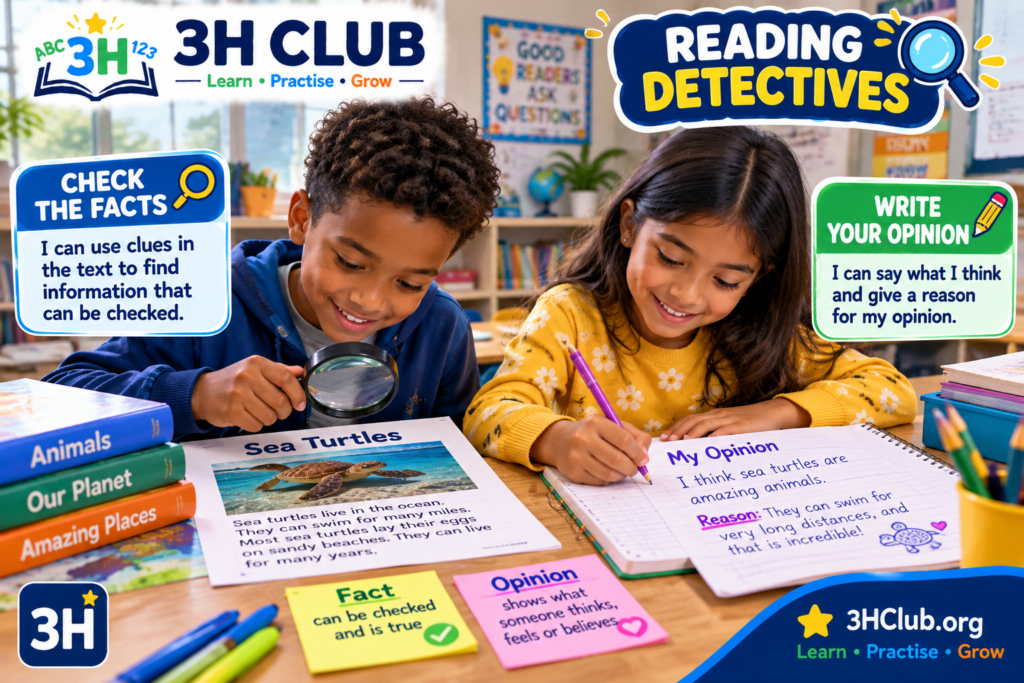
✍️ 12. Activity 4: Write a Fact and an Opinion
Choose one topic:
- 🐶 Pets
- 🏖️ The beach
- 📚 Reading
- ⚽ Sports
- 🌳 Nature
Write one fact and one opinion about your chosen topic.
My Topic
My Fact
How can I check it?
My Opinion
Why do I think this?
⭐ Extra Challenge
Use the word because to explain your opinion.
For example:
“I think visiting the beach is enjoyable because I love playing in the sand.”
🏆 13. Final Challenge: Fact, Opinion, or Incorrect Fact?
You now know that a factual statement can be correct or incorrect.
For this challenge, use:
- CF = Correct Fact
- IF = Incorrect Fact
- O = Opinion
Read each statement.
- The Moon is made of cheese.
- A square has four equal sides.
- Strawberries are the tastiest fruit.
- A year has twelve months.
- Dogs are better pets than cats.
- A triangle has five sides.
- The Earth is a planet.
- Reading stories is the most exciting way to learn.
🌟 Think carefully! Some statements are incorrect, but that does not make them opinions.
✅ 14. Check Your Answers!
Activity 1: Quick Sorting
| Number | Answer | Explanation |
|---|---|---|
| 1 | F | You can check the number of legs a spider has. |
| 2 | O | People prefer different cake flavours. |
| 3 | F | You can count a rectangle’s sides. |
| 4 | O | People have different feelings about rain. |
| 5 | F | This is a checkable statement about fish. |
| 6 | O | Colour preferences are personal. |
| 7 | F | You can check what a calendar shows. |
| 8 | O | People enjoy different activities. |
| 9 | F | Scientific evidence supports this statement. |
| 10 | O | This expresses a belief about what children should learn. |
Activity 2: Sort the Statements
🔵 Facts: A, C, E
🟢 Opinions: B, D, F
You could check the facts by counting the windows or desks or looking at the book.
Activity 3: A Little Trickier
| Statement | Answer | Why? |
|---|---|---|
| 1 | Fact | You can count the sunflower plants. |
| 2 | Opinion | Beauty is a personal judgement. |
| 3 | Opinion | It expresses what someone thinks should happen. |
| 4 | Fact | You can measure the playground. |
| 5 | Opinion | “I think” introduces a personal judgement about its size. |
Activity 4: Write Your Own
Your answers will depend on your chosen topic.
A good fact should be something you can check.
A good opinion should express your view, preferably with a reason.
Final Challenge
| Number | Answer | Explanation |
|---|---|---|
| 1 | IF | The Moon is not made of cheese. |
| 2 | CF | A square has four equal sides. |
| 3 | O | People have different favourite fruits. |
| 4 | CF | A year has twelve months. |
| 5 | O | People have different pet preferences. |
| 6 | IF | A triangle has three sides, not five. |
| 7 | CF | The Earth is a planet. |
| 8 | O | People enjoy different ways of learning. |
🎉 Well done! If you made a mistake, look at the explanation and try again.
Every time you check your thinking, you’re building stronger reading skills.
🌈 15. What Have You Learned?
Let’s review!
🔵 Facts
Facts are statements that can be checked.
They can be supported or disproved using evidence.
🟢 Opinions
Opinions tell us what someone thinks, feels, believes, or prefers.
People can have different opinions.
🟡 Evidence
Evidence helps you check factual statements.
It can also help you explain or support an opinion.
🟣 Smart Reading
When you read a statement, ask:
“Can I check this, or is it someone’s view?”
That’s a powerful question!
🌟 Keep Learning with 3HClub!
You’ve practised identifying facts, recognising opinions, explaining your choices, and sorting statements.
Now try using these skills whenever you read a story.
You can practise with:
🐶 The Lost Puppy
Read the story and identify details that the text confirms. Then share an opinion about a character or event.
🏖️ A Day at the Beach
Look for statements about what happens in the story. Then explain what you think about the events.
Remember:
🔍 Facts can be checked.
💬 Opinions express personal views.
🧠 Thoughtful readers know the difference!
⭐ Your Next Reading Challenge
The next time someone tells you something interesting, ask yourself:
“Is that a fact, an opinion, or a factual claim I need to check?”
Keep reading, keep questioning, and keep growing!
3H CLUB — Learn • Practise • Grow