Finding the Main Idea:
Reading Comprehension for Kids
⭐⭐ Builders — Ages 8–9
When you read a story or paragraph, you will find lots of information. Some details tell you what happened, while others describe the people, places, or events. But how do you decide which information is most important?
The answer is to look for the main idea.
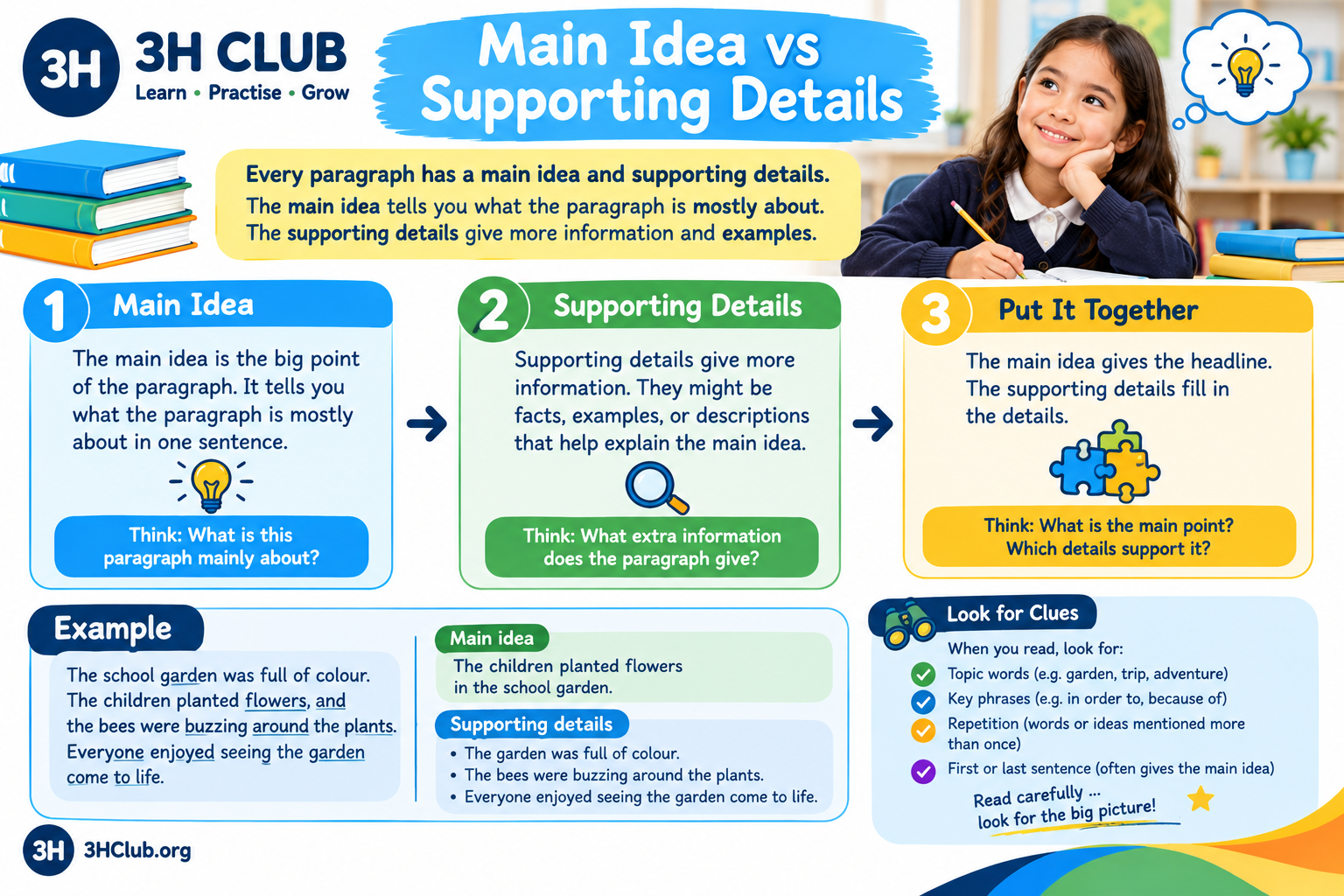
The main idea tells you what a story or paragraph is mostly about. Supporting details explain, describe, or give examples of that idea.
Learning to find the main idea helps you understand what you read, remember important information, and explain a text clearly in your own words.
In this lesson, you will practise finding the main idea, recognising supporting details, choosing suitable headings, and writing short summaries.
Let’s build your reading skills!
💡 1. What Is the Main Idea?
The main idea is the most important point a writer wants you to understand about a topic.
A topic tells you what the writing is about. The main idea tells you something important about that topic.
For example:
- Topic: Sea turtles
- Main idea: Sea turtles have special features that help them live in the ocean.
- Supporting details: They have flippers for swimming, streamlined bodies that move through water, and lungs for breathing air.
Notice the difference. “Sea turtles” is only the topic. The main idea gives us a fuller message about sea turtles.
Let’s try an example
Read this paragraph:
Every Saturday, Noah visits the community garden with his grandmother. He waters the vegetables, removes weeds, and checks whether the tomatoes are ripe. He also learns how compost helps plants grow. Noah enjoys helping because he likes seeing the garden become healthier.
What is the paragraph mostly about?
a) Noah checks the tomatoes.
b) Noah enjoys helping his grandmother in the garden.
c) Noah learns about compost.
Correct answer: b) Noah enjoys helping his grandmother in the garden.
The other answers are details from the paragraph. They tell us what Noah does and learns, but the main idea brings the information together.
Remember: A good main idea covers the whole paragraph, not just one sentence or one interesting detail.
🔎 2. Main Idea vs Supporting Details
Supporting details help explain the main idea. They may tell you:
- What a character does.
- Why something happens.
- What something looks like.
- Where an event takes place.
- Examples that help explain a topic.
Read this paragraph about a beach visit.
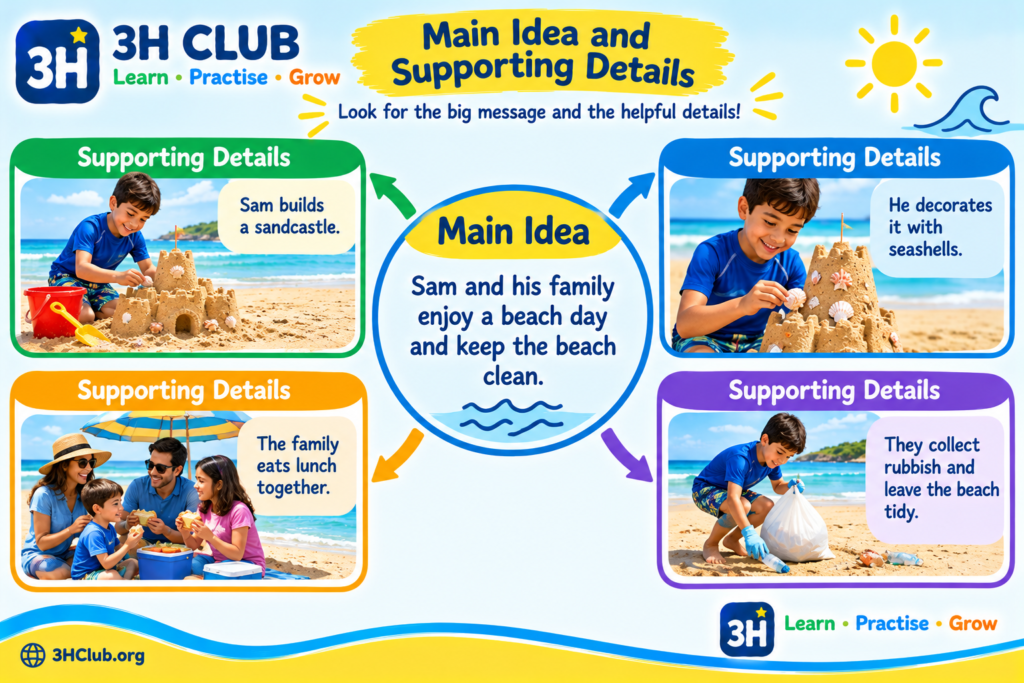
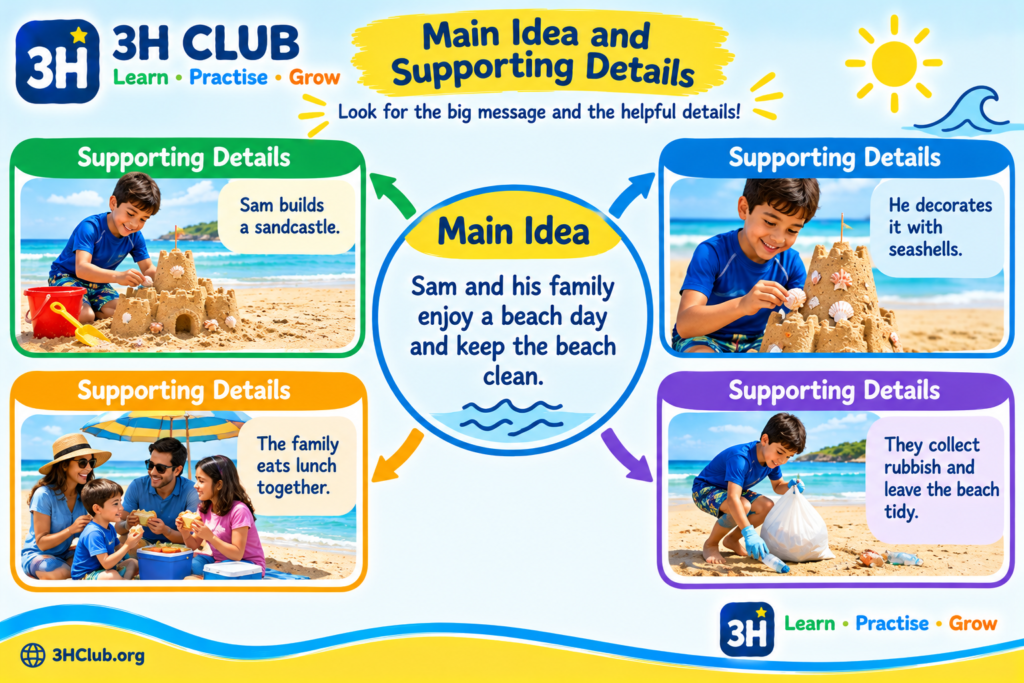
Sam and his family spent Saturday at the beach. Sam used a red bucket and a yellow spade to build a sandcastle. He decorated it with seashells and showed it to his sister. After lunch, the family collected their rubbish and left the beach tidy.
Main idea: Sam and his family enjoyed a day at the beach and helped keep it clean.
Supporting details:
- Sam built a sandcastle.
- He decorated it with seashells.
- The family ate lunch.
- They collected their rubbish before leaving.
Each detail helps us understand the family’s day. Together, the details support the main idea.
How can you tell the difference?
Ask yourself two questions:
- Main idea: What is the most important message?
- Supporting detail: What information helps explain that message?
A supporting detail may be interesting, but it does not always tell you what the whole paragraph is mostly about.
Quick practice
Paragraph: A hedgehog is a small mammal with sharp spines on its back. It uses its nose to explore its surroundings and often searches for food at night. When it feels threatened, it can curl into a ball.
Which sentence gives the main idea?
a) A hedgehog can curl into a ball.
b) A hedgehog has features and behaviours that help it survive.
c) A hedgehog searches for food at night.
Answer: b) The other two sentences give supporting details about the hedgehog.
🧠 3. Four Steps to Finding the Main Idea
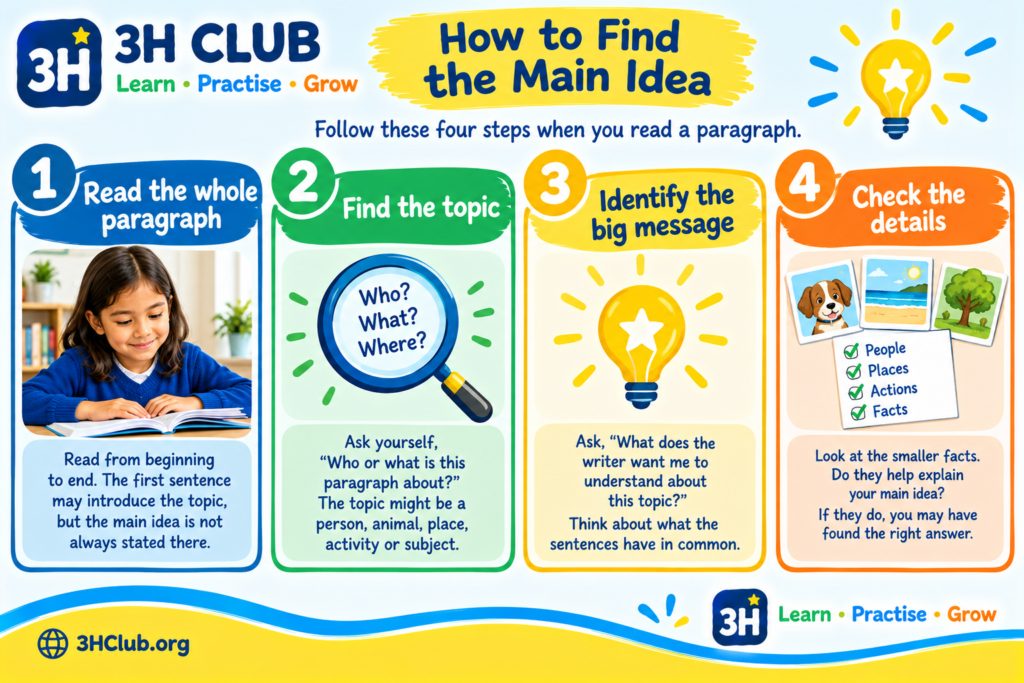
Finding the main idea becomes easier when you follow a clear process.
Step 1: Read the whole paragraph
Read from beginning to end. A paragraph’s first sentence may introduce the topic, but the main idea is not always stated at the beginning.
Step 2: Identify the topic
Ask, “Who or what is this paragraph about?”
The topic might be a person, animal, place, activity, or subject.
Step 3: Look for the message that connects the details
Ask, “What does the writer want me to understand about this topic?”
Think about what the sentences have in common.
Step 4: Check your answer against the whole paragraph
A good main idea should fit most or all of the important details. If it describes only one small part, it is probably a supporting detail instead.
Let’s work through an example
Read this paragraph:
Bees play an important role in nature. As they visit flowers to collect nectar, they carry pollen from one flower to another. This helps many plants produce seeds and fruit. Bees also provide food for other animals and are an important part of many ecosystems.
Step 1 — Topic: Bees.
Step 2 — Important message: Bees help nature in several ways.
Step 3 — Supporting details: They carry pollen, help plants produce seeds and fruit, and provide food for other animals.
Main idea: Bees play an important role in nature.
That sentence covers the whole paragraph. It is more complete than saying only “Bees visit flowers.”
4. Can the Main Idea Be Stated or Implied?
Sometimes a writer tells you the main idea directly. This is called a stated main idea.
At other times, the writer gives you several clues, and you must work out the main idea yourself. This is called an implied main idea.
A. Stated main idea
Read this paragraph:
Exercise is good for your body. Walking helps strengthen your muscles, cycling improves fitness, and swimming works many parts of your body. Regular physical activity can also help you feel energetic.
The first sentence tells us the main idea directly: Exercise is good for your body.
The other sentences provide supporting details.
B. Implied main idea
Read this paragraph:
Maya packed her swimming costume and towel. Her dad placed the sun cream and beach umbrella in the car. When they arrived, Maya ran towards the sand and began looking for seashells.
The paragraph does not directly say, “Maya went to the beach for a fun day out.” However, the clues tell us that she and her dad are probably spending time at the beach.
Possible main idea: Maya and her dad are enjoying a trip to the beach.
This answer is based on the details in the paragraph.
Important: When the main idea is implied, choose an answer supported by the text. Do not add information that the writer has not given you clues for.
🏷️ 5. Choosing the Best Heading
A heading is a title that tells readers what a section or paragraph is about.
A suitable heading should be:
- Relevant: It matches the topic and main idea.
- Clear: It is easy to understand.
- Broad enough: It covers the important information, not just one small detail.
- Short: It uses only the words needed to describe the text.
Example
Read this paragraph:
Many birds build nests to protect their eggs and young. Some use twigs, leaves, grass, or mud to make their nests. Different birds build different kinds of nests, depending on where they live and what materials they can find.
Choose the best heading:
a) A Bird Finds a Twig
b) How Birds Build Nests
c) A Rainy Day
Correct answer: b) How Birds Build Nests.
The paragraph explains how birds make nests and what materials they use. The first option describes only one small detail, while the third does not match the topic.
Your turn
Read this paragraph:
Oliver wanted to help birds during the cold winter months. He filled a bird feeder with seeds, placed it in a safe spot, and checked that it stayed full. Soon, small birds began visiting his garden each morning.
Which heading fits best?
a) Oliver Helps the Birds
b) Oliver Buys New Shoes
c) A Trip to the Beach
Answer: a) Oliver Helps the Birds.
The heading describes the main idea of the whole paragraph.
✂️ 6. How to Write a Good Summary
A summary is a shorter version of a text that includes its main idea and the most important supporting details.
A summary does not need every event, description, or example. It should give someone enough information to understand the main point.
Read the original paragraph
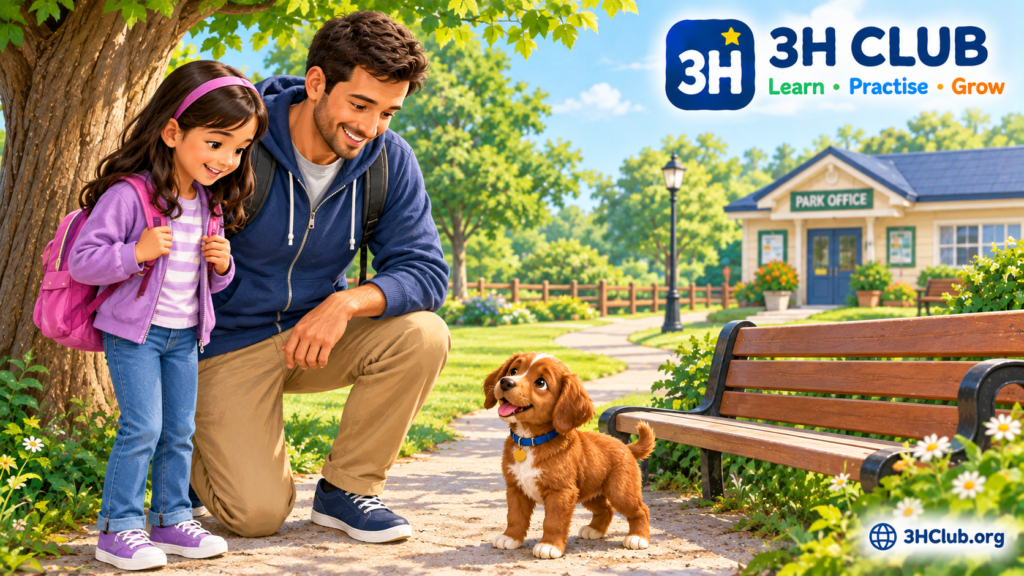
On Sunday, Mia went to the park with her dad. Near a large tree, she heard a puppy whimpering. She found a small brown puppy beside a bench and told her dad. Together, they took the puppy to the park office and asked for help. Soon, the owner arrived, and the puppy was safely reunited with its family.
Identify the important information
- Main idea: Mia helps a lost puppy.
- Important detail 1: She finds the puppy in the park.
- Important detail 2: She tells her dad and they ask for help.
- Important detail 3: The owner arrives and the puppy is reunited with its family.
A good summary
Mia finds a lost puppy in the park and asks her dad to help. They take it to the park office, where it is reunited with its owner.
The summary is shorter than the original, but it keeps the main idea and the important events.
How to write your own summary
- Read the whole text.
- Identify the main idea.
- Choose two or three details that are important to understanding it.
- Combine the information into a few sentences.
- Use your own words where possible.
- Check that your summary is accurate and does not include unnecessary details.
Top tip: A summary should be shorter than the original text. If you include every detail, you may be retelling the whole story instead of summarising it.
📝 7. Reading Practice: The Lost Puppy
Read the passage carefully. Then answer the questions.
A Puppy Needs Help
On Sunday afternoon, Mia went to the park with her dad. As they walked along a path, Mia heard a small whimper near a tree. She looked around and spotted a brown puppy with floppy ears and a white patch on its chest.
Mia stayed beside her dad and told him what she had found. They took the puppy to the park office, where they asked whether anyone had reported a missing pet. Mia gave the puppy some water while they waited.
A little later, the owner arrived. The puppy had slipped through an open gate while the owner was carrying shopping inside. The owner was relieved to find the puppy safe. Mia was pleased that she had helped.
Questions
1. What is the main idea of the passage?
a) Mia goes for a walk beside a tree.
b) Mia helps a lost puppy get back to its owner.
c) Mia drinks water at the park.
2. Which detail helps explain how Mia discovered the puppy?
a) She heard a whimper near a tree.
b) The owner was carrying shopping.
c) The puppy had a name.
3. Which is the best heading for the passage?
a) A Lost Puppy Finds Help
b) Shopping at the Store
c) A Day at School
4. Which detail supports the main idea?
a) Mia and her dad take the puppy to the park office.
b) The path goes past a tree.
c) It is Sunday afternoon.
5. Write a one- or two-sentence summary of the passage.
🏖️ 8. Reading Practice: A Day at the Beach
Now use the same skills with a different passage.
A Clean and Happy Beach Day
Sam and his family arrived at the beach on Saturday morning. Sam carried a red bucket and a yellow spade to a sandy spot near the water. He filled his bucket with wet sand and turned it upside down to make a sandcastle. Then he decorated the castle with small seashells.
After playing, the family sat under a beach umbrella and ate lunch together. Before leaving, Sam noticed some rubbish nearby. He helped his dad collect it and put it into a bag. They left the beach clean and tidy.
Questions
6. What is the main idea of the passage?
a) Sam loses his yellow spade.
b) Sam and his family enjoy a beach day and help keep the beach clean.
c) Sam finds a large shell.
7. Which detail tells you how Sam built his sandcastle?
a) He used wet sand and a bucket.
b) He sat under an umbrella.
c) He arrived on Saturday morning.
8. Choose the best heading.
a) Sam’s Beach Day
b) A Busy School Morning
c) The Lost Puppy
9. Which sentence is a supporting detail?
a) Sam’s family enjoy a beach day.
b) Sam decorates his sandcastle with small seashells.
c) Sam’s family spend time together.
10. Write a short summary of the passage.
🎯 9. Main Idea Challenge
These questions are a little trickier. Read carefully and think about how the details connect.
Activity A: A Helpful Class
The pupils in Class 3 wanted to make their classroom more welcoming. Some pupils organised the bookshelves, while others made labels for the storage boxes. A small group created colourful posters for the walls. By the end of the day, the classroom was neat, organised, and bright.
11. What is the main idea?
a) The pupils work together to improve their classroom.
b) The pupils use colourful paper.
c) The bookshelves contain books.
12. Which detail best supports the main idea?
a) The pupils organise shelves, label boxes, and make posters.
b) The classroom has walls.
c) The day comes to an end.
13. Choose the best heading.
a) Working Together to Improve Our Classroom
b) A Walk in the Forest
c) A Broken Toy
Activity B: Protecting Water
Water is important for people, animals, and plants. We use it for drinking, cooking, washing, and growing food. Turning off the tap while brushing your teeth can help save water. Fixing leaking taps also prevents water from being wasted.
14. What is the main idea?
a) Water is useful and should not be wasted.
b) Teeth need brushing.
c) Plants grow in soil.
15. Which detail supports the main idea?
a) Turning off the tap while brushing your teeth helps save water.
b) Some people own toothbrushes.
c) Plants can be different sizes.
16. Write a suitable heading for the paragraph.
✍️ 10. Write Your Own Summary
Choose one of these topics:
- A pet you know.
- A day at the beach.
- A helpful thing someone did.
- A place you enjoy visiting.
Write a short paragraph of four or five sentences about your chosen topic. Then write a summary of one or two sentences.
My paragraph
My summary
Now check your work:
- Does your summary explain the main idea?
- Have you included the most important details?
- Have you left out small or repeated details?
- Have you used your own words?
- Is your summary shorter than your paragraph?
If you can answer yes to these questions, you have made a strong start!
✅ 11. Answer Key
Check your answers after completing the activities. Some written answers may be worded differently and still be correct if they express the same idea.
Reading Practice: The Lost Puppy
- b) Mia helps a lost puppy get back to its owner.
- a) She heard a whimper near a tree.
- a) A Lost Puppy Finds Help.
- a) Mia and her dad take the puppy to the park office.
- Possible summary: Mia finds a lost puppy in the park and asks her dad to help. They take it to the park office, where the puppy is reunited with its owner.
Reading Practice: A Day at the Beach
- b) Sam and his family enjoy a beach day and help keep the beach clean.
- a) He used wet sand and a bucket.
- a) Sam’s Beach Day.
- b) Sam decorates his sandcastle with small seashells.
- Possible summary: Sam builds and decorates a sandcastle at the beach. Before going home, he helps his dad collect rubbish so the beach stays clean.
Main Idea Challenge
- a) The pupils work together to improve their classroom.
- a) The pupils organise shelves, label boxes, and make posters.
- a) Working Together to Improve Our Classroom.
- a) Water is useful and should not be wasted.
- a) Turning off the tap while brushing your teeth helps save water.
- Possible heading: “Why Saving Water Matters” or “Using Water Wisely”.
Writing Your Own Summary
Answers will vary. A successful summary includes the main idea and the most important details, uses clear wording, and is shorter than the original paragraph.
🎉 Great Work, Builders!
You have learned how to look beyond individual facts and discover what a paragraph is mostly about. You have also practised choosing headings and writing summaries that keep the important information.
Whenever you read, ask yourself:
“What is the writer mostly telling me?”
That question can help you understand stories, information books, articles, and many other kinds of writing.
Keep reading, keep thinking, and keep growing with 3HClub!
Learn • Practise • Grow