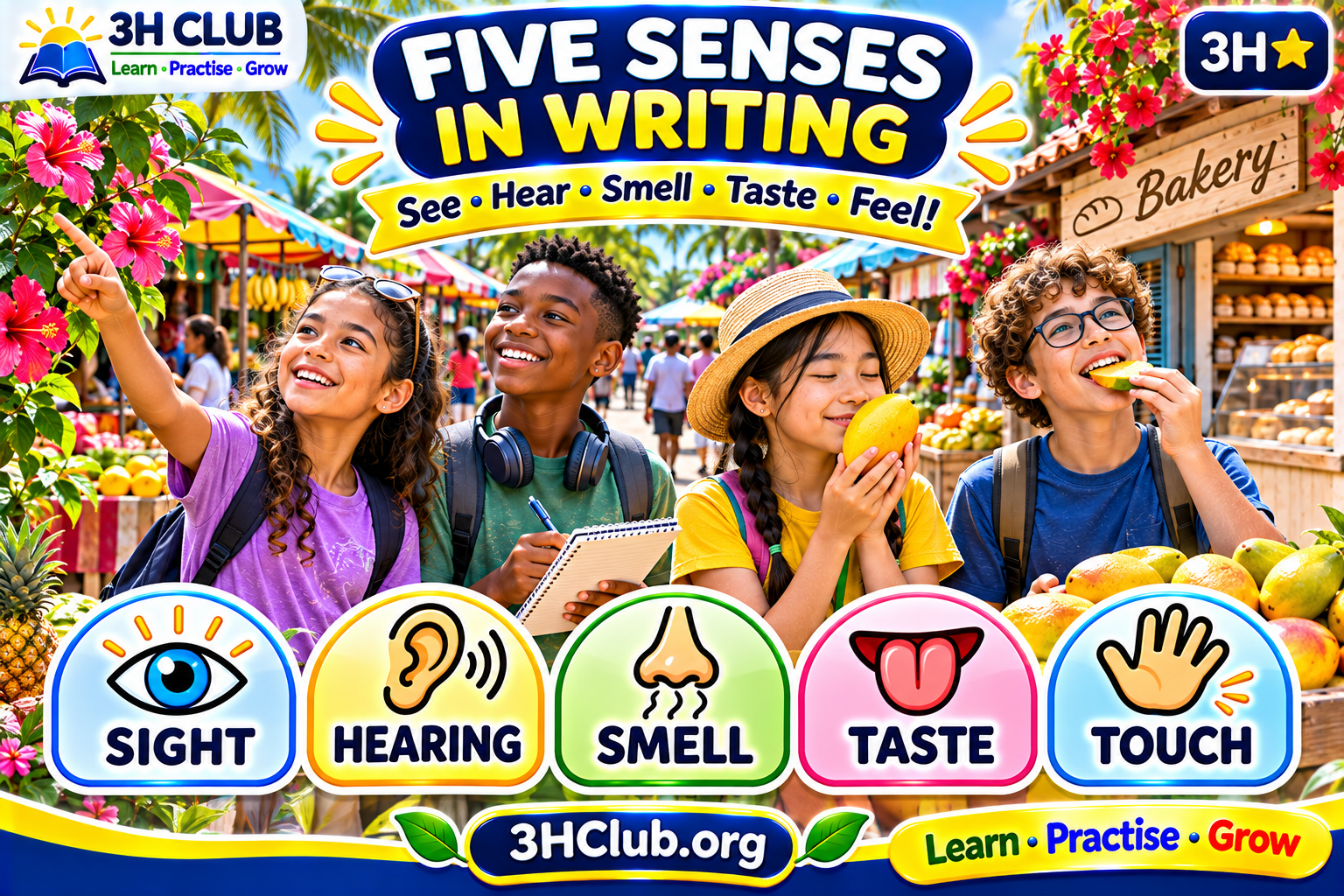
Five Senses in Writing for Kids:
🌈 Make Your Descriptions Come Alive!
⭐⭐⭐ CHAMPIONS — Ages 10–11
📚 Subject: English – Creative Writing, Descriptive Writing and Grammar
🎯 Skills: Sensory details, precise vocabulary, setting descriptions, atmosphere, figurative language, subject and predicate, paragraph writing and editing.
🌟 Hello, Sensory Writer!
Read this sentence:
The market was busy.
You understand the idea, but what does the market look and sound like?
Now read:
Colourful stalls lined the crowded street. Traders called out to shoppers, while the smell of freshly baked bread drifted through the warm afternoon air.
Can you picture the market more clearly?
The second description uses details that help you imagine the scene.
These are called sensory details.
Sensory details describe what a character can see, hear, smell, taste or feel.
Writers use them to make places, characters and events more memorable.
But here’s an important secret:
Good sensory writing isn’t about using every sense in every sentence. It’s about choosing the details that matter.
In this lesson, you’ll learn how to turn simple sentences into vivid descriptions, create different moods and write paragraphs that help readers experience your story.
Ready to put your senses to work?
Let’s begin!
🎯 What Will You Learn?
By the end of this lesson, you will be able to:
- Name and explain the five senses.
- Identify sensory details in sentences and stories.
- Choose appropriate sensory details for different settings.
- Use precise nouns, verbs and adjectives.
- Identify complete subjects and predicates.
- Expand simple sentences using sensory information.
- Use similes and personification to strengthen descriptions.
- Create atmosphere through carefully chosen details.
- Show a character’s feelings and reactions.
- Avoid unnecessary or repetitive descriptions.
- Organise sensory details into effective paragraphs.
- Write and edit your own sensory-rich story scene.
⭐ Your goal: Help readers imagine a scene clearly without overwhelming them with unnecessary details.
⭐ STAGE 1: SENSORY EXPLORERS
Discover the senses and build descriptive sentences
🔵 1. What Are the Five Senses?
Your senses help you notice and understand the world around you.
Writers can use these experiences to create descriptions that readers can imagine.
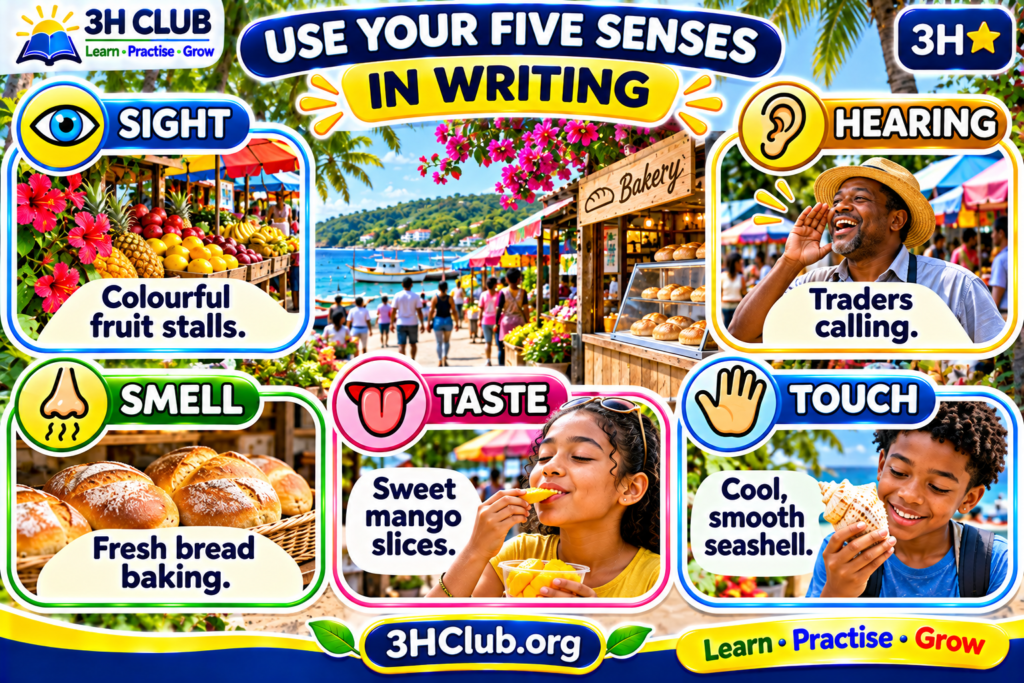
| Sense | What It Helps You Notice | Example |
|---|---|---|
| 👀 Sight | Colours, shapes, movement, light | Golden sunlight covered the hills. |
| 👂 Hearing | Voices, music, natural sounds | Waves crashed against the rocks. |
| 👃 Smell | Scents and odours | The scent of fresh bread filled the kitchen. |
| 👅 Taste | Flavours | The pineapple tasted sweet and juicy. |
| ✋ Touch | Texture, pressure, temperature | The rough rope scratched Leo’s palm. |
You might experience a place through several senses at once.
For example, at a beach you could see sparkling water, hear waves, smell salty air and feel warm sand.
However, taste would only be useful if something in the scene made it relevant, such as a character eating a mango.
✏️ Activity 1: Match the Sense
Identify the main sense in each sentence.
- The bright red kite floated above the field.
- The school bell echoed across the courtyard.
- The warm stone felt smooth beneath Maya’s hand.
- A spicy aroma drifted from the kitchen.
- Daniel tasted the tangy orange juice.
✏️ Activity 2: Sensory Detective
Read:
The garden glowed in the morning sunlight. Bees hummed beside the flowers, and the fresh scent of wet grass filled the air. Maya touched the cool wooden bench before sitting down.
Answer:
- What can Maya see?
- What can she hear?
- What can she smell?
- What can she feel?
- Which sense is not directly described?
- Does the paragraph need that missing sense? Explain.
⭐ Remember
A description can be effective with just two or three well-chosen sensory details.
🟢 2. Use Sight to Create a Clear Picture
Sight helps you describe:
- Colour and shape.
- Size and distance.
- Light and shadow.
- Movement.
- Important objects and landmarks.
Compare:
Basic: The forest was beautiful.
Improved: Golden sunlight filtered through tall trees, lighting the bright green ferns beside the path.
The improved sentence shows what makes the forest beautiful.
Choose Specific Details
Instead of writing There were many things in the room, you could write:
Maps covered the walls, and a wooden model ship rested beside the window.
Specific details help readers form a clearer picture.
✏️ Activity 3: Paint a Picture with Words
Choose one location:
A. A colourful harbour.
B. A mountain village.
C. A busy classroom.
D. A tropical rainforest.
Write four sentences describing what someone might see.
Include at least one detail about light and one about movement.
🟡 3. Use Hearing to Bring a Scene to Life
Sounds can tell readers what is happening nearby or far away.
Think about:
Rustling, splashing, humming, rattling, whispering, ringing, echoing and crackling.
Compare:
Basic: The street was noisy.
Improved: Bicycle bells rang as buses rumbled along the crowded street.
The second sentence identifies the sounds instead of simply calling the street noisy.
Sounds Can Suggest Atmosphere
Children laughed while music played across the square.
This suggests a cheerful atmosphere.
A loose shutter rattled against the empty building.
This might suggest a lonely or mysterious atmosphere.
✏️ Activity 4: Sound Search
Write a suitable sound for each setting.
- A library.
- A rocky beach.
- A school playground.
- A forest after rain.
- A busy railway station.
Then choose two settings and write a complete sentence about each.
🟣 4. Use Smell, Taste and Touch Carefully
These senses can make descriptions especially memorable because they often connect strongly to experiences.
👃 Smell
The scent of ripe mangoes drifted from the fruit stall.
Smell can help identify a place or remind a character of something familiar.
👅 Taste
Amira bit into the fresh pineapple, enjoying its sweet, slightly sharp flavour.
Taste works best when the character is eating or drinking something.
✋ Touch
The cool metal railing felt smooth beneath Daniel’s fingers.
Touch can describe textures, temperatures and physical sensations.
✏️ Activity 5: Complete the Description
Choose a suitable word or phrase.
- The freshly baked bread smelled __________.
- The old stone wall felt __________.
- The lemonade tasted __________.
- The morning breeze felt __________.
- The damp earth smelled __________.
Try to avoid using nice for every answer.
✏️ Activity 6: Choose the Most Natural Detail
Which detail fits the scene best?
1. A character is exploring a dark cave.
A. The stone wall feels cold and damp.
B. The character tastes strawberry ice cream without any explanation.
2. A character is eating lunch at a market.
A. The mango tastes sweet.
B. The distant mountain tastes purple.
3. A character walks beside a bakery.
A. The scent of warm bread drifts into the street.
B. The pavement smells like a computer screen.
Explain your choices.
🔵 5. Use Subjects and Predicates in Sensory Sentences
A strong description still needs clear, complete sentences.
A sentence usually contains a subject and a predicate.
🟦 Subject
The subject tells us who or what the sentence is about.
The gentle waves splashed against the rocks.
Complete subject: The gentle waves
🟩 Predicate
The predicate tells us what the subject does, is or experiences.
The gentle waves splashed against the rocks.
Complete predicate: splashed against the rocks
Sensory Sentence Examples
| Complete Subject | Complete Predicate | Main Sense |
|---|---|---|
| Bright lanterns | glowed above the street. | Sight |
| A distant bell | rang across the valley. | Hearing |
| The fresh bread | smelled delicious. | Smell |
| The ripe pineapple | tasted sweet. | Taste |
| The rough stones | pressed against Maya’s palms. | Touch |
✏️ Activity 7: Subject and Predicate Detective
Identify the complete subject and predicate.
- The colourful boats rocked beside the jetty.
- A loud whistle echoed across the station.
- The fresh flowers filled the room with fragrance.
- The warm sand shifted beneath Leo’s feet.
- The juicy orange tasted wonderfully sweet.
✏️ Activity 8: Build Complete Sensory Sentences
Add a predicate to each subject.
- The golden sunlight __________.
- The distant thunder __________.
- The fresh bread __________.
- The cold stone steps __________.
- The ripe strawberries __________.
Check that each sentence expresses a complete thought.
🟢 6. Grow a Sentence with Sensory Details
Begin with a simple sentence.
The waves crashed.
Subject: The waves
Predicate: crashed
Now expand it.
Step 1 — Add a precise description
The powerful waves crashed.
Step 2 — Add a place detail
The powerful waves crashed against the rocky shore.
Step 3 — Add another useful sensory detail
The powerful waves crashed against the rocky shore, sending cool spray into the air.
The sentence now includes sound, movement and touch.
✏️ Activity 9: Sensory Sentence Expansion
Expand these sentences.
- The rain fell.
- The market opened.
- The wind blew.
- The door closed.
- The fire crackled.
For each, add one or two sensory details.
⭐ Writing Tip
Don’t make sentences longer just to make them longer.
Choose details that help readers understand or imagine the scene.
⭐⭐ STAGE 2: SENSORY WRITERS
Choose powerful details and create atmosphere
🟡 7. Use Precise Vocabulary
Precise words help your reader imagine exactly what you mean.
Compare:
The water moved.
The stream trickled between smooth stones.
The verb trickled suggests a small, gentle flow.
Now compare:
The water moved.
The river surged over the rocks.
The verb surged suggests powerful movement.
One well-chosen verb can be more effective than several adjectives.
Useful Sensory Vocabulary
| Sense | Useful Words |
|---|---|
| Sight | shimmered, glimmered, shadowy, dazzling, faded |
| Hearing | rattled, echoed, murmured, thundered, rustled |
| Smell | fragrant, smoky, earthy, musty, fresh |
| Taste | tangy, bitter, sweet, sour, savoury |
| Touch | coarse, silky, slippery, rough, cool |
✏️ Activity 10: Upgrade the Word
Improve the bold words.
- The water moved along the stream.
- The leaves made a noise.
- The soup had a nice smell.
- The path felt bad beneath his bare feet.
- The stars looked bright.
Use precise words that suit the scene.
🟣 8. Create Mood and Atmosphere
Atmosphere is the feeling created by a setting.
Sensory details can make the same place feel completely different.
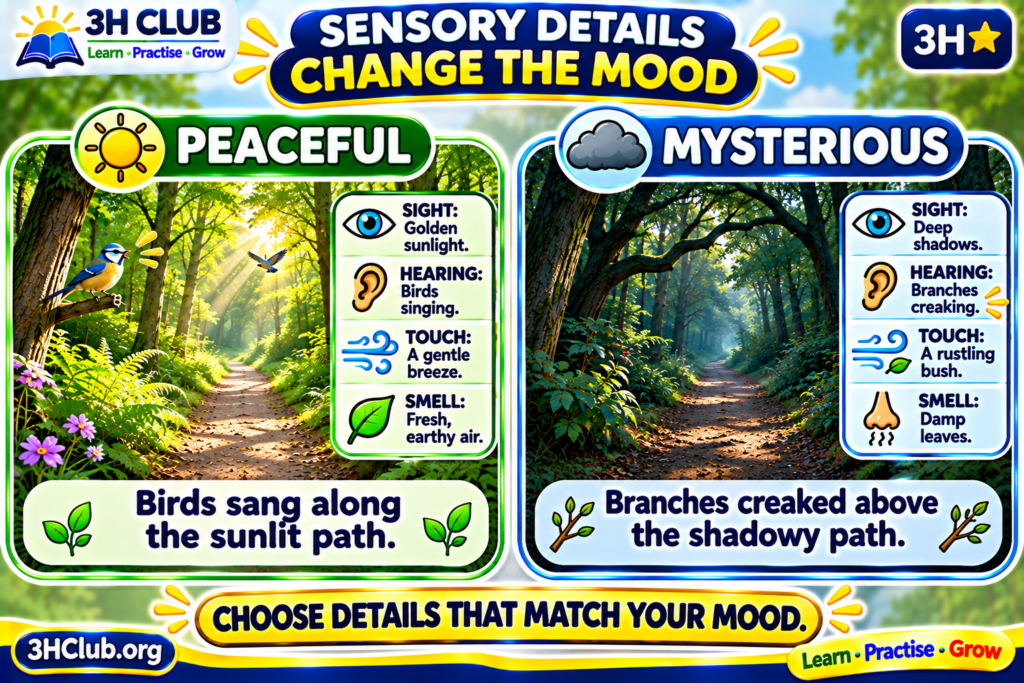
🌳 Peaceful Forest
Birds sang above the sunlit path. A gentle breeze moved through the ferns, carrying the fresh scent of leaves.
🌳 Mysterious Forest
Branches creaked above the shadowy path. A sudden rustle came from the bushes, and the damp air felt unusually cold.
Both descriptions take place in a forest.
But the sensory details create different feelings.
✏️ Activity 11: Atmosphere Detective
Identify the most likely mood.
- Cheerful music played while colourful flags fluttered above the square.
- The empty hallway echoed with slow footsteps.
- Gentle waves whispered along the quiet shore.
- Thunder rumbled as heavy rain struck the windows.
- Warm sunlight lit the garden while birds sang in the trees.
Possible moods: cheerful, mysterious, peaceful, tense, welcoming.
Some answers may overlap. Use evidence to explain your choice.
✏️ Activity 12: Mood Switch
Describe the same school courtyard twice.
Version A: Make it feel welcoming.
Version B: Make it feel mysterious.
Write three or four sentences for each version.
Change the sounds, light, movement and word choices.
🔵 9. Use Similes to Strengthen Sensory Writing
A simile compares two things using like or as.
Similes can make descriptions clearer or more imaginative.
Examples
Sight: The lake sparkled like a sheet of silver.
Hearing: The rain tapped on the roof like tiny footsteps.
Touch: The smooth pebble felt as cool as ice.
A good simile helps readers imagine the detail.
✏️ Activity 13: Create a Sensory Simile
Complete:
- The stars glittered like __________.
- The wind sounded like __________.
- The stone felt as rough as __________.
- The morning mist covered the hills like __________.
- The waterfall roared like __________.
Choose comparisons that make sense.
🟢 10. Try Personification
Personification gives human-like actions or qualities to something that is not human.
Examples
The wind whispered through the branches.
The old floorboards complained beneath his feet.
The morning sunlight danced across the water.
These expressions are imaginative rather than literal.
✏️ Activity 14: Bring the Setting to Life
Write one sentence using personification for each:
- The wind.
- The rain.
- The river.
- The old door.
- The sunlight.
⭐ Important
Not every sentence needs figurative language.
Sometimes a direct sentence, such as The door slammed in the wind, creates a stronger effect.
🟡 11. Show How a Character Experiences the Setting
Different characters may notice different things.
A character who enjoys wildlife might notice birds, insects and plants.
A character who is worried about being late might notice the crowded road and the ticking station clock.
The setting hasn’t changed, but the character’s attention has.
Example: A Busy Market
Maya, who loves cooking:
Maya breathed in the scent of warm bread and hurried towards the colourful fruit stalls.
Daniel, who dislikes crowded places:
Daniel stepped aside as shoppers hurried past him. Loud voices echoed between the stalls, and he searched for a quieter place to stand.
Their different reactions reveal something about them.
✏️ Activity 15: Two Characters, One Setting
Choose a setting:
- A busy festival.
- A quiet forest.
- A crowded sports stadium.
- A school science fair.
Invent two characters with different interests or feelings.
Write three sentences from each character’s point of view.
Choose sensory details that match what each character would notice.
🟣 12. Avoid Sensory Overload
Sensory writing becomes less effective when too many details compete for attention.
Overloaded Description
The bright, golden, shining, sparkling sun lit the loud, noisy, bustling, crowded market while sweet, sugary, fruity, delicious smells filled the warm, hot, heated air.
This sentence repeats similar ideas and becomes difficult to follow.
Improved Description
Golden sunlight warmed the crowded market. Traders called from colourful stalls, and the scent of ripe fruit drifted through the air.
The improved version is shorter, clearer and more focused.
Three Questions to Ask
1. Is the detail relevant?
Does it help the reader understand the scene?
2. Is the detail specific?
Does it create a clear image, sound or sensation?
3. Does the detail fit the atmosphere?
Does it support the feeling you want to create?
✏️ Activity 16: Sensory Editor
Improve this sentence:
The very big, huge, enormous waves made a really loud, noisy, booming sound on the wet, watery beach.
Use precise words and remove repetition.
Then explain what you changed.
⭐⭐⭐ STAGE 3: SENSORY MASTERS
Analyse, write and improve sensory-rich stories
📖 13. Model Story: The Morning Market Mystery
Read this story carefully.
Notice how sensory details help create the setting, develop atmosphere and guide the characters towards a discovery.
🧺 The Morning Market Mystery
Beginning: A Colourful Morning
The Saturday market stretched along the harbour road beneath a clear blue sky.
Colourful umbrellas shaded baskets of mangoes, pineapples and sweet peppers. Traders greeted customers, and bicycle bells rang as people moved between the stalls.
Maya walked beside her grandfather, carrying a small shopping bag.
The warm scent of freshly baked coconut bread drifted from a nearby bakery.
“That smells wonderful,” Maya said.
Her grandfather smiled.
“We’ll buy some after we collect the vegetables.”
Maya stopped at a fruit stall, where bright yellow mangoes were arranged in neat rows.
The stallholder offered her grandfather a small piece of ripe mango to sample, and he shared it with Maya.
Its sweet juice filled her mouth.
Middle: An Unexpected Sound
As they continued along the road, Maya noticed that the market was growing busier.
Shoppers crowded the narrow spaces between stalls, and the voices of traders rose above the distant sound of waves.
Suddenly, a sharp metallic clatter came from behind a wooden table.
Maya turned.
“What was that?”
A small silver bell lay on the ground beside a basket of oranges.
Nearby, an elderly stallholder searched through a box of supplies.
“My bell!” she exclaimed. “I wondered where it had gone.”
Maya picked up the bell and placed it carefully on the table.
The stallholder smiled.
“Thank you. I use that to let customers know when my fresh bread is ready.”
Just then, another sound reached Maya’s ears.
A soft tapping came from a cardboard box beneath the table.
She looked towards the box.
“Is something inside?”
End: A Small Discovery
The stallholder laughed gently.
“That’s my new clock. I haven’t unpacked it yet.”
She lifted the box onto the table and opened it.
Inside was a small wooden clock with a swinging pendulum.
Tick. Tock. Tick. Tock.
The steady sound was almost hidden beneath the busy market noises.
Maya leaned closer to admire the clock’s polished wooden case.
“It sounds different from our clock at home,” she said.
“It certainly does,” her grandfather replied.
They thanked the stallholder and continued shopping.
As they walked back towards the bakery, Maya noticed how many sounds filled the market: bicycle bells, cheerful voices, the soft tapping of the clock and waves beyond the harbour.
She smiled.
The market was full of stories, and every sound seemed to have one.
🔍 Sensory Story Detective
| Sense | Example from the Story |
|---|---|
| Sight | Colourful umbrellas and baskets of fruit |
| Hearing | Bicycle bells, traders’ voices, clattering bell and ticking clock |
| Smell | Freshly baked coconut bread |
| Taste | Sweet ripe mango |
| Touch | The polished wooden clock case is described visually; no direct touch sensation is given |
| Atmosphere | Busy, cheerful and briefly mysterious |
| Important sound | The metallic clatter and soft tapping |
| Character reaction | Maya turns, investigates and asks questions |
📖 Reading Comprehension Questions
- Where does the story take place?
- What time of the week is it?
- Who accompanies Maya?
- Name two things Maya sees at the market.
- What food can Maya smell?
- What does she taste?
- Which sounds suggest that the market is busy?
- What causes the metallic clatter?
- Why does the stallholder need the bell?
- What makes the tapping sound?
- How does Maya react to the unusual sounds?
- Why does the final sentence suggest that Maya is curious?
✏️ Activity 17: Find the Sensory Evidence
Find an example of:
- Sight.
- Hearing.
- Smell.
- Taste.
- A precise verb.
- A detail that creates a cheerful atmosphere.
- A sound that creates curiosity.
- A character reacting to a sensory detail.
✏️ Activity 18: Subject and Predicate Challenge
Identify the complete subject and predicate.
- Colourful umbrellas shaded the fruit stalls.
- Bicycle bells rang along the harbour road.
- The warm scent of bread drifted from the bakery.
- A small silver bell lay beside the basket.
- The wooden clock made a steady ticking sound.
🧠 Think More Deeply
- Which sense is used most often in the story?
- Why are sounds especially important to the plot?
- How does the atmosphere briefly change in the middle?
- Does the story need a direct touch detail?
- What sensory details might Maya notice if she returned during a rainy afternoon?

✍️ 14. Plan Your Own Sensory Setting
Before writing, choose a place and decide what readers should experience.
📝 My Sensory Writing Planner
Setting: A beach after a rain shower.
Time: Late afternoon.
Atmosphere: Calm and refreshing.
Sight: Sunlight shining on wet sand.
Hearing: Gentle waves and distant seabirds.
Smell: Fresh, salty sea air.
Taste: A cool drink of coconut water.
Touch: Damp sand beneath the character’s feet.
Important detail: A small wooden boat near the shoreline.
Character reaction: Curious about why the boat is there.
Possible story event: The character discovers a folded map inside the boat.
✏️ Activity 19: Create Your Sensory Planner
Choose a setting:
A. A tropical beach at sunrise.
B. A rainforest after rain.
C. A lively town festival.
D. A quiet library on a stormy afternoon.
E. A mountain village in winter.
Complete:
Place: __________
Time: __________
Atmosphere: __________
Sight details: __________
Sound details: __________
Smell details: __________
Touch details: __________
Taste detail, if relevant: __________
Important object or event: __________
Character reaction: __________
⭐ Planning Tip
You may leave one or more senses out if they don’t suit your scene.
A focused description is better than an unnatural one.
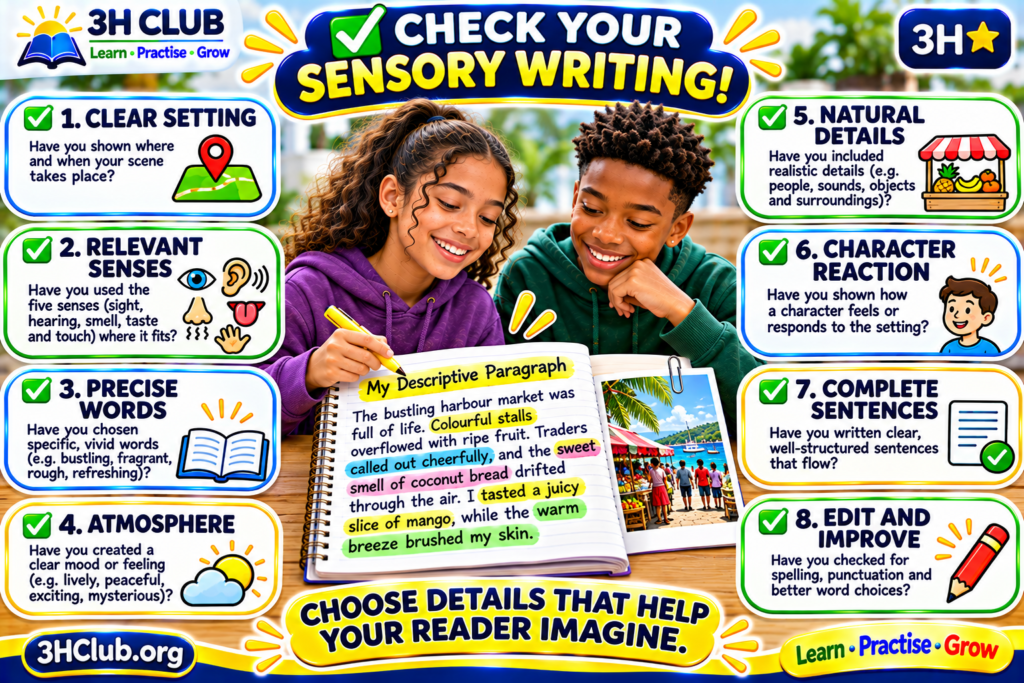
🟢 15. Write a Sensory Paragraph
A good descriptive paragraph focuses on a clear place, event or moment.
You can organise it like this:
1. Introduce the setting.
2. Give the reader a clear visual picture.
3. Add one or two sounds or other sensations.
4. Focus on a meaningful detail.
5. Show how a character reacts.
Example: The Beach After Rain
Late in the afternoon, Leo walked along the quiet beach after a short rain shower. The wet sand shimmered beneath the returning sunlight, and gentle waves washed over the scattered shells. A cool breeze brushed his face, carrying the salty scent of the sea. Near the shoreline, a small wooden boat rested on the sand. Leo stopped when he noticed a folded piece of paper beneath one of its seats.
Why Does This Work?
- The setting and time are clear.
- The sensory details are connected.
- Precise verbs create movement.
- The paragraph has a calm atmosphere.
- An important object leads towards a possible story.
✏️ Activity 20: Write Your Paragraph
Write a paragraph of six to eight sentences using your sensory planner.
Include:
- A clear setting.
- At least three relevant sensory details.
- Two precise verbs.
- One atmosphere.
- A character’s reaction.
- Complete sentences.
🟡 16. Combine and Vary Sensory Sentences
Descriptions become more enjoyable when you vary sentence structure.
Repetitive Version
The market was bright. The market was noisy. The market smelled of bread. The market was crowded.
Improved Version
Bright sunlight covered the crowded market. Traders called across the stalls, while the scent of warm bread drifted through the air.
The second version connects related details and avoids repeating the same subject.
Sentence Combining
Sentence 1: The rain stopped.
Sentence 2: The birds began to sing.
Combined: When the rain stopped, the birds began to sing.
The combined sentence has a main clause with the subject the birds and predicate began to sing.
The introductory dependent clause When the rain stopped also contains a subject and predicate, but it does not express a complete thought on its own.
✏️ Activity 21: Combine the Details
Combine each pair into one clear sentence.
- The wind grew stronger. The shutters rattled.
- The sun appeared. The wet leaves glittered.
- The market opened. Traders began calling to shoppers.
- The waves crashed. Cool spray filled the air.
- The rain ended. A fresh scent rose from the earth.
Use words such as when, as, while or after where appropriate.
🔍 17. Edit Your Sensory Writing
A first draft gives you ideas.
Editing helps you choose the strongest ones.
First Draft
The beach was nice. The water was blue. The waves were loud. The sand was hot. It smelled good.
Improved Draft
Turquoise waves rolled towards the shore, breaking against the pale sand with a gentle hiss. Warm grains shifted beneath Maya’s feet, while a salty breeze moved through the nearby palm trees.
What Changed?
The writer:
- Replaced general words with precise details.
- Chose useful sounds and textures.
- Removed unnecessary repetition.
- Connected the details into a clear scene.
- Created a consistent atmosphere.
✏️ Activity 22: Sensory Editing Challenge
Improve:
The forest was big and green. It smelled nice. There were sounds. The ground felt funny. Daniel walked.
Write four or five improved sentences.
Include:
- A clear time of day.
- Two precise nouns or verbs.
- At least three sensory details.
- A consistent atmosphere.
- A character reaction.
🎲 18. Five Fun Sensory Writing Games
🎯 Game 1: Guess the Place
Describe a location using three sensory clues without naming it.
Example:
Warm sand presses beneath my feet. Waves splash nearby. Salty air moves across my face.
Answer: A beach.
Now create your own mystery location.
🎭 Game 2: Mood Switch
Describe a garden in three sentences.
First, make it feel peaceful.
Then change the sensory details to make it feel mysterious.
🧩 Game 3: Sensory Word Swap
Choose a general word:
nice, loud, bright, rough, sweet
Replace it with a more precise word or phrase.
Use it in a complete sentence.
🔎 Game 4: Sensory Detective
Choose a paragraph from a book you enjoy.
Underline or list details connected to sight, hearing, smell, taste and touch.
Which senses does the writer use most?
Why might those choices suit the scene?
🎬 Game 5: Two Characters, One Scene
Choose a setting.
Write two short descriptions from the viewpoints of characters with different interests or emotions.
Notice how their sensory observations change.
🏆 19. Final Sensory Champions Challenge
Part A: Five Senses Knowledge
Choose the correct answer.
1. What is sensory writing?
A. Writing that uses only adjectives.
B. Writing that helps readers imagine experiences through the senses.
C. Writing that includes every sense in every sentence.
2. Why should writers choose sensory details carefully?
A. To make descriptions relevant and clear.
B. To make every paragraph as long as possible.
C. To avoid using verbs.
3. Which sentence uses hearing most clearly?
A. The yellow flowers covered the hillside.
B. The bell echoed across the empty courtyard.
C. The stone wall felt rough.
Part B: Identify the Sense
- The wooden floor creaked beneath his feet.
- The spicy soup tasted rich and warm.
- The scent of fresh rain filled the air.
- Bright lanterns shone above the street.
- The cool water splashed against her ankles.
Part C: Figurative Language
Identify each sentence as simile, personification or literal description.
- The river sparkled like polished glass.
- The wind whispered through the leaves.
- The rain fell steadily onto the roof.
- The rough rope felt like sandpaper.
- The old house watched over the quiet road.
Part D: Subject and Predicate
Identify the complete subject and predicate.
- The distant thunder echoed through the valley.
- The sweet scent of flowers filled the garden.
- The cold stones pressed against Maya’s hands.
- Brightly coloured kites floated above the field.
Part E: Choose the Better Detail
Which is more effective, and why?
A: The market was very, very noisy.
B: Traders called across the stalls as bicycle bells rang along the street.
Part F: Improve a Paragraph
Rewrite:
The park was nice. The grass was green. There were birds. It was sunny. Maya was happy.
Use:
- Three relevant sensory details.
- Precise vocabulary.
- A clear atmosphere.
- One character reaction.
⭐ Final Creative Writing Mission
Write a story scene titled:
A Place I Will Never Forget
Your scene should include:
- A clear place and time.
- At least three relevant senses.
- Precise nouns and verbs.
- An atmosphere that suits the scene.
- One meaningful sensory detail.
- A character reacting to the setting.
- Complete sentences with clear subjects and predicates.
- An ending that leaves the reader with a memorable image, sound or feeling.
Aim for two paragraphs of approximately six to eight sentences each.
Paragraph 1: Introduce the setting and atmosphere.
Paragraph 2: Focus on a detail or event that makes the place memorable.
✅ 20. Check Your Answers!
Activity 1: Match the Sense
- Sight.
- Hearing.
- Touch.
- Smell.
- Taste.
Activity 2: Sensory Detective
- The sunlit garden.
- Bees humming.
- Wet grass.
- The cool wooden bench.
- Taste.
- No. Taste isn’t needed for this scene.
Activity 3: Sight Description
Answers will vary.
Possible example:
Bright fishing boats lined the harbour. Golden sunlight reflected off the water. A white seabird circled above the jetty. Farther away, a small boat moved towards the horizon.
Activity 4: Sound Search
Possible answers:
- Quiet page-turning or footsteps.
- Waves crashing or seabirds calling.
- Children laughing or a ball bouncing.
- Water dripping from leaves.
- Announcements, whistles or trains moving.
Activity 5: Complete the Description
Possible answers:
- Warm and buttery.
- Rough and uneven.
- Sweet and tangy.
- Cool and refreshing.
- Rich and earthy.
Activity 6: Natural Details
- A.
- A.
- A.
Each selected detail fits the situation naturally.
Activity 7: Subjects and Predicates
| Complete Subject | Complete Predicate |
|---|---|
| The colourful boats | rocked beside the jetty |
| A loud whistle | echoed across the station |
| The fresh flowers | filled the room with fragrance |
| The warm sand | shifted beneath Leo’s feet |
| The juicy orange | tasted wonderfully sweet |
Activity 8: Complete Sensory Sentences
Possible answers:
- The golden sunlight warmed the garden.
- The distant thunder rumbled above the hills.
- The fresh bread smelled delicious.
- The cold stone steps felt rough beneath Maya’s feet.
- The ripe strawberries tasted sweet.
Activity 9: Sensory Sentence Expansion
Possible example:
Original: The rain fell.
Expanded: Heavy rain drummed against the metal roof, sending cool droplets across the windows.
Activity 10: Upgrade the Word
Possible answers:
- The water trickled along the stream.
- The leaves rustled.
- The soup had a rich, savoury aroma.
- The path felt rough and stony beneath his bare feet.
- The stars glittered.
Activity 11: Atmosphere Detective
Possible answers:
- Cheerful.
- Mysterious.
- Peaceful.
- Tense.
- Welcoming.
Activity 12: Mood Switch
Welcoming: Warm sunlight filled the school courtyard. Children laughed beside the colourful flowerbeds, and a gentle breeze moved through the trees.
Mysterious: Long shadows stretched across the empty courtyard. A loose gate creaked in the wind, and faint footsteps echoed beneath the covered walkway.
Activity 13: Sensory Similes
Possible answers:
- The stars glittered like tiny diamonds.
- The wind sounded like a distant whistle.
- The stone felt as rough as sandpaper.
- The morning mist covered the hills like a grey blanket.
- The waterfall roared like a passing train.
Activity 14: Personification
Possible answers:
- The wind whispered through the trees.
- The rain danced across the rooftop.
- The river hurried towards the sea.
- The old door groaned as it opened.
- The sunlight crept across the floor.
Activity 15: Two Characters
Answers will vary. Look for different sensory observations that match the characters’ interests or feelings.
Activity 16: Sensory Editor
Possible answer:
Enormous waves thundered against the rocky shore, sending cool spray across the sand.
Reading Comprehension: The Morning Market Mystery
- A market along the harbour road.
- Saturday morning.
- Her grandfather.
- Possible answers: Fruit, colourful umbrellas, shoppers or stalls.
- Freshly baked coconut bread.
- Ripe mango.
- Bicycle bells and traders calling.
- A small silver bell has fallen beside a basket.
- She uses it to announce when her fresh bread is ready.
- A wooden pendulum clock.
- She turns, looks and asks questions.
- She notices unusual details and wonders about their stories.
Activity 17: Sensory Evidence
Possible answers:
- Colourful umbrellas.
- Bicycle bells ringing.
- The scent of coconut bread.
- Sweet mango juice.
- Drifted, echoed or clattered.
- Traders greeting customers.
- The unexplained tapping sound.
- Maya turns when she hears the clatter.
Activity 18: Subjects and Predicates
| Complete Subject | Complete Predicate |
|---|---|
| Colourful umbrellas | shaded the fruit stalls |
| Bicycle bells | rang along the harbour road |
| The warm scent of bread | drifted from the bakery |
| A small silver bell | lay beside the basket |
| The wooden clock | made a steady ticking sound |
Think More Deeply
- Hearing is especially important.
- The unusual sounds lead Maya towards the discoveries.
- The atmosphere briefly becomes mysterious before the explanations are revealed.
- No. A direct touch detail isn’t necessary for the story to work.
- On a rainy afternoon, Maya might notice splashing water, wet pavement, raindrops on awnings and cooler air.
Activity 19: Sensory Planner
Answers will vary. Check that details fit the setting and support the chosen atmosphere.
Activity 20: Sensory Paragraph
Answers will vary. Look for clear, connected details rather than an unrelated list of sensations.
Activity 21: Combine the Details
Possible answers:
- As the wind grew stronger, the shutters rattled.
- When the sun appeared, the wet leaves glittered.
- When the market opened, traders began calling to shoppers.
- As the waves crashed, cool spray filled the air.
- After the rain ended, a fresh scent rose from the earth.
Activity 22: Sensory Editing
Possible answer:
Late in the afternoon, Daniel followed a narrow path through the rainforest. Tall trees rose above him, and damp leaves rustled in the gentle breeze. The earthy scent of wet soil filled the cool air. Water dripped from broad leaves onto the muddy ground. Daniel stopped when he heard a bird calling from somewhere beyond the trees.
Final Challenge: Part A
- B.
- A.
- B.
Final Challenge: Part B
- Hearing.
- Taste.
- Smell.
- Sight.
- Touch.
Final Challenge: Part C
- Simile.
- Personification.
- Literal description.
- Simile.
- Personification.
Final Challenge: Part D
| Complete Subject | Complete Predicate |
|---|---|
| The distant thunder | echoed through the valley |
| The sweet scent of flowers | filled the garden |
| The cold stones | pressed against Maya’s hands |
| Brightly coloured kites | floated above the field |
Final Challenge: Part E
B is more effective because it identifies specific sounds and actions that help readers imagine the market.
Final Challenge: Part F
Possible answer:
Golden sunlight warmed the park, and a gentle breeze moved through the tall grass. Birds sang from the branches above the winding path. Maya smiled as she followed the scent of flowering plants towards the pond.
⭐ Final Creative Writing Mission: Example
A Place I Will Never Forget
Early one morning, Maya stepped onto a quiet beach just as the sun appeared above the horizon. Golden light shimmered across the turquoise water, and gentle waves rolled towards the pale sand. The cool morning breeze brushed her face, carrying the fresh scent of the sea. A few seabirds called from the rocks beside the shore. Maya removed her sandals and felt the smooth, damp sand beneath her feet. The beach seemed peaceful, as though the whole world had not quite awakened.
As she walked towards the water, Maya noticed a tiny trail of tracks crossing the sand. She stopped and followed them with her eyes. Near the edge of the beach, a young sea turtle was moving slowly towards the waves. Maya watched quietly from a distance, careful not to disturb it. The turtle reached the shallow water and disappeared beneath a gentle wave. Maya smiled as the sunlight spread across the sea. She knew she would remember that quiet morning for a long time.
🎉 Excellent work, Sensory Champion!
You’ve learnt how to use sensory details, precise vocabulary, atmosphere and complete sentences to make your writing vivid and memorable.
🌈 21. What Have You Learnt?
👀 The Five Senses Add Detail
Sight, hearing, smell, taste and touch help readers imagine a scene.
✏️ Precise Vocabulary Makes Writing Clearer
Specific nouns and verbs often create stronger descriptions than unnecessary adjectives.
🌦️ Sensory Details Create Atmosphere
Different sounds, sights and sensations can make a place feel peaceful, exciting, mysterious or tense.
🎭 Characters Notice Different Things
A character’s feelings and interests can influence which sensory details matter.
🧩 Complete Sentences Support Clear Writing
SUBJECT + PREDICATE = COMPLETE SENTENCE
⭐ The Sensory Writing Formula
CLEAR SETTING + RELEVANT SENSES + PRECISE WORDS + ATMOSPHERE + CHARACTER REACTION = VIVID WRITING
This is a helpful guide, not a rule that every paragraph must follow exactly.
🌟 Keep Learning with 3HClub!
You now have the tools to make your writing more vivid.
Remember:
Choose a clear setting.
Notice meaningful details.
Use the senses naturally.
Select precise words.
Create atmosphere.
Show how your character experiences the scene.
And edit until every detail has a purpose.
📚 Your Next Learning Adventures
- Describe a Setting
- Create a Story Character
- How to Write a Story Opening
- Beginning, Middle and End of a Story
- How to Write a Paragraph for Kids
- Making a Sentence More Interesting
- Subject and Predicate
- Adjectives for Kids
- Making Inferences
- Cause and Effect
⭐ Your Sensory Writer Promise
I can identify the five senses.
I can use relevant sensory details.
I can choose precise vocabulary.
I can create atmosphere.
I can describe a character’s reactions.
I can write complete sentences.
I can improve my writing through editing.
Keep observing, imagining and writing!
3H CLUB — Learn • Practise • Grow