How to Write a Story Opening:
✏️ Catch Your Reader’s Attention!
⭐⭐ BUILDERS — Ages 8–9
📚 Subject: English – Creative Writing, Grammar and Storytelling
🎯 Skills: Story openings, characters, settings, hooks, descriptive language, dialogue, subjects, predicates, complete sentences and editing.
🌟 Hello, Creative Story Writer!
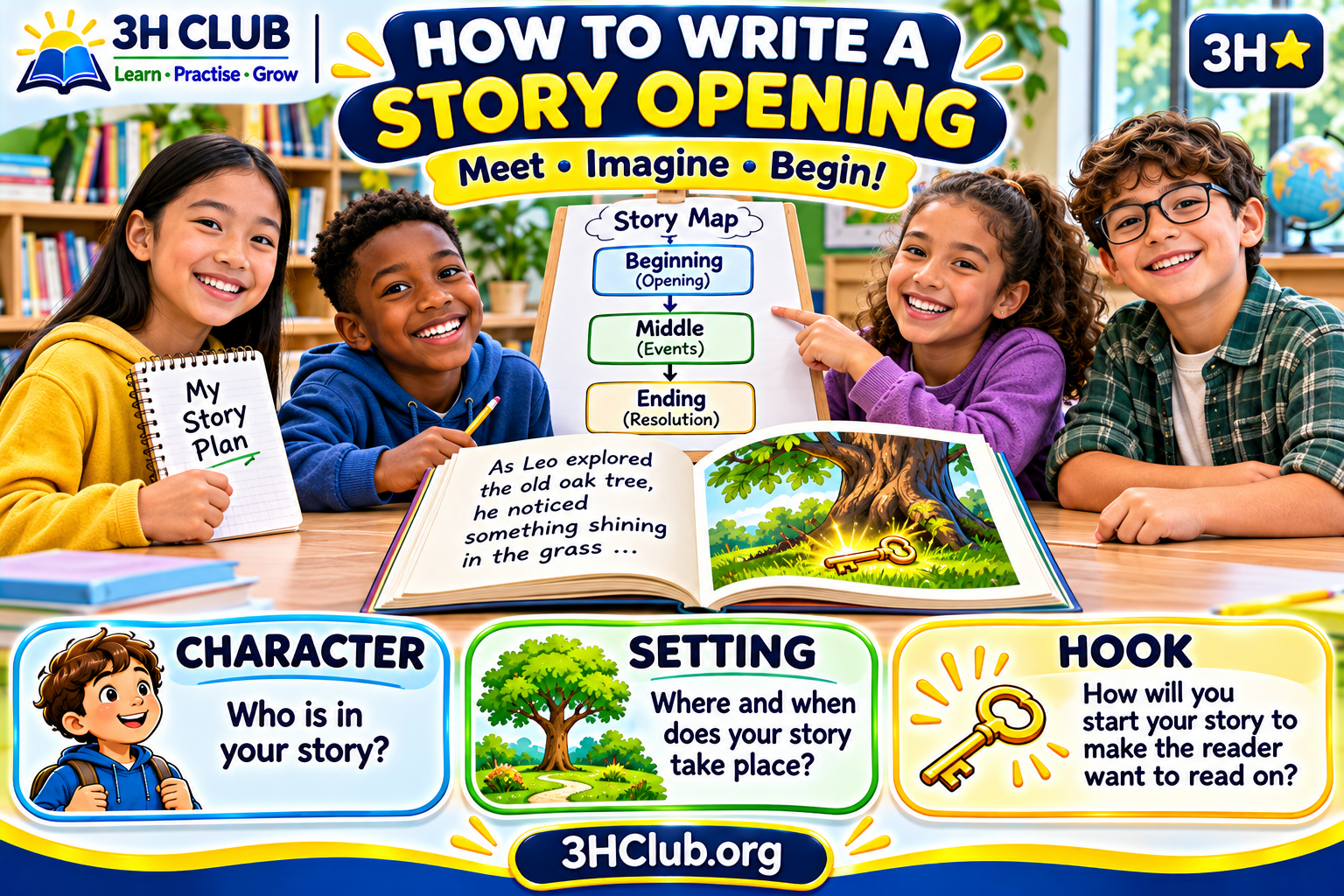
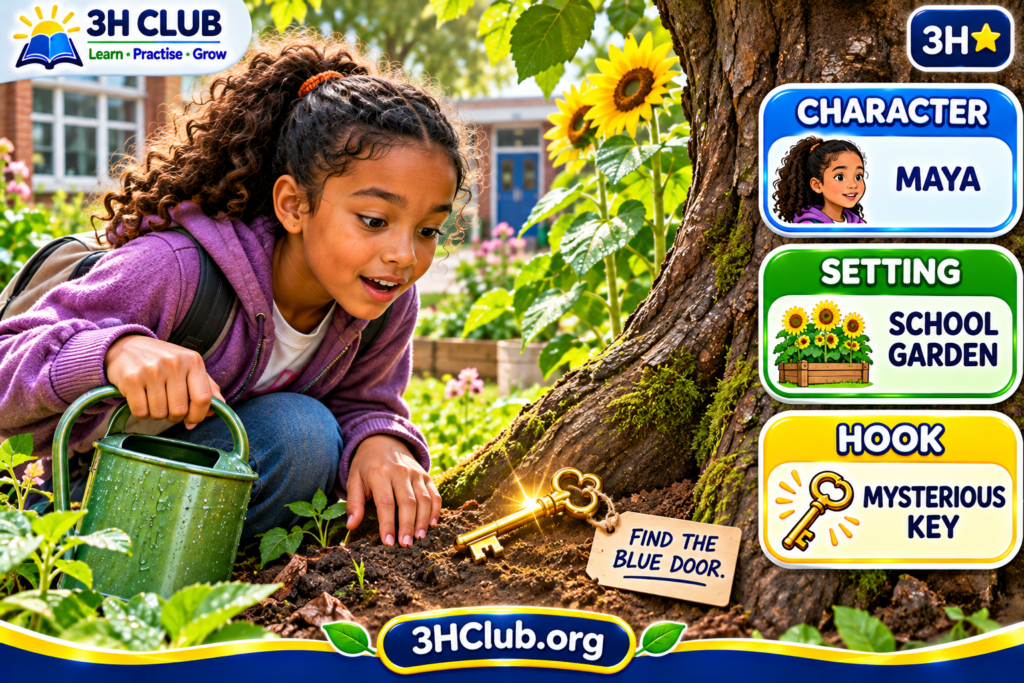
Imagine finding a tiny golden key beneath a tree.
What would you do?
Would you pick it up? Would you wonder what it opens? Would you search for clues?
You already have the beginning of an exciting story!
Now read this:
Maya found a key.
This is a complete sentence. It tells us who found something and what she found.
But what if we added a little more?
Maya found a tiny golden key beneath the oldest tree in the school garden.
Now we can picture the scene.
Let’s add a surprise!
Maya found a tiny golden key beneath the oldest tree in the school garden. Attached to it was a note that said, “Find the blue door.”
What do you want to know now?
Where is the blue door? Who left the key? What might happen next?
That’s what a good story opening can do!
It helps your reader enter the story and gives them a reason to keep reading.
Today, you’ll discover how to create your own story openings using interesting characters, clear settings, strong sentences and exciting ideas.
Ready? Let’s begin!
🎯 What Will You Learn?
By the end of this lesson, you will be able to:
- Explain what a story opening is.
- Identify characters, settings and starting situations.
- Recognise different ways to begin a story.
- Write complete sentences with subjects and predicates.
- Use interesting action words and useful descriptions.
- Begin a story with action, dialogue, a question or a surprise.
- Create curiosity without confusing your reader.
- Choose details that help readers imagine a scene.
- Write and improve an original story opening.
- Check spelling, capital letters and punctuation.
⭐ Your goal: Write a story opening that introduces an interesting situation and makes your reader want to discover what happens next.
⭐ STAGE 1: OPENING EXPLORERS
Discover what makes a clear story beginning
🔵 1. What Is a Story Opening?
A story opening is the first part of a story.
It introduces your reader to the story world.
A story opening often helps us discover:
- Who the story is about.
- Where the story takes place.
- When the story begins.
- What is happening.
- Why we might want to read more.
You don’t have to answer every question in your first sentence.
You can reveal information little by little.
🐶 Example: The Puppy at the Gate
On Saturday morning, Ava stepped into her garden. A small brown puppy was sitting beside the gate. It looked up at her and gave a quiet bark.
Let’s investigate.
Character: Ava
Another character: A small brown puppy
Setting: Ava’s garden
Time: Saturday morning
Interesting situation: A puppy has appeared at the gate.
The opening makes us wonder where the puppy came from.
✏️ Activity 1: Discover the Opening
Read:
Early one morning, Leo hurried to the beach with his sister. The waves sparkled in the sunshine. Near the rocks, they noticed a small wooden box half-buried in the sand.
Answer:
- Who are the characters?
- Where does the story begin?
- When does it begin?
- What do the children discover?
- What question would you like the story to answer?
⭐ Remember
A story opening doesn’t need to explain everything.
It should give your reader enough information to follow the story and enough interest to keep going.
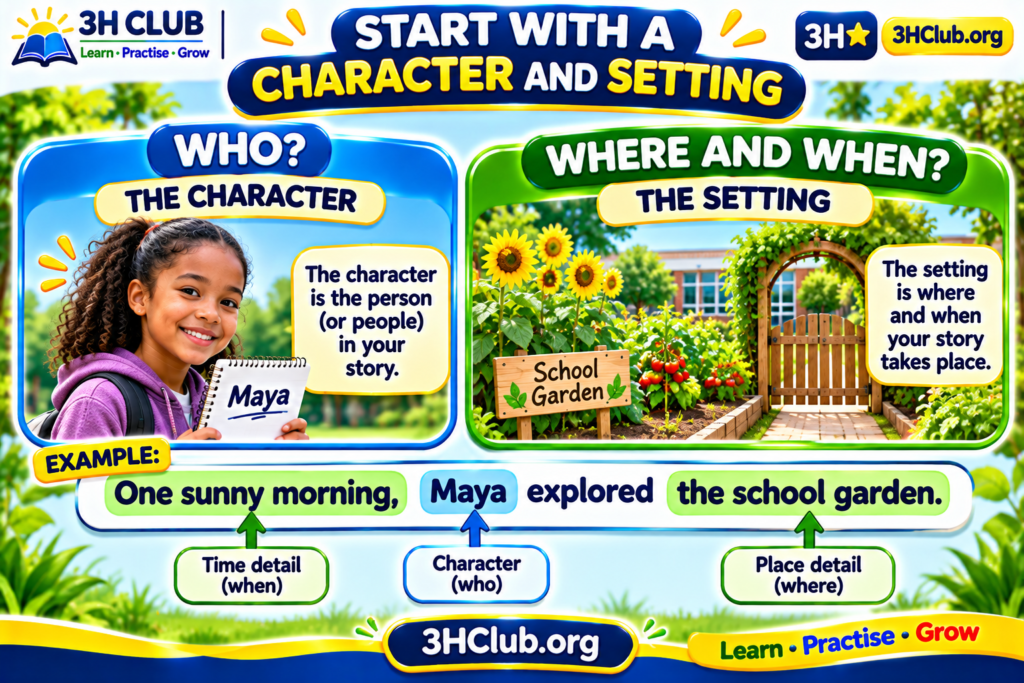
🟢 2. Introduce an Interesting Character
A character is a person, animal or imaginary being in a story.
Your main character is often the person or creature your story follows most closely.
Look at:
Sam went outside.
This tells us something, but not much about Sam.
Now try:
Sam hurried outside with his sketchbook tucked beneath his arm.
We know Sam is carrying a sketchbook, and the word hurried shows how he moves.
What might Sam be planning to draw?
Ways to Introduce a Character
You could tell readers:
- The character’s name.
- Something the character is doing.
- What the character wants.
- How the character is feeling.
- Something unusual about the character.
🌈 Compare These Openings
Simple: Nina walked into the classroom.
More interesting: Nina walked into the classroom carrying a mysterious envelope.
Simple: Ben looked out of the window.
More interesting: Ben pressed his face against the window when he heard a strange tapping sound.
Both improved openings give the reader something to wonder about.
✏️ Activity 2: Meet the Character
Choose one of these characters:
Maya, a curious girl who enjoys solving puzzles.
Leo, a boy who loves exploring nature.
Amira, a child who enjoys building inventions.
Kai, a boy who loves drawing maps.
Write two sentences that introduce your chosen character.
Try to show something interesting through an action.
Example:
Amira carried a small cardboard robot into the classroom. She couldn’t wait to test her newest invention.
🟡 3. Create a Clear Setting
The setting tells us where and sometimes when a story happens.
Your story could begin:
- In a school garden.
- On a sunny beach.
- Inside a busy library.
- Beside a quiet river.
- At a crowded market.
- In an imaginary castle.
A clear setting helps your reader imagine the scene.
🌳 Example
Simple: Maya stood in the garden.
Improved: Maya stood beside the tall sunflowers in her school’s garden.
With an extra detail: Maya stood beside the tall sunflowers in her school’s garden as the morning breeze rustled the leaves.
The extra details help us imagine where Maya is.
✏️ Activity 3: Add a Setting
Add a suitable place or time detail.
- The children gathered __________.
- Maya opened the gate __________.
- The puppy slept __________.
- Leo found a shell __________.
- Amira began her experiment __________.
Example: The children gathered beside the school library after lunch.
✏️ Activity 4: Picture the Place
Imagine a quiet forest path.
Write three details that someone might notice.
Think about:
What can you see?
What can you hear?
What might you feel?
Now write two complete sentences describing the forest.
Example:
Tall trees shaded the narrow path. Birds sang above Maya as a cool breeze moved through the leaves.
🔵 4. Build Complete Sentences: Subject and Predicate
An interesting opening still needs clear sentences.
Let’s review the two main parts of a simple sentence.
🟦 The Subject: Who or What?
The subject tells us who or what the sentence is about.
The curious girl opened the wooden box.
Subject: The curious girl
🟩 The Predicate: What Is Said About the Subject?
The predicate tells us what the subject does, is or experiences.
The curious girl opened the wooden box.
Predicate: opened the wooden box
🧩 Put Them Together
SUBJECT + PREDICATE = COMPLETE SENTENCE
| Subject | Predicate | Complete Sentence |
|---|---|---|
| Maya | found a golden key. | Maya found a golden key. |
| The little puppy | barked softly. | The little puppy barked softly. |
| The old door | creaked in the wind. | The old door creaked in the wind. |
| Two children | hurried towards the garden. | Two children hurried towards the garden. |
| The mysterious box | was empty. | The mysterious box was empty. |
✏️ Activity 5: Find the Subject and Predicate
Write the complete subject and predicate.
- The excited children entered the old library.
- Maya discovered a small silver key.
- The heavy door creaked slowly.
- Leo and Amira searched beneath the table.
- A tiny bird landed on the windowsill.
✏️ Activity 6: Complete the Opening Sentence
Add a predicate to finish each sentence.
- The curious boy __________.
- A strange sound __________.
- The old wooden gate __________.
- Maya and Leo __________.
- The little brown puppy __________.
Make sure each sentence shares a complete thought.
⭐ Writing Tip
When you add describing words or place details, keep the sentence clear.
The bird sang.
The small blue bird sang beside the window.
Both are complete sentences. The second helps the reader imagine more.
⭐⭐ STAGE 2: OPENING BUILDERS
Explore different ways to catch your reader’s attention
🟢 5. What Is a Story Hook?
A hook is something near the start of a story that catches the reader’s interest.
It makes the reader think:
I want to know what happens next!
There are several ways to create a hook.
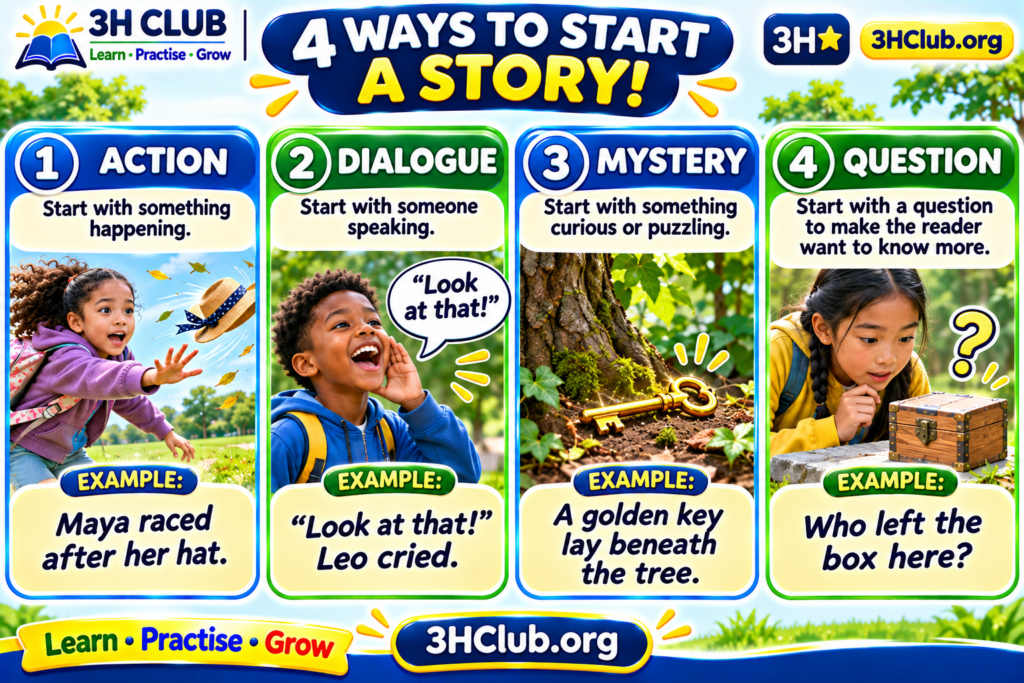
You might begin with:
- An exciting action.
- Something surprising.
- A line of dialogue.
- A curious question.
- An unusual sound.
- An interesting description.
You don’t need to use every technique at once.
Choose one that suits your story.
🟡 6. Begin with Action
An action opening starts with something happening.
It can make your reader feel as though the story has already begun.
🏃 Example
Leo raced across the playground as a bright red kite sailed over the fence.
We immediately know that something is happening.
We might wonder:
Why is Leo running? Where will the kite land?
Compare
Ordinary: The children were in the garden.
Action opening: The children hurried towards the garden when they heard a loud crash.
The second sentence begins with an event that creates curiosity.
✏️ Activity 7: Start with Action
Turn each idea into an action opening.
- A girl sees her hat blowing away.
- A boy hears a noise behind a door.
- A puppy runs towards a garden gate.
- Two friends spot a ball rolling downhill.
- A child discovers that a paper boat is floating away.
Example:
Amira dashed across the grass as the wind carried her hat towards the fence.
🟣 7. Begin with Dialogue
Dialogue means the words characters say.
A line of dialogue can introduce a problem, feeling or surprising situation.
💬 Example
“Look! There’s something moving beneath that bench!” Maya whispered.
This opening makes us wonder what Maya has seen.
Remember Speech Marks
In direct speech, speech marks show the words a character says.
“I found it!” Leo shouted.
The exclamation mark belongs inside the closing speech mark.
✏️ Activity 8: Write a Dialogue Opening
Choose one idea.
- A child discovers a mysterious package.
- Two friends hear an unusual sound.
- A class finds a message on the board.
- A brother and sister spot something unexpected at the beach.
Write an opening that begins with something a character says.
Example:
“Who left this tiny box on my desk?” Amira asked.
Add one more sentence to show what happens next.
⭐ Dialogue Tip
Make sure your reader can understand who is speaking.
You can use words such as said, asked, whispered or shouted when they fit the situation.
🔵 8. Begin with a Surprise or Mystery
Sometimes a story starts with something unexpected.
🔑 Example
When Maya opened her schoolbag, she found a golden key she had never seen before.
What would you wonder?
Who put it there? What does it open?
A mystery gives the reader a question to think about.
✏️ Activity 9: Add a Surprise
Complete each opening.
- When Leo opened the cupboard, he discovered __________.
- Beneath the old tree, Maya noticed __________.
- The classroom was empty except for __________.
- Inside the small wooden box was __________.
- Just as Amira finished her invention, __________.
Now choose your favourite and add two more sentences.
⭐ Mystery Tip
You don’t have to reveal the answer straight away.
But your reader should understand enough to follow the story.
🟢 9. Begin with an Interesting Question
A question can create curiosity.
❓ Example
Why was there a tiny footprint on the classroom windowsill?
This opening encourages the reader to think about what might have happened.
You can follow it with a sentence that introduces the character.
Why was there a tiny footprint on the classroom windowsill? Maya leaned closer to examine it.
✏️ Activity 10: Write a Question Hook
Write an opening question about one of these situations.
- A missing garden sign.
- A strange map.
- A locked wooden box.
- A mysterious sound.
- An unexpected visitor.
Example:
Who had left a folded map beneath Leo’s desk?
Then write a complete sentence to continue your opening.
⭐ Remember
A story can begin with a question, but it doesn’t have to.
Sometimes an action or a simple description works better.
🟡 10. Add Details That Create a Picture
Good story openings help readers imagine the scene.
You can add details about:
Sight: What can the character see?
Sound: What can the character hear?
Touch: What can the character feel?
Smell: What can the character smell?
These are called sensory details.
🌧️ Example: A Rainy Morning
Simple: Maya walked to school.
Improved: Maya walked towards school as rain tapped against her yellow umbrella.
The second sentence helps us hear the rain and imagine the umbrella.
🌊 Example: At the Beach
Simple: Leo stood on the beach.
Improved: Leo stood on the warm sand while gentle waves splashed against the shore.
We can imagine the warmth and hear the waves.
✏️ Activity 11: Add a Sensory Detail
Improve each sentence by adding one useful detail.
- The rain fell.
- The children entered the forest.
- Maya opened the old book.
- Leo walked along the beach.
- The wind blew through the garden.
⭐ Don’t Add Too Much!
You don’t need to describe everything in your first paragraph.
Choose a few details that help create the right picture or feeling.
🟣 11. Show Feelings Through Actions
Readers enjoy learning how characters react to events.
Look at:
Amira was nervous.
Now try:
Amira held her notebook tightly and took a slow breath before stepping onto the stage.
Her actions help us understand how she might be feeling.
😊 Feelings and Actions
| Feeling | Possible Action |
|---|---|
| Excited | The character grins and hurries forward. |
| Worried | The character keeps checking the door. |
| Surprised | The character stops and opens their eyes wide. |
| Proud | The character smiles at their finished work. |
| Curious | The character leans closer to investigate. |
✏️ Activity 12: Show, Don’t Just Tell
Rewrite these sentences to show the feeling through an action.
- Leo was excited.
- Maya was worried.
- Amira was surprised.
- Ben was proud.
- Nina was curious.
Example:
Leo was excited.
Leo grinned and hurried towards the football field.
Different people show feelings in different ways, so there can be many good answers.
⭐⭐⭐ STAGE 3: CONFIDENT STORY WRITERS
Read, plan, write and improve your own opening
📖 12. Model Story Opening: The Secret of the Blue Door
Read this opening carefully.
Notice how the writer introduces the character, setting and mystery.
🔑 The Secret of the Blue Door
The school garden was quiet when Maya arrived on Monday morning. Dew sparkled on the leaves, and a cool breeze moved through the tall sunflowers.
Maya was carrying a watering can when something shiny caught her eye. Beneath the oldest tree lay a tiny golden key.
“That’s strange,” she whispered.
Attached to the key was a small paper tag. On it were four carefully written words:
FIND THE BLUE DOOR.
Maya looked around. She had explored the school garden many times, but she had never noticed a blue door.
Then she heard footsteps behind her.
🔍 Explore the Opening
Main character: Maya
Setting: The school garden
Time: Monday morning
Starting situation: Maya arrives to care for the garden.
Mystery: She finds a key with a message about a blue door.
Hook: The strange key, mysterious message and approaching footsteps make the reader curious.
📖 Reading Comprehension Questions
- Where does the opening take place?
- When does Maya arrive?
- What is Maya carrying?
- Where does she find the key?
- What colour is the key?
- What message is attached to it?
- Why does Maya find the message strange?
- What does Maya hear at the end?
- Which detail helps you imagine the garden?
- What do you predict might happen next?
✏️ Activity 13: Find the Story Opening Features
Find one example of each.
- A character.
- A setting.
- A time detail.
- A sensory detail.
- A line of dialogue.
- A mysterious object.
- Something that makes you want to read more.
✏️ Activity 14: Subject and Predicate Detective
Write the complete subject and predicate.
- The school garden was quiet.
- Dew sparkled on the leaves.
- Maya carried a watering can.
- A tiny golden key lay beneath the tree.
- The mysterious message puzzled Maya.
🧠 Think More Deeply
- Why might the writer have chosen to describe the quiet garden before introducing the key?
- How does the message create curiosity?
- Why is the sound of footsteps an interesting place to pause the story?
- Would the opening feel different if it began with Maya already holding the key?
✍️ 13. Plan Your Own Story Opening
Before writing, decide what your reader needs to know.
Use this simple planner.
📝 My Story Opening Planner
Story title: The Mysterious Package
Main character: Amira
Setting: Her classroom
Time: Friday morning
Starting situation: Amira arrives early to prepare for a science activity.
Opening technique: Mystery
Interesting object: A small box wrapped in blue paper
Question for the reader: Who left the package?
Example Opening
Amira arrived at her classroom early on Friday morning. She was putting her science notebook on her desk when she noticed a small package wrapped in blue paper.
There was no name on the box.
“Who could have left this here?” she wondered.
Just then, the classroom door creaked open.
This opening introduces the character, setting and mystery without explaining the whole story.
✏️ Activity 15: Make Your Own Opening Plan
Choose a story idea:
A. A mysterious map in the library.
B. A strange sound in the garden.
C. An unexpected visitor at school.
D. A lost toy at the beach.
E. A surprising discovery during a class trip.
Complete:
Story title: __________
Main character: __________
Setting: __________
When the story begins: __________
Opening technique: __________
First important event: __________
One interesting detail: __________
Question the reader might ask: __________
🟢 14. Write Your First Draft
Now turn your plan into a story opening.
Step 1: Introduce Your Character
Tell us who the story is about.
Example: Leo hurried towards the old library.
Step 2: Help Us Imagine the Setting
Add a useful place, time or sensory detail.
Example: Rain tapped against the tall windows.
Step 3: Introduce Something Interesting
Add a surprise, action, question or problem.
Example: A folded map lay on the floor beside the door.
Step 4: Leave the Reader Curious
Give the reader a reason to continue.
Example: Across the map, someone had written, DO NOT FORGET THE CLOCK.
✏️ Activity 16: Write Your Story Opening
Write an opening of about five to eight sentences.
Try to include:
- A clear character.
- A setting.
- At least one complete sentence with an interesting action.
- One or two useful descriptive details.
- A hook that creates curiosity.
- Correct capital letters and punctuation.
The sentence count is a guide, not a strict rule.
⭐ Remember
You are writing the opening, not the entire story.
You don’t need to solve the mystery or finish the adventure yet.
🔍 15. Improve a Story Opening
Good writers often change their first drafts.
Let’s compare two versions.
First Draft
Ben went to the park. He saw a box. He opened it. Something was inside.
The sentences are complete, but the opening could be clearer and more interesting.
Improved Opening
Ben hurried through the park on a windy Saturday morning. Beside the old oak tree, he noticed a small wooden box half-hidden beneath some leaves. He knelt down and brushed the leaves away. A tiny tapping sound came from inside.
What Improved?
- We know when and where the story happens.
- The action words are more specific.
- The box is described clearly.
- A mysterious sound creates curiosity.
- The writer doesn’t reveal everything immediately.
✏️ Activity 17: Improve the Draft
Rewrite this opening.
Mia went to school. She found a note. She read it. She was surprised.
Try adding:
- A time detail.
- A clearer setting.
- A more specific action word.
- The message on the note.
- An action that shows Mia’s surprise.
⭐ Editing Tip
An interesting opening is not always a long opening.
Choose details that help your story move forward.
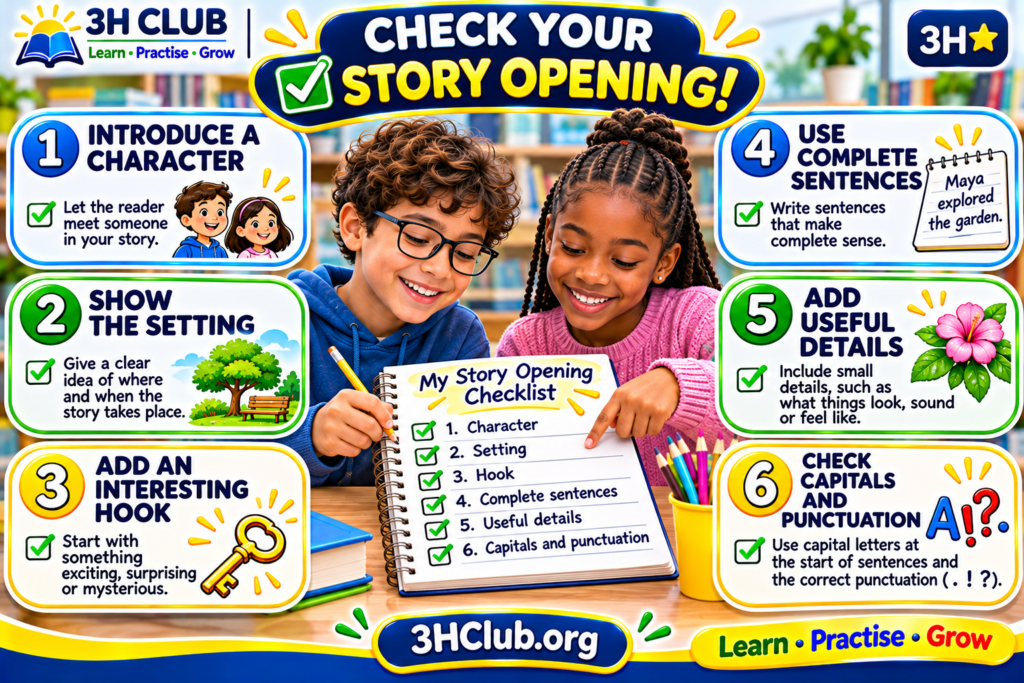
📝 16. Check Your Story Opening
Before you share your writing, use the 3HClub Story Opening Checklist.
✅ My Story Opening Checklist
STORY IDEAS
- Have I introduced a character?
- Can my reader imagine the setting?
- Does something interesting happen?
- Have I given the reader a reason to keep reading?
SENTENCES
- Are my sentences complete?
- Can I identify the subject and predicate in my main sentences?
- Have I chosen clear action words?
- Have I added useful details without making the writing confusing?
EDITING
- Do my sentences begin with capital letters?
- Have I used full stops, question marks or exclamation marks correctly?
- Are my speech marks correct when I use dialogue?
- Have I checked spelling and word spacing?
✏️ Activity 18: Opening Editor
Correct the capital letters and punctuation.
- maya found a golden key beneath the tree
- where did the strange noise come from
- leo hurried into the old library
- “look at this” amira whispered
- the little wooden box began to shake
Then choose one sentence and add an interesting detail.
🎲 17. Five Fun Story Opening Games
🎯 Game 1: Hook Match
Match each opening to its technique.
A. “Where did you find that?” Maya asked.
B. Leo sprinted across the field as the wind carried his hat away.
C. A small silver bell appeared on Amira’s desk overnight.
D. Who had written a message on the classroom window?
Techniques: Action, Dialogue, Mystery, Question
🧩 Game 2: Story Opening Dice
Choose one idea from each group.
Character: Explorer, scientist, football player, gardener
Setting: Forest, classroom, beach, school garden
Surprise: Strange footprint, missing object, secret message, unexpected sound
Use your three choices to write an opening.
🔍 Game 3: Find the Hook
Choose a storybook.
Read its opening paragraph.
Ask yourself:
- Who is introduced?
- Where does the story begin?
- What makes you interested?
- What do you want to know next?
🎭 Game 4: Dialogue Starter
Work with a friend.
One person begins with a line of dialogue.
The other person adds a sentence that explains what is happening.
Example:
“Did you hear that?” Leo whispered.
Maya turned towards the garden shed.
🌈 Game 5: Three Different Beginnings
Choose one story idea.
Write three different opening sentences:
- An action opening.
- A dialogue opening.
- A mystery opening.
Choose your favourite and explain why it suits your story.
🏆 18. Final Story Opening Champions Challenge
You’re ready to show your new skills!
Part A: What Does an Opening Do?
Choose the best answer.
A. It always explains the entire story.
B. It introduces the story and gives readers a reason to continue.
C. It must solve the main problem immediately.
Part B: Identify the Opening Technique
Write Action, Dialogue, Mystery or Question.
- “There’s something inside the cupboard!” Ben whispered.
- Nina raced towards the school gate.
- A tiny blue envelope appeared beneath the door.
- Who had taken the missing garden sign?
- The puppy bounded across the playground.
Part C: Find the Character and Setting
Read:
On a warm Friday afternoon, Maya and Leo walked along the beach. Gentle waves rolled towards the shore. Near a group of rocks, they noticed something shining in the sand.
Answer:
- Who are the characters?
- Where does the story begin?
- When does it begin?
- What makes the opening interesting?
Part D: Subject and Predicate
Write the complete subject and predicate.
- The curious children opened the wooden gate.
- A small golden key glittered in the sunlight.
- Maya heard a strange tapping sound.
Part E: Improve the Opening
Improve this sentence:
The boy found a box.
Add:
- A more interesting description.
- A clear setting.
- One detail that creates curiosity.
Part F: Fix the Writing
Rewrite correctly.
- maya opened the little box
- what was behind the old door
- “come and look” leo shouted
- the wind blew across the empty playground
- amira found a folded map
⭐ Final Creative Writing Mission
Write an original story opening with the title:
The Strange Discovery
Your opening should include:
- A main character.
- A clear setting.
- An interesting event or discovery.
- One strong action word.
- At least one sensory detail.
- A hook that encourages your reader to continue.
- Complete sentences with correct punctuation.
Aim for six to ten sentences.
Then read your opening aloud.
Ask yourself:
Would I want to read the next paragraph?
✅ 19. Check Your Answers!
Activity 1: Discover the Opening
- Leo and his sister.
- At the beach.
- Early one morning.
- A small wooden box half-buried in the sand.
- Answers will vary. Example: What is inside the box?
Activity 2: Meet the Character
Answers will vary.
Possible answer:
Maya carried her puzzle notebook into the school garden. She was searching for clues to a mystery she wanted to solve.
Activity 3: Add a Setting
Possible answers:
- beside the school library
- after lunch
- beneath the kitchen table
- on the beach
- in the science classroom
Activity 4: Picture the Place
Answers will vary.
Possible answer:
Sunlight shone through the tall trees. Maya heard birds singing as she walked along the quiet path.
Activity 5: Subjects and Predicates
| Sentence | Subject | Predicate |
|---|---|---|
| The excited children entered the old library. | The excited children | entered the old library |
| Maya discovered a small silver key. | Maya | discovered a small silver key |
| The heavy door creaked slowly. | The heavy door | creaked slowly |
| Leo and Amira searched beneath the table. | Leo and Amira | searched beneath the table |
| A tiny bird landed on the windowsill. | A tiny bird | landed on the windowsill |
Activity 6: Complete the Sentence
Possible answers:
- The curious boy opened the small box.
- A strange sound came from the cupboard.
- The old wooden gate swung open.
- Maya and Leo searched the garden.
- The little brown puppy wagged its tail.
Activity 7: Start with Action
Possible answers:
- Nina chased her hat as it blew towards the fence.
- Ben hurried towards the door when he heard a loud knock.
- The puppy raced towards the garden gate.
- Maya and Leo ran after the ball as it rolled downhill.
- Amira reached towards the paper boat as it floated away.
Activity 8: Dialogue Opening
Answers will vary.
Example:
“Who left this package here?” Maya asked.
Leo looked at the box and shook his head.
Activity 9: Add a Surprise
Answers will vary.
Possible answers:
- a tiny glowing marble
- a folded map
- a colourful envelope
- a small silver bell
- the robot began to move on its own
Activity 10: Question Hook
Answers will vary.
Example:
Why was there a strange footprint beside the garden shed?
Maya knelt down to examine it.
Activity 11: Sensory Details
Possible answers:
- Heavy rain tapped against the classroom windows.
- The children entered the cool forest beneath the tall trees.
- Maya opened the dusty old book.
- Leo walked along the warm sand as waves splashed nearby.
- The wind rustled the leaves in the garden.
Activity 12: Show the Feeling
Possible answers:
- Leo grinned and bounced on his toes.
- Maya kept looking towards the gate.
- Amira stopped and opened her eyes wide.
- Ben smiled as he showed his finished model.
- Nina leaned closer to examine the strange object.
Reading Comprehension: The Secret of the Blue Door
- The school garden.
- Monday morning.
- A watering can.
- Beneath the oldest tree.
- Golden.
- FIND THE BLUE DOOR.
- She had never noticed a blue door in the garden.
- Footsteps behind her.
- Possible answer: Dew sparkling on the leaves or the breeze moving through the sunflowers.
- Answers will vary.
Activity 13: Opening Features
- Maya.
- The school garden.
- Monday morning.
- Dew sparkled on the leaves; a cool breeze moved through the sunflowers.
- “That’s strange,” she whispered.
- A tiny golden key.
- The message or the footsteps.
Activity 14: Subjects and Predicates
| Sentence | Subject | Predicate |
|---|---|---|
| The school garden was quiet. | The school garden | was quiet |
| Dew sparkled on the leaves. | Dew | sparkled on the leaves |
| Maya carried a watering can. | Maya | carried a watering can |
| A tiny golden key lay beneath the tree. | A tiny golden key | lay beneath the tree |
| The mysterious message puzzled Maya. | The mysterious message | puzzled Maya |
Activity 15: Opening Planner
Answers will vary.
Check that the character, setting and hook fit the chosen story.
Activity 16: Write Your Opening
Answers will vary.
Check for complete sentences, a clear setting and a reason to continue reading.
Activity 17: Improve the Draft
Possible answer:
Early on Monday morning, Mia entered her quiet classroom. A folded note lay on her desk beside her pencil case. She opened it carefully and read the words, “Meet me by the school garden.” Mia’s eyes widened. She looked around, wondering who had written the message.
Activity 18: Opening Editor
- Maya found a golden key beneath the tree.
- Where did the strange noise come from?
- Leo hurried into the old library.
- “Look at this,” Amira whispered.
- The little wooden box began to shake.
Game 1: Hook Match
A. Dialogue
B. Action
C. Mystery
D. Question
Final Challenge: Part A
B — It introduces the story and gives readers a reason to continue.
Final Challenge: Part B
- Dialogue
- Action
- Mystery
- Question
- Action
Final Challenge: Part C
- Maya and Leo.
- At the beach.
- A warm Friday afternoon.
- They notice something shining in the sand.
Final Challenge: Part D
| Sentence | Subject | Predicate |
|---|---|---|
| The curious children opened the wooden gate. | The curious children | opened the wooden gate |
| A small golden key glittered in the sunlight. | A small golden key | glittered in the sunlight |
| Maya heard a strange tapping sound. | Maya | heard a strange tapping sound |
Final Challenge: Part E
Possible answer:
On a windy afternoon, Ben discovered a dusty wooden box beneath a bench in the park. A quiet ticking sound came from inside.
Final Challenge: Part F
- Maya opened the little box.
- What was behind the old door?
- “Come and look!” Leo shouted.
- The wind blew across the empty playground.
- Amira found a folded map.
Final Creative Writing Mission: Example
The Strange Discovery
On a bright Saturday morning, Leo explored the quiet garden behind his grandmother’s house. The leaves rustled gently as he walked along the narrow path. Near an old mango tree, something silver glittered in the sunlight.
Leo knelt down and brushed away the soil. It was a tiny metal box with a star carved into its lid. He lifted it carefully and noticed a folded piece of paper tucked beneath it.
Across the paper were three surprising words:
LOOK UNDERNEATH THE STEPS.
Leo turned towards the house. What could be waiting there?
🎉 Excellent work, Story Writer!
You’ve learnt how to introduce characters and settings, create curiosity, write complete sentences and improve your story openings.
Keep practising. Your next story could begin with just one exciting idea!
🌈 20. What Have You Learnt?
🟦 A Story Opening Introduces the Story
It helps the reader discover who, where, when or what.
🟩 A Hook Creates Curiosity
You can begin with action, dialogue, mystery or a question.
🟨 Useful Details Help Readers Imagine the Scene
Choose descriptions that make the setting or action clearer.
🧩 Complete Sentences Matter
SUBJECT + PREDICATE = COMPLETE SENTENCE
✏️ Good Writers Improve Their Openings
PLAN → WRITE → READ → IMPROVE → CHECK
⭐ The Story Opening Formula
CHARACTER + SETTING + INTERESTING EVENT = A STRONG START
This is a helpful guide, not a rule that every story must follow in exactly the same order.
🌟 Keep Learning with 3HClub!
You’ve discovered how to begin a story in a way that helps your reader imagine the scene and wonder what will happen next.
Remember, a good opening doesn’t need to be long or complicated.
Start with a clear idea.
Choose interesting words.
Add a few useful details.
Give your reader a reason to turn the page.
📚 Your Next Learning Adventures
- Beginning, Middle and End of a Story
- How to Write a Paragraph for Kids
- Making a Sentence More Interesting
- Write a Sentence for Kids
- Subject and Predicate
- Direct Speech
- Making Predictions
- Making Inferences
- Cause and Effect
- Writing a Story Ending
⭐ Your Story Writer Promise
I can introduce a character.
I can describe a setting.
I can write complete sentences.
I can create an interesting hook.
I can add useful details.
I can check and improve my story opening.
Keep reading, keep imagining and keep writing!
3H CLUB — Learn • Practise • Grow