Making Predictions While Reading:
🔮 What Might Happen Next?
Have you ever read a story and wondered what would happen next? Perhaps a character hears a strange noise, discovers a mysterious footprint or notices dark clouds gathering in the sky. You might start guessing what could happen before you turn the page!
That is called making a prediction.
A prediction is a sensible guess about what might happen next. When you read, you can use clues from the story and what you already know about the world to work out what could happen.
You do not have to get every prediction right. The important thing is to use clues, explain your thinking and check what happens as you continue reading.
At 3HClub, you will become a reading detective and learn how to make thoughtful predictions.
⭐⭐ Builders — Ages 8–9
You will practise:
- 🔎 Spotting useful clues.
- 💡 Using what you already know.
- 📖 Predicting what might happen next.
- 🗣️ Explaining your predictions.
- ✅ Checking whether your predictions were correct.
Let’s investigate the clues and see where your reading takes you!
🔎 1. What Is a Prediction?
A prediction is an idea about what you think may happen in the future.
When you read a story, you can use details the author gives you to make a prediction. These details are called clues.
Imagine you are reading this short passage:
Mia looked out of the window. The sky was dark, the trees were swaying, and raindrops began tapping against the glass. She quickly picked up her umbrella before leaving the house.
What do you predict might happen next?
You might predict that Mia will use her umbrella because it is about to rain heavily.
Why is that a sensible prediction?
- The sky is dark.
- The trees are swaying.
- Raindrops are already falling.
- Mia has picked up an umbrella.
You used the clues in the passage to make your prediction. You also used what you know about rainy weather.
Remember: A good prediction is more than a random guess. It is supported by clues and what you already know.
🕵️ 2. Become a Reading Detective: Look for Clues
A reading detective pays close attention to the details in a story. These details help you understand what is happening and predict what could happen next.
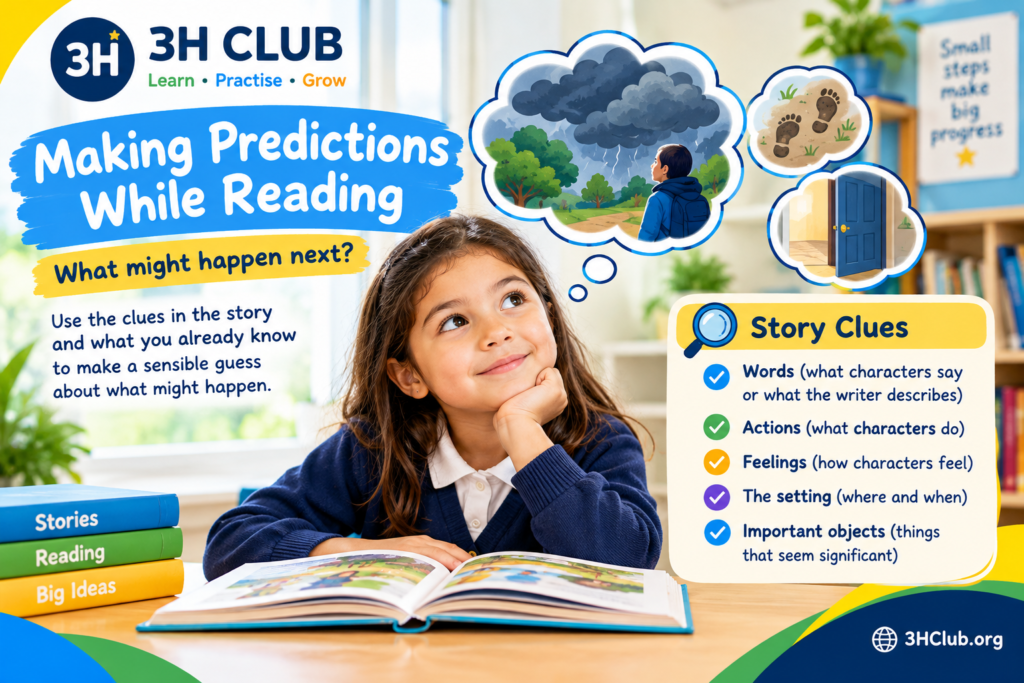
Clues can come from several places.
Clues in the story
Look for details about:
- What characters say.
- What characters do.
- How characters feel.
- Where the story takes place.
- What has already happened.
- Objects or details that seem important.
For example, suppose a character keeps checking the time, packs a bag and waits beside the front door.
What might happen next?
You could predict that the character is about to leave for a trip. The packed bag and waiting by the door are clues that support your idea.
Clues in pictures
Illustrations can also help you make predictions.
Look carefully at:
- Characters’ faces and body language.
- Objects in the background.
- Weather and surroundings.
- What characters are holding or looking at.
- Anything unusual in the picture.
If a picture shows a character reaching towards a wobbly tower of blocks, you might predict that the tower could fall.
Clues from what you already know
Your own experiences can help you understand a story.
For example, if you know that ice melts when it gets warm, you might predict that a snowman will begin to melt on a sunny day.
However, remember to use the story’s clues too. Your prediction should fit what is happening in the story, not just what you imagine.
Detective tip: Ask yourself, “Which details helped me think of that?”
💡 3. Use Clues and What You Know
The strongest predictions often combine two things:
- Story clues: Information you find in the words or pictures.
- What you know: Facts, experiences or ideas you already understand.
Let’s try an example.
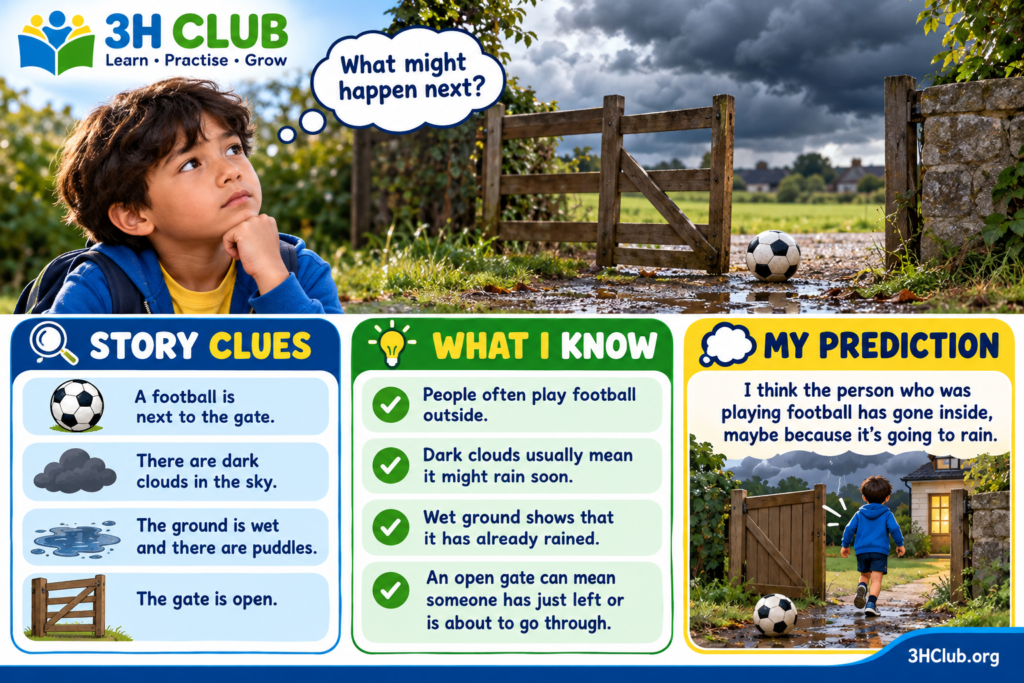
Sam placed his football beside the gate. He looked at the dark clouds and heard thunder rumbling in the distance. His friends were still on their way.
What might happen next?
<box>
Story clues
- Dark clouds are gathering.
- Thunder is rumbling.
- Sam is waiting for his friends.
What you already know
- Thunderstorms can bring heavy rain.
- Playing football outside may become unsafe during a storm.
Possible prediction
Sam and his friends may have to postpone their football game or find somewhere safe to wait.
</box>
Notice that this prediction is based on evidence. We cannot know exactly what will happen until we read more, but the clues help us make a sensible prediction.
📚 4. Make Predictions in a Story
Let’s practise using clues in a short story.
Story: The Lost Puppy
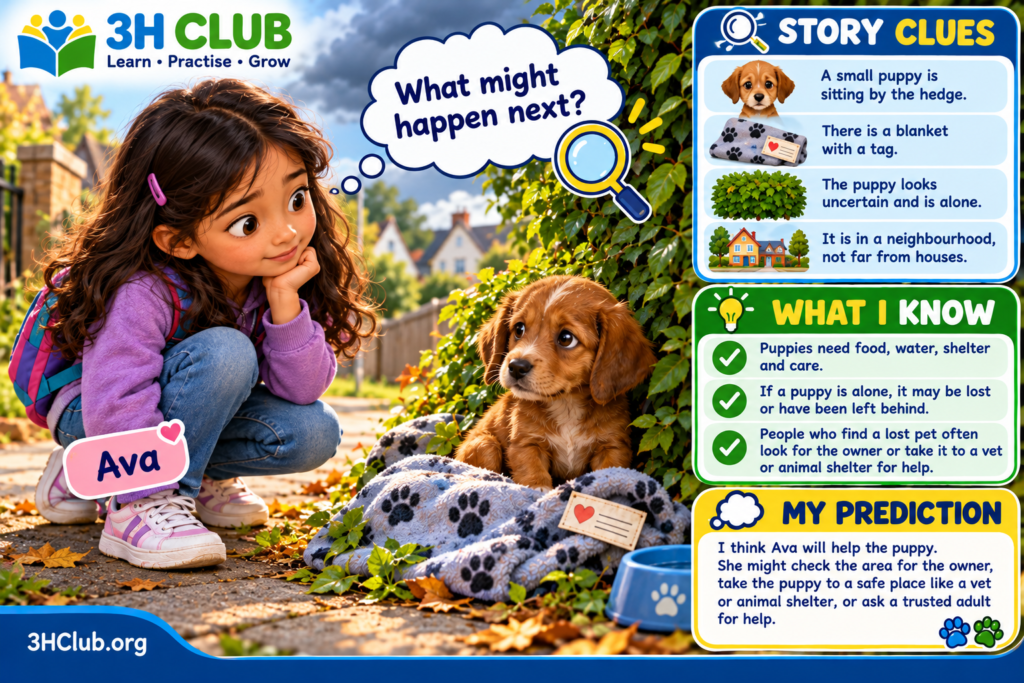
Ava was walking home when she heard a soft whimper near a hedge. She stopped and looked carefully. A small brown puppy was sitting beneath the leaves. It had no collar, and it looked frightened. Ava knelt down and spoke gently to it. Then she noticed a phone number on a tag attached to the puppy’s little blanket.
Pause here. Before reading any further, think about what might happen next.
What do you predict Ava will do?
You might predict that Ava will use the phone number to contact the puppy’s owner.
Which clues support your prediction?
- Ava has found a puppy that may be lost.
- The puppy has no collar.
- A phone number is attached to its blanket.
- Ava is already trying to help it.
These clues suggest that Ava may call the number to find out who owns the puppy.
But there are other possibilities. Perhaps an adult will help her make the call, or the owner will arrive before she can contact them.
A prediction does not have to describe every detail. It should explain what you think may happen and why.
Check your prediction
Now imagine the story continues:
Ava asked her older brother to help her call the number. A worried woman answered. She explained that her puppy, Coco, had slipped through an open gate that morning. Ava stayed with her brother until the woman arrived. When Coco heard her owner’s voice, he wagged his tail and ran towards her.
Ava’s prediction that the number could help her find the owner was supported by what happened next.
Reading detective question: Which clue was most useful in predicting that Ava would contact the owner?
The phone number on the blanket was a particularly useful clue.
If your prediction was different, that is fine. Compare it with the ending and see which clues you noticed.
🏖️ 5. Predict What Happens at the Beach
Stories about familiar places can also help you practise making predictions.
Story: A Day at the Beach
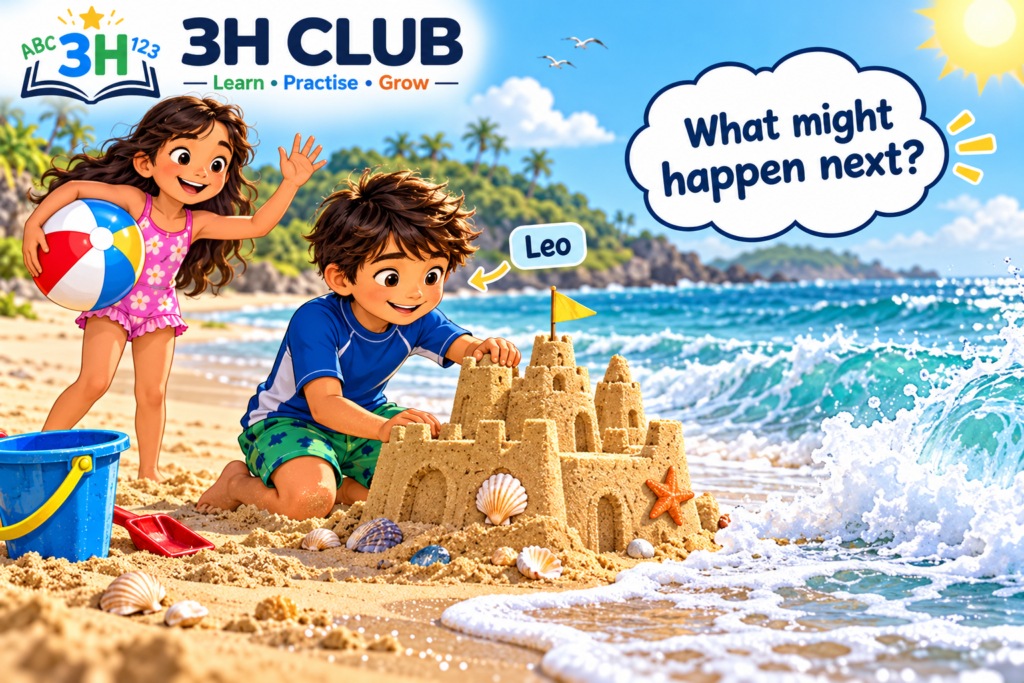
Leo and his family arrived at the beach early in the morning. Leo carried a bucket and spade, while his sister brought a beach ball. They spread their towels on the sand and began building a sandcastle. Soon, Leo noticed that the waves were getting closer to the edge of their castle. His sister picked up the beach ball and called for him to come and play.
Pause here and make a prediction.
What might happen next?
You might predict that Leo will leave the sandcastle to play with his sister. You might also predict that the rising waves will wash away part of the sandcastle.
What clues support these predictions?
- Leo’s sister has picked up the beach ball.
- She has called him to come and play.
- The waves are getting closer to the sandcastle.
These details support more than one possible prediction. Leo might join his sister, try to protect the sandcastle first or ask his family to help move it.
Check the next part
Imagine the story continues:
Leo ran over to his sister and began tossing the ball back and forth. When he glanced at the sandcastle, a wave had washed away one of its towers. Leo felt disappointed for a moment, but then he smiled. He and his sister decided to build a new castle farther from the water.
The story supports the prediction that the waves might damage the sandcastle. It also shows Leo joining his sister to play.
A prediction can be partly correct. You might have predicted that the sandcastle would be washed away without guessing what Leo would do afterwards.
Remember: Keep reading to discover what really happens. The next part of the story may confirm your prediction, change it or surprise you!
🗣️ 6. Explain Your Prediction
It is helpful to explain not only what you predict but also why you think it will happen.
Try using these sentence starters:
- “I predict that …”
- “I think … might happen because …”
- “The clue that helped me was …”
- “I noticed that …”
- “This makes me think …”
- “My prediction is based on …”
Here is an example:
Story clue: Ben placed his lunchbox in his bag and put on his school shoes.
Prediction: “I predict that Ben is getting ready to go to school because he has packed his lunch and put on his school shoes.”
This explanation connects the prediction to details in the story.
Compare it with this answer:
“I think Ben will go somewhere.”
That could be possible, but it does not explain your thinking very clearly.
You do not need a long explanation. One sentence that connects your idea to a useful clue can be enough.
🔄 7. Check Whether Your Prediction Was Correct
Making a prediction is only part of the job. A reading detective also checks what happens next.
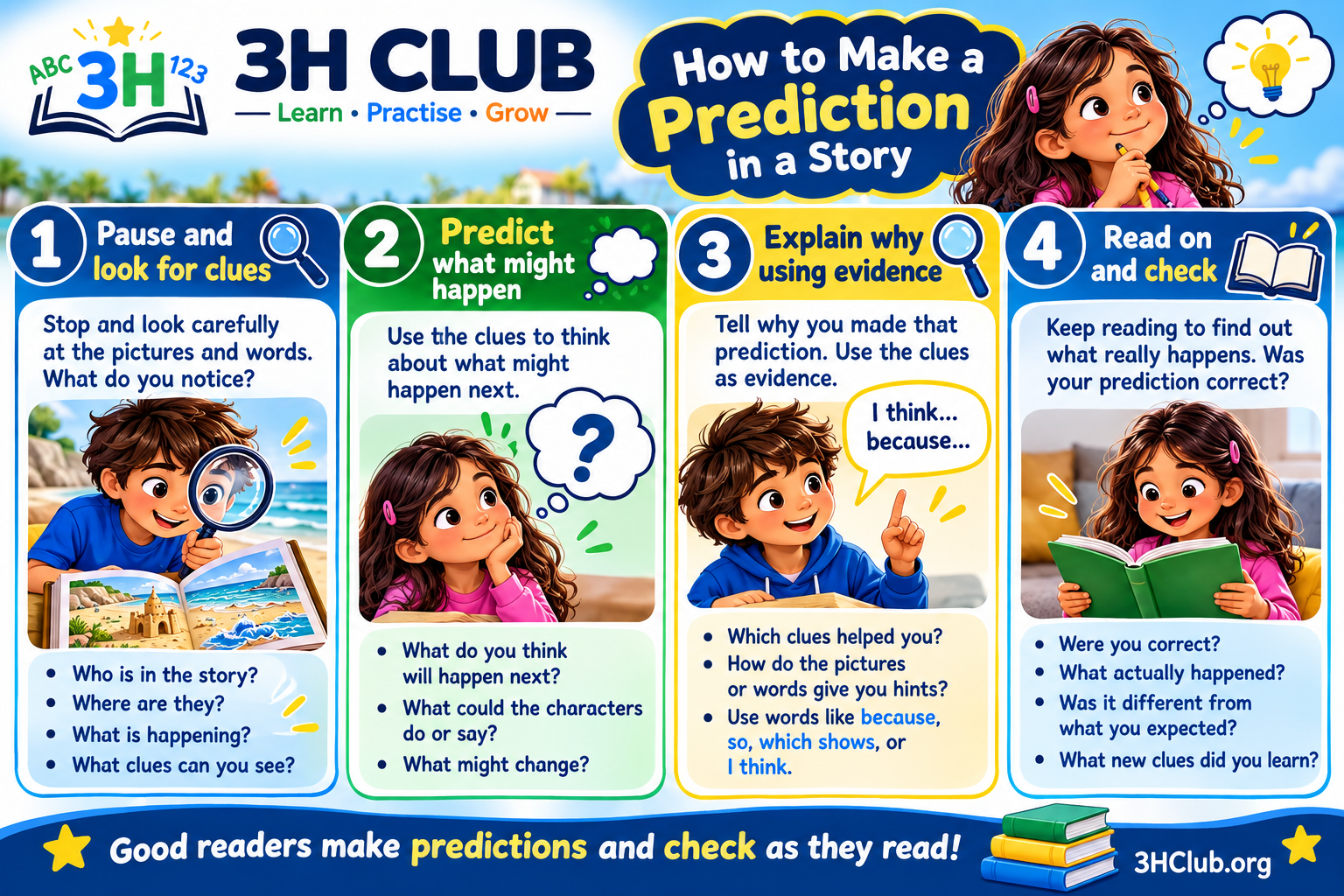
Follow these four steps:
- Pause: Stop at an interesting moment in the story.
- Predict: Think about what might happen next.
- Explain: Identify the clue or clues that helped you.
- Check: Continue reading and compare your prediction with the story.
When you check your prediction, ask yourself:
- Was my prediction correct?
- Was it partly correct?
- Did the story take a different turn?
- Which clue did I miss or misunderstand?
- What new clue have I discovered?
If your prediction was wrong, do not worry. You are learning to notice details and think carefully. Sometimes authors deliberately surprise readers!
A useful habit: Change your prediction when new evidence appears. Good readers are willing to rethink their ideas.
✏️ 8. Builders Activity: What Happens Next?
Read each short passage. Make a prediction and identify the clue that helped you.
Question 1: The Missing Lunchbox
Priya opened her schoolbag and searched inside. She checked every pocket, but her lunchbox was missing. Then she remembered leaving it on the kitchen table that morning.
What might Priya do next?
A. She might ask someone at home to check the kitchen table.
B. She might decide that lunchboxes cannot be found.
C. She might start building a snowman.
Which answer is the most sensible prediction? What clue supports your choice?
Question 2: The School Garden
The children planted bean seeds in small pots. Each day, they watered the soil and placed the pots near a sunny window. After several days, tiny green shoots appeared.
What might happen next?
A. The shoots may continue to grow if they receive what they need.
B. The pots will turn into footballs.
C. The children will forget what plants are.
Which prediction makes the most sense? Explain why.
Question 3: The Birthday Surprise
Daniel walked into the living room. His family quickly stopped talking, and his sister tried to hide a large box behind the sofa. Daniel noticed colourful balloons near the window.
What might Daniel discover?
Write your own prediction and explain which clues helped you.
Question 4: The Rainy Walk
Maya and her grandfather were walking in the park. The wind grew stronger, dark clouds covered the sky, and they heard thunder. Grandfather looked towards the path leading back home.
What might they do next?
Write one sensible prediction and identify two clues that support it.
Question 5: The Unfinished Puzzle
Oliver had been working on a large jigsaw puzzle for an hour. He found pieces that matched the picture of a boat, but one corner was still empty. He looked under the table and spotted a puzzle piece beside his chair.
What might Oliver do next?
Explain how the final clue helps you make your prediction.
Check Your Answers
There can be more than one sensible prediction if it is supported by the story.
- The missing lunchbox: A is the strongest choice. Priya remembers leaving the lunchbox on the kitchen table, so she may ask someone to check there.
- The school garden: A is the strongest choice. The shoots have appeared, and the children have been watering the plants and placing them near sunlight.
- The birthday surprise: Daniel might discover that his family has prepared a birthday surprise. The hidden box and colourful balloons are useful clues.
- The rainy walk: Maya and her grandfather may head home or find a safe place to shelter. The thunder, dark clouds and grandfather looking towards the path support this prediction.
- The unfinished puzzle: Oliver may pick up the piece and try it in the empty corner. The piece beside his chair may be part of the unfinished puzzle.
The most important part is your explanation. Show which details helped you reach your answer.
🌟 9. Champions’ Challenge for Builders: Read, Predict and Check
Ready for a longer challenge? Read this passage and stop before the final paragraph.
The School Talent Show
On Friday morning, Nia arrived at school carrying a small bag. Inside was a shiny silver microphone that her uncle had given her. She had practised her song every evening, but she still felt nervous about singing in front of the class.
During lunchtime, Nia watched her friends rehearsing their jokes and dance routines. When her teacher announced that the talent show would begin in ten minutes, Nia took a deep breath and looked at the microphone in her bag.
Pause here.
- What do you predict Nia will do?
- Which two clues helped you make your prediction?
- How might Nia feel when the show begins?
- What could help her feel more confident?
Now read the ending:
When her name was called, Nia walked to the front of the room. Her hands trembled slightly, but she remembered all the practice she had done. She began to sing softly. As she continued, she grew more confident, and by the final note, her classmates were clapping and smiling.
Challenge Answers
- Nia may decide to sing in the talent show because she has brought a microphone and practised her song.
- The microphone in her bag and her regular practice are useful clues.
- She may feel nervous at first because she is singing in front of the class.
- Remembering her practice, taking a deep breath and receiving encouragement could help her feel more confident.
Your prediction might not have matched every detail of the ending. That is part of reading: you use the clues you have, then update your thinking as the story unfolds.
📌 10. Quick Reference: Making Predictions
| Word or phrase | Meaning |
|---|---|
| Prediction | An idea about what might happen next |
| Clue | A detail that helps you understand or predict something |
| Evidence | Information that supports an idea |
| Character | A person or animal in a story |
| Rehearse | To practise before a performance |
| Confirm | To show that an idea was correct |
| Revise | To change an idea when new information appears |
Your Reading Detective Checklist
Before you turn the page, ask yourself:
- 🔎 Have I noticed important details?
- 💡 Have I used what I already know?
- 📖 Does my prediction fit the story?
- 🗣️ Can I explain which clues helped me?
- ✅ Have I checked my prediction by reading on?
Keep these questions in mind whenever you read a story.
❓ Frequently Asked Questions About Making Predictions
What does making a prediction mean in reading?
Making a prediction means using story clues and what you already know to work out what might happen next.
Do predictions always have to be correct?
No. A prediction is an informed idea, not a guarantee. The important thing is to use clues and check your thinking as you read.
What clues can help me make a prediction?
You can use what characters say and do, their feelings, the setting, illustrations, important objects and events that have already happened.
How do I explain a prediction?
State what you think might happen, then give a reason. For example: “I predict that the team will practise again because they want to improve before the match.”
What should I do if my prediction is wrong?
Keep reading and look for new clues. Think about what surprised you and whether the new information changes your prediction.
Can there be more than one correct prediction?
Yes. A story can support several sensible possibilities. A good prediction is one that fits the available clues, even if the ending turns out differently.
🎉 Keep Reading with 3HClub!
Well done, reading detective! You have learned how to look for clues, use what you already know, make sensible predictions and check your ideas as you read.
Every story gives you a chance to practise. The next time you reach an exciting moment, pause and ask yourself: “What might happen next, and which clues make me think so?”
Keep noticing the details, keep asking questions and keep enjoying your reading adventures.
Learn • Practise • Grow