Non-Fiction Reading Comprehension:
🌍 Discover Amazing Facts About Our World!
⭐⭐ ⭐ CHAMPIONS | Ages 10-11
📚 Subject: English – Reading Comprehension
🎯 Skills: Finding key information, identifying main ideas, understanding text features, learning vocabulary, and using evidence.
🌟 Let’s Get Started!
Did you know that octopuses have three hearts?
Or that some plants can grow in places where very little rain falls?
What about the fact that people have been using different kinds of calendars for thousands of years?
Our world is full of fascinating information!
When you read to discover facts about animals, nature, science, history, or everyday life, you are often reading non-fiction.
Non-fiction helps you understand how things work, why events happen, and what makes our world so interesting.
But reading non-fiction is about more than collecting facts.
You also need to understand what the information means.
That’s where non-fiction reading comprehension comes in!
Ready to explore?
Let’s begin!
🎯 What Will You Learn?
By the end of this lesson, you will be able to:
- ✅ Find important information in a non-fiction passage.
- ✅ Identify the main idea of a paragraph or text.
- ✅ Recognise how headings and paragraphs organise information.
- ✅ Understand new subject vocabulary.
- ✅ Find supporting details.
- ✅ Answer questions using evidence from a passage.
- ✅ Explain what you have learned in your own words.
💡 Remember: Good readers don’t just collect facts. They connect ideas and think about what they mean!
🔵 1. What Is Non-Fiction?
Non-fiction is writing that gives information about real people, places, events, and things.
Non-fiction texts are usually written to inform, explain, describe, or teach.
You can find non-fiction in many places.
📚 Examples of Non-Fiction
| Type of Non-Fiction | What You Might Learn |
|---|---|
| 🐘 Animal information books | Where animals live and what they eat |
| 🌳 Nature articles | How plants grow and why forests matter |
| 🔬 Science books | How electricity, magnets, or the human body work |
| 🏛️ History articles | What happened in the past |
| 🌍 Geography books | Information about countries, oceans, and mountains |
| 🍎 Health information | How food, exercise, and sleep affect our bodies |
| 📰 News reports | Information about real events |
📖 Fiction vs Non-Fiction
You may already know that fiction tells stories involving imagined characters or events.
Non-fiction is different.
| 📘 Fiction | 📗 Non-Fiction |
|---|---|
| Usually tells an imagined story | Gives information about real subjects |
| May include invented characters | Focuses on real people, places, events, or things |
| Often includes a plot | Often explains or describes a topic |
| Example: A story about a talking dolphin | Example: An article about how dolphins communicate |
⭐ Important!
Non-fiction aims to provide factual information, but that does not mean every non-fiction text is automatically correct.
Writers can make mistakes, and information can become outdated.
Good readers learn to check important facts using reliable sources.
🧠 Quick Question
Which of these is most likely to be non-fiction?
A. A story about a dragon who learns to fly.
B. An article explaining how volcanoes erupt.
C. A fairy tale about an enchanted forest.
Think carefully!
Answer: B.
An article explaining volcanoes is non-fiction because it describes a real natural process.
🟢 2. How Is a Non-Fiction Text Organised?
Non-fiction writers use special features to help readers find and understand information.
These are called text features.
Let’s explore some common ones.
🏷️ Headings
A heading tells you what a section is about.
For example:
How Do Bees Make Honey?
This heading tells you that the section will explain how bees produce honey.
📄 Paragraphs
A paragraph is a group of sentences about a particular idea.
In non-fiction, paragraphs often explain one main part of a topic.
🔤 Bold Words
Writers sometimes use bold text to highlight important words.
For example:
Pollination is the movement of pollen from one flower to another.
🖼️ Pictures and Captions
Pictures help readers understand information.
Captions explain what the pictures show.
📊 Charts and Diagrams
Charts and diagrams organise information visually.
They can help you compare facts or understand how something works.
📘 Glossaries
A glossary explains important words used in a text.
Glossaries are especially useful when reading about science, geography, or history.
🧠 Let’s Practise!
Imagine you are reading an article titled:
Amazing Sea Creatures
It contains these headings:
- Where Sea Creatures Live
- What Sea Creatures Eat
- How Sea Creatures Protect Themselves
Which heading would help you find information about an octopus hiding from predators?
Answer: Heading 3 — How Sea Creatures Protect Themselves.
⭐ Reading Tip
Before reading a non-fiction article, look at its title, headings, pictures, and captions.
These features give you clues about what you are going to learn.
🟡 3. Finding Key Information
When you read non-fiction, some details are more important than others.
Key information includes the facts you need to understand the topic or answer a question.
You don’t have to remember every word.
Instead, look for information that answers questions such as:
- Who?
- What?
- Where?
- When?
- Why?
- How?
These questions are sometimes called the 5 Ws and 1 H.
📖 Example: The Busy Honeybee
Read this short paragraph:
Honeybees collect nectar from flowers. They carry the nectar back to their hive, where it is processed and stored as honey. Honey provides food for the bee colony.
Now answer these questions.
What do honeybees collect?
Nectar.
Where do they take it?
Back to their hive.
Why do bees make and store honey?
Honey provides food for the colony.
🔍 How Did We Find the Answers?
We looked for the words and sentences that answered each question.
We did not need to guess.
The information was already in the paragraph.
💡 Remember!
When a question asks for a fact from the text, return to the passage and find the evidence.
Don’t rely only on your memory.
🟣 4. Finding the Main Idea
Every non-fiction passage has a topic.
The main idea tells you the most important thing the writer wants you to understand about that topic.
Supporting details provide extra information that explains the main idea.
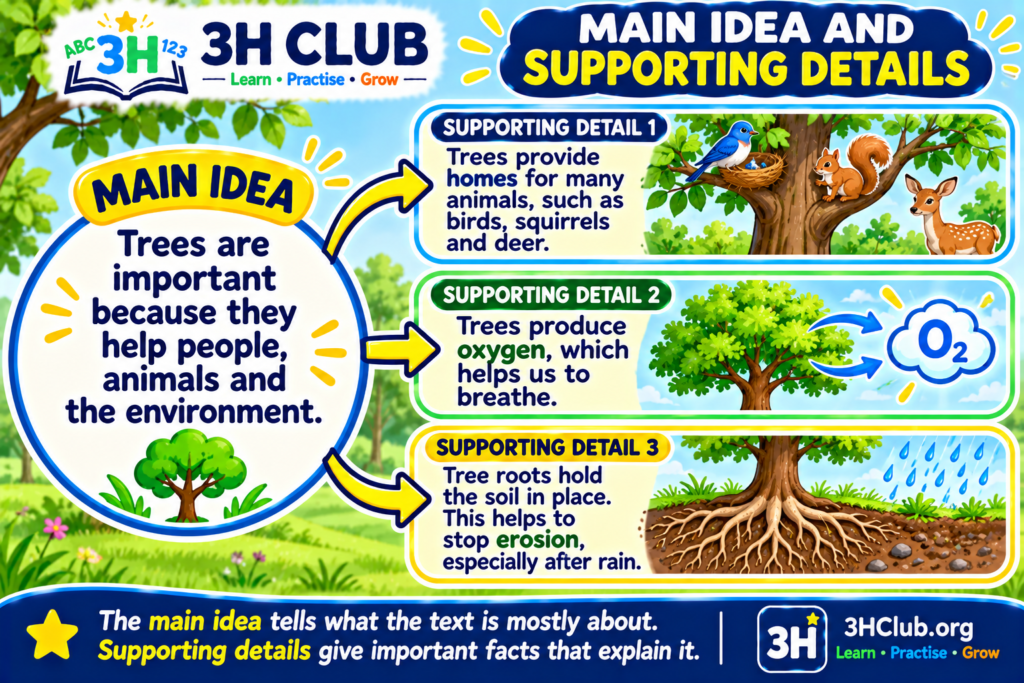
📖 Example: Why Trees Matter
Read this paragraph:
Trees are important to living things. They provide shelter for many animals, including birds and insects. Trees also absorb carbon dioxide and release oxygen during photosynthesis. Their roots can help hold soil in place.
🌳 What Is the Main Idea?
Trees are important to living things.
🔍 What Are the Supporting Details?
- Trees provide shelter for animals.
- Trees absorb carbon dioxide and release oxygen during photosynthesis.
- Tree roots help hold soil in place.
Each detail explains why trees are important.
🧠 Main Idea Formula
MAIN IDEA = What the whole paragraph is mostly teaching you
SUPPORTING DETAILS = Facts that explain or develop the main idea
✏️ Your Turn!
Read this paragraph:
Penguins are birds that are well adapted to swimming. Their wings act like flippers, helping them move through water. Their streamlined bodies allow them to swim efficiently. Penguins also have feathers that help protect them from cold water.
What is the main idea?
A. Penguins have feathers.
B. Penguins are well adapted to swimming.
C. Penguins live in cold places.
Answer: B.
The paragraph mainly explains how penguins are adapted to swimming.
The other facts are supporting details.
🌍 5. Non-Fiction Reading Passage 1: Amazing Octopuses
🐙 Topic: Animals and Marine Life
📖 Read the Passage
Amazing Octopuses
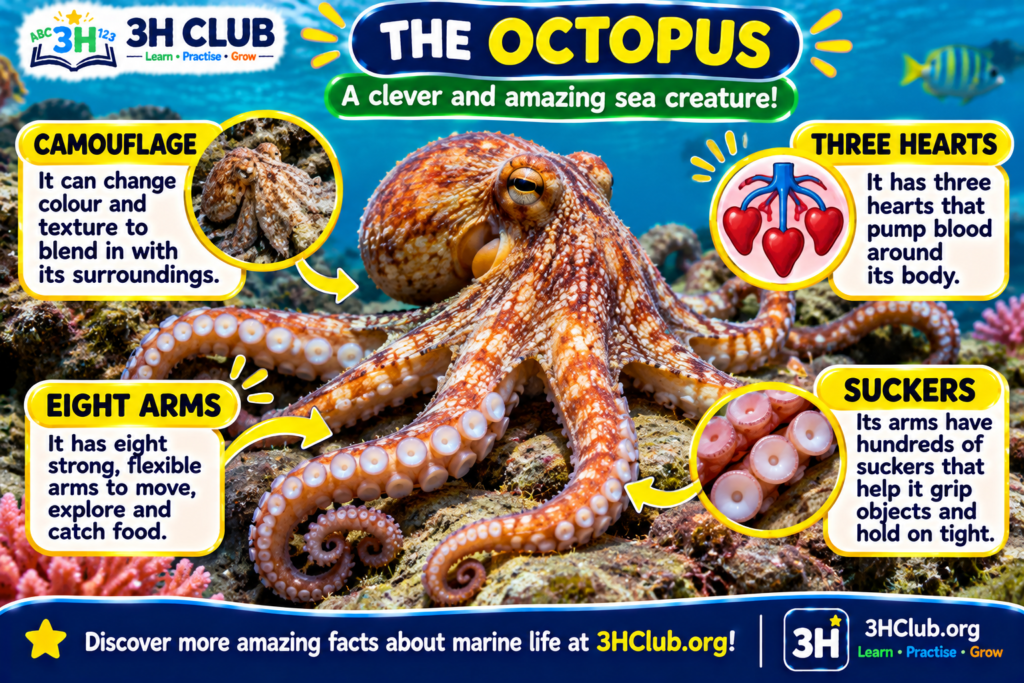
Octopuses are fascinating sea animals that belong to a group called molluscs. They have soft bodies, eight arms, and remarkable abilities that help them survive underwater.
Eight Useful Arms
An octopus has eight arms covered with suckers.
These suckers help it grip objects, explore its surroundings, and catch food.
Octopuses can use their arms to investigate narrow spaces and move across the sea floor.
Clever Camouflage
Many octopuses can change their colour and the appearance of their skin.
This ability is called camouflage.
Camouflage helps an octopus blend into its surroundings and avoid being noticed by predators.
Three Hearts
An octopus has three hearts.
Two hearts pump blood towards the gills, where oxygen enters the blood.
The third heart pumps blood around the rest of the body.
Intelligent Sea Creatures
Octopuses can solve simple problems, explore objects, and learn from experience.
Some have even been observed opening containers to reach food.
Their unusual bodies and clever behaviour make them remarkable animals.
🔍 Comprehension Questions
1. What type of animal is an octopus?
A. A fish
B. A mollusc
C. A reptile
2. How many arms does an octopus have?
3. What helps an octopus grip objects?
4. What does the word camouflage mean in this passage?
5. How does camouflage help an octopus survive?
6. How many hearts does an octopus have?
7. What is the main idea of the passage?
8. Find two details that show octopuses have special abilities.
⭐ Challenge Question
Why do you think the writer used separate headings?
Explain how they help the reader.
🌿 6. Non-Fiction Reading Passage 2: How Plants Survive in the Desert
🌵 Topic: Nature and Plant Adaptations
📖 Read the Passage
Plants of the Desert
Deserts are places that receive very little rainfall.
Although deserts can be extremely hot during the day, some deserts are cold.
Living things in deserts must survive with limited water.
Storing Water
Some desert plants, such as many cacti, have thick stems that store water.
This stored water helps them survive long periods without rain.
Reducing Water Loss
Many cacti have spines instead of ordinary leaves.
Their spines can help protect them from animals.
Having very small leaves or spines also helps some desert plants reduce water loss.
Finding Water
Desert plants have different kinds of root systems.
Some have wide, shallow roots that absorb rainwater quickly.
Others have deep roots that reach water farther underground.
Surviving Difficult Conditions
These special features are called adaptations.
An adaptation is a feature that helps a living thing survive in its environment.
Desert plants have adaptations that help them live where water is scarce.
🔍 Comprehension Questions
1. What is a desert?
2. Why do some desert plants store water?
3. Name one way cactus spines can help the plant.
4. What do shallow roots help some plants do?
5. What does adaptation mean?
6. What is the main idea of the passage?
7. Which heading would you read to learn about plant roots?
8. Find two supporting details that explain how desert plants survive.
⭐ Challenge Question
Why might a plant with ordinary large leaves lose more water than a cactus with spines?
Use information from the passage to explain your answer.
🔬 7. Non-Fiction Reading Passage 3: How Shadows Are Made
☀️ Topic: Science – Light and Shadows
📖 Read the Passage
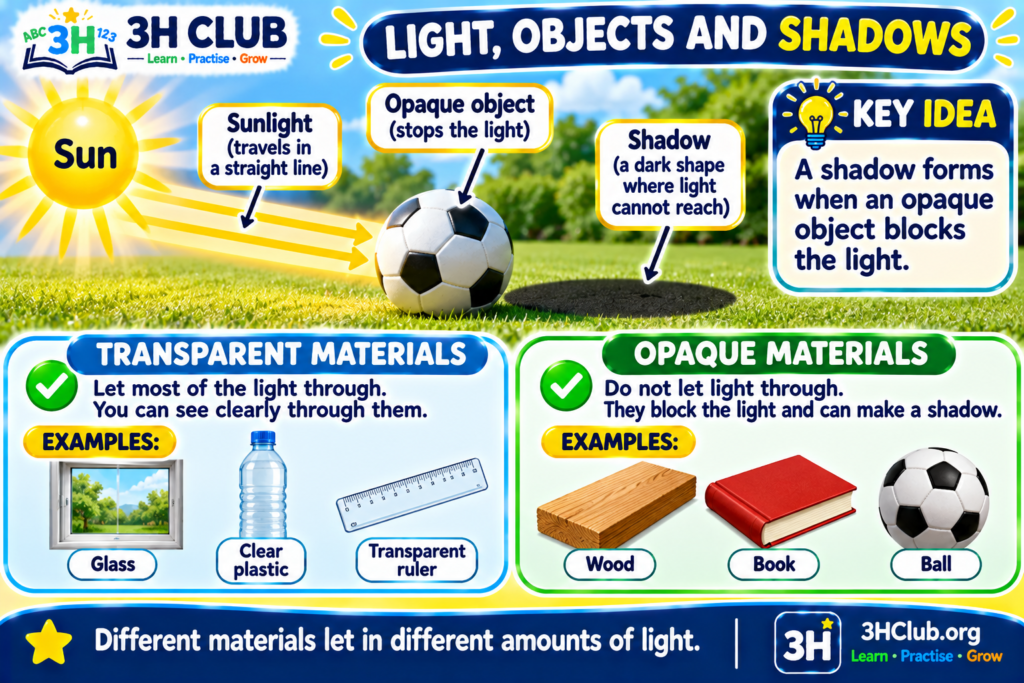
How Shadows Are Made
Have you ever noticed your shadow following you on a sunny day?
A shadow forms when an object blocks light.
Light Travels in Straight Lines
Light usually travels in straight lines through the air.
When an object blocks some of that light, a darker area forms behind it.
This darker area is called a shadow.
Why Shadows Change
The size and direction of a shadow can change.
For example, your shadow may look long when the Sun is low in the sky.
Around the middle of the day, when the Sun is higher, your shadow may become shorter.
The exact length depends on the Sun’s position.
Transparent and Opaque Objects
Some objects allow light to pass through them.
These are called transparent objects.
Clear glass is an example.
Other objects block light.
These are called opaque objects.
A wooden door is opaque.
Opaque objects can form clear, dark shadows when light shines on them.
Learning from Shadows
By observing shadows, scientists and learners can investigate the direction of light and the position of objects.
Shadows help us understand how light behaves.
🔍 Comprehension Questions
1. What causes a shadow to form?
2. How does light usually travel through the air?
3. Why might your shadow be longer in the early morning?
4. What does transparent mean?
5. What does opaque mean?
6. Give one example of an opaque object.
7. What is the main idea of the passage?
8. Find a sentence that explains why shadows change.
⭐ Challenge Question
Imagine you move a torch closer to a toy.
What might happen to the toy’s shadow on a wall behind it?
Explain your prediction using what you know about light.
🏛️ 8. Non-Fiction Reading Passage 4: How People Wrote Long Ago
📜 Topic: History – Communication and Writing
📖 Read the Passage
Writing Through History
Today, people write using pencils, pens, computers, and tablets.
But writing has changed greatly over thousands of years.
Long ago, people developed different ways to record information.
Writing on Clay
In ancient Mesopotamia, people used clay tablets to record information.
They pressed marks into soft clay using a pointed tool called a stylus.
Some tablets were dried or baked to preserve the writing.
Writing on Papyrus
In ancient Egypt, people made a writing material called papyrus.
Papyrus was produced from a plant that grew near the River Nile.
People could write on sheets of papyrus using ink.
Writing on Paper
Paper was developed in ancient China.
Over time, papermaking spread to other parts of the world.
Paper became an important material for recording information, sharing ideas, and creating books.
Writing Today
Modern technology allows people to write and share information quickly.
Although writing tools have changed, people still use writing to communicate, learn, and remember important events.
🔍 Comprehension Questions
1. What did people in ancient Mesopotamia use to record information?
2. What was a stylus used for?
3. What was papyrus made from?
4. Where was paper first developed?
5. Why has writing been important throughout history?
6. What is the main idea of the passage?
7. Name two writing materials mentioned in the text.
8. Which heading would help you find information about ancient Egypt?
⭐ Challenge Question
How is writing today different from writing in ancient Mesopotamia?
Give one difference using evidence from the passage.
🍎 9. Non-Fiction Reading Passage 5: Why Our Bodies Need Water
💧 Topic: Health and Everyday Life
📖 Read the Passage
Why Water Matters
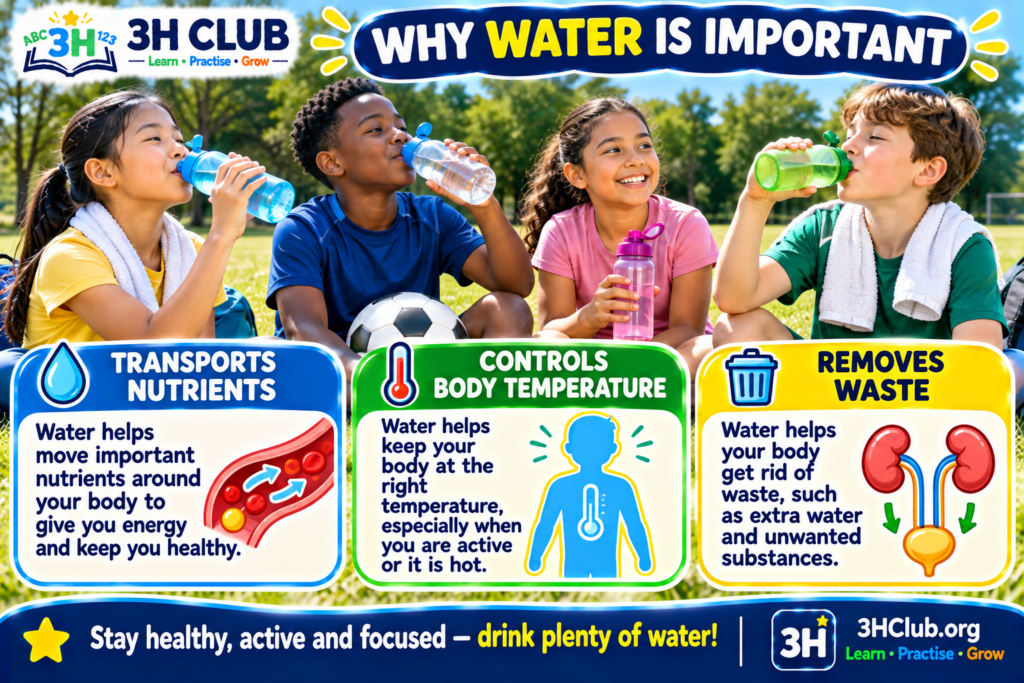
Water is essential for life.
Our bodies need water to work properly.
Every day, we lose water through breathing, sweating, and using the toilet.
We need to replace the water we lose.
Helping the Body Work
Water helps transport nutrients around the body.
It also helps the body remove waste.
Water is important for many processes that keep us healthy.
Keeping Cool
When you become hot, your body may produce sweat.
As sweat evaporates from your skin, it helps cool your body.
This is one way your body controls its temperature.
Drinking Enough Water
The amount of water a person needs can vary.
It depends on factors such as age, activity, weather, and health.
Drinking water regularly is a good habit, especially when you are active or the weather is hot.
Water in Food
You can also get water from foods.
Fruits and vegetables such as watermelon, oranges, and cucumbers contain plenty of water.
Water is an important part of everyday life.
🔍 Comprehension Questions
1. Why do our bodies need water?
2. Name two ways the body loses water.
3. How does sweating help the body?
4. What does evaporates mean?
5. Name two foods that contain water.
6. What is the main idea of the passage?
7. Why might someone need more water on a hot day?
8. Find two details that explain why water is important.
⭐ Challenge Question
Why is it important to replace the water our bodies lose?
Use information from the passage.
🧩 10. Activity 1: Find the Main Idea
Read each paragraph.
Choose the best main idea.
Question 1
Butterflies begin life as eggs. They hatch into caterpillars, which grow and later form a chrysalis. Inside the chrysalis, the insect changes before emerging as an adult butterfly.
What is the main idea?
A. Butterflies have colourful wings.
B. Butterflies go through several stages of development.
C. Caterpillars eat leaves.
Question 2
Recycling helps reduce the amount of waste sent to landfill sites. Materials such as paper, glass, and certain plastics can be collected and processed into new products. Recycling can also help conserve natural resources.
What is the main idea?
A. Recycling helps reduce waste and conserve resources.
B. Glass is made from sand.
C. Plastic comes in different colours.
Question 3
The Moon moves around the Earth. It does not produce its own visible light but reflects sunlight. As the Moon travels around Earth, we see different amounts of its sunlit half.
What is the main idea?
A. The Moon is made of rock.
B. The Moon reflects sunlight and appears to change shape as it moves around Earth.
C. The Sun is hotter than the Moon.
🔍 11. Activity 2: Find the Supporting Details
Read the paragraph.
🐬 Dolphins
Dolphins are intelligent marine mammals. They communicate using different sounds, including clicks and whistles. Many dolphins live in social groups called pods. They also use echolocation to help locate objects underwater.
Questions
1. What is the main idea?
2. Find three supporting details.
3. What does the word pods mean in this paragraph?
4. Why is the final sentence a supporting detail rather than the main idea?
📘 12. Activity 3: Vocabulary Detective
Match each word with its meaning.
| Word | Meaning |
|---|---|
| 1. Adaptation | A. A material that allows light to pass through |
| 2. Camouflage | B. A feature that helps a living thing survive |
| 3. Transparent | C. The ability to blend into surroundings |
| 4. Opaque | D. The change from liquid water into water vapour |
| 5. Evaporation | E. A material that blocks light |
Your Answers
1 → _____
2 → _____
3 → _____
4 → _____
5 → _____
⭐ Extra Challenge
Choose two words and write your own sentences.
🏆 13. Final Reading Challenge: The Amazing Journey of a Seed
Read this passage carefully.
🌱 The Amazing Journey of a Seed
Plants need suitable conditions to grow.
Many plants begin life as seeds.
A seed contains a young plant, called an embryo, and a supply of stored food.
How Seeds Travel
Seeds can move from one place to another in different ways.
Some seeds are carried by the wind.
Others float on water.
Some seeds have hooks that attach to animal fur.
Animals may also eat fruits and later spread the seeds.
This movement is called seed dispersal.
How Seeds Begin to Grow
When a seed has suitable conditions, it may begin to germinate.
Germination is the process in which a seed begins to grow.
Most seeds need water, oxygen, and a suitable temperature to germinate.
Some seeds have additional requirements, such as light or darkness.
Growing into a Plant
As the seed begins to grow, a root usually develops first.
The root helps anchor the young plant and absorb water.
A shoot then grows upwards.
With enough light, water, air, and nutrients, the young plant can continue developing.
Why Seeds Matter
Seeds allow many plants to reproduce.
They also help plants spread to new places.
Without seeds, many familiar plants would not grow in the same way.
🔍 Final Challenge Questions
1. What is the main idea of the passage?
2. What is an embryo?
3. Name three ways seeds can travel.
4. What does seed dispersal mean?
5. What is germination?
6. Name three conditions most seeds need to germinate.
7. What usually develops first when a seed begins to grow?
8. Why are roots important?
9. Which heading would help you learn how seeds move?
10. Find two supporting details that explain why seeds are important.
⭐ Super Challenge
Write a short summary of the passage using three or four sentences.
Try to include:
- The main idea.
- Two important supporting details.
- At least one subject vocabulary word.
✍️ 14. How to Answer Questions Using Evidence
When you answer a non-fiction comprehension question, it’s important to support your answer with information from the passage.
This is called using text evidence.
🔍 A Simple Three-Step Method
STEP 1: READ THE QUESTION
Work out what the question is asking.
STEP 2: FIND THE EVIDENCE
Look for the sentence or paragraph that contains the answer.
STEP 3: ANSWER CLEARLY
Use the information to write a complete answer in your own words.
📖 Example
Question: Why do octopuses use camouflage?
Evidence from the passage: Camouflage helps an octopus blend into its surroundings and avoid predators.
Good answer: Octopuses use camouflage to blend into their surroundings so predators have difficulty noticing them.
🌟 Helpful Sentence Starters
You can use these when answering questions:
- The passage explains that…
- According to the text…
- One important detail is…
- The writer tells us that…
- I know this because the passage says…
⭐ Remember!
A strong answer should:
- Answer the question.
- Use correct information.
- Include evidence when needed.
- Be written clearly.
✅ 15. Check Your Answers!
Let’s see how you did!
Remember, some questions may have more than one acceptable answer.
If your answer is accurate and supported by the passage, it may also be correct.
🐙 Passage 1: Amazing Octopuses
| Question | Answer |
|---|---|
| 1 | B — A mollusc |
| 2 | Eight arms |
| 3 | Suckers |
| 4 | Blending into surroundings to avoid being noticed |
| 5 | It helps protect the octopus from predators. |
| 6 | Three hearts |
| 7 | Octopuses have unusual bodies and abilities that help them survive. |
| 8 | They can camouflage themselves and solve simple problems. |
Challenge: Headings divide the passage into smaller sections, making information easier to find.
🌵 Passage 2: Plants of the Desert
| Question | Answer |
|---|---|
| 1 | A place that receives very little rainfall |
| 2 | To survive long periods without rain |
| 3 | They help protect the plant from animals or reduce water loss. |
| 4 | Absorb rainwater quickly |
| 5 | A feature that helps a living thing survive in its environment |
| 6 | Desert plants have special adaptations that help them survive with little water. |
| 7 | Finding Water |
| 8 | Thick stems store water, and roots help plants collect water. |
Challenge: Large leaves may lose more water through evaporation than very small leaves or spines.
☀️ Passage 3: How Shadows Are Made
| Question | Answer |
|---|---|
| 1 | An object blocks light. |
| 2 | In straight lines |
| 3 | The Sun is lower in the sky. |
| 4 | Allowing light to pass through |
| 5 | Blocking light |
| 6 | A wooden door |
| 7 | Shadows form when objects block light, and their appearance can change. |
| 8 | “The size and direction of a shadow can change.” |
Challenge: If the torch moves closer to the toy while the toy and wall stay in place, the shadow will usually become larger.
📜 Passage 4: Writing Through History
| Question | Answer |
|---|---|
| 1 | Clay tablets |
| 2 | Pressing marks into soft clay |
| 3 | A plant that grew near the River Nile |
| 4 | Ancient China |
| 5 | It allows people to record and share information. |
| 6 | Writing materials and tools have changed throughout history. |
| 7 | Clay tablets and papyrus |
| 8 | Writing on Papyrus |
Challenge: People in ancient Mesopotamia pressed marks into clay, while people today can type on computers or tablets.
💧 Passage 5: Why Water Matters
| Question | Answer |
|---|---|
| 1 | Water helps the body carry out important processes. |
| 2 | Sweating and breathing |
| 3 | Evaporating sweat helps cool the body. |
| 4 | Changing from liquid into vapour |
| 5 | Watermelon and cucumber |
| 6 | Water is essential for keeping the body working properly. |
| 7 | The body may lose more water through sweating. |
| 8 | Water helps transport nutrients and remove waste. |
Challenge: We must replace lost water because our bodies need it to carry out essential functions.
🧩 Activity 1: Main Idea
1. B — Butterflies go through several stages of development.
2. A — Recycling helps reduce waste and conserve resources.
3. B — The Moon reflects sunlight and appears to change shape as it moves around Earth.
🐬 Activity 2: Supporting Details
1. Main idea: Dolphins are intelligent marine mammals.
2. Supporting details:
- They communicate using clicks and whistles.
- They often live in groups called pods.
- They use echolocation to locate objects underwater.
3. Pods are groups of dolphins.
4. The final sentence gives one example of a dolphin’s abilities rather than explaining the whole paragraph.
📘 Activity 3: Vocabulary Detective
| Word | Answer |
|---|---|
| 1. Adaptation | B |
| 2. Camouflage | C |
| 3. Transparent | A |
| 4. Opaque | E |
| 5. Evaporation | D |
🌱 Final Challenge: The Amazing Journey of a Seed
| Question | Answer |
|---|---|
| 1 | Seeds help plants reproduce and grow in new places. |
| 2 | A young plant inside a seed |
| 3 | Wind, water, and animals |
| 4 | The movement of seeds from one place to another |
| 5 | The process in which a seed begins to grow |
| 6 | Water, oxygen, and a suitable temperature |
| 7 | A root |
| 8 | Roots anchor the plant and absorb water. |
| 9 | How Seeds Travel |
| 10 | Seeds allow plants to reproduce and spread to new places. |
⭐ Example Super Challenge Summary
Seeds help many plants reproduce and spread to new places. They can travel through wind, water, or animals. When a seed has suitable conditions, germination begins. Roots and shoots develop as the young plant starts to grow.
🎉 Fantastic work!
You’ve explored animals, nature, science, history, and everyday life while practising important reading skills.
🌈 16. What Have You Learned?
Let’s review your new skills.
📘 Non-Fiction
Non-fiction gives information about real people, places, events, and things.
🔍 Key Information
Key information includes the important facts needed to understand a topic or answer a question.
💡 Main Idea
The main idea tells you what a passage is mostly about.
🧩 Supporting Details
Supporting details explain or develop the main idea.
🏷️ Text Features
Headings, paragraphs, pictures, captions, and diagrams help organise information.
📚 Subject Vocabulary
Subject vocabulary includes words that are important when learning about a particular topic.
🧠 Text Evidence
Text evidence is information from a passage that supports your answer.
⭐ The Golden Rule
READ CAREFULLY → FIND THE INFORMATION → THINK → ANSWER USING EVIDENCE
🌟 Keep Learning with 3HClub!
You’ve discovered fascinating facts about octopuses, desert plants, shadows, writing, water, and seeds.
More importantly, you’ve practised how to understand and explain non-fiction information.
These skills will help you in English, Science, History, Geography, and many other subjects.
📚 Try These Reading Challenges
Choose a non-fiction book or article about something that interests you.
It could be:
- 🐘 An animal.
- 🌋 A natural wonder.
- 🚀 Space.
- 🏛️ An important historical event.
- 🌳 A plant or ecosystem.
After reading, ask yourself:
1. What is the text mostly about?
2. What are three important facts I learned?
3. Which new words did I discover?
4. What evidence supports my answers?
⭐ Your Next Reading Challenge
Find one amazing fact about the world.
Explain it to someone using your own words.
Then show them where you found the information!
🌍 Read • Discover • Understand • Explain
Keep reading, keep exploring, and keep growing!
3H CLUB — Learn • Practise • Grow