Number Bonds to 20:
20 Practice Questions for Kids
3HClub.org | Maths for Kids | ⭐ Starters — Ages 6–7
Learn • Practise • Grow
Welcome, Maths Star! 🌟
Did you know that two numbers can work together to make 20?
You may already know that 6 + 4 = 10. But what happens when we want to make 20 instead?
That’s where number bonds to 20 come in!
Number bonds help you discover how numbers fit together. You can use them to add, subtract, solve missing-number puzzles and check your answers.
In this lesson, you’ll learn how to make 20 using colourful counters, two ten-frames, number lines and simple number sentences. Then you’ll try 20 practice questions to see what you’ve learned.
Ready to become a Number Bond Champion? Let’s begin!
What Will You Learn?
By the end of this lesson, you will be able to:
-
Find two numbers that add up to 20.
-
Use counters and ten-frames to show number bonds.
-
Count on to find missing numbers.
-
Use number bonds for addition and subtraction.
-
Answer 20 practice questions and check your work.
What Are Number Bonds to 20?
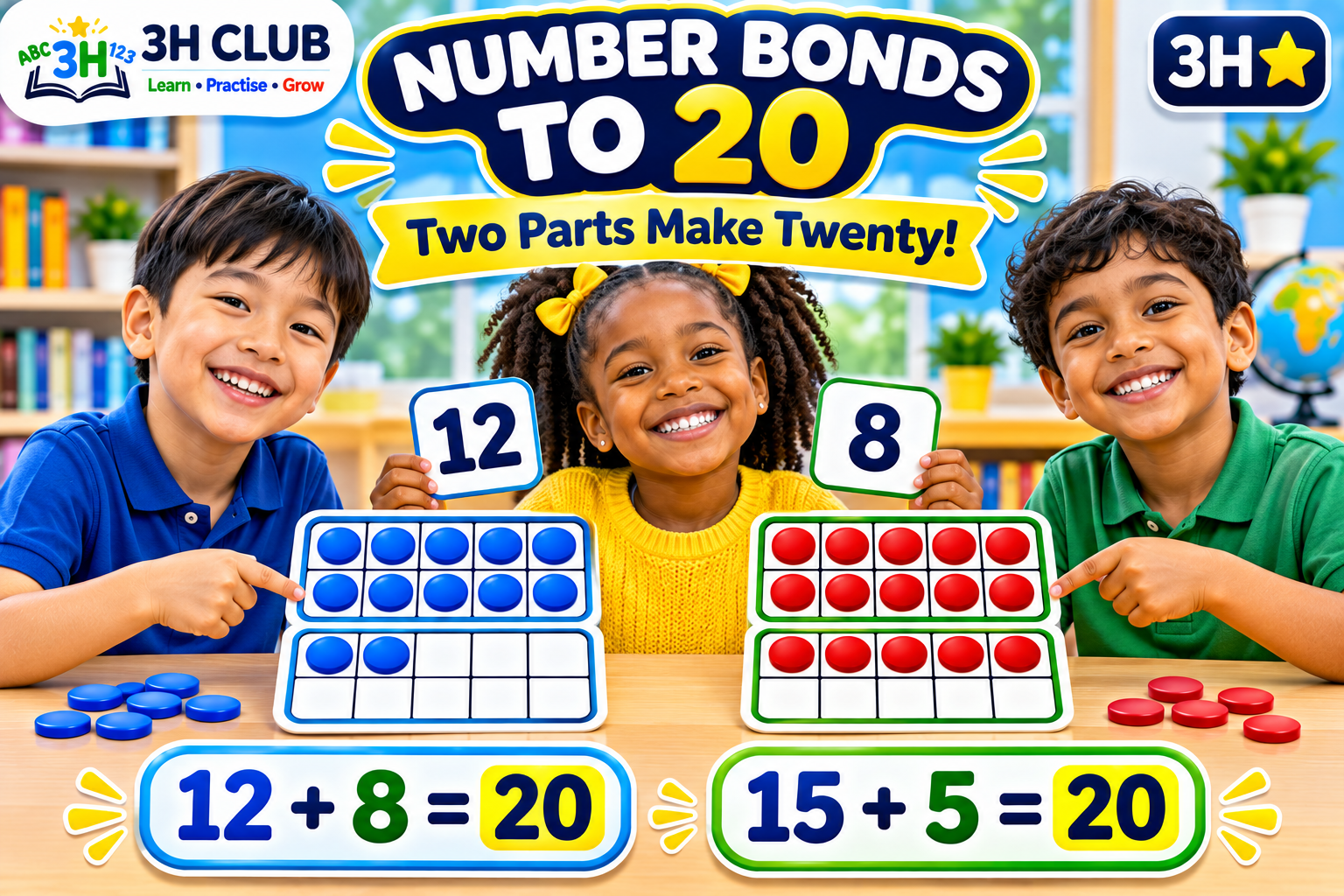
A number bond to 20 is a pair of whole numbers that add together to make 20.
For example:
12 + 8 = 20
The two parts are 12 and 8. The whole is 20.
Imagine you have 12 blue counters and 8 green counters.
When you put them together, you have 20 counters altogether!
Make 20 with Counters
Blue group
Green group
20 counters altogether!
20 blue
Every time you move a counter from one group
to the other, you make a new number bond to 20.
You can also turn the numbers around:
8 + 12 = 20
The total stays the same!
This is because changing the order of two numbers in addition does not change their sum.
Learn All the Number Bonds to 20
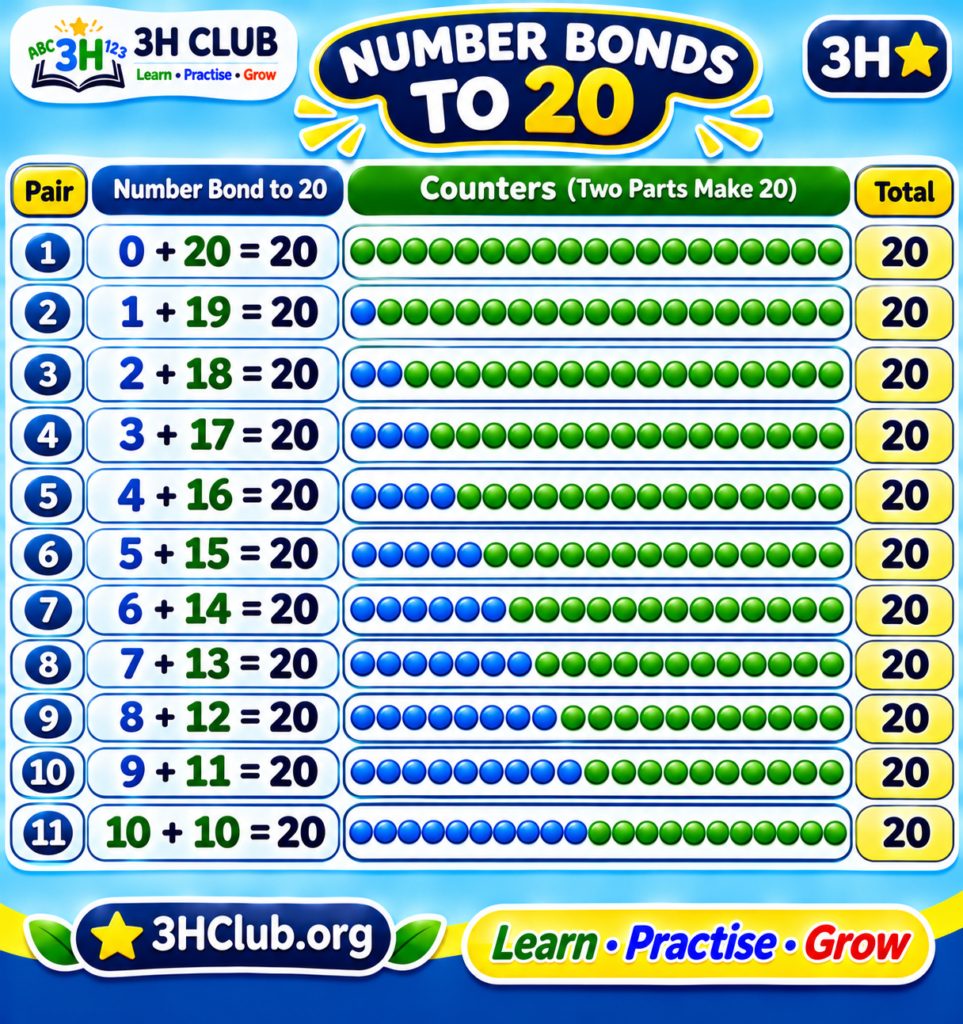
Let’s look at the pairs that make 20.
| First number | Second number | Number bond |
|---|---|---|
| 0 | 20 | 0 + 20 = 20 |
| 1 | 19 | 1 + 19 = 20 |
| 2 | 18 | 2 + 18 = 20 |
| 3 | 17 | 3 + 17 = 20 |
| 4 | 16 | 4 + 16 = 20 |
| 5 | 15 | 5 + 15 = 20 |
| 6 | 14 | 6 + 14 = 20 |
| 7 | 13 | 7 + 13 = 20 |
| 8 | 12 | 8 + 12 = 20 |
| 9 | 11 | 9 + 11 = 20 |
| 10 | 10 | 10 + 10 = 20 |
| 11 | 9 | 11 + 9 = 20 |
| 12 | 8 | 12 + 8 = 20 |
| 13 | 7 | 13 + 7 = 20 |
| 14 | 6 | 14 + 6 = 20 |
| 15 | 5 | 15 + 5 = 20 |
| 16 | 4 | 16 + 4 = 20 |
| 17 | 3 | 17 + 3 = 20 |
| 18 | 2 | 18 + 2 = 20 |
| 19 | 1 | 19 + 1 = 20 |
| 20 | 0 | 20 + 0 = 20 |
Look carefully!
The first number goes up by one while the second number goes down by one.
The total is always 20.
There are 11 different pairs if you count each pair only once, or 21 ordered combinations if you count reversed pairs separately.
⭐ Starters — Ages 6–7: Let’s Make 20!
1. Make 20 with Two Ten-Frames
You may have used a ten-frame to practise number bonds to 10.
Now you can use two ten-frames to make 20!
Each ten-frame has 10 spaces arranged in two rows of five.
Two ten-frames have 20 spaces altogether.
Let’s show:
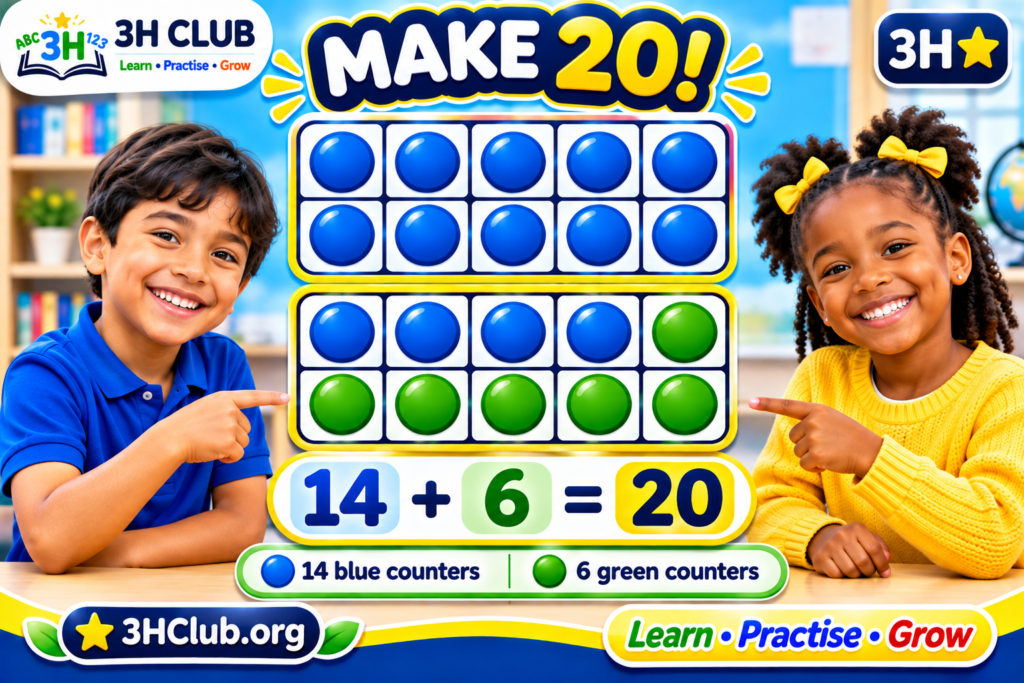
14 + 6 = 20
Two Ten-Frames: 14 + 6 = 20
First ten-frame
10 blue counters
Second ten-frame
4 blue counters and 6 green counters
14 + 6 = 20
There are 14 blue counters and 6 green counters.
Together, they fill all 20 spaces.
14 + 6 = 20
Now try imagining 16 blue counters. How many green counters would you need?
You need 4!
16 + 4 = 20
2. Count On to Make 20
Counting on means starting with a number and counting forwards until you reach another number.
Let’s try:
17 + ? = 20
Start at 17.
Count forwards:
18, 19, 20.
You counted three more numbers.
So:
17 + 3 = 20
Try another example:
15 + ? = 20
Count forwards:
16, 17, 18, 19, 20.
You counted five more numbers.
15 + 5 = 20
You can use a number line from 0 to 20 to help you.
3. Find the Missing Number
Sometimes one number in a number bond is missing.
For example:
13 + ? = 20
Ask yourself:
“How many more do I need to make 20?”
You can count on from 13 or use counters.
The missing number is 7.
13 + 7 = 20
Here’s another:
? + 8 = 20
The missing number is 12.
12 + 8 = 20
4. Use Number Bonds to Subtract
Number bonds help with subtraction, too!
If you know:
12 + 8 = 20
You also know:
20 − 12 = 8
20 − 8 = 12
These number sentences belong to the same fact family.
Let’s look at another example:
15 + 5 = 20
So:
20 − 15 = 5
20 − 5 = 15
Addition puts the parts together. Subtraction helps you find a missing part.
5. Make 20 with Everyday Objects
You can practise number bonds using things around you.
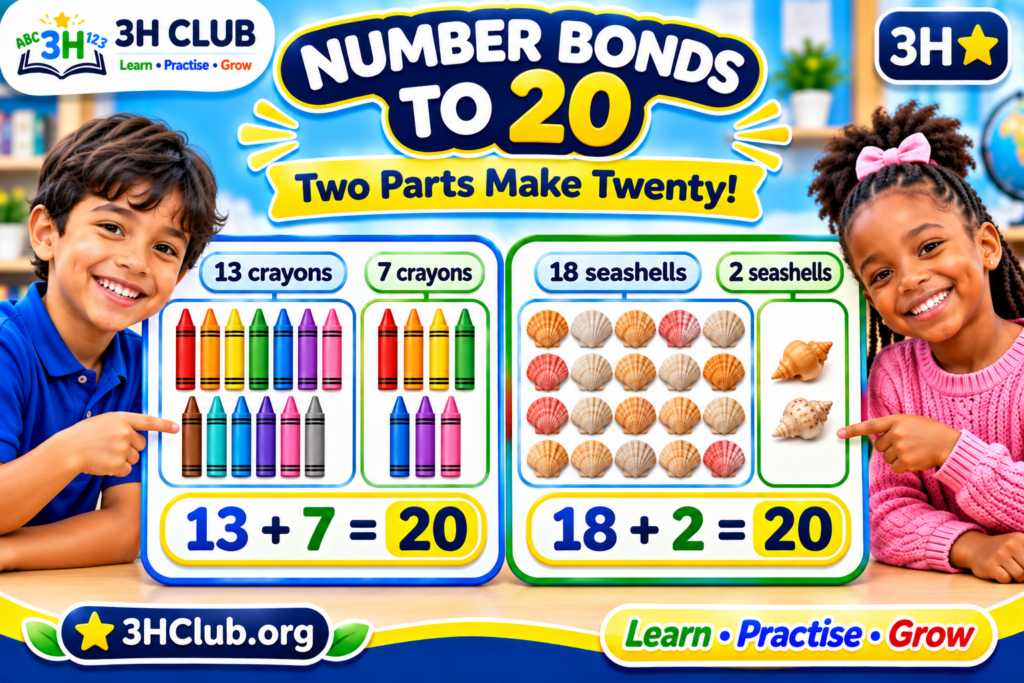
Imagine you have a box that can hold 20 crayons.
There are already 13 crayons inside.
How many more crayons can you add?
13 + 7 = 20
You can add 7 more crayons!
Now imagine you have 18 shells.
How many more shells do you need to make 20?
18 + 2 = 20
You need 2 more shells.
Fun Ways to Practise Number Bonds to 20
Activity 1: Number Bond Card Match
Make number cards from 0 to 20.
Place them on a table.
Choose one card and find another number that makes 20.
For example, if you choose 6, look for 14.
6 + 14 = 20
Try to find all 11 different pairs!
Activity 2: Build Two Groups
Collect 20 counters or small blocks.
Put some into one group and the rest into another.
Count each group and write a number sentence.
For example:
9 blue counters + 11 green counters = 20 counters.
9 + 11 = 20
Move one counter from one group to the other.
What new number bond can you make?
Activity 3: Make 20 with a Friend
Ask a friend to choose a number between 0 and 20.
Your job is to say the number that makes 20.
If your friend says 7, you say 13!
7 + 13 = 20
Take turns and see how many pairs you can remember.
⭐ Number Bonds to 20: 20 Practice Questions
Now it’s your turn!
There are 20 questions, starting with easy number pairs and moving on to missing numbers, subtraction and word problems.
You can write your answers on paper, use counters or count on using a number line.
My 20-Question Challenge
Part A — Complete the Number Bonds
1. 10 + ___ = 20
2. 15 + ___ = 20
3. 12 + ___ = 20
4. 18 + ___ = 20
5. 7 + ___ = 20
Part B — Find the Missing Number
6. ___ + 6 = 20
7. ___ + 9 = 20
8. ___ + 4 = 20
9. ___ + 17 = 20
10. ___ + 0 = 20
Part C — Subtract from 20
11. 20 − 5 = ___
12. 20 − 8 = ___
13. 20 − 13 = ___
14. 20 − 19 = ___
15. 20 − 10 = ___
Part D — Word Problems
16. You have 14 stickers. How many more do you need to have 20?
17. There are 8 birds in a tree. How many more birds would make 20?
18. A box holds 20 pencils. There are 16 pencils inside. How many spaces are empty?
19. You have 20 shells and give away 7. How many shells remain?
20. You have 11 blue counters. How many green counters do you need to make 20?
Check my 20 answers Try again
Practice Questions — Copyable WordPress Version
For your WordPress Visual Editor, here are the same 20 questions in ordinary text.
Part A — Complete the Number Bonds
-
10 + ___ = 20
-
15 + ___ = 20
-
12 + ___ = 20
-
18 + ___ = 20
-
7 + ___ = 20
Part B — Find the Missing Number
-
___ + 6 = 20
-
___ + 9 = 20
-
___ + 4 = 20
-
___ + 17 = 20
-
___ + 0 = 20
Part C — Subtract from 20
-
20 − 5 = ___
-
20 − 8 = ___
-
20 − 13 = ___
-
20 − 19 = ___
-
20 − 10 = ___
Part D — Word Problems
-
You have 14 stickers. How many more do you need to have 20?
-
There are 8 birds in a tree. How many more birds would make 20?
-
A box holds 20 pencils. There are 16 pencils inside. How many spaces are empty?
-
You have 20 shells and give away 7. How many shells remain?
-
You have 11 blue counters. How many green counters do you need to make 20?
Answer Key
Show answers
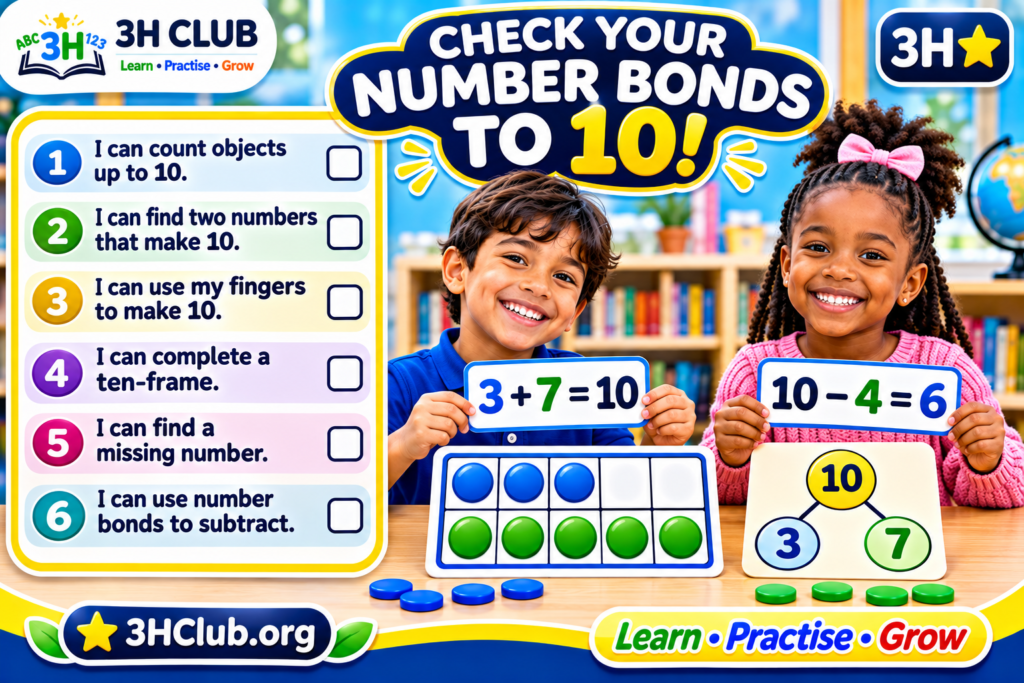
Check Your Number Bonds to 20!
Before you finish, see how many of these skills you can do.
My Number Bonds Checklist
0 of 6 skills checked
Why Are Number Bonds to 20 Important?
Number bonds to 20 help you add and subtract more confidently.
They also help you solve bigger problems by breaking numbers into smaller, easier parts.
For example:
16 + 7 = ?
You know that 16 needs 4 more to make 20.
Break 7 into 4 and 3.
16 + 4 = 20
20 + 3 = 23
So:
16 + 7 = 23
This is called making 20, and it is one way to help you add numbers mentally.
Frequently Asked Questions About Number Bonds to 20
What is a number bond to 20?
A number bond to 20 is a pair of numbers that add together to make 20. For example, 12 and 8 make 20.
How many number bonds to 20 are there?
There are 11 different whole-number pairs when reversed pairs are counted as the same pair, including 10 + 10 and 0 + 20. There are 21 ordered combinations when reversed pairs are counted separately.
How can I learn number bonds to 20 easily?
Start with the number bonds you already know to 10. Then practise using two ten-frames, counters and number cards. Try a few pairs each day.
Can number bonds to 20 help with subtraction?
Yes! If you know 14 + 6 = 20, you also know 20 − 14 = 6 and 20 − 6 = 14.
What is the difference between number bonds to 10 and number bonds to 20?
Number bonds to 10 use two numbers that add up to 10. Number bonds to 20 use two numbers that add up to 20. Both help you understand how numbers fit together.
Keep Learning with 3HClub.org!
Well done, Number Bond Star! 🌟
You have learned how to find number pairs that make 20, use two ten-frames, solve missing-number problems and connect addition with subtraction.
Remember:
Two parts join together to make one whole.
Keep practising your number bonds. Every question you solve helps your maths skills grow stronger.
Learn • Practise • Grow