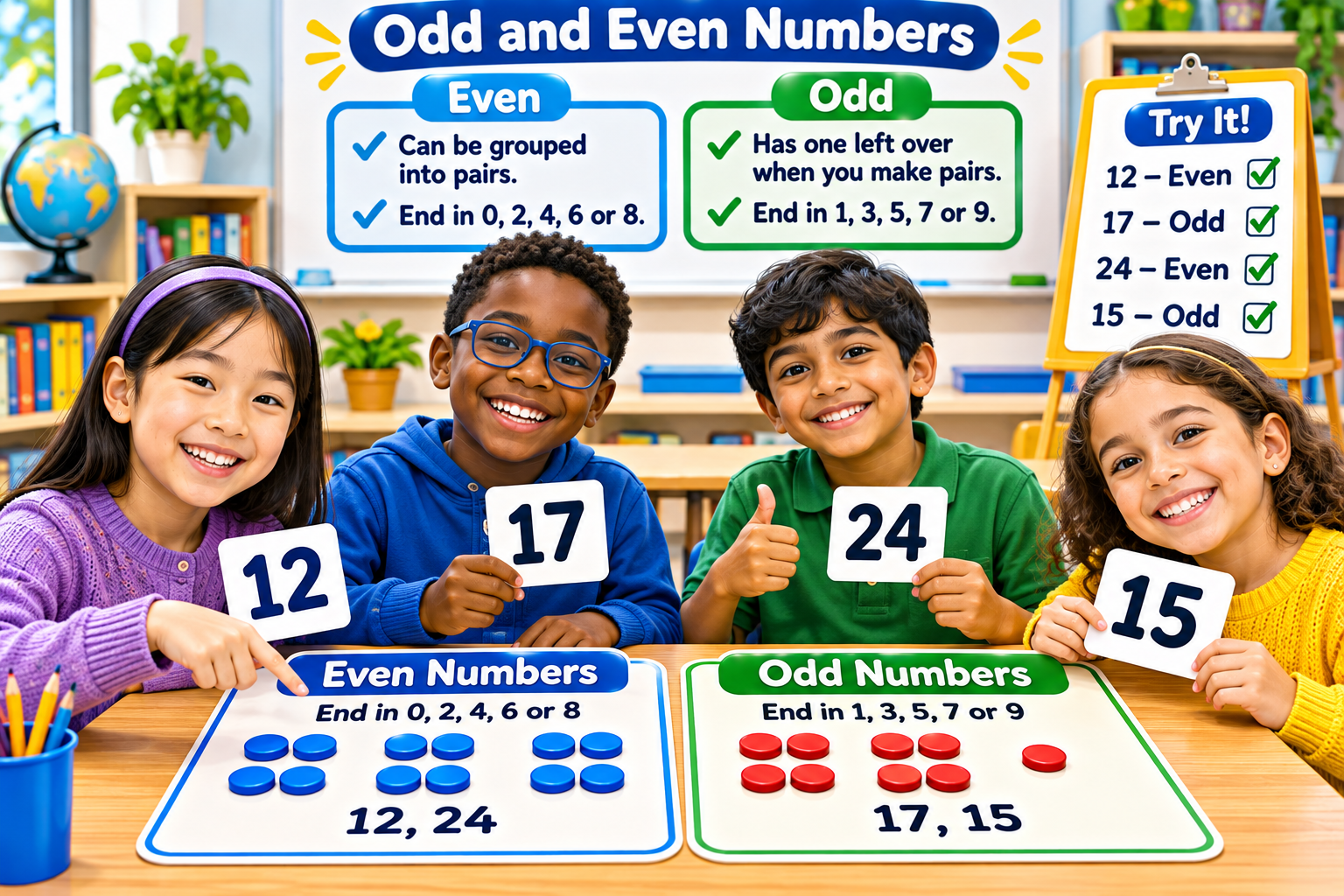
Odd and Even Numbers:
Easy Guide for Kids
⭐⭐ Builders — Ages 8–9 | Maths • Number Skills
Discover how to recognise odd and even numbers, make equal pairs, and use number patterns to solve maths problems!
Have you ever shared sweets equally with a friend? Or arranged your shoes into pairs?
You have already used an important maths idea: odd and even numbers!
Some numbers can be divided into two equal groups without anything left over. Other numbers leave one extra.
In this lesson, you will learn how to tell whether a number is odd or even, recognise patterns, and use clever tricks to check your answers.
By the end, you will be able to look at a number like 47 or 128 and quickly decide whether it is odd or even.
⭐⭐ Builders — Let’s Explore Odd and Even Numbers!
1. What Are Even Numbers?
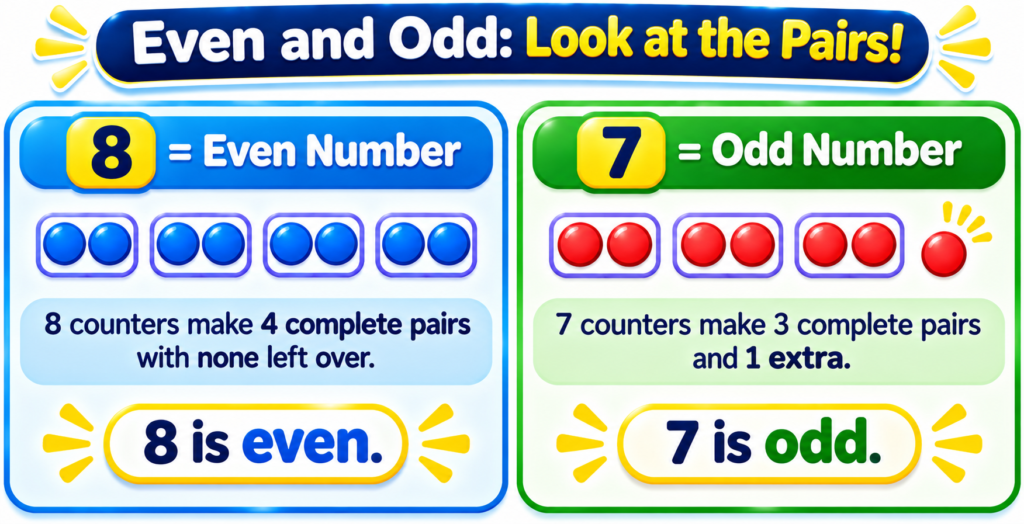
An even number can be divided into two equal groups with nothing left over.
Imagine you have 8 counters.
Arrange them into pairs:
🔵 🔵 🔵 🔵 🔵 🔵 🔵 🔵
You have four complete pairs.
You could also share them equally between two children:
Child A: 🔵 🔵 🔵 🔵
Child B: 🔵 🔵 🔵 🔵
Each child gets 4 counters.
8 ÷ 2 = 4
Nothing is left over, so 8 is an even number.
Other even numbers include:
0, 2, 4, 6, 8, 10, 12, 14, 16, 18, 20
Did you notice something? Each even number is two more than the even number before it.
2. What Are Odd Numbers?
An odd number cannot be divided into two equal groups of whole objects without something left over.
Imagine you have 7 counters.
Arrange them into pairs:
🟢 🟢 🟢 🟢 🟢 🟢 🟢
You have three complete pairs and one extra counter.
If you share seven counters between two children, you cannot give each child the same whole number of counters without one being left over.
7 ÷ 2 = 3 remainder 1
That means 7 is an odd number.
Other odd numbers include:
1, 3, 5, 7, 9, 11, 13, 15, 17, 19
3. The Easy Odd and Even Number Trick
You do not need to count every object to decide whether a number is odd or even.
There is a much faster trick!
Look at the last digit of the number.
EVEN
0, 2, 4, 6, 8
Numbers ending in these digits are even.
ODD
1, 3, 5, 7, 9
Numbers ending in these digits are odd.
Let’s try some examples.
Example 1: Is 24 odd or even?
The last digit of 24 is 4.
4 is an even digit.
So 24 is even.
Example 2: Is 57 odd or even?
The last digit of 57 is 7.
7 is an odd digit.
So 57 is odd.
Example 3: Is 130 odd or even?
The last digit is 0.
So 130 is even.
Remember: The last digit tells you whether any whole number is odd or even, no matter how large it is.
4. Odd and Even Numbers from 1 to 100
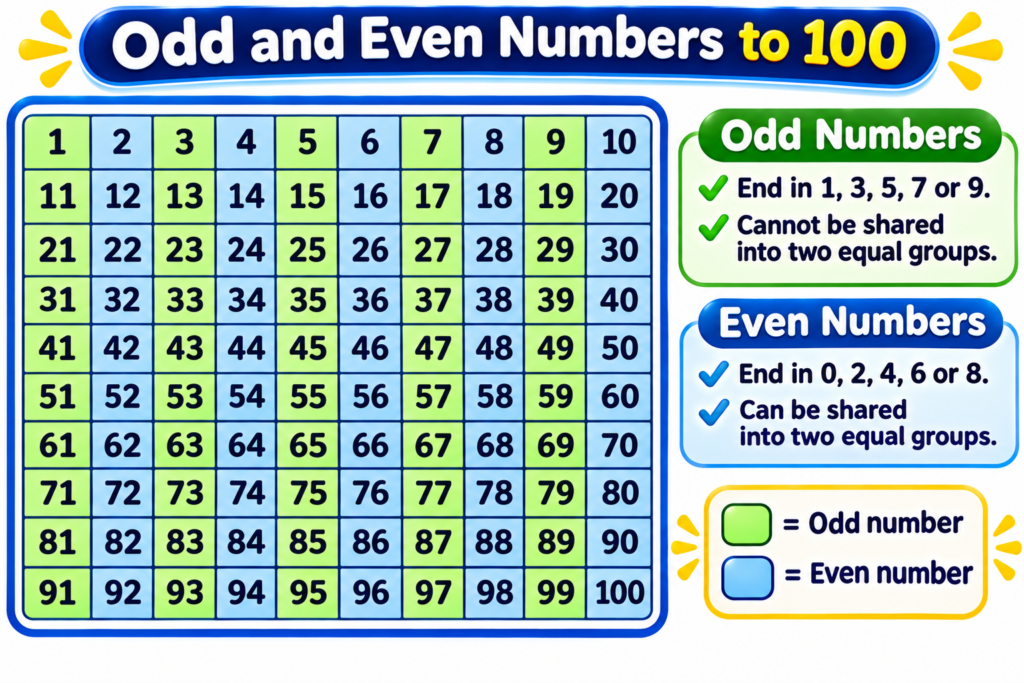
Look at this number chart.
Odd and Even Number Chart
Odd and Even Number Chart
Numbers from 1 to 100
Odd Numbers
Even Numbers
Odd Numbers
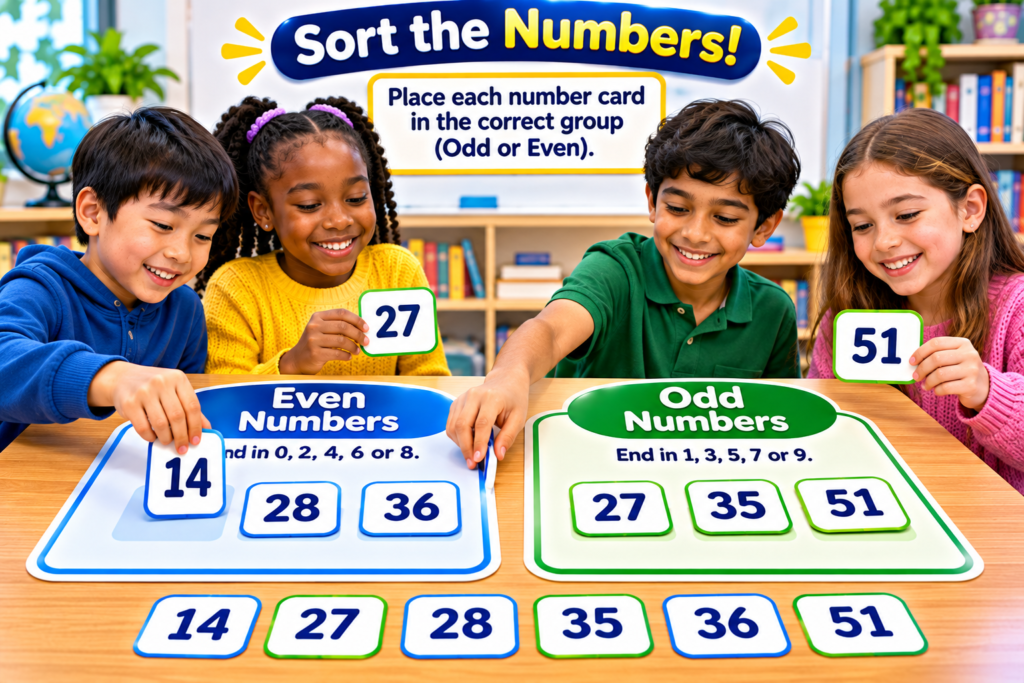
End in 1, 3, 5, 7 or 9.
Even Numbers
End in 0, 2, 4, 6 or 8.
Notice how the colours alternate.
Odd, even, odd, even, odd, even …
This pattern continues as far as you can count!
5. Is Zero Odd or Even?
This is a question that can surprise you!
Zero is an even number.
Why?
If you have zero counters and divide them into two groups, each group has zero counters.
0 ÷ 2 = 0
Nothing is left over.
Also, zero ends in 0, which is an even digit.
So remember:
0 is even, not odd.
6. Using Multiplication to Find Even Numbers
You can make even numbers by multiplying whole numbers by 2.
For example:
2 × 3 = 6
2 × 4 = 8
2 × 5 = 10
2 × 6 = 12
Every answer is even!
This happens because multiplying by 2 makes two equal groups.
Try it: What is 2 × 9?
2 × 9 = 18
18 is even.
7. Odd and Even Numbers in Addition
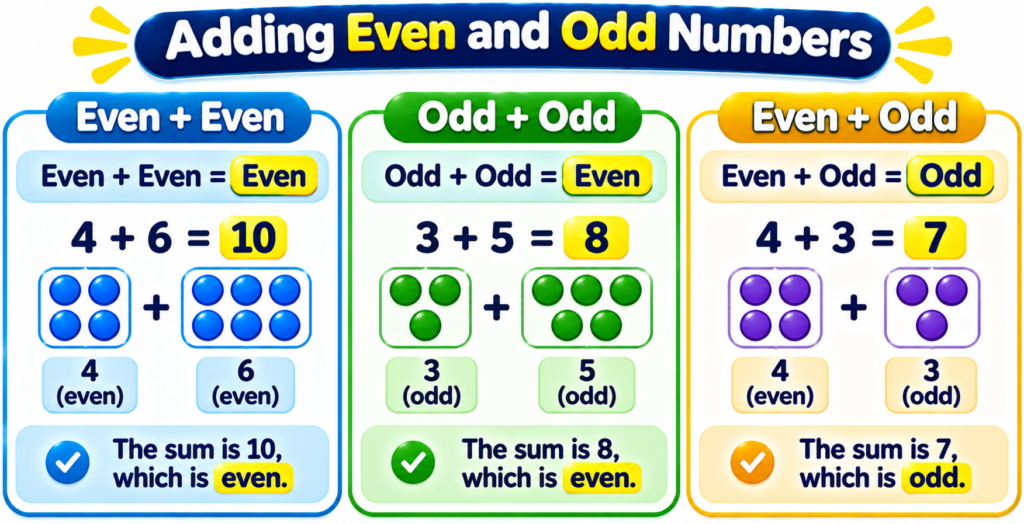
Odd and even numbers follow some interesting patterns when you add them.
| First number | Second number | Example | Answer type |
|---|---|---|---|
| Even | Even | 4 + 6 = 10 | Even |
| Odd | Odd | 3 + 5 = 8 | Even |
| Even | Odd | 4 + 3 = 7 | Odd |
| Odd | Even | 5 + 2 = 7 | Odd |
Here is an easy way to remember:
Even + Even = Even
Odd + Odd = Even
Even + Odd = Odd
Why does odd + odd make an even number?
Imagine 5 counters and 3 counters.
Each odd group has one counter without a partner. When you join the groups, those two extra counters can make another complete pair.
5 + 3 = 8
And 8 is even!
8. What About Subtraction?
The same types of patterns work when you subtract whole numbers, as long as the result is a whole number.
Even − Even = Even
12 − 4 = 8
Odd − Odd = Even
9 − 3 = 6
Even − Odd = Odd
10 − 3 = 7
Odd − Even = Odd
11 − 4 = 7
You can use these patterns to predict whether an answer will be odd or even before calculating it.
9. Odd and Even Numbers in Everyday Life
You can find odd and even numbers all around you!

Pairs of Shoes
Four pairs of shoes have eight shoes altogether. Eight is even because every shoe has a partner.

Sharing Apples
Seven apples cannot be shared equally between two children using whole apples without one being left over. Seven is odd.

Look at the numbers on sports jerseys. Is 12 even? Yes! Is 17 odd? Yes! Check the last digit to find out.
Odd or Even?
Look at the number. Is it odd or even?
Choose your answer!
What kind of number am I?
Odd Numbers
End in 1, 3, 5, 7 or 9.
Even Numbers
End in 0, 2, 4, 6 or 8.
11. Let’s Practise Odd and Even Numbers!
Part A — Write Odd or Even
-
12 = __________
-
19 = __________
-
34 = __________
-
51 = __________
-
80 = __________
-
97 = __________
Part B — Complete the Number Patterns
-
2, 4, 6, ___, ___, ___
-
1, 3, 5, ___, ___, ___
-
20, 22, 24, ___, ___
-
31, 33, 35, ___, ___
Part C — Think Carefully
-
Is 246 odd or even?
-
Is 503 odd or even?
-
Odd + Odd = __________
-
Even + Odd = __________
-
Is 0 odd or even?
Practice Answers
Show answers
Complete the questions before revealing the answers.
12. Odd and Even Numbers Mini Quiz
Ready to test what you have learned? Choose the correct answer for each question.
Test Your Number Skills!
1. Which number is even?
2. Which number is odd?
3. What happens when you make pairs with 9 counters?
4. Is zero odd or even?
5. What is odd + odd?
6. Which number comes next: 15, 17, 19, ___?
7. Is 1,248 odd or even?
8. What is even + odd?
13. Check Your Odd and Even Number Skills!
Can you tick all six boxes?
-
☐ I can explain what an even number is.
-
☐ I can explain what an odd number is.
-
☐ I can make pairs to check whether a number is odd or even.
-
☐ I know the five even ending digits and five odd ending digits.
-
☐ I can identify odd and even numbers greater than 100.
-
☐ I can use odd and even patterns in addition and subtraction.
Frequently Asked Questions About Odd and Even Numbers
What is an even number?
An even number can be divided into two equal groups of whole objects with nothing left over. Examples include 2, 8, 16 and 40.
What is an odd number?
An odd number leaves one object without a partner when its objects are arranged into pairs. Examples include 1, 7, 15 and 33.
How can I tell if a large number is odd or even?
Look at the last digit. Numbers ending in 0, 2, 4, 6 or 8 are even. Numbers ending in 1, 3, 5, 7 or 9 are odd.
Is 100 odd or even?
100 is even because it ends in 0.
Is zero an even number?
Yes. Zero is even because dividing it by 2 leaves no remainder.
Can two odd numbers make an even number?
Yes! For example:
7 + 9 = 16
Both 7 and 9 are odd, but their sum, 16, is even.
Do odd and even numbers alternate?
Yes. As you count consecutive whole numbers, the pattern alternates between odd and even.
⭐⭐ You Did It! Keep Exploring Numbers
You have learned how odd and even numbers work, how to recognise them quickly, and how to use them in maths.
Remember these important ideas:
Even numbers end in 0, 2, 4, 6 or 8.
Odd numbers end in 1, 3, 5, 7 or 9.
Even numbers make complete pairs. Odd numbers leave one extra.
Next time you see a house number, a page number or a sports jersey, challenge yourself to decide whether it is odd or even.
Keep noticing patterns, asking questions and enjoying maths!
Learn • Practise • Grow