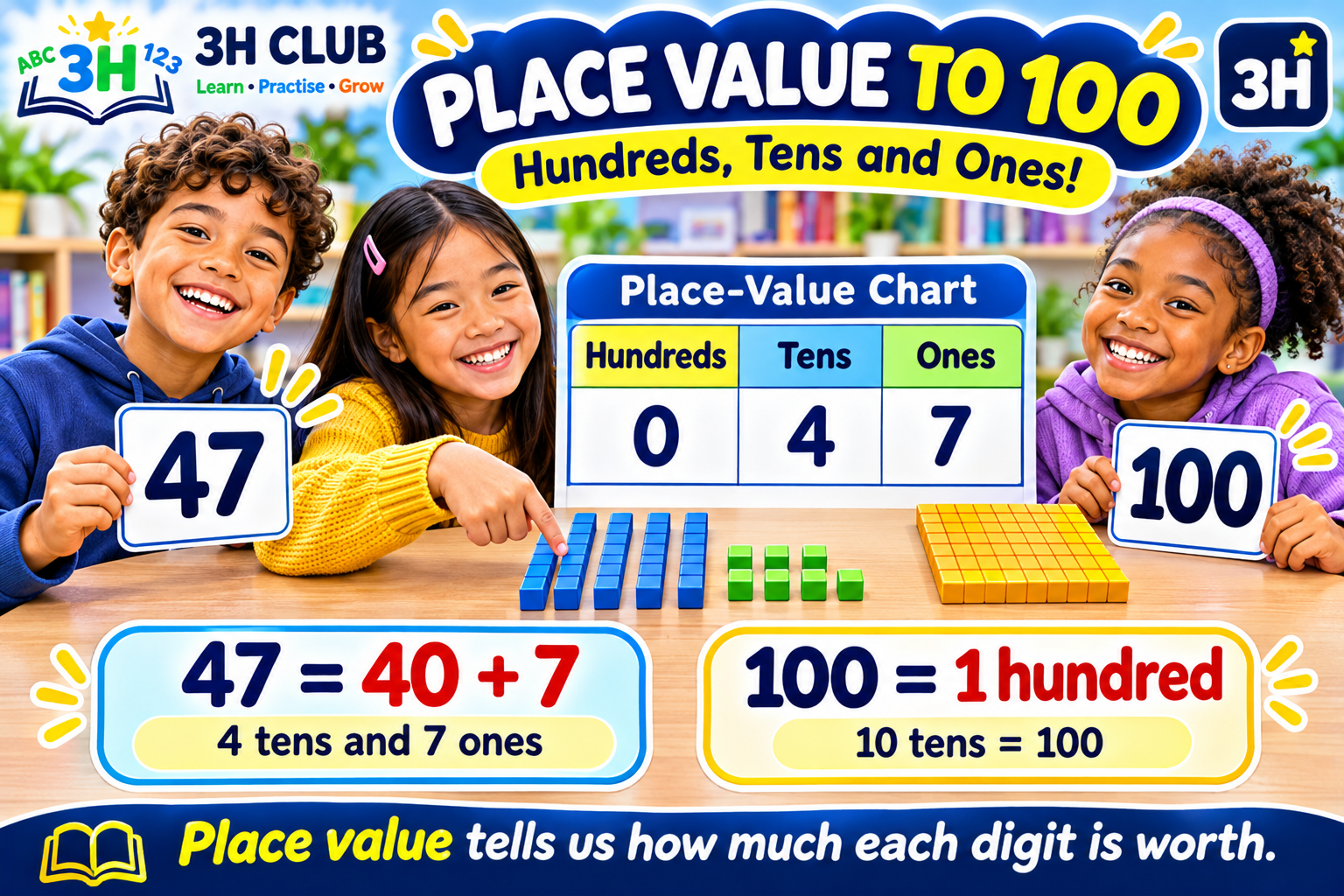
Place Value to 100 for Kids:
Learn Hundreds, Tens and Ones
⭐⭐ Builders — Ages 8–9 | Maths • Numbers and Place Value
Discover how numbers work, build numbers using hundreds, tens and ones, and become confident with place value up to 100!
Have you ever wondered why the number 42 is different from 24, even though both numbers use the same digits?
The answer is place value!
Every digit has a special position in a number. That position tells you how much the digit is worth.
In this lesson, you will discover how to read, build, compare and break apart numbers up to 100. You will also learn how to use place-value charts, number lines and expanded form to make sense of numbers.
Ready to become a place-value expert? Let’s begin!
⭐⭐ Builders — Let’s Explore Place Value!
1. What Is Place Value?
Place value tells us how much a digit is worth because of its position in a number.
Look at the number 36.
It has two digits: 3 and 6.
The digit 3 is in the tens place, so it represents 30.
The digit 6 is in the ones place, so it represents 6.
Place Value of 36
36 has 3 tens and 6 ones.
2. Understanding Ones, Tens and Hundreds
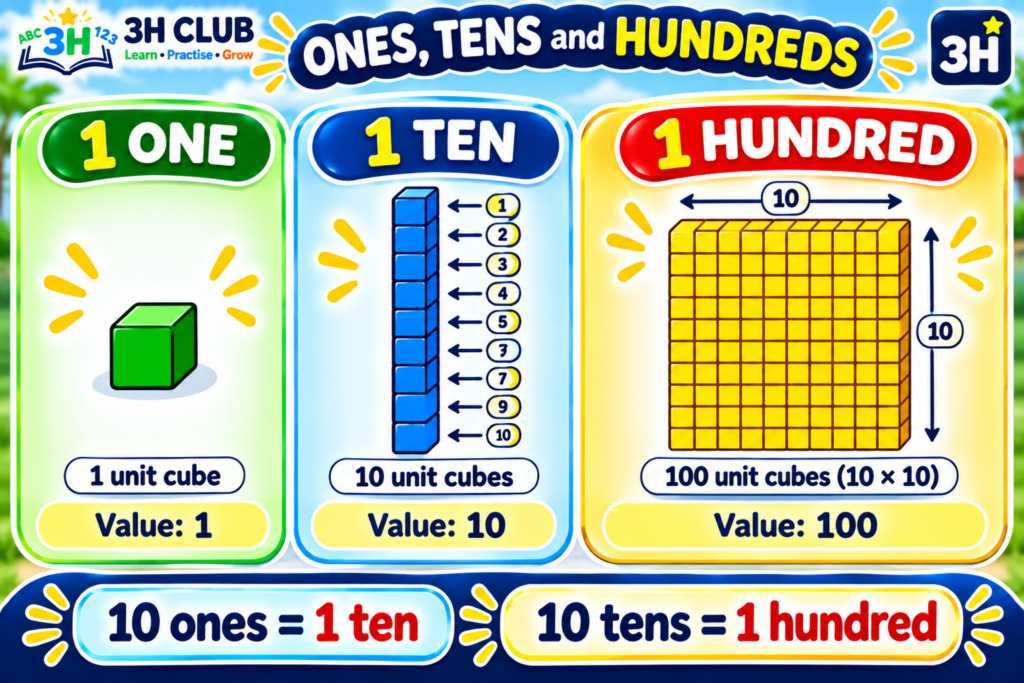
Our number system uses groups of ten.
-
1 one means one single object.
-
1 ten means a group of ten ones.
-
1 hundred means ten groups of ten.
Here is how they fit together:
From Ones to One Hundred
See how ones, tens and hundreds are connected!
Remember:
We can group ten smaller units to make
one larger place-value unit.
You can imagine one hundred as a large square made from 100 small cubes.
Important: 100 is the first three-digit number. It has 1 hundred, 0 tens and 0 ones.
3. How to Read a Place-Value Chart
A place-value chart helps you see where each digit belongs.
Let’s look at 74.
| Hundreds | Tens | Ones |
|---|---|---|
| 0 | 7 | 4 |
There are no hundreds, seven tens and four ones.
That means:
70 + 4 = 74
Now look at 100.
| Hundreds | Tens | Ones |
|---|---|---|
| 1 | 0 | 0 |
The digit 1 is in the hundreds place.
The zeros tell us there are no extra tens or ones.
Try it! What are the tens and ones in 58?
Answer: 5 tens and 8 ones.
4. Build Numbers with Base-Ten Blocks
Base-ten blocks are maths tools that help you see the value of numbers.
A ten-rod represents ten.
A unit cube represents one.
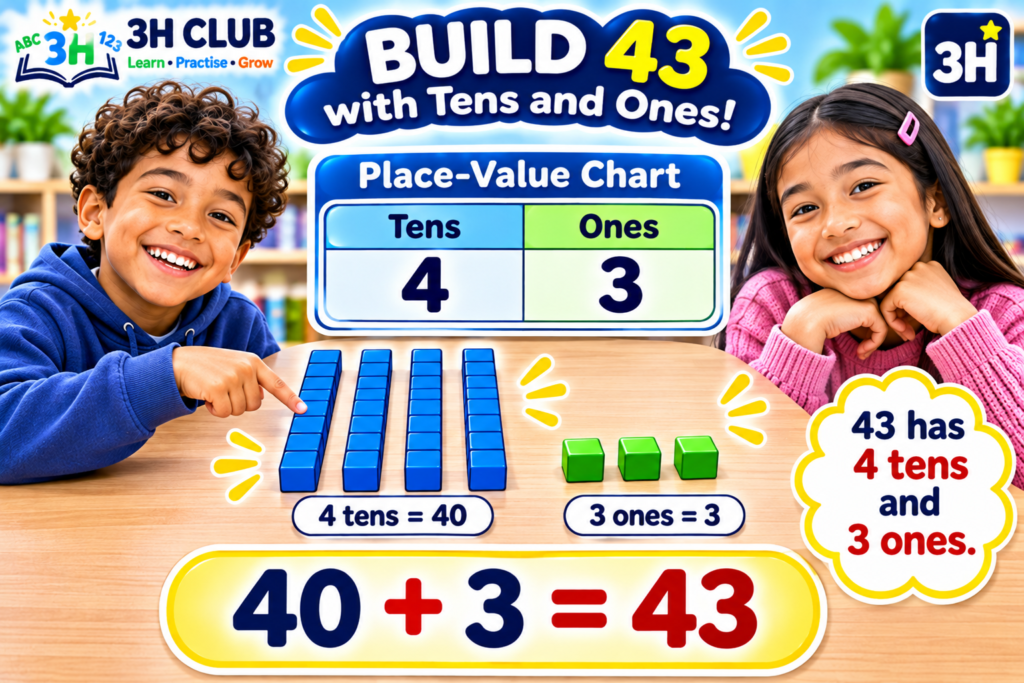
Let’s build 43.
We need:
-
4 ten-rods = 40
-
3 unit cubes = 3
40 + 3 = 43.
Build Your Own Number!
Change the number of tens and ones. Watch your number change!
Build Your Own Number!
Use the plus and minus buttons to change
the number of tens and ones.
Watch your number change!
4 tens and 3 ones
Try building:
26, 51, 74 and 90.
Can you build 26, 51 and 90?
For 90, you need nine tens and zero extra ones.
5. Writing Numbers in Expanded Form
Expanded form shows the value of each digit by breaking a number into parts.
For example:
68 = 60 + 8
The 6 represents six tens, or 60.
The 8 represents eight ones.
Here are some more examples:
| Number | Tens | Ones | Expanded form |
|---|---|---|---|
| 25 | 2 | 5 | 20 + 5 |
| 39 | 3 | 9 | 30 + 9 |
| 46 | 4 | 6 | 40 + 6 |
| 70 | 7 | 0 | 70 + 0 |
| 82 | 8 | 2 | 80 + 2 |
| 95 | 9 | 5 | 90 + 5 |
| 100 | 0 | 0 | 100 + 0 + 0 |
Your turn!
Write 57 in expanded form.
Think: 5 tens = 50, and 7 ones = 7.
57 = 50 + 7
6. The Same Digits Can Have Different Values
The Same Digits Can Have Different Values
Look at 24 and 42. They use the same digits,
but the digits are in different places!
42 is greater than 24
because 42 has more tens.
Remember:
A digit’s position tells you its value.
The same digits can make different numbers!
Both numbers use the digits 2 and 4.
But the digits are in different places, so their values are different.
24 has two tens. 42 has four tens.
That makes 42 greater than 24.
7. Compare Numbers Using Place Value
Place value helps you decide which number is greater or smaller.
Let’s compare 56 and 63.
First, look at the tens.
56 has 5 tens.
63 has 6 tens.
Six tens are greater than five tens, so:
56 < 63
Now compare 72 and 78.
Both numbers have seven tens, so look at the ones.
72 has 2 ones.
78 has 8 ones.
Since 2 is less than 8:
72 < 78
Remember these signs:
-
>means greater than. -
<means less than. -
=means equal to.
Tip: When comparing two-digit numbers, check the tens first. If the tens are equal, compare the ones.
8. Use a Number Line to Understand Place Value
A number line helps you see how numbers grow.
Number Line: 0 to 100
Each step between labelled marks is worth ten.
Starting at zero, each jump of ten takes you to the next multiple of ten.
0 → 10 → 20 → 30 → 40 → 50 → 60 → 70 → 80 → 90 → 100
Where would 65 go?
It would be halfway between 60 and 70.
Where would 92 go?
It would be just after 90.
9. What Happens When You Reach 100?
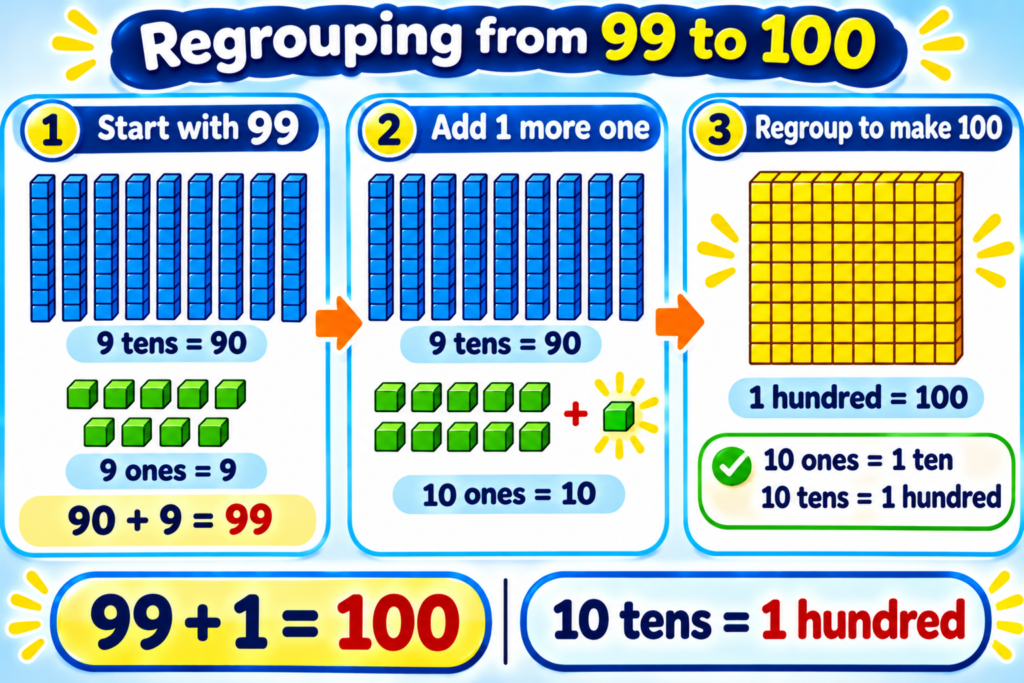
Imagine you have nine groups of ten and nine extra ones.
That makes 99.
Now add one more cube.
99 + 1 = 100.
The ten ones can be exchanged for one ten. Then the ten tens can be exchanged for one hundred.
From 99 to 100
99
9 tens
9 ones
100
1 hundred
0 tens, 0 ones
99 + 1 = 100
This is called regrouping. You exchange ten smaller units for one larger unit without changing the total value.
10. Fun Place Value Activities
You can practise place value using everyday objects.
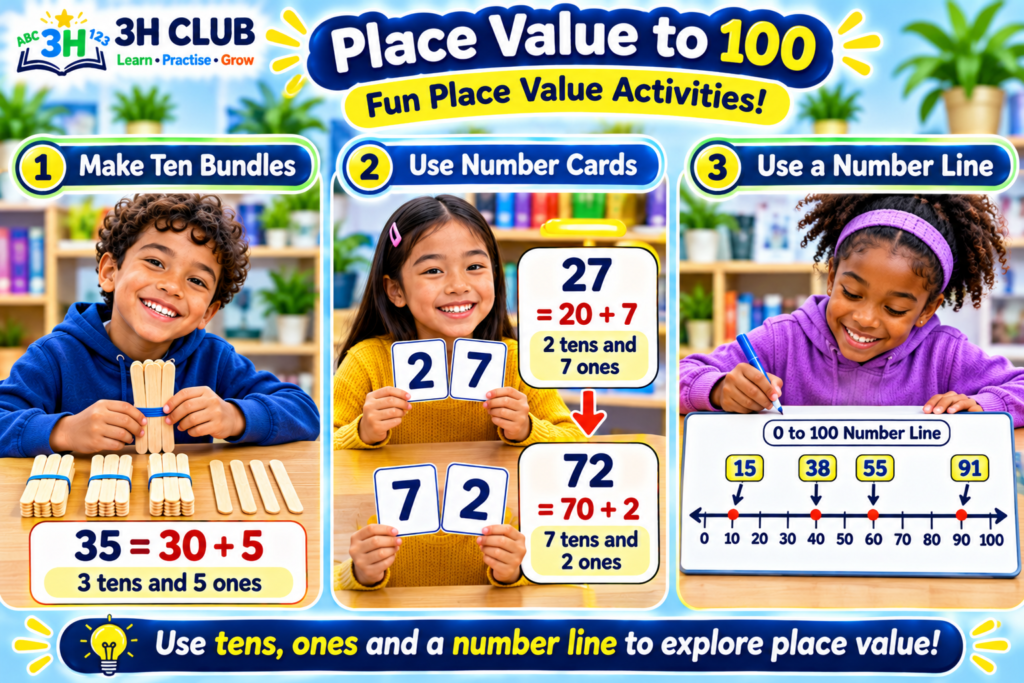
Activity 1 — Make Ten Bundles
Collect 35 craft sticks, pencils or straws. Put them into groups of ten.
You should have three complete bundles and five loose sticks.
That shows 35 = 30 + 5.
Activity 2 — Number Card Swap
Write the digits 2 and 7 on separate cards.
Make 27, then swap the cards to make 72.
What changed?
The digit 7 changed from seven ones to seven tens. Its value changed from 7 to 70.
Activity 3 — Mystery Number
Read these clues:
-
I have 6 tens.
-
I have 4 ones.
-
I am greater than 60 but less than 70.
What number am I?
Answer: 64!
Activity 4 — Find It on the Number Line
Draw a number line from 0 to 100, with marks at every ten.
Try placing 15, 38, 55 and 91 in approximately the correct positions.
11. Place Value Practice Questions
Now it’s your turn to show what you know!
Part A — Find the tens and ones
-
34 = ___ tens and ___ ones.
-
58 = ___ tens and ___ ones.
-
70 = ___ tens and ___ ones.
-
96 = ___ tens and ___ ones.
-
100 = ___ hundred, ___ tens and ___ ones.
Part B — Write the number
-
2 tens and 7 ones = ___.
-
4 tens and 5 ones = ___.
-
8 tens and 0 ones = ___.
-
9 tens and 3 ones = ___.
-
1 hundred, 0 tens and 0 ones = ___.
Part C — Expanded form
-
63 = ___ + ___.
-
48 = ___ + ___.
-
91 = ___ + ___.
-
20 = ___ + ___.
-
100 = ___ + ___ + ___.
Part D — Compare the numbers
Fill in >, < or =.
-
45 ___ 54
-
72 ___ 68
-
39 ___ 39
-
90 ___ 100
-
81 ___ 18
Check Your Practice Answers
Show answers
Try all 20 questions before revealing the answers.
12. Place Value to 100 Mini Quiz
Place Value Challenge!
0 of 8 answered
1. What is the value of the digit 5 in 58?
2. Which number has 7 tens and 2 ones?
3. What is 40 + 6?
4. Which number is greater?
5. How many tens make one hundred?
6. What is the expanded form of 84?
7. What happens when you add 1 to 99?
8. Which number has zero ones?
Reset
13. Check Your Place Value Skills!
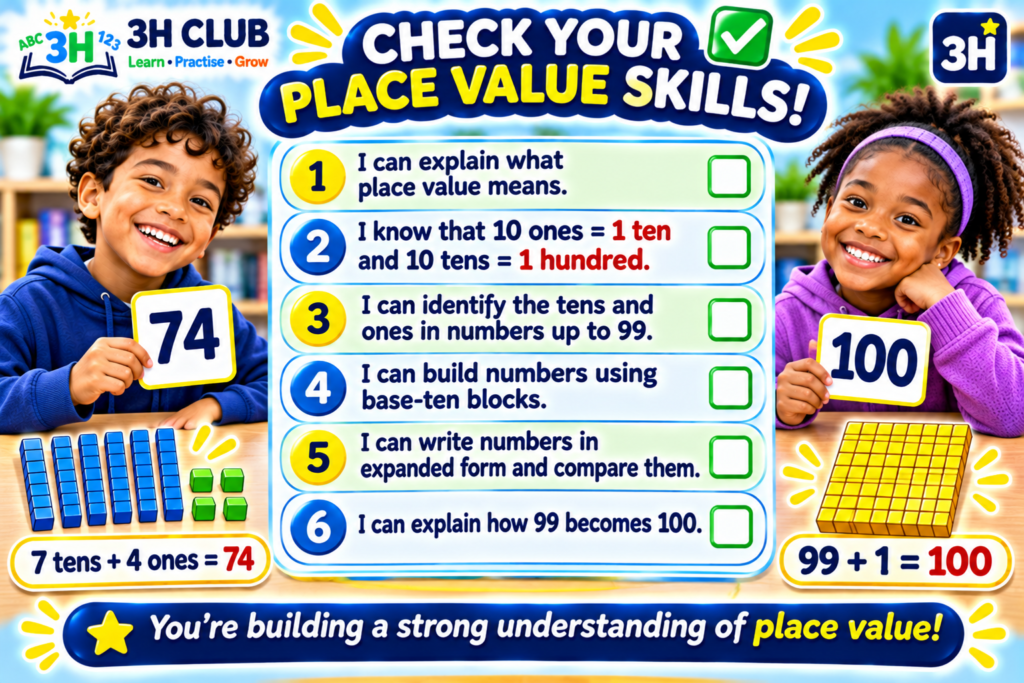
Use this checklist to see what you can do.
-
☐ 1. I can explain what place value means.
-
☐ 2. I know that 10 ones make 1 ten and 10 tens make 1 hundred.
-
☐ 3. I can identify the tens and ones in numbers up to 99.
-
☐ 4. I can build numbers using base-ten blocks.
-
☐ 5. I can write numbers in expanded form and compare them.
-
☐ 6. I can explain how 99 becomes 100.
Frequently Asked Questions About Place Value
What does place value mean?
Place value tells you how much a digit is worth because of where it appears in a number.
What are the tens and ones in 64?
64 has 6 tens and 4 ones. That means 60 + 4 = 64.
What is expanded form?
Expanded form breaks a number into the values of its digits. For example, 83 = 80 + 3.
Why is the zero important in 50?
The zero shows that there are no extra ones. The 5 represents five tens.
Is 100 a two-digit number?
No. 100 is the first three-digit number. It has one digit in the hundreds place and zeros in the tens and ones places.
How can place value help me compare numbers?
You can compare the digits in the tens place first. If they are the same, compare the digits in the ones place.
What is regrouping?
Regrouping means exchanging units for an equal value, such as ten ones for one ten or ten tens for one hundred.
⭐⭐ You Did It! Keep Growing
You have learned how numbers up to 100 are built from hundreds, tens and ones.
Remember:
10 ones = 1 ten
10 tens = 1 hundred
76 = 70 + 6
99 + 1 = 100
Place value helps you understand numbers, compare them and prepare for bigger maths challenges.
Keep exploring, practising and discovering new number patterns!
Learn • Practise • Grow
Keep Learning Maths at 3HClub.org
Suggested related article links for your sidebar:
-
Tens and Ones Made Easy — Review how tens and ones build two-digit numbers.
-
Counting for Kids — Strengthen counting and number recognition.
-
Number Bonds to 10 — Practise making ten with two numbers.
-
Number Bonds to 20 — Explore different pairs that add to twenty.
-
Odd and Even Numbers — Discover number patterns and identify odd and even numbers.