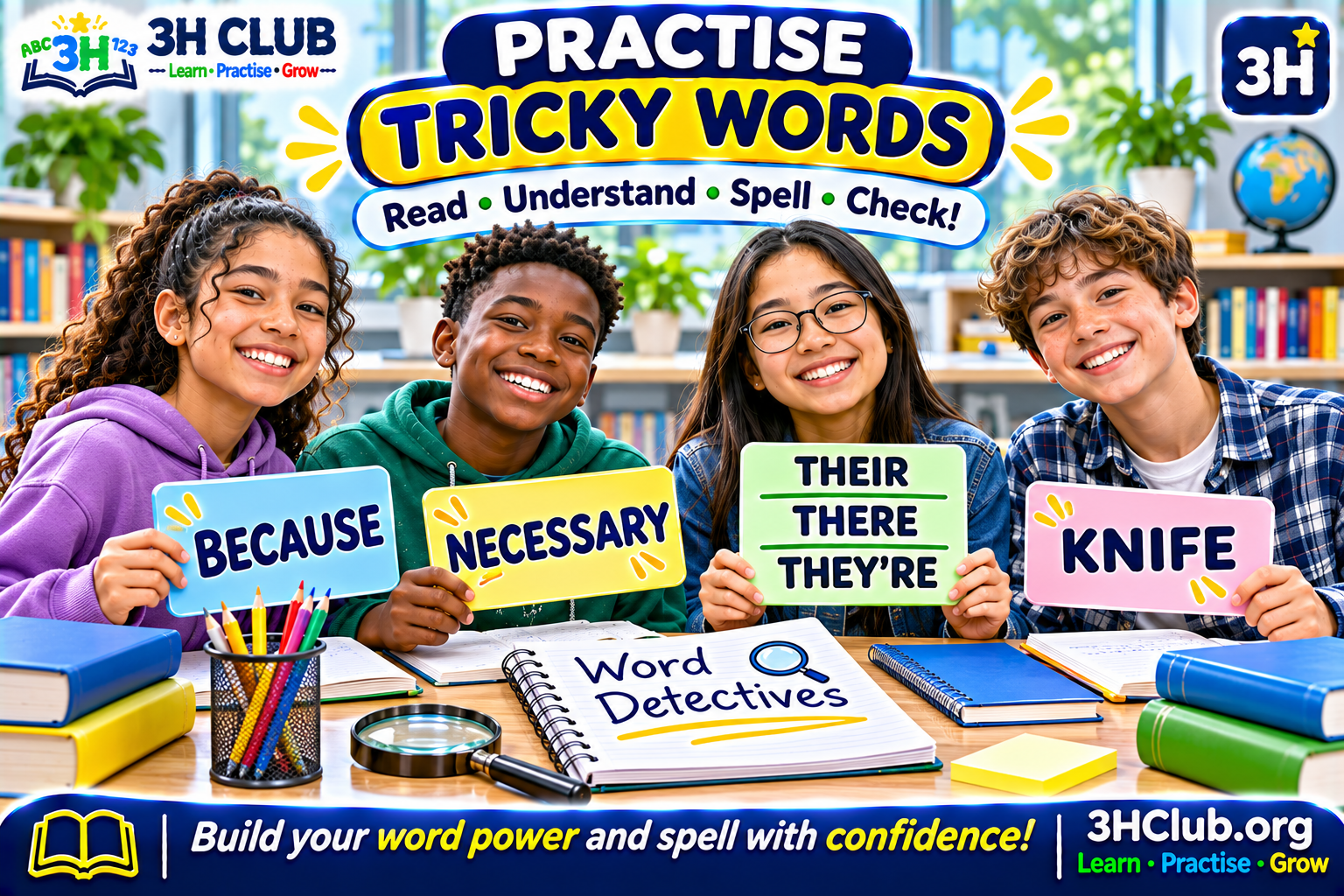
Practise Tricky Words:
🔍 Read, Spell and Use Confusing Words with Confidence!
⭐⭐⭐ CHAMPIONS | Ages 10–11
📚 Subject: English – Spelling, Vocabulary and Reading
🎯 Skills: Tricky spellings, irregular words, homophones, commonly confused words, memory strategies, proofreading and reading comprehension.
🌟 Welcome, Word Detective!
Have you ever stopped while writing because you weren’t sure which word to use?
Look at these sentences:
Their bags are on the table.
They’re getting ready for school.
There is a book on the desk.
The words their, they’re and there sound the same in many accents, but they have different spellings and meanings.
Now look at these words:
because
necessary
beautiful
Wednesday
Some have letters or spelling patterns that are easy to forget.
These are examples of words that can be tricky to read or spell.
The good news? You can learn strategies to understand, remember and use them accurately.
Today, you’ll become a word detective. You’ll investigate unusual spellings, explore confusing words, practise memory techniques and solve proofreading challenges.
Ready to sharpen your spelling skills?
Let’s begin!
🎯 What Will You Learn?
By the end of this lesson, you will be able to:
- Explain why some English words are tricky.
- Recognise regular and unexpected spelling patterns.
- Read and spell common tricky words.
- Identify and use homophones correctly.
- Distinguish commonly confused words.
- Use spelling strategies to remember difficult words.
- Understand how meaning and grammar affect word choice.
- Proofread sentences and paragraphs.
- Use tricky words accurately in your own writing.
⭐ Champion’s goal: Don’t simply memorise a word. Learn its sounds, spelling, meaning and use.
🔵 1. What Makes a Word Tricky?
A word may be tricky for different reasons.
Sometimes its spelling doesn’t match the sound you expect.
Sometimes it has a silent letter.
Sometimes it sounds like another word but has a different meaning.
And sometimes you need to know the sentence’s meaning before choosing the correct spelling.
🧩 Four Types of Tricky Words
| Type | Examples | Why They Can Be Tricky |
|---|---|---|
| Unexpected spelling | said, does, people | Some letters represent sounds you may not expect |
| Silent letters | knife, write, doubt | A letter is written but not pronounced |
| Homophones | their, there, they’re | Words sound alike but have different meanings |
| Common spelling challenges | necessary, separate, definitely | Letter order and spelling patterns can be difficult to remember |
💡 Important!
Not every tricky word is completely irregular.
For example, in said, the letters s and d represent their usual sounds, while ai represents an unexpected short E sound.
Look for the parts you already know before concentrating on the unusual part.
🧠 Quick Check
Why might each word be tricky?
- knife
- their
- necessary
Think about silent letters, similar-sounding words and difficult spelling patterns.
⭐ STAGE 1: WORD DETECTIVES
Recognise unusual spellings and discover useful patterns
🟢 2. Words with Unexpected Spellings
Some common words contain letters that don’t represent the sounds you might expect.
Let’s investigate.
| Tricky Word | What to Notice | Example Sentence |
|---|---|---|
| said | ai represents a short E sound | She said hello. |
| says | ay represents a short E sound | The sign says STOP. |
| does | oe represents a short U sound | Does this belong to you? |
| people | eo represents a long E sound | Many people visited the library. |
| friend | ie represents a short E sound | My friend likes reading. |
| enough | ough represents the vowel sound in cup followed by /f/ | We have enough pencils. |
| could | oul represents the vowel sound in book | I could solve the puzzle. |
| would | Same pattern as could | Would you like to join us? |
| should | Same pattern as could | You should check your answer. |
🔤 Look for Familiar Parts
Take the word friend.
The beginning fr and ending nd are familiar.
The letters ie are the unexpected part.
Instead of guessing the entire word, focus on remembering ie.
Now try:
said
You already know the beginning s and ending d.
The tricky part is ai.
✏️ Activity 1: Spot the Tricky Part
Write the unusual letter group in each word.
- said
- friend
- people
- does
- enough
- should
✏️ Activity 2: Choose the Correct Spelling
- I (sed / said) I would help.
- My (freind / friend) won the competition.
- We have (enuf / enough) time.
- She (does / duz) her homework carefully.
- The (people / peeple) waited patiently.
⭐ Reading Strategy
When a word looks unusual:
- Find the letters that follow familiar patterns.
- Notice the unexpected letters.
- Say the word accurately.
- Read it in a sentence.
- Practise writing the correct spelling.
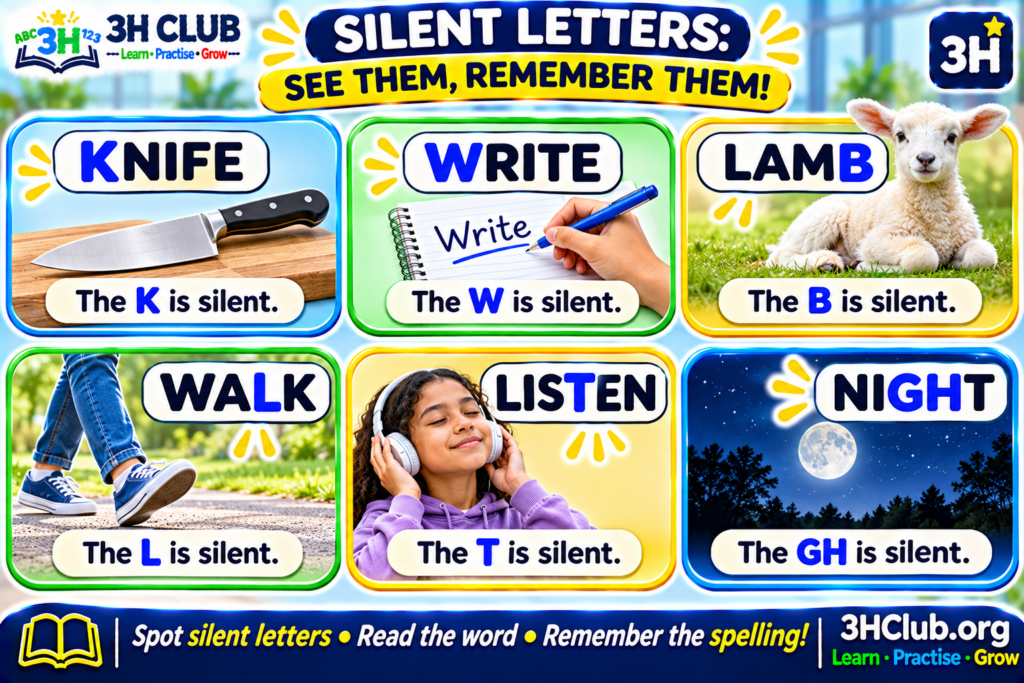
🟡 3. Silent Letters: Written but Not Heard
Some English words contain letters that are not pronounced.
These are called silent letters.
Look at:
knife
The k is silent.
Now try:
write
The w is silent.
🔤 Common Silent-Letter Patterns
| Silent Letter | Examples |
|---|---|
| k | knife, knee, know |
| w | write, wrist, wrong |
| b | lamb, thumb, climb |
| l | walk, talk, calm |
| t | listen, castle, whistle |
| gh | night, light, bright |
🧠 Why Keep Silent Letters?
English spelling has a long history. Some letters were pronounced in earlier forms of English, and spellings have often remained even as pronunciation changed.
Other spellings help show relationships between words.
For example, sign has a silent g, but you can hear the g in signal.
✏️ Activity 3: Find the Silent Letter
Identify the silent letter or letters.
- knife
- wrist
- lamb
- listen
- night
- walk
- climb
- wrong
✏️ Activity 4: Complete the Word
Add the missing silent letter.
- _nife
- _rite
- lam_
- ni__t
- _nee
🔵 4. Tricky Words with Useful Spelling Patterns
Some words become easier when you recognise a pattern.
The -OULD Family
could – would – should
These three words share the spelling -ould.
The -IGHT Family
light – night – bright – sight
These words share -ight.
The -OUGH Pattern
The letters ough can represent different sounds.
Compare:
though
through
thought
rough
These words don’t all rhyme.
That’s why it’s important to learn each word’s pronunciation as well as its spelling.
✏️ Activity 5: Sort the Words
Sort these words into their groups.
could – night – should – light – would – bright
| -ould | -ight |
|---|---|
| _____ | _____ |
| _____ | _____ |
| _____ | _____ |
⭐ Pattern Detective Challenge
Explain why through and rough are not rhyming words, even though both end with ough.
⭐⭐ STAGE 2: MEANING MASTERS
Understand confusing words and strengthen your spelling memory
🟣 5. Homophones: Same Sound, Different Meaning
Homophones are words that sound the same but have different meanings.
They may also have different spellings.
You need to understand the sentence before choosing the correct word.
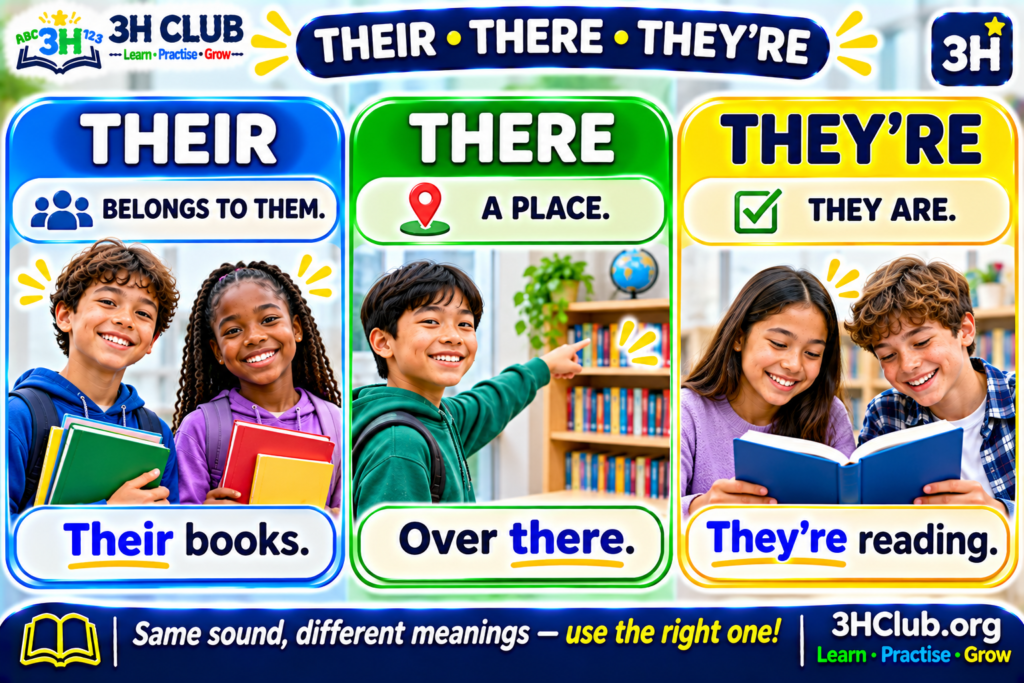
THEIR, THERE and THEY’RE
their — belongs to them
there — refers to a place or is used to introduce something
they’re — short for they are
Examples:
Their books are on the shelf.
The books are over there.
They’re reading quietly.
YOUR and YOU’RE
your — belongs to you
you’re — short for you are
Examples:
Is this your pencil?
You’re improving your spelling.
ITS and IT’S
its — belongs to it
it’s — short for it is or it has
Examples:
The dog wagged its tail.
It’s raining outside.
It’s been a busy day.
TO, TOO and TWO
to — used for direction or before a verb
too — also or more than needed
two — the number 2
Examples:
We walked to school.
I want to come too.
I have two notebooks.
✏️ Activity 6: Choose the Correct Homophone
- (Their / There / They’re) planning a class trip.
- Please put the books over (their / there / they’re).
- Is this (your / you’re) jacket?
- (Your / You’re) going to enjoy the story.
- The bird spread (its / it’s) wings.
- (Its / It’s) time for lunch.
- I have (to / too / two) pencils.
- This bag is (to / too / two) heavy.
🧠 Champion’s Trick
Try replacing a contraction with its full form.
They’re → They are
You’re → You are
It’s → It is or It has
If the full form fits the sentence, the contraction may be correct.
🟢 6. Commonly Confused Words
Not all confusing words are homophones.
Some look similar or have related meanings.
Let’s investigate.
| Word Pair | Difference |
|---|---|
| affect / effect | Affect is usually a verb meaning influence; effect is usually a noun meaning result |
| accept / except | Accept means receive or agree; except means excluding |
| lose / loose | Lose means misplace or fail to win; loose means not tight |
| quiet / quite | Quiet means making little noise; quite often means fairly or completely |
| than / then | Than is used in comparisons; then relates to time or sequence |
| principal / principle | Principal can mean a school leader; principle means a rule or belief |
✏️ Activity 7: Choose the Correct Word
- Heavy rain can (affect / effect) our plans.
- The new rule had a positive (affect / effect).
- I will (accept / except) your invitation.
- Everyone came (accept / except) Maya.
- Be careful not to (lose / loose) your keys.
- My shoelaces are (lose / loose).
- The library was very (quiet / quite).
- We finished our work and (than / then) went outside.
- This book is longer (than / then) that one.
- The school (principal / principle) spoke at assembly.
⭐ Meaning Matters
Don’t choose a word only because it sounds right.
Ask yourself:
What does the sentence mean?
The correct meaning will help you choose the correct spelling.
🟡 7. Remembering Difficult Spellings
Some words are difficult because they contain repeated letters, unusual letter combinations or unstressed syllables.
Try these examples:
necessary
separate
definitely
beautiful
Wednesday
business
environment
accommodation
🔍 Break Words into Parts
Try:
beau-ti-ful
en-vi-ron-ment
ac-com-mo-da-tion
Breaking a long word into syllables can make it easier to study.
But remember: the spelling of a syllable doesn’t always match exactly what you hear.
🧠 Useful Memory Clues
necessary: One c and two s letters.
accommodation: Two c letters and two m letters.
Wednesday: Remember the written d after We.
separate: Notice the a in the middle of sep-a-rate.
definitely: Remember the base word definite and the ending -ly.
✏️ Activity 8: Correct the Spelling
Rewrite each word correctly.
- neccessary
- seperate
- definately
- beautifull
- Wensday
- accomodation
- enviroment
- buisness
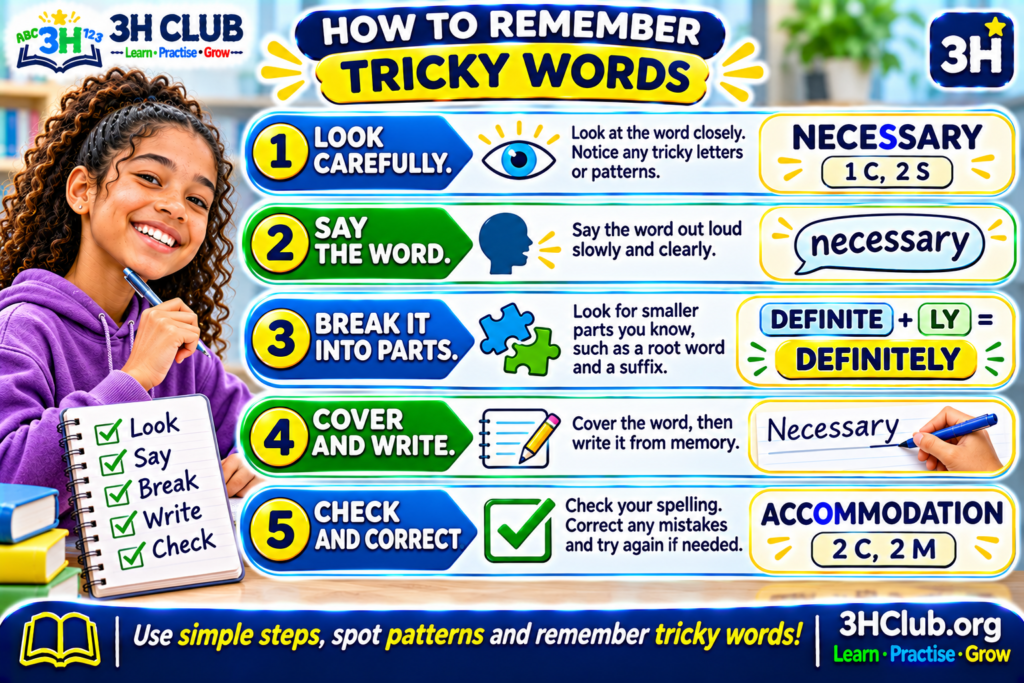
🔵 8. The Look, Say, Cover, Write, Check Method
Here’s a useful strategy for learning spellings.
Step 1: LOOK
Look carefully at the word.
Notice its letters and unusual spelling patterns.
Step 2: SAY
Say the word clearly.
Break it into syllables if that helps.
Step 3: COVER
Cover the word so you can’t see it.
Try to picture its spelling in your mind.
Step 4: WRITE
Write the word from memory.
Step 5: CHECK
Compare your spelling with the original.
If you made a mistake, identify the tricky part and practise again.
✏️ Activity 9: Your Personal Tricky Word List
Choose five words that you find difficult.
For each word:
- Write the correct spelling.
- Underline the tricky part.
- Divide it into helpful chunks.
- Write a sentence using it.
- Test yourself later without looking.
⭐ Spelling Tip
Practise the words you find difficult rather than spending all your time on words you already know.
Short, regular practice sessions can help you remember them.
⭐⭐⭐ STAGE 3: SPELLING CHAMPIONS
Apply tricky words in reading, writing and proofreading
📖 9. Reading Passage: The School Newspaper Mystery
The School Newspaper Mystery
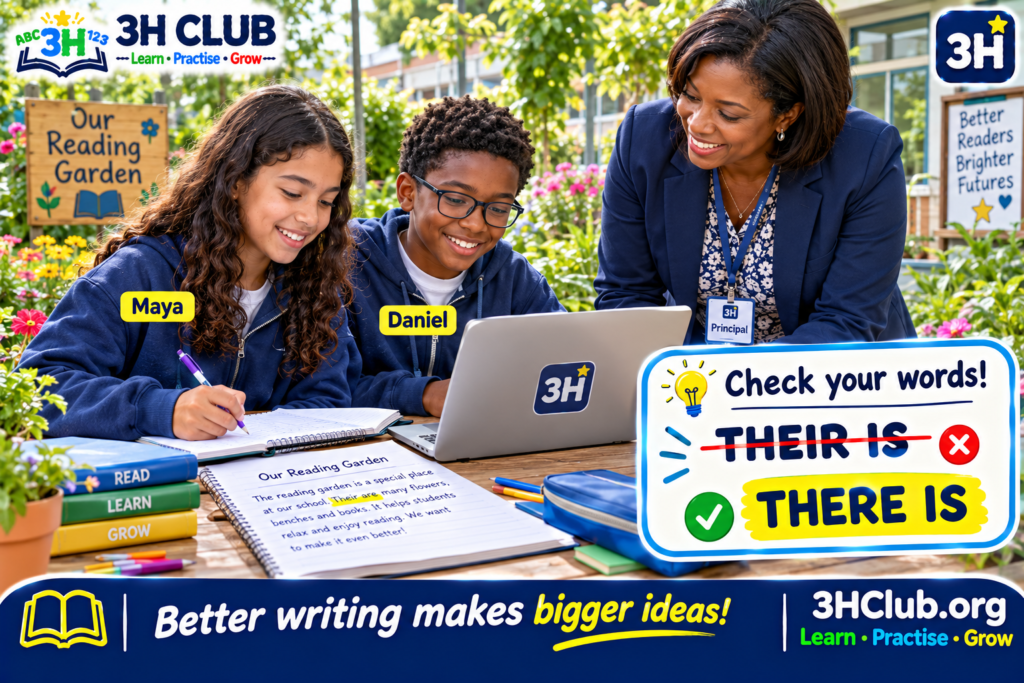
Maya and Daniel were preparing an article for their school newspaper.
Their assignment was to report on the new reading garden behind the library.
“We should check our facts before we publish anything,” Maya said.
Daniel agreed. “There are several details we still need to confirm.”
They visited the garden on Wednesday afternoon.
The garden was quiet, and the flowers were beginning to bloom.
Near the entrance, they noticed a sign that said:
PLEASE KEEP THE GARDEN TIDY.
Maya wrote down the message while Daniel took photographs.
Later, they spoke to the school principal.
She explained that the garden had been created to give students a peaceful place to read.
“It’s important that everyone looks after this space,” she said.
Back in the classroom, Daniel began writing the article.
He typed:
Their is a new reading garden at our school.
Maya noticed the mistake.
“Do you mean there?” she asked.
Daniel smiled. “You’re right! I used the wrong word.”
They checked the article carefully.
They corrected several spellings, confirmed the facts and improved the opening paragraph.
When the newspaper was published, the principal congratulated them.
“You’ve shown that careful editing makes writing clearer and more accurate,” she said.
Maya and Daniel were pleased.
They had learned that good writing needs more than interesting ideas. It also needs accurate words, clear meaning and careful proofreading.
🔍 Tricky Word Hunt
Find these words in the passage:
- their
- there
- they’re — not used in the story; write your own sentence
- Wednesday
- should
- said
- principal
- quiet
- you’re
- it’s
✏️ Comprehension Questions
- What were Maya and Daniel preparing?
- What was their article about?
- Why did they visit the garden?
- What did the sign ask students to do?
- Who explained the purpose of the garden?
- What mistake did Daniel make?
- How did Maya help?
- What did the students learn about good writing?
🧠 Think More Deeply
9. Why is it important to check the meaning of a word when proofreading?
10. What could happen if a newspaper article contains confusing or incorrectly spelled words?
✍️ Writing Challenge
Write a paragraph of 80–120 words describing a place at your school or in your community.
Include at least:
- Three tricky spelling words.
- Two homophones used correctly.
- One word containing a silent letter.
- One sentence explaining why the place is important.
Underline the tricky words you use.
✍️ 10. Proofreading: Find and Fix the Mistakes
Every writer makes mistakes sometimes.
The important skill is learning to notice and correct them.
✏️ Activity 10: Correct the Sentences
Each sentence contains one incorrect word.
- Their going to the library.
- The dog wagged it’s tail.
- I definately remembered my homework.
- Please except my apology.
- We visited the museum on Wensday.
- I don’t want to loose my notebook.
- The class was very quite during the test.
- Your going to enjoy the book.
- The teacher sed the answer was correct.
- The school principle welcomed the visitors.
Rewrite each sentence correctly.
⭐ Proofreading Strategy
Read your work twice.
First reading: Check whether your ideas make sense.
Second reading: Check spelling, homophones, punctuation and grammar.
Reading aloud may help you notice missing words, but remember that homophones can sound exactly the same. You must also check meaning.
🎲 11. Fun Tricky Word Games
🎯 Game 1: Homophone Match
Write these words on separate cards:
their, there, they’re, your, you’re, its, it’s
Make another set of cards with meanings.
Match each word to its meaning.
🧩 Game 2: Word Detective Challenge
Choose a tricky word.
Investigate:
- Its meaning.
- Its spelling.
- Any unusual letter patterns.
- Whether it has related words.
- A sentence using it correctly.
📝 Game 3: Spelling Challenge
Ask someone to read these words aloud:
necessary, separate, definitely, Wednesday, accommodation
Write each word without looking.
Then check your answers.
🔍 Game 4: Find the Mistake
Write three sentences.
Make one deliberate spelling mistake in each.
Swap sentences with a partner.
Can your partner find and correct every mistake?
🏆 Game 5: Context Clue Challenge
Choose the correct word.
1. The children left (their / there) bags by the door.
2. I would like to come (too / two).
3. Please speak (quiet / quite) softly.
4. The weather may (affect / effect) our trip.
5. (You’re / Your) doing a great job!
🏆 12. Final Spelling Champions Challenge
Ready to test your skills?
Part A: Correct the Spelling
Rewrite these words correctly.
- freind
- neccessary
- seperate
- definately
- Wensday
- accomodation
Part B: Choose the Correct Homophone
- (Their / There / They’re) working on a group project.
- The bird spread (its / it’s) wings.
- (Your / You’re) welcome to join us.
- I have (to / too / two) notebooks.
- The books are over (their / there / they’re).
Part C: Find the Silent Letter
- knife
- write
- lamb
- listen
- night
Part D: Choose the Correct Word
- The weather may (affect / effect) our plans.
- The result had a positive (affect / effect).
- Please (accept / except) my invitation.
- Everyone arrived (accept / except) Leo.
- Be careful not to (lose / loose) your keys.
Part E: Explain the Difference
Explain the difference between:
- their / there / they’re
- your / you’re
- its / it’s
- quiet / quite
- principal / principle
Part F: Write Your Own Sentences
Write one sentence using each word:
- necessary
- definitely
- beautiful
- because
- friend
Check your spelling carefully.
⭐ Final Writing Mission
Write 100–150 words about an event at school or in your community.
Include:
- Four tricky spelling words.
- Three correctly used homophones.
- Two words containing silent letters.
- One example of a commonly confused word pair.
Proofread your paragraph before sharing it.
✅ 13. Check Your Answers!
Section 1: Quick Check
- knife — silent k.
- their — sounds like there and they’re but has a different meaning.
- necessary — easy to confuse the number of c and s letters.
Activity 1: Tricky Letter Groups
- said — ai
- friend — ie
- people — eo
- does — oe
- enough — ough
- should — ould
Activity 2: Correct Spelling
- said
- friend
- enough
- does
- people
Activity 3: Silent Letters
- knife — k
- wrist — w
- lamb — b
- listen — t
- night — gh
- walk — l
- climb — b
- wrong — w
Activity 4: Complete the Word
- knife
- write
- lamb
- night
- knee
Activity 5: Word Sort
| -ould | -ight |
|---|---|
| could | night |
| should | light |
| would | bright |
Pattern Detective Challenge: The letters ough can represent different sounds. Through and rough have different vowel sounds and do not rhyme.
Activity 6: Homophones
- They’re
- there
- your
- You’re
- its
- It’s
- two
- too
Activity 7: Confusing Words
- affect
- effect
- accept
- except
- lose
- loose
- quiet
- then
- than
- principal
Activity 8: Correct Spellings
- necessary
- separate
- definitely
- beautiful
- Wednesday
- accommodation
- environment
- business
Activity 9: Personal Tricky Word List
Answers will vary.
Check that each word is spelled correctly and used in a suitable sentence.
Reading Passage: Comprehension
- A school newspaper article.
- The new reading garden.
- To collect information and photographs.
- Keep the garden tidy.
- The school principal.
- He wrote their instead of there.
- She noticed the mistake and helped him correct it.
- Good writing needs accurate spelling, clear meaning and careful proofreading.
- Because similar-sounding words may have different meanings.
- Readers may become confused or misunderstand the information.
Activity 10: Corrected Sentences
- They’re going to the library.
- The dog wagged its tail.
- I definitely remembered my homework.
- Please accept my apology.
- We visited the museum on Wednesday.
- I don’t want to lose my notebook.
- The class was very quiet during the test.
- You’re going to enjoy the book.
- The teacher said the answer was correct.
- The school principal welcomed the visitors.
Game 5: Context Clues
- their
- too
- quite
- affect
- You’re
Final Challenge: Part A
- friend
- necessary
- separate
- definitely
- Wednesday
- accommodation
Final Challenge: Part B
- They’re
- its
- You’re
- two
- there
Final Challenge: Part C
- k
- w
- b
- t
- gh
Final Challenge: Part D
- affect
- effect
- accept
- except
- lose
Final Challenge: Part E
- their = belongs to them; there = place or introduction; they’re = they are.
- your = belongs to you; you’re = you are.
- its = belongs to it; it’s = it is or it has.
- quiet = making little noise; quite = fairly or completely.
- principal = school leader; principle = rule or belief.
Final Challenge: Part F
Possible sentences:
- It is necessary to check your spelling.
- I will definitely finish the story.
- We visited a beautiful garden.
- I stayed inside because it was raining.
- My friend helped me study.
Final Writing Mission
Answers will vary.
Check the spelling, meaning and grammar of each tricky word.
🎉 Excellent work, Spelling Champion!
You’ve practised reading unusual spellings, recognising silent letters, choosing confusing words and proofreading your writing.
Remember: confident writers don’t need to get every word right on the first try. They know how to investigate, practise and correct their work.
🌈 14. What Have You Learned?
🔤 Tricky Spellings
Some words contain unexpected letter-sound patterns.
Examples:
said – friend – people – enough
🤫 Silent Letters
Some letters are written but not pronounced.
Examples:
knife – write – lamb – night
📚 Homophones
Homophones sound the same but may have different spellings and meanings.
Examples:
their – there – they’re
🧠 Meaning and Context
The meaning of a sentence helps you choose the correct word.
✍️ Spelling Strategies
Use:
LOOK → SAY → COVER → WRITE → CHECK
🔍 Proofreading
Check your writing for spelling, meaning, punctuation and grammar.
⭐ The Champion’s Tricky Word Method
NOTICE THE PATTERN → UNDERSTAND THE MEANING → PRACTISE THE SPELLING → USE THE WORD → CHECK YOUR WORK
🌟 Keep Learning with 3HClub!
You’ve discovered that tricky words become easier when you understand how they work.
The next time you meet an unfamiliar or confusing word, investigate it.
Look at its spelling.
Think about its meaning.
Check the sentence.
And practise until you can use it confidently.
📚 Your Next Learning Adventures
- Discover Common Spelling Patterns
- Prefixes and Suffixes
- Homophones and Commonly Confused Words
- Synonyms and Antonyms
- Proofreading and Editing
- Reading Comprehension
- Writing Clear Sentences
⭐ Your Spelling Champion Promise
I can recognise tricky spelling patterns.
I can identify silent letters.
I can choose the correct homophone.
I can remember difficult spellings.
I can proofread and improve my writing.
🎉 Keep investigating, keep practising and keep growing!
3H CLUB — Learn • Practise • Grow