Prefixes and Suffixes:
🔤 Unlock the Meaning of Words!
⭐⭐⭐ CHAMPIONS | Ages 10–11
📚 Subject: English – Vocabulary, Spelling and Grammar
🎯 Skills: Prefixes, suffixes, base words, word meaning, word formation, spelling rules, word classes and reading comprehension.
🌟 Welcome, Word Detective!
Have you ever wondered how one word can turn into several different words?
Look at this word:
help
Now look what happens when we add letters:
help → helpful
help → helpless
help → unhelpful
help → helper
All these words are connected, but they don’t mean exactly the same thing.
The secret is in the word parts we add.
Some go at the beginning of a word.
Others go at the end.
These word parts are called prefixes and suffixes.
Learning them can help you understand unfamiliar words, improve your spelling and choose more precise vocabulary when you write.
Ready to unlock the meaning of words?
Let’s investigate!
🎯 What Will You Learn?
By the end of this lesson, you will be able to:
- Explain the difference between a prefix, a suffix and a base word.
- Recognise common prefixes and their meanings.
- Recognise common suffixes and their functions.
- Build new words by adding prefixes and suffixes.
- Understand how suffixes can change a word’s grammatical class.
- Apply spelling rules when adding suffixes.
- Break unfamiliar words into meaningful parts.
- Use context clues to check a word’s meaning.
- Identify prefixes and suffixes in a reading passage.
- Use new vocabulary accurately in your own writing.
⭐ Champion’s goal: Don’t just memorise words. Discover how their parts work together.
🔵 1. What Are Prefixes and Suffixes?
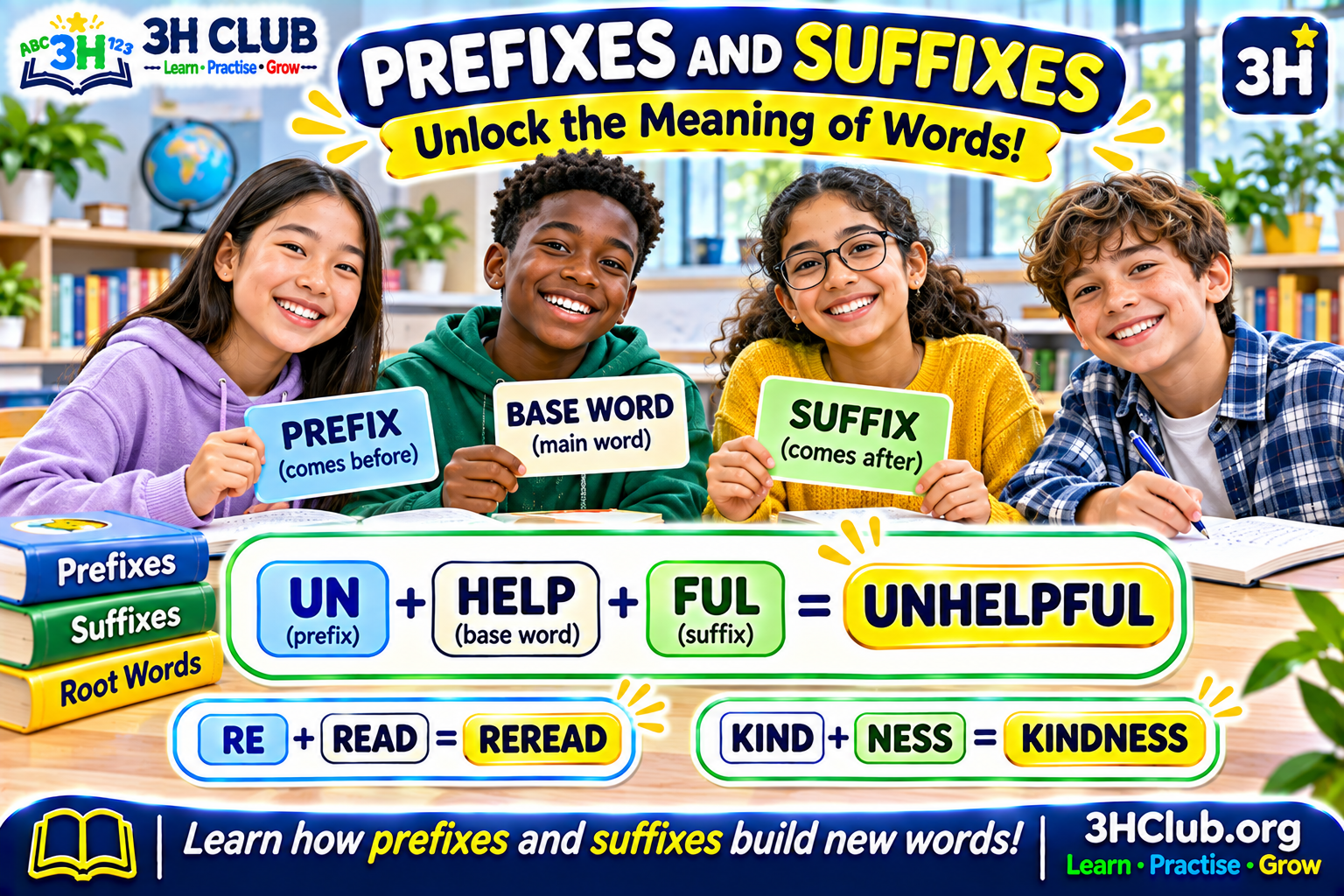
Many English words contain a base word and one or more meaningful word parts called affixes.
An affix is a word part added to a base or root.
There are two important kinds to learn.
🧩 Prefix
A prefix is added to the beginning of a word.
For example:
un + happy = unhappy
The prefix un- changes the meaning of happy to its opposite.
🔗 Suffix
A suffix is added to the end of a word.
For example:
help + ful = helpful
The suffix -ful helps form an adjective meaning that someone or something gives help or is useful.
🌱 Base Word
A base word is the main part to which an affix can be added.
For example:
kind
You can build:
unkind
kindness
unkindness
Some bases can stand alone as words, while others are bound roots that cannot stand alone.
📚 Compare the Three Parts
| Word Part | Position | Example | Meaning |
|---|---|---|---|
| Prefix | Beginning | unhappy | not happy |
| Base word | Main word | happy | feeling pleasure |
| Suffix | End | happiness | the state of being happy |
🧠 Quick Check
Look at:
unhelpful
Can you identify its three parts?
un + help + ful
- un- is the prefix.
- help is the base word.
- -ful is the suffix.
Together, the parts help us understand the word’s meaning.
⭐ STAGE 1: WORD DETECTIVES
Recognise prefixes and discover their meanings
🟢 2. Common Prefixes That Change Meaning
Prefixes often give us clues about a word’s meaning.
Let’s investigate some useful ones.
| Prefix | Common Meaning | Example | Meaning of New Word |
|---|---|---|---|
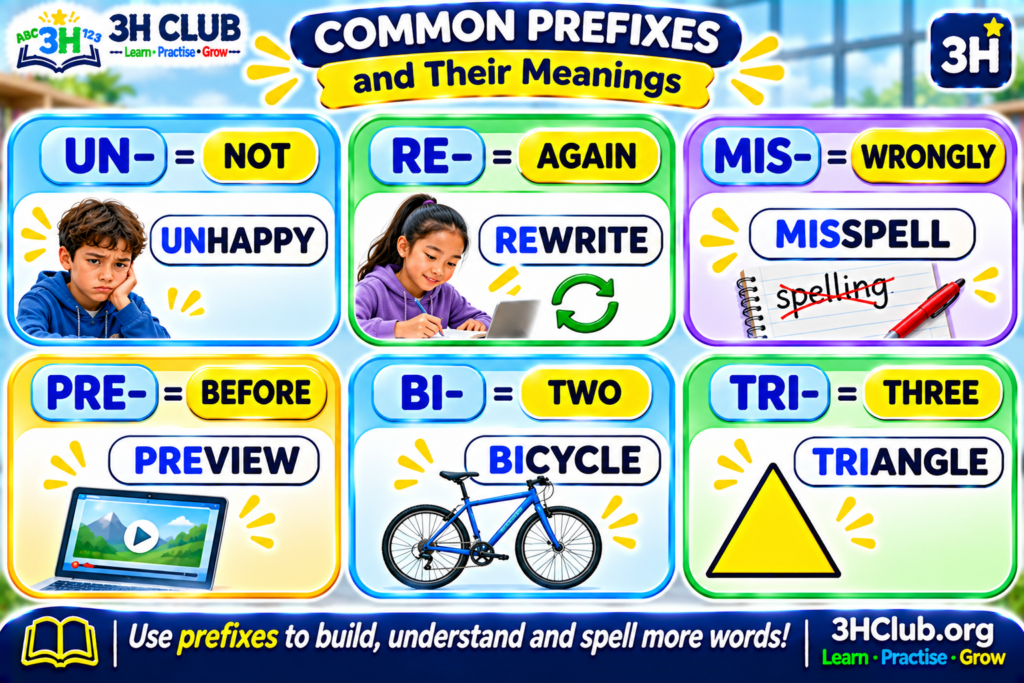
| un- | not; reverse | unhappy | not happy |
| re- | again; back | rewrite | write again |
| dis- | not; opposite; reverse | disagree | have a different opinion |
| mis- | wrongly; badly | misread | read incorrectly |
| pre- | before | preview | view beforehand |
| non- | not | nonfiction | writing based on facts rather than invented events |
| over- | too much; above | overcook | cook too much |
| under- | too little; below | undercook | cook too little |
| inter- | between; among | international | involving different nations |
| sub- | under; below | submarine | a vessel that travels underwater |
🔄 The Prefix RE-
Look at:
read → reread
write → rewrite
build → rebuild
The prefix re- often means again.
If you rebuild a wall, you build it again.
🚫 The Prefix UN-
happy → unhappy
fair → unfair
kind → unkind
The prefix un- often means not.
But it can also mean reversing an action:
tie → untie
lock → unlock
⚠️ The Prefix MIS-
spell → misspell
understand → misunderstand
lead → mislead
The prefix mis- often means wrongly or incorrectly.
For example, if you misunderstand a question, you understand it incorrectly.
✏️ Activity 1: Match the Prefix
Match each prefix to its meaning.
| Prefix | Meaning |
|---|---|
| re- | before |
| un- | wrongly |
| pre- | again |
| mis- | not |
| over- | too much |
✏️ Activity 2: Choose the Correct Prefix
Complete each word with un-, re-, mis-, pre- or over-.
- I had to _____write my paragraph because I wanted to improve it.
- The answer was _____correct.
- Please _____heat the oven before baking.
- I _____read the instructions and made a mistake.
- Don’t _____fill the glass or the water may spill.
🧠 Think About It!
What’s the difference between unhappy and misunderstood?
One uses a prefix meaning not.
The other uses a prefix meaning wrongly.
Prefixes can change meaning in different ways.
🟡 3. Prefixes That Tell Us About Numbers and Position
Some prefixes give clues about numbers, size or position.
| Prefix | Meaning | Example |
|---|---|---|
| bi- | two | bicycle |
| tri- | three | triangle |
| multi- | many | multicoloured |
| semi- | half; partly | semicircle |
| micro- | very small | microscope |
| tele- | far; at a distance | telephone |
| sub- | below; under | subsoil |
| inter- | between | interschool |
🚲 BI- Means Two
A bicycle has two wheels.
bi + cycle = bicycle
🔺 TRI- Means Three
A triangle has three sides.
tri + angle = triangle
🌈 MULTI- Means Many
A multicoloured design has many colours.
multi + coloured = multicoloured
✏️ Activity 3: Prefix Meaning Challenge
Choose the correct answer.
- How many sides does a triangle have?
- What does multicoloured tell you about the colours?
- What shape is a semicircle?
- Does subsoil refer to soil above or below the topsoil?
- What does interschool suggest about the schools involved?
⭐ Word Detective Tip
Not every word that begins with the same letters contains that prefix.
For example, the letters re at the beginning of red are not the prefix re-.
Look for a meaningful base or root, and check the word’s meaning.
🔵 4. Build Words Using Prefixes
Let’s practise combining prefixes with base words.
Example 1
re + play = replay
Meaning: play again.
Example 2
dis + appear = disappear
Meaning: go out of sight.
Example 3
mis + place = misplace
Meaning: put something in the wrong place or lose track of where it is.
Example 4
un + lock = unlock
Meaning: open something that was locked.
✏️ Activity 4: Build the Word
Combine the parts.
- re + use = _____
- un + fair = _____
- dis + connect = _____
- mis + spell = _____
- pre + view = _____
- over + load = _____
Now choose two words and write a sentence using each.
⭐⭐ STAGE 2: MEANING BUILDERS
Explore suffixes, word classes and spelling changes
🟣 5. Common Suffixes and Their Meanings
Suffixes can change a word’s meaning or grammatical function.
Some turn verbs into nouns.
Others turn nouns into adjectives.
Some change the tense or form of a verb.
| Suffix | Common Function | Example |
|---|---|---|
| -ful | full of; having | hopeful |
| -less | without; lacking | fearless |
| -ness | state or quality | kindness |
| -ment | result, process or state | enjoyment |
| -er | a person or thing that does something | teacher |
| -able | capable of being | washable |
| -ly | often forms an adverb | carefully |
| -tion | often forms a noun | creation |
| -ing | verb form or noun | reading |
| -ed | often marks past tense | jumped |
🌟 -FUL and -LESS
Compare:
hope → hopeful
hope → hopeless
A hopeful person feels hope.
A hopeless situation seems to offer no hope.
Now try:
care → careful
care → careless
The endings change the meaning.
💛 -NESS
The suffix -ness often forms a noun that names a state or quality.
kind → kindness
dark → darkness
happy → happiness
✏️ Activity 5: Choose the Suffix
Complete the words with -ful, -less, -ness, -ment or -er.
- kind + _____ = kindness
- teach + _____ = teacher
- enjoy + _____ = enjoyment
- hope + _____ = hopeful
- fear + _____ = fearless
🧠 Meaning Challenge
Explain the difference between:
careful and careless
Write one sentence using each word.
🟢 6. How Suffixes Change Word Classes
Words have different jobs in sentences.
These jobs are called word classes.
Common word classes include:
- Noun: Names a person, place, thing or idea.
- Verb: Expresses an action or state.
- Adjective: Describes a noun.
- Adverb: Often tells us how, when or where something happens.
Suffixes can help form words in different classes.
Example: CARE
care — noun or verb
careful — adjective
carefully — adverb
carelessness — noun
Example: CREATE
create — verb
creation — noun
creative — adjective
creatively — adverb
📚 Word Class Chart
| Base | New Word | Word Class |
|---|---|---|
| help | helpful | Adjective |
| kind | kindness | Noun |
| teach | teacher | Noun |
| quick | quickly | Adverb |
| enjoy | enjoyment | Noun |
| create | creative | Adjective |
✏️ Activity 6: Identify the Word Class
Identify the word class of the bold word.
- Her kindness made everyone smile.
- The helpful student carried the books.
- He answered the question quickly.
- The teacher explained the task.
- We enjoyed the creative display.
⭐ Grammar Connection
Look at:
The careful student checked the answer.
- The careful student is the subject.
- checked the answer is the predicate.
- careful is an adjective describing student.
Now compare:
The student checked the answer carefully.
The word carefully is an adverb describing how the student checked.
Changing the suffix has changed the word’s job in the sentence.
🟡 7. Spelling Rules When Adding Suffixes
Sometimes you can simply add a suffix.
help + ful = helpful
Other times, the spelling changes.
Let’s investigate three useful rules.
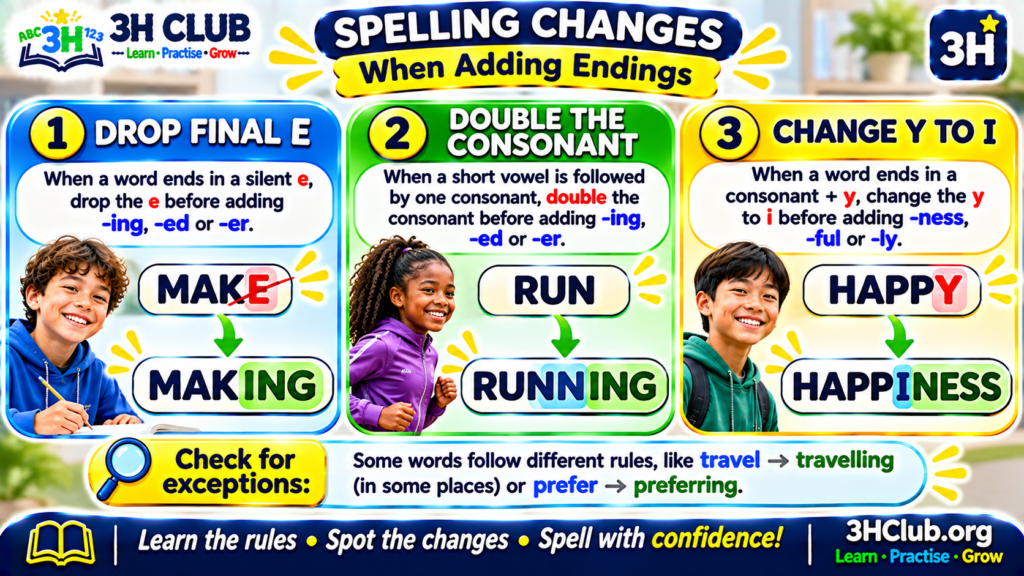
Rule 1: Drop the Final Silent E
For many words ending in silent e, remove the e before adding a suffix beginning with a vowel.
make + ing = making
hope + ing = hoping
create + ion = creation
But there are exceptions.
For example:
notice + able = noticeable
The e is kept to preserve the soft c sound.
Rule 2: Double the Final Consonant
In many one-syllable words ending with one consonant after one short vowel, double the final consonant before adding a vowel suffix.
run + ing = running
hop + ing = hopping
stop + ed = stopped
But don’t double every consonant.
jump + ing = jumping
The word jump ends with two consonant letters.
Rule 3: Change Y to I
When a word ends in a consonant followed by y, change y to i before many suffixes.
happy + ness = happiness
lazy + ness = laziness
beauty + ful = beautiful
But usually keep the y before -ing:
carry + ing = carrying
And keep y after a vowel in words such as:
enjoy + ment = enjoyment
✏️ Activity 7: Apply the Spelling Rule
Write the correct word.
- hope + ing = _____
- run + ing = _____
- happy + ness = _____
- create + ion = _____
- stop + ed = _____
- beauty + ful = _____
- carry + ing = _____
- notice + able = _____
🔵 8. Words with Both Prefixes and Suffixes
Some words contain both a prefix and a suffix.
Let’s explore:
unhelpful
Break it apart:
un + help + ful
- un- means not.
- help is the base.
- -ful helps form an adjective.
Unhelpful means not helpful.
More Examples
| Word | Prefix | Base | Suffix |
|---|---|---|---|
| unkindness | un- | kind | -ness |
| disagreement | dis- | agree | -ment |
| rereading | re- | read | -ing |
| unhappiness | un- | happy | -ness |
| unhelpful | un- | help | -ful |
Notice that happy changes to happi when -ness is added.
✏️ Activity 8: Break the Word Apart
Identify the prefix, base word and suffix.
- unhelpful
- disagreement
- rereading
- unkindness
- unhappiness
🧠 Think More Deeply
What does disagreement mean?
Start with the base:
agree
Add dis-:
disagree
Add -ment:
disagreement
A disagreement is a difference of opinion or a situation in which people do not agree.
Word parts help you build meaning step by step.
🧩 9. How to Work Out Unfamiliar Words
What should you do when you find a word you’ve never seen before?
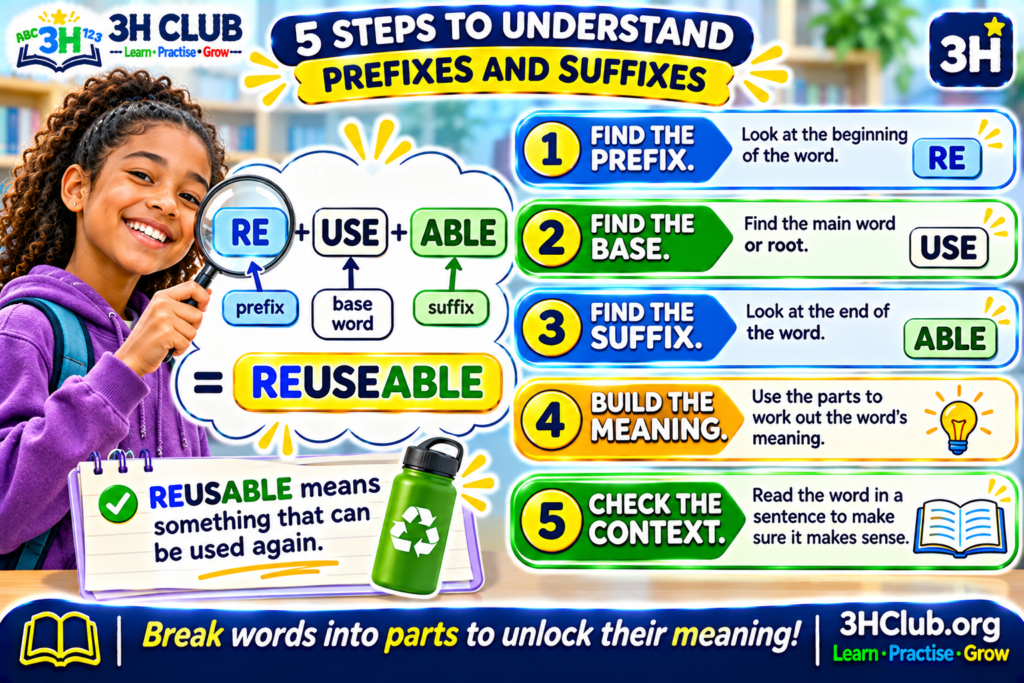
Try the Word Detective Method.
Step 1: Look for a Prefix
Does the word begin with a familiar prefix?
Step 2: Find the Base or Root
Can you recognise the main word or root?
Step 3: Look for a Suffix
Does the ending tell you something about the meaning or word class?
Step 4: Put the Meanings Together
Use the word parts to make a sensible prediction.
Step 5: Check the Sentence
Does your predicted meaning fit the context?
🔍 Example: REUSABLE
re + use + able
- re- = again
- use = put something to a purpose
- -able = capable of being
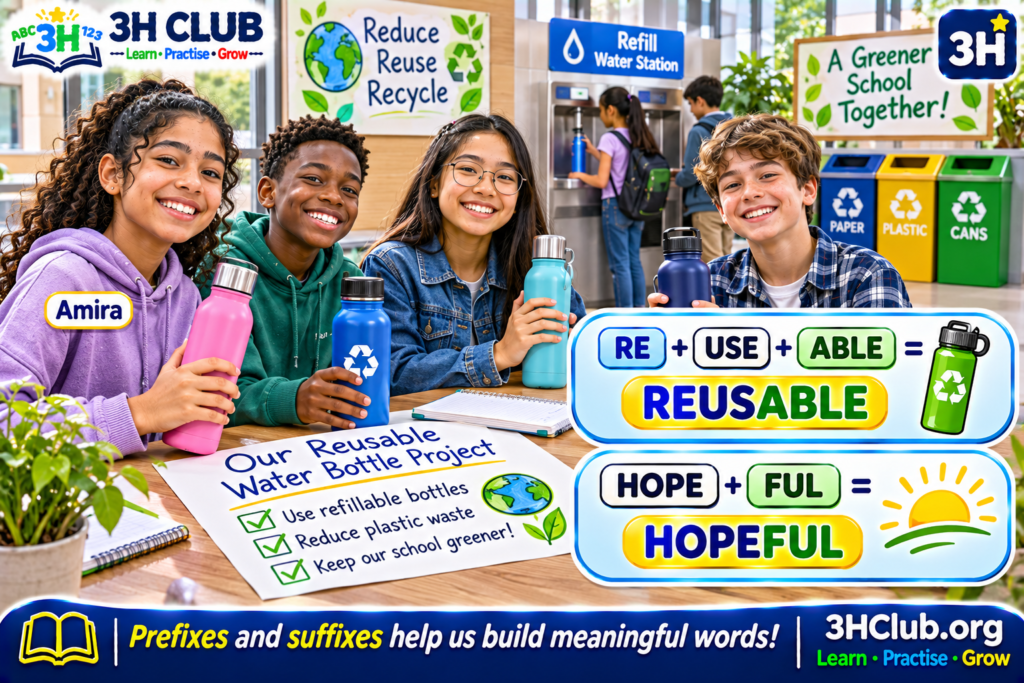
Reusable means able to be used again.
🔍 Example: MISUNDERSTANDING
mis + understand + ing
The prefix mis- suggests something is understood incorrectly.
In the sentence A misunderstanding caused the confusion, the word is a noun meaning a failure to understand correctly.
✏️ Activity 9: Word Detective Challenge
Use the word parts to explain:
- reusable
- fearless
- miscommunication
- prehistoric
- unbreakable
Then write a sentence using any two words.
⭐⭐⭐ STAGE 3: WORD MASTERS
Apply word structure in reading, writing and reasoning
📖 10. Reading Passage: The Reusable Bottle Project
The Reusable Bottle Project
When Amira noticed the overflowing rubbish bins at school, she felt concerned.
Many students were throwing away single-use plastic bottles after lunch.
Amira believed that reducing waste could make the school cleaner and more environmentally friendly.
She decided to organise a reusable bottle project.
First, she asked her classmates to collect information about the number of bottles being discarded each day.
The results were surprising.
Some students were unaware of how much plastic they used.
Others misunderstood the purpose of the project and thought they would have to buy expensive bottles.
Amira explained that students could reuse bottles they already owned, provided the bottles were safe and suitable for repeated use.
The class designed colourful posters encouraging everyone to reduce waste.
They also organised a refill station with the help of their teachers.
At first, a few students were unwilling to change their habits.
However, after several weeks, more students began bringing reusable bottles.
The amount of plastic waste decreased.
Amira felt hopeful about the progress.
She realised that small changes, when repeated by many people, could make a meaningful difference.
🔤 Prefix Hunt
Find words containing these prefixes:
- re-
- un-
- mis-
- over-
Write one example for each.
✍️ Suffix Hunt
Find words ending with:
- -able
- -ful
- -ment
- -ing
- -ed
Some endings may appear more than once.
🔍 Comprehension Questions
- What problem did Amira notice at school?
- Why did she want to start a reusable bottle project?
- What did the class investigate first?
- Why did some students misunderstand the project?
- What solution did Amira suggest?
- How did the teachers help?
- What happened after several weeks?
- What lesson did Amira learn?
🧠 Critical Thinking
Question 9: How does the prefix re- help you understand the word reusable?
Question 10: What is the difference between hopeful and hopeless?
Question 11: Why might the word unwilling describe some students at the beginning of the project?
✏️ Writing Challenge
Imagine you are helping Amira promote the project.
Write a paragraph of 80–120 words encouraging students to reduce plastic waste.
Try to include:
- Two words with prefixes.
- Three words with suffixes.
- One word containing both a prefix and a suffix.
- At least one persuasive reason.
Underline the words you have built.
📝 11. Proofreading: Fix the Word Parts
Even confident writers make spelling mistakes.
Good writers know how to find and correct them.
✏️ Activity 10: Become a Word Editor
Each sentence contains one incorrectly spelled word.
Find and correct it.
- The students were hopefull about the project.
- Amira wanted to reus her bottle.
- The class showed great kindnes.
- He was runing towards the classroom.
- The team had a small disagreemant.
- The poster was beautifull.
- The children were makeing a plan.
- Her happyness was easy to see.
⭐ Editing Tip
When proofreading, check:
- The spelling of the prefix.
- The spelling of the base word.
- The spelling of the suffix.
- Any letter changes required.
- Whether the finished word fits the sentence.
🎲 12. Prefix and Suffix Games
🎯 Game 1: Word-Part Match
Make three sets of cards.
Prefixes: un-, re-, dis-, mis-
Bases: kind, read, agree, spell
Suffixes: -ness, -ing, -ment, -ed
Try combining parts to make real words.
For example:
un + kind + ness = unkindness
dis + agree + ment = disagreement
Not every combination will make a standard English word.
Check each new word before using it.
🧩 Game 2: Word Building Challenge
Start with:
help
How many real words can you make?
Try:
helpful
helpless
helper
unhelpful
helpfulness
Can you explain the meaning of each?
🔍 Game 3: Prefix Detective
Read a page from a book.
Find five words beginning with prefixes.
Write each word.
Underline the prefix.
Explain what the prefix contributes to its meaning.
✍️ Game 4: Suffix Transformation
Change each base word into the requested word class.
- kind → noun
- quick → adverb
- teach → noun for a person
- care → adjective
- enjoy → noun
🏆 Game 5: Meaning Challenge
Explain the difference between:
helpful / helpless
hopeful / hopeless
agree / disagree
read / reread
understand / misunderstand
Try using each pair in two different sentences.
🏆 13. Final Champions Challenge
You’ve explored prefixes, suffixes, spelling rules and word meanings.
Now put everything together.
Part A: Identify the Prefix
Underline the prefix.
- unhappy
- rewrite
- misunderstand
- preview
- disagree
- submarine
Part B: Identify the Suffix
Underline the suffix.
- helpful
- kindness
- teacher
- enjoyment
- carefully
- washable
Part C: Build the Word
- un + kind = _____
- re + use + able = _____
- happy + ness = _____
- dis + agree + ment = _____
- hope + ful = _____
- quick + ly = _____
Part D: Choose the Correct Word
- The instructions were unclear, so I had to (reread / misread) them carefully a second time.
- The student showed great (kind / kindness) towards the new pupil.
- The glass bottle was (reuse / reusable).
- The group had a (disagree / disagreement) about the plan.
- The artist painted the picture (careful / carefully).
Part E: Explain the Meaning
Explain each word using its parts.
- unhelpful
- rereading
- fearless
- miscommunication
- prehistoric
Part F: Word Classes
Identify whether the bold word is a noun, verb, adjective or adverb.
- The student worked carefully.
- Her kindness impressed everyone.
- The helpful neighbour carried the bags.
- We will rebuild the bridge.
- The teacher explained the lesson.
Part G: Create a Word Family
Start with the base word:
care
Write four related words using prefixes or suffixes.
Explain how their meanings or word classes differ.
⭐ Final Writing Mission
Write 100–150 words about a challenge you solved or a goal you achieved.
Include at least:
- Three words containing prefixes.
- Three words containing suffixes.
- Two words containing both a prefix and a suffix.
Underline your chosen words and explain two of them.
✅ 14. Check Your Answers!
Activity 1: Match the Prefix
| Prefix | Meaning |
|---|---|
| re- | again |
| un- | not |
| pre- | before |
| mis- | wrongly |
| over- | too much |
Activity 2: Choose the Prefix
- rewrite
- incorrect — in- is the correct prefix for this word
- preheat
- misread
- overfill
Important discovery: The word incorrect uses in-, not any of the five prefixes listed in the activity. This is an opportunity to learn another negative prefix. A suitable alternative question using the listed prefixes is “The decision was _____fair” → unfair.
Activity 3: Prefix Meanings
- Three.
- Many colours.
- Half a circle.
- Below the topsoil.
- Between or involving different schools.
Activity 4: Build the Word
- reuse
- unfair
- disconnect
- misspell
- preview
- overload
Activity 5: Choose the Suffix
- -ness
- -er
- -ment
- -ful
- -less
Activity 6: Word Classes
- kindness — noun
- helpful — adjective
- quickly — adverb
- teacher — noun
- creative — adjective
Activity 7: Spelling Rules
- hoping
- running
- happiness
- creation
- stopped
- beautiful
- carrying
- noticeable
Activity 8: Word Parts
| Word | Prefix | Base | Suffix |
|---|---|---|---|
| unhelpful | un- | help | -ful |
| disagreement | dis- | agree | -ment |
| rereading | re- | read | -ing |
| unkindness | un- | kind | -ness |
| unhappiness | un- | happy | -ness |
Activity 9: Word Meanings
- reusable: Able to be used again.
- fearless: Without fear; very brave.
- miscommunication: Communication that goes wrong or causes misunderstanding.
- prehistoric: From a time before written history.
- unbreakable: Not able to be broken, or extremely difficult to break.
Reading Passage: Prefix Hunt
Examples:
- re-: reusable, reuse, repeated
- un-: unaware, unwilling
- mis-: misunderstood
- over-: overflowing
Reading Passage: Suffix Hunt
Examples:
- -able: reusable
- -ful: hopeful, meaningful
- -ment: environmentally contains -ly at the end, not -ment; the passage does not contain a clear word ending in -ment
- -ing: overflowing, gathering is not in this passage; encouraging, bringing
- -ed: noticed, discarded, explained, decreased
Reading accuracy note: For a direct -ment example, add the sentence “The project was an important improvement for the school” to the passage before publication. The word improvement contains -ment.
Reading Passage: Comprehension
- Overflowing rubbish bins and discarded plastic bottles.
- She wanted to reduce waste and make the school cleaner.
- How many bottles were discarded each day.
- They thought they would have to buy expensive bottles.
- Reuse safe, suitable bottles they already owned.
- They helped organise a refill station.
- More students brought reusable bottles and plastic waste decreased.
- Small changes made by many people can make a difference.
- re- suggests that something can be used again.
- hopeful means having hope; hopeless means having little or no hope.
- They were reluctant to change their habits.
Activity 10: Proofreading
- hopeful
- reuse
- kindness
- running
- disagreement
- beautiful
- making
- happiness
Game 4: Suffix Transformation
- kindness
- quickly
- teacher
- careful
- enjoyment
Final Challenge: Part A
- un-
- re-
- mis-
- pre-
- dis-
- sub-
Final Challenge: Part B
- -ful
- -ness
- -er
- -ment
- -ly
- -able
Final Challenge: Part C
- unkind
- reusable
- happiness
- disagreement
- hopeful
- quickly
Final Challenge: Part D
- reread
- kindness
- reusable
- disagreement
- carefully
Final Challenge: Part E
- unhelpful: Not helpful.
- rereading: Reading again.
- fearless: Without fear.
- miscommunication: A failure to communicate correctly.
- prehistoric: Before written history.
Final Challenge: Part F
- carefully — adverb
- kindness — noun
- helpful — adjective
- rebuild — verb
- teacher — noun
Final Challenge: Part G
Possible answers:
care — noun or verb
careful — adjective
careless — adjective
carefully — adverb
carelessness — noun
Final Writing Mission
Answers will vary.
Check that your writing uses the required prefixes and suffixes correctly.
Example:
Our class decided to reorganise the school reading corner. At first, the shelves were untidy and some books were misplaced. We worked carefully to sort the books into categories. A few students disagreed about where the comics should go, but we solved the problem through discussion. Everyone was helpful, and the final arrangement made the books easier to find. Our teacher praised our teamwork and kindness. I felt proud because we had turned a disorganised space into a welcoming place to read.
🎉 Excellent work, Word Master!
You’ve learned how word parts can change meaning, spelling and grammatical function.
Keep investigating unfamiliar words. The more patterns you recognise, the stronger your vocabulary becomes.
🌈 15. What Have You Learned?
Let’s review your discoveries.
🔤 Prefixes
Prefixes are added to the beginnings of words.
Examples:
un-, re-, dis-, mis-, pre-
🔗 Suffixes
Suffixes are added to the ends of words.
Examples:
-ful, -less, -ness, -ment, -able
🌱 Base Words
Base words are the main words to which prefixes and suffixes can be added.
help → helpful → unhelpful
🧩 Word Building
You can combine word parts to create new words.
re + use + able = reusable
✍️ Spelling Rules
You may need to drop a final e, double a consonant or change y to i.
📚 Word Classes
Suffixes can change how words function in sentences.
kind → kindness
quick → quickly
🔍 Understanding Unfamiliar Words
Break words into meaningful parts.
Then check their meanings in context.
⭐ The Word Detective Method
FIND THE PREFIX → FIND THE BASE → FIND THE SUFFIX → BUILD THE MEANING → CHECK THE CONTEXT
🌟 Keep Learning with 3HClub!
You’ve unlocked an important vocabulary skill!
Prefixes and suffixes help you understand how words are built and why their meanings change.
Next time you read a story, article or textbook, look for familiar word parts.
You may discover that a long, unfamiliar word is easier to understand than it first appears.
📚 Your Next Learning Adventures
- Discover Common Spelling Patterns
- Word Roots and Their Meanings
- Synonyms and Antonyms
- Nouns, Verbs and Adjectives
- Subject and Predicate
- Complex Sentences
- Reading Comprehension and Vocabulary
⭐ Your Word Master Promise
I can recognise prefixes and suffixes.
I can explain how word parts change meaning.
I can apply spelling rules.
I can identify word classes.
I can use word parts to understand unfamiliar vocabulary.
🎉 Keep investigating, keep practising and keep growing!
3H CLUB — Learn • Practise • Grow