Tens and Ones Made Easy for Kids
Learn how to group numbers into tens and ones, read two-digit numbers, and discover how numbers are built!
Have you ever counted a big pile of pencils, blocks or buttons? Counting them one by one works, but there is an easier way!
You can put objects into groups of ten and count the ones left over.
This is called tens and ones, and it helps you understand numbers from 10 to 99.
In this lesson, you will learn how to make tens, find ones, build numbers, and solve fun maths challenges.
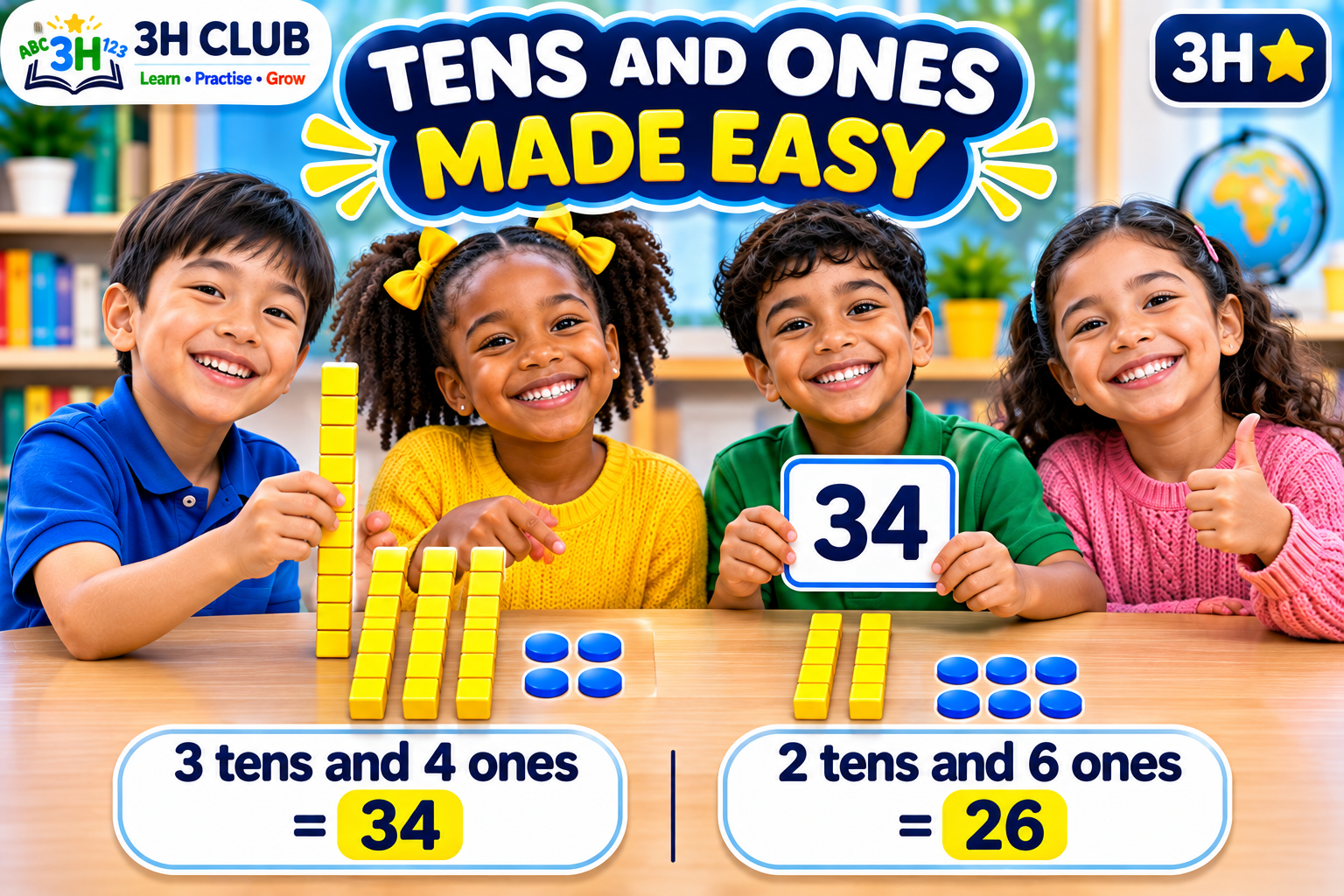
By the end, you will be able to look at a number like 34 and say:
34 is 3 tens and 4 ones!
⭐ Starters — Let’s Learn Tens and Ones!
1. What Are Ones?
A one is a single object.
Look at these stars:
⭐ ⭐ ⭐ ⭐
Count them.
1, 2, 3, 4.
You have 4 ones.
Each star is one.
You can count ones using fingers, buttons, pencils, blocks or anything you can collect.
Try it!
Count these apples:
🍎 🍎 🍎 🍎 🍎 🍎
How many ones can you see?
Answer: 6 ones.
2. What Is a Ten?
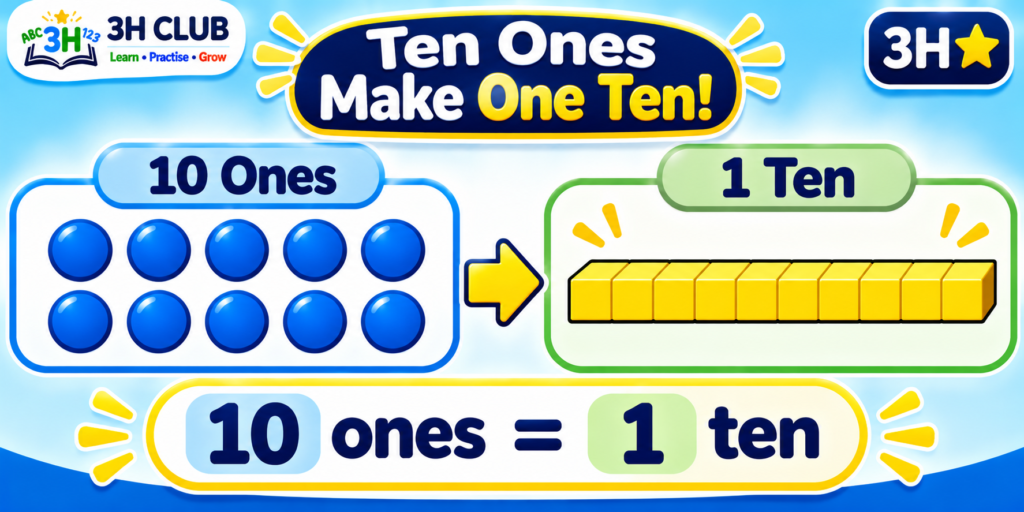
When you collect 10 ones, you can put them together to make 1 ten.
Count these counters:
🔵 🔵 🔵 🔵 🔵
🔵 🔵 🔵 🔵 🔵
There are 10 counters altogether.
That means:
10 ones = 1 ten
Imagine tying ten pencils together with a rubber band. Instead of counting ten separate pencils every time, you can call the bundle one ten.
3. What Are Tens and Ones?
Numbers can be made from groups of ten and extra ones.
Let’s look at the number 14.
One group of ten:
🔵 🔵 🔵 🔵 🔵
🔵 🔵 🔵 🔵 🔵
Four extra ones:
🟢 🟢 🟢 🟢
So:
14 = 1 ten and 4 ones
10 + 4 = 14
The group of ten and the four extra ones work together to make fourteen.
4. Let’s Build More Numbers
Build a Number!
Tens
2
Ones
5
Your number is
25
2 tens + 5 ones = 25
Groups of ten
Extra ones
| Number | Tens | Ones | Expanded form |
|---|---|---|---|
| 12 | 1 | 2 | 10 + 2 = 12 |
| 23 | 2 | 3 | 20 + 3 = 23 |
| 35 | 3 | 5 | 30 + 5 = 35 |
| 47 | 4 | 7 | 40 + 7 = 47 |
| 58 | 5 | 8 | 50 + 8 = 58 |
Remember: The number of tens tells you how many complete groups of ten you have.
5. Meet the Tens and Ones Houses
Every digit in a two-digit number has a special place.
Look at 36.
| Tens | Ones |
|---|---|
| 3 | 6 |
The 3 is in the tens place. It means 3 tens, or 30.
The 6 is in the ones place. It means 6 ones.
30 + 6 = 36
This is called place value. A digit’s place helps tell you how much it is worth.
6. What Happens When There Are No Extra Ones?
Some numbers have complete groups of ten with no extra ones.
For example, 40 has:
-
4 tens
-
0 ones
40 = 10 + 10 + 10 + 10
Here are more examples:
| Number | Tens | Ones |
|---|---|---|
| 10 | 1 | 0 |
| 20 | 2 | 0 |
| 30 | 3 | 0 |
| 40 | 4 | 0 |
| 50 | 5 | 0 |
The zero is important. It shows that there are no extra ones.
7. Make a Number Using Ten-Frames
A ten-frame is a rectangle with 10 spaces arranged in two rows of five.
When every space is filled, you have one complete ten.
Example: Make 13
First, fill one ten-frame:
| 🔵 | 🔵 | 🔵 | 🔵 | 🔵 |
|---|---|---|---|---|
| 🔵 | 🔵 | 🔵 | 🔵 | 🔵 |
Then add three extra counters:
🟢 🟢 🟢
Now count:
10 + 3 = 13
13 has 1 ten and 3 ones.
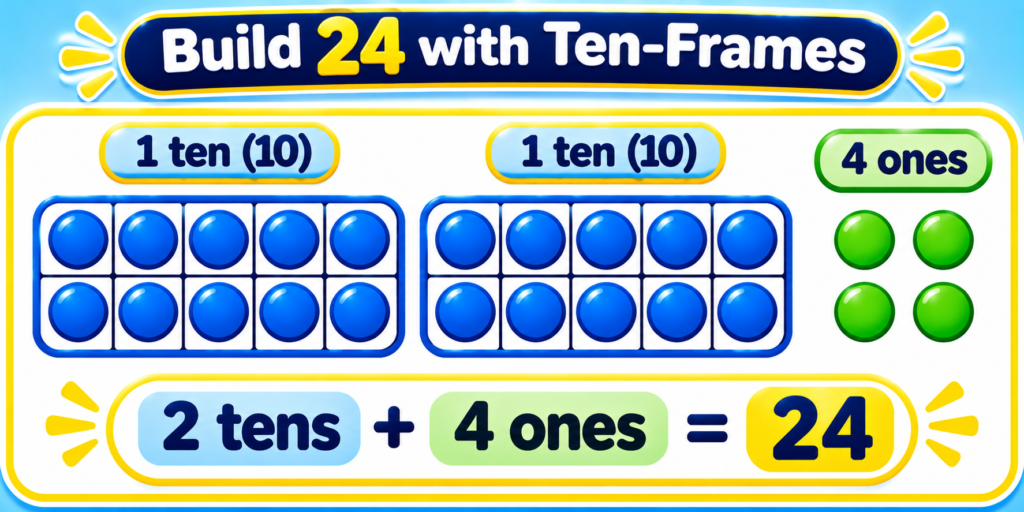
Example: Make 24
Use two complete groups of ten and four extra ones.
10 + 10 + 4 = 24
24 has 2 tens and 4 ones.
8. Count in Tens!
When you count complete groups of ten, you can count by tens instead of ones.
10, 20, 30, 40, 50, 60, 70, 80, 90.
Let’s count three bundles of ten pencils:
First bundle: 10 pencils.
Second bundle: 20 pencils altogether.
Third bundle: 30 pencils altogether.
3 tens = 30
Now imagine adding five loose pencils.
30 + 5 = 35
You have 35 pencils!
Your turn: Count five groups of ten and two extra ones.
50 + 2 = ___
Answer: 52.
9. What Happens When You Add One More?
Look at the number 27.
It has 2 tens and 7 ones.
Add one more:
27 + 1 = 28
Now you have 2 tens and 8 ones.
But what happens when you add one to 29?
29 + 1 = 30
The 9 ones and the new one make 10 ones. You can exchange those 10 ones for another ten.
Now you have 3 tens and 0 ones.
This is a useful pattern to remember!
10. Fun Tens and Ones Activities
Activity 2 — Build a Number
Choose a number such as 32. Use three groups of ten blocks and two single blocks to build it.
Activity 1 — Pencil Bundles
Collect pencils or craft sticks. Make bundles of ten, then leave a few loose. Count your tens and ones to find the total.

Choose a number such as 32. Use three groups of ten blocks and two single blocks to build it.

Activity 3 — Number Card Challenge
Pick two digit cards. Put one in the tens place and one in the ones place. Say your new number aloud.

11. Let’s Practise Tens and Ones!
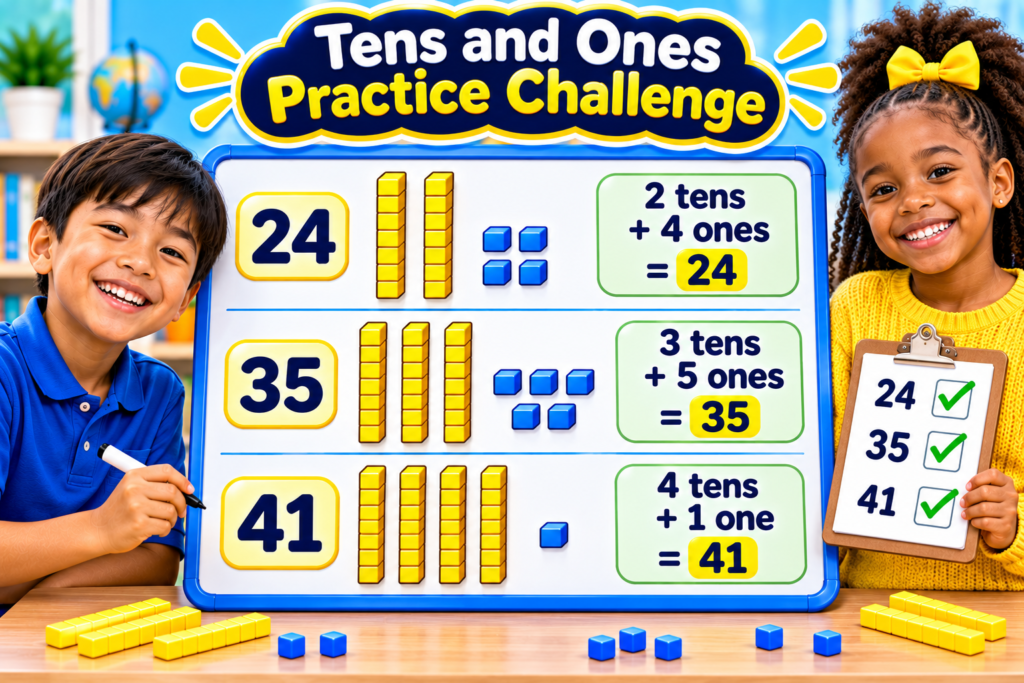
Write the missing numbers.
Part A — Find the tens and ones
-
16 = ___ ten and ___ ones.
-
28 = ___ tens and ___ ones.
-
43 = ___ tens and ___ ones.
-
50 = ___ tens and ___ ones.
-
67 = ___ tens and ___ ones.
Part B — Build the number
-
2 tens and 4 ones = ___.
-
3 tens and 7 ones = ___.
-
5 tens and 1 one = ___.
-
6 tens and 0 ones = ___.
-
8 tens and 2 ones = ___.
Part C — Complete the addition
-
20 + 6 = ___.
-
40 + 3 = ___.
-
70 + 5 = ___.
-
30 + 9 = ___.
-
90 + 0 = ___.
Check Your Answers
Try all 15 questions before checking.
12. Tens and Ones Mini Quiz
Test Your Skills!
1. How many ones make one ten?
2. How many tens are in 40?
3. What number is 3 tens and 6 ones?
4. In 52, which digit is in the ones place?
5. What is 20 + 8?
6. How many ones are in 70 after making groups of ten?
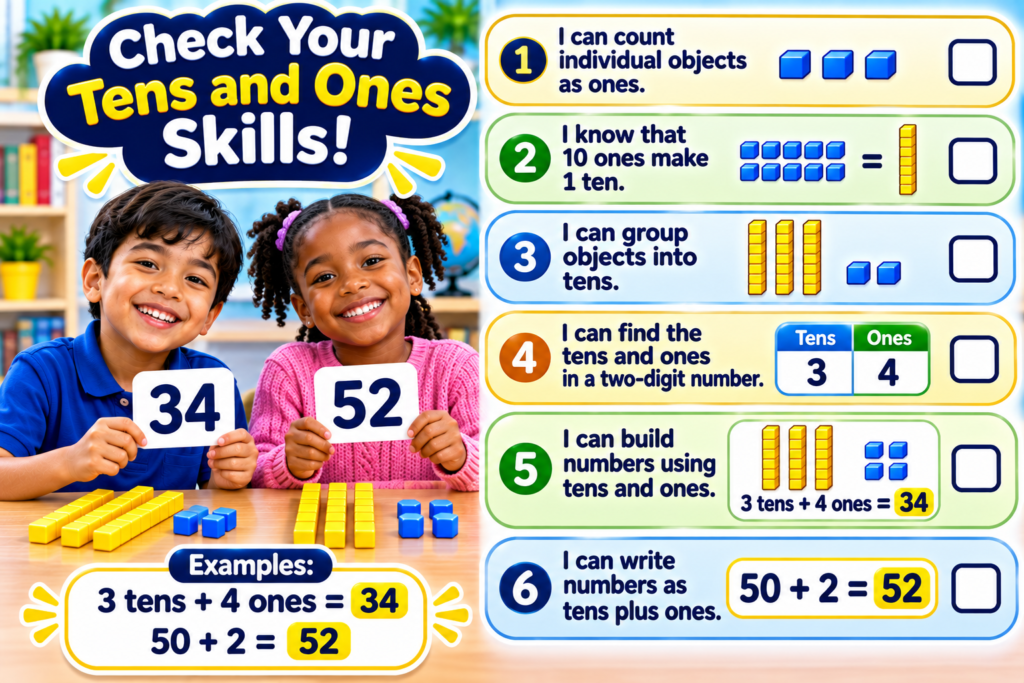
13. Check Your Tens and Ones Skills!
Can you do all six?
-
☐ I can count individual objects as ones.
-
☐ I know that 10 ones make 1 ten.
-
☐ I can group objects into tens.
-
☐ I can find the tens and ones in a two-digit number.
-
☐ I can build numbers using tens and ones.
-
☐ I can write numbers as tens plus ones.
Frequently Asked Questions About Tens and Ones
What is the difference between tens and ones?
Ones are single objects. A ten is a group of ten ones.
How many ones are in one ten?
There are exactly 10 ones in one ten.
What are the tens and ones in 25?
25 has 2 tens and 5 ones.
20 + 5 = 25
Why is zero important in a number like 60?
The zero tells you there are no extra ones. The 6 tells you there are six tens.
What is the biggest two-digit number?
99 is the biggest two-digit number. It has 9 tens and 9 ones.
Can I use real objects to learn tens and ones?
Yes! Pencils, buttons, blocks and craft sticks are all useful for practising.
⭐ You Did It! Keep Learning
You have discovered that numbers are made from tens and ones.
Remember these three important ideas:
10 ones = 1 ten
2 tens + 5 ones = 25
40 + 7 = 47
The more you practise grouping, counting and building numbers, the easier place value becomes.
Keep exploring, keep counting and enjoy discovering how numbers work!
Learn • Practise • Grow
Recommended External Learning Links
-
Learn more about place value — Math Is Fun — simple explanations of tens, ones and number positions.
-
Practise tens and ones — Khan Academy — introductory lessons and exercises for first-grade learners.
-
Watch an introduction to place value — Khan Academy — a video explaining how groups of ten help us understand numbers.
mathsisfun.org+2