Understanding Time: Seconds, Minutes, Hours, Days & Years
Time helps us understand when things happen and how long things take.
We use time every day. We use it to know when to wake up, when school starts, how long a lesson lasts and even when it is time for bed!
🎯 What You Will Learn
By the end of this lesson, you should be able to:
- ✅ recognise common units of time
- ✅ change simple units of time
- ✅ understand hours, days, weeks, months and years
- ✅ solve easy time problems
⏱️ Units of Time
Some things happen very quickly. Other things take much longer.
For example:
- A blink takes about a second.
- A short cartoon might last several minutes.
- A school day lasts several hours.
- A holiday may last several days or weeks.
- Your age is usually measured in years.
Units of Time Chart
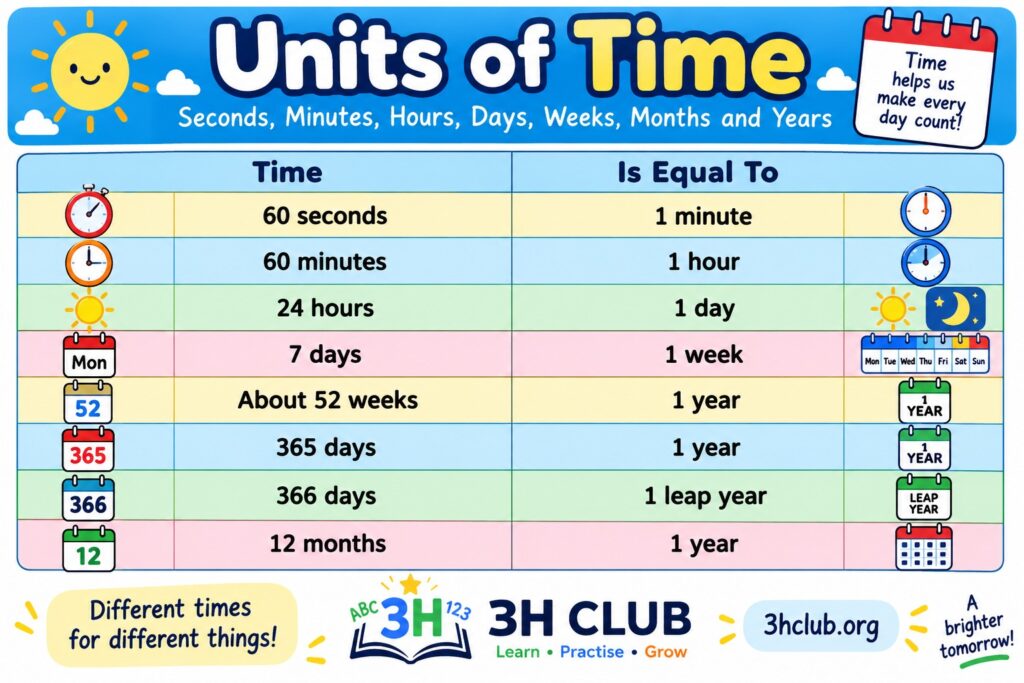
Use this chart to remember the most important units of time.
⭐ Remember These Time Facts
| 60 seconds | 1 minute |
| 60 minutes | 1 hour |
| 24 hours | 1 day |
| 7 days | 1 week |
| About 52 weeks | 1 year |
| 365 days | 1 year |
| 366 days | 1 leap year |
| 12 months | 1 year |
🧠 Memory Tip
60 seconds → 1 minute
60 minutes → 1 hour
24 hours → 1 day
⌛ Seconds
A second is a very short amount of time.
Count slowly:
1… 2… 3… 4… 5…
You have counted about 5 seconds.
We use seconds for quick activities such as:
- 👀 blinking
- 👏 clapping
- 🏃 running a short race
- ⏱️ using a stopwatch
60 seconds = 1 minute
Example
If Mia waits for 60 seconds, she has waited for:
60 seconds = 1 minute

60 Seconds = 1 Minute
🕐 Minutes
A minute is longer than a second.
Some activities that may take a few minutes include:
- 🪥 brushing your teeth
- 🥪 making a sandwich
- 📚 reading a short story
- 👟 putting on your shoes
60 minutes = 1 hour
So:
30 minutes = half an hour
15 minutes = quarter of an hour
Example
A lesson begins at 9:00 and finishes at 10:00.
That lesson lasts:
1 hour = 60 minutes
🕒 Hours
We use hours for activities that take longer.
For example:
🎬 A film may last about 2 hours.
🏫 You spend several hours at school.
😴 Children sleep for several hours every night.
24 hours = 1 day
A complete day has:
☀️ daytime
and
🌙 nighttime
🤔 Can You Work It Out?
If:
1 hour = 60 minutes
then:
2 hours = 120 minutes
because:
60 + 60 = 120
And:
3 hours = 180 minutes
because:
60 + 60 + 60 = 180
Shortcut:
You can multiply.
3 × 60 = 180 minutes
☀️ Days
A day contains:
24 hours
The seven days of the week are:
Monday → Tuesday → Wednesday → Thursday → Friday → Saturday → Sunday
7 days = 1 week
Question
If today is Monday, what day will it be in 3 days?
Count forward:
Monday → Tuesday → Wednesday → Thursday
✅ Answer: Thursday

7 Days = 1 Week
📅 Weeks
One week contains 7 days.
So:
2 weeks = 14 days
because:
2 × 7 = 14
And:
3 weeks = 21 days
because:
3 × 7 = 21
Try This
How many days are in 4 weeks?
4 × 7 = ?
✅ Answer: 28 days
🗓️ Months
There are 12 months in one year.
They are:
January
February
March
April
May
June
July
August
September
October
November
December
12 months = 1 year
A useful rhyme can help you remember how many days are in each month:
30 days have September,
April, June and November.
Most of the other months have 31 days.
February usually has 28 days, but during a leap year it has 29 days.

12 Months = 1 Year
🌍 Years
A normal year has:
365 days
A leap year has:
366 days
The extra day is added to February, so February has 29 days during a leap year.
A year is also approximately:
52 weeks
Good to know:
52 weeks is actually 364 days, so a normal calendar year has 52 weeks plus 1 extra day. A leap year has 52 weeks plus 2 extra days.
For younger learners, remembering “about 52 weeks = 1 year” is enough.
🔄 Changing Units of Time
Sometimes we need to change one unit of time into another.
Example 1
How many minutes are in 2 hours?
We know:
1 hour = 60 minutes
So:
2 × 60 = 120
✅ 2 hours = 120 minutes
Example 2
How many seconds are in 3 minutes?
We know:
1 minute = 60 seconds
So:
3 × 60 = 180
✅ 3 minutes = 180 seconds
Example 3
How many days are in 2 weeks?
We know:
1 week = 7 days
So:
2 × 7 = 14
✅ 2 weeks = 14 days
🧩 Time Conversion Machine
You can imagine a little Maths machine.
Minutes → Seconds
Multiply by 60
Hours → Minutes
Multiply by 60
Days → Hours
Multiply by 24
Weeks → Days
Multiply by 7
Years → Months
Multiply by 12
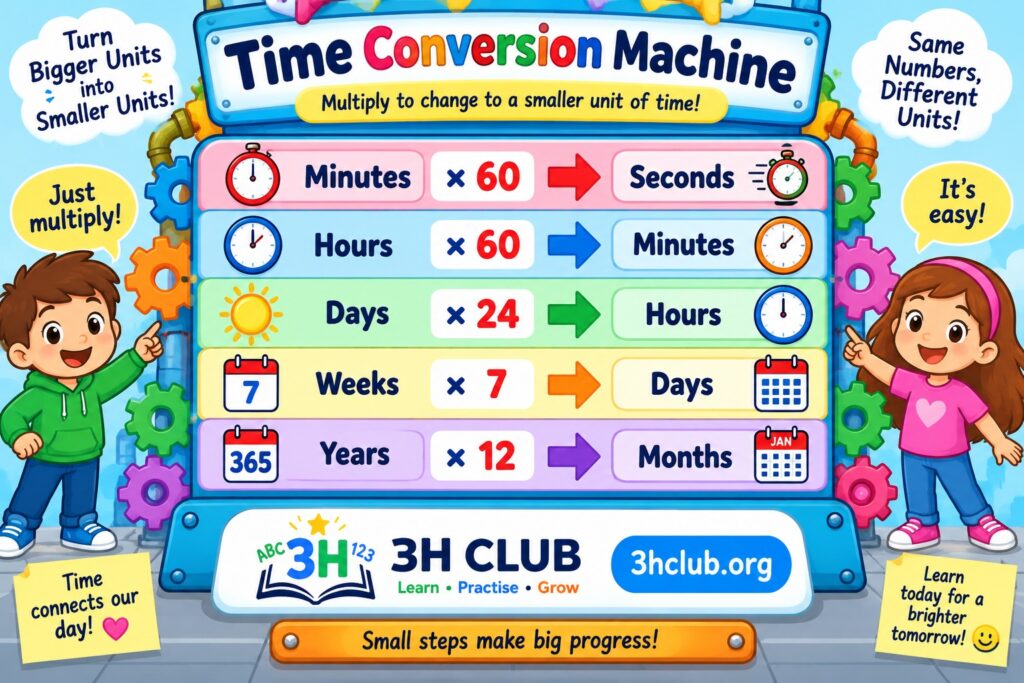
Time Conversion Machine
✏️ Your Turn
Try these questions before looking at the answers.
Level 1 ⭐
- How many seconds are in 1 minute?
- How many minutes are in 1 hour?
- How many hours are in 1 day?
- How many days are in 1 week?
- How many months are in 1 year?
Level 2 ⭐⭐
- How many minutes are in 2 hours?
- How many days are in 3 weeks?
- How many seconds are in 2 minutes?
- How many hours are in 2 days?
- How many months are in 2 years?
Level 3 ⭐⭐⭐
- Sam practises football for 2 hours. How many minutes does he practise?
- Ava reads for 3 minutes. How many seconds does she read?
- A holiday lasts 4 weeks. How many days is that?
- Liam stays with his grandparents for 3 days. How many hours is that?
- A club meets once every month for 2 years. How many months is that?
🏆 Challenge Question
A school trip lasts 2 days and 6 hours.
We know:
2 days = 2 × 24 hours
2 days = 48 hours
Now add the extra 6 hours:
48 + 6 = 54 hours
✅ The school trip lasts 54 hours.
✅ Answers
1. 60 seconds
2. 60 minutes
3. 24 hours
4. 7 days
5. 12 months
6. 120 minutes
7. 21 days
8. 120 seconds
9. 48 hours
10. 24 months
11. 120 minutes
12. 180 seconds
13. 28 days
14. 72 hours
15. 24 months
🌟 What Have We Learned?
Great work!
You now know that:
60 seconds = 1 minute
60 minutes = 1 hour
24 hours = 1 day
7 days = 1 week
12 months = 1 year
365 days = 1 normal year
366 days = 1 leap year
The more you practise using time, the easier it becomes.
🚀 Keep Learning
Next, try learning how to:
- 👉 read an analogue clock
- 👉 understand a.m. and p.m.
- 👉 find half past and quarter past
- 👉 calculate how much time has passed
The more often you use clocks, calendars and time facts, the easier they become to remember.