Verb Tenses for Kids
Learn Past, Present and Future with Examples and Fun Activities
⏳ 📚 ✏️ Every action happens at a time. You might have played yesterday, be reading today or plan to visit a friend tomorrow. The words you choose help your reader understand when something happens.
These words are called verbs, and the forms we use to show time are called verb tenses.
⏰ What Are Verb Tenses?
A verb is a word that tells us about an action, an event or a state. Examples include jump, think, grow, is and have.
A verb tense helps show when something happens.
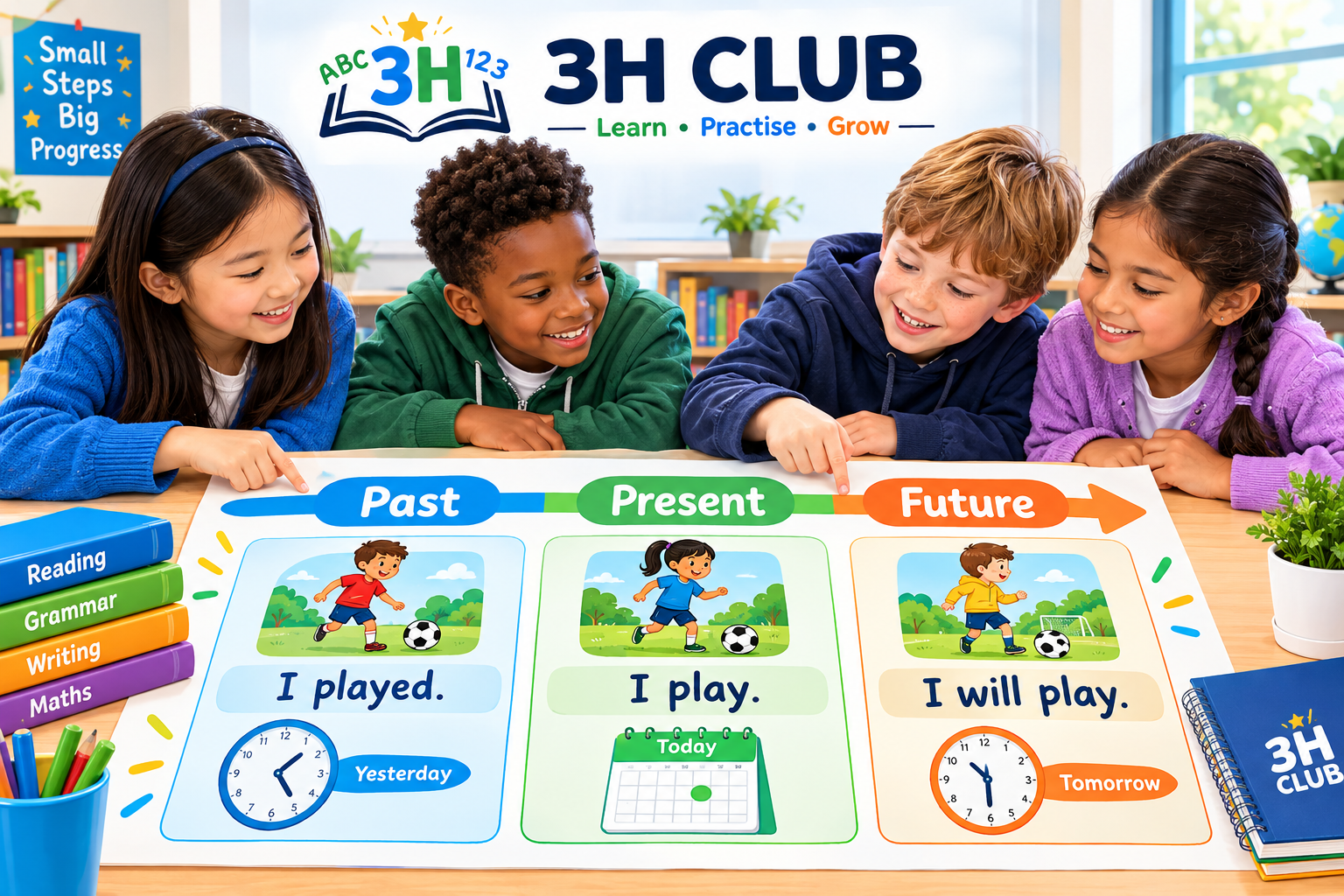
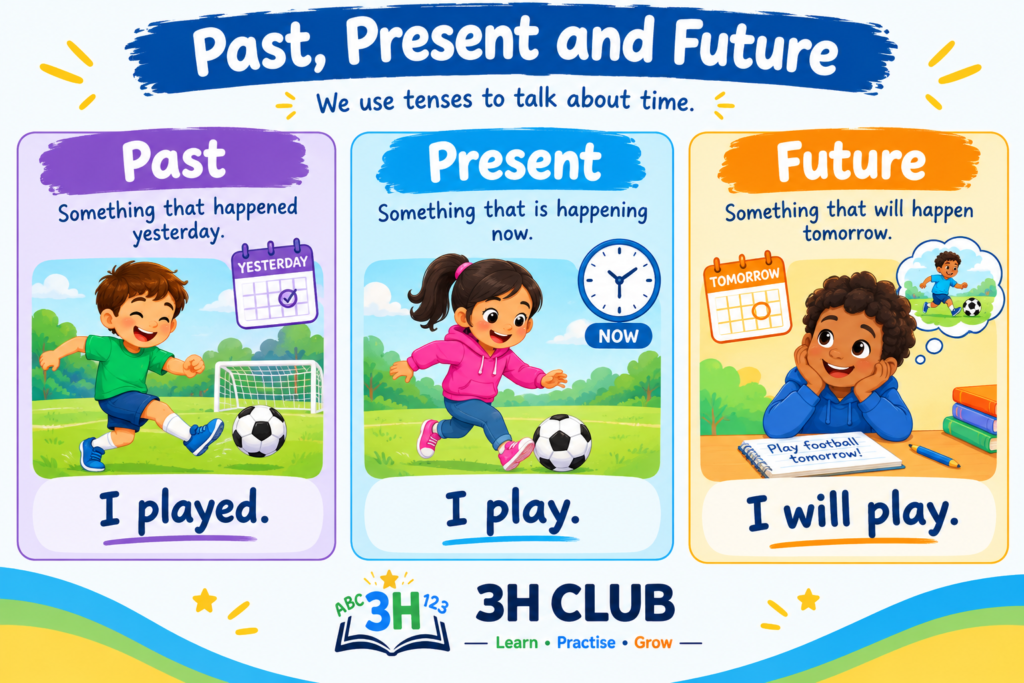
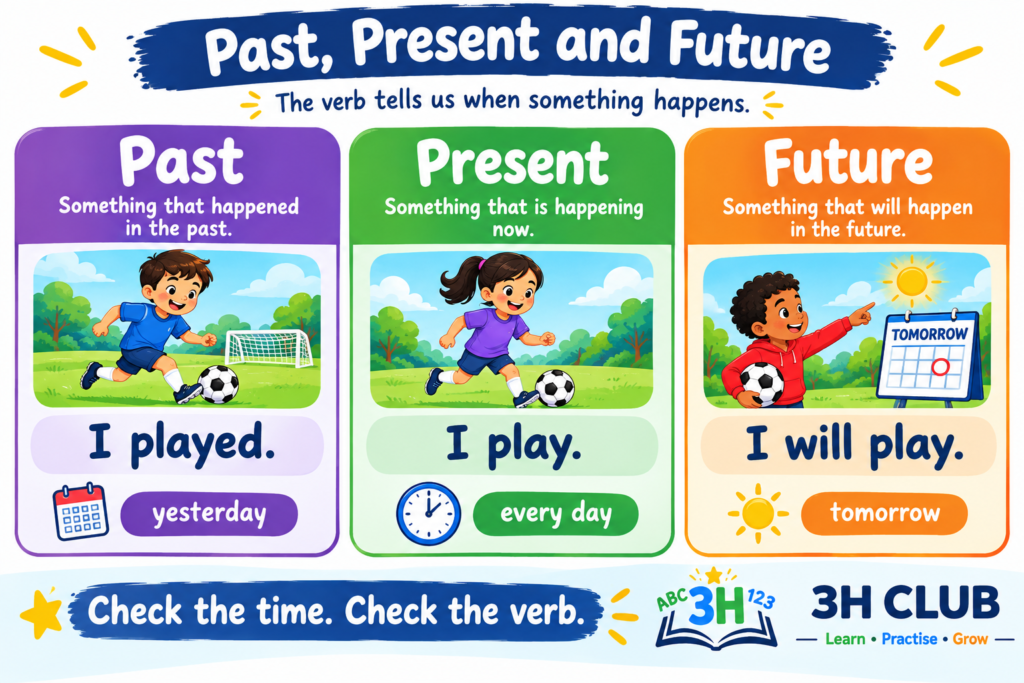
In this lesson, we’ll begin with three useful time groups:
- Past — something happened before now.
- Present — something happens now, happens regularly or is true now.
- Future — something is expected or planned to happen later.
Look at this example using the verb play:
| Time | Example | What it tells us |
|---|---|---|
| Past | I played yesterday. | The action happened before now. |
| Present | I play every day. | The action happens regularly. |
| Future | I will play tomorrow. | The action is expected to happen later. |
Notice that the verb changes to help express the time.
Remember: English uses several verb forms to talk about time. The past and present have different grammatical forms, while future time is often expressed with words such as will or going to. For now, thinking about past, present and future is a helpful way to get started.
🔎 Jump To
- ⭐ Starters — Ages 6–7
- ⭐⭐ Builders — Ages 8–9
- ⭐⭐⭐ Champions — Ages 10–11
- 🧠 Big Verb Tenses Challenge
- 📌 Verb Tenses Checklist
- ❓ Frequently Asked Questions
⭐ Starters: Past, Present and Future
Around ages 6–7
Let’s begin with the three main ways to think about time.
🕰️ 1. Past Tense — What Happened Before?
We use past-tense verbs to talk about actions or events that happened before now.
Examples:
- I jumped over the puddle.
- Sam played with a ball.
- We walked to the park.
- The baby smiled.
Words such as yesterday, last night and last week can help you recognize when someone is talking about the past.
Look at the Change
- Today I walk.
- Yesterday I walked.
The verb changes from walk to walked.
Many verbs form the past tense by adding -ed, but not all verbs follow this pattern.
For example:
- Today I play. Yesterday I played.
- Today I jump. Yesterday I jumped.
Some verbs change in different ways:
- Today I go. Yesterday I went.
- Today I eat. Yesterday I ate.
- Today I see. Yesterday I saw.
You will learn more about these special verbs as you progress.
🌞 2. Present Tense — What Happens Now or Regularly?
We use present-tense verbs to describe things that happen regularly or things that are true now.
Examples:
- I read every evening.
- Birds fly in the sky.
- We play after school.
- My friend likes music.
We can also use a present-tense form to describe an action happening right now.
- I am reading a story.
- The children are playing outside.
- Mum is cooking dinner.
Look closely at these two sentences:
- I read every day.
- I am reading now.
The first tells us about a habit. The second describes an action happening at this moment.
🚀 3. Future Time — What Will Happen Later?
We use future forms to talk about something that has not happened yet.
Examples:
- I will visit Grandma tomorrow.
- We will play outside later.
- She will read a new book next week.
We can also use going to when talking about plans or things we expect to happen.
- I am going to draw a picture.
- They are going to visit the zoo.
- He is going to kick the ball.
Words such as tomorrow, soon, later and next week can give clues that a sentence is about future time.
🎯 Starters Activity: Which Time Is It?
Read each sentence. Decide whether it describes the past, present or future.
1. I played with my blocks yesterday.
A. Past
B. Present
C. Future
2. I read a story every night.
A. Past
B. Present
C. Future
3. We will visit the library tomorrow.
A. Past
B. Present
C. Future
4. The dog barked last night.
A. Past
B. Present
C. Future
5. Mia is drawing a flower now.
A. Past
B. Present
C. Future
✏️ Complete the Sentences
Choose the correct verb.
6. Yesterday, I ______ to school.
A. walk
B. walked
C. will walk
7. Every morning, Jay ______ his teeth.
A. brushes
B. brushed
C. will brush
8. Tomorrow, we ______ a game.
A. played
B. play
C. will play
🎨 Your Turn
Write three sentences about yourself:
- Past: Something you did yesterday.
- Present: Something you do regularly or are doing now.
- Future: Something you plan to do tomorrow.
✅ Check Your Answers
- A — Past
- B — Present
- C — Future
- A — Past
- B — Present
- B — walked
- A — brushes
- C — will play
Your own sentences may be different. Check that each one clearly shows the time you mean.
⭐ Starters Tip: Look for time clues such as yesterday, every day and tomorrow. Then check the verb to see how it helps express the time.
⭐⭐ Builders: Explore Verb Forms and Time Clues
Around ages 8–9
You can now recognize past, present and future time. Let’s look at how verbs change and how time clues help you choose the right form.
📝 1. Regular Verbs in the Past
Many verbs form their past tense by adding -ed.
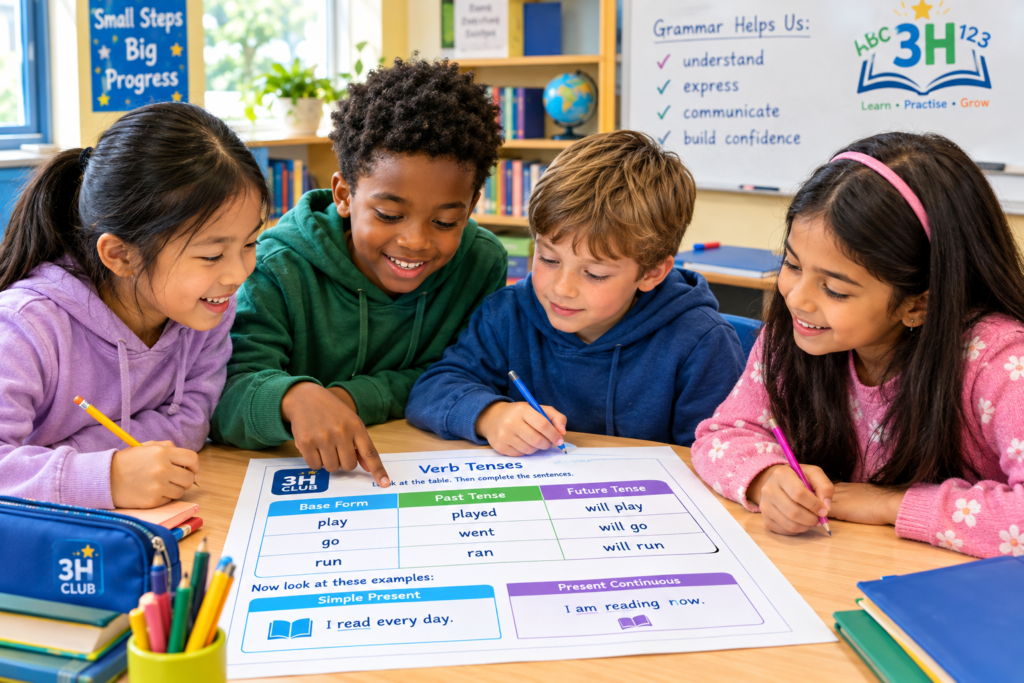
| Present form | Past form |
|---|---|
| walk | walked |
| jump | jumped |
| help | helped |
| clean | cleaned |
| look | looked |
Some spelling changes happen when we add -ed.
- like → liked
- carry → carried
- stop → stopped
These are useful spelling patterns. You do not need to memorise every rule at once. Notice how the verb changes when you read and write.
🧩 2. Irregular Verbs
Some common verbs do not form their past tense by simply adding -ed. They are called irregular verbs.
| Present form | Past form |
|---|---|
| go | went |
| eat | ate |
| see | saw |
| have | had |
| make | made |
| take | took |
| come | came |
| buy | bought |
Read these examples:
- Today I go to the park. Yesterday I went to the park.
- Today I eat an apple. Yesterday I ate an apple.
- Today I make a model. Yesterday I made a model.
These verbs are very common, so learning them will help you with everyday writing.
🌞 3. Present Simple and Present Continuous
Both forms can talk about the present, but they are used in different ways.
Present simple
We often use the present simple for habits, routines and general facts.
- I walk to school every day.
- Leo plays football on Saturdays.
- Plants need water to grow.
Notice that we often add -s or -es to the verb with he, she or it.
- I play.
- She plays.
- They watch.
- He watches.
Present continuous
We often use the present continuous for an action happening now or around the current time.
Its usual pattern is:
am / is / are + verb ending in -ing
Examples:
- I am reading.
- She is drawing.
- They are playing.
Compare:
- I play football every Saturday. (A regular activity.)
- I am playing football now. (An action happening at this moment.)
The time clue helps you understand which form is suitable.
🚀 4. Talking About the Future
Two useful ways to talk about future time are will and going to.
Using will
We often use will for predictions, offers, promises or decisions made at the time of speaking.
- I will help you carry the books.
- I think it will rain later.
- We will visit the museum next week.
Using going to
We often use going to for plans or predictions based on what we can see.
- I am going to practise my spelling tonight.
- They are going to bake a cake.
- Look at those dark clouds! It is going to rain.
Both forms can refer to the future. Which one sounds best depends on what the speaker means.
🕵️ 5. Time Clues Help You Choose
Time words can give useful hints about a verb tense.
| Time clue | Example |
|---|---|
| yesterday | We visited the farm yesterday. |
| last week | I finished my book last week. |
| every day | He practises every day. |
| now | She is writing now. |
| at the moment | They are working at the moment. |
| tomorrow | We will travel tomorrow. |
| next month | I am going to start a new club next month. |
Time clues are helpful, but do not rely on them alone. Always check what the sentence is trying to say.
🎯 Builders Activity: Choose the Right Verb
A. Complete the sentences
1. Yesterday, we ______ (visit) the aquarium.
2. Every Sunday, Ava ______ (bake) bread with her family.
3. Look! The cat ______ (climb) the tree.
4. Tomorrow, I ______ (help) my cousin with her project. Use will.
5. Last night, Dad ______ (make) soup.
B. Choose the correct sentence
6. Which sentence describes a regular habit?
A. I am brushing my teeth now.
B. I brush my teeth every morning.
C. I brushed my teeth yesterday.
7. Which sentence describes an action happening now?
A. They played outside yesterday.
B. They play outside every day.
C. They are playing outside now.
8. Which sentence uses an irregular past-tense verb?
A. She jumped over the rope.
B. She went to the shop.
C. She cleaned her desk.
C. Correct the mistakes
Rewrite each sentence with the correct verb form.
9. Yesterday, I go to the beach.
10. He play basketball every Friday.
11. We is making a poster now.
D. Your Turn
Write two sentences about an activity you enjoy:
- One sentence about what you do regularly.
- One sentence about what you did last time.
✅ Check Your Answers
- visited
- bakes
- is climbing
- will help
- made
- B — I brush my teeth every morning.
- C — They are playing outside now.
- B — She went to the shop.
- Yesterday, I went to the beach.
- He plays basketball every Friday.
- We are making a poster now.
For your own sentences, check that the verb matches the time you intended.
⭐⭐ Builder Tip: A sentence can have a time clue and a verb form. Use both to make your meaning clear.
⭐⭐⭐ Champions: Use Verb Tenses with Confidence
Around ages 10–11
You have explored past, present and future time, regular and irregular verbs, and the difference between habits and actions happening now. Next, you’ll learn more ways to describe when an action happens and how long it lasts.
🕰️ 1. Past Simple and Past Continuous
Both forms can talk about the past, but they help describe actions in different ways.
Past simple
The past simple often describes a completed action or event.
- I finished my homework.
- Maya visited the library.
- We watched a film last night.
Past continuous
The past continuous describes an action that was in progress at a particular time in the past.
Its usual pattern is:
was / were + verb ending in -ing
Examples:
- I was reading at eight o’clock.
- They were playing when the rain began.
- She was walking home when she saw her friend.
The past continuous often gives the background to another event.
Compare:
- I read the book yesterday. (The action is presented as a completed event.)
- I was reading when the phone rang. (The reading was in progress when another event happened.)
🌞 2. Present Simple and Present Continuous
These two forms are useful for describing habits and actions happening now.
| Present simple | Present continuous |
|---|---|
| I write in my diary every day. | I am writing in my diary now. |
| He plays tennis on Saturdays. | He is playing tennis at the moment. |
| They study English regularly. | They are studying English right now. |
The present simple is often used for routines, facts and states. The present continuous is often used for actions in progress.
Do not assume that the present simple always means an action is happening at this exact moment. In “I walk to school every day,” it describes a habit.
🧠 3. Present Perfect: A Past Action Connected to Now
The present perfect can connect a past event or experience to the present.
Its usual pattern is:
have / has + past participle
Examples:
- I have finished my homework.
- She has visited that museum before.
- We have seen this film.
The present perfect can be useful when the exact past time is not the main point.
Compare:
- I visited the museum last Saturday. (The sentence tells us when.)
- I have visited the museum before. (The experience matters; no exact time is given.)
The present perfect has several uses. You do not need to master them all at once, but it is useful to recognise this form when you read.
🚀 4. Ways to Talk About the Future
English uses several forms to express future time.
Will + base verb
We often use will for predictions, promises, offers and decisions.
- I will explain the answer.
- I think our team will win.
- I will help you carry those books.
Be going to + base verb
We often use going to for plans or predictions based on present evidence.
- We are going to enter the writing competition.
- She is going to practice this afternoon.
- The sky is very dark. It is going to rain.
Present continuous for arrangements
We can also use the present continuous to talk about a future arrangement.
- I am meeting my friend after school.
- We are visiting the museum on Friday.
The sentence uses a present form, but a future time expression tells us that the event is planned for later.
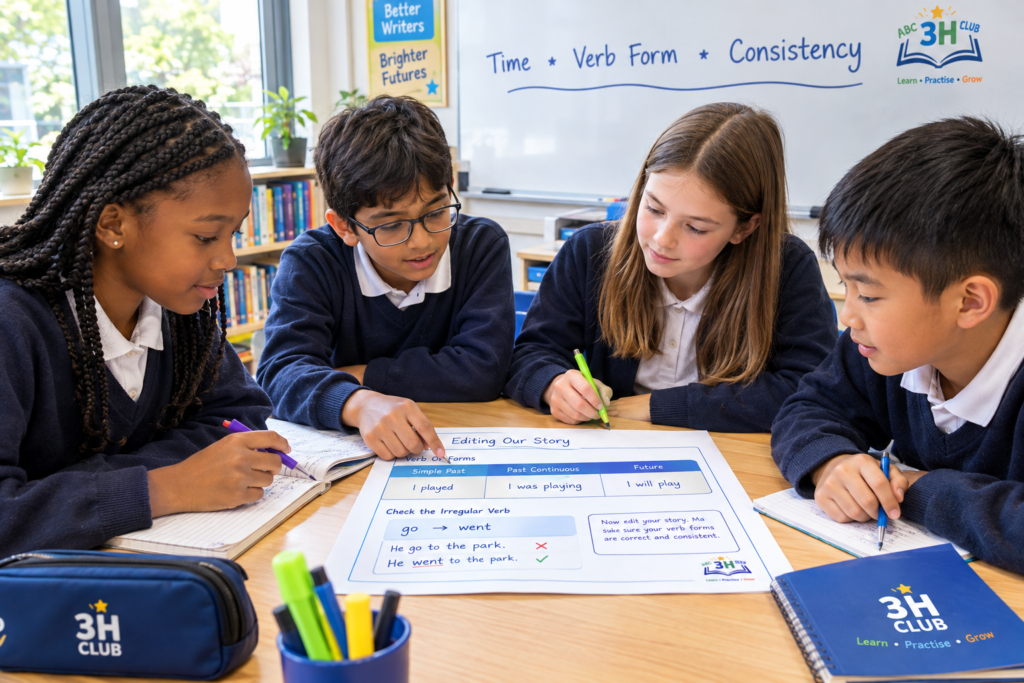
🧱 5. Keep Your Verb Tense Consistent
When you write a story or describe an event, choose verb forms that make the timeline clear.
Read this example:
Yesterday, I walked to the park. I met my friend and we played football. Then we went home.
The past-tense verbs walked, met, played and went keep the events in a clear past-time sequence.
Now look at this version:
Yesterday, I walked to the park. I meet my friend and we played football. Then we go home.
The verbs suddenly shift into the present, making the timeline confusing.
How to check your writing
- Decide when the events happen.
- Underline the verbs.
- Check whether each verb matches the timeline.
- Change any verb that does not fit, unless you have a clear reason to change the time.
- Read the passage aloud to check that it makes sense.
A tense shift is not always wrong. Writers sometimes change tense for a reason, such as moving from a past event to a general truth or to what is happening now. The key is to make the change clear.
📝 6. Irregular Verbs: Past Forms and Past Participles
Some irregular verbs have different forms for the past simple and the past participle.
| Base form | Past simple | Past participle |
|---|---|---|
| go | went | gone |
| see | saw | seen |
| write | wrote | written |
| eat | ate | eaten |
| take | took | taken |
| break | broke | broken |
| do | did | done |
| speak | spoke | spoken |
Compare:
- Yesterday, I wrote a story.
- I have written three stories this month.
The past simple uses wrote. The present perfect uses have written.
This is why learning irregular verb forms can improve your writing.
🎯 Champions Challenge: Become a Tense Detective
A. Choose the best verb form
1. At seven o’clock last night, I ______ a book.
A. read
B. was reading
C. will read
2. She ______ the science museum last Saturday.
A. visits
B. visited
C. has visit
3. We ______ our project, so we can show it to the class.
A. have finished
B. has finished
C. finishing
4. Look at those clouds! It ______ rain.
A. is going to
B. went to
C. was
B. Correct the sentences
5. Last weekend, we go to the farm and see some goats.
6. She have finished her homework.
7. At six o’clock yesterday, they was eating dinner.
8. I am play football every Saturday.
C. Identify the tense or form
9. “They were building a sandcastle when the tide came in.”
Which verb phrase describes the action that was already in progress?
10. “I have lost my pencil.”
Which verb phrase connects a past event with the present?
11. “We are meeting our cousins tomorrow.”
Which words show the future arrangement?
D. Editing Challenge
Read this short paragraph:
Last Saturday, Ella visits her aunt. They baked biscuits and make a card. While the biscuits were cooling, Ella draws a picture. They gave the card to her aunt before Ella went home.
Rewrite the paragraph so the past-time sequence is clear.
E. Write Your Own
Write a short paragraph of four or five sentences about a memorable day. Include:
- At least three past-tense verbs.
- One irregular past-tense verb.
- A time clue such as last week or yesterday.
- A clear sequence of events.
Then underline your verbs and check that the timeline is easy to follow.
✅ Check Your Answers
- B — was reading
- B — visited
- A — have finished
- A — is going to
- Last weekend, we went to the farm and saw some goats.
- She has finished her homework.
- At six o’clock yesterday, they were eating dinner.
- I play football every Saturday.
- were building
- have lost
- are meeting and tomorrow show that the meeting is a future arrangement.
Editing Challenge — one possible correction:
“Last Saturday, Ella visited her aunt. They baked biscuits and made a card. While the biscuits were cooling, Ella drew a picture. They gave the card to her aunt before Ella went home.”
Your own paragraph will be different. Check each verb against the time you are describing.
⭐⭐⭐ Champion Tip: Strong writers do not simply choose a tense because a sentence contains a time word. They think about what they want the reader to understand: a completed event, a regular habit, an action in progress, an experience connected to now or a future plan.
🧠 Big Verb Tenses Challenge
Try this final challenge to see how much you have learned.
⭐ Starters
1. Which sentence is about the past?
A. I will jump.
B. I jumped.
C. I jump every day.
2. Complete the sentence: “Tomorrow, we ______ visit the park.”
3. Is “I am drawing now” describing a habit or an action happening now?
⭐⭐ Builders
4. What is the past form of go?
5. Complete the sentence: “Every morning, she ______ (walk) to school.”
6. What is the difference between “I read every day” and “I am reading now”?
⭐⭐⭐ Champions
7. Complete the sentence: “While I ______ (walk) home, I saw a rainbow.”
8. Choose the correct sentence:
A. She have written a letter.
B. She has wrote a letter.
C. She has written a letter.
9. Correct this sentence: “Yesterday, we are playing in the garden.”
10. Write one sentence using the past continuous and another using the present perfect.
✅ Big Challenge Answers
- B — I jumped.
- will
- An action happening now.
- went
- walks
- “I read every day” describes a regular habit; “I am reading now” describes an action in progress.
- was walking
- C — She has written a letter.
- “Yesterday, we were playing in the garden” or “Yesterday, we played in the garden,” depending on the intended meaning.
- Answers will vary. Examples: “I was reading when the bell rang.” “I have finished my drawing.”
📌 Verb Tenses Checklist
Before you finish, check that you can:
- ⏪ Recognise past-tense verbs and describe completed events.
- 🌞 Use the present simple for habits and general truths.
- 🔄 Use the present continuous for actions in progress.
- ⏩ Talk about future plans and predictions using will and going to.
- 🧩 Recognise common irregular verbs such as went, saw, made and written.
- 🕰️ Understand how the past continuous describes an action in progress in the past.
- 🔗 Recognise how the present perfect connects a past event or experience with the present.
- ✏️ Check that verb forms make the timeline clear in your writing.
The most important rule: Choose a verb form that matches what you want to say about time. Then check that your reader can follow the sequence of events.
❓ Verb Tenses — Frequently Asked Questions
What is a verb tense?
A verb tense is a grammatical form that helps show when an action, event or state happens. In this lesson, we group examples into past, present and future time.
What are the three main time groups?
The three useful starting points are past, present and future. Past describes what happened before now, present can describe what happens regularly or is true now, and future describes what is expected or planned to happen later.
What is the past tense?
The past tense is used to talk about actions or events that happened before now. Examples include “I played”, “She went” and “They saw”.
What is the present tense?
The present tense can describe habits, routines and general truths. Examples include “I play every day” and “The Earth moves around the Sun”. Present forms can also describe actions happening now, as in “I am playing”.
What is the future tense?
In everyday learning, “future tense” often means ways of talking about future time. English commonly uses forms such as will play, am going to play and am playing tomorrow.
What is the difference between past simple and past continuous?
The past simple often presents an event as completed, as in “I finished my work”. The past continuous describes an action that was in progress at a time in the past, as in “I was finishing my work when the bell rang”.
What is the difference between present simple and present continuous?
The present simple often describes routines or facts: “She walks to school every day.” The present continuous often describes an action in progress: “She is walking to school now.”
What are irregular verbs?
Irregular verbs do not form their past tense by simply adding -ed. Examples include go → went, see → saw and make → made.
What is the present perfect?
The present perfect uses have or has with a past participle, as in “I have finished” or “She has written”. It often connects a past action or experience with the present.
Why is it important to keep verb tenses consistent?
Consistent verb forms help readers follow when events happen. If you are telling a story about yesterday, past-tense verbs usually help keep the timeline clear. You can change tense when you have a reason, but the change should make sense.
How can I get better at using verb tenses?
Read stories, notice the verbs authors use, practise changing sentences from past to present or future, and check the verbs in your own writing. Learning common irregular verbs will also help.
Keep reading, keep writing and keep practising. Learn • Practise • Grow with 3HClub!