Write a Short Poem for Kids:
✍️ Turn Your Ideas into Poetry!
⭐⭐⭐ CHAMPIONS — Ages 10–11
📚 Subject: English – Poetry, Creative Writing and Grammar
🎯 Skills: Poetry writing, imagery, rhyme, rhythm, line breaks, stanzas, sensory language, figurative language, subject and predicate, editing and creative expression.
🌟 Hello, Young Poet!
Imagine standing beside the sea as the sun begins to rise.
You could write:
The sun rose over the sea.
That’s a clear sentence.
But what if you wanted readers to feel the quiet beauty of the moment?
You might write:
Gold spills across the waking sea,
Soft waves whisper back to me.
These two lines use carefully chosen words, sound and imagery to create a poetic effect.
That’s the exciting thing about poetry.
You can use a few words to express a big idea.
A poem doesn’t have to be long. It doesn’t even have to rhyme.
Some poems tell stories. Others describe nature, celebrate friendships, ask questions or express emotions.
Your poem can be playful, thoughtful, mysterious, cheerful or surprising.
In this lesson, you’ll discover how to choose powerful words, experiment with poetic techniques and create original short poems.
Ready to find your poetic voice?
Let’s begin!
🎯 What Will You Learn?
By the end of this lesson, you will be able to:
- Explain what makes a piece of writing a poem.
- Recognise lines, stanzas and different poem structures.
- Identify subjects and predicates in poetic sentences.
- Use precise nouns, verbs and descriptive language.
- Experiment with rhyme and rhythm.
- Use similes, metaphors and personification.
- Create imagery using the five senses.
- Write free verse, rhyming poems and cinquains.
- Choose effective line breaks and repetition.
- Express feelings through images and actions.
- Read poems aloud and improve their sound.
- Plan, draft, revise and present an original poem.
⭐ Your mission: Write a short poem that expresses a clear idea and uses language in an imaginative, purposeful way.
⭐ STAGE 1: POETRY EXPLORERS
Discover poetic language and build strong lines
🔵 1. What Is a Poem?
A poem is a form of creative writing that uses language in thoughtful, expressive ways.
Poems often use:
- Carefully chosen words.
- Lines and stanzas.
- Images that appeal to the senses.
- Interesting sounds or rhythms.
- Comparisons and figurative language.
- Feelings, ideas and observations.
Some poems rhyme, but many do not.
Some poems tell complete stories, while others focus on a single moment.
Compare Prose and Poetry
Prose:
Rain fell on the garden. The leaves moved in the wind, and puddles formed along the path.
Poetry:
Rain taps on the garden leaves,
Wind bends branches overhead.
Silver puddles fill the path,
Where hurried footsteps once had led.
Both describe the same scene, but the poem uses line breaks, rhythm and imagery to shape the experience.
✏️ Activity 1: Poetry Detective
Read:
The moon climbs over sleepy hills,
The night grows quiet, calm and still.
Answer:
- How many lines are there?
- Which words rhyme?
- What time of day does the poem describe?
- What atmosphere does it create?
- Does the moon literally climb? Explain.
⭐ Remember
Poetry is not simply prose with shorter lines. Poets choose words, sounds, images and line breaks to create meaning and effect.
🟢 2. Learn About Lines and Stanzas
A line is one row of words in a poem.
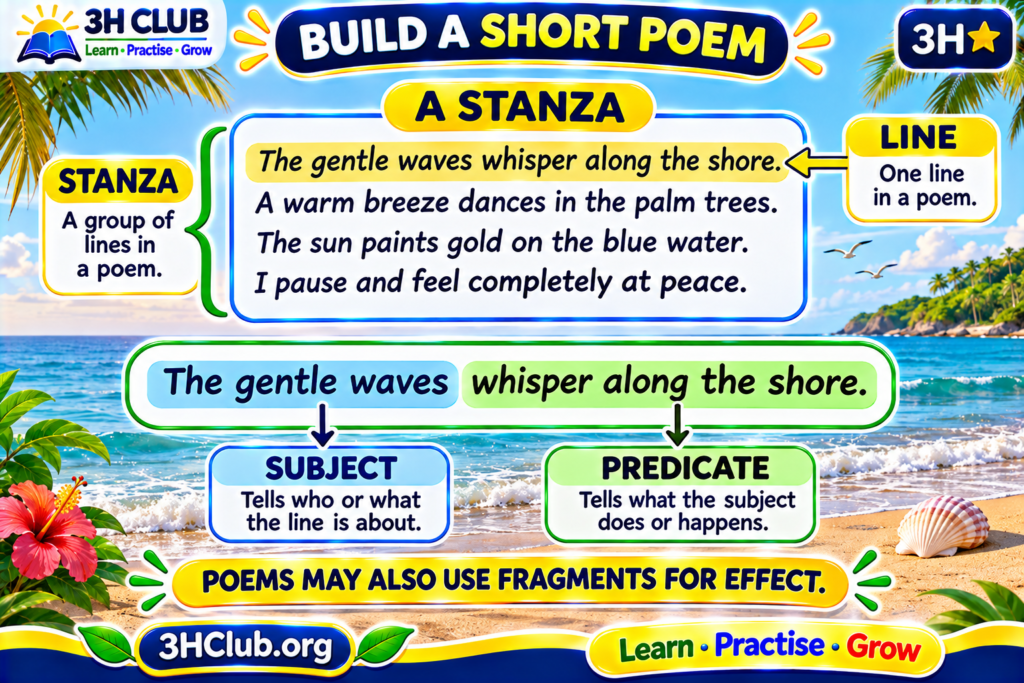
A stanza is a group of lines. It is similar to a paragraph in prose because it can organise a poem into sections.
Look at this original poem.
🌿 The Garden at Dawn
The garden wakes beneath the sun,
And shadows slowly disappear.
A tiny bird begins to sing,
Its cheerful song is bright and clear.
The flowers lift their coloured heads,
The morning breeze moves through the trees.
The world feels fresh and full of hope,
With dancing leaves and humming bees.
This poem has:
- Eight lines.
- Two stanzas.
- Four lines in each stanza.
The space between the stanzas helps organise the poem.
✏️ Activity 2: Count the Lines
Read:
The river runs beyond the hill,
Past stones that shine beneath the sky.
It winds around the sleeping fields,
As clouds move quietly nearby.
Answer:
- How many lines are there?
- How many stanzas are there?
- Which line mentions movement in the sky?
- What is the main subject of the poem?
✏️ Activity 3: Create a Four-Line Stanza
Choose one topic:
A. A rainy afternoon.
B. A busy playground.
C. A quiet beach.
D. A colourful garden.
Write four lines describing your chosen scene.
Your poem does not need to rhyme.
🟡 3. Choose a Topic and Main Idea
Every poem begins with something worth noticing, imagining or expressing.
You might write about:
Nature: A storm, sunrise, river, forest or butterfly.
Feelings: Courage, excitement, worry, hope or gratitude.
People: A friend, family member or someone who inspires you.
Everyday moments: Walking to school, opening a book or hearing rain.
Imagination: A talking cloud, a secret island or a clock that remembers yesterday.
Turn a Broad Topic into a Clear Idea
Broad topic: The sea.
Focused idea: The peaceful sound of waves at sunrise.
Broad topic: Friendship.
Focused idea: A friend helping you feel brave on your first day at a new school.
A focused idea helps you decide which details belong in your poem.
✏️ Activity 4: Find the Focus
Turn these broad topics into more specific ideas.
- Rain.
- School.
- A tree.
- Friendship.
- The night sky.
Example:
Topic: Rain.
Focused idea: The first raindrops after a long, hot afternoon.
🔵 4. Understand Subjects and Predicates in Poetry
Poetry often uses the same sentence-building skills you practise in other writing.
A complete sentence normally has a subject and a predicate.
The subject tells us who or what the sentence is about.
The predicate tells us what the subject does, is or experiences.
Example 1
The silver moon shines above the sea.
Complete subject: The silver moon.
Complete predicate: shines above the sea.
Example 2
The gentle waves whisper along the shore.
Complete subject: The gentle waves.
Complete predicate: whisper along the shore.
Example 3
Bright stars glitter in the evening sky.
Complete subject: Bright stars.
Complete predicate: glitter in the evening sky.
But Poetry Can Also Use Fragments
Read:
Silver moonlight.
An empty road.
Footsteps in the distance.
These are phrases rather than complete sentences.
They do not each contain a complete subject-and-predicate structure.
A poet may use fragments deliberately to create a particular rhythm, mood or emphasis.
For this lesson, practise complete sentences first. Then experiment with fragments when they serve a clear poetic purpose.
✏️ Activity 5: Subject and Predicate Detective
Identify the complete subject and predicate.
- The golden sun rises over the hills.
- A tiny bird sings beside the window.
- The restless wind shakes the branches.
- Bright lanterns glow along the street.
- The quiet river reflects the stars.
✏️ Activity 6: Complete Sentence or Poetic Fragment?
Label each example.
- The rain drums on the roof.
- A whisper in the dark.
- The old clock ticks.
- Beneath the silver moon.
- The flowers sway in the breeze.
- Footsteps along the empty road.
Then turn two fragments into complete sentences.
⭐ Grammar Reminder
Knowing the difference between complete sentences and fragments helps you make deliberate writing choices.
🟢 5. Choose Powerful Nouns and Verbs
Strong poems often depend on precise nouns and verbs.
A noun names a person, place, thing or idea.
A verb expresses an action or state.
Compare:
Basic: The bird moved.
Stronger: The heron glided.
Compare:
Basic: The water went over the rocks.
Stronger: The stream tumbled over the rocks.
The more precise verbs create clearer images.
Useful Poetry Words
| Ordinary Word | More Precise Possibilities |
|---|---|
| Went | wandered, rushed, crept, glided |
| Made a sound | whispered, rattled, echoed, hummed |
| Looked | gazed, peered, glanced, watched |
| Shone | glimmered, shimmered, glittered |
| Moved | swayed, drifted, darted, rolled |
✏️ Activity 7: Upgrade the Line
Improve the bold words.
- The butterfly moved above the flowers.
- The river went around the stones.
- The wind made a sound in the trees.
- The stars looked bright.
- The kitten went across the garden.
Use precise words that fit the scene.
⭐⭐ STAGE 2: POETRY CREATORS
Explore sound, imagery and poetic techniques
🟣 6. Discover Rhyme
Rhyme happens when words have matching or similar ending sounds.
Examples:
- Light / night.
- Tree / sea.
- Glow / snow.
- Play / day.
- Bright / flight.
Rhyming words do not always have the same spelling.
For example, blue and through rhyme.
Example: A Rhyming Poem
The stars appear in skies of blue,
As evening paints a darker hue.
The quiet moon begins to glow,
Above the fields and trees below.
This poem uses pairs of rhyming line endings:
blue / hue
glow / below
Rhyme Scheme
A rhyme scheme is the pattern of rhyming sounds at the ends of lines.
We use letters to show the pattern.
For the poem above:
- Blue — A.
- Hue — A.
- Glow — B.
- Below — B.
The rhyme scheme is AABB.
✏️ Activity 8: Find the Rhymes
Read:
The morning sun begins to rise,
And paints soft colours through the skies.
The waves roll gently to the shore,
Then turn and travel back once more.
Answer:
- Which words rhyme?
- What is the rhyme scheme?
- How many lines are there?
- What is the main setting?
✏️ Activity 9: Write a Rhyming Couplet
A couplet is a pair of lines. A rhyming couplet has matching ending sounds.
Complete:
The little boat sailed out to sea,
____________________________.
Or create your own two-line rhyming poem.
⭐ Important
Never force an unnatural word into a poem just to make it rhyme.
Meaning matters more than a perfect rhyme.
🔵 7. Explore Rhythm
Rhythm is the pattern of beats and movement in language.
Poems can have regular rhythms or more flexible ones.
Read these lines aloud:
The raindrops tap upon the ground,
And little streams go rushing round.
Notice how the words move as you speak.
Now read:
Rain falls.
One drop.
Then another.
The whole garden listens.
The second poem has a slower, less regular rhythm.
Both approaches can work.
How to Improve Rhythm
- Read your poem aloud.
- Listen for awkward phrases.
- Remove unnecessary words.
- Change a line if it sounds forced.
- Use pauses when they strengthen the meaning.
✏️ Activity 10: Read for Rhythm
Read:
The leaves dance softly in the breeze,
The sunlight slips between the trees.
Then read:
The leaves are moving in a soft and very gentle breeze,
And there is some sunlight that is going between the trees.
Which version sounds smoother?
Explain why.
Rewrite the longer version in your own words.
🟢 8. Use the Five Senses to Create Imagery
Imagery is language that helps readers imagine experiences, often through the senses.
Think about what your reader might:
- 👀 See.
- 👂 Hear.
- 👃 Smell.
- 👅 Taste.
- ✋ Feel.
Example: The Market
Red mangoes shine beneath the sun,
While cheerful traders call to everyone.
Warm bread sends its scent along the street,
And cool stone rests beneath my feet.
This poem uses sight, hearing, smell and touch.
You do not need all five senses in every poem.
Choose the details that best express your idea.
✏️ Activity 11: Sensory Poetry Challenge
Choose a setting:
A. A tropical beach.
B. A rainforest after rain.
C. A busy morning market.
D. A quiet library.
Write four lines using at least three relevant sensory details.
⭐ Sensory Writing Tip
Avoid adding a taste description unless tasting something makes sense in the scene.
🖼️ IMAGE 3 PLACEHOLDER — Sensory Imagery in Poetry
📷 Image tag: [IMAGE: five-senses-imagery-poetry-for-kids.webp]
🎨 Image description: A polished five-panel poetry infographic titled CREATE IMAGERY WITH THE FIVE SENSES. Show a tropical seaside scene with accurate connected examples: SIGHT — Golden sunlight, HEARING — Rolling waves, SMELL — Fresh sea air, TASTE — Sweet mango, TOUCH — Cool wet sand. Show a child actually eating mango for the taste example. Include a small four-line original poem about the beach with clear line breaks, and the reminder CHOOSE THE DETAILS THAT FIT YOUR POEM. Use the official 3H CLUB logo, navy site icon with yellow star, exact tagline and navy/blue/green/yellow palette.
🏷️ Alt text: Five senses poetry infographic showing sight, hearing, smell, taste and touch through a tropical seaside scene.
📝 Caption: 🌈 Sensory imagery helps readers picture, hear and feel the world of your poem.
🟡 9. Write Similes and Metaphors
A simile compares two things using like or as.
Examples:
The moon glows like a silver coin.
The water is as smooth as glass.
A metaphor describes one thing as another to suggest a shared quality.
Examples:
The moon is a silver lantern.
The classroom is a hive of activity.
The classroom is not literally a hive. The metaphor suggests that it is busy and full of movement.
Compare
Literal: The stars are bright.
Simile: The stars glitter like diamonds.
Metaphor: The stars are diamonds scattered across the sky.
Each version creates a different effect.
✏️ Activity 12: Identify the Comparison
Label each example as a simile or metaphor.
- The clouds were cotton blankets across the sky.
- The river shone like polished glass.
- Her laughter was music in the room.
- The leaves floated like tiny boats.
- The night was a dark curtain over the hills.
✏️ Activity 13: Create Your Own
Write:
- A simile about rain.
- A metaphor about the sun.
- A simile about the sea.
- A metaphor about friendship.
Choose comparisons that make sense and add meaning.
🟣 10. Bring Poetry to Life with Personification
Personification gives human-like actions or qualities to something non-human.
Examples:
The wind whispered through the trees.
The sleepy town stretched beneath the sunrise.
The old gate complained as it opened.
Personification can make a setting feel alive.
Example Poem: The Wind’s Secret
The wind tiptoes across the hill,
Then whispers to the trees.
It gathers stories from the clouds,
And carries them with ease.
The wind does not literally tiptoe or gather stories.
These imaginative actions create a playful picture.
✏️ Activity 14: Personification Challenge
Choose three:
Rain, wind, river, sunlight, moon, clouds, flowers, ocean.
Write one line of personification for each.
Then combine your favourite lines into a short poem.
🔵 11. Try Repetition and Alliteration
Repetition
Repetition means deliberately using a word, phrase or idea more than once.
It can create emphasis, rhythm or a memorable pattern.
Example:
I hear the rain.
I hear the wind.
I hear the world begin again.
The repeated phrase I hear connects the lines.
Alliteration
Alliteration is the repetition of initial consonant sounds in nearby words.
Examples:
Silver stars shimmer.
Busy bees buzz.
Wild winds whistle.
Alliteration can make a line memorable, but too much can make it sound unnatural.
✏️ Activity 15: Sound Pattern Challenge
Part A — Repetition
Write three lines beginning with:
I remember…
Part B — Alliteration
Write a short poetic line using two or three words beginning with the same consonant sound.
Part C — Explain
Which technique creates emphasis? Which technique repeats initial consonant sounds?
🟢 12. Discover Different Types of Short Poems
You can write poetry in many forms.
Here are three useful styles to try.
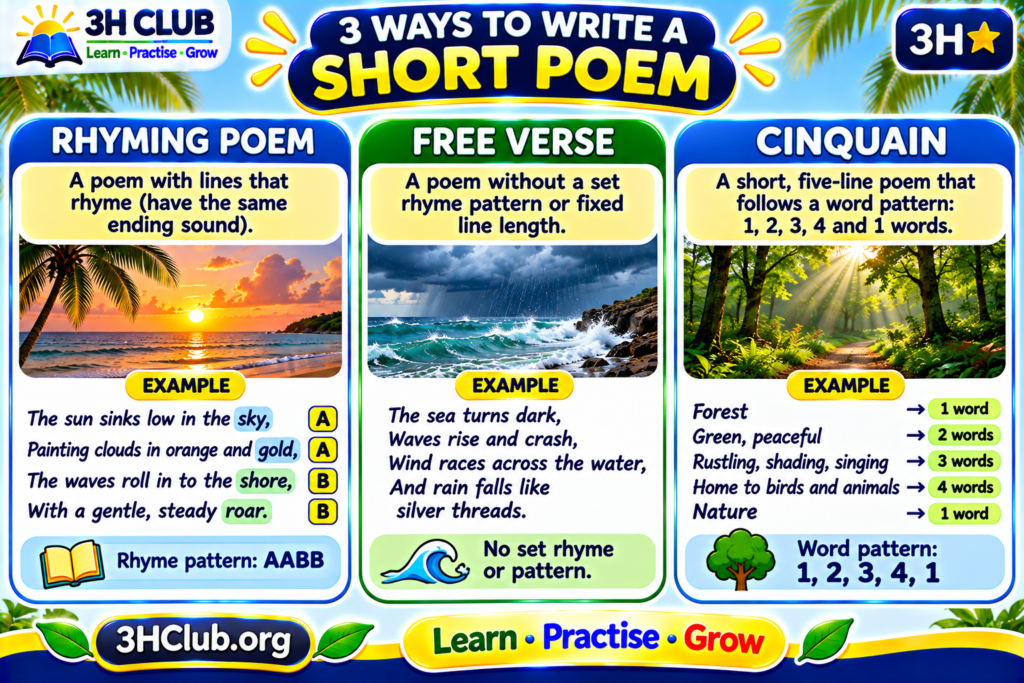
A. Rhyming Poem
A rhyming poem uses matching ending sounds.
🌙 Evening Sky
The sunset fades beyond the bay,
And golden colours drift away.
The stars appear, so clear and bright,
Like tiny lanterns in the night.
Rhyme scheme: AABB.
B. Free Verse
Free verse does not follow a fixed rhyme scheme or regular metre.
It still uses carefully chosen words, line breaks and sound.
🌊 Before the Storm
The sea grows quiet.
Dark clouds gather
above the distant boats.
One seabird turns,
then disappears
into the heavy sky.
Notice how the short lines create pauses.
C. Cinquain
A cinquain is a five-line poem. There are several types of cinquains.
For this lesson, try a simple classroom word-pattern cinquain:
- Line 1: One word naming the topic.
- Line 2: Two describing words.
- Line 3: Three action words.
- Line 4: Four words expressing an idea or feeling.
- Line 5: One word summarising the topic.
🌳 Forest
Forest
Green, peaceful
Growing, sheltering, whispering
Home to countless creatures
Life
This is a useful classroom pattern, not a rule for every cinquain.
✏️ Activity 16: Try Three Poetry Forms
Choose one topic, such as the sea, friendship or a garden.
Write:
- A four-line rhyming poem.
- A four-to-six-line free verse poem.
- A five-line word-pattern cinquain.
Compare how the same topic feels in different forms.
⭐⭐⭐ STAGE 3: POETRY MASTERS
Analyse, write and improve original poetry
📖 13. Model Poem: The Rain Returns
Read this original poem carefully.
Think about the sounds, images and feelings it creates.
🌧️ The Rain Returns
All afternoon the earth lay still,
Beneath the sun’s unbroken glow.
The thirsty garden waited there,
Where dusty paths ran dry and slow.
Then clouds arrived across the hill,
And distant thunder shook the air.
The first cool raindrops touched the leaves,
Like tiny footsteps everywhere.
The roof began its steady song,
The branches danced beside the door.
The garden drank the welcome rain,
And green seemed brighter than before.
At last the clouds moved out to sea,
The evening sky turned soft and clear.
One silver drop slid from a leaf,
And all the world felt fresh and near.
🔍 Poetry Detective
| Feature | Example |
|---|---|
| Main topic | Rain returning after a dry afternoon |
| Setting | A garden |
| Stanzas | Four |
| Lines | Sixteen |
| Sight | Clouds, dusty paths, green garden, silver drop |
| Hearing | Thunder, rain on the roof |
| Touch | Cool raindrops |
| Simile | Like tiny footsteps everywhere |
| Personification | The thirsty garden waited; the garden drank |
| Atmosphere | Changes from dry and still to refreshed and peaceful |
| Precise verb | Shook, touched, danced, slid |
| Rhyme | Some line endings rhyme, but not every pair |
📖 Reading Comprehension Questions
- What is the setting?
- How does the garden seem before the rain?
- What change in weather begins the second stanza?
- What sound does the thunder make?
- Which line uses a simile?
- What is being compared in that simile?
- Find two examples of personification.
- What does The roof began its steady song suggest?
- How does the garden change after the rain?
- Which image appears near the end of the poem?
- How does the mood change?
- What do you think the poet wants readers to notice about rain?
✏️ Activity 17: Find the Poetic Techniques
Find an example of:
- A precise verb.
- A simile.
- Personification.
- Hearing imagery.
- Sight imagery.
- A line describing change.
- A complete subject.
- A complete predicate.
✏️ Activity 18: Grammar in Poetry
Identify the complete subject and predicate.
- The thirsty garden waited there.
- Distant thunder shook the air.
- The first cool raindrops touched the leaves.
- The branches danced beside the door.
- One silver drop slid from a leaf.
🧠 Think More Deeply
Why might the poet have chosen thirsty garden instead of dry garden?
Does every line need to rhyme?
How does the final image of a single drop help end the poem?
What would change if the poem ended with a loud clap of thunder instead?
✍️ 14. Plan Your Own Short Poem
Before writing, decide what you want your poem to express.
📝 My Poetry Planner
Poem topic: __________
Main idea or feeling: __________
Setting, if needed: __________
Mood: __________
Three useful images: __________
Interesting sounds: __________
Two precise verbs: __________
Possible simile or metaphor: __________
Possible personification: __________
Poem form: Rhyming / Free verse / Cinquain
Possible opening line: __________
Possible final image or thought: __________
Example Planner
Topic: A quiet beach at sunrise.
Main idea: The peaceful beginning of a new day.
Mood: Calm and hopeful.
Images: Pale sand, golden sunlight, small waves.
Sounds: Gentle waves, distant seabirds.
Precise verbs: Shimmer, glide.
Simile: The sea shines like polished glass.
Personification: The morning stretches across the shore.
Form: Free verse.
Opening line: The first light touches the sand.
Ending idea: The day feels full of possibilities.
✏️ Activity 19: Plan Your Poem
Choose one topic:
A. A place I love.
B. The first rain after a hot day.
C. A moment of courage.
D. My favourite time of day.
E. A journey through an imaginary world.
Complete the planner.
Choose only the techniques that help your idea.
🟢 15. Write Your First Draft
Your first draft does not need to be perfect.
Begin with your strongest image or idea.
Example: First Draft
The sun came up.
The sea was blue.
The waves were moving.
It was a beautiful morning.
This expresses an idea, but the language is general.
Improved Draft
Gold stretches across the sea,
Small waves curl along the shore.
A seabird glides through morning light,
And quiet fills the world once more.
The improved version uses more precise verbs and images.
✏️ Activity 20: Write Your Poem
Write a poem of eight to twelve lines.
Try to include:
- A clear topic or feeling.
- At least two vivid images.
- Three precise nouns or verbs.
- One example of figurative language, if it fits.
- Deliberate line breaks.
- A memorable ending.
You may use rhyme or free verse.
🔵 16. Choose Effective Line Breaks
Poets decide where each line ends.
A line break can create a pause, emphasise a word or guide the reader’s attention.
Compare:
Version A
The small boat moved slowly across the quiet water beneath the morning sky.
Version B
The small boat moved slowly
across the quiet water
beneath the morning sky.
The words are the same, but the second version invites the reader to notice each part of the scene.
✏️ Activity 21: Line Break Experiment
Rewrite this sentence as a short free verse poem:
The first raindrop landed on the dusty path and the whole garden seemed to wake.
Try two different arrangements of the same words.
Read both aloud.
Which version creates the effect you prefer?
Explain why.
🟣 17. Edit Your Poem Like a Poet
Editing is not just correcting spelling.
It is also about improving meaning, sound and imagery.
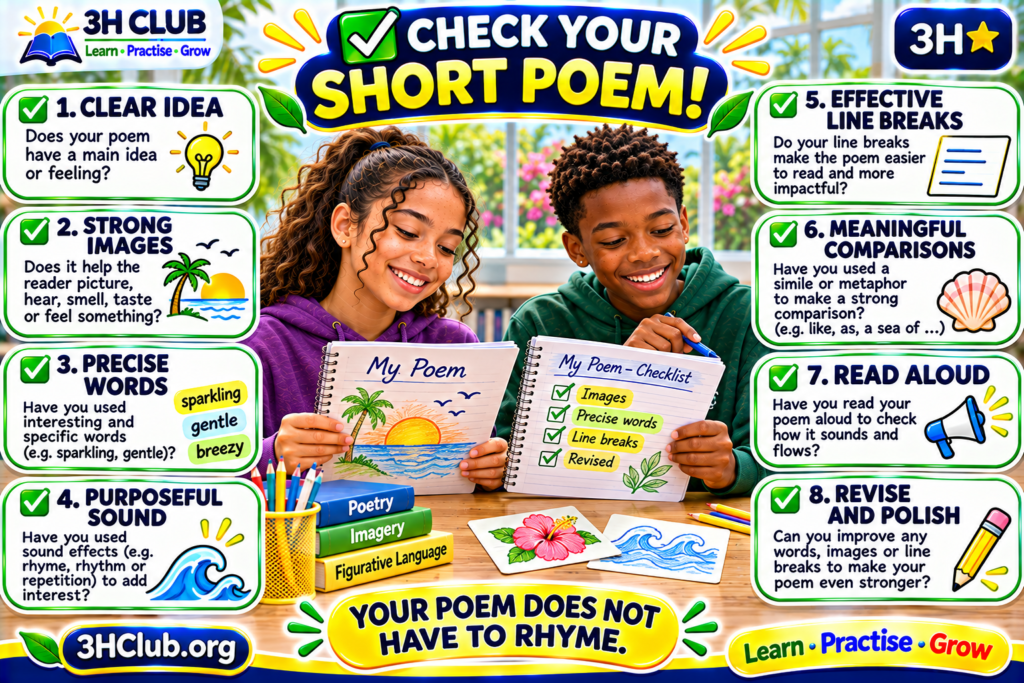
Ask Yourself
Meaning: Does my poem express a clear idea or feeling?
Words: Can I replace a general word with a more precise one?
Imagery: Can the reader imagine what I describe?
Sound: Does the poem sound natural when read aloud?
Line breaks: Do they support the rhythm or emphasis?
Figurative language: Do my comparisons make sense?
Grammar: Are any sentence fragments deliberate?
Ending: Does the final line leave a useful image, thought or feeling?
✏️ Activity 22: Poetry Editing Challenge
Improve this poem:
The wind was strong.
The trees moved a lot.
The clouds were dark.
The weather was bad.
Write four to six lines.
Try using:
- Two precise verbs.
- One sound detail.
- One example of figurative language.
- A consistent atmosphere.
🎲 18. Five Fun Poetry Writing Games
🎯 Game 1: Rhyme Hunt
Choose a word such as light, sea or day.
Find five words that rhyme.
Then write a two-line poem using one pair.
🌈 Game 2: Five-Senses Poetry
Choose a place and write one poetic line for each relevant sense.
You may leave out senses that don’t fit.
🧩 Game 3: Poetry Word Swap
Start with a general word such as went, nice or bright.
Find three more precise alternatives.
Use your favourite in a poetic line.
🎭 Game 4: Mood Switch
Write four lines about a garden.
First, make it feel peaceful.
Then rewrite the lines to make it feel mysterious.
🎤 Game 5: Poetry Performance
Read a poem aloud.
Experiment with pauses, pace and emphasis.
Ask a listener which words or images they remember most.
🏆 19. Final Poetry Champions Challenge
Part A: Poetry Knowledge
Choose the correct answer.
1. What is a stanza?
A. A group of lines in a poem.
B. A type of punctuation mark.
C. A word that always rhymes.
2. Must every poem rhyme?
A. Yes.
B. No.
C. Only poems about nature.
3. What is imagery?
A. A list of unrelated adjectives.
B. Language that helps readers imagine experiences.
C. Writing without verbs.
Part B: Identify the Technique
Name the main technique.
- The wind whispered through the trees.
- The moon was a silver lantern.
- The river sparkled like glass.
- Wild winds whistled.
- I remember the sea. I remember the sky. I remember the light.
Choose from personification, metaphor, simile, alliteration, repetition.
Part C: Subject and Predicate
Identify the complete subject and predicate.
- The golden moon shines above the sea.
- The gentle rain taps against the roof.
- Bright butterflies glide over the flowers.
- The old clock ticks beside the window.
Part D: Rhyme Scheme
Read:
The little stars begin to glow,
Above the fields of falling snow.
The moon appears beyond the bay,
And slowly lights the distant way.
Identify the rhyme scheme.
Part E: Improve the Poetic Line
Rewrite:
The bird went across the sky.
Use a more precise verb and at least one useful descriptive detail.
Part F: Write a Cinquain
Create a five-line word-pattern cinquain about:
The Ocean, Friendship, Rain or A Forest.
Follow the classroom pattern:
1 word / 2 words / 3 words / 4 words / 1 word.
⭐ Final Creative Writing Mission
Write an original poem titled:
A Moment Worth Remembering
Your poem should include:
- A clear topic or feeling.
- Eight to twelve lines.
- At least two vivid images.
- Three precise words.
- One purposeful poetic technique.
- Thoughtful line breaks.
- A memorable final line.
After writing, read your poem aloud and revise it.
Then give your poem a title that suits its meaning.
✅ 20. Check Your Answers!
Activity 1: Poetry Detective
- Two lines.
- Hills and still.
- Night or evening.
- Quiet and peaceful.
- No. It is personification because the moon is described as climbing.
Activity 2: Count the Lines
- Four lines.
- One stanza.
- Line four.
- The river.
Activity 3: Four-Line Stanza
Answers will vary.
Example:
Rain taps softly on the roof,
And gathers on the ground.
The garden drinks the welcome drops,
While birds wait without a sound.
Activity 4: Find the Focus
Possible answers:
- Rain tapping on the classroom windows.
- The excitement of the last school day.
- An old mango tree sheltering birds.
- A friend offering help during a difficult moment.
- The first stars appearing after sunset.
Activity 5: Subjects and Predicates
| Complete Subject | Complete Predicate |
|---|---|
| The golden sun | rises over the hills |
| A tiny bird | sings beside the window |
| The restless wind | shakes the branches |
| Bright lanterns | glow along the street |
| The quiet river | reflects the stars |
Activity 6: Sentences and Fragments
- Complete sentence.
- Fragment.
- Complete sentence.
- Fragment.
- Complete sentence.
- Fragment.
Possible revisions:
An unexpected whisper echoed in the dark.
Footsteps sounded along the empty road.
Activity 7: Upgrade the Line
Possible answers:
- The butterfly fluttered above the flowers.
- The river wound around the stones.
- The wind whispered in the trees.
- The stars glittered.
- The kitten crept across the garden.
Activity 8: Find the Rhymes
- Rise/skies and shore/more.
- AABB.
- Four.
- A seaside setting at sunrise.
Activity 9: Rhyming Couplet
Possible answer:
The little boat sailed out to sea,
Beyond the rocks where gulls flew free.
Activity 10: Rhythm
The shorter version generally sounds smoother because it avoids unnecessary words and has a more regular rhythm.
Activity 11: Sensory Poetry
Answers will vary.
Possible example:
Bright shells shine along the shore,
Soft waves whisper evermore.
The salty breeze moves through the air,
And cool wet sand lies everywhere.
Activity 12: Simile or Metaphor
- Metaphor.
- Simile.
- Metaphor.
- Simile.
- Metaphor.
Activity 13: Create Comparisons
Possible answers:
- Rain tapped like tiny fingers on the roof.
- The sun was a golden lantern.
- The sea shimmered like polished glass.
- Friendship is a bridge between two hearts.
Activity 14: Personification
Possible answers:
- The rain danced across the windows.
- The river hurried towards the sea.
- The moon watched over the quiet village.
Activity 15: Repetition and Alliteration
Repetition example:
I remember the morning.
I remember the waves.
I remember the sunlight.
Alliteration example:
Silver stars shimmer softly.
Repetition creates emphasis; alliteration repeats initial consonant sounds.
Activity 16: Poetry Forms
Answers will vary. Check that the rhyming poem has a clear rhyme pattern, the free verse uses deliberate line breaks, and the cinquain follows the stated classroom word pattern.
Reading Comprehension: The Rain Returns
- A garden.
- Dry, still and waiting for rain.
- Clouds arrive.
- Thunder shakes the air.
- Like tiny footsteps everywhere.
- Raindrops are compared to tiny footsteps.
- The thirsty garden waited and The garden drank the welcome rain.
- The rain makes a steady sound on the roof.
- It becomes refreshed and greener.
- A silver drop sliding from a leaf.
- From dry and still to lively, refreshed and peaceful.
- Possible answer: Rain can transform the appearance and feeling of a place.
Activity 17: Poetic Techniques
Possible answers:
- Shook, touched or slid.
- Like tiny footsteps everywhere.
- The garden drank the welcome rain.
- Distant thunder shook the air.
- One silver drop slid from a leaf.
- And green seemed brighter than before.
- The branches.
- Danced beside the door.
Activity 18: Grammar in Poetry
| Complete Subject | Complete Predicate |
|---|---|
| The thirsty garden | waited there |
| Distant thunder | shook the air |
| The first cool raindrops | touched the leaves |
| The branches | danced beside the door |
| One silver drop | slid from a leaf |
Activity 19: Poetry Planner
Answers will vary. Look for a focused idea, suitable imagery and a clear choice of poem form.
Activity 20: First Draft
Answers will vary. Strong drafts use purposeful word choices and line breaks.
Activity 21: Line Breaks
Possible version:
The first raindrop
landed on the dusty path,
and the whole garden
seemed to wake.
Different arrangements may also be effective.
Activity 22: Editing Challenge
Possible answer:
Wild winds raced across the hill,
And branches rattled overhead.
Dark clouds swallowed the afternoon,
While leaves spun past the garden shed.
Final Challenge: Part A
- A.
- B.
- B.
Final Challenge: Part B
- Personification.
- Metaphor.
- Simile.
- Alliteration.
- Repetition.
Final Challenge: Part C
| Complete Subject | Complete Predicate |
|---|---|
| The golden moon | shines above the sea |
| The gentle rain | taps against the roof |
| Bright butterflies | glide over the flowers |
| The old clock | ticks beside the window |
Final Challenge: Part D
AABB
Glow/snow rhyme, and bay/way rhyme.
Final Challenge: Part E
Possible answer:
The white seabird glided across the glowing evening sky.
Final Challenge: Part F
Possible cinquain:
Ocean
Blue, endless
Rolling, sparkling, whispering
Waves dance along shores
Wonder
⭐ Final Creative Writing Mission: Example
A Moment Worth Remembering
The first light touched the quiet bay,
And golden colours filled the sky.
A fishing boat moved slowly past,
While seabirds circled, calling high.
The gentle waves brushed pale wet sand,
The morning breeze felt fresh and cool.
One silver fish broke through the sea,
Then vanished in a shining pool.
I stood and watched the waking world,
As sunlight stretched across the shore.
The day had only just begun,
Yet I could not have wished for more.
🎉 Wonderful work, Poetry Champion!
You’ve learnt how to turn observations, feelings and ideas into expressive poetry.
🌈 21. What Have You Learnt?
✍️ Poems Express Ideas and Feelings
A poem can describe a moment, tell a story or explore an emotion.
📖 Lines and Stanzas Organise Poetry
Line breaks and stanza divisions help shape meaning and rhythm.
🎵 Rhyme and Rhythm Create Sound
Some poems rhyme, while others use flexible rhythms and free verse.
🌟 Imagery Makes Poems Memorable
Sensory details help readers imagine experiences.
✨ Figurative Language Adds Imagination
Similes, metaphors and personification can create striking comparisons.
🧩 Grammar Helps You Make Choices
Understanding subjects and predicates helps you write complete sentences and use fragments deliberately.
🔍 Revision Makes Every Word Count
Read your poem aloud, choose precise words and improve the lines that feel unclear.
⭐ The Short Poetry Writing Formula
CLEAR IDEA + PRECISE WORDS + IMAGERY + PURPOSEFUL SOUND + THOUGHTFUL LINE BREAKS = EXPRESSIVE POETRY
This is a helpful writing guide, not a rule that every poem must follow.
🌟 Keep Learning with 3HClub!
Your next poem could begin with something as simple as a sound, a colour, a memory or a question.
Notice the world around you.
Choose the details that matter.
Experiment with language.
Read your words aloud.
And remember that your voice is worth expressing.
📚 Your Next Learning Adventures
- Five Senses in Writing for Kids
- Describe a Setting
- Making a Sentence More Interesting
- Write a Sentence for Kids
- How to Write a Paragraph for Kids
- Subject and Predicate
- Adjectives for Kids
- Verbs for Kids
- Similes and Metaphors
- Alliteration and Onomatopoeia
⭐ Your Poetry Writer Promise
I can choose an interesting topic.
I can organise lines and stanzas.
I can use precise words and imagery.
I can experiment with rhyme and rhythm.
I can use figurative language thoughtfully.
I can identify subjects and predicates.
I can write, read aloud and improve my own poem.
Keep imagining, creating and expressing yourself!
3H CLUB — Learn • Practise • Grow