✏️ It’s Time to Use Your Imagination!
Welcome to Writing at 3H Club!
Have you ever imagined discovering a secret island, meeting a talking animal or travelling to another planet?
With writing, you can bring your ideas to life!
Writing helps you share your thoughts, describe exciting adventures, explain what you know and tell wonderful stories.
At 3H Club, you’ll learn how to write better sentences, organise paragraphs, invent interesting characters and choose words that make your writing more exciting.
There are three learning levels:
⭐ Starters — Around ages 6–7: Write simple sentences and short stories.
⭐⭐ Builders — Around ages 8–9: Develop paragraphs, descriptions and creative stories.
⭐⭐⭐ Champions — Around ages 10–11: Plan, write and improve detailed, imaginative pieces.
Remember, ages are only a guide. Choose the level that feels right for you!
💡 Quick Answer: What Is Writing?
Writing is a way of sharing ideas, information, feelings and stories using words and sentences.
You can write to:
📖 Tell an exciting story.
💌 Send a friendly message.
🌳 Describe a beautiful place.
🧠 Explain something you know.
😂 Make someone laugh.
🌟 Share your imagination with others.
Here’s an example:
The dog ran.
That’s a complete sentence!
But look what happens when we add some details:
The playful brown dog raced across the garden to catch his favourite ball.
Now we can imagine the action much more clearly.
Great writing begins with an idea, and every idea can grow!
Your imagination can turn simple ideas into exciting writing.
🧭 Jump to a Writing Skill
🌟 What Makes Good Writing?
Good writing helps your reader understand and enjoy your ideas.
You don’t need to use enormous words or write very long sentences. What matters is making your meaning clear and interesting.
Here are five useful writing skills:
💭 Ideas: Think about what you want to say.
🧩 Organisation: Put your sentences and paragraphs in a sensible order.
🎨 Description: Choose words that help your reader imagine things.
✏️ Sentences: Write complete sentences that make sense.
🔍 Checking: Read your work again and look for ways to improve it.
✨ Watch a Sentence Grow!
Step 1 — Simple sentence
The bird sang.
Step 2 — Add description
The little yellow bird sang.
Step 3 — Add more detail
The little yellow bird sang sweetly in the tall mango tree.
Each step gives the reader a clearer picture.
You can learn more about building sentences in English Grammar Essentials.
⭐ Choose Your Level
Everyone becomes a better writer through learning and practice.
Start with simple sentences, move on to paragraphs and stories, then develop your own writing style.
⭐ Starters — Around Ages 6–7
Learn to write clear sentences, describe familiar things and tell short stories.
⭐⭐ Builders — Around Ages 8–9
Connect ideas, create interesting paragraphs and write stories with a beginning, middle and ending.
⭐⭐⭐ Champions — Around Ages 10–11
Create detailed descriptions, develop characters, organise longer pieces and edit your writing carefully.
⭐ Starters — Around Ages 6–7
🌱 Begin Your Writing Adventure!
Every great writer begins with words and sentences.
In Starters, you’ll practise writing about things you know, see, enjoy and imagine.
You can begin with just one sentence!
✏️ 1. Write a Complete Sentence
A sentence tells us a complete idea.
Look at this example:
The cat sleeps.
A good sentence usually needs:
- 🔠 A capital letter at the beginning.
- 💬 Words that make sense together.
- 🔴 Correct punctuation at the end.
Your turn!
Put these words in the correct order:
plays / Mia / outside
Answer: Mia plays outside.
Try writing three sentences about your favourite animal.
⭐ Related lesson: English Grammar Essentials
🎨 2. Add Describing Words
Describing words help readers imagine what you’re writing about.
Compare:
I saw a butterfly.
I saw a beautiful orange butterfly.
The second sentence tells us more about the butterfly.
Try describing:
🐶 A dog
🌺 A flower
🏠 Your home
🍉 Your favourite fruit
Use colours, sizes, shapes or feelings to make your sentences interesting.
🖼️ 3. Write About a Picture
Pictures are wonderful for finding writing ideas.
Imagine a picture of a child playing beside a large tree.
Ask yourself:
Who is in the picture?
What are they doing?
Where are they?
How might they feel?
Now write two or three sentences.
Example:
Sam sat beneath a tall tree. He watched a colourful bird building a nest. Sam felt happy.
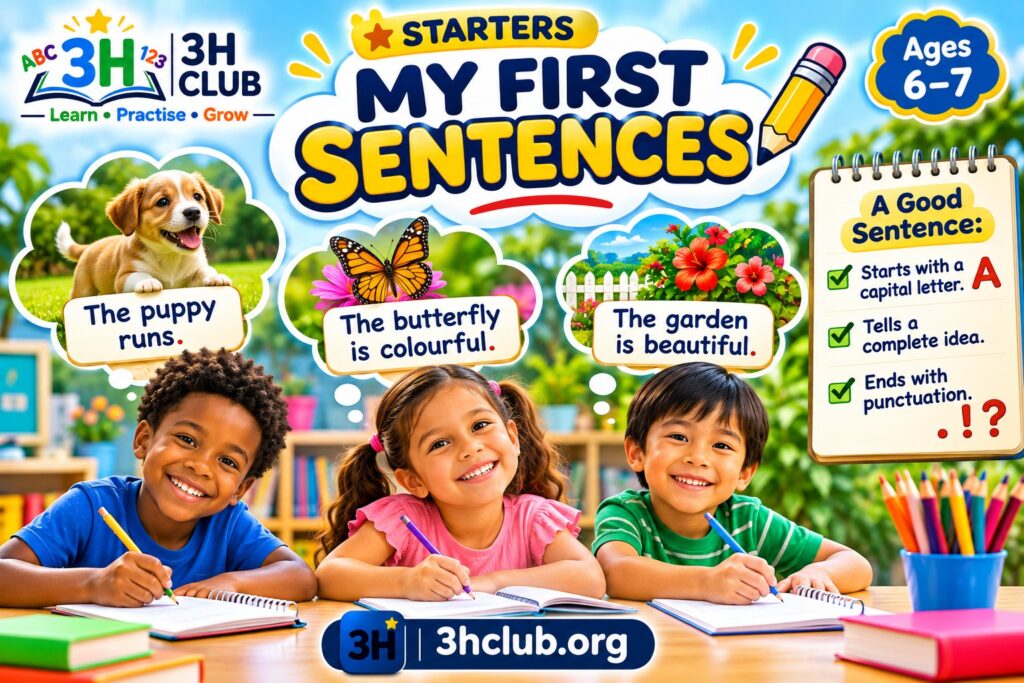
Start with simple sentences and add details to make your writing interesting.
📖 4. Write a Short Story
A story tells us about something that happens.
Let’s write a tiny story with three parts.
Beginning: Introduce someone.
One morning, Lily found a small kitten.
Middle: Tell what happened.
The kitten followed Lily into the garden.
Ending: Finish the story.
Lily gave the kitten some water and helped it find its home.
You have written a short story!
Try making your own story about a lost toy, a birthday surprise or an unusual animal.
⭐ Starter Writing Challenge
Write four sentences about a magical pet.
Tell us:
- What is your pet?
- What does it look like?
- What special thing can it do?
- Why do you love it?
⭐ Starter Checklist
Before moving on, practise:
- Writing complete sentences.
- Using capital letters and full stops.
- Adding describing words.
- Writing about pictures.
- Telling a short story in order.
⭐⭐ Builders — Around Ages 8–9
🚀 Make Your Writing More Interesting!
Ready to turn your sentences into paragraphs and exciting stories?
In Builders, you’ll learn to organise your thoughts, describe people and places, and connect ideas so your writing flows smoothly.
🧩 1. Build a Paragraph
A paragraph is a group of sentences about one main idea.
Look at this example:
My Favourite Place
My favourite place is the beach near my home. The golden sand feels warm beneath my feet. I love listening to the waves and watching the seabirds. Visiting the beach always makes me happy.
All four sentences describe the same main idea: a favourite place.
A useful paragraph has:
Opening sentence: Introduce the main idea.
Supporting sentences: Add details or examples.
Closing sentence: Finish the idea.
Your turn!
Write a paragraph of four or five sentences about your favourite place.
🎨 2. Describe a Character
Characters are the people or animals in your story.
Good writers help readers imagine what their characters look like and how they behave.
Instead of:
Ben was a boy.
Try:
Ben was a curious boy with untidy black hair and a cheerful smile. He loved exploring mysterious places.
Think about:
- 👀 Appearance — What does the character look like?
- 😊 Personality — Are they brave, shy, kind or adventurous?
- 💭 Feelings — What makes them happy, worried or excited?
- 🎯 Goals — What do they want to do?
Writing activity: Invent a character and describe them in five sentences.
🌳 3. Describe a Setting
A setting is where and when a story happens.
Imagine walking into a tropical rainforest.
What might you see, hear, smell or feel?
Tall trees stretched towards the sky. Bright parrots called from the branches. The damp earth smelled fresh after the rain.
These details help readers imagine being there.
Try this!
Describe one of these places:
🏝️ A mysterious island
🏰 An ancient castle
🚀 A space station
🌲 A magical forest
Use at least three senses in your description.
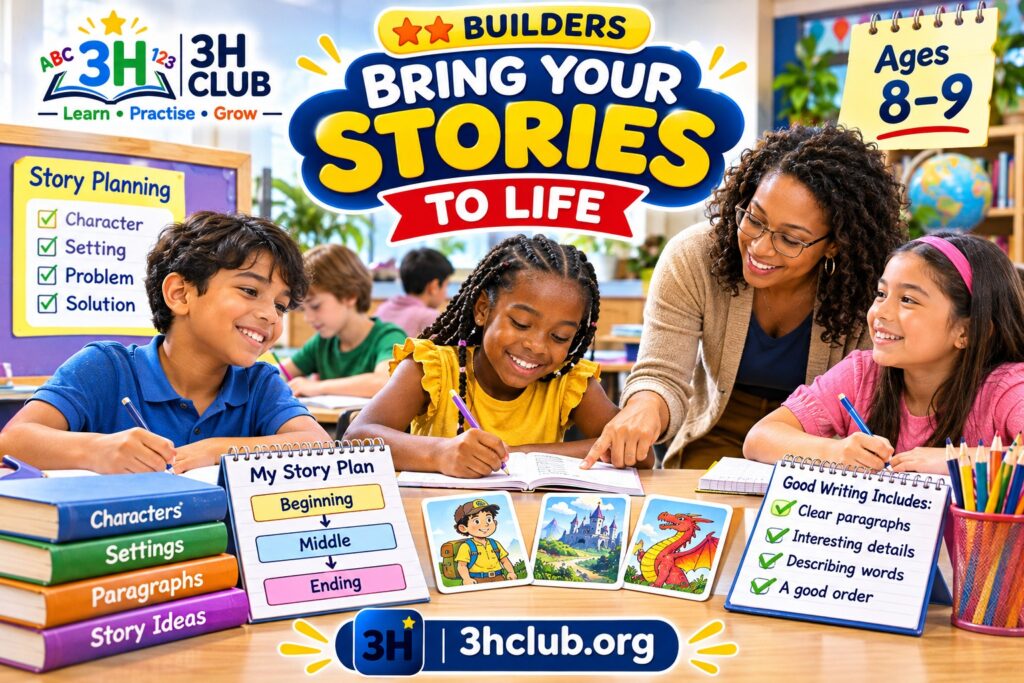
Builders learn to create paragraphs, describe characters and organise imaginative stories.
📚 4. Plan a Story
A good story usually has a beginning, middle and ending.
Beginning — Introduce the story
Who is the main character? Where are they?
Middle — Something happens
What problem or adventure does the character experience?
Ending — Finish the story
How does the problem get solved?
Example: The Missing Treasure
Beginning: Zara discovers an old treasure map.
Middle: She follows the map through a mysterious forest.
Ending: Zara finds a hidden chest filled with colourful gemstones.
Now use this plan to write your own adventure.
🔗 5. Connect Your Ideas
Connecting words help your writing flow smoothly.
Useful words include:
and • but • because • so • when • while • after • suddenly
Compare:
It started raining. We went inside.
We went inside because it started raining.
The word because explains why something happened.
For more help with words and sentences, visit English Grammar Essentials.
⭐⭐ Builder Writing Challenge
Write a story called “The Secret Door.”
Your story should include:
- A main character.
- An interesting setting.
- A mysterious discovery.
- A problem to solve.
- A satisfying ending.
Aim for three short paragraphs, then read your story aloud.
⭐⭐ Builder Checklist
Practise:
- Organising sentences into paragraphs.
- Describing characters and settings.
- Planning a story.
- Connecting ideas.
- Choosing interesting words.
- Checking punctuation and spelling.
⭐⭐⭐ Champions — Around Ages 10–11
🏆 Become a Confident Creative Writer!
You’re ready to take your writing further!
Champions learn how to create believable characters, build excitement, write for different purposes and improve their work through careful editing.
✨ 1. Write an Exciting Opening
The beginning of a story should make readers curious.
Compare these openings:
Ordinary opening:
It was a rainy day. Tom went outside.
More exciting opening:
Thunder shook the windows as Tom stepped into the deserted street. Somewhere in the darkness, a strange voice whispered his name.
Which opening makes you want to read more?
Try beginning a story with:
- A surprising event.
- A mysterious question.
- An unusual sound.
- An exciting action.
- A character facing a problem.
Your challenge: Write three different openings for a mystery story.
🎭 2. Develop Interesting Characters
Memorable characters have personalities, feelings, strengths and weaknesses.
Imagine a young explorer named Amara.
She is brave but sometimes impatient. She loves discovering new places, yet she is frightened of deep water.
These details make Amara more believable.
Think about your character’s:
Personality: What are they like?
Motivation: What do they want?
Challenge: What stands in their way?
Change: What might they learn?
A good character doesn’t need to be perfect. Sometimes their mistakes make the story more interesting.
💬 3. Use Dialogue
Dialogue is what characters say to each other.
It helps readers understand personalities and relationships.
Example:
“Did you hear that?” whispered Noah.
“It’s probably just the wind,” replied Amara.
Suddenly, something scratched against the wooden door.
Dialogue can create excitement, reveal feelings and move the story forward.
Remember to use quotation marks and punctuation carefully.
🌪️ 4. Build Suspense and Excitement
Suspense makes readers wonder what will happen next.
You can create suspense by:
- Revealing clues gradually.
- Describing unusual sounds.
- Giving a character a difficult choice.
- Using shorter sentences during exciting moments.
- Ending a paragraph with an unanswered question.
Example:
The footsteps stopped. Maya held her breath. Slowly, the door began to open.
What do you think happens next?
Write a paragraph that continues the scene.
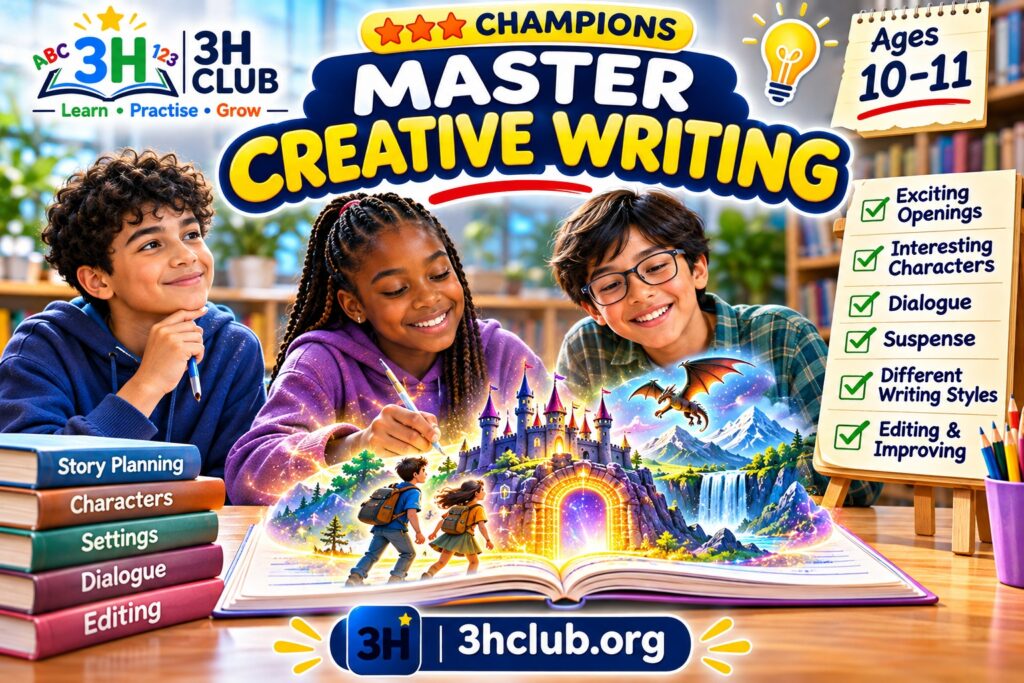
Champions develop characters, dialogue, suspense, and more detailed stories.
📝 5. Write for Different Purposes
Not all writing is storytelling.
Sometimes we write to inform, explain, persuade or entertain.
| Writing type | Purpose |
|---|---|
| 📖 Narrative | Tell a story |
| 🌄 Descriptive | Help readers imagine something |
| 📰 Informative | Share facts and information |
| 📢 Persuasive | Convince someone of an opinion |
| 📋 Instructional | Explain how to do something |
| 💌 Letter | Communicate with someone |
Try this challenge:
Choose a topic such as protecting the environment.
Write one paragraph explaining why trees are important.
Then write another paragraph persuading people to plant more trees.
Notice how your choice of words changes.
🔍 6. Edit and Improve Your Writing
Even experienced writers improve their work after writing a first draft.
Editing helps make your writing clearer, stronger and more enjoyable.
The Champion Editing Checklist
☐ Does my writing have a clear purpose?
☐ Are my ideas organised logically?
☐ Have I chosen interesting and accurate words?
☐ Have I used different sentence lengths?
☐ Are my paragraphs clearly organised?
☐ Have I checked spelling, grammar and punctuation?
☐ Does my ending feel complete?
Remember: Your first draft does not have to be perfect. Good writers revise their work!
⭐⭐⭐ Champion Writing Challenge
Write a story called “The Message From Tomorrow.”
Imagine discovering a mysterious message sent from the future.
Your story should include:
- An exciting opening.
- At least two interesting characters.
- A clearly described setting.
- Dialogue.
- A surprising event.
- A problem and resolution.
- An ending that makes readers think.
Aim for four to six paragraphs. Read your work aloud and improve at least three sentences.
⭐⭐⭐ Champion Checklist
Work towards:
- Writing engaging openings.
- Creating developed characters.
- Using dialogue correctly.
- Building suspense.
- Writing for different purposes.
- Organising longer pieces.
- Editing and proofreading independently.
🛤️ Your Writing Learning Path
Every writer develops new skills through practice.
Follow the 3H Club writing pathway!
⭐ STARTERS — AGES 6–7
Words → Sentences → Describing Words → Picture Writing → Short Stories
⬇️
⭐⭐ BUILDERS — AGES 8–9
Better Sentences → Paragraphs → Characters → Settings → Story Planning
⬇️
⭐⭐⭐ CHAMPIONS — AGES 10–11
Story Openings → Dialogue → Suspense → Different Writing Styles → Editing
You don’t need to rush through the levels. Keep practising and enjoy discovering what you can create.
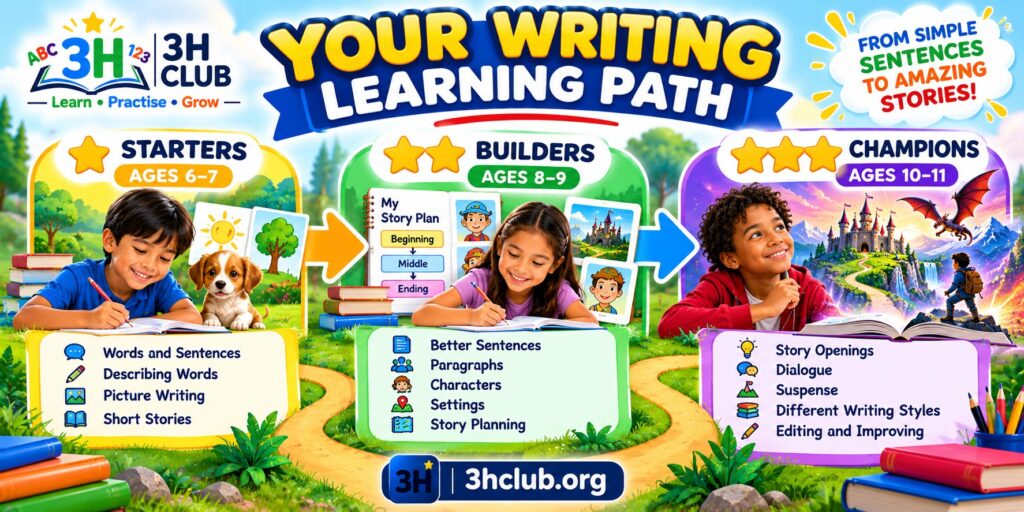
Grow from writing simple sentences to creating detailed and imaginative stories.
🎯 Writing Practice — Learn, Practise, Grow!
The best way to become a confident writer is to write regularly.
You don’t need to write a whole story every day. Even a few sentences can help you improve.
📚 LEARN
Read examples of good writing.
Notice how authors describe characters, choose words and organise their ideas.
Reading can also help you discover new vocabulary.
Visit Reading & Comprehension to develop your reading and understanding skills.
✏️ PRACTISE
Choose a writing activity that matches your level.
| Level | Activity |
|---|---|
| ⭐ Starters | Write three sentences about a favourite toy |
| ⭐⭐ Builders | Write a paragraph describing a mysterious place |
| ⭐⭐⭐ Champions | Write a short story with an unexpected ending |
🌱 GROW
Read your writing again.
Choose one sentence and make it better.
Add a useful detail, replace a repeated word or correct a mistake.
Every improvement helps you become a stronger writer.
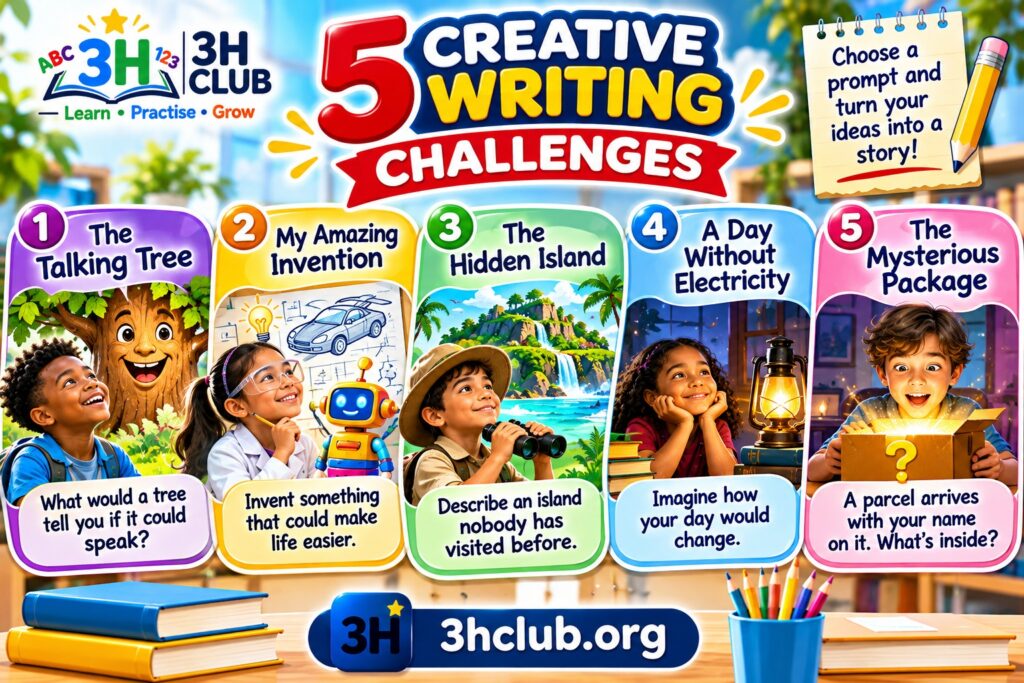
🎲 Five Fun Writing Prompts
Need an idea? Choose one!
1. The Talking Tree: What would a tree tell you if it could speak?
2. My Amazing Invention: Invent something that could make life easier.
3. The Hidden Island: Describe an island nobody has visited before.
4. A Day Without Electricity: Imagine how your day would change.
5. The Mysterious Package: A parcel arrives with your name on it. What’s inside?
Choose a prompt, plan your ideas, and begin writing!
🔍 Frequently Asked Questions About Writing
What is creative writing?
Creative writing uses imagination to produce stories, poems, descriptions and other interesting pieces of writing.
You can invent characters, places and adventures or write about things that have happened to you.
How can I make my writing more interesting?
Add useful descriptions, choose clear and varied words, develop your ideas and think about what your reader might want to know.
Remember, longer sentences are not always better. Sometimes a short sentence makes a big impact!
How do I start writing a story?
Begin with a character, a setting and an idea about what might happen.
Ask yourself:
Who is the story about?
Where does it happen?
What problem or adventure will take place?
Then write your opening sentence.
How many paragraphs should I write?
It depends on your age, the task and how much you need to explain.
Starters may begin with a few connected sentences. Builders can practise short paragraphs, while Champions can organise longer pieces using several paragraphs.
What should I do when I cannot think of anything to write?
Look at a picture, read a story, think about something unusual or ask a question beginning with “What if?”
For example:
What if my school suddenly floated into the sky?
That’s the beginning of a story idea!
Why is proofreading important?
Proofreading helps you find spelling, punctuation and grammar mistakes before sharing your work.
Editing goes further by helping you improve your ideas, word choices and organisation.
Both are important writing skills.
👨👩👧 For Grown-Ups — Helping Children Become Confident Writers
Children develop writing skills at different speeds.
Encourage your child to enjoy expressing ideas before worrying too much about making every sentence perfect.
A few helpful approaches include:
- Encourage short, regular writing activities.
- Let children choose topics that interest them.
- Read stories together and discuss the author’s word choices.
- Praise creative ideas and improvements.
- Help children plan before writing.
- Encourage them to read their work aloud.
- Give helpful feedback without correcting every mistake at once.
For additional guidance, explore these educational resources:
Reading Rockets — Writing — Advice and resources for developing children’s writing skills.
BBC Bitesize — Primary English — English learning resources, including writing, grammar and comprehension.
For more ways to develop language skills, explore English Grammar Essentials and Phonics & Spelling.
🌟 Ready to Become a Better Writer?
Every story begins with a single idea.
You might write a funny sentence today, an exciting paragraph tomorrow and an amazing adventure story next week.
The important thing is to keep trying, practising and enjoying your creativity.
Choose your level and begin your writing adventure!
✏️ Learn • Practise • Grow
Your imagination is full of possibilities. Pick up your pencil and see where your writing takes you!