Let’s become super spellers! ⭐
Learn letter sounds, word families, spelling patterns, and tricky words through short lessons and fun activities.
Have you ever wondered why cat rhymes with hat, why cake has a silent e, or why some words do not sound exactly the way they look?
Welcome to Phonics & Spelling at 3H Club!
Here, you will learn how letters represent sounds, how sounds join together to make words, and how spelling patterns help you read and write with confidence.
You can practise reading words aloud, matching sounds with letters, building words, and spelling correctly.
Learn • Practise • Grow!
Learn phonics and spelling with 3H Club! Explore letter sounds, word families, spelling patterns and tricky words for ages 6–11.
⚡ Quick Answer: What Are Phonics and Spelling?
Phonics helps you understand how letters and groups of letters represent sounds. It helps you read unfamiliar words.
Spelling helps you put letters in the correct order to write words.
Look at these examples:
| Word | Sounds | What to notice |
|---|---|---|
| CAT | c • a • t | Three letters and three sounds |
| SHIP | sh • i • p | The letters sh make one sound |
| CAKE | c • a_e • k | The final e helps make the long a sound |
When you learn letter sounds and spelling patterns, reading and writing become easier.
Remember: You do not have to learn everything in one day. A little practice each day can make a big difference!
👉 Jump to What You Want to Learn
⭐ Starters — Ages 6–7
Start with letter sounds, short words, and simple spelling patterns.
Are you ready to make words?
At the Starters level, you will learn how letters represent sounds and how to blend those sounds to read simple words.
STARTERS: SOUND OUT AND BLEND WORDS
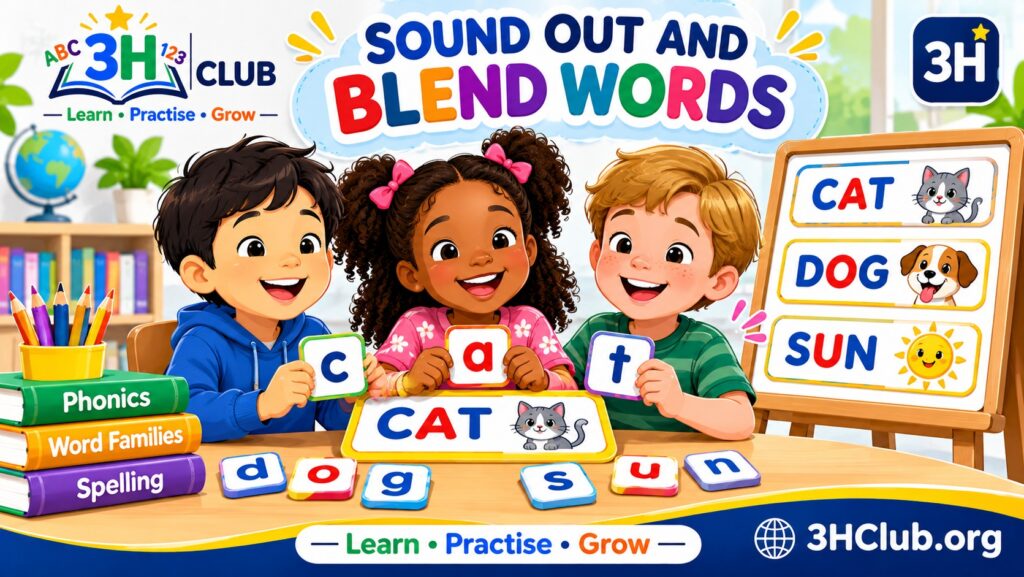
1. Learn Letter Sounds
Every letter has a name, and letters represent sounds.
For example:
- m as in mat
- s as in sun
- t as in tap
- p as in pan
Say each sound clearly.
Now look around you. Can you find something that begins with one of these sounds?
Some sounds are represented by two letters.
For example, the letters sh work together to make one sound in ship.
2. Read CVC Words
CVC means consonant–vowel–consonant.
Many short words follow this pattern.
| Word | Sounds |
|---|---|
| cat | c • a • t |
| dog | d • o • g |
| sun | s • u • n |
| pen | p • e • n |
| pig | p • i • g |
| cup | c • u • p |
Try reading each word slowly.
Say the sounds separately, then blend them together.
For example:
c • a • t → cat
👉 Learn More: 20 Easy CVC Words for Early Readers
3. Discover Short A Words
The letter a often makes the short vowel sound heard at the beginning of apple.
Try reading these words:
cat • bat • map • jam • fan
Can you hear the short a sound?
Now try writing each word in your notebook.
👉 Learn More: Short A Words for Kids
4. Learn Word Families
A word family is a group of words that share a spelling pattern and usually rhyme.
Look at these three word families:
| AT Family | AN Family | AP Family |
|---|---|---|
| cat | can | cap |
| bat | fan | map |
| hat | man | tap |
| mat | pan | nap |
When you learn one word family, you can often read several new words.
For example:
If you can read cat, you may also be able to read bat, hat, and mat.
👉 Learn More: Word Families: AT, AN and AP
⭐ Starters Mini Challenge
Try these three activities.
Challenge 1: Say the sounds in sun and blend them together.
Challenge 2: Write two words that rhyme with cat.
Challenge 3: Complete the missing letter:
m _ p
Clue: It is something that shows you where places are.
Well done! You are becoming a confident word reader.
⭐⭐ Builders — Ages 8–9
Explore longer words, vowel sounds, and common spelling patterns.
You already know how to read many short words.
Now it is time to discover why some words sound different even when they contain similar letters.
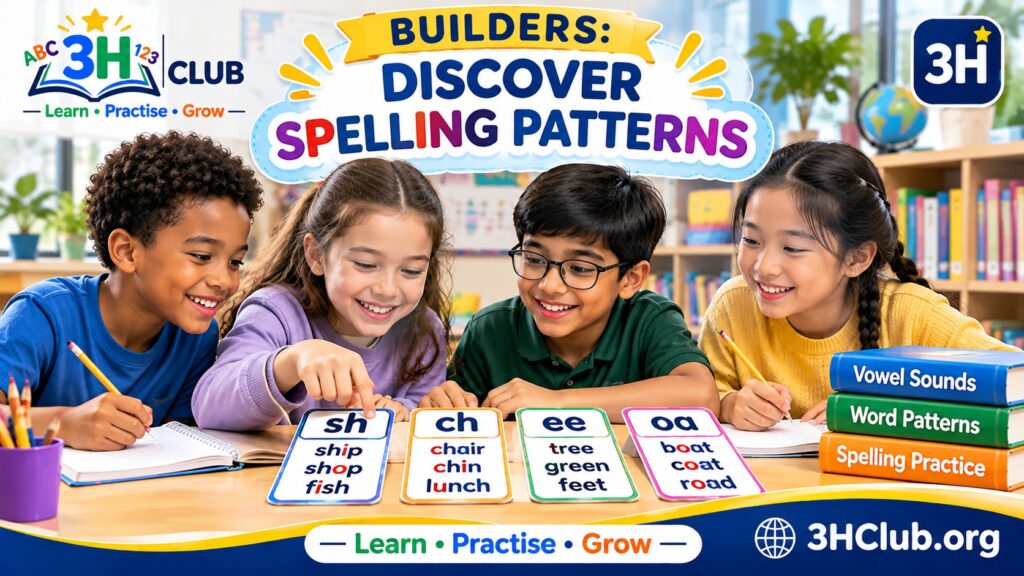
BUILDERS: DISCOVER SPELLING PATTERNS
1. Short and Long Vowel Sounds
English has five main vowel letters:
A • E • I • O • U
Vowel sounds can be short or long.
A long vowel sound often sounds like the letter’s name.
Compare these words:
| Short Vowel | Long Vowel |
|---|---|
| cap | cape |
| kit | kite |
| hop | hope |
| cub | cube |
Notice how adding a final e can change the vowel sound.
This is often called the magic e or silent e pattern.
For example:
cap → cape
kit → kite
The final e is not pronounced, but it helps us understand the vowel sound.
👉 Learn More: Short and Long Vowel Sounds
2. Discover Common Spelling Patterns
Some groups of letters appear in many English words.
Look at these examples:
| Pattern | Example Words |
|---|---|
| sh | ship, shop, fish |
| ch | chair, chin, lunch |
| ee | tree, green, feet |
| oa | boat, coat, road |
| ai | rain, train, paint |
| igh | night, light, bright |
When two letters represent one sound, they are called a digraph.
For example, sh represents one sound in ship.
Learning spelling patterns helps you recognise familiar parts of new words.
👉 Learn More: Common Spelling Patterns
3. Build Longer Words
Some words have more than one syllable.
A syllable is a beat or part of a word.
Try clapping these words:
- rab-bit — 2 syllables
- sun-shine — 2 syllables
- bas-ket — 2 syllables
- el-e-phant — 3 syllables
Clapping syllables can help you hear the parts of longer words.
Try writing the words after saying them aloud.
⭐⭐ Builders Mini Challenge
Choose the correct answer.
1. I flew my ______ in the park.
A. kit
B. kite
C. kitt
2. The ______ sailed across the lake.
A. bote
B. boat
C. bot
3. Which word has two syllables?
A. cat
B. rabbit
C. sun
Write your answers in your notebook.
Answer key: 1. B — kite; 2. B — boat; 3. B — rabbit.
⭐⭐⭐ Champions — Ages 10–11
Master word building, tricky spellings, and advanced vocabulary.
Welcome, Champions!
You are ready to explore how words are formed, how spelling changes when we add new word parts, and why some English words have unusual spellings.
CHAMPIONS: WORD BUILDING CHALLENGE
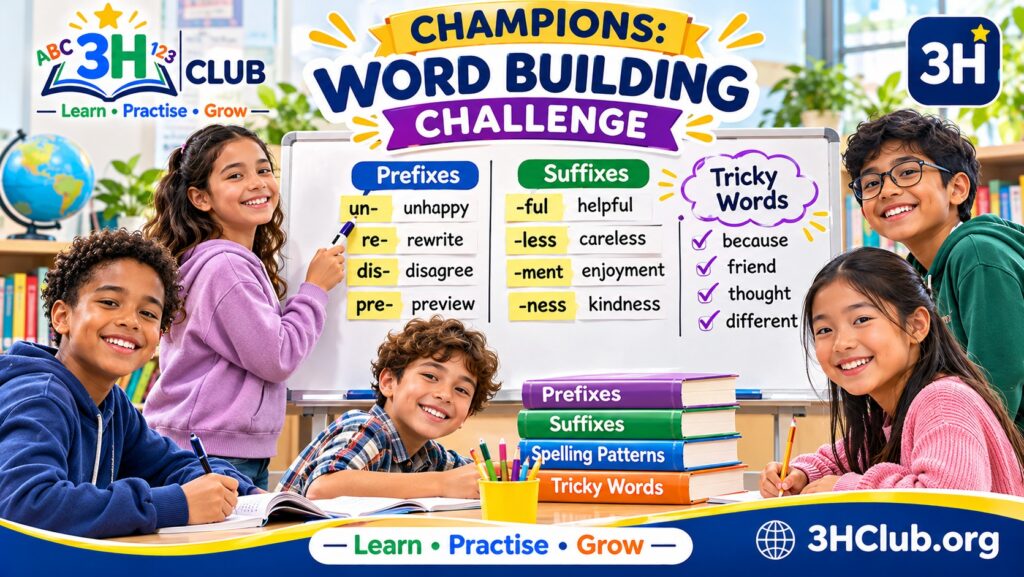
1. Understand Prefixes
A prefix is a group of letters added to the beginning of a word to change its meaning.
| Prefix | Meaning | Example |
|---|---|---|
| un- | not or opposite | unhappy |
| re- | again | rewrite |
| dis- | not or opposite | disagree |
| pre- | before | preview |
For example:
re + write = rewrite
The word rewrite means to write something again.
Try making your own words using these prefixes.
2. Understand Suffixes
A suffix is a group of letters added to the end of a word.
| Suffix | Example | Meaning |
|---|---|---|
| -ful | helpful | full of help |
| -less | careless | without care |
| -ment | enjoyment | the state or experience of enjoying |
| -ness | kindness | the quality of being kind |
For example:
kind + ness = kindness
Learning prefixes and suffixes helps you understand unfamiliar words and expand your vocabulary.
👉 Learn More: Prefixes and Suffixes
3. Practise Tricky Words
Some English words have spellings that are difficult to predict from their sounds.
Try these words:
- because
- friend
- enough
- thought
- answer
- different
- beautiful
- knowledge
Read each word aloud.
Look carefully at its letters.
Cover the word and try writing it from memory.
Then check your spelling.
4. Discover Spelling Changes
When you add a suffix, sometimes the spelling of the original word changes.
For example:
make + ing = making
The final e is dropped.
happy + ness = happiness
The y changes to i.
run + ing = running
The final n is doubled.
These are useful spelling patterns, but remember that English also has exceptions.
⭐⭐⭐ Champions Mini Challenge
Try answering these questions without looking back at the tables.
1. Which word means “write again”?
A. unwrite
B. rewrite
C. prewrite
2. Which spelling is correct?
A. happyness
B. happiness
C. hapiness
3. Which word contains a suffix meaning “without”?
A. careless
B. careful
C. preview
Answer key: 1. B — rewrite; 2. B — happiness; 3. A — careless.
🗺️ Phonics & Spelling Learning Path
Everyone learns at a different pace.
Follow the learning path that suits you best.
PHONICS & SPELLING LEARNING PATH
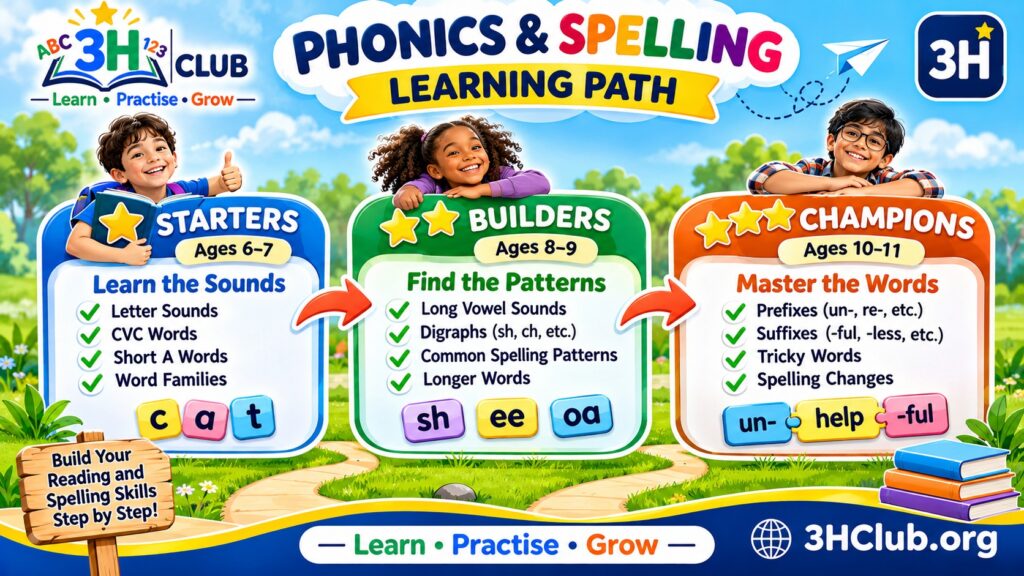
⭐ Starters — Learn the Sounds
Letter Sounds → CVC Words → Short A Words → Word Families
⭐⭐ Builders — Find the Patterns
Long Vowels → Digraphs → Spelling Patterns → Longer Words
⭐⭐⭐ Champions — Master the Words
Prefixes → Suffixes → Tricky Words → Spelling Changes
Remember: You do not have to finish everything at once.
Choose the level that feels right, practise a little each day, and move forward when you are ready.
🎲 Fun Phonics & Spelling Activities
Learning spelling can be fun!
Try these activities at home or in the classroom.
1. Sound Match
Choose a letter sound.
Find three words containing that sound.
For example, the /m/ sound appears in:
moon • mat • milk
2. Rhyme Time
Choose a word such as cake.
Think of words that rhyme with it.
For example:
cake • make • lake • take
How many more rhyming words can you find?
3. Look, Cover, Write, Check
This is a useful way to practise tricky spellings.
- Look carefully at the word.
- Say the word aloud.
- Cover the word.
- Write it from memory.
- Check your spelling.
If you make a mistake, study the word and try again.
4. Word Detective
Open a book or story.
Find five words containing the same spelling pattern.
For example, look for words containing sh, ee, or ai.
Write the words in your notebook and underline the matching pattern.
✏️ Common Spelling Mistakes and How to Fix Them
Everyone makes spelling mistakes while learning.
The important thing is to understand the mistake and try again.
| Common Mistake | Correct Spelling | Helpful Reminder |
|---|---|---|
| frend | friend | Remember the ie |
| becaus | because | Remember the final e |
| runing | running | Double the n |
| happyness | happiness | Change y to i |
| seperate | separate | Remember par in the middle |
Helpful tip: Keep a personal spelling notebook.
Write down difficult words, underline tricky letter patterns, and practise using the words in short sentences.
📝 Practise and Check Your Skills
Ready to see what you have learned?
Choose your level and try these questions.
⭐ Starters Spelling Check
1. Which word rhymes with cat?
A. hat
B. dog
C. sun
2. Which is a CVC word?
A. ship
B. pen
C. tree
3. Which word belongs to the AN family?
A. fan
B. fish
C. cup
Answers: 1. A; 2. B; 3. A.
⭐⭐ Builders Spelling Check
1. Which word has a long a sound?
A. cap
B. cape
C. cat
2. Which two letters make one sound in ship?
A. sh
B. hi
C. ip
3. Which spelling is correct?
A. bote
B. boat
C. boet
Answers: 1. B; 2. A; 3. B.
⭐⭐⭐ Champions Spelling Check
1. What does the prefix re- mean in rewrite?
A. not
B. again
C. before
2. Choose the correct spelling.
A. beautifull
B. beutiful
C. beautiful
3. What is the correct spelling of make + ing?
A. makeing
B. making
C. makking
Answers: 1. B; 2. C; 3. B.
How did you do?
If you answered every question correctly, excellent work!
If you missed some questions, review the lesson and try again.
Practising helps your brain remember new spelling patterns.
📚 Keep Learning With 3H Club
Phonics and spelling work together with grammar, reading, and writing.
Explore these lessons to keep improving your English skills.
English Grammar Essentials
Learn how words work together to build clear sentences.
👉 Explore English Grammar Essentials
Vowels and Consonants for Kids
Discover the important letters and sounds that help us build words.
👉Learn About Vowels and Consonants
Reading Comprehension for Kids
Practise reading passages, understanding stories, and answering questions.
👉 Start Reading and Comprehension
Nouns for Kids
Learn how to identify naming words for people, places, animals, and things.
Start Writing
Writing helps you share your thoughts, describe exciting adventures, and tell wonderful stories.
Start Learning
Explore more English, Maths, and Practice activities for your level.
🌍 Helpful Reading Resources
Want to learn more about phonics and spelling?
Reading Rockets
Learn about phonics instruction, letter sounds, and helping children become confident readers.
BBC Bitesize — Primary English
Explore English learning resources, spelling activities, and reading lessons.
🌟 Keep Practising, Super Speller!
Every sound you learn, every word you read, and every spelling you improve helps you become a stronger reader and writer.
Remember these three important steps:
Learn something new.
Practise what you have learned.
Grow more confident every day.
Learn • Practise • Grow!
3H Club — English and Maths Learning for Children Ages 6–11